How to Layer Lighting in a Small Living Room
How to layer lighting in a room, applied to small living rooms: ambient, task, and accent light layers, living room zones, TV glare fixes, and seating-area plans with real light layers.
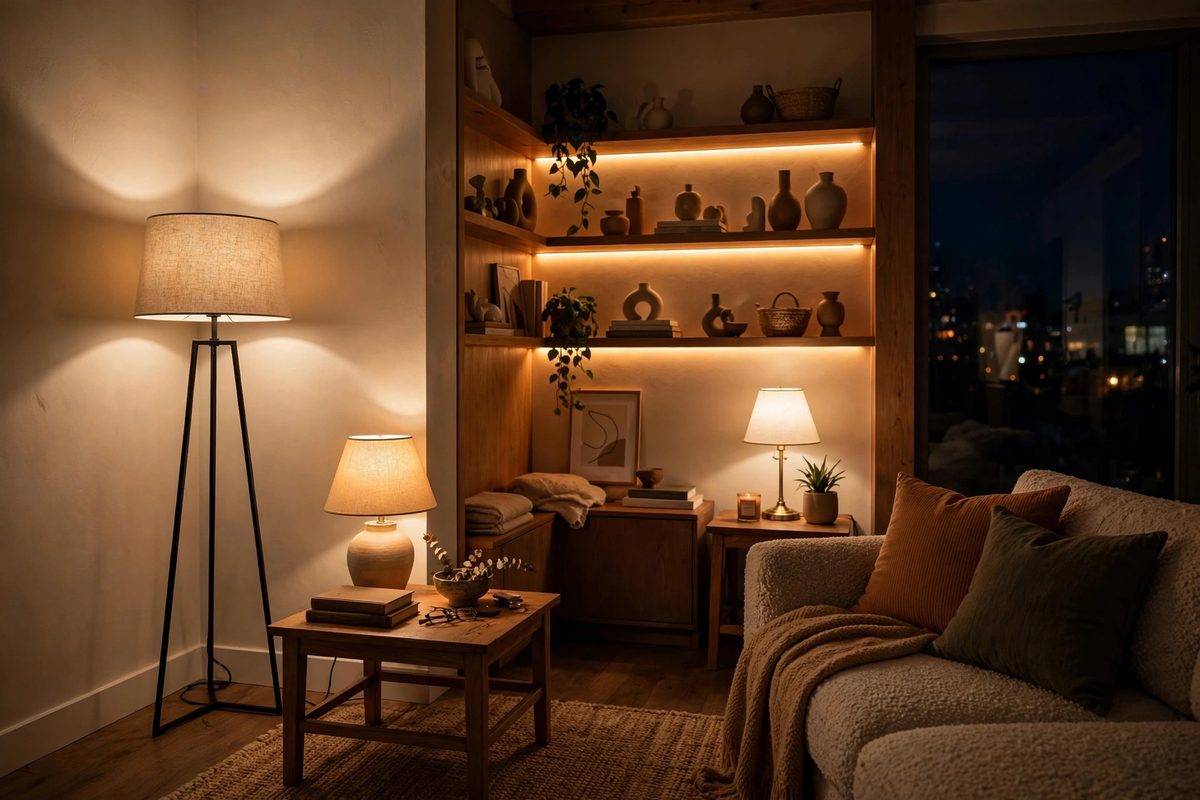
Small living room at night with layered lighting: a floor lamp wash, table lamps, and shelf accent light
In This Guide
Layering lighting in a small living room means using three kinds of light together instead of relying on one bright lamp: ambient light for general brightness, task light for reading and work, and accent light for warmth and depth. One lamp, however bright, flattens a room. Three layers, each dimmer than that one lamp, make the same room feel bigger, warmer, and easier to live in.
This post is living-room specific. Our apartment-wide layering guide, layered lighting ideas for small apartments, covers the whole-apartment formula; here you get the living room zones, the TV glare problem that only living rooms have, and seating-area plans for real small-room layouts. If your living room also has no ceiling light, pair this with how to light an apartment without ceiling lights.
1. The Three Layers, in Plain Terms
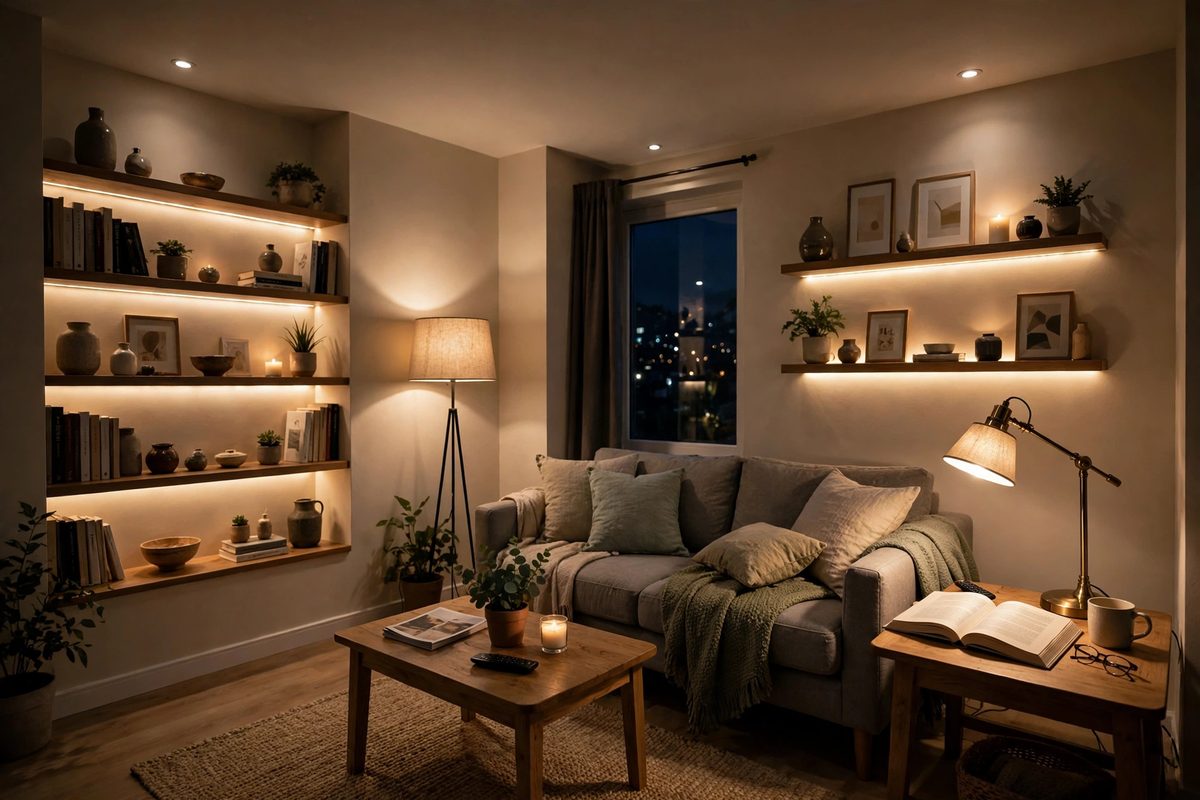
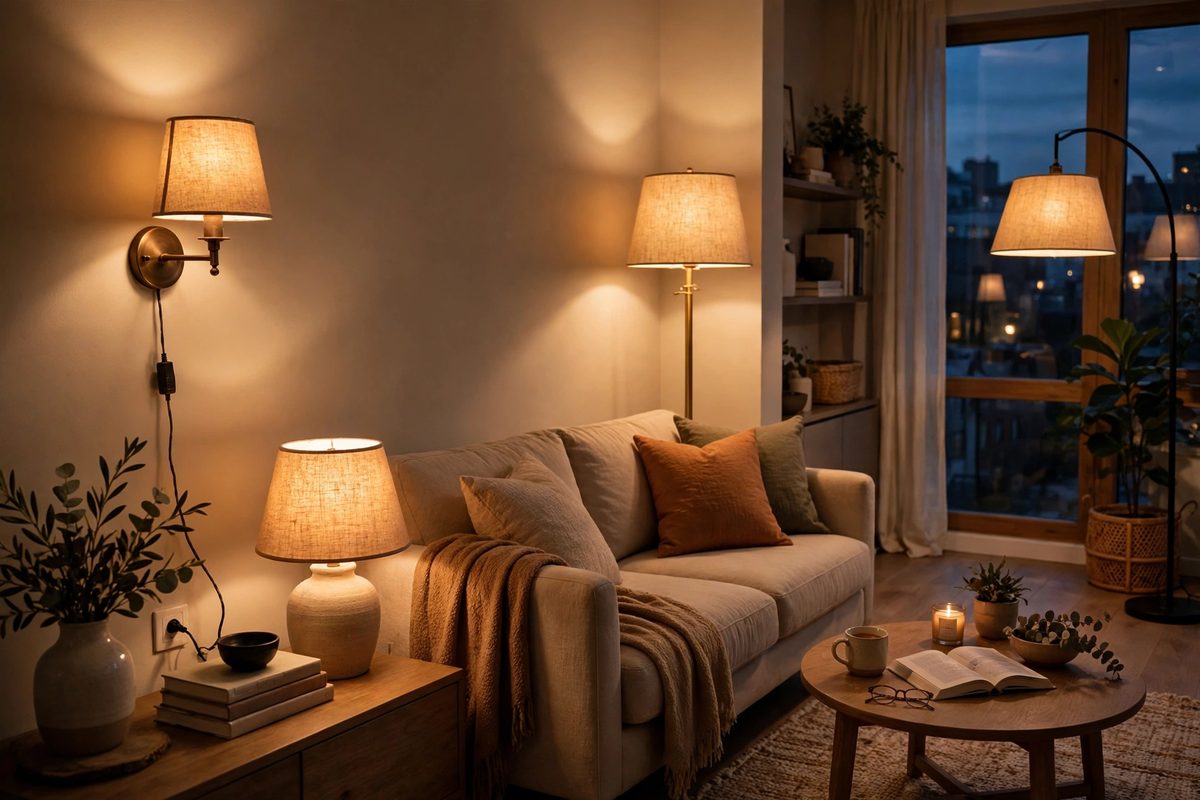
Ambient light is the base: the general brightness that lets you walk around and see faces. In a small living room without a ceiling light, that is usually a floor lamp wash aimed at a wall or ceiling, 1000 to 1600 lumens. Task light is focused light for a job: a reading lamp by the armchair, 400 to 800 lumens, aimed at the book, not the room. Accent light is the low, warm glow that adds depth: a shelf light, a strip behind the TV, a small lamp on a console, 200 to 400 lumens each.
The ratio matters more than the total. Aim for ambient doing about half the work, task about a third, and accent the rest. If accent light is brighter than ambient, the room feels like a stage set; if task light is the only light on, the room feels like an office after hours. Dimmers on at least the ambient layer let you rebalance the ratio for TV time, reading time, and hosting without moving a lamp.
How to make it work
Switch the layers on one at a time at night and look at the room after each one. Ambient alone should feel bright but flat. Adding task should create a clear reading spot. Adding accent should make the room feel finished. If any layer makes the room feel worse, its brightness or color temperature is wrong, not the layer itself; adjust that lamp before adding another.
2. Zone the Room Before You Place a Lamp
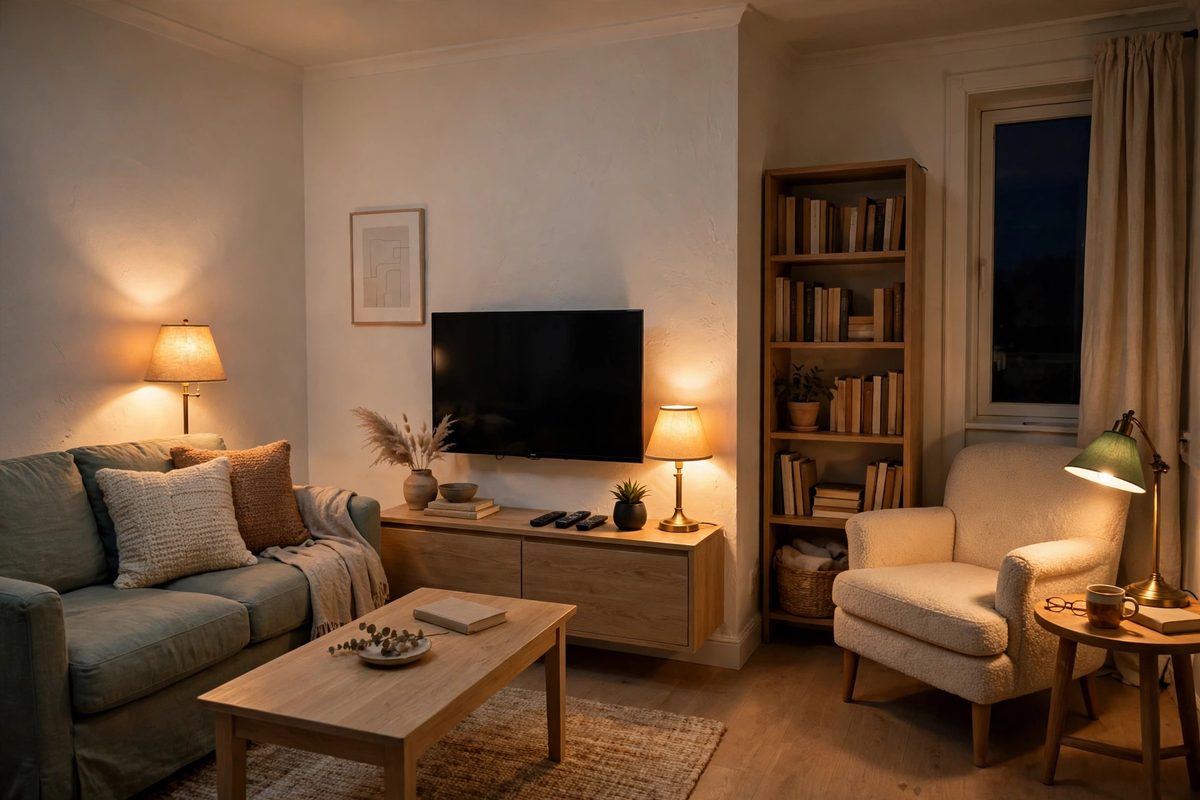
A small living room usually holds three zones in one space: the main seating area, the TV wall, and a reading or work corner, sometimes plus a dining spot at the edge. Each zone needs its own light logic, and lamps placed by zone beat lamps placed by symmetry. A lamp that looks balanced on a floor plan can light an empty corner while the reading chair sits dark.
Sketch the zones, then assign one ambient source to the room as a whole and one task or accent source to each zone. The seating zone gets a table lamp or a floor lamp beside the sofa. The TV zone gets bias lighting behind the screen. The reading zone gets a focused lamp. The dining edge, if you have one, gets a small pendant-style plug-in or a table lamp on the sideboard. For seating layouts to zone around, see small living room seating ideas.
How to make it work
Stand in each zone at night and ask what you do there: read, watch TV, talk, eat. Write one lighting job per zone on the sketch. If two zones share one lamp, that lamp is doing two jobs badly; split it into two smaller lamps. Zone lighting also saves electricity, since you light the zone you use instead of the whole room at full brightness.
3. The Ambient Layer: One Wash, Not One Bulb
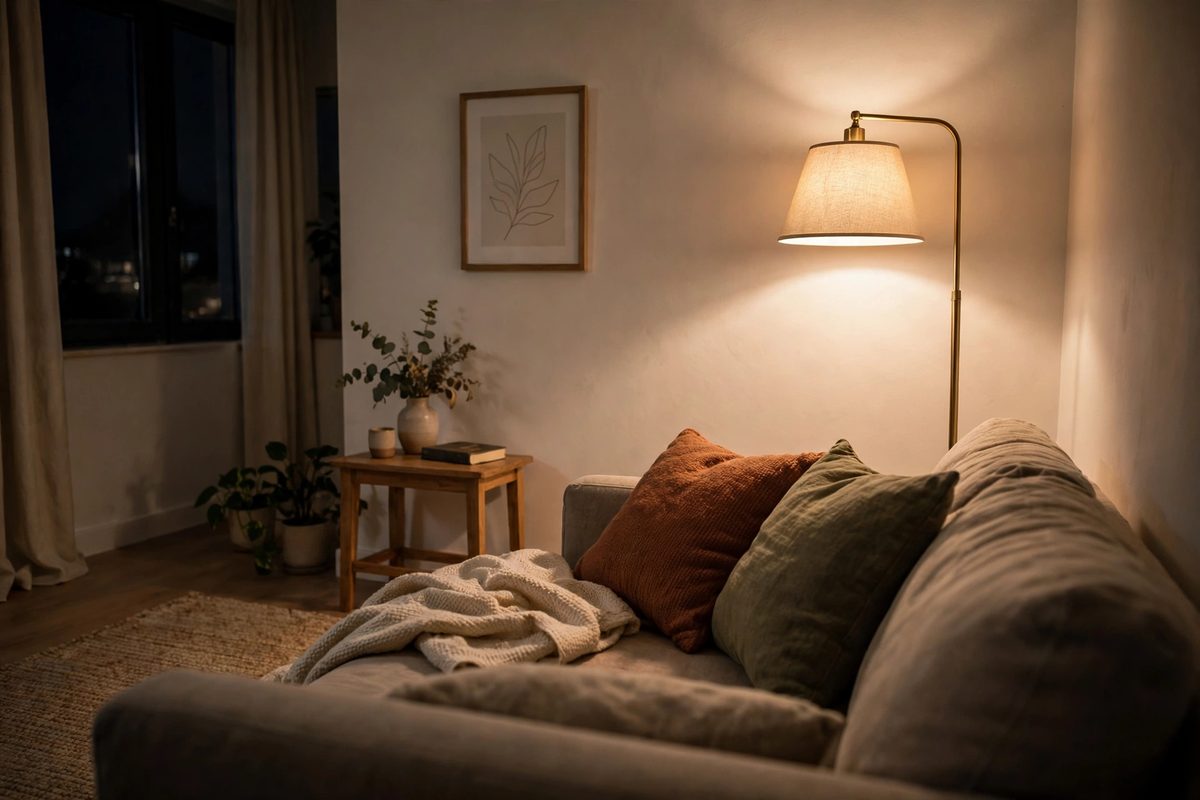
The ambient layer in a small living room should wash a wall or ceiling, not beam down from a single point. A torchiere or arc floor lamp placed 12 to 18 inches from a corner, aimed upward, turns that wall into a large soft light source. The room brightens evenly, shadows soften, and the ceiling feels higher because it is lit.
Use a 1600 lumen dimmable bulb, roughly a 100 watt equivalent, in a 2700K to 3000K color temperature for evening ambient light. If the room doubles as a work space during the day, a 4000K bulb in the same lamp, swapped or smart-controlled, keeps daytime work bright without buying a second lamp. One good ambient wash, 50 to 100 dollars for the lamp, beats two harsh table lamps for general brightness. Floor lamp styles are covered in small living room floor lamp ideas.
How to make it work
Keep the ambient lamp out of the TV sightline, since a bright lamp behind the viewer reflects in the screen. If the only corner is behind the sofa, aim the wash at the side wall rather than the wall behind the TV. Dim the ambient layer to about 60 percent for TV time and back to full for hosting; a dimmer on this one lamp is the most-used control in the whole plan.
4. The Task Layer: Reading Chair and Sofa Ends
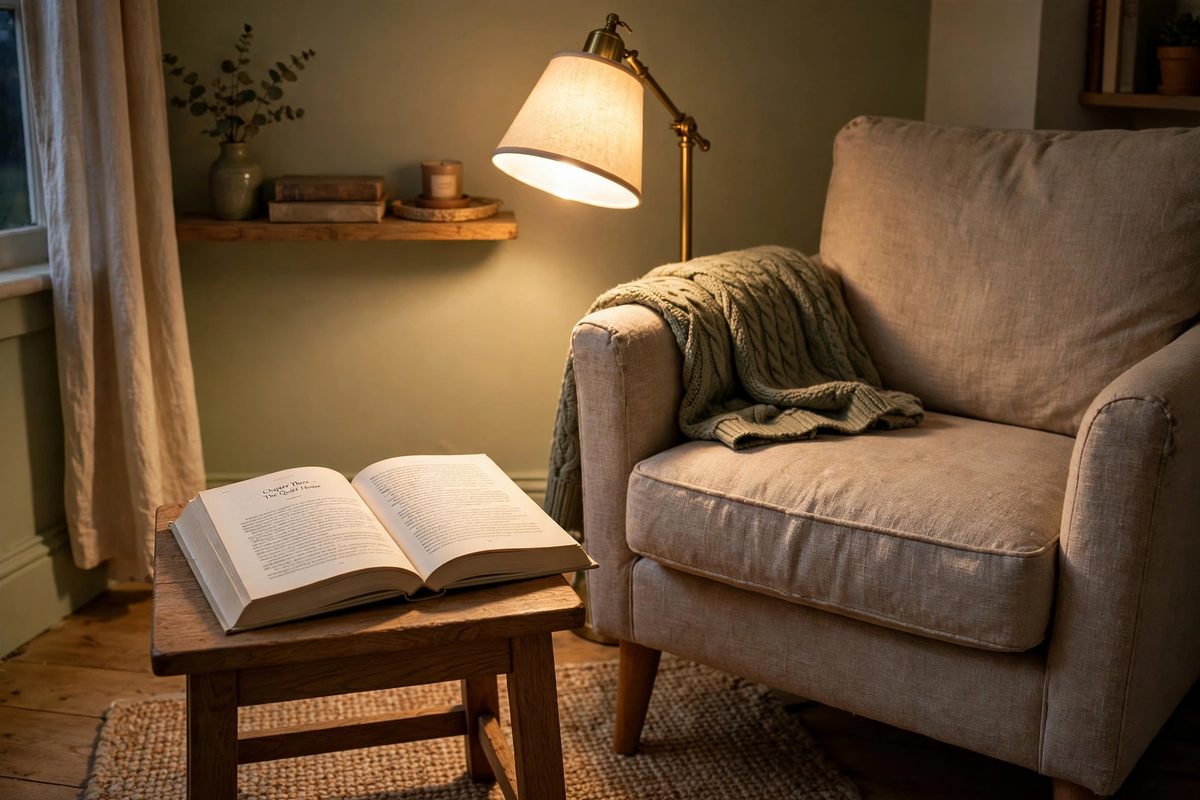
Task light in a living room lives at the seating, not in the middle of the room. A reading chair needs a focused lamp on the chair’s non-dominant side, shade bottom at about eye level when seated, 58 to 64 inches from the floor. A sofa needs a table lamp at one or both ends, same height rule, so readers at either end get light without leaning.
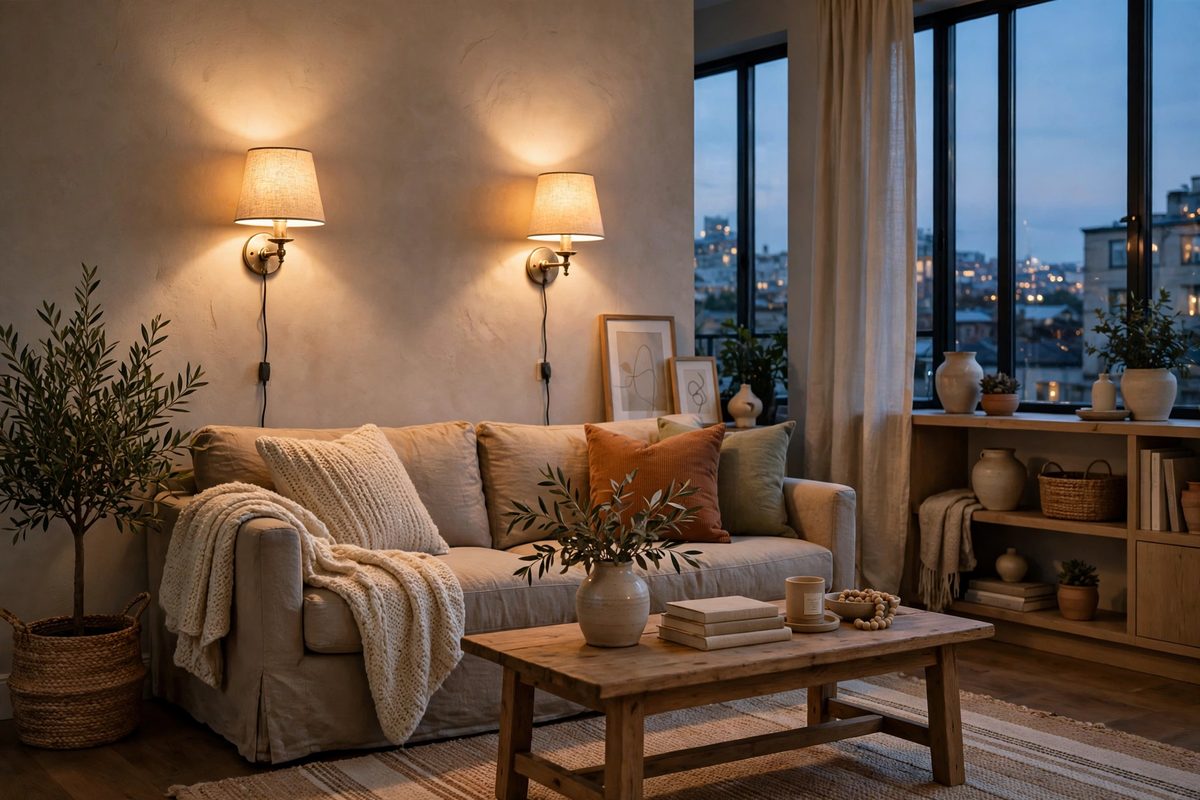
A swing-arm plug-in sconce, 35 to 70 dollars, is the space-saving task light for a reading chair with no side table, since it mounts on the wall and folds away. A table lamp, 30 to 60 dollars, suits a sofa end with a side table. Use 400 to 800 lumen bulbs at 2700K to 3000K for evening reading; brighter or cooler bulbs cause eye strain when the rest of the room is dim. The sconce version of this setup is plug-in wall sconce ideas for apartments.
How to make it work
Test task light with an actual book, not by eye. Sit in the chair, open a paperback, and read two pages. If you lean forward or squint, move the lamp 6 inches closer or go up one brightness step before buying anything new. Keep task lamps on separate switches from ambient lamps so a reader can have bright task light while the rest of the room stays low for TV.
5. The Accent Layer: Shelves, Art, and Console Glows
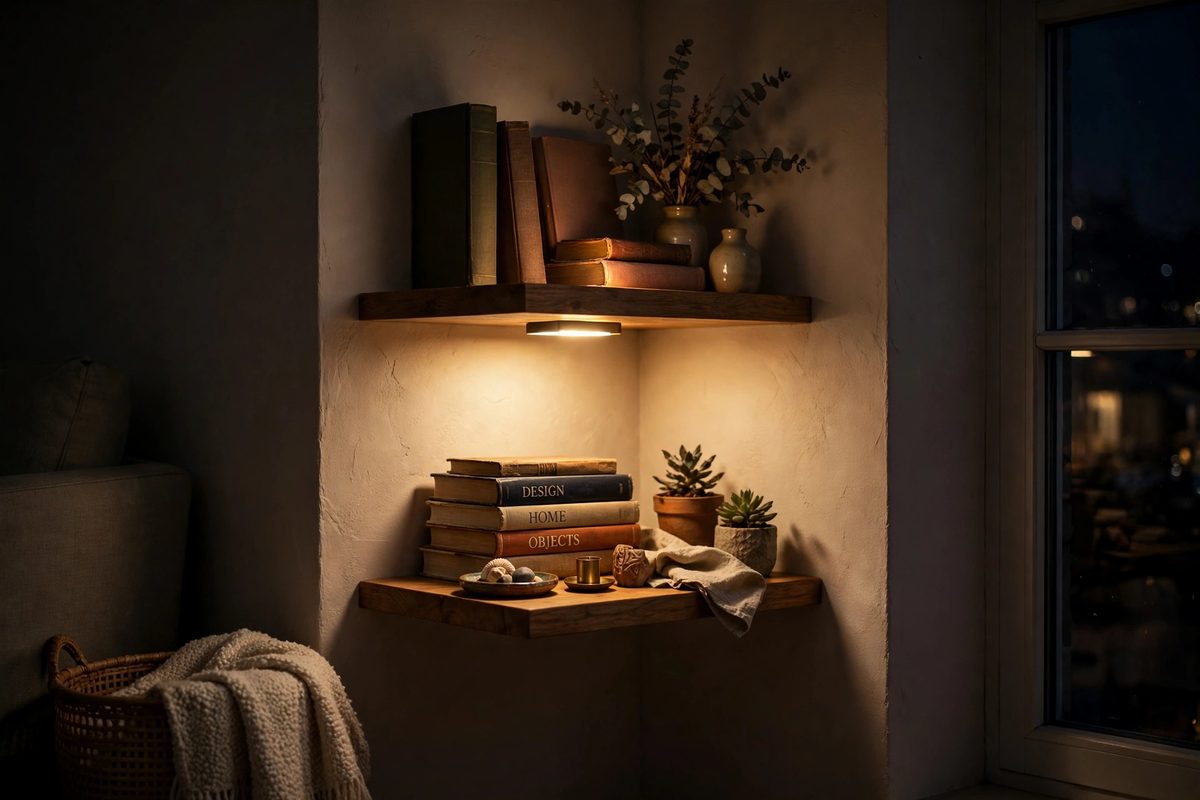
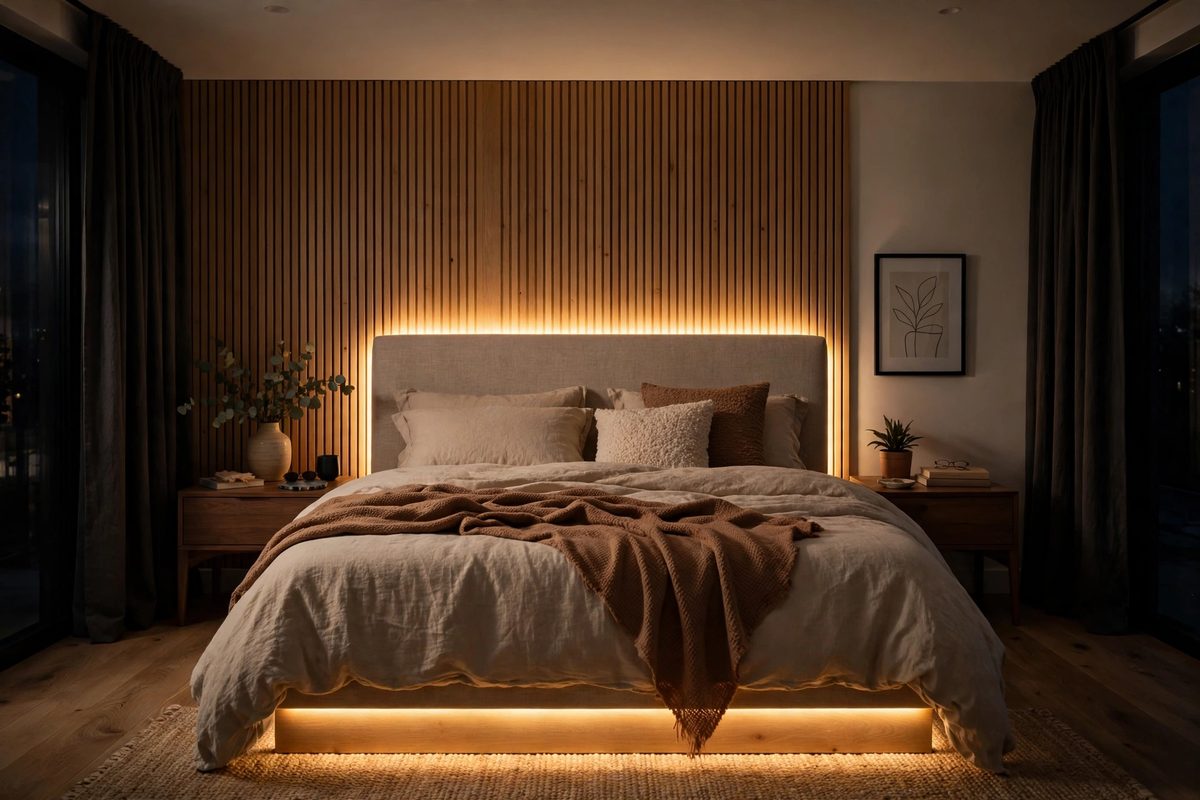
Accent light is the layer small living rooms skip, and it is the layer that makes a room feel decorated rather than just lit. A strip light under a shelf, a small lamp on a console, a puck light inside a bookcase, or a picture light over art each add a low warm glow that draws the eye and adds depth. None of them lights the room alone, and that is the point.
Pick one or two accent spots, not five. A shelf strip above the sofa and a console lamp by the entry are enough in a room under 200 square feet. Use warm 2700K accent light at 200 to 400 lumens, dimmer than the ambient layer, so accents glow rather than compete. Battery strips and pucks, 15 to 30 dollars, work where no outlet exists, and they move with you at the next apartment.
How to make it work
Switch on accent lights last, after ambient and task, and look for the effect: the room should gain depth and the eye should travel to the lit shelf or art. If an accent light glares into your eyes from the sofa, it is too bright or too high; dim it or move it 6 inches lower. Dust shelf strips monthly, since dust on a strip dims it unevenly and looks patchy.
6. TV Glare: Bias Lighting and the Dark Wall Problem
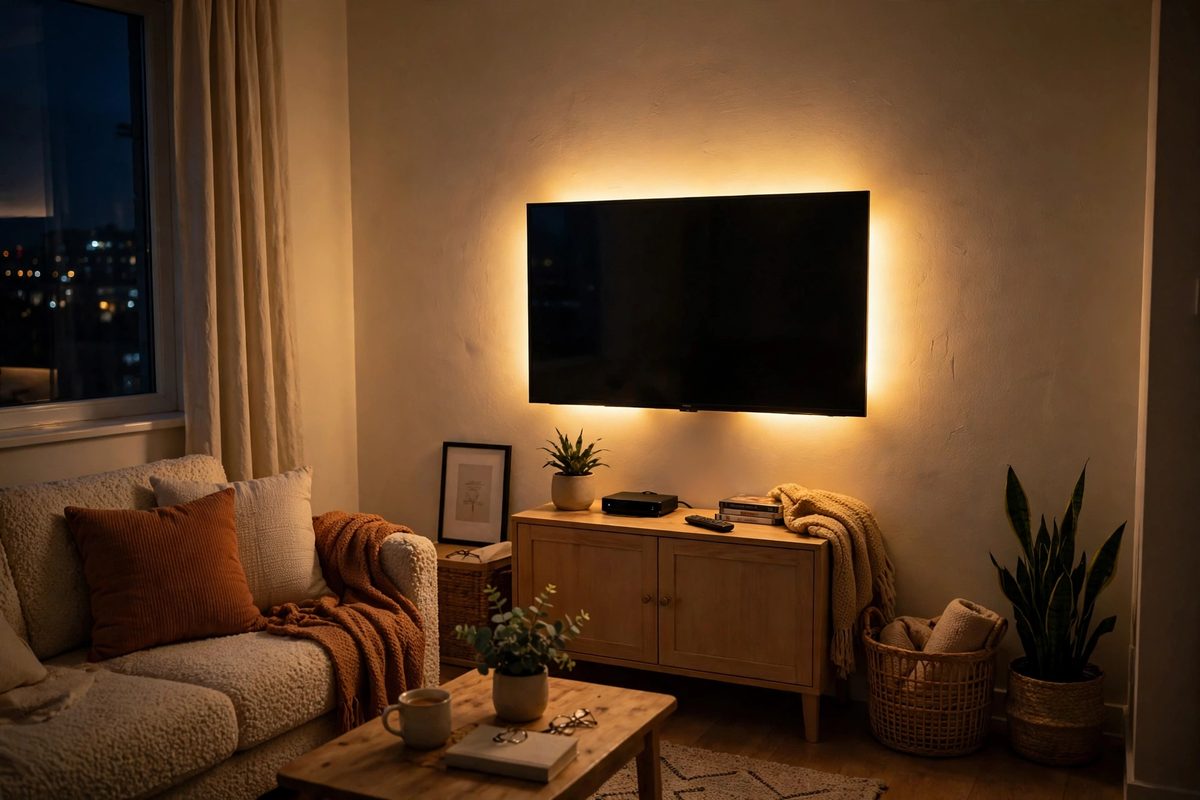
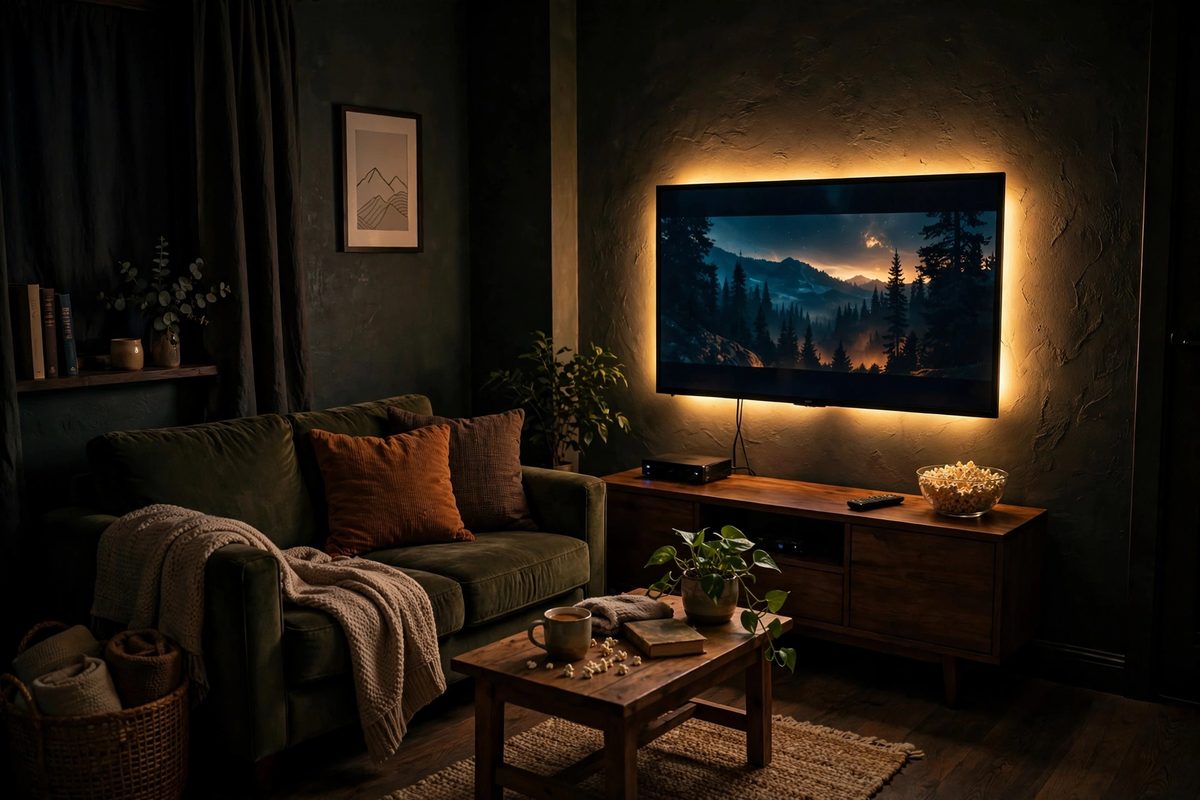
TV glare in a small living room has two causes: a lamp reflecting in the screen, and a bright screen floating in a pitch-dark room, which strains eyes and makes the screen feel harsh. The fix for both is bias lighting: a warm LED strip stuck to the back of the TV, 15 to 25 dollars, that glows softly onto the wall behind the screen.
Bias lighting raises the ambient brightness around the TV just enough that your eyes stop straining, and it makes the screen look better, with deeper perceived blacks, because the contrast between screen and wall drops. Set the strip to about 10 percent of the TV’s peak brightness, warm 2700K to 3000K, and dim the room’s other lamps to 40 to 60 percent during TV time. For TV placement and wall ideas, see small living room TV ideas.
How to make it work
Stick the strip to the back edges of the TV, 2 inches in from the edge, so the glow frames the screen evenly rather than leaking from one side. If the TV sits in a corner, bias lighting still works, but angle the strip so it washes the nearest wall, not the corner joint, which creates a hard bright line. Never place a table lamp directly opposite the TV; its reflection is the most common glare complaint in small rooms.
7. The Seating Area Plan for a Two-Seat Sofa
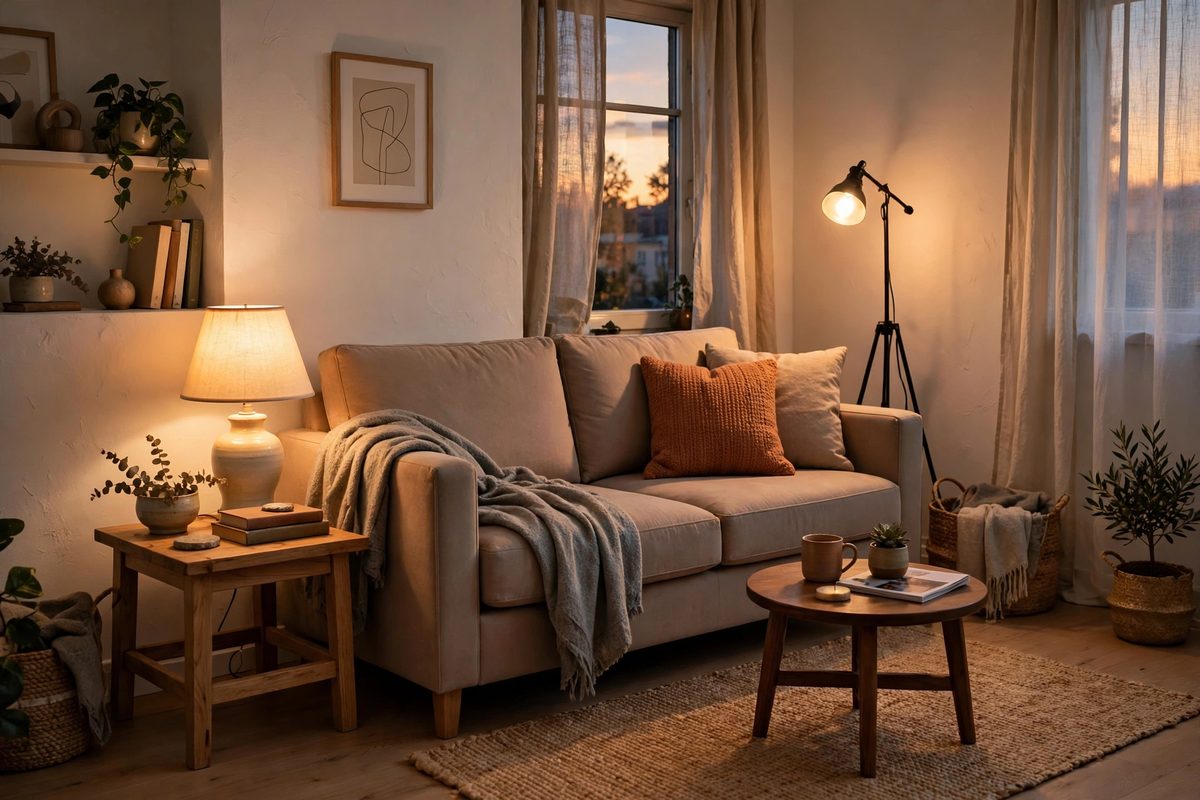
A two-seat sofa against one wall is the most common small living room layout, and its lighting plan is simple: one ambient wash in the nearest corner, one table lamp at one sofa end, and one accent light on the wall or shelf above or beside the sofa. Three lights total, each with a job, and no lamp in the middle of the floor where it trips people.
If the sofa faces the TV, keep the table lamp on the far end from the TV sightline to avoid screen reflection, and put the ambient wash on the TV wall side, aimed at the side wall. If the sofa floats in the room, an arc lamp behind one end doubles as ambient and task light, since its head reaches over the seating. Budget for this plan: 120 to 220 dollars for three decent lamps and bulbs.
How to make it work
Sit on both sofa seats at night with all three lights on and check for glare, shadows on books, and dark spots at the sofa ends. The most common fix is moving the table lamp from the outer end to the inner end, closer to the room’s center, which balances the light across both seats. Add a dimmer to the ambient lamp so the same plan works for a bright gathering and a low movie night.
8. The Reading Corner Inside the Living Room
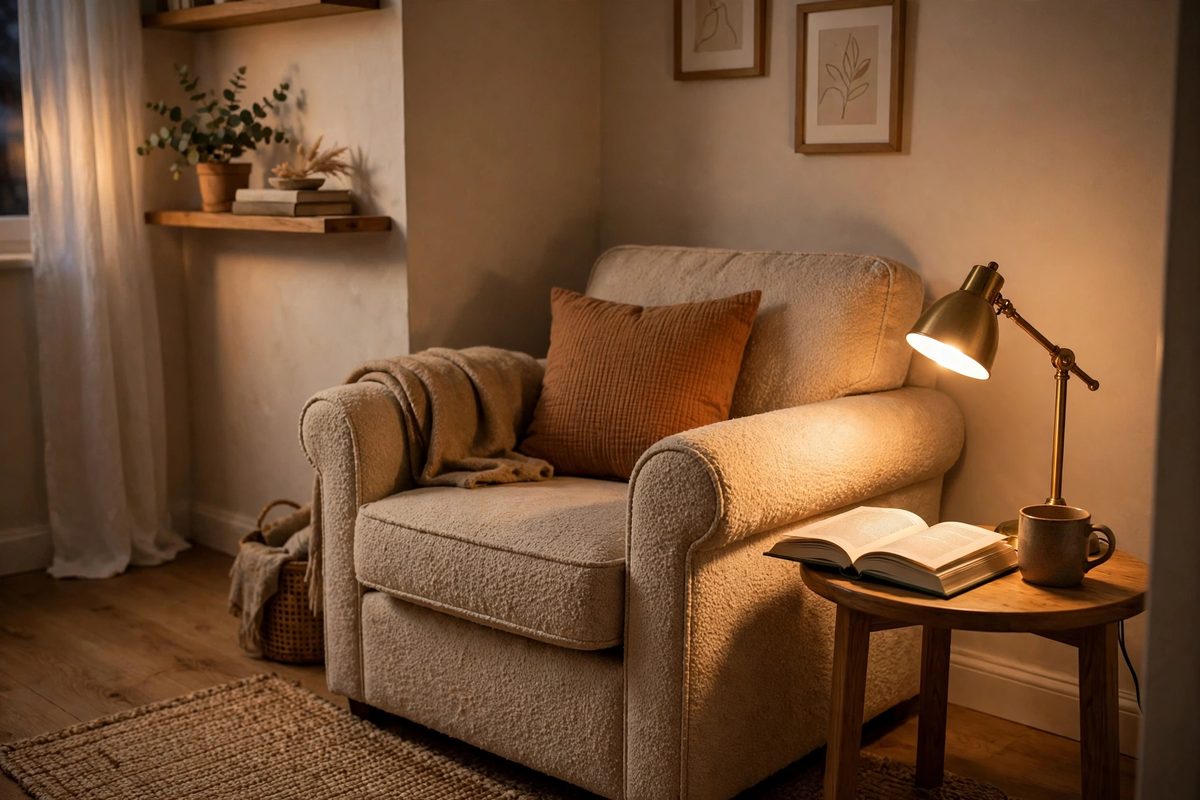
A reading corner carved out of a living room needs its own light logic, or it borrows the room’s ambient light and stays too dim to read in. Give the corner a focused task lamp, a small side table for the book and a drink, and a low accent light, like a shelf strip above the chair, that marks the corner as its own place after dark.
The task lamp should be brighter than the room’s ambient layer at the reading spot, about 600 to 800 lumens at the book, while the room around it stays at 40 to 60 percent. That contrast is what makes a corner feel like a nook rather than just a chair in a room. A plug-in sconce works well here if floor space is tight, and a small curtain or a tall plant can mark the corner’s edge visually. Curtain ideas for the room are in small living room curtain ideas.
How to make it work
Angle the task lamp so light falls on the book from behind and above your shoulder, not from in front of your face. If the lamp glares when you look up, the shade is too high or too close; lower it 2 inches or move it 6 inches back. Keep a warm accent light on in the corner even when you are not reading, since a dark corner in an otherwise lit room makes the whole living room feel unfinished.
9. Dimmer Scenes for TV, Reading, and Hosting
Dimmers turn three lamps into a lighting system. Without them, every scene is all lamps on or all lamps off, and the room only ever looks one way. With a plug-in dimmer on the ambient lamp, about 15 dollars, and smart plugs or dimmable bulbs on the rest, you get scenes: TV time, reading time, hosting, and winding down, each with its own brightness balance.
TV scene: ambient at 40 percent, bias light on, task lamps off. Reading scene: task lamp at full, ambient at 60 percent, accent on low. Hosting scene: all layers at 80 to 100 percent, warm color temperature throughout. Wind-down scene: accent only, everything else off, for the last half hour before bed. Write the scenes on a card inside a drawer until they become habit; most people use two scenes daily and the rest weekly.
How to make it work
Put dimmers on the ambient layer first, since it changes the room most, then on task lamps if they buzz or flicker at low settings with non-dimmable bulbs. Check bulb boxes for the word dimmable before you buy; a non-dimmable LED on a dimmer flickers and shortens the bulb’s life. If smart plugs appeal to you, label them by zone in the app, not by plug number.
10. The Small Living Room Lighting Checklist
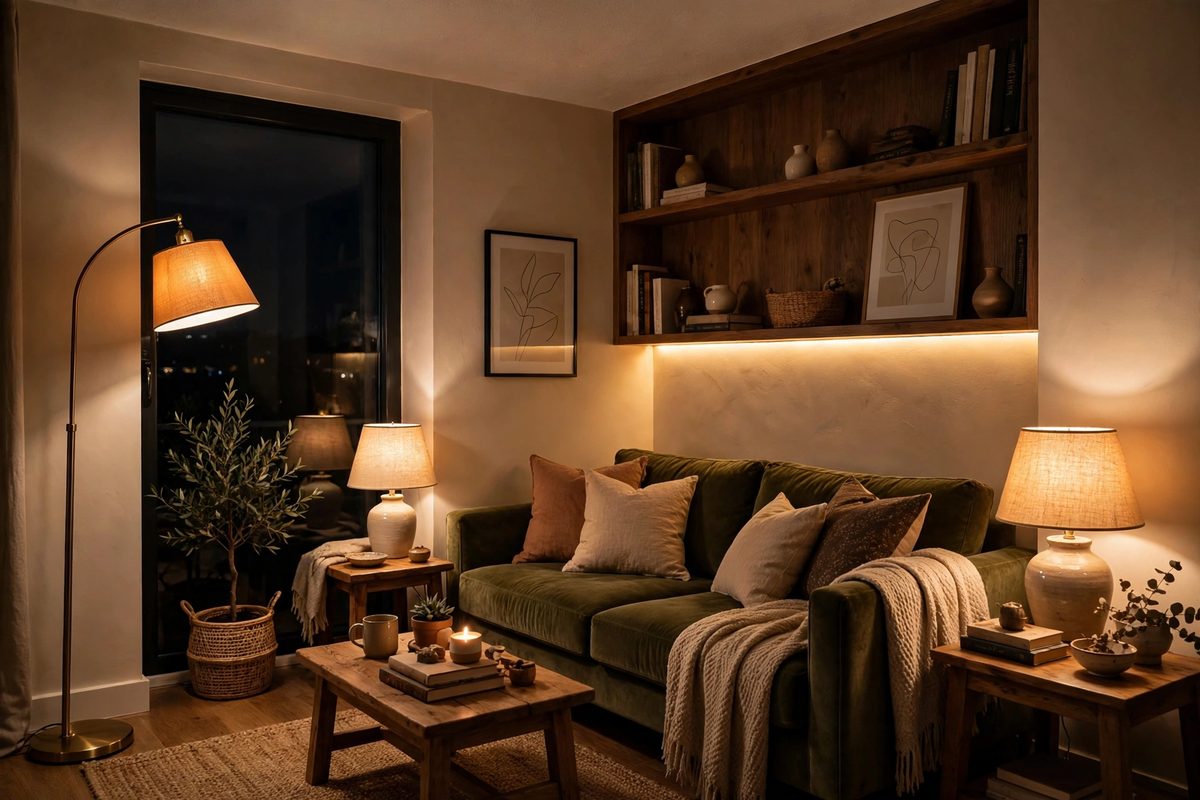
Before you call the living room done, run this checklist at night with all layers on. One ambient wash, lit and dimmable. One task light per regular reader. One or two accent glows, no more. No lamp reflecting in the TV. No dark corner wider than about 3 feet. No cord crossing a walkway. Every bulb the right color temperature for its job: warm for evening, daylight only for daytime work zones.
If the room fails one item, fix that item before buying anything new. Most small living rooms fail on accent light or on TV glare, both of which cost under 25 dollars to fix. For the renter-wide version of this plan, including kitchens and entries, see renter-friendly lighting ideas, and for the dark-room version, see renter-friendly lighting for dark apartments.
Layered lighting in a small living room is not about more lamps, it is about the right lamp in each zone, at the right brightness, at the right color temperature. One wash, one task light per reader, one or two accents, and dimmers to balance them: that is the whole system, and it fits in a room of any size.