10 Small Living Room Floor Lamp Ideas That Add Light Without Taking Over the Room
Brighten your dark living room without losing floor area. Discover 10 space-saving floor lamp ideas—from arc lamps to corner uplights and shelf lamps.
In This Guide
Small living rooms often need more light than they have surfaces for.
A table lamp usually needs:
- side table
- console
- shelf
- cabinet.
If those surfaces are already limited, adding lighting can accidentally mean adding more furniture too.
That is where a floor lamp can be useful.
It gives you light without requiring another tabletop.
But floor lamps still occupy space.
A poor choice can:
- narrow a walkway
- crowd a sofa arm
- interfere with curtains
- visually block a corner
- create glare
- make a small room feel over-furnished.
The best floor lamp for a compact living room is usually not the most decorative or the largest.
It is the one that fits the room’s:
footprint, light direction, furniture layout, and circulation.
Here are ten ways to use floor lamps in a small living room without letting the lighting become another space problem.
1. The Sofa-Corner Arc Lamp
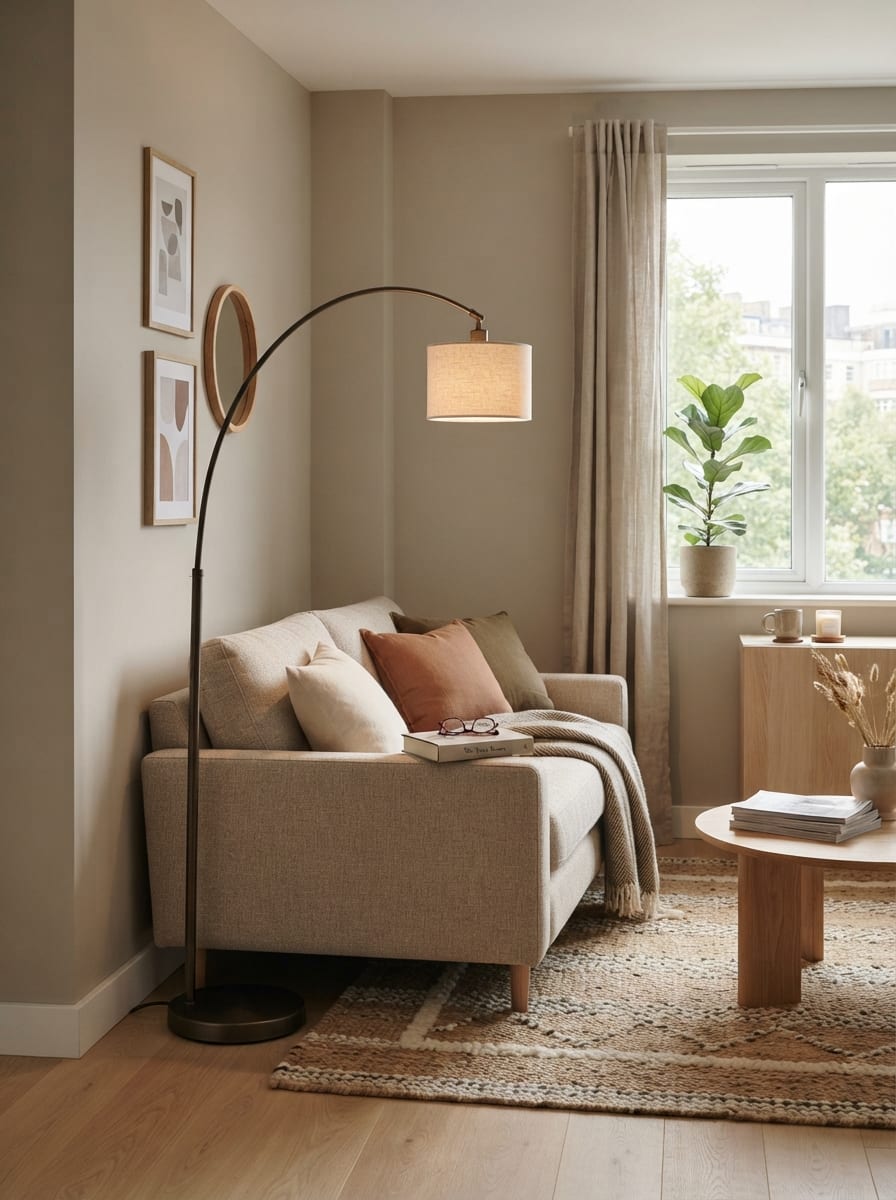
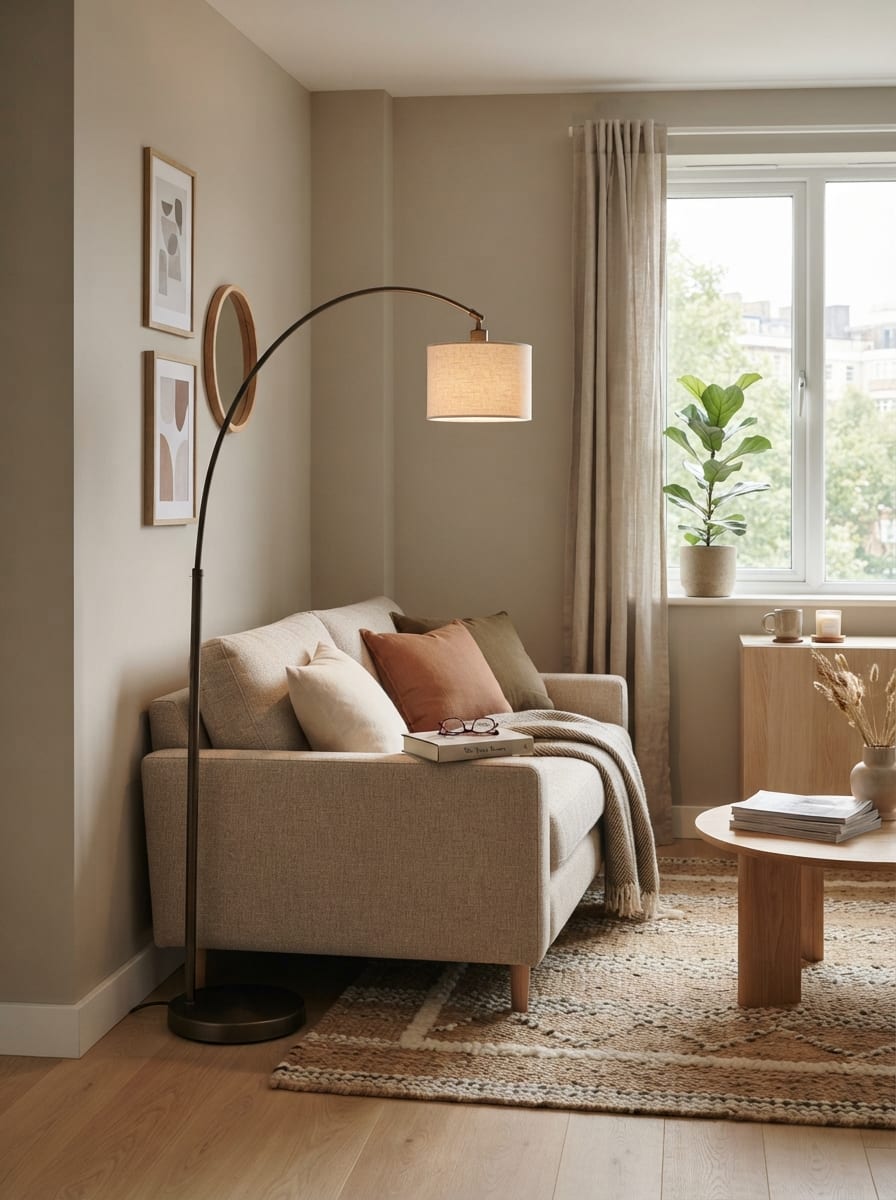
An arc lamp can bring light over a sofa or chair without requiring the lamp base to sit directly beside the seating.
That makes it useful when the best lighting position and the best base position are not the same.
Why it works
The base can sit in an underused corner while the arm extends toward the seating area.
You get overhead-style light without:
- ceiling installation
- side table
- large central fixture.
Watch the arc depth
An oversized arc can stretch too far into the room.
That may interfere with:
- walking
- standing
- sightlines
- ceiling fan clearance.
In a small living room, use a restrained arc rather than a dramatic oversized one.
Keep the base out of the walkway
A heavy arc-lamp base needs stable floor space.
Good positions may include:
- behind a sofa corner
- beside an end wall
- inside an unused furniture gap.
Do not leave the base where people need to step around it repeatedly.
Use it to replace another lamp
The arc lamp works best when it reduces the need for additional fixtures rather than becoming one more thing in the room.
2. The Slim Uplight Lamp
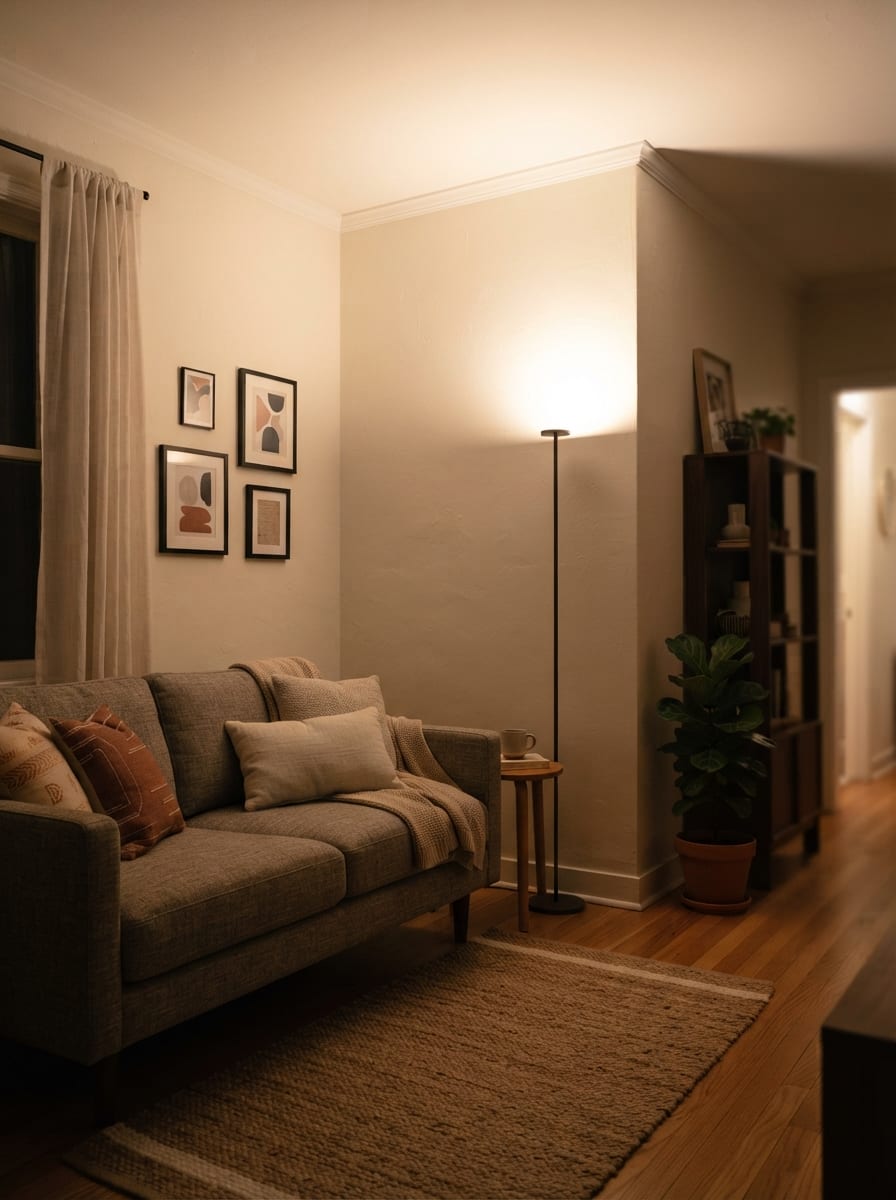
If the room needs more overall brightness rather than focused task light, a slim uplight can be one of the smallest-footprint options.
Instead of directing light downward, it sends light toward:
- ceiling
- upper wall.
Why it works
The reflected light spreads more broadly than a narrow task beam.
This can make the living room feel brighter without adding a large lamp shade at eye level.
Best placement
A good position is often:
- in a dark corner
- beside a bookcase
- near the end of a sofa
- behind a chair.
Ceiling color matters
Light-colored ceilings reflect more light.
A very dark ceiling will absorb more of the illumination.
Avoid glare
The lamp should not direct a harsh visible bulb straight into seated eye level.
Choose a shade or fixture designed to control the light properly.
3. The Narrow Tripod Alternative
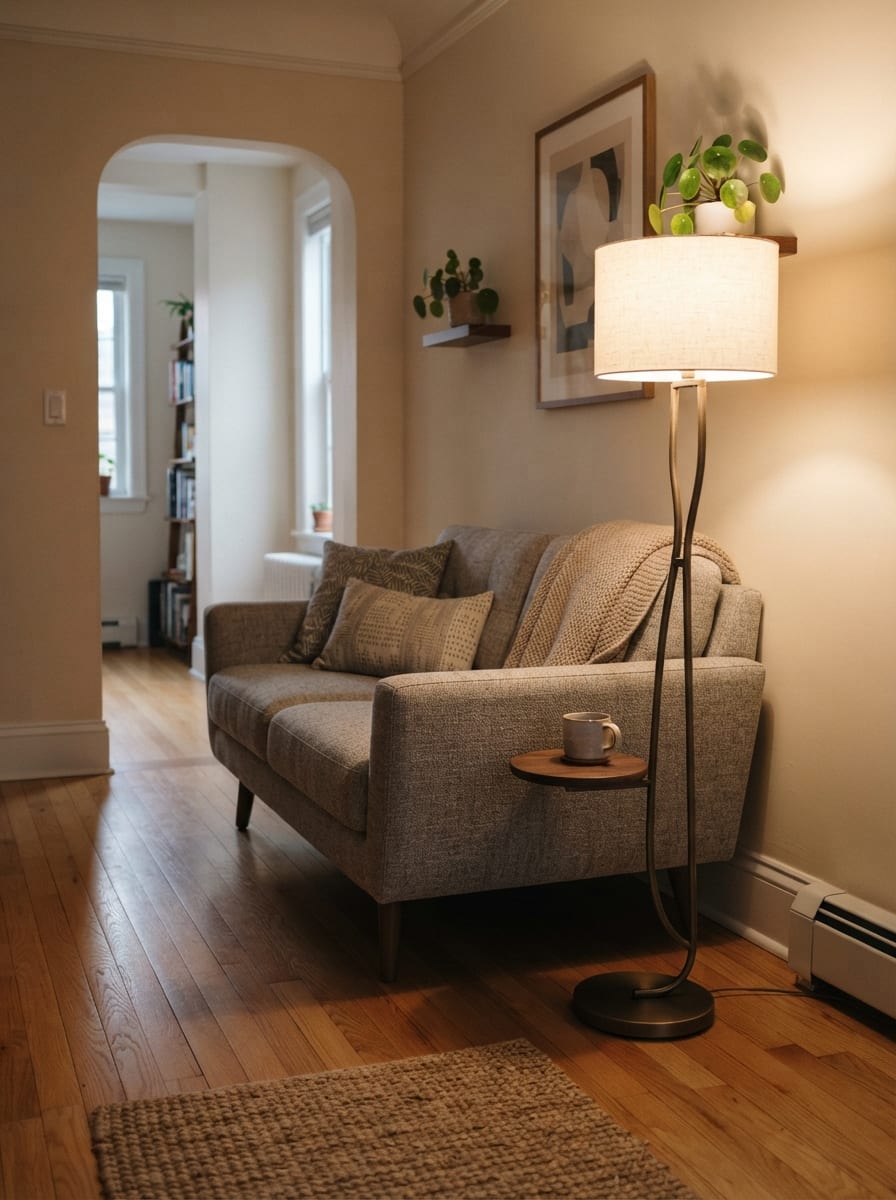
Tripod lamps can look attractive, but three widely spread legs can consume more floor area than expected.
If you like the visual idea, choose a narrower-base version or a single-stem lamp with a similar sculptural feel.
Why it works
You keep the decorative presence without sacrificing unnecessary floor area.
Measure the base, not just the height
Product photos can make a lamp look slim from the front.
Always check:
- base width
- leg spread
- shade diameter.
The base is what competes with:
- sofa
- chair
- walkway.
Keep it against the room edge
A lamp with a slightly wider footprint works better:
- against a wall
- in a corner
than floating near the center of the room.
Avoid pairing a wide lamp with a wide side table
Choose one or the other as the visually dominant element.
4. The Behind-the-Sofa Reading Lamp
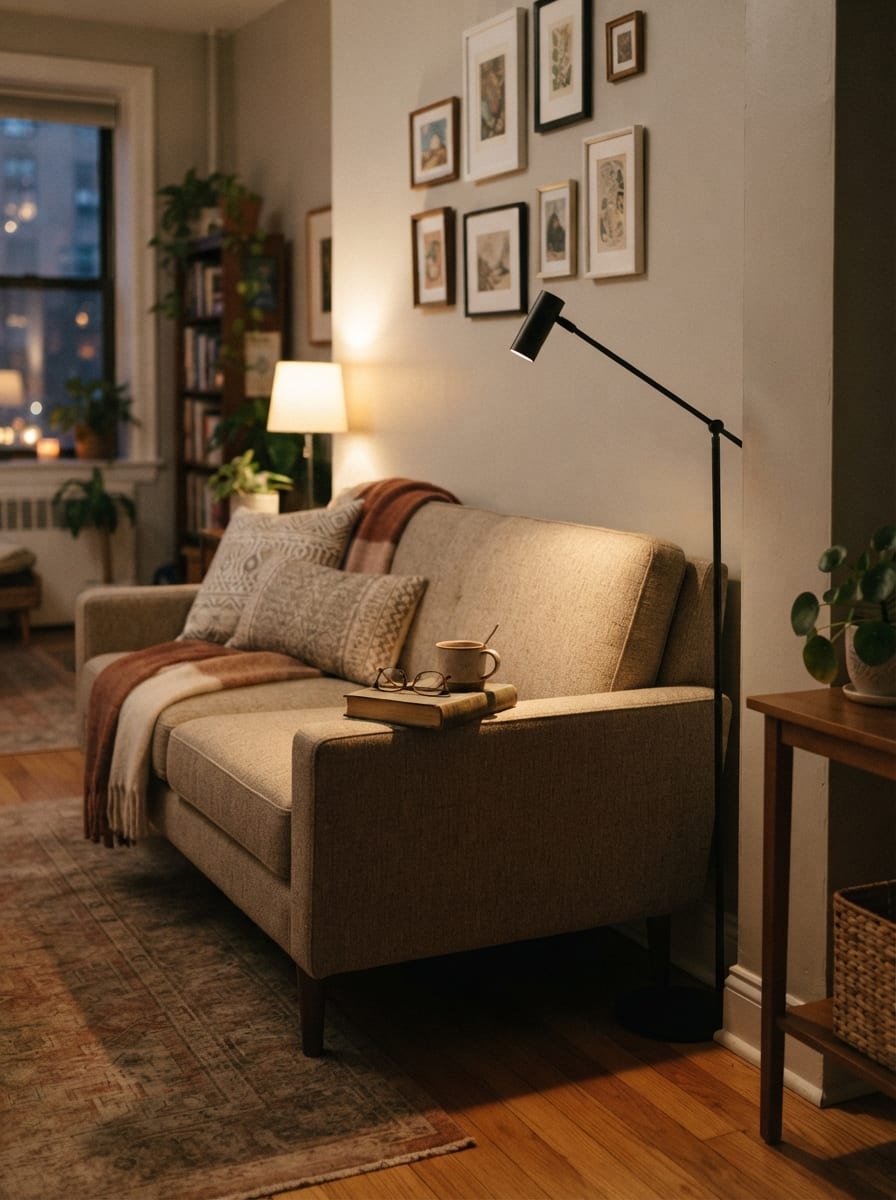
The space immediately behind a sofa is often difficult to use, especially when there is not enough room for a console table.
A slim floor lamp can make that narrow zone functional.
Why it works
The lamp uses space that would otherwise remain empty while placing light exactly where someone sits.
Choose a small base
The gap behind the sofa may be narrow.
Avoid:
- broad marble bases
- oversized tripod feet
- deep decorative stands.
Use an adjustable head
A reading lamp works better if the light can be directed toward:
- book
- magazine
- knitting
- laptop.
Keep the bulb out of direct sight
The lamp should illuminate the task without shining directly into your eyes.
Watch the sofa back height
The fixture should clear the sofa enough to function properly.
5. The Tiny-Corner Task Lamp
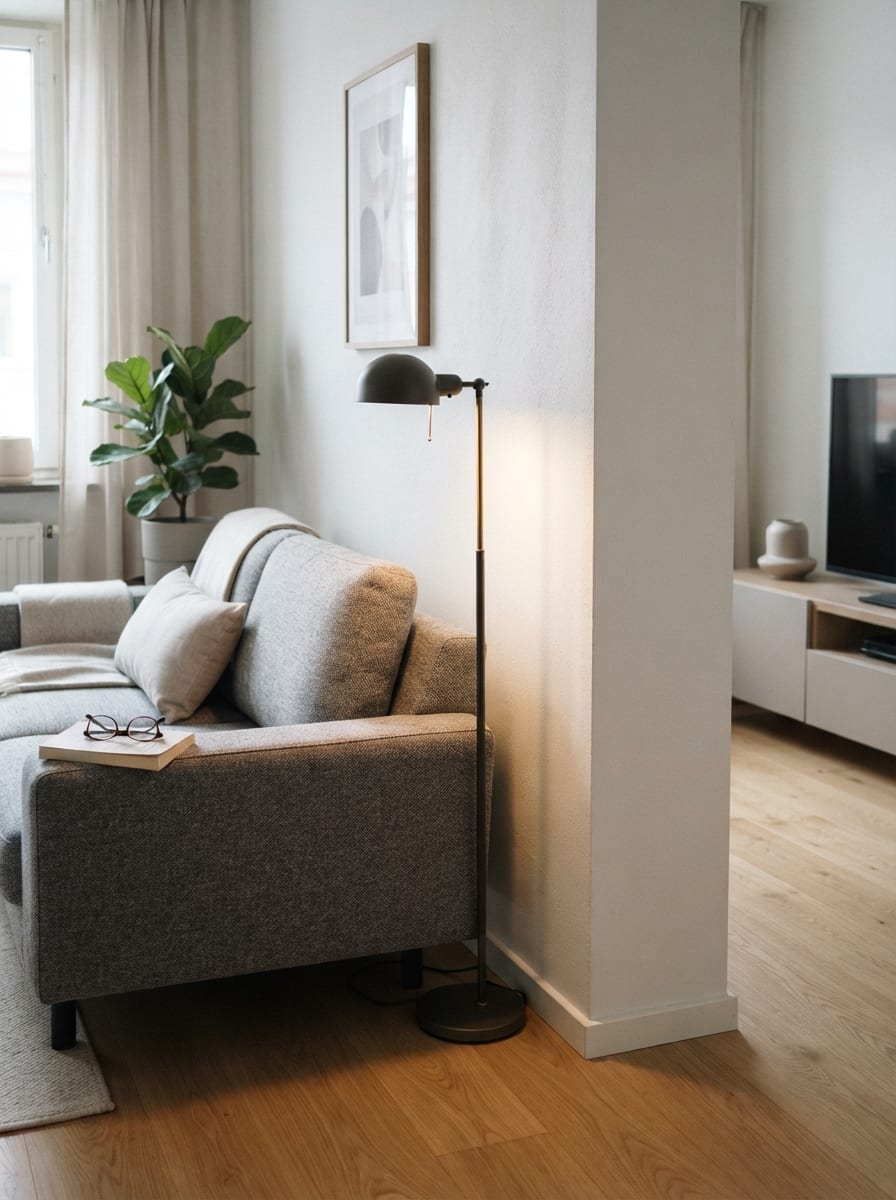
A small unused corner between furniture pieces can sometimes hold a narrow task lamp even when there is not enough room for a table.
Good locations
For example:
- between sofa and wall
- beside an accent chair
- between bookshelf and chair
- beside a compact media cabinet.
Why it works
The lamp fills a vertical gap without taking much horizontal space.
Keep the shade compact
A very wide shade can interfere with:
- sitting
- walking
- cabinet doors
- curtains.
Use it where the light is needed
Do not add a floor lamp to a corner only because the corner is empty.
It should support:
- reading
- ambient light
- artwork
- another specific function.
Avoid overdecorating the corner
If the lamp already gives the corner visual height, you may not also need:
- tall plant
- wall shelf
- floor basket.
6. The Wall-Washing Floor Lamp
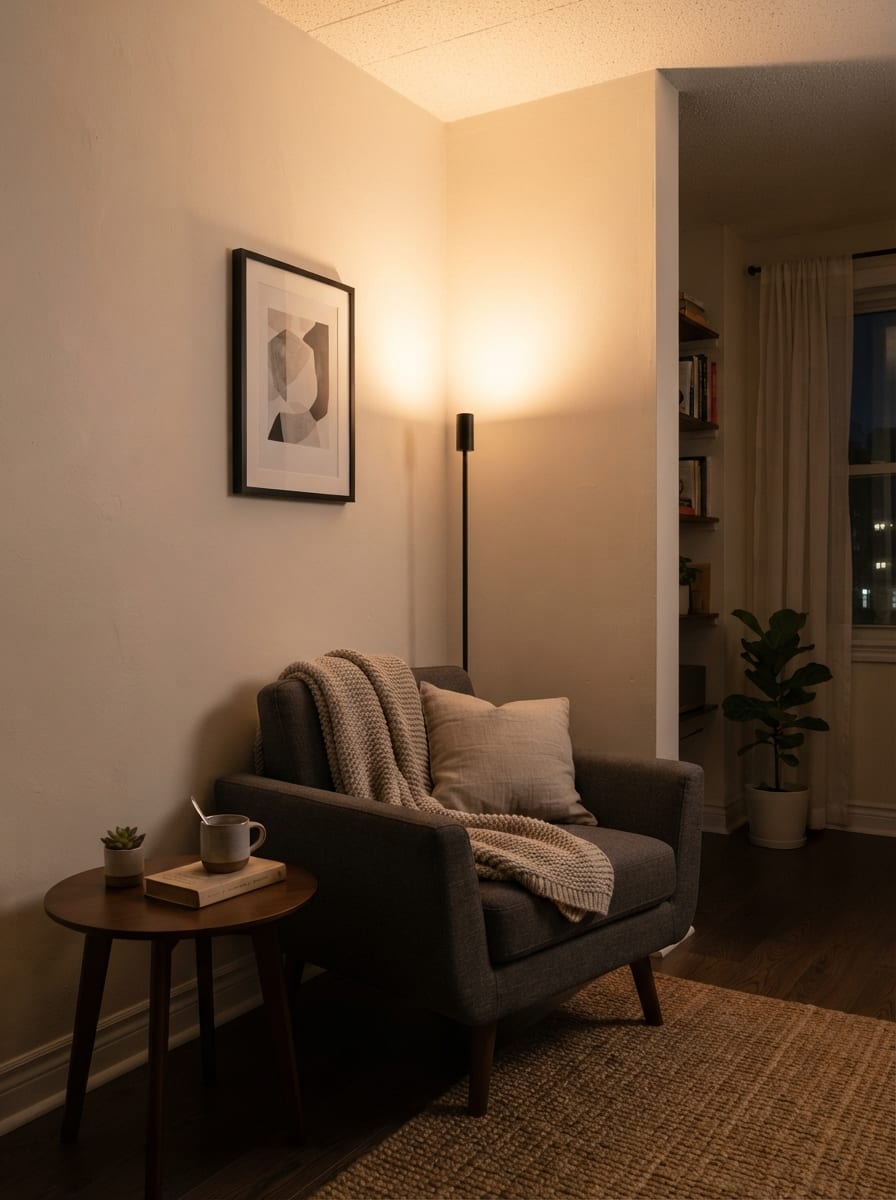
A wall-washing lamp directs light toward a vertical surface instead of into the middle of the room.
This can be an effective way to make a small living room feel brighter without filling it with visible lighting hardware.
Why it works
The wall becomes part of the lighting system.
Reflected light can soften:
- dark corners
- heavy furniture shadows
- uneven room lighting.
Use a quiet wall
This works best on a wall that is not overloaded with:
- shelves
- frames
- decor.
A clean wall reflects light more evenly.
Good behind furniture
A wall washer can sometimes sit behind:
- sofa
- armchair
- low console.
That hides some of the fixture while keeping the light visible.
Watch shiny artwork
If the wall contains framed glass, direct light may create distracting reflections.
7. The Shelf-Lamp Hybrid
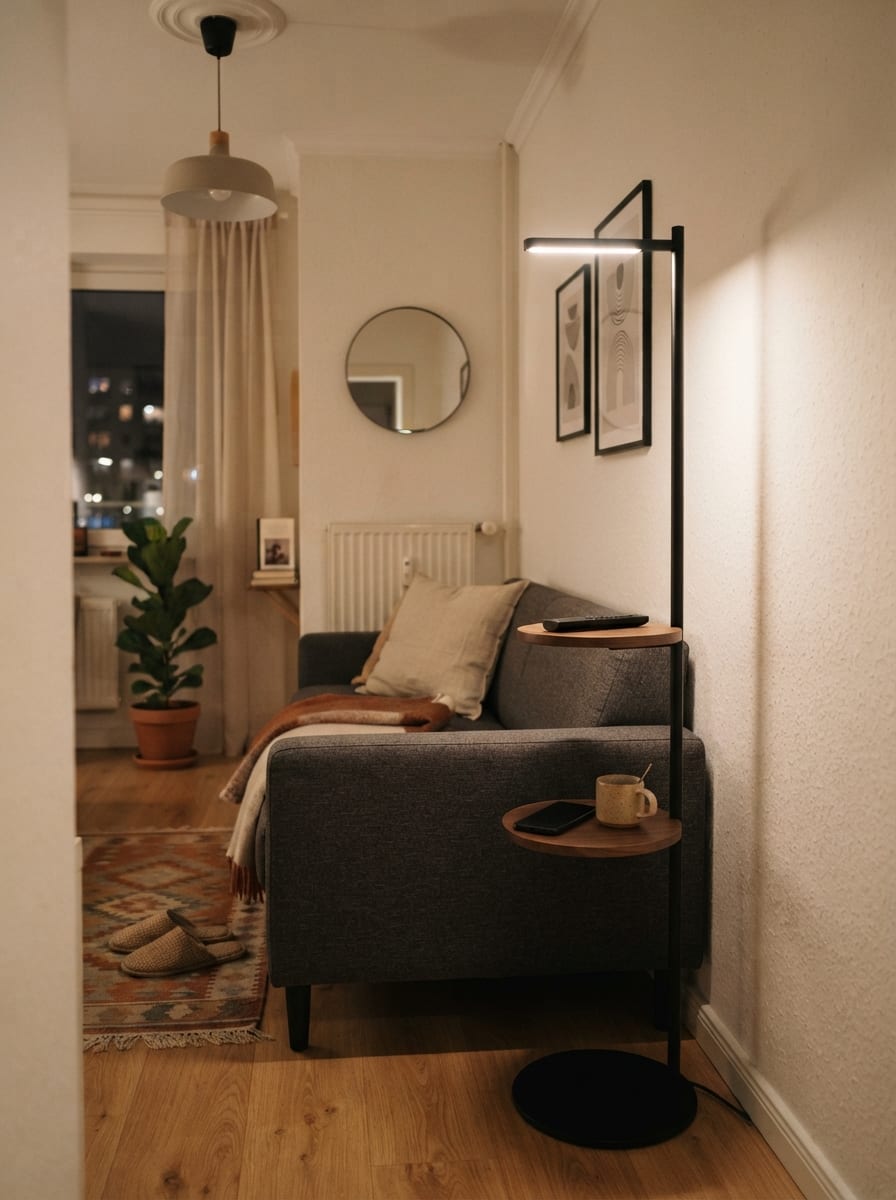
A floor lamp with one or two integrated small shelves can replace both:
- lamp
- tiny side table.
This can be useful where there is simply not enough floor space for separate pieces.
Why it works
One vertical footprint provides:
- light
- a small landing surface.
Keep the shelves small
A shelf-lamp should not become a tall clutter tower.
Use the surface for one or two essentials such as:
- phone
- cup
- remote.
Check stability
The design should be suitable for both:
- lighting
- placing objects.
Follow product guidance for weight limits.
Best beside a sofa
This is especially useful when you need a place for a drink but do not want a separate side table.
Avoid deep shelving
If the shelves project too far, the hybrid piece can become bulkier than the two furniture functions it is meant to replace.
8. The Bedside-Style Lamp Beside the Sofa
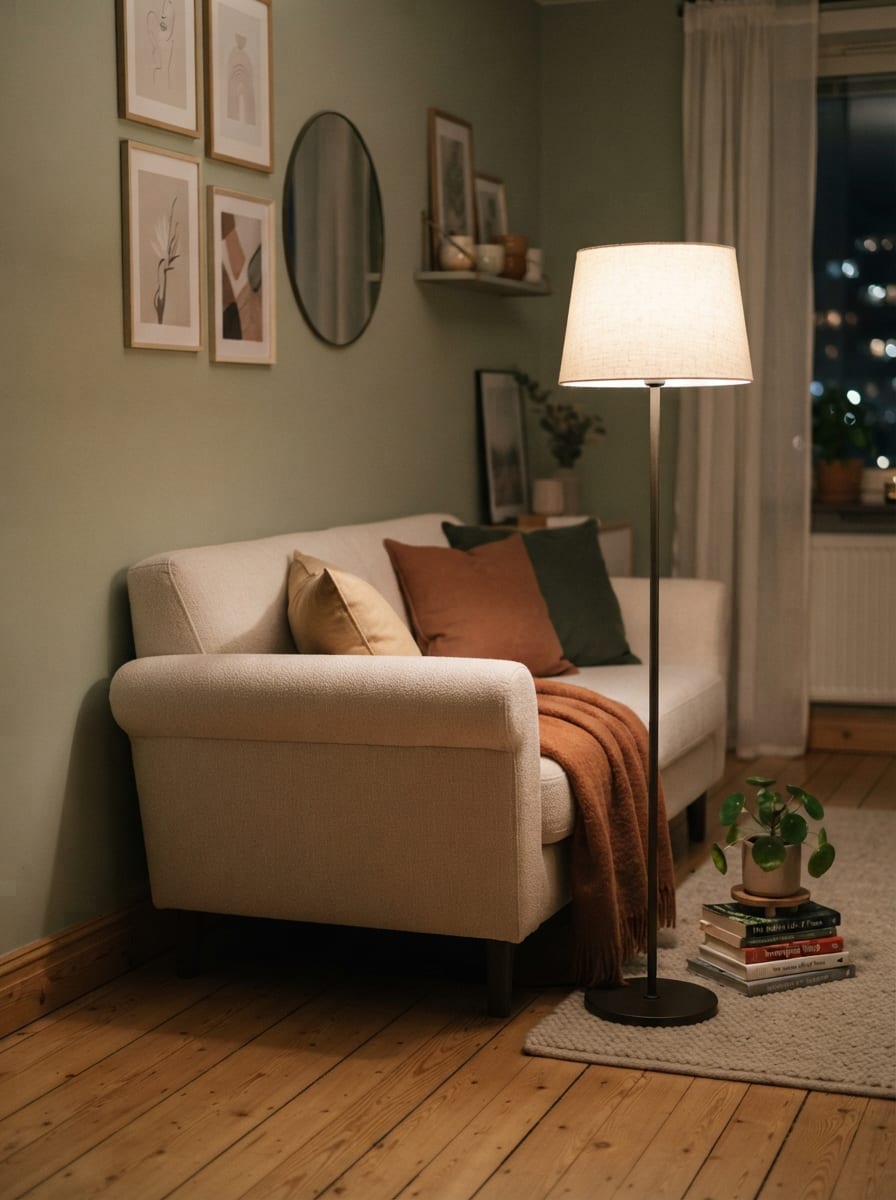
A small floor lamp with a compact fabric shade can create the softer effect of a table lamp without needing the table.
Think of it almost as a bedside lamp scaled vertically.
Why it works
It adds:
- softness
- warm ambient light
- a familiar domestic feel
without adding another horizontal surface.
Good for rooms that feel too hard
If the living room already contains:
- metal
- glass
- hard-edged furniture
a simple fabric shade can soften the atmosphere.
Keep the shade proportionate
A huge drum shade can visually overpower a small sofa.
Choose a shade that feels scaled to:
- sofa arm
- chair
- nearby wall.
Use a warm bulb
For relaxing evening light, warmer color temperature often feels more comfortable than very cool white light.
9. The Double-Duty Adjustable Lamp
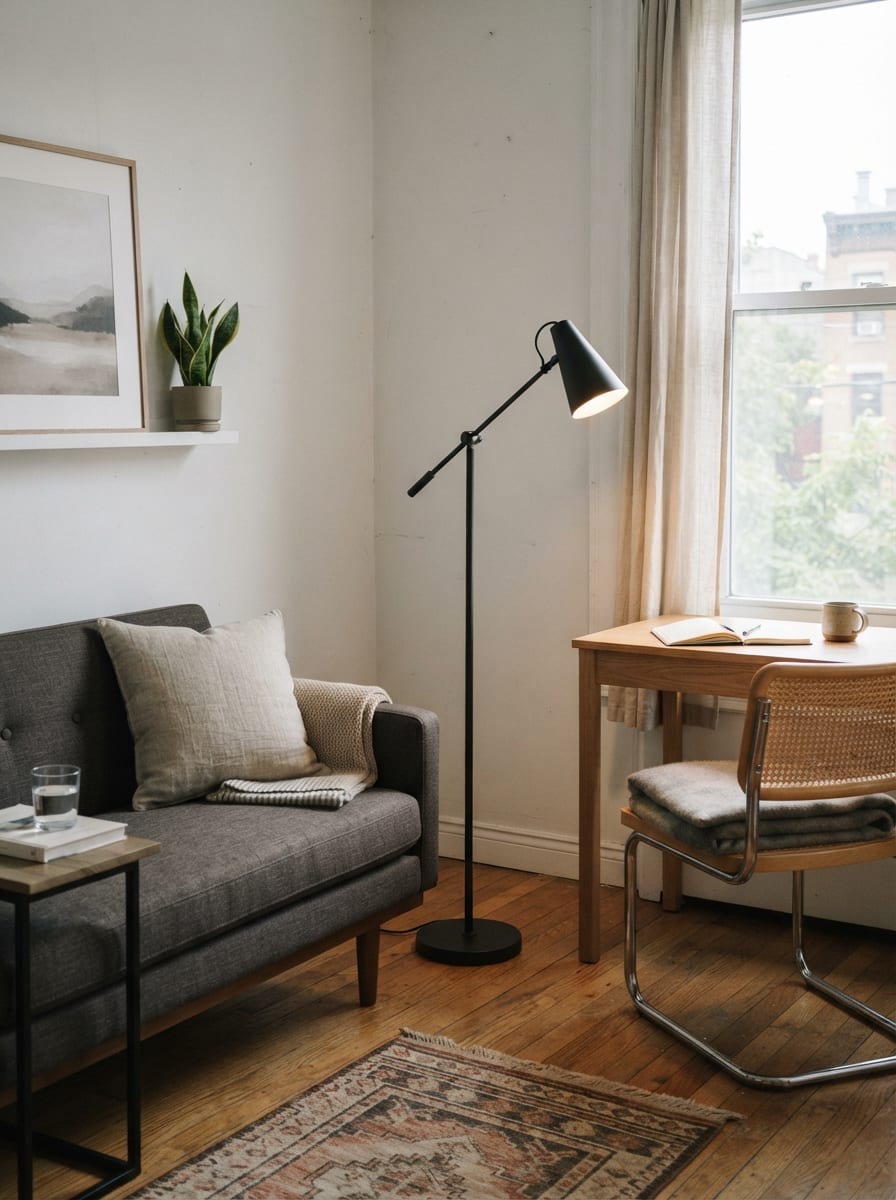
If the living room serves multiple purposes, choose a lamp that can change direction.
For example, the same lamp might provide:
- reading light beside the sofa
- indirect light toward the wall
- task light toward a small desk.
Why it works
One fixture can adapt to several activities.
That reduces the need for multiple lamps.
Look for useful adjustment
Helpful features can include:
- pivoting head
- swing arm
- adjustable height.
Avoid overcomplicated mechanisms
A lamp with too many joints can look visually busy in a small room.
Choose adjustment that solves a real problem.
Place it between zones
In a studio or multifunctional living room, a lamp between:
- sofa
- desk
- reading chair
can serve more than one area.
10. The Footprint-First Lighting Formula
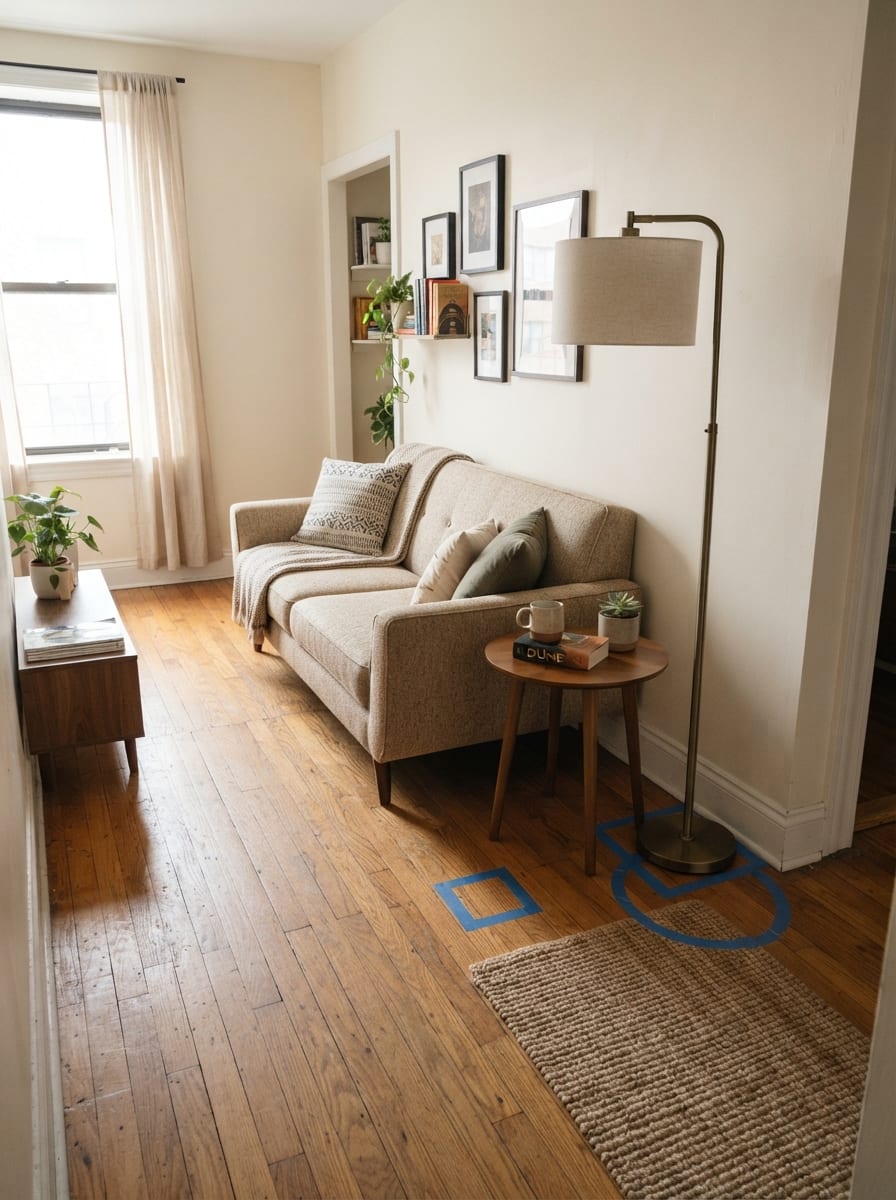
Before choosing the style of the lamp, solve the layout problem.
Use this order:
floor footprint → placement → light direction → shade size → style
Step 1: Mark the lamp base
Use painter’s tape to mark the approximate base size.
Step 2: Check the nearby furniture
Open:
- drawers
- doors
- recliners
if relevant.
Make sure the lamp is not in the way.
Step 3: Walk through the room
Test the main route between:
- doorway
- sofa
- balcony
- kitchen
- hallway.
Step 4: Decide where the light should go
Do you need:
- reading light
- ambient light
- upward light
- wall wash?
Step 5: Choose the lamp style
Only after you know the functional footprint should you decide on:
- arc
- task lamp
- uplight
- shaded lamp.
Start With the Kind of Light You Need
Not every dark living room needs the same lamp.
Before buying anything, decide whether the problem is:
- not enough overall light
- no reading light
- one dark corner
- poor evening atmosphere.
Ambient Light
Ambient lighting helps brighten the room generally.
Good options may include:
- uplights
- shaded floor lamps
- wall-washing lamps.
Task Light
Task lighting is more focused.
Useful for:
- reading
- studying
- working.
Look for:
- adjustable head
- directional shade
- controllable beam.
Accent Light
Accent light highlights:
- artwork
- wall texture
- plant
- shelving.
It should support the room rather than become the only light source.
Layered Lighting Works Better Than One Bright Fixture
A small living room may feel more comfortable with:
- ceiling light
- one floor lamp
- one secondary light
than with one extremely bright central fixture.
Do Not Add Lamps Without a Lighting Plan
Several lamps can easily create:
- cable clutter
- crowded corners
- inconsistent light.
Think about what each fixture contributes.
Floor Lamp Footprint Matters More Than It Looks
A lamp is visually narrow at eye level but can have a surprisingly large base.
Measure:
- diameter
- leg spread
- shade projection.
Arc Lamps Need Two Footprints
They occupy:
- floor space at the base
- air space where the arm extends.
Both matter.
Tripod Lamps Need More Width
Three-leg lamps often occupy more floor than a simple pole lamp.
Use them where the room edge provides enough clearance.
Pole Lamps Usually Have the Smallest Footprint
A slim central stem with a compact base often works best in very tight rooms.
Shade Diameter Counts Too
A shade can collide with:
- curtains
- shelves
- people walking past.
Do not focus only on the base.
Position Beside the Sofa
This is one of the most practical locations.
But check whether the lamp competes with:
- side table
- curtain
- wall decor.
Position Behind the Sofa
Useful when the lamp base can disappear into an otherwise unusable strip.
Position in a Corner
Ideal for:
- uplighting
- ambient light
- wall washing.
Position Beside a Reading Chair
Use a directional lamp rather than a purely decorative one.
Position Near a TV
Be careful about:
- screen reflections
- glare.
Indirect lighting can often work better here.
Position Near Curtains
Keep lamp fixtures and bulbs appropriately separated from fabric and follow manufacturer safety guidance.
Do Not Trap Curtains Behind a Lamp
If curtains need to open fully, do not place the lamp where the base blocks their movement.
Lamp Beside a Balcony Door
Protect the door swing and main exit path.
Do not put a lamp where people need to move around it every time they go outside.
Lamp Near a Bookcase
A narrow lamp can fit well beside shelving.
Keep the shade from overlapping open shelves.
Lamp Between Sofa and Wall
This works if there is enough space for the base and cable.
Lamp Between Sofa and Chair
Only if the center of the room remains clear.
Do not create a furniture bottleneck.
Lamp Behind an Accent Chair
A good way to keep the base visually hidden.
Lamp Next to a Console
This can work, but ask whether you still need both.
If the console already holds a table lamp, another floor lamp may be unnecessary.
Small Living Room With No Side Tables
This is one of the best cases for a floor lamp.
Use it to deliver light without adding another furniture footprint.
Small Living Room With One Side Table
Put the table lamp on one side and a floor lamp on the other only if the room actually needs balanced lighting.
Do not force visual symmetry.
Asymmetry Can Work Better in Small Rooms
One lamp beside the sofa may be enough.
You do not need matching lamps on both sides.
Low-Ceiling Living Room
Avoid very bulky top-heavy lamps.
A slim uplight or narrow-shade lamp may feel lighter.
Tall-Ceiling Living Room
You can use slightly more vertical scale, but the base still needs to stay compact.
Narrow Living Room
Keep the lamp against the outer edge.
Do not let the shade or base project into the center walkway.
Square Living Room
You may have more flexibility with corners.
Use one dark corner as the lighting zone.
Studio Apartment
Choose a lamp that can serve more than one zone.
An adjustable lamp can work between:
- living area
- desk
- sleeping zone.
Dark Living Room
Use reflected light.
A light-colored wall or ceiling can help distribute illumination.
Bright Living Room
A floor lamp may be needed mostly at night.
Focus on warm ambient or reading light rather than raw brightness.
Small Living Room With Dark Walls
Wall-washing light can create dramatic depth.
But very dark surfaces reflect less light than pale walls.
Small Living Room With White Walls
Indirect light will bounce more strongly.
You may need less lamp output to achieve a bright effect.
Choose the Shade Shape Carefully
Drum Shade
Soft, familiar and good for ambient light.
Cone Shade
Can direct light more purposefully.
Dome Shade
Useful for downward task lighting.
Open Uplight Shade
Sends light toward the ceiling.
Fabric Shades Soften Light
They can create a cozy effect.
Metal Shades Direct Light More Strongly
Good for tasks.
Glass Shades Can Reflect More Light
But visible bulbs can cause glare if the design is not well controlled.
Bulb Brightness
Choose based on:
- lamp design
- room size
- intended task.
Follow fixture wattage or equivalent guidance.
Bulb Color Temperature
For living rooms, warm light often feels more relaxed.
Cooler light may feel more task-oriented.
Dimmable Floor Lamps
Dimming is useful when the same lamp needs to support:
- reading
- television
- entertaining
- evening atmosphere.
Make sure the bulb and lamp controls are compatible.
Smart Bulbs
These can give:
- dimming
- scheduling
- color-temperature control
without changing the fixture.
Compatibility matters.
Foot Switches
Useful if the lamp switch would otherwise be difficult to reach.
Keep the switch out of the main walking path.
Cord Management Matters
A floor lamp can create a long visible cable across the room if the outlet is poorly located.
Check Outlet Position Before Buying
The best lamp location may be impractical if the nearest outlet is across the main walkway.
Avoid Extension Cords Across Circulation Paths
Use electrical products safely and according to manufacturer guidance.
Route the Cord Along the Wall
Where appropriate, keeping the cable near the room perimeter reduces visual clutter.
Do Not Pinch the Cord Under Heavy Furniture
Cords should not be damaged by:
- sofa legs
- cabinet feet
- doors.
Floor Lamp Behind a Sofa
Make sure the cord does not cross where the sofa shifts or reclines.
Floor Lamp on a Rug
A lamp should sit stably.
Avoid unstable placement across thick or uneven rug edges.
Heavy Bases Are Useful for Stability
But they also occupy more visual and physical space.
Balance stability with footprint.
Very Light Lamps Can Tip More Easily
Consider household conditions such as:
- pets
- children
- high-traffic areas.
Use products as intended.
Do Not Place a Lamp Where People Frequently Brush Against It
A floor lamp should live at the edge of activity, not in the center of it.
Match the Lamp Scale to the Sofa
A huge sculptural lamp can make a compact sofa look even smaller.
Slim Sofa + Slim Lamp
This often creates the most balanced result.
Bulky Sofa + Bulky Lamp
Usually too much visual weight for a compact room.
A Floor Lamp Can Replace Decor
The lamp itself adds vertical interest.
You may not need:
- tall plant
- sculpture
- floor basket
in the same corner.
Avoid Decorating Around the Lamp Base
Keep the floor surrounding it open.
One Strong Lamp Is Better Than Three Decorative Lamps
Small rooms benefit from editing.
Black Floor Lamps
Create a strong graphic line.
Useful in:
- light rooms
- modern interiors.
Brass Floor Lamps
Add warmth.
Use one metal family consistently enough that the room feels intentional.
White Floor Lamps
Visually recede against pale walls.
Good for low-contrast rooms.
Wood Floor Lamps
Can soften a room.
But wide wood tripod designs often use more floor area.
Match Every Metal?
Not necessary.
The lamp can coordinate loosely with:
- curtain rod
- coffee-table legs
- cabinet hardware.
Keep Metal Mixing Controlled
Three or four unrelated finishes in one small room can feel busy.
Lamps and Curtains
A floor lamp beside curtains should not make the window harder to use.
Lamps and Plants
Both occupy vertical corner space.
Choose one to dominate.
Lamps and Wall Art
A lamp can overlap artwork visually.
Check sightlines before committing.
Lamps and Shelving
A tall lamp should not make the shelving corner feel overcrowded.
Lamps and Mirrors
A nearby mirror can reflect lamp light and make the room feel brighter.
But visible bulbs may create glare in the reflection.
Lamp Beside the TV
Indirect light can reduce the contrast between a bright screen and dark room.
Avoid putting a bare bright bulb where it reflects on the screen.
Lamp Behind the TV
Only if the fixture is designed and positioned safely and does not interfere with ventilation or cables.
Floor Lamps for Renters
They are especially useful because they usually require no wall or ceiling installation.
That makes them a flexible lighting upgrade.
Renter-Friendly Advantage
You can improve:
- ambient light
- task light
- mood
without changing permanent fixtures.
Avoid Huge Lamps Just Because You Cannot Change the Ceiling Light
One appropriate floor lamp often works better than trying to compensate with an oversized fixture.
Combine With Existing Ceiling Lighting
Use the ceiling fixture for general brightness and the floor lamp for:
- atmosphere
- reading
- dark corners.
Use a Floor Lamp to Correct Uneven Lighting
If one side of the living room is consistently darker, place the lamp there rather than beside the already brightest area.
Do Not Put Every Lamp Beside the Sofa Automatically
Sometimes the most useful position is across the room where the light balances the space.
Common Small Living Room Floor Lamp Mistakes
Choosing a lamp based only on height
The base may occupy too much floor area.
Buying a huge arc lamp
The arm invades the room.
Blocking the main walkway
The lamp becomes a permanent obstacle.
Using a decorative lamp where task light is needed
The corner looks good but is still hard to read in.
Choosing an oversized shade
The lamp crowds nearby furniture.
Ignoring the cord path
A cable ends up crossing the room.
Using too many lamps
The room becomes visually cluttered.
Positioning the lamp directly beside curtains
The window treatment becomes difficult to operate.
Using a tripod lamp in a tiny gap
The legs spread farther than expected.
Buying a lamp without checking bulb direction
The light solves the wrong problem.
Quick Floor Lamp Decision Guide
Choose an Arc Lamp if:
You need light over a sofa but the base needs to stay out of the way.
Choose an Uplight if:
The entire room feels dim.
Choose a Slim Pole Lamp if:
Floor footprint is the biggest constraint.
Choose a Reading Lamp if:
You need focused light beside a chair or sofa.
Choose a Wall-Washing Lamp if:
You want softer ambient light and have an empty wall.
Choose a Shelf-Lamp Hybrid if:
You need both light and a tiny landing surface.
Choose a Shaded Floor Lamp if:
You want softer evening light.
Choose an Adjustable Lamp if:
The living room serves several functions.
The Small Living Room Floor Lamp Formula
Before buying a lamp, solve four questions.
FOOTPRINT
How much floor can the lamp base actually occupy?
PLACEMENT
Can it sit outside the main walking path?
DIRECTION
Where should the light go?
FUNCTION
Is it for:
- reading
- ambience
- wall washing
- general brightness?
Only then choose:
- finish
- shape
- shade
- decorative style.
That order prevents a good-looking lamp from becoming bad furniture.
Frequently Asked Questions
Are floor lamps good for small living rooms?
Yes.
They can add lighting without requiring a side table or other surface, especially when the lamp has a narrow base.
Where should I put a floor lamp in a small living room?
Good locations often include:
- beside the sofa
- behind the sofa
- in a dark corner
- beside a reading chair.
The best location depends on the room’s circulation and lighting needs.
What floor lamp takes up the least space?
Slim pole-style lamps usually use less floor area than wide tripod or large arc designs.
Can I use a floor lamp instead of a side table lamp?
Yes.
This is particularly useful when the room does not have enough floor space for both a table and lamp.
Are arc lamps good for small rooms?
They can be, especially when the base can sit outside the main seating area.
Choose a restrained arc that does not project too far into the room.
What type of floor lamp makes a room brighter?
Uplights and wall-washing lamps can spread reflected light across larger surfaces.
Should a floor lamp be taller than the sofa?
It often needs enough height to deliver light above the sofa arm or back, but exact proportions depend on the fixture type and purpose.
Can a floor lamp go behind a sofa?
Yes, if there is enough space for:
- base
- cord
- lamp movement
and the fixture does not interfere with the sofa.
How many floor lamps should a small living room have?
There is no fixed number.
One well-positioned lamp may be enough when combined with existing ceiling or table lighting.
Final Thoughts
A small living room does not need more furniture just to get better lighting.
That is where the right floor lamp earns its place.
Start with the problem:
Is the room:
- generally too dark?
- missing reading light?
- unevenly lit?
- lacking warm evening light?
Then find the smallest practical footprint that solves it.
Use an arc lamp when the base and light need to occupy different positions.
Use an uplight when the whole room needs brightness.
Use a slim task lamp when one seat needs focused light.
Use a shelf-lamp hybrid when you also need a tiny surface.
And always test:
- the base
- the shade
- the cord
- the walkway.
The best floor lamp for a small living room is not simply the most attractive one.
It is the one that adds useful light without becoming another piece of furniture you have to walk around.