10 Small Living Room Curtain Ideas That Make the Room Feel Taller Without Blocking Light
Discover 10 small living room curtain ideas using higher rods, wider placement, light fabrics and smart proportions to make a compact room feel taller and brighter.
In This Guide
Curtains take up far more visual space than most people realize.
In a small living room, they can occupy almost an entire wall from:
ceiling to floor
and sometimes from:
corner to corner.
That means they can either help the room feel:
- taller
- brighter
- softer
- more finished
or make the window look:
- shorter
- narrower
- heavier
- darker.
The most common problem is treating curtains as if they only need to cover the glass.
They do not.
In a small room, curtains also affect how you perceive:
- wall height
- window width
- daylight
- furniture spacing
- visual weight.
The best setup usually does three things at once:
draws the eye upward, lets panels move away from the glass, and controls privacy without sacrificing more daylight than necessary.
Here are ten small living room curtain ideas that use those principles without turning the window wall into a heavy block of fabric.
1. The Ceiling-Lift Curtain
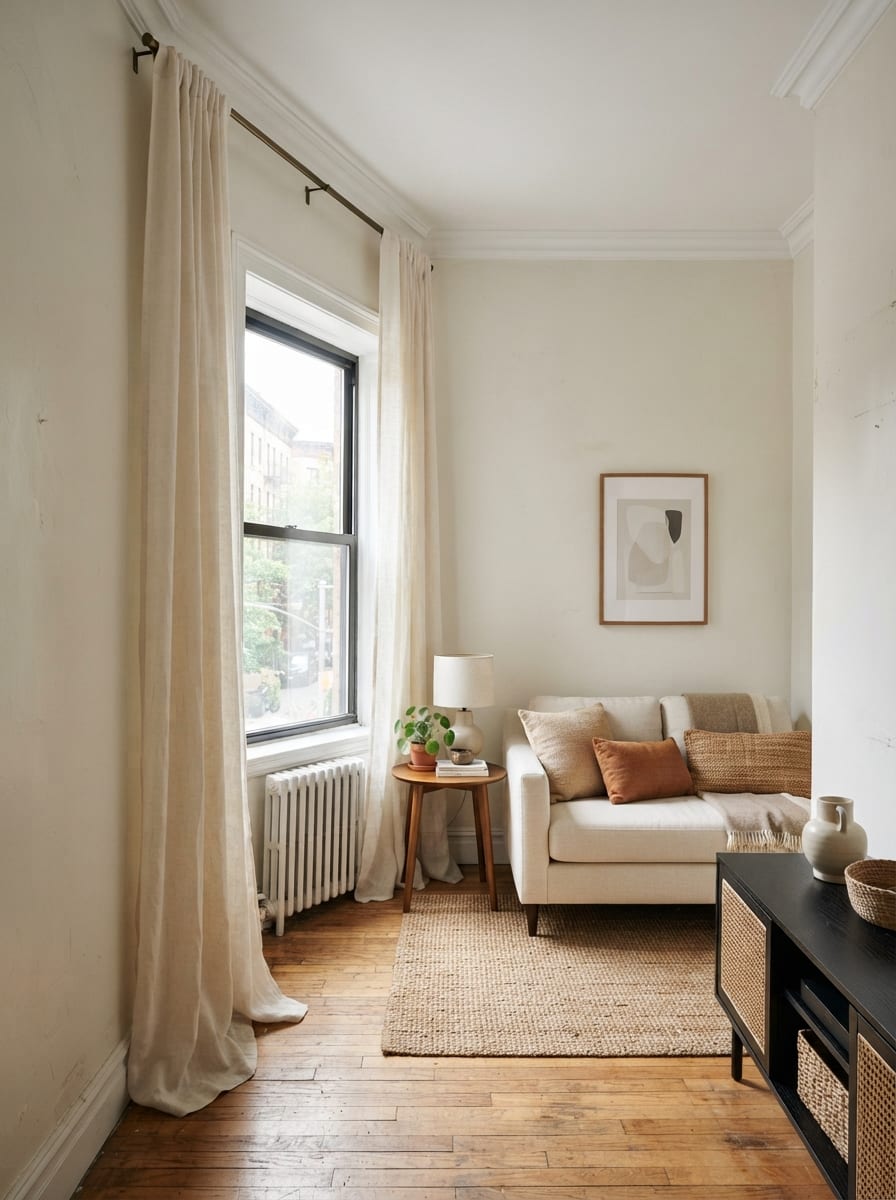
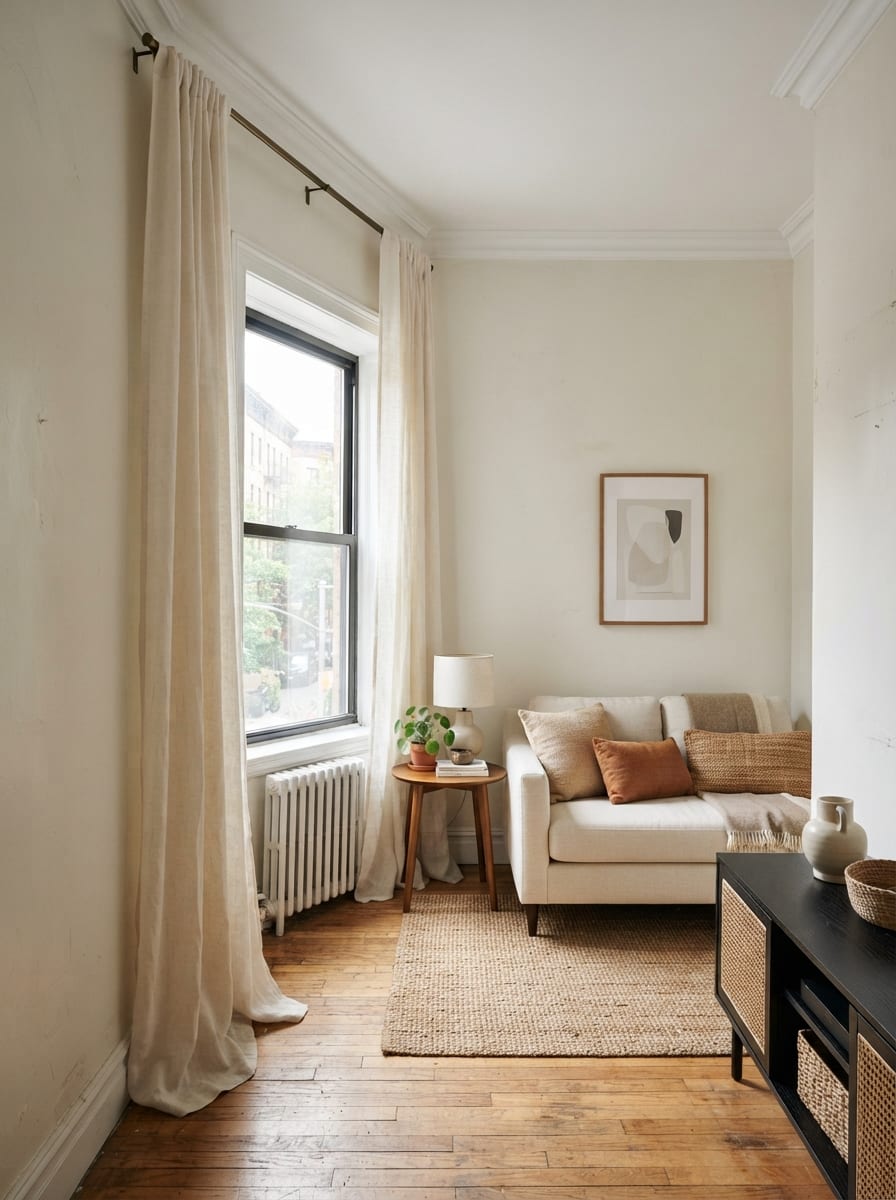
One of the simplest ways to make a small living room feel taller is to move the curtain treatment visually upward.
Instead of placing the rod immediately above the window frame, position it higher where the wall and installation conditions allow.
Why it works
The eye tends to follow the long vertical line created by the curtain.
If that line begins close to the ceiling and continues toward the floor, the room can feel taller than when the curtain starts just above the window.
You are visually emphasizing:
room height
instead of:
window height.
Do not automatically push the rod against the ceiling
The goal is not to install it as high as physically possible.
Check:
- crown molding
- ceiling slope
- wall structure
- air vents
- curtain hardware
- panel length
before deciding.
The rod should look intentional rather than squeezed into an awkward strip of wall.
Keep the top treatment simple
Heavy:
- valances
- layered swags
- oversized decorative cornices
can cancel out the height effect by creating a thick horizontal band.
For a compact living room, a clean rod usually feels lighter.
Measure before ordering panels
Measure from the intended rod position to the floor.
Do this before choosing curtain length.
Do not buy panels first and then let their length dictate an awkward rod height.
2. The Wide-Stack Curtain
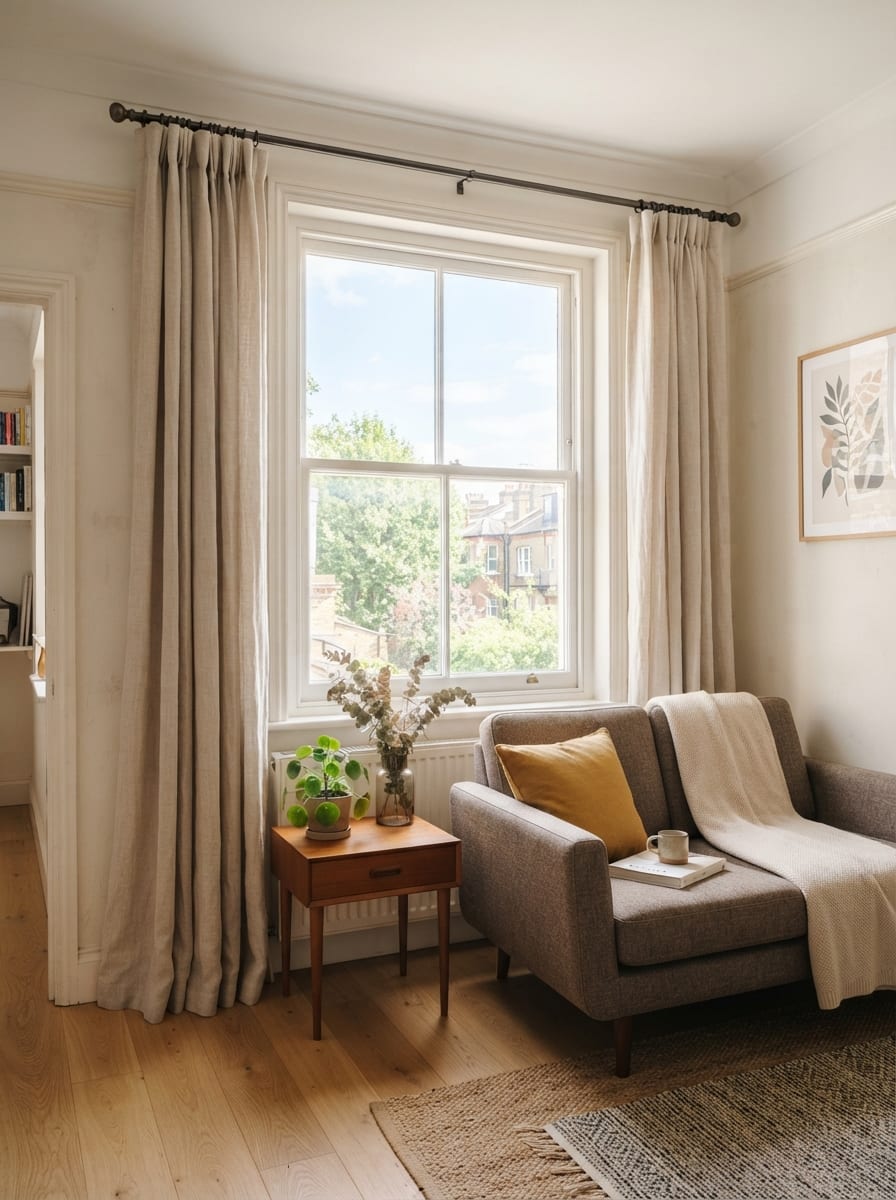
Curtain height gets most of the attention, but width matters just as much.
If the curtain rod ends at the window frame, the open panels may still cover part of the glass.
That reduces daylight and makes the window look narrower.
A better strategy is to give the curtains enough room to stack beside the window.
Why it works
When the curtains are open, most of the fabric sits on the wall instead of directly over the glass.
That can make the window appear:
- wider
- brighter
- less boxed in.
Think about stack-back
Every curtain needs somewhere to go when it is open.
Thicker fabrics create a larger stack.
Lighter fabrics need less wall space.
So before extending the rod, look at:
- available wall beside the window
- furniture placement
- curtain thickness
- number of panels.
Watch nearby furniture
A wider curtain treatment may conflict with:
- tall bookcases
- wall-mounted lighting
- artwork
- media cabinets.
Do not extend the rod simply because “wide curtains are better.”
The wider treatment still needs to fit the actual wall.
Avoid covering light switches
Check wall controls before choosing rod width.
3. The Floor-Skimming Panel
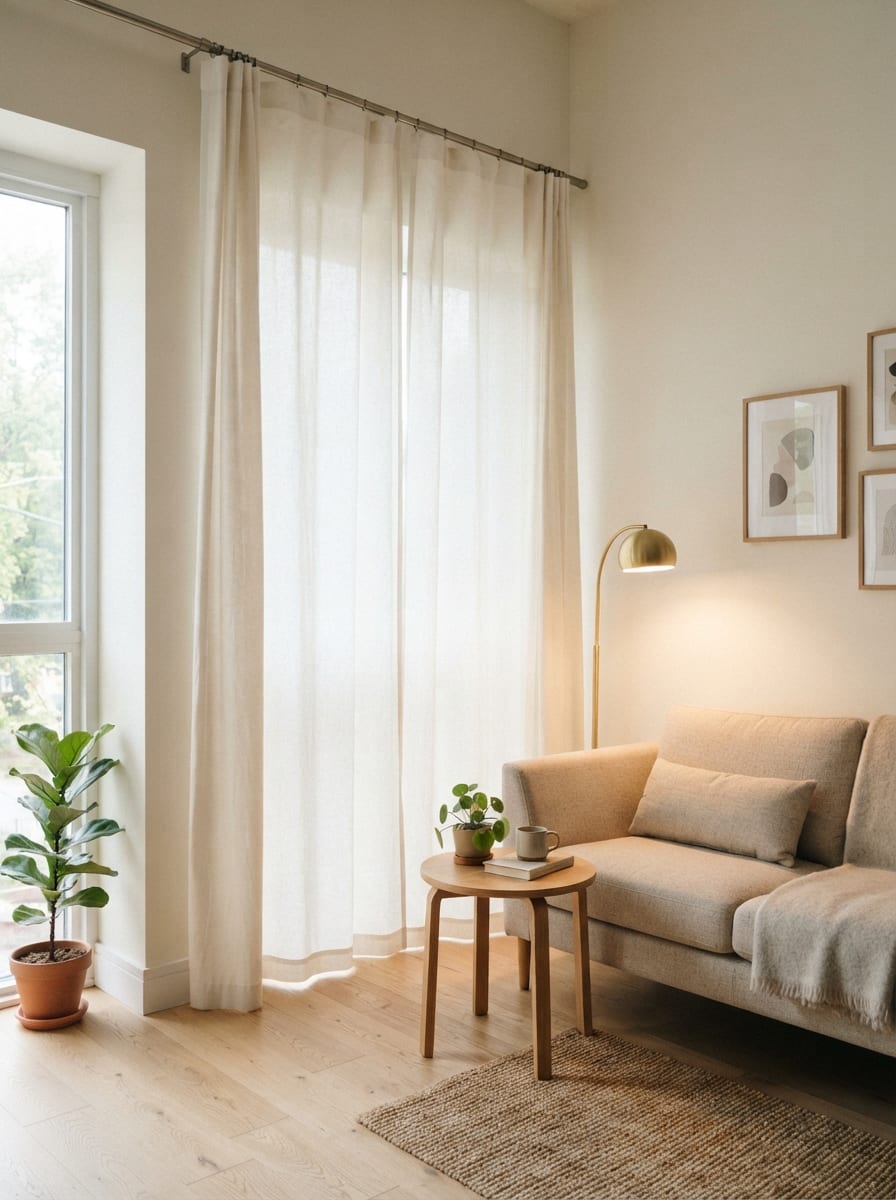
Short curtains can visually divide a wall into several horizontal sections.
That can make a compact living room feel shorter.
Longer panels create one continuous vertical line.
Aim for a clean finish near the floor
For a frequently used small living room, a practical curtain usually looks best when it reaches close to the floor without excessive fabric pooling.
Why?
Because heavy pooling can:
- collect dust
- interfere with cleaning
- bunch near radiators
- create visual heaviness.
Avoid awkward mid-wall endings
Unless there is a functional reason, curtains that stop:
- halfway down the wall
- just below the sill
- at an arbitrary height
can visually emphasize the limited size of the window.
When shorter curtains may make sense
A shorter treatment can still be appropriate when:
- furniture sits directly beneath the window
- a radiator needs clearance
- there is a built-in bench
- safety or airflow requires it.
Function should win over a styling rule.
Check floor level
Older apartments may have floors that are slightly uneven.
Measure both sides if necessary.
4. The Soft-Sheer Light Filter
Privacy can become complicated in apartments.
You may want to block views from:
- neighboring buildings
- sidewalks
- shared courtyards
without turning the living room dark during the day.
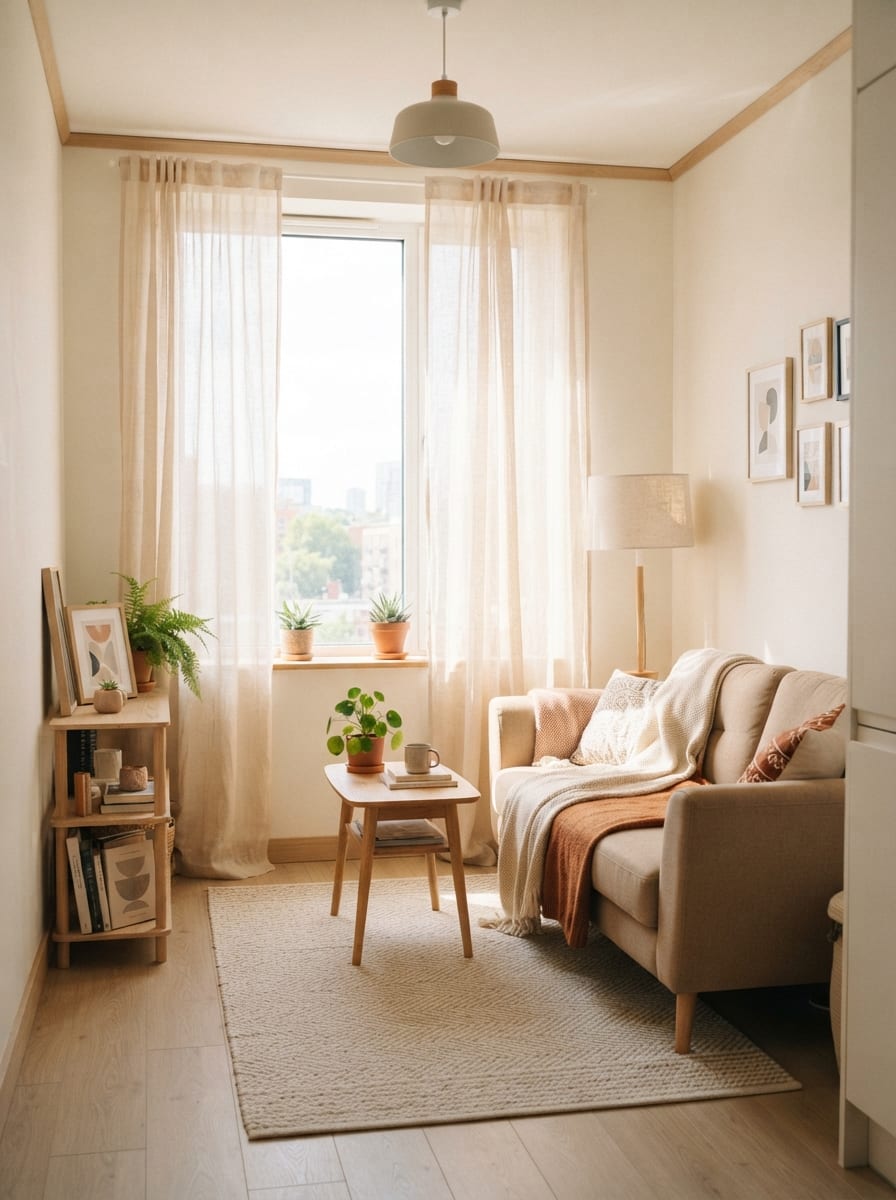
A sheer or semi-sheer layer can help.
Why it works
A lighter curtain can soften direct sunlight while still allowing much of the room’s natural brightness to remain.
This is especially useful when the living room has only:
- one main window
- a shaded exposure
- limited daylight.
Sheer does not mean invisible
Different fabrics provide different levels of privacy.
Some become much more transparent when:
- the room is lit at night
- the exterior is dark.
Do not assume a sheer curtain provides full evening privacy.
Look at fabric density
A very open weave may provide little screening.
A denser translucent fabric may give a better balance between:
- privacy
- softness
- daylight.
Pair with a separate privacy layer when necessary
For night use, you may need:
- a shade
- blinds
- an additional curtain layer.
5. The Tonal Wall-Match Curtain
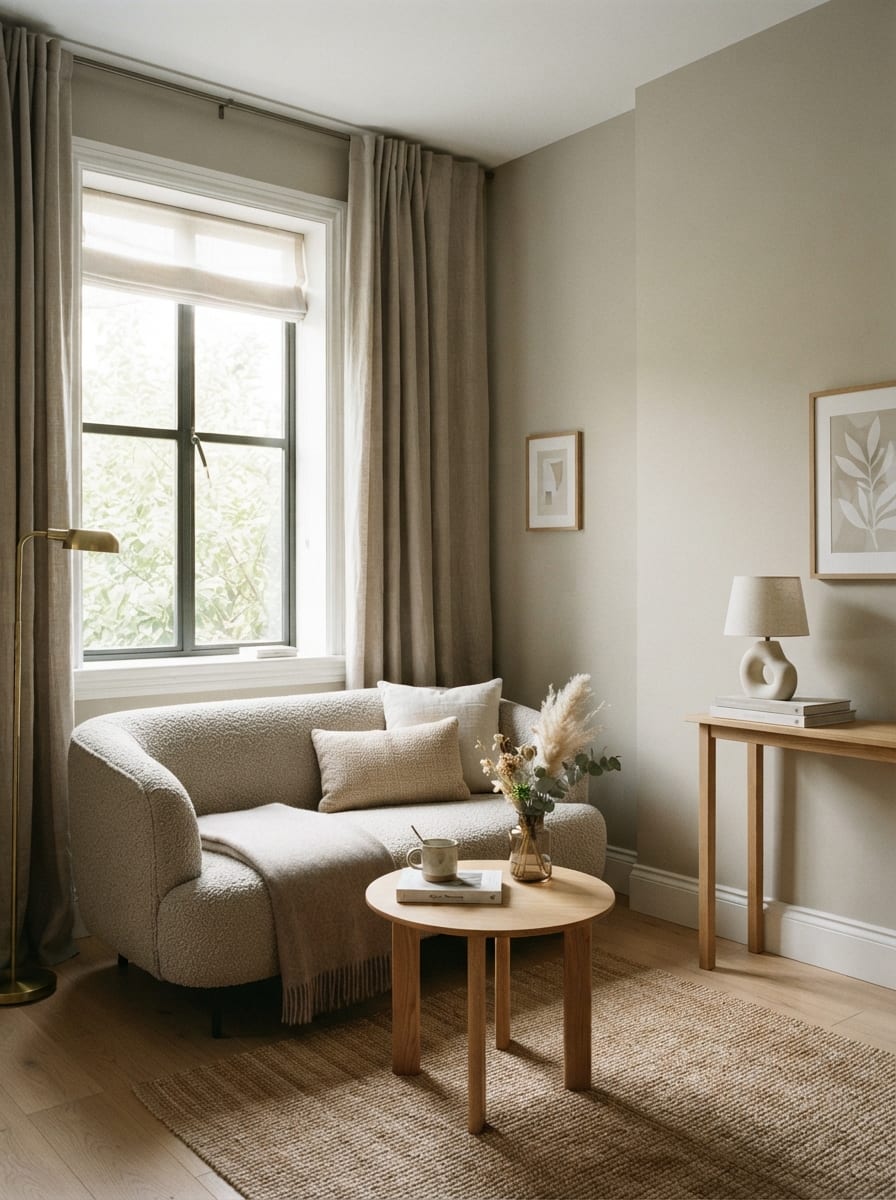
Contrast makes objects more noticeable.
That means a very dark curtain against a very light wall can make the window treatment feel like a large visual block.
If you want the room to feel calmer, choose curtains close to the wall color.
Examples
Warm white wall:
ivory or oatmeal curtain
Greige wall:
taupe or warm-gray curtain
Muted green wall:
soft sage curtain
Why it works
The curtain and wall read more like one continuous vertical surface.
That can reduce visual fragmentation.
Tonal does not mean identical
You can still use:
- texture
- weave
- subtle variation
to keep the room from feeling flat.
Use contrast intentionally
A dark curtain can still work beautifully.
The issue is not that dark curtains are “wrong.”
They simply carry more visual weight.
If your small living room already has:
- dark sofa
- dark rug
- dark cabinetry
another large dark surface may make the room feel heavier.
6. The Vertical-Line Curtain
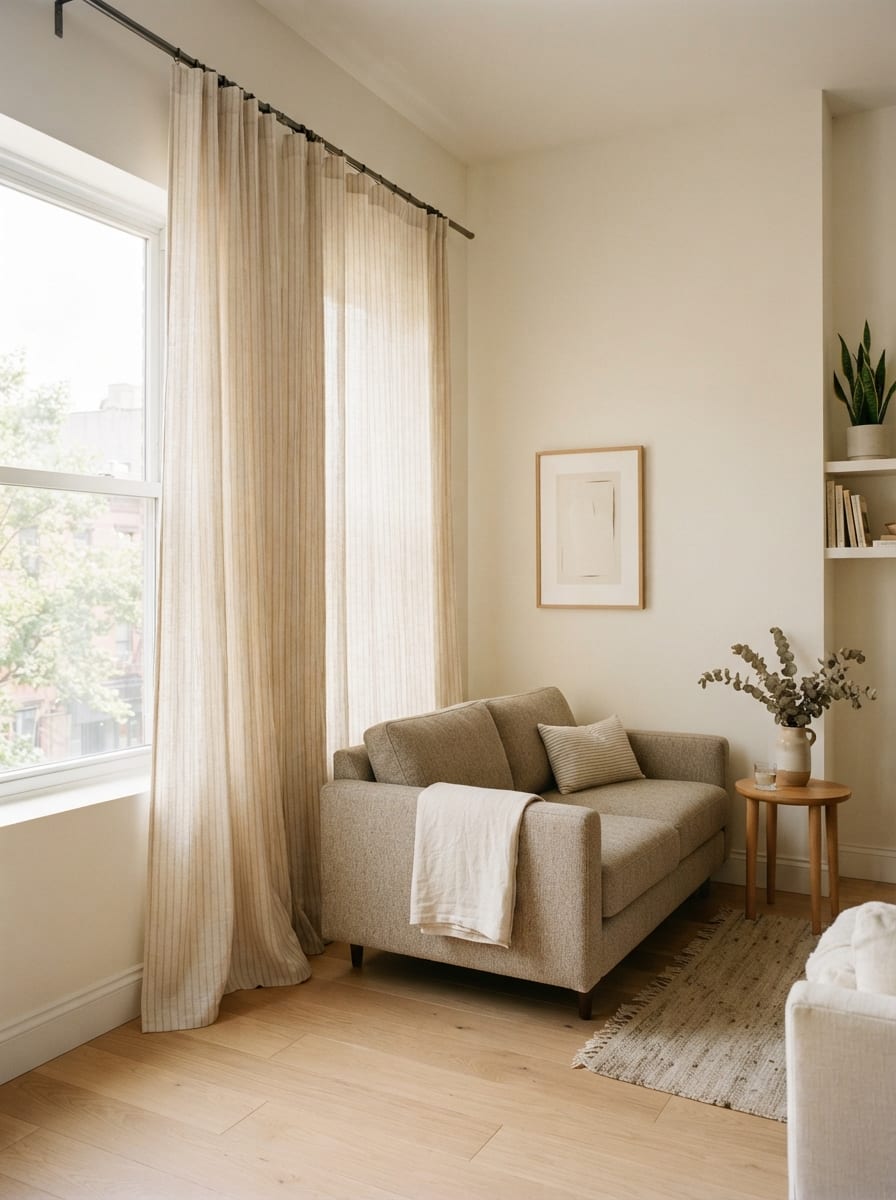
Pattern can help or hurt a small room depending on its direction and contrast.
A subtle vertical stripe can reinforce height.
Keep it restrained
Try:
- cream and beige
- warm white and soft gray
- muted sage and cream.
A narrow tonal stripe usually feels calmer than a bold high-contrast stripe.
Why vertical lines work
The repeated lines visually encourage the eye to move:
up and down
rather than:
side to side.
That supports the same height effect as long curtain panels.
Do not combine too many vertical features
If the room already has:
- strong striped wallpaper
- vertical wall paneling
- tall shelving
another stripe may be unnecessary.
One dominant vertical rhythm is often enough.
Check pattern alignment
Patterned curtains look more polished when the panels hang consistently and the repeat does not feel random.
7. The Corner-Window Curtain
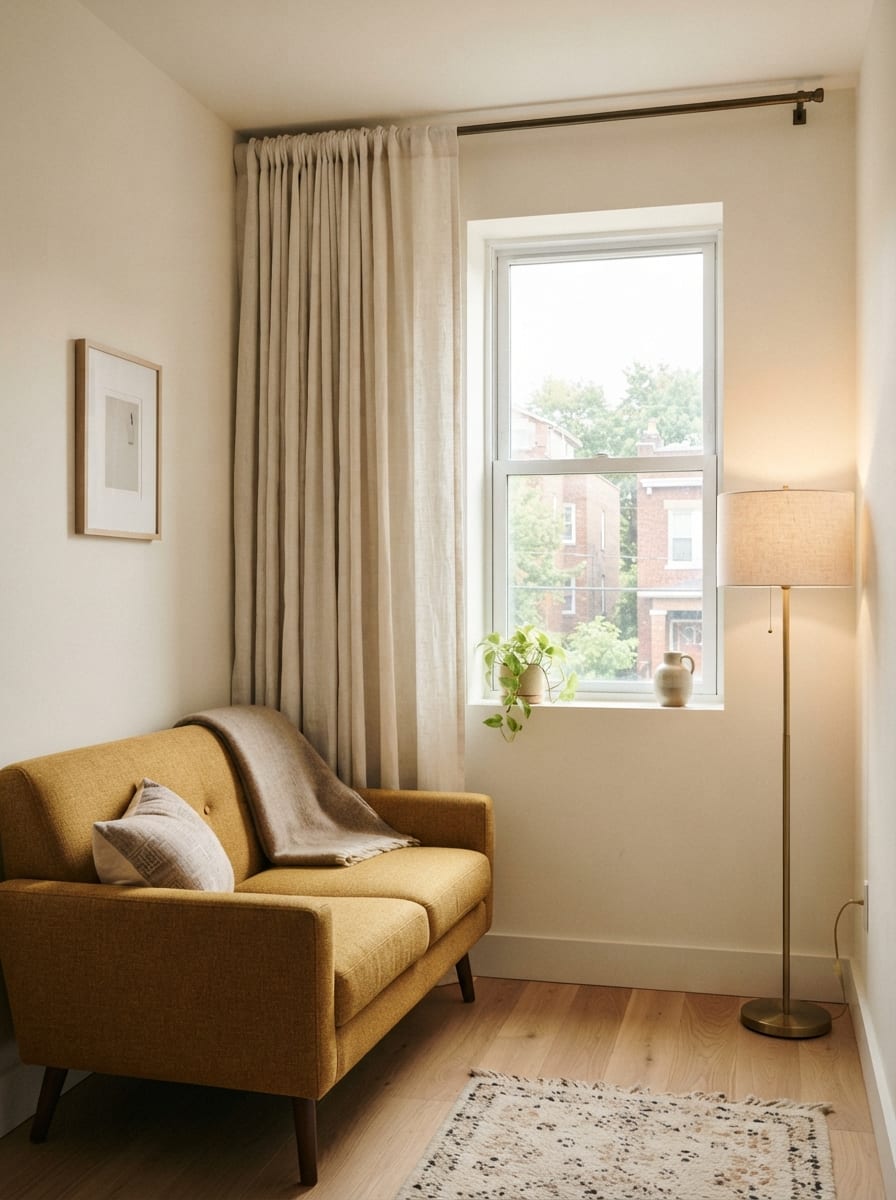
A window close to a room corner creates a tricky situation.
There may not be enough wall on one side for a large curtain stack.
Instead of forcing symmetry, work with the actual wall.
Consider an asymmetric stack
If one side has substantially more wall space, it may be practical for more of the curtain fabric to gather there.
That can protect the glass from being covered unnecessarily.
Do not block the corner circulation zone
A curtain stack can interfere with:
- a door
- floor lamp
- side table
- radiator
- sofa arm.
Look at the whole corner, not only the window.
Keep hardware visually light
In a tight corner, oversized finials and thick rods can look crowded.
Simpler hardware usually works better.
Avoid forcing equal panels if the room does not support them
Visual balance does not always require perfect symmetry.
8. The Curtain + Shade Layer
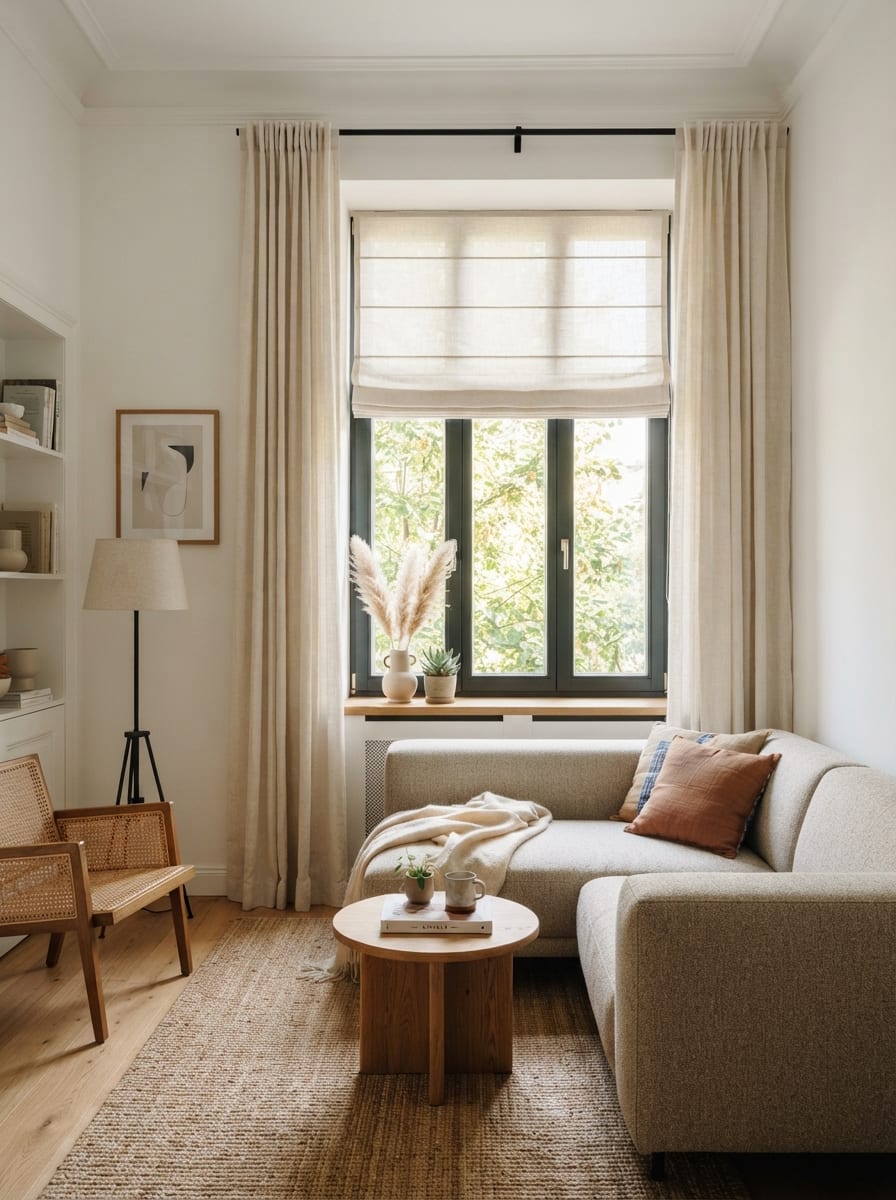
Curtains do not need to handle every window function by themselves.
Sometimes the best small-space setup is:
one slim shade for privacy/light control
plus:
curtains for softness and height.
Why it works
The shade can provide:
- glare control
- privacy
- flexible daylight adjustment
while the curtains can remain mostly open.
That keeps the window visually wider.
Keep the layers visually simple
Avoid combining:
- heavy blinds
- thick valance
- double curtain rods
- ornate curtains
unless the room genuinely supports that much visual weight.
Good combinations can include
- roller shade + curtains
- Roman shade + curtains
- woven shade + simple panels.
Choose based on:
- privacy needs
- light direction
- room style.
Do not obstruct window operation
Make sure the shade and curtain hardware allow the window to open properly.
9. The Narrow-Window Expansion Trick
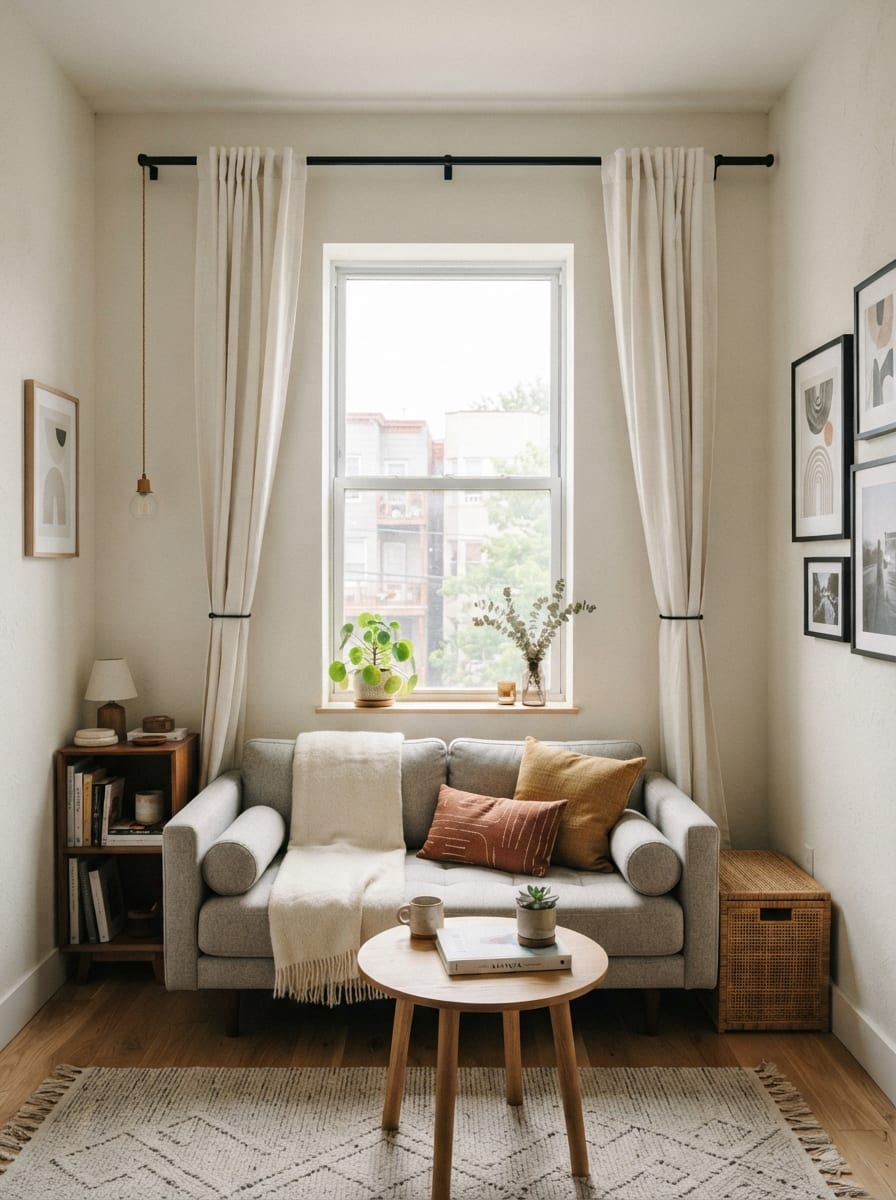
A narrow window can make a small living room feel even tighter if the curtain treatment emphasizes its exact width.
Instead, allow the curtain arrangement to create the impression of a broader opening.
Use the wall around the window
A rod that extends beyond the frame can visually widen the treatment.
When the curtains are closed, the viewer sees a larger fabric composition rather than the exact narrow glass width.
Keep the panels full enough
Extremely skimpy panels can expose the illusion immediately and may look unfinished when closed.
The goal is not to hide the window dimensions artificially.
It is to give the treatment better proportion.
Do not extend beyond what the wall can support
If a:
- doorway
- cabinet
- corner
- thermostat
interrupts the wall, work within those limits.
Keep the hardware continuous
One clean rod generally looks calmer than several fragmented pieces around a small opening.
10. The Height-Width-Light Curtain Formula
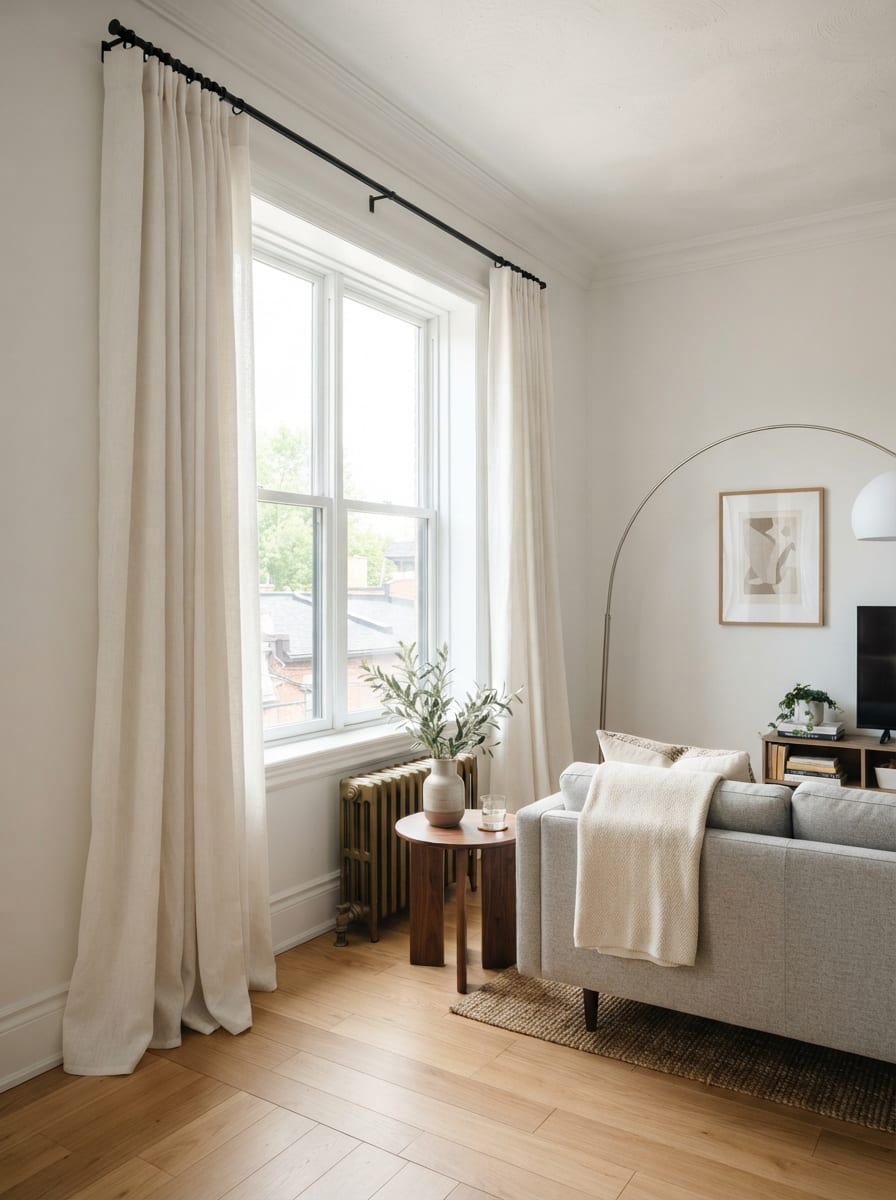
Instead of choosing curtains based only on:
- fabric
- color
use a three-part decision formula.
Step 1: Height
Ask:
Where can the rod sit so the treatment visually emphasizes the full wall height?
Then measure from there.
Step 2: Width
Ask:
Where will the curtains sit when they are open?
The rod needs enough wall width for the fabric to move away from the glass where possible.
Step 3: Light
Ask:
How much daylight can this room afford to lose?
A bright south-facing room may tolerate heavier curtains.
A shaded apartment living room may benefit from:
- lighter fabric
- sheers
- curtains that stack completely off the window.
Why this formula works
It stops you from choosing curtains as decoration first.
Instead, you solve:
proportion + movement + daylight
before deciding on aesthetic details.
Measure the Window Wall Before Buying Anything
Do not start with curtain color.
Start with the wall.
Measure:
- floor-to-ceiling height
- window width
- window height
- wall width on each side
- distance to nearby furniture
- nearby switches or vents.
You are not only measuring the window.
You are measuring the space the entire curtain system needs to occupy.
Measure for the Rod Position You Actually Want
If you plan to mount the rod higher than the window frame, measure from that location.
Do not rely on the window-frame height.
This avoids buying panels that become too short once the rod moves upward.
Check Both Sides of the Window
Many small living rooms are not symmetrical.
One side may have:
- a corner
- bookcase
- doorway
while the other has open wall.
That affects how far the rod can extend.
Think About the Curtain When It Is Open
This is one of the most overlooked measurements.
Closed curtains are easy to imagine.
But most living rooms spend much of the daytime with curtains open.
Ask:
Where does all that fabric go?
That is the stack-back problem.
Fabric Weight Changes Everything
A thick curtain occupies more space when gathered.
A lighter curtain creates a smaller stack.
So two curtains with the same width may behave very differently on the wall.
Small Living Rooms Need Daylight
Natural light is particularly valuable when a room has:
- limited floor area
- low ceilings
- dark furniture
- narrow windows.
Do not sacrifice half the window simply because the curtains are oversized or poorly placed.
Let the Glass Stay Visible During the Day
When possible, open curtains far enough that most of the actual window remains unobstructed.
That improves both:
- brightness
- perceived window width.
Sheer vs Blackout Curtains
These solve different problems.
Sheer curtains
Better for:
- daytime filtering
- softness
- partial privacy.
Blackout curtains
Better for:
- stronger light blocking
- media rooms
- privacy
- glare control.
A small living room does not automatically need one or the other.
Choose based on how the room is actually used.
Heavy Curtains Can Still Work
A compact room does not require thin white curtains.
Heavier curtains can be useful when you need:
- stronger privacy
- insulation
- sound softening
- glare control.
Just account for their larger visual and physical footprint.
Dark Curtains Are Not Automatically Wrong
A deep:
- navy
- olive
- charcoal
- chocolate
can look sophisticated in a small living room.
The issue is contrast and volume.
Dark curtains become a major visual element, so keep the rest of the room balanced.
Light Curtains Reflect More Daylight
Warm whites, pale neutrals and soft colors often help maintain a bright feeling around the window.
This can be useful in apartments with limited exposure.
White Does Not Have to Mean Stark White
Try:
- ivory
- cream
- oatmeal
- soft linen.
These often work better with warm interiors than a bright blue-white fabric.
Tonal Curtains Can Make the Wall Feel Broader
When curtains and walls sit within a similar color family, the eye is less likely to break the surface into separate blocks.
This can help a small room feel more continuous.
Contrast Can Frame a Window
If you want the window to become a focal point, stronger contrast may be appropriate.
For example:
warm white wall + olive curtains
can create a deliberate frame.
Just recognize that it will visually emphasize the curtain area.
Pattern Scale Matters
Curtains are large surfaces.
A print that looks subtle in a fabric sample may become much stronger across:
- two full panels
- nearly ceiling-height fabric.
Always consider the pattern at room scale.
Small Pattern
Can add detail but may look busy when viewed from across the room.
Large Pattern
Can feel graphic and bold but may dominate a narrow wall.
Tonal Pattern
Often provides the safest middle ground when you want interest without visual noise.
Vertical Stripe
Useful when you want to reinforce height.
Horizontal Stripe
Emphasizes width.
That can work in some rooms, but a strong horizontal line may also make a low room feel flatter.
Curtains Behind a Sofa
This is common in small living rooms.
Make sure the sofa does not:
- crush the curtain
- prevent panels from moving
- force fabric against a heater.
Leave enough practical clearance for the material to hang properly.
Curtains Beside a Sofa
Check whether the fabric falls behind:
- sofa arm
- side table
- floor lamp.
Curtains should be able to open and close without dragging objects around.
Curtains Behind a TV
Usually avoid placing the television directly where curtain movement or glare becomes a problem.
If a TV sits close to a window, consider:
- adjustable shade
- controlled curtain stack
- careful screen angle.
Curtains Near a Radiator
Do not let fabric interfere with:
- airflow
- heating equipment
- safety clearances.
Follow the equipment manufacturer’s guidance.
Curtains Near Floor Vents
Long curtains can block airflow from floor registers.
Adjust the layout or treatment accordingly.
Curtains Near Baseboard Heaters
Again, follow heater-specific clearance guidance.
Do not let fabric rest against hot surfaces.
Curtains Over Sliding Doors
A sliding balcony or patio door needs a different movement pattern from a standard window.
Choose a setup that lets panels move fully away from the doorway.
Do not create a fabric pile where people walk through.
Curtains for a Window Beside a Balcony Door
You may need to treat the two openings as one composition if they are close together.
This can sometimes make the wall feel calmer than using separate tiny curtain treatments.
Curtains for Corner Windows
Avoid forcing perfectly symmetrical fabric where the architecture is not symmetrical.
Work with the available stack space.
Curtains for a Narrow Living Room
The biggest risk is losing side-to-side circulation.
Keep:
- curtain stacks
- furniture
- lamps
from building too much bulk along the same wall.
Curtains for a Low-Ceiling Living Room
Prioritize:
- higher placement
- long vertical panels
- simple header style
- restrained pattern.
Avoid a thick horizontal top treatment.
Curtains for a Tall, Narrow Window
You may not need to exaggerate height further.
Focus more on adding visual width and letting the panels stack away from the glass.
Curtains for a Wide, Short Window
Higher rod placement and floor-length panels can help visually rebalance the proportions.
Curtains for a Tiny Window
Do not automatically use tiny curtains.
The surrounding wall can become part of the composition.
One Window vs Multiple Windows
If two windows sit close together, sometimes treating them as one larger visual group creates a calmer result.
But this depends on the wall architecture and furniture arrangement.
Curtain Headers Affect Visual Weight
Different curtain styles create different top profiles.
A simple:
- ring
- grommet
- pleat
- hidden tab
can all work.
Choose based on:
- style
- movement
- stack size
- rod visibility.
Very Bulky Headers Can Make the Top Feel Heavy
If the room has a low ceiling, avoid an unnecessarily large fabric mass near the top of the wall.
Curtain Rings Can Add a Little Length
Remember that hardware changes where the fabric begins.
Include:
- rod
- rings
- clips
when measuring.
Curtain Rod Color
The rod does not need to disappear.
But it should work with other metal finishes in the room.
Possible directions:
- black
- brass
- brushed nickel
- white.
Keep Finials Controlled
Large ornate finials can consume precious side space on a narrow wall.
A simple end cap may work better.
Double Rods Add Depth
A double curtain setup projects farther from the wall.
Make sure it does not interfere with:
- furniture
- corners
- doors.
Renter-Friendly Curtain Options
Renters need to consider both:
- visual goals
- installation restrictions.
Check the lease before drilling.
Possible alternatives may include:
- tension systems in suitable openings
- existing curtain hardware
- removable solutions specifically rated for the required load.
Do not assume every adhesive hook can safely hold a curtain rod.
Curtains Are Heavier Than They Look
Curtain weight includes:
- rod
- brackets
- panels
- rings
- movement force.
Use hardware appropriate for the wall and load.
Do Not Use Unrated Adhesive Hardware for Heavy Curtains
Always follow the hardware manufacturer’s load and installation guidance.
Roman Shades Can Help Renters Simplify the Window
If curtains are impractical, a simple shade may give:
- privacy
- light control
without a large fabric stack.
Curtains + Blinds
Existing blinds do not automatically need to be removed.
Curtains can soften them visually while the blinds handle privacy.
Curtains + Roller Shade
This is one of the cleanest combinations for small living rooms.
The shade controls light.
The curtains create height and softness.
Curtains + Woven Shade
This adds more texture.
Keep the curtain itself simpler if the shade already has strong visual detail.
Avoid Too Many Window Layers
Small rooms can quickly become overworked when the window has:
- blind
- shade
- sheer
- curtain
- valance.
Use only the layers that solve an actual need.
How to Make Curtains Feel Less Bulky
Try:
- tonal fabric
- lighter weave
- simpler header
- enough rod width for stack-back
- clean floor length
- minimal hardware.
Do Not Overfill the Window Wall
If the curtains already make a strong statement, you may not need:
- large artwork
- wall shelves
- tall plants
immediately beside them.
Curtains Can Replace Some Wall Decor
A well-scaled curtain treatment already adds:
- color
- texture
- vertical movement.
You do not need to decorate every remaining inch of wall.
Common Small Living Room Curtain Mistakes
Hanging the rod directly on top of the window
This can visually emphasize the window’s limited height.
Making the rod exactly the width of the window
The panels may cover too much glass when open.
Buying panels before measuring rod placement
The final curtains may end up too short.
Using overly heavy fabric in a dark room
The window wall can become visually dense.
Choosing curtains that stop awkwardly above the floor
This can break the vertical line.
Letting curtains block radiators or vents
Function and safety come before styling.
Ignoring stack-back
The curtains open, but half the window remains covered.
Using too many layers
The window becomes the heaviest part of the room.
Choosing a huge pattern without seeing it at room scale
The fabric can overwhelm the wall.
Treating every small window with tiny curtains
Sometimes using more of the surrounding wall creates better proportions.
Quick Curtain Decision Guide
Choose High-Mounted Curtains if:
You want the room to feel taller.
Choose a Wider Rod if:
The curtains are blocking too much glass when open.
Choose Floor-Length Panels if:
You want one continuous vertical line.
Choose Sheers if:
Daytime brightness is more important than complete light blocking.
Choose Tonal Curtains if:
You want the window treatment to visually recede.
Choose Vertical Stripes if:
You want subtle extra emphasis on height.
Choose an Asymmetric Stack if:
The window sits close to a corner.
Choose Curtains + Shade if:
You need privacy and flexible light control.
Extend Beyond a Narrow Window if:
You want the treatment to feel wider than the glass alone.
The Small Living Room Curtain Formula
Before choosing the fabric, solve these three questions:
HEIGHT:
Where should the curtain begin so the wall feels taller?
WIDTH:
Where will the fabric sit when the curtains are open?
LIGHT:
How much daylight can this room afford to lose?
Then choose:
- color
- texture
- pattern
- hardware.
That order usually leads to a better result than choosing a pretty curtain first and forcing it into the room afterward.
Frequently Asked Questions
Should curtains touch the floor in a small living room?
Full-length curtains often create a stronger vertical line, but the exact finish should account for:
- cleaning
- floor level
- heating
- traffic.
Excessive pooling is usually unnecessary in a heavily used small room.
Should curtains be wider than the window?
Often, yes, if there is enough wall space.
Extra width can allow the panels to stack beside the glass when open.
Do dark curtains make a small living room look smaller?
Not automatically.
Dark curtains add more visual weight and contrast, so the overall room palette and daylight level matter.
What curtain colors make a living room feel bigger?
Curtains close to the wall color can create a more continuous visual surface.
Light neutrals can also help maintain brightness.
Are sheer curtains good for apartments?
They can be excellent for daytime light filtering, but they may not provide enough privacy at night.
Should I hang curtains close to the ceiling?
Higher placement can help emphasize room height, but leave appropriate space for:
- molding
- hardware
- installation.
What if my sofa sits under the window?
Make sure the sofa does not stop the fabric from hanging or moving properly.
A shade may also be useful if floor-length curtains are impractical there.
Can I use curtains in a rental without drilling?
Possibly, depending on the window and curtain weight.
Use only installation methods rated for the load and allowed under the lease.
Final Thoughts
In a small living room, curtains are not just decoration around a window.
They influence how you perceive the entire wall.
A poorly placed curtain can make the window feel:
- shorter
- narrower
- darker.
A better setup uses the room itself.
Raise the visual starting point when possible.
Give the curtains enough width to move away from the glass.
Use full vertical lines.
Protect daylight.
And choose fabric weight according to how much space the room can visually carry.
The best small-living-room curtain setup is not simply the prettiest fabric.
It is the one that makes the window feel larger, the wall feel taller, and the room stay bright enough to live in.