How to Make a Rental Feel Like Home: 10 Renter-Safe Ideas
How to make an apartment feel like home without drilling or permanent changes: layered lighting, textiles, scent, personal photos, daily rituals, and renter-safe personalization that protects your deposit.
In This Guide
A rental feels like home when it carries your habits, your colors, and your people, not when it looks like a showroom. The blank walls and beige carpet are not the problem; the problem is a space that has not yet learned your routines. Every idea below works without drilling, painting, or any permanent change, so your deposit stays safe and everything you buy moves with you to the next place.
The trick is layering small, personal changes instead of chasing one big renovation. Warm light beats a new sofa. A rug underfoot beats a repainted wall. A scent you chose, a photo wall built with adhesive strips, and a morning ritual in the same corner every day do more for the feeling of home than any single purchase. Work through these 10 ideas in order, or pick the three that match your biggest complaint about your place, and give each one a week to settle before judging it. If you want project ideas to go with the warmth, DIY room decor for small apartments covers builds that leave no holes.
1. Layer Your Lighting Until the Overhead Light Stays Off
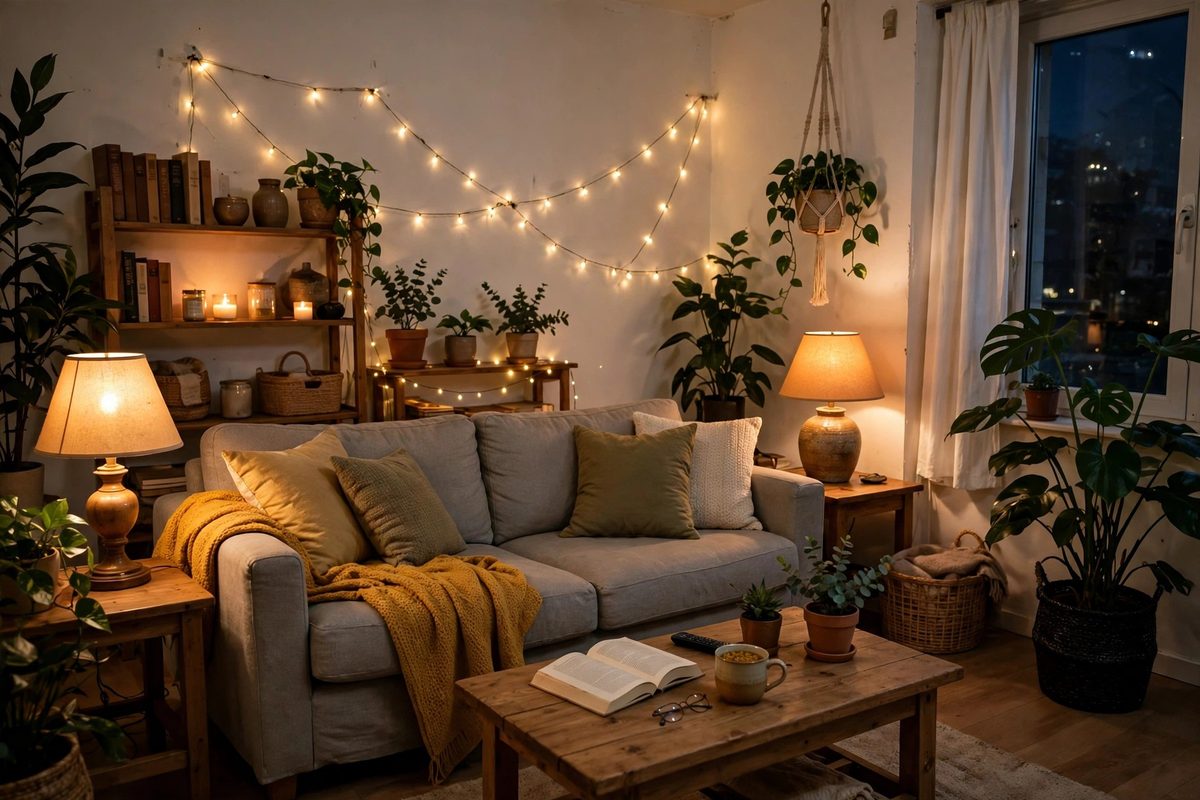
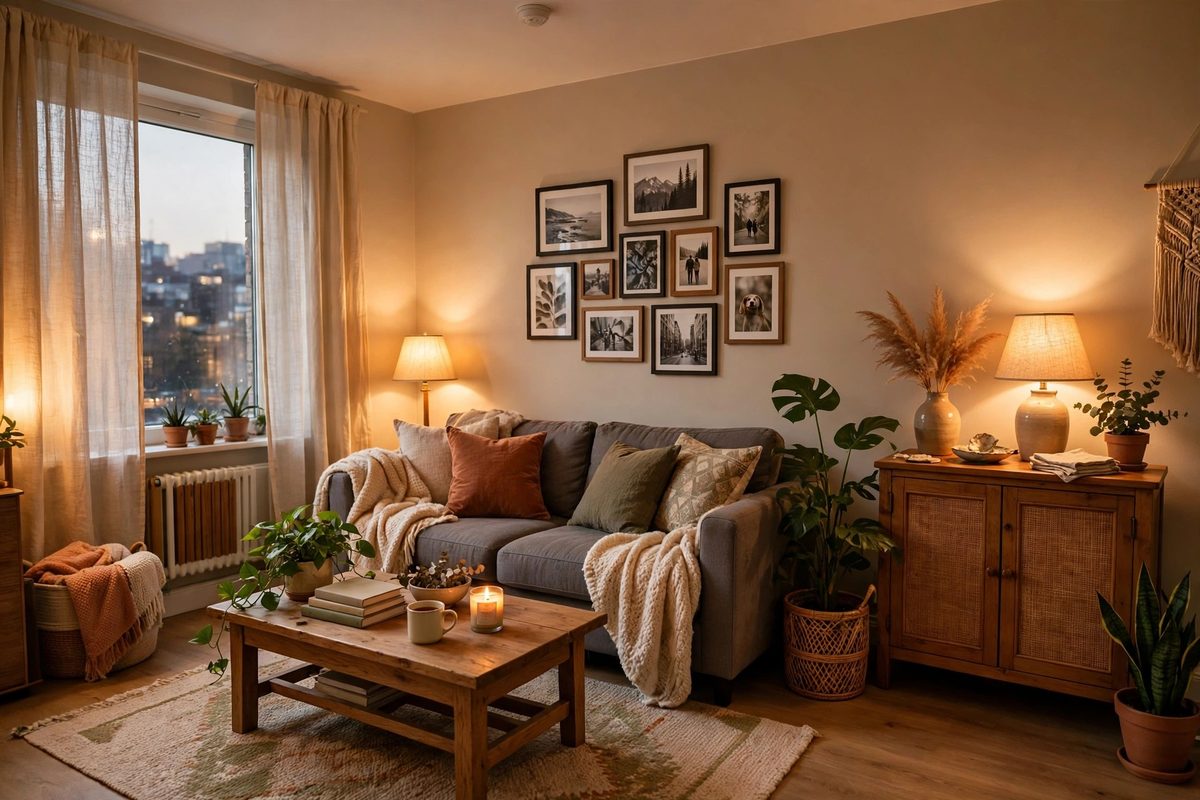
Nothing makes a rental feel temporary faster than a single overhead light. Bare ceiling fixtures cast flat, cold light that flattens every room and reminds you the place came furnished by a landlord, not by you. Layering fixes it: a floor lamp in a corner, a table lamp beside the sofa, and a warm string light along a shelf create pools of light at different heights, and the room suddenly feels lived in. Aim for three light sources per main room, all in warm white, 2700K, which reads cozy rather than clinical.
Budget lamps do this job well. A basic floor lamp runs $25 to $45, a pair of table lamps runs $30 to $60, and a battery-operated string light costs $8 to $15 with no outlet hunting. Put the brightest lamp where you read or work, the softest light where you relax, and a small lamp in the hallway so you never walk into a dark flat. Use smart plugs, $10 to $15 each, to switch lamps on together at sunset, so you come home to a lit apartment instead of fumbling for switches. The goal is simple: if your overhead light stays off most evenings, the lighting is working.
2. Soften Every Hard Surface With Textiles
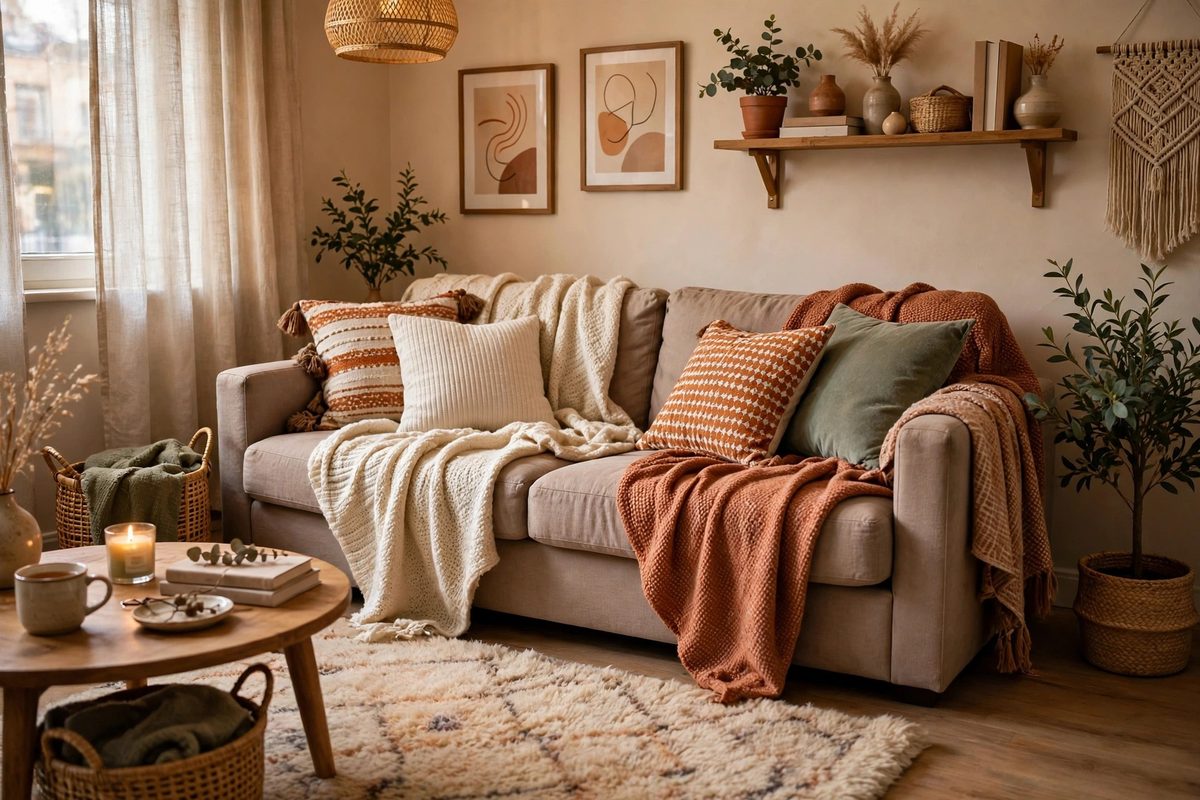
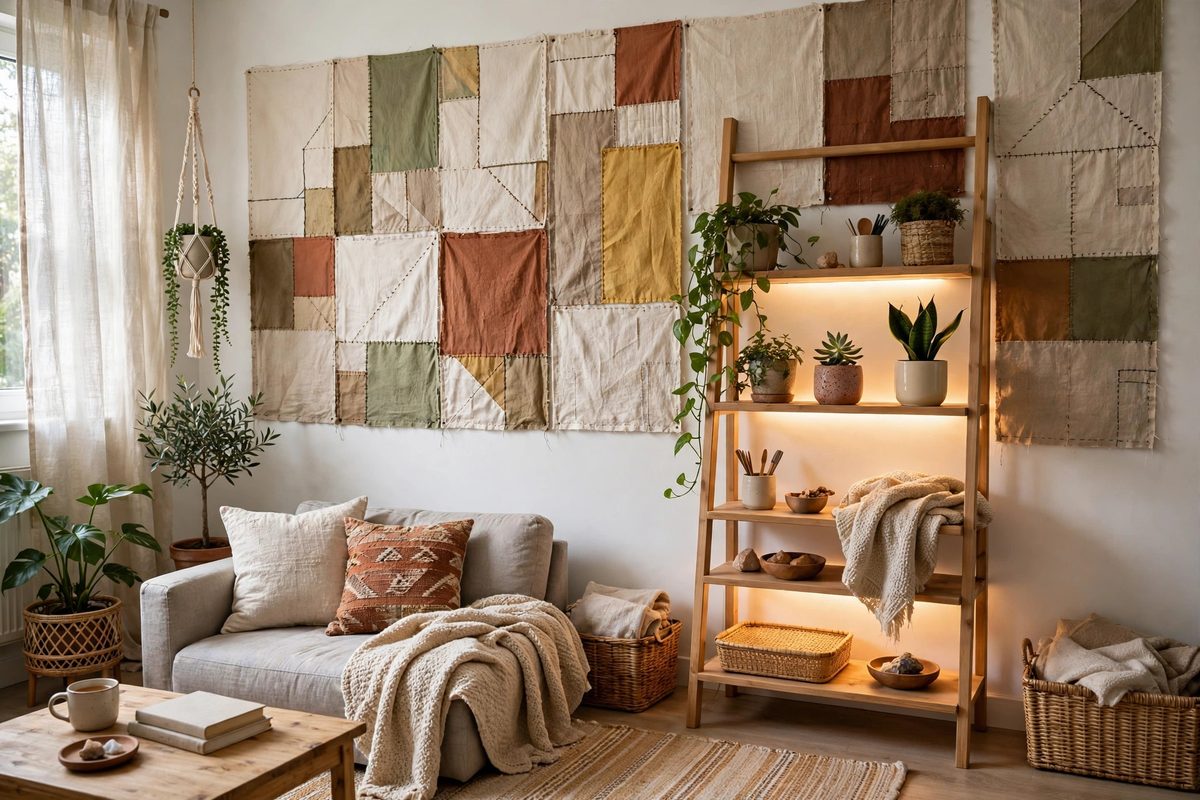
Rental floors and furniture tend toward the hard and the wipeable: laminate, tile, beige carpet, and a sofa you did not choose. Textiles are the fastest softening agent. A rug defines a seating area and warms bare feet, throws invite you to actually sit down, and cushions in your colors turn a landlord’s sofa into your sofa. Start with the surfaces your body touches daily: the floor beside your bed, the sofa you sit on every evening, and your bedding.
Real numbers help here. A 5 by 7 foot living room rug runs $60 to $120, a quality throw runs $20 to $40, and two cushion covers in a color you love cost $15 to $30. Choose washable fabrics, since rental life means spills, pets, and no dry-cleaning budget for a throw. Layer rather than match: a chunky knit throw over a smooth cotton one, a patterned cushion beside a plain one, reads collected over time instead of bought in one afternoon. Swap throws seasonally, heavier knits in winter, light linen in summer, and the same room feels refreshed twice a year for the price of one new throw.
3. Give Your Home a Signature Scent
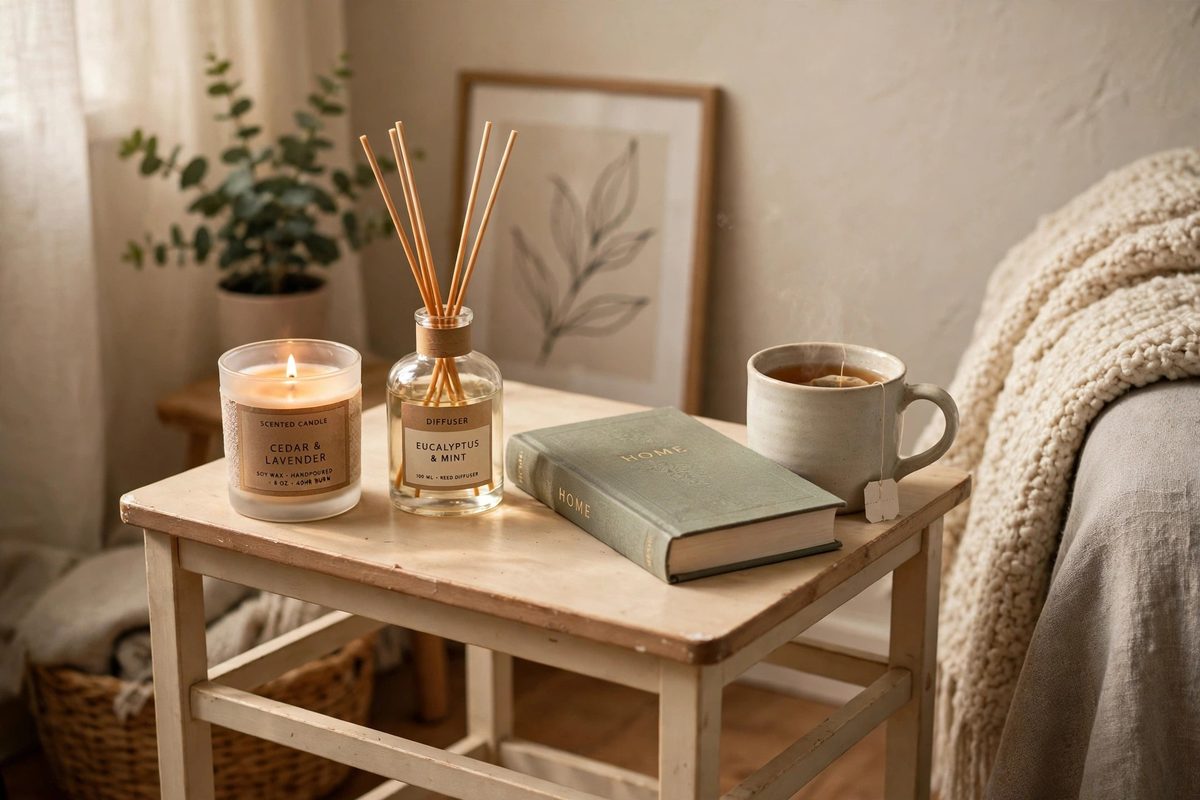
Scent is the sense most tied to memory, which is why a familiar smell can make a new flat feel like yours within days. Pick one signature scent for your home and use it consistently: a candle in the living room, a diffuser in the bedroom, and the same hand soap in the bathroom all carrying the same family, cedar, vanilla, citrus, or whatever smells like home to you. Your brain links that scent to your space fast, and walking in after a long day starts to feel like arriving rather than entering.
Keep it simple and safe. One candle, $12 to $25, burned for an hour in the evening beats five competing scents fighting across rooms. Never leave a candle burning unattended, and skip open flames entirely if your lease restricts them: reed diffusers, $10 to $20, and wax warmers, $15 to $30, give steady scent with no flame. In a small apartment, one scent source per room is plenty; two in one room turns cozy into a candle shop. Change your signature scent with the seasons if you like, but keep one anchor scent year-round so the place always smells like you.
4. Display Photos and Objects That Tell Your Story
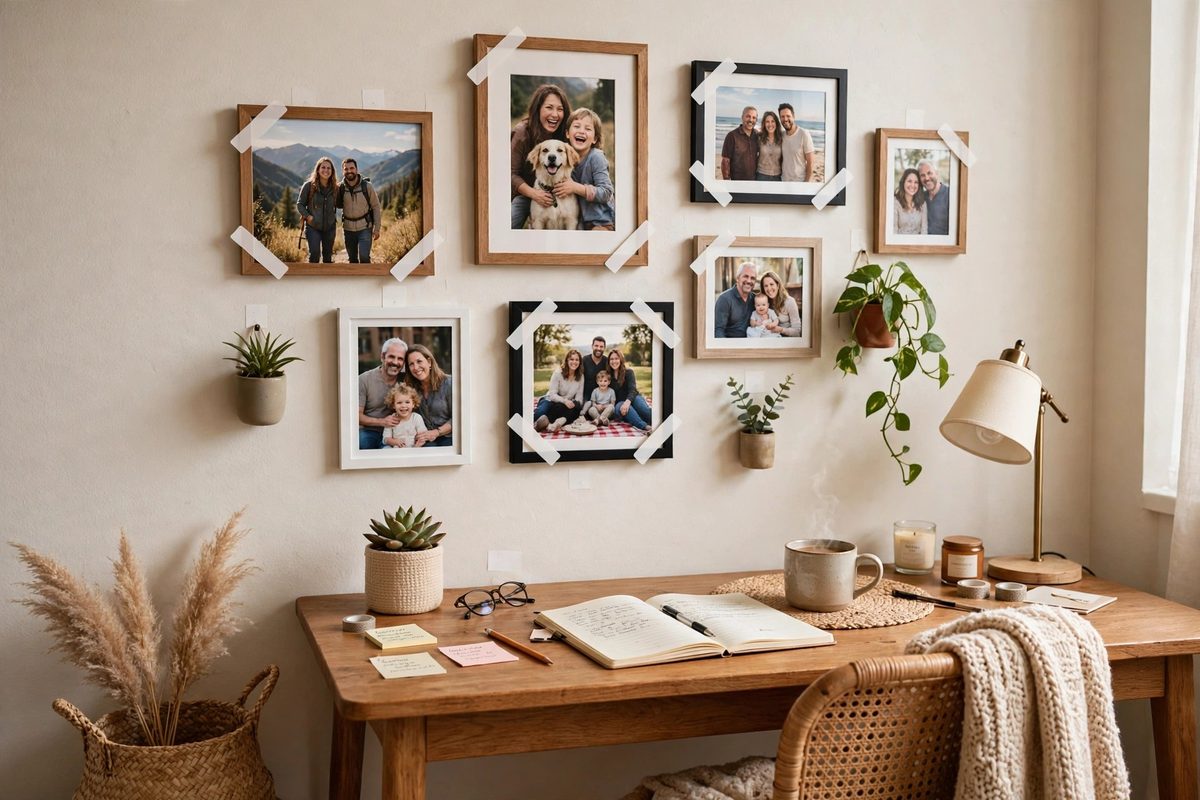
A home without a single personal object is just a room, and photos are the quickest fix. Print 10 to 20 favorite photos, frame the best six in matching or mixed frames, and hang them with adhesive strips rated for the frame weight, usually 3 to 12 pounds per pair of strips. A gallery wall above a desk or sofa, or a single row along a hallway, tells visitors who lives here within seconds, and it reminds you every day too. Print costs are small: 4 by 6 inch prints run about $0.30 to $0.50 each at a drugstore kiosk, and simple frames run $5 to $12 each.
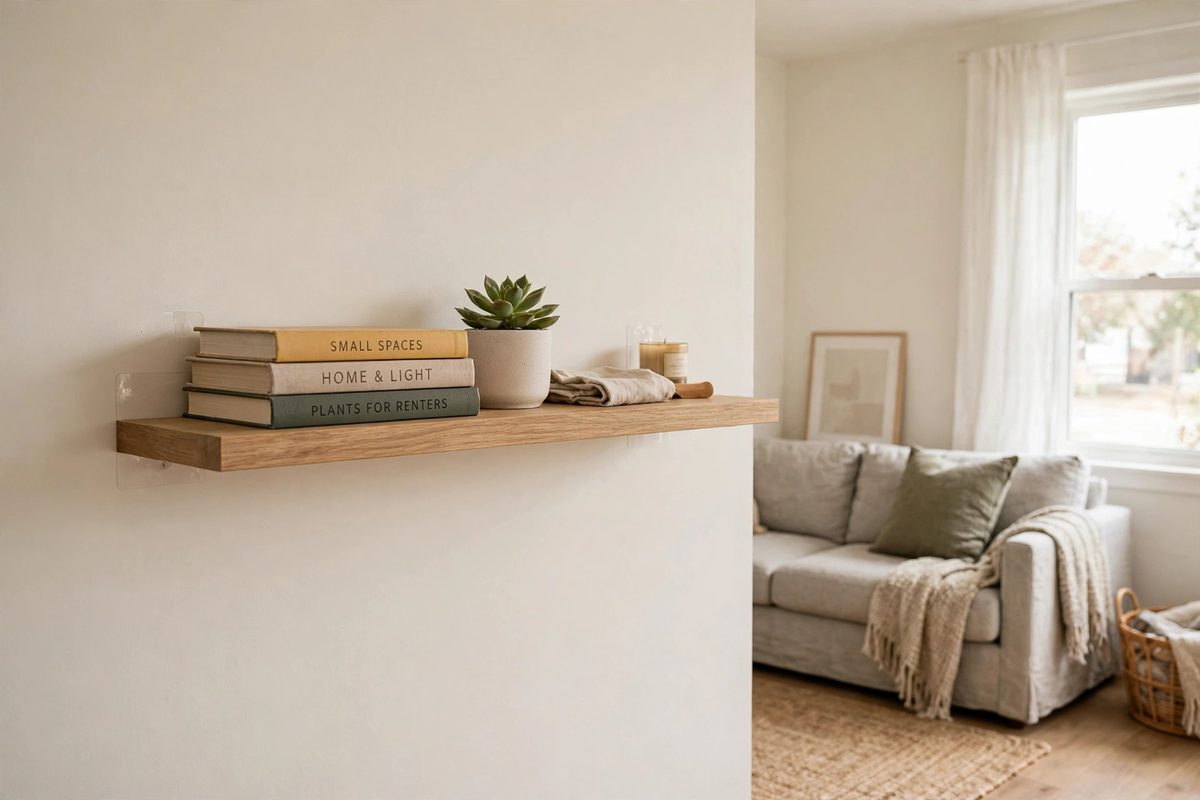
Objects matter as much as photos. A souvenir mug on open shelving, a book collection arranged by color or memory, a handmade bowl from a trip, these are the things no landlord supplied and no previous tenant left behind. Group objects in odd numbers, three or five per shelf, and give each group breathing room instead of lining every surface edge to edge. If wall hanging feels daunting, lean large frames against the wall on a dresser or shelf: it looks deliberate, it needs no strips at all, and it moves in one lift. For shelves that hold these displays without drilling, see no-drill shelves for renters.
5. Build Daily Rituals Into the Same Corners
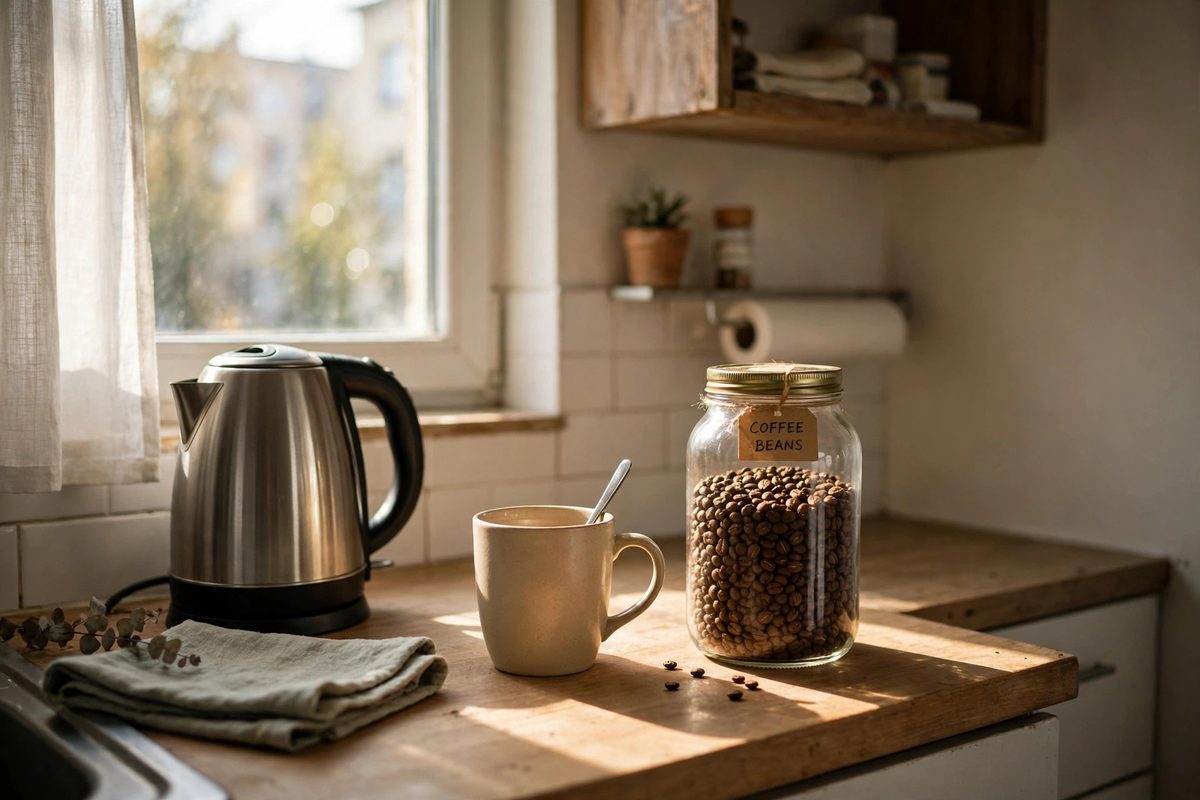
A place becomes home through repetition, not decoration. The corner where you drink coffee every morning, the chair where you read for 20 minutes before bed, the spot by the window where you water plants on Sundays: these rituals attach memories to rooms faster than any purchase. Pick one ritual for the morning and one for the evening, and give each a fixed place. A coffee station on one kitchen counter section, mug hooks on adhesive strips, a kettle, and your favorite beans in a jar, turns a generic kitchen into your kitchen in a week.
Evening rituals matter more, because evenings are when a rental can feel loneliest. A wind-down routine in the same chair, lamp on, phone charging across the room, a book or a show for 30 minutes, teaches your brain that this chair means rest. Keep the ritual small enough to do daily: a 5 minute tidy of one surface, a cup of tea at the window, a short walk around the block before locking up. After two weeks of the same ritual in the same corner, that corner stops feeling rented. It feels like the place where your day starts and ends, which is the definition of home.
6. Personalize Without Drilling a Single Hole
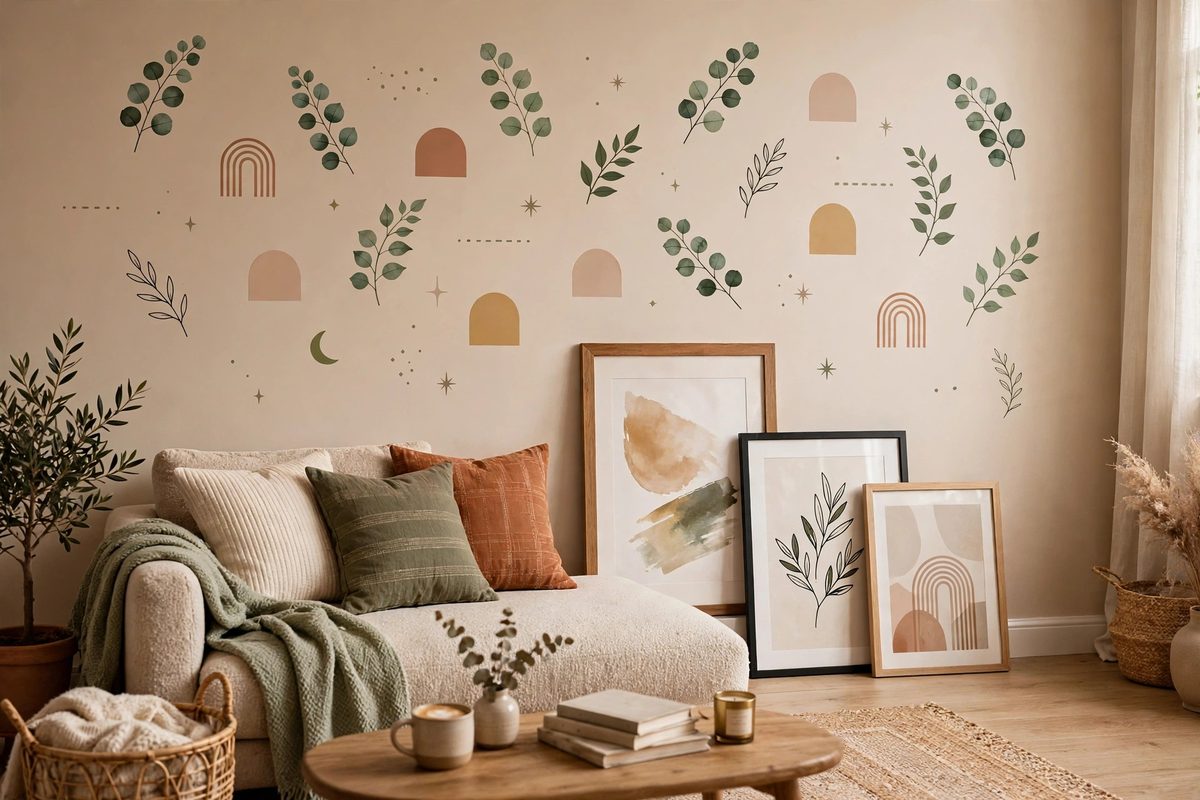
Personalization does not require permission slips or power tools. Adhesive strips hold frames up to 12 pounds per pair, washi tape creates graphic wall patterns that peel off clean, peel-and-stick decals add color to a blank wall, and tension rods hang curtains without a single bracket. A renter-safe gallery wall, a washi tape frame around a mirror, or a decal arch behind a desk can change a room’s character in an afternoon, and all of it comes down at move-out with a hair dryer and a slow peel.
Start with the wall you see first when you walk in, since that wall sets the tone for the whole flat. One bold move there beats five timid ones scattered around: a large leaning mirror, a decal mural, or a cluster of framed prints. Keep a small kit for move-out day: a hair dryer, dental floss for slicing stubborn adhesive, rubbing alcohol, and a damp cloth, and removal takes under an hour for a whole flat. If you want the full method for hanging things without studs or drills, how to hang shelves without drilling or studs covers weight limits and wall types in detail, and renter-friendly accent walls with glue, no screws covers bigger wall projects that still leave no holes.
7. Bring in Plants, Even If You Swear You Kill Them
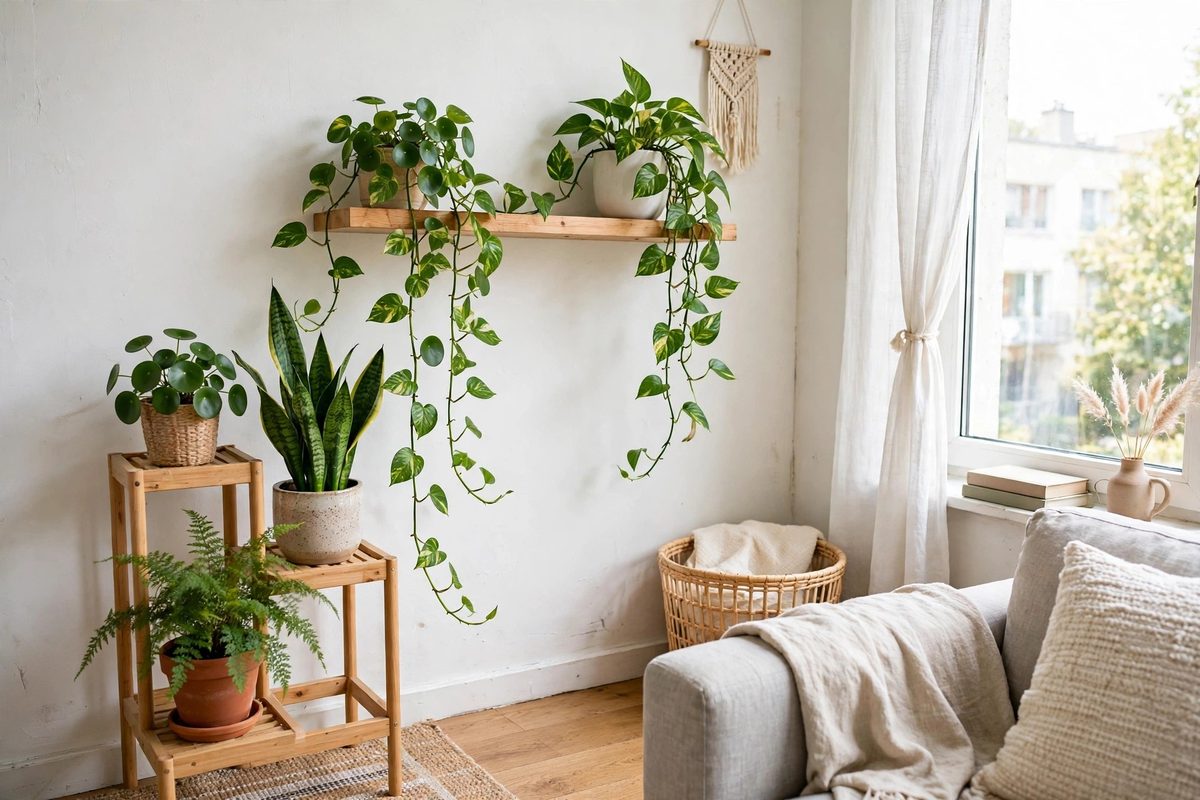
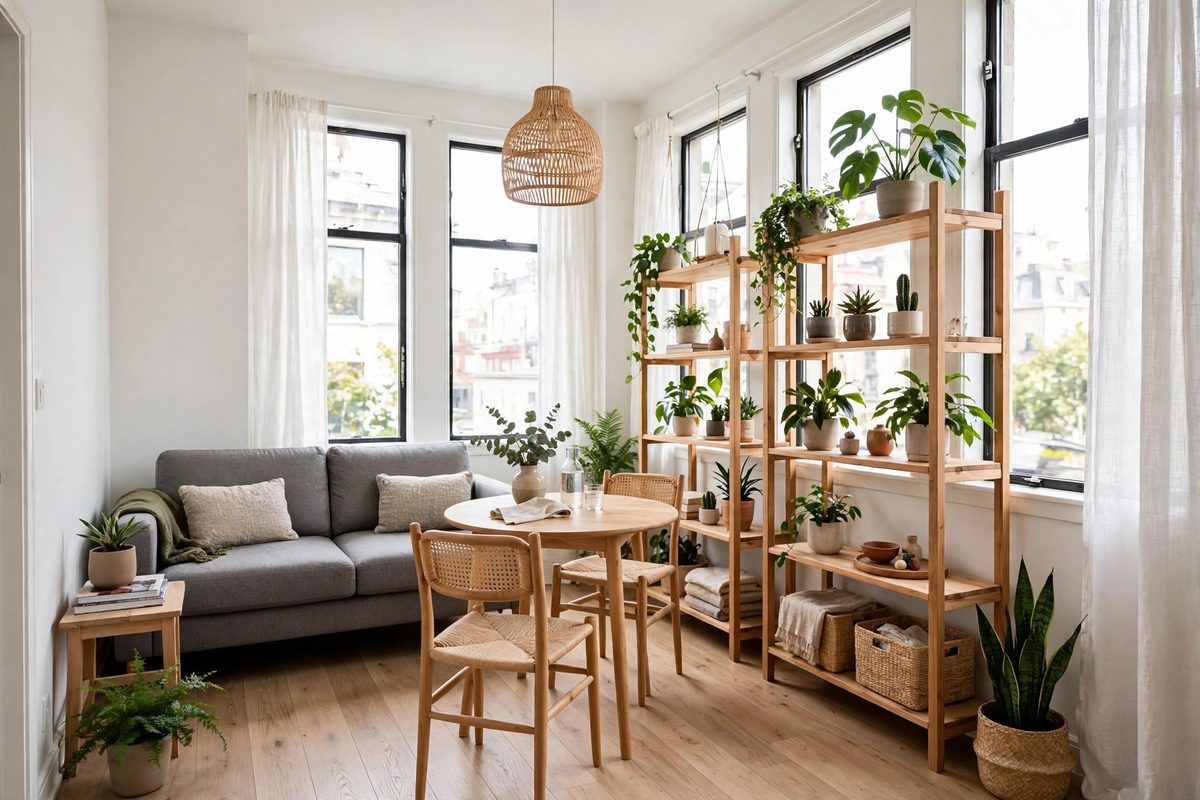
Plants make a rental feel alive in a way no object can, because they change daily: new leaves, longer trails, a pot that needs turning toward the light. They also soften the hard edges of rental architecture, filling empty corners and trailing from shelves in a way that looks organic rather than staged. Start with three nearly unkillable plants: a pothos, $8 to $15, a snake plant, $12 to $25, and a ZZ plant, $15 to $30. All three tolerate low light and irregular watering, which covers most rental windowsills and most busy schedules.
Placement beats quantity. One trailing pothos on a high shelf, one snake plant in a floor pot by the door, and one small plant on the kitchen counter give every room a living accent without turning your flat into a greenhouse. Water on a fixed day, Sundays work for most people, and check soil with a finger first: dry an inch down means water, damp means wait. If real plants truly stress you out, one or two high-quality faux plants in spots you touch rarely, high shelves and bathroom tops, still add the visual softness, but keep them out of arm’s reach where the fakeness gives itself away.
8. Create an Entryway That Greets You
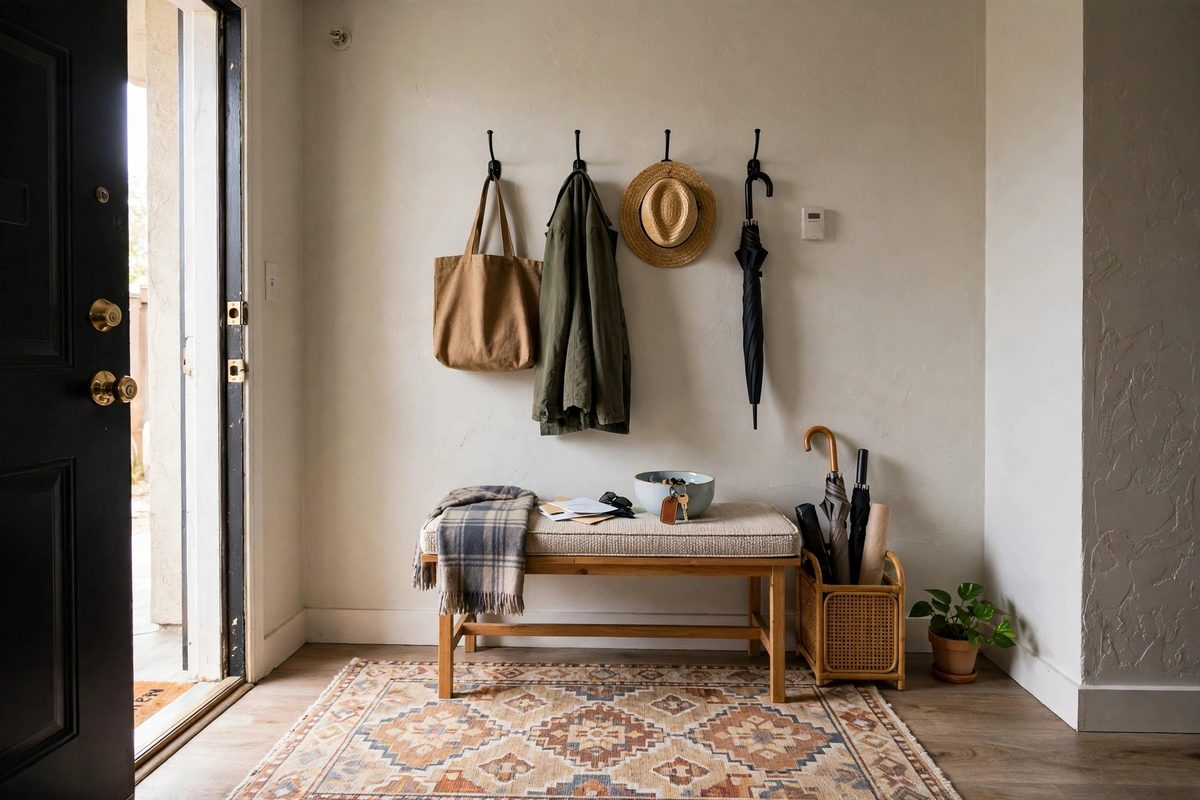
Most rentals have no entryway at all, just a door that opens straight into a living room. Claiming even a 3 foot zone by the door changes how arriving home feels: a small bench or stool, a row of adhesive hooks for keys and a bag, a tray for shoes, and a rug that marks the boundary. The whole zone costs $40 to $90 if you shop simply: a bench or stool $25 to $50, adhesive hooks $8 to $12, a small rug $15 to $30. It also keeps clutter from migrating across the flat, since keys, bags, and shoes now have a home of their own.
Make the entryway personal, not just functional. A framed photo at eye level beside the door, a small plant on the bench, a scent diffuser nearby, and the first thing you see when you walk in is yours, not the landlord’s hallway paint. Keep the zone tight: if coats and bags overflow it, the entryway becomes a dumping ground instead of a welcome. One hook per person, one basket for mail, and a weekly 2 minute reset on Sundays keep it working. A defined entry also helps guests, who instantly know where to put their shoes instead of hovering awkwardly in your living room.
9. Warm Up the Kitchen and Bathroom First
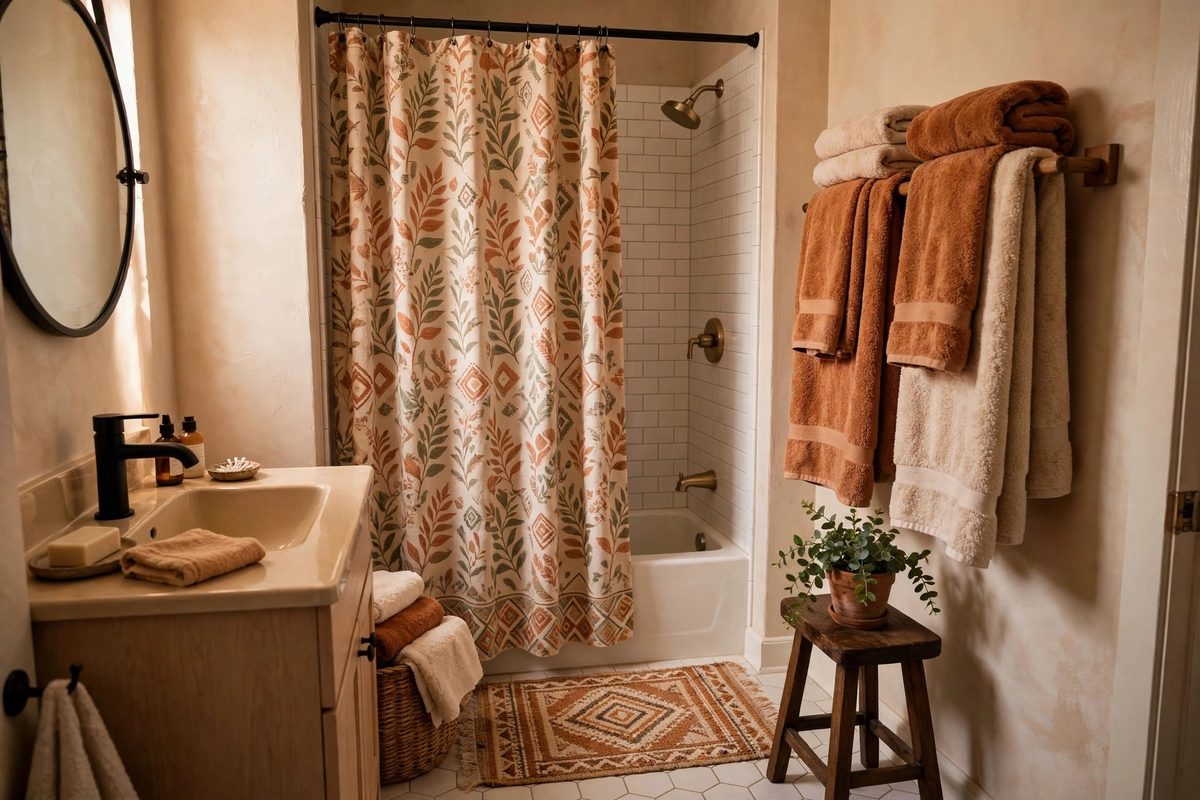
Kitchens and bathrooms are where rentals feel most institutional, all tile, chrome, and landlord-grade fixtures, so warming these two rooms pays off disproportionately. In the kitchen, a rug runner by the sink, $20 to $40, a set of matching dish towels in your color, $12 to $20, and one open shelf or countertop tray for oils and spices you actually use make the room feel cooked-in rather than issued. In the bathroom, thick towels in a color you chose, $25 to $45 for a set of four, a shower curtain with a pattern you like, $15 to $30, and a small wooden stool or bath mat, $15 to $25, do the same job.
These rooms reward small, washable upgrades because they get daily use and daily mess. Swap the shower curtain and towels together for a coordinated look, and keep a candle or diffuser in the bathroom if your lease allows it, so the smallest room in the flat smells like yours too. A plant that loves humidity, like a pothos or a fern, $8 to $18, thrives on a bathroom stool and softens all that tile. Skip anything that needs drilling or plumbing changes: suction shelves and adhesive hooks hold toiletries fine, and a freestanding stool beats a screwed-in shelf for both looks and deposit safety.
10. Claim One Corner That Is Only Yours
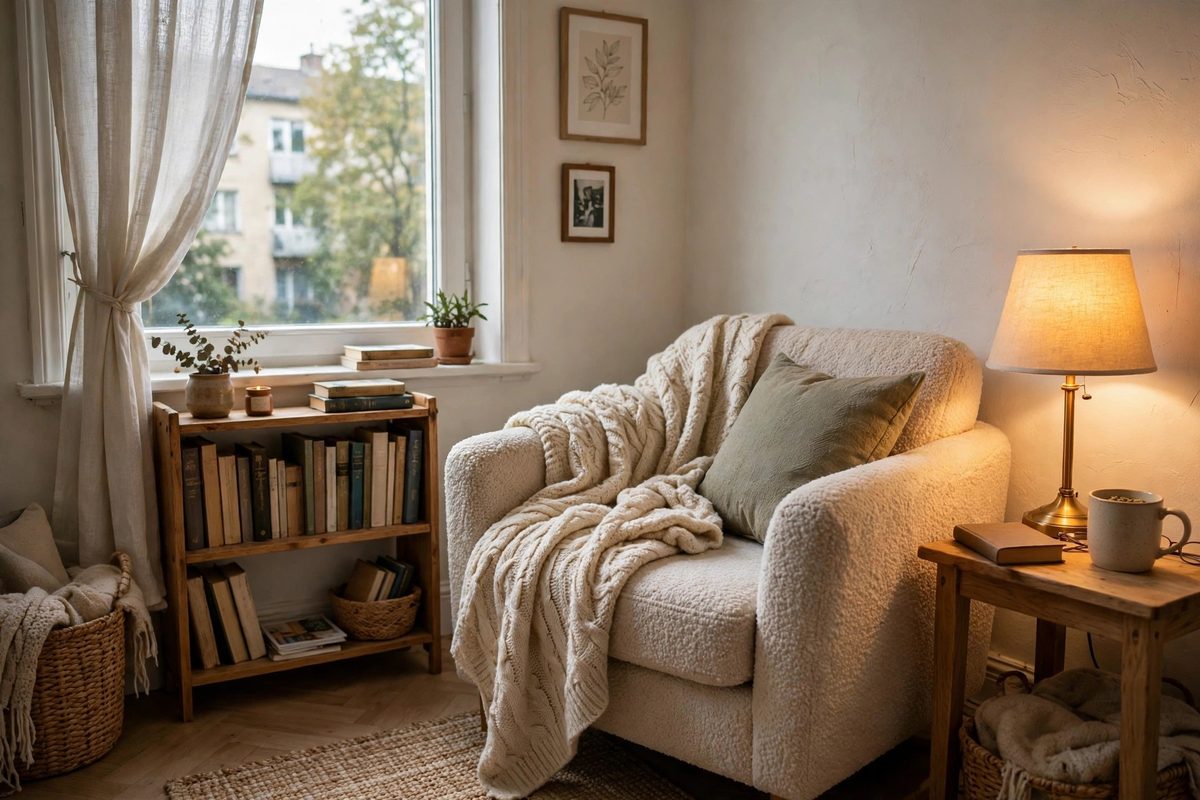
Every home needs one corner that belongs entirely to one person and one purpose, even in a studio. A reading nook, a craft corner, a meditation cushion by the window, or a desk arranged exactly how you like it: this corner is where the flat stops being generic and starts being yours. Furnish it slowly and only with things you chose: a comfortable chair, $80 to $200 secondhand or $150 to $300 new, a lamp with warm light, a blanket, and the books or supplies for your hobby within arm’s reach.
The power of a personal corner is that it gives the rest of the flat permission to stay imperfect. The kitchen can stay landlord beige and the hallway can stay bare, because you have one spot that feels fully, unmistakably yours. Spend your best decorating energy here first, not spread thin across every room. Sit in it daily, even for 10 minutes, and it becomes the anchor of the whole home: the place you picture when someone asks where you live, and the corner you will miss most when you eventually move on. That feeling, more than any single object, is what makes a rental feel like home.