9 Wall-Mounted Dining Table Ideas for Small Apartments That Need Their Floor Space Back
Explore 9 wall-mounted dining table ideas for small apartments, including fold-down, floating, corner-fit, and extendable designs that help reclaim floor space.
In This Guide
A dining table can be surprisingly difficult to fit into a small apartment. Even a modest table needs room for chairs, people getting in and out of their seats, and a clear path through the room. When the dining area also serves as a living room, home office, or passage between rooms, that footprint can become a daily frustration.
A wall-mounted dining table offers another way to approach the problem. Depending on its design, it can fold flat against the wall, occupy a narrow strip of space, or provide a permanent eating surface without the visual bulk of a conventional table with four legs. Some versions work well for everyday meals, while others are better suited to occasional dining or a quick breakfast.
The important distinction is that wall-mounted does not automatically mean space-saving, easy to install, or suitable for every apartment. A fixed table still occupies floor space with its chairs, and a fold-down design needs enough clearance to open safely. The mounting system also has to suit the wall construction and the table’s intended load.
These nine wall-mounted dining table ideas explore different ways to create a useful eating area without letting a table dominate your apartment. The best choice depends on how many people you seat, how often you use it, where the table can be mounted, and what needs to fit around it.
1. The Fold-Down Dining Table
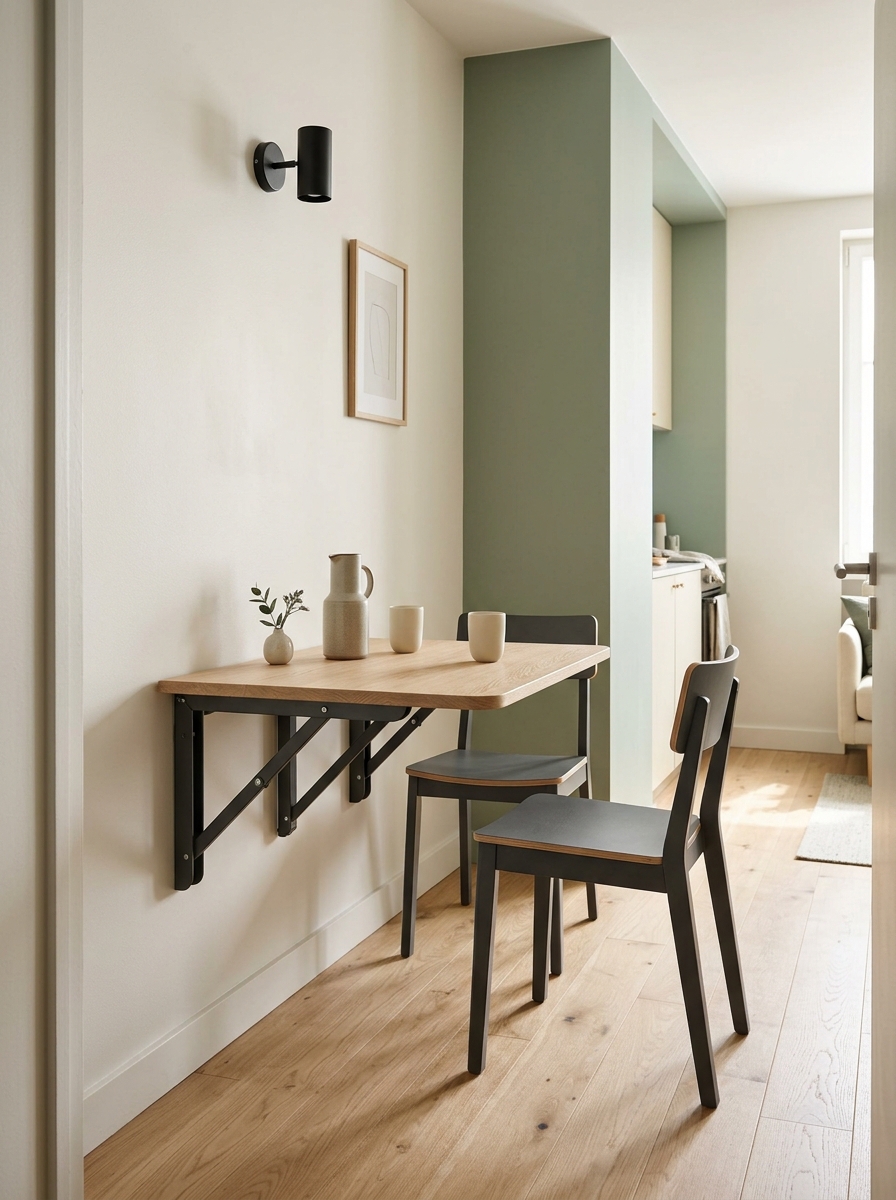
A fold-down dining table is one of the most direct ways to reclaim floor space after a meal. Its tabletop lowers into a compact vertical position when it is not being used, leaving more of the room available for walking, relaxing, or other activities.
This design is particularly useful in a studio apartment or a combined living-and-dining room where a permanent table would interrupt the main route through the space.
How to make it work
- Choose a table that suits the number of people who will regularly use it, rather than selecting the largest option that fits the wall.
- Check the full opening arc and the space needed for chairs before deciding where to mount it.
- Consider whether the folded table will project from the wall or sit relatively flat against it.
- Make sure the open position is comfortable for eating and does not block a doorway, cabinet, or appliance.
Imagine a warm-white wall with a compact pale-oak fold-down table, two lightweight chairs, and a small pendant or wall light nearby. When the table is closed, the wall becomes visually quieter and the chairs can be moved elsewhere.
For a particularly narrow apartment, a simple rectangular tabletop may be easier to position than a large, rounded design. The ideal shape depends on the available wall and the circulation space around it.
Before buying: Inspect the hinges, support brackets, locking mechanism, and stated load capacity. The wall and fixings must be suitable for the complete installation. A fold-down table should not be treated as secure simply because the hardware looks substantial.
Best for: People who need a dining surface but do not want it permanently occupying the room.
2. The Wall-Mounted Drop-Leaf Table
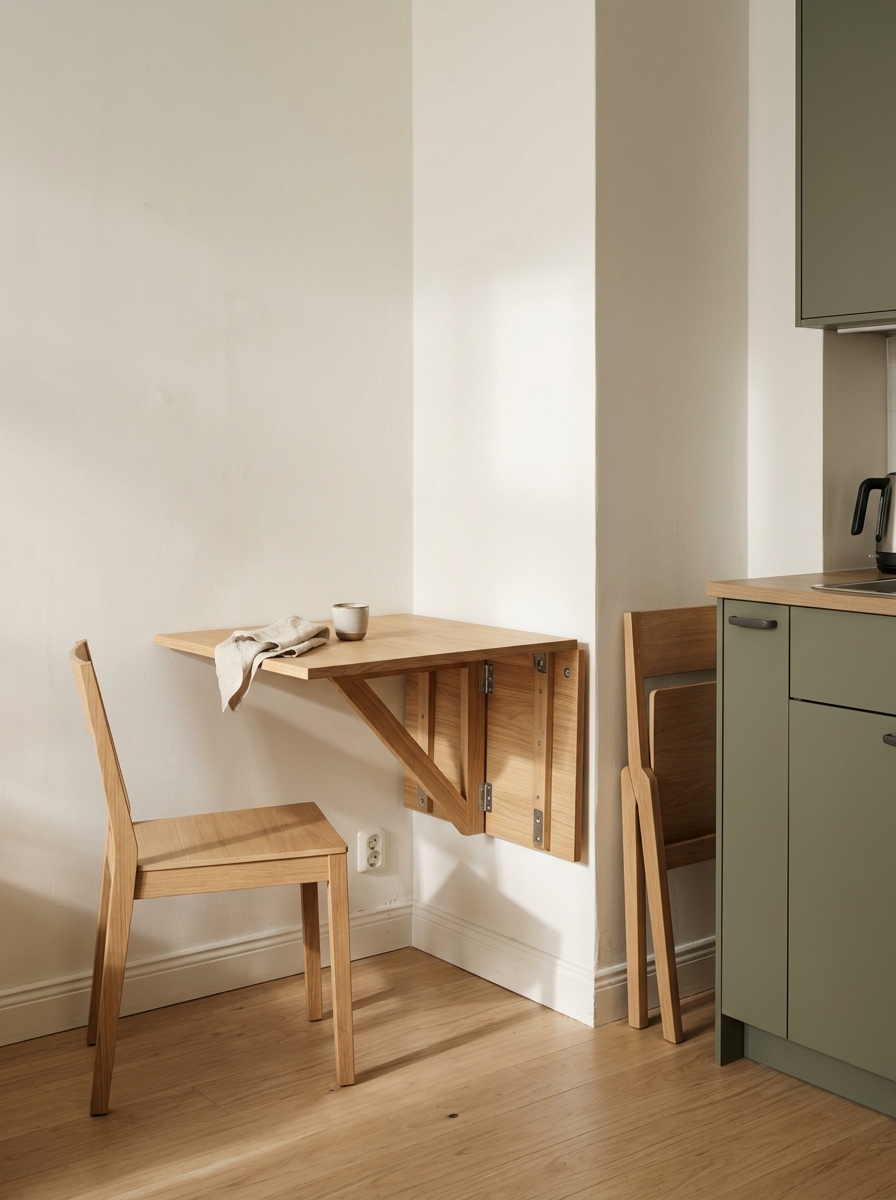
A wall-mounted drop-leaf table provides a useful middle ground between a fixed tabletop and a fully folding design. One or more leaves can lower when they are not needed, allowing the table to change size according to the occasion.
Depending on the model, the main section may remain fixed to the wall while a supported leaf opens outward. This makes the design useful when one person usually eats alone but occasionally needs a larger surface.
How to make it work
- Decide whether you need a small everyday surface or enough room for two or more people to dine together.
- Check whether the leaves fold independently or need to open as one unit.
- Measure the table in both its open and closed configurations.
- Look at the underside and support system to understand where legs, brackets, or folding supports will sit.
A compact oak table with one lowered leaf can sit against a warm-white kitchen wall, paired with a single slim chair. When guests arrive, the leaf opens to create additional dining space without requiring a permanently larger tabletop.
The wall attachment and leaf supports need to be appropriate for the table’s construction and expected use. A leaf that appears stable when empty may behave differently when weight is placed near its outer edge.
Small-space tip: Do not judge this table only by its closed dimensions. The open leaf, seated person, and chair all need room to function together.
Best for: Small households that need a compact daily table with occasional extra surface area.
3. The Slim Floating Dining Table
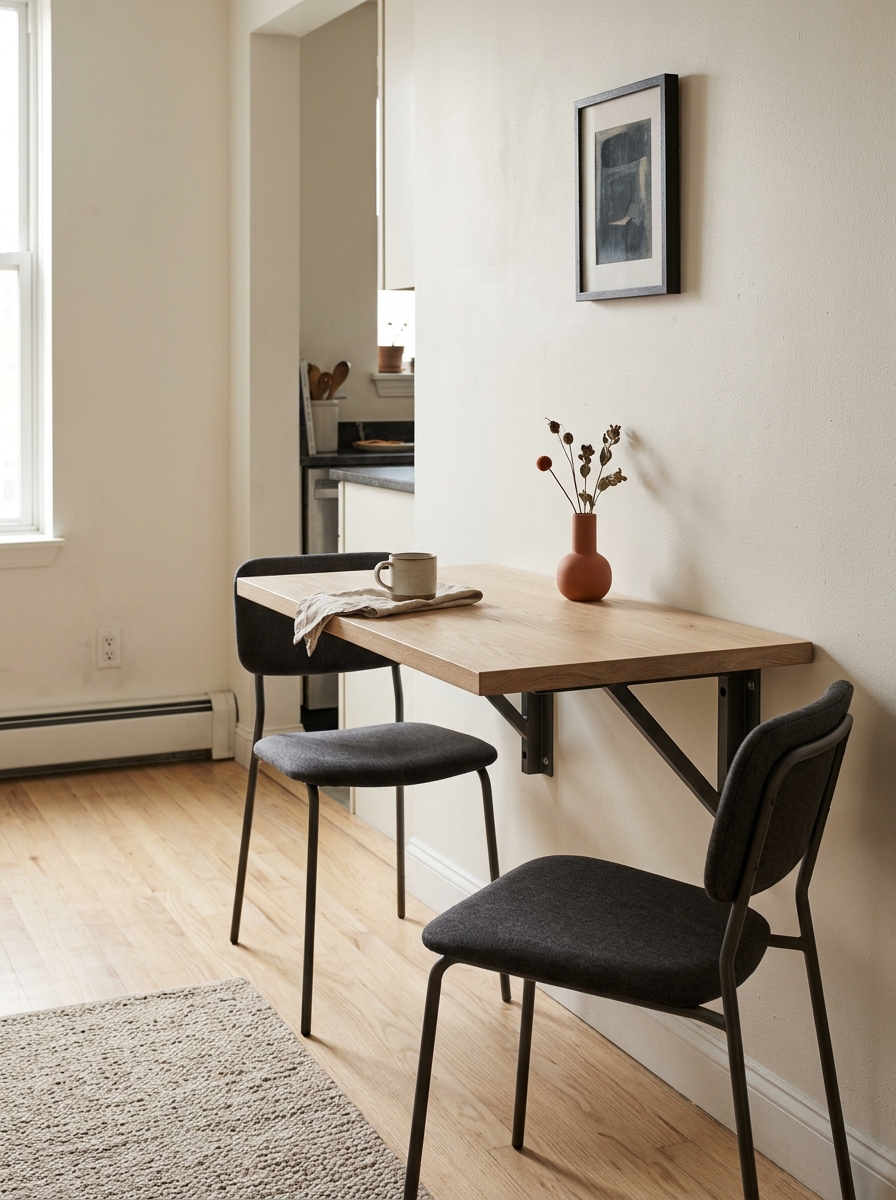
A slim floating dining table is a fixed tabletop mounted to the wall without conventional table legs along its outer edge. Its uninterrupted underside can create a lighter visual effect and may make it easier to tuck a chair underneath when the table is not in use.
Unlike a fold-down table, it remains in place. The benefit comes from its narrow footprint and reduced visual bulk rather than from disappearing completely.
How to make it work
- Keep the tabletop depth appropriate for how you eat, work, or serve food.
- Consider rounded corners if the table sits beside a busy walkway.
- Check the available knee space and the position of any support brackets.
- Coordinate the tabletop with nearby cabinetry, flooring, or shelving so it feels integrated with the room.
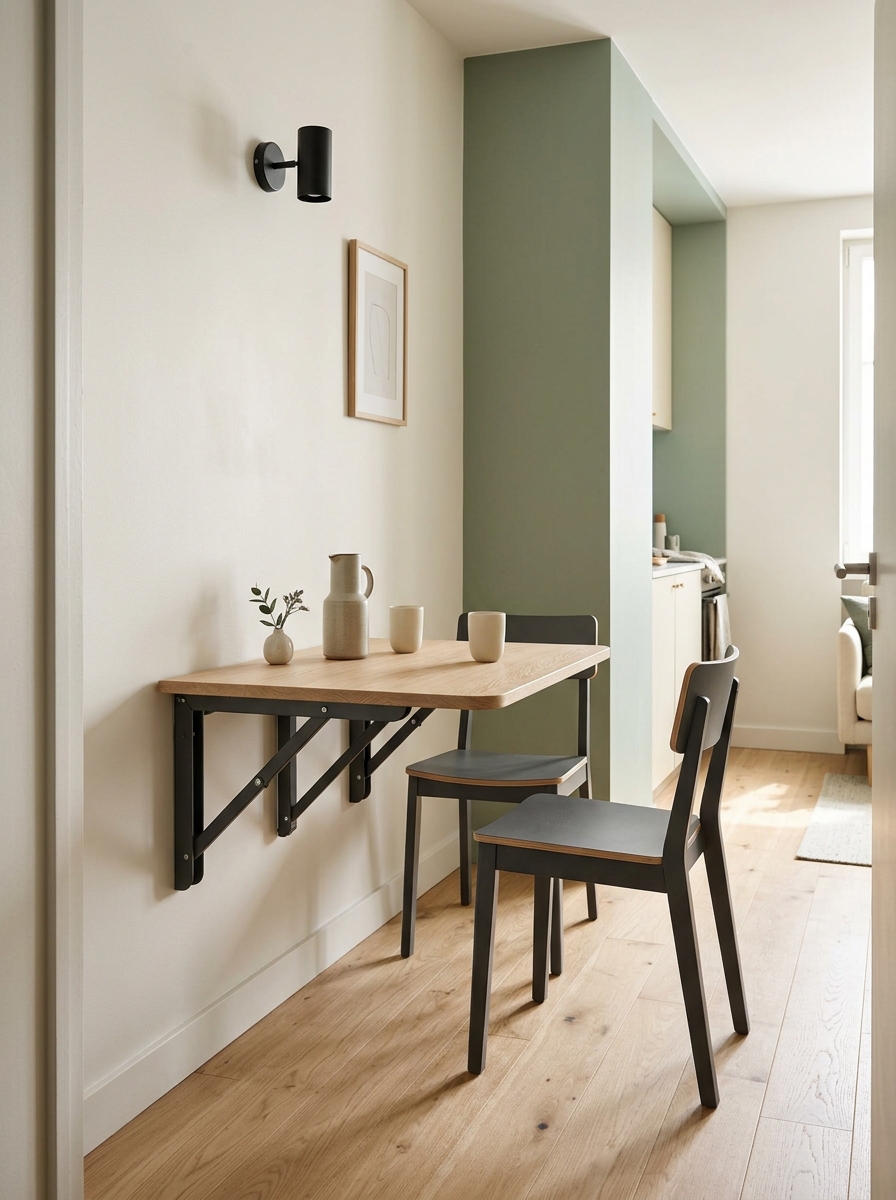
A pale-oak floating table against a warm-white wall can work as a two-person dining surface in a compact kitchen or living area. Pair it with two simple chairs and restrained tabletop styling to keep the area from feeling crowded.
A floating tabletop needs a suitable structural support system. The mounting method must account for the wall construction, the table’s dimensions, and the loads it will experience. Heavy stone, thick timber, or long projecting surfaces may require more substantial engineering than a lightweight-looking design suggests.
Small-space tip: A shallow table can be useful, but it should still accommodate plates, glasses, and comfortable arm movement. Measure the items you actually use before settling on a depth.
Best for: Apartments where a permanent dining surface is needed but a conventional table frame would add unnecessary visual weight.
4. The Wall-Mounted Breakfast Bar
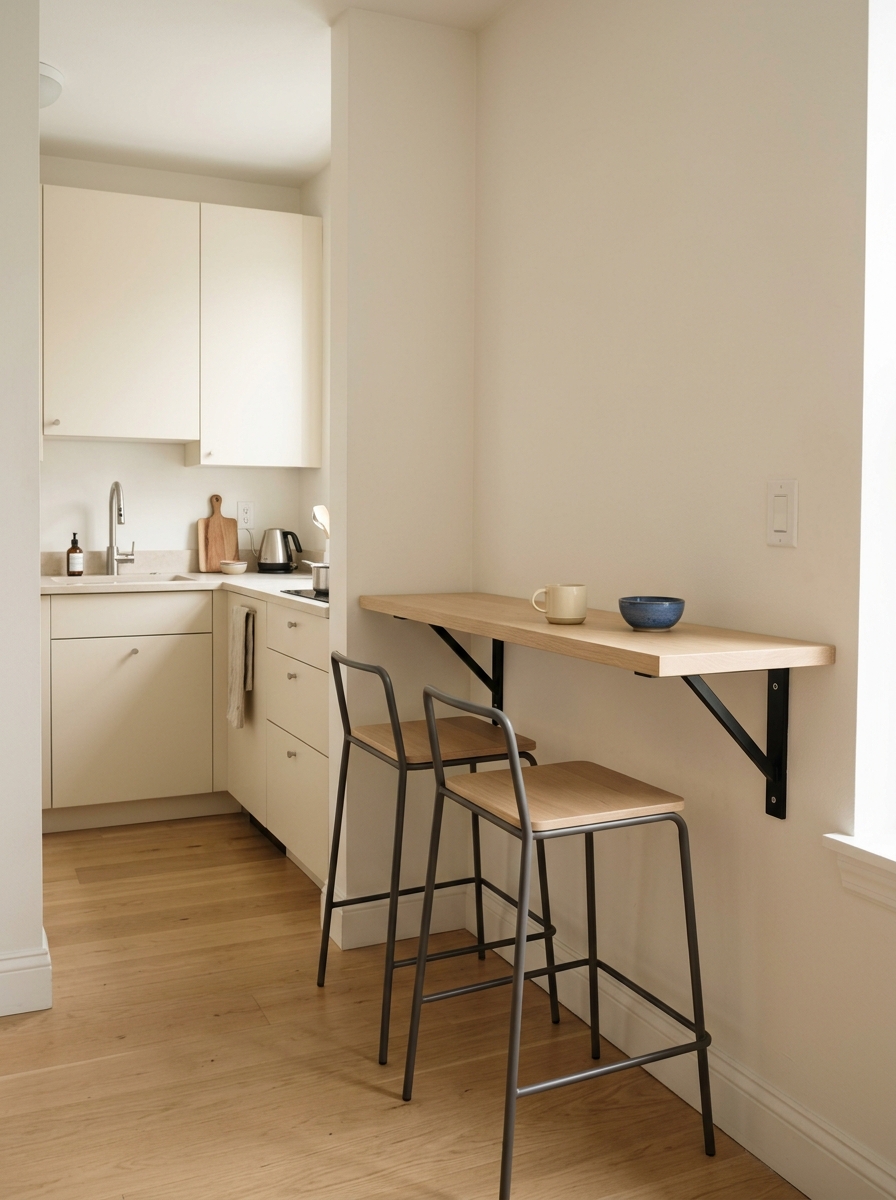
A wall-mounted breakfast bar creates a narrow place for quick meals, coffee, or a casual lunch. It can be particularly effective along an unused kitchen wall or at the edge of an open-plan living area.
Unlike a conventional dining table, a breakfast bar is designed around a more compact eating position. Depending on its height and depth, it may work with standard dining chairs or require suitable counter-height seating.
How to make it work
- Choose the table height and seating together rather than buying them separately.
- Leave enough room for knees, legs, and getting on and off the seat.
- Check that the bar does not interfere with kitchen drawers, cupboard doors, or appliance access.
- Use a durable, easy-to-clean tabletop if it will serve as a daily food-preparation or eating surface.
A narrow oak breakfast bar along a kitchen wall can provide a place for two people to eat without introducing a full dining set. Add a small ceramic vase or a simple bowl, but keep the working surface mostly clear.
If the bar sits near a kitchen worktop, check the relative heights and the space between the two surfaces. A bar that is too close to the worktop may feel awkward, while one positioned in a circulation route can become an obstacle.
Important: Do not assume a breakfast bar is suitable for every wall. Its depth, height, bracket design, and expected load all affect the mounting requirements.
Best for: People who mainly need a compact everyday eating spot for breakfast, coffee, or casual meals.
5. The Corner-Fit Dining Table
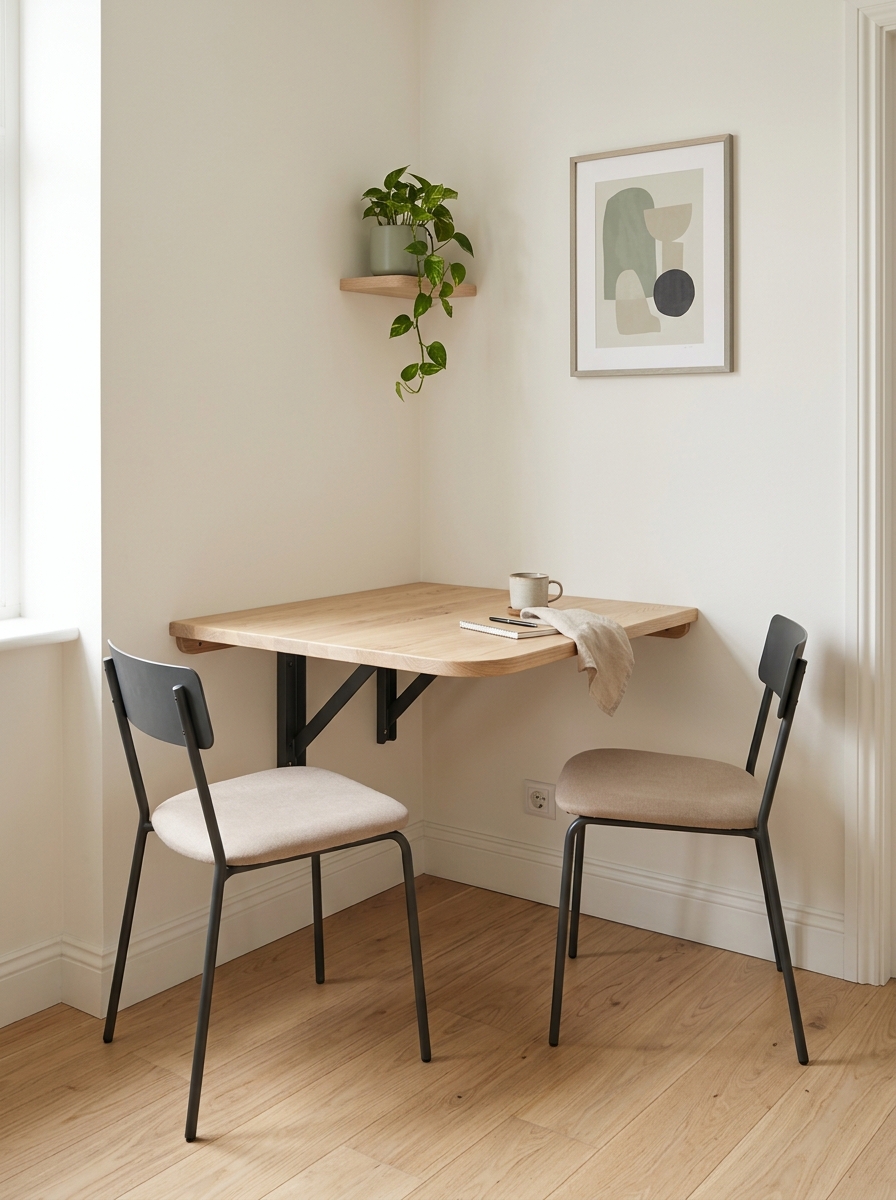
An underused corner can be an excellent place for a wall-mounted dining surface. A corner-fit design uses the available wall arrangement to create a dedicated eating area while keeping the center of the room more open.
Some versions use a compact triangular or curved tabletop, while others use a small rectangular surface that meets one or both adjoining walls. The right shape depends on the corner and how people will approach the table.
How to make it work
- Measure both walls and identify any skirting boards, radiators, outlets, windows, or cabinet doors that affect placement.
- Consider whether the table will be used by one person, two people, or more.
- Make sure the seated position does not trap someone against the wall.
- Check that the table shape offers enough usable surface for plates and drinks.
A small rounded-corner oak tabletop fitted into a bright apartment corner can create a comfortable two-person dining spot. One chair may face into the room, while the second position can be added if the available clearance allows it.
A corner table is not automatically more efficient than a straight wall-mounted table. Deep corners can be awkward to reach, and an overly compact surface may leave little room for a full meal. Think about how people will sit and move, not just how neatly the tabletop fits the corner.
Small-space tip: Rounded edges can soften a tight layout, but they do not replace the need for adequate seating clearance and safe installation.
Best for: Apartments with an unused corner and limited room for a conventional dining arrangement.
6. The Dining Table With an Integrated Wall Shelf
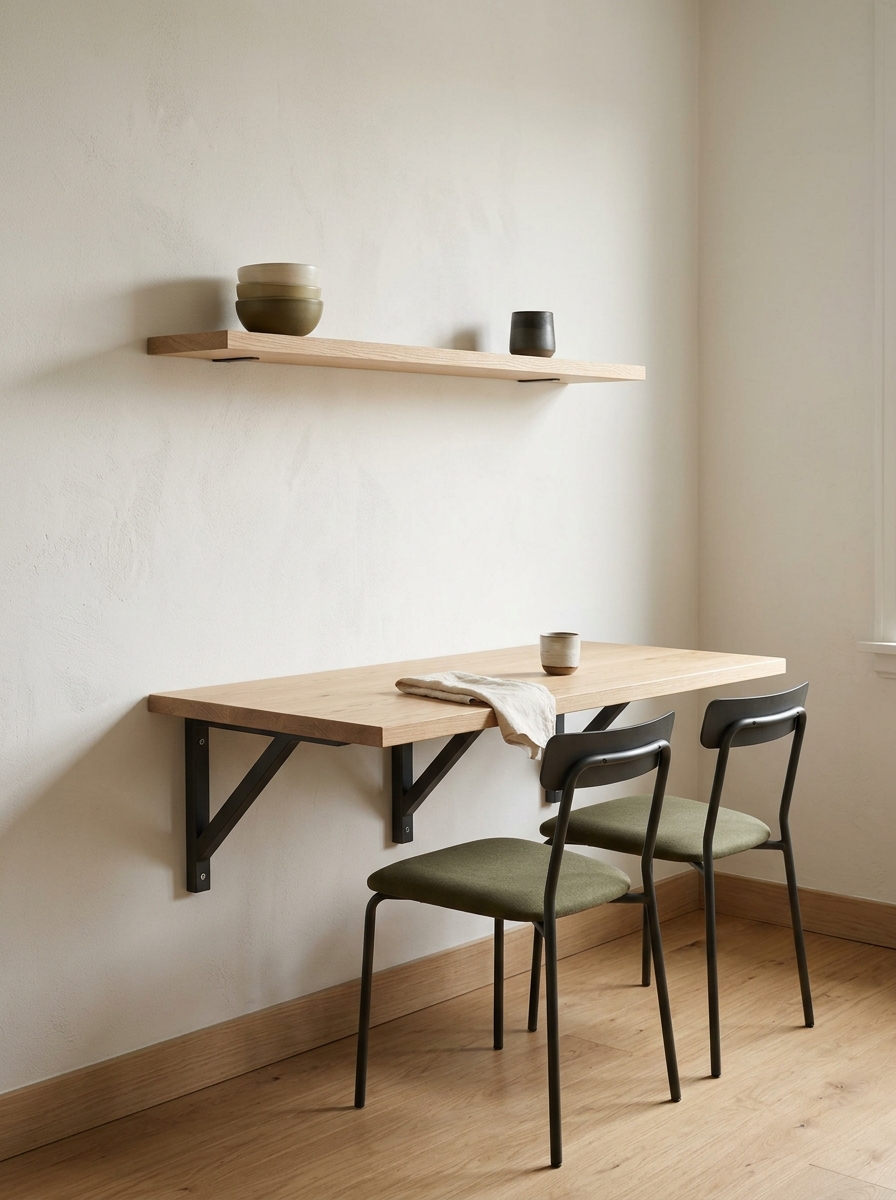
A wall-mounted dining table with an integrated shelf combines an eating surface with a small amount of nearby storage. Depending on the design, the shelf may sit above the tabletop, beside it, or form part of a coordinated wall-mounted unit.
This can help keep dining essentials close without adding a separate storage cabinet. It is especially useful when the dining area shares space with a kitchen or a compact living room.
How to make it work
- Reserve the shelf for lightweight, frequently used items such as coasters, napkins, or a small serving bowl.
- Keep fragile objects away from edges where they could be knocked down during meals.
- Check that the shelf does not interfere with seated headroom or make the table feel enclosed.
- Coordinate the shelf depth and finish with the tabletop so the arrangement feels intentional.
Picture a slim floating oak dining table beneath a short matching shelf on a warm-white wall. Two simple chairs sit below, while the shelf holds a small stack of bowls and a ceramic vessel. The result feels like a compact dining station rather than a collection of unrelated pieces.
The table and shelf may have different mounting requirements. Do not assume that the shelf supports make the table structurally secure, or that the same fixings are suitable for both.
Small-space tip: Keep the shelf visually light. Too many objects above the table can make a narrow dining area feel cramped and can create unnecessary clutter near food.
Best for: People who want a dining surface and a little nearby storage without bringing in a separate sideboard.
7. The Tuck-Away Stool Setup
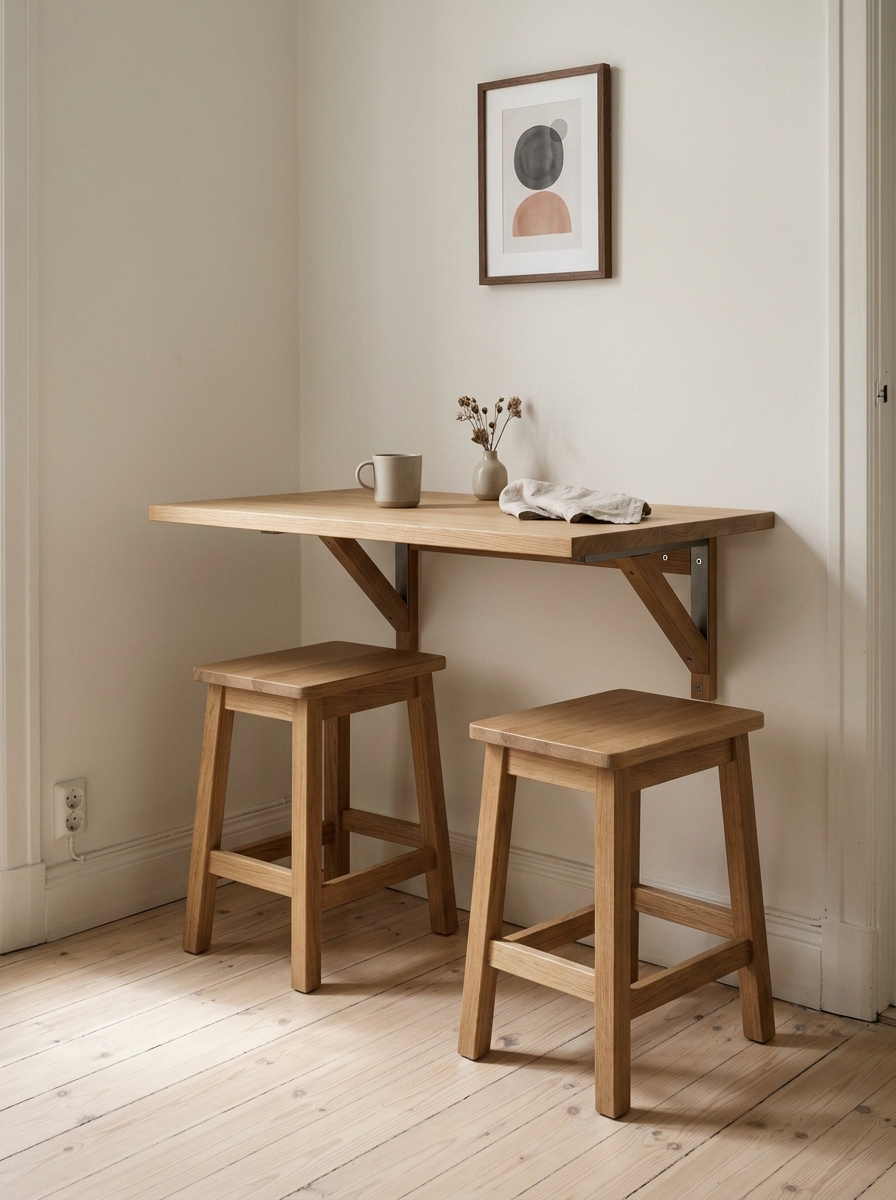
Sometimes the biggest space problem is not the tabletop but the chairs. A wall-mounted table paired with stools that can tuck underneath or be stored elsewhere can reduce the amount of floor space the dining arrangement occupies when it is not being used.
This approach works with several types of wall-mounted table, including floating tables and compact breakfast bars. The important point is to plan the seating and tabletop as one system.
How to make it work
- Check the underside of the table for brackets, supports, and other obstructions.
- Choose stools that fit comfortably beneath the tabletop without blocking legs or knees.
- Make sure the stools are stable and appropriate for the table’s height.
- If the stools need to be stored on a rack or wall hook, use a suitable mounting system and keep the storage position clear of doors and walkways.
A compact wall-mounted oak table with two simple backless stools can create a clean dining setup. When the meal is finished, the stools slide beneath the table, leaving a more open route through the room.
Do not choose stools based on storage alone. Seat height, stability, foot support, and comfort matter, especially if the table will be used for longer meals or work sessions.
Small-space tip: Test the full arrangement with the stools pulled out. A setup that looks compact when everything is tucked away may still obstruct the main walkway when people are seated.
Best for: Apartments where chairs take up too much space or interfere with everyday circulation.
8. The Window-Side Dining Ledge
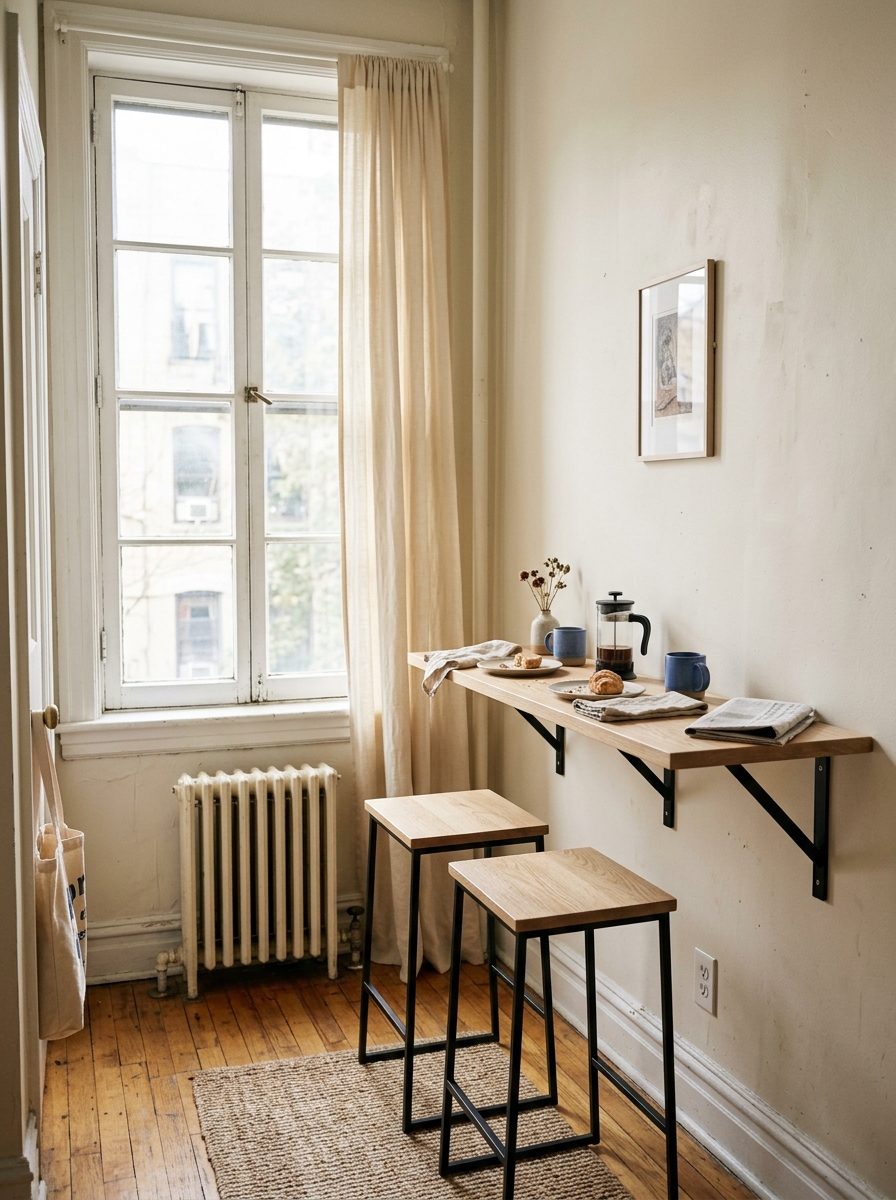
A wall-mounted dining ledge near a window can make use of a narrow area that might otherwise remain underused. It provides a place for breakfast, coffee, or a quick meal while keeping the main part of the room available for other activities.
The window can also give the dining spot a pleasant outlook and natural light. However, the ledge should not interfere with window operation, curtains, blinds, heating equipment, or safe access.
How to make it work
- Check the window’s opening direction and the position of its handles.
- Account for curtains, blinds, radiators, and any window sill that projects into the room.
- Choose a tabletop depth that allows comfortable use without crowding the window area.
- Consider glare and direct sunlight at the times you expect to use the table.
A pale-oak ledge beneath a bright apartment window can be paired with two slim chairs and a simple linen runner. Keep the window area uncluttered so the natural light remains a feature rather than being blocked by tall decor.
A window-side ledge does not need to span the entire window wall. A shorter surface may be more practical if the window has operating hardware or if a nearby doorway limits the available width.
Safety note: Never obstruct an emergency escape route or compromise the safe operation of a window. Keep the installation clear of heaters and follow applicable requirements for the room.
Best for: Apartments with a usable window-side wall and a need for a bright, compact dining spot.
9. The Extendable Wall-Mounted Table
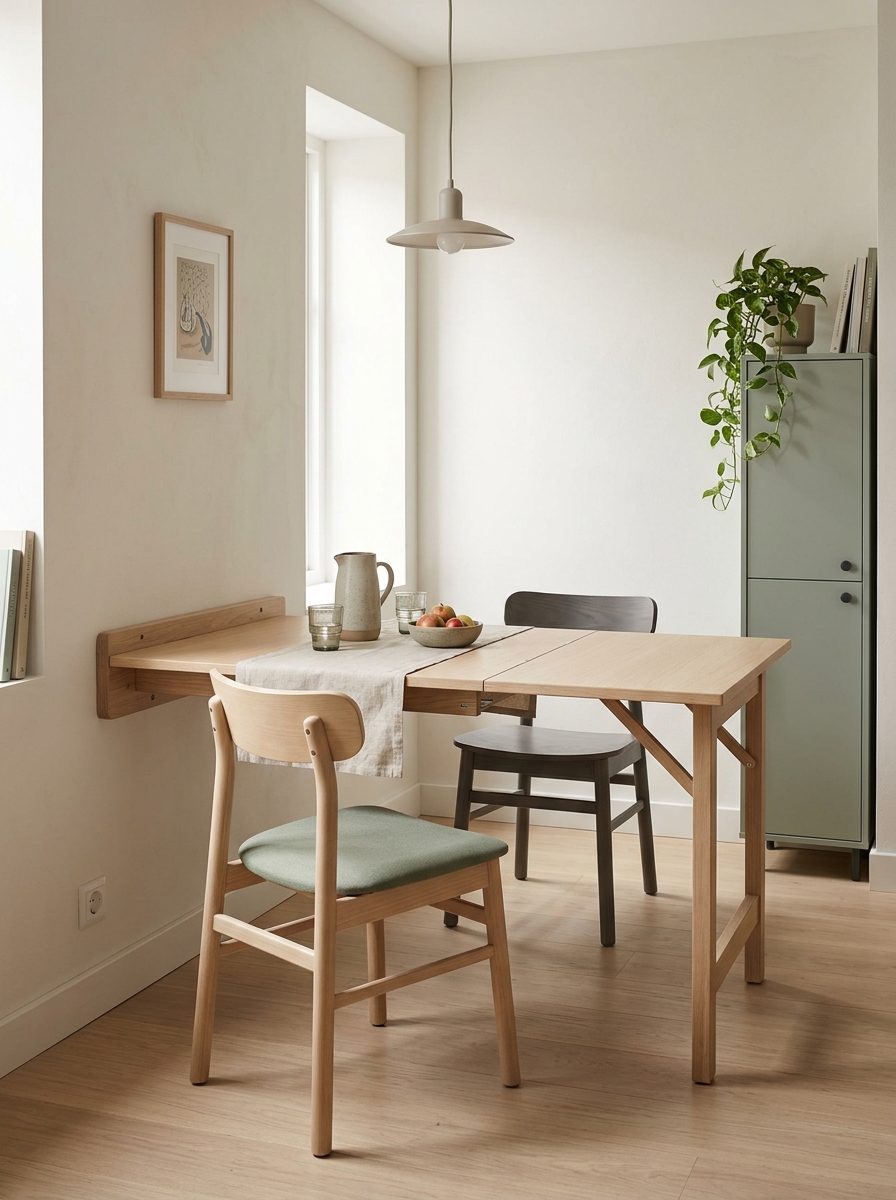
An extendable wall-mounted table offers a more flexible solution for households whose dining needs change throughout the week. It may use a hinged leaf, sliding extension, or another supported mechanism to provide additional surface area when needed.
This differs from a simple drop-leaf table because the extension mechanism and the way it is supported are central to the design. Some models are compact when stored but require a substantial amount of room when fully extended.
How to make it work
- Check the dimensions in every configuration, including the full extension.
- Understand how the extension is supported and whether any legs or braces need to be deployed.
- Consider how the table will behave when weight is placed near the extended edge.
- Confirm that chairs can be positioned comfortably without blocking a walkway or doorway.
A compact wall-mounted table with a pale-oak finish can remain relatively narrow for everyday meals and expand when friends visit. Keep the nearby furniture simple so the open configuration has room to function.
Before buying, read the installation requirements and load guidance carefully. A table that expands outward puts different demands on its mounting and support system than a narrow fixed surface. The wall attachment, hinges, brackets, and any folding legs must all be suitable for the intended configuration.
Small-space tip: Measure the fully extended table with chairs in place. The usable dining footprint is larger than the tabletop alone.
Best for: People who need a compact daily dining arrangement but occasionally require a larger table.
How to Choose the Right Wall-Mounted Dining Table
The most suitable design depends on how often you dine at home, how many people use the table, and whether the wall and room can accommodate the installation.
If you need the floor space back after every meal
Start with a fold-down table or a suitable drop-leaf design. Compare the folded projection, opening movement, and space needed for chairs.
If you eat at the table every day
A fixed floating table or breakfast bar may be more convenient. These options avoid the repeated setup and closing routine, but the chairs and table still occupy space.
If you only have one usable corner
Look at a corner-fit table, provided it leaves enough room to sit down and get up comfortably. Do not sacrifice usability just to fill an awkward corner.
If you need storage as well as a dining surface
A table with an integrated shelf may reduce the need for a separate storage unit. Keep the shelf small and use it for items you reach for regularly.
If you regularly host guests
Consider a supported extendable or drop-leaf design. Confirm the maximum usable size, support system, and available room for additional chairs before purchasing.
If you rent your apartment
Review your lease and ask the landlord or property manager before drilling or making structural changes. A wall-mounted table is not automatically renter-friendly. If permanent mounting is not permitted, a freestanding folding table may be a safer alternative.
Measuring Before You Buy
A wall-mounted dining table needs more than a suitable stretch of wall. Measure the complete dining arrangement so it works during everyday use.
- Measure the wall area: Check the usable width and height, including skirting boards, outlets, switches, radiators, windows, and nearby cabinet doors.
- Measure the tabletop in every configuration: For folding and extendable models, record both the stored dimensions and the fully open dimensions.
- Plan the chair footprint: Include the room needed to pull out a chair, sit down, stand up, and move past another person. A tabletop that fits on the wall may still make the room difficult to use.
- Check the main walkway: Map the route between entrances, kitchen units, seating, and other frequently used areas. The table should not force people into an awkward detour.
- Check mounting suitability: Identify the wall construction and follow the manufacturer’s installation guidance. The required fixings and support method depend on the wall, table, brackets, and expected load.
- Test the layout on the floor: Use removable tape to mark the tabletop footprint and approximate chair positions. For a fold-down table, also mark the open area. This will not confirm structural suitability, but it can reveal circulation problems before you buy.
There is no single tabletop depth or clearance measurement that works for every apartment. Start with the product’s specifications, the dimensions of your dining essentials, and the space available around the furniture.
Wall-Mounted Dining Table Mistakes to Avoid
- Choosing a table only because it folds: A fold-down table still needs room to open and space for people to sit. Check the entire movement and seating area.
- Ignoring the wall construction: A strong-looking bracket cannot compensate for an unsuitable wall or fixing. Follow the manufacturer’s requirements and seek qualified installation advice when needed.
- Buying the table and stools separately without checking compatibility: The seat height, tabletop height, underside supports, and knee clearance need to work together.
- Assuming a floating table is automatically safer or more spacious: Removing legs may improve the visual appearance, but the tabletop and seating still occupy a footprint and require appropriate support.
- Placing the table in the main traffic route: A dining surface that blocks the path to the kitchen, bathroom, balcony, or entrance can become frustrating very quickly.
- Overloading shelves and extensions: Storage shelves and expandable surfaces have their own load limits. Do not use them beyond their intended capacity.
- Forgetting the open position: A fold-down, drop-leaf, or extendable design must be practical when fully deployed, not just when closed.
- Assuming every solution suits renters: Drilling, heavy fixings, and structural changes may require permission. Check the rules before buying a table that depends on permanent installation.
Styling a Wall-Mounted Dining Table
A wall-mounted table can look intentional without needing a large dining set or a lot of decoration.
- Keep the tabletop edited: A small vase, a simple runner, or a bowl may be enough. Leave the majority of the surface available for meals.
- Repeat one material: Match an oak tabletop with a nearby shelf or small wooden accessory for a connected look.
- Use lighting thoughtfully: A suitable wall light or existing overhead fixture can define the dining spot. Check installation requirements before adding electrical fittings.
- Choose seating that suits the room: Slim chairs or compact stools can reduce visual bulk, but comfort and stability still matter.
- Use the wall above selectively: One piece of artwork or a small shelf can give the dining area an identity without making the wall feel crowded.
- Keep folding hardware accessible: Avoid placing decor where it interferes with hinges, support arms, or the table’s movement.
The goal is not to make the dining area look empty. It is to give every part of the arrangement a purpose while keeping the apartment easy to move through.
Conclusion
A wall-mounted dining table can make a small apartment easier to use, but the best option depends on more than how little space it occupies when closed.
A fold-down table is useful when the room needs to change functions throughout the day. A floating table or breakfast bar can provide a permanent eating surface, while a corner-fit design or window-side ledge can make a specific part of the apartment work harder. Drop-leaf and extendable options offer flexibility when the number of diners changes.
Before choosing a design, measure the tabletop, chairs, opening movement, and walking route. Confirm that the wall and mounting system are suitable, and check permission requirements if you rent.
A successful small-space dining setup is one you can use comfortably every day, not just one that looks compact in a photograph.