11 Small Living Room Side Table Ideas for Tight Spaces That Keep Everything Within Reach
Tight space next to your sofa? Discover 11 narrow side table ideas for small living rooms—from slide-under C-tables to slim nesting tables that fit.
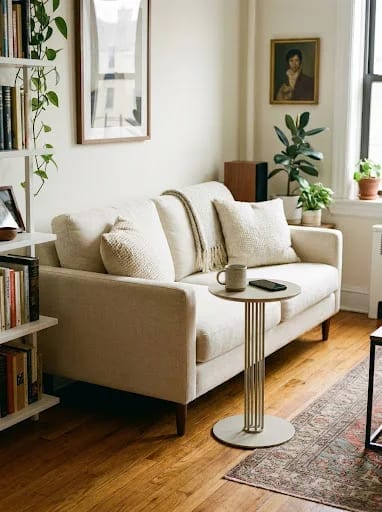
Small apartment living room with a slim pedestal side table beside a compact sofa keeping the surrounding floor visibly open
In This Guide
A small living room does not need a table at both ends of the sofa. It does not even necessarily need a traditional end table. What it does need is a convenient place for the things people actually reach for while sitting down:
- drink
- phone
- remote
- glasses
- book
- lamp The mistake is assuming that function has to come from a standard square end table with:
- four legs
- a drawer
- a shelf
- enough width for a large lamp Those tables can work beautifully in bigger rooms. In a compact apartment, they may consume exactly the few inches you need for:
- walkway
- door clearance
- sofa access
- chair placement A better approach is to start with the function and then choose the smallest surface that comfortably handles it. Sometimes that is:
- a narrow pedestal
- a C-table
- a tiny wall-mounted shelf
- one shared table between two seats And sometimes the best decision is simply to use one side table instead of two. Here are eleven ways to keep essentials within reach without crowding the edges of a small living room.
1. The Slim Pedestal Side Table
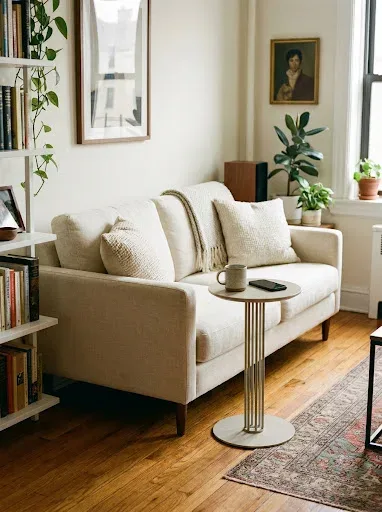
A pedestal table is one of the easiest ways to add a useful surface without adding a visually heavy furniture block. Instead of:
- four legs
- thick cabinet sides
- lower shelf you get: one small top + one central support.
Why it works
The base occupies relatively little visual space. That helps when the table sits between:
- sofa
- wall
- chair where there is not much room to spare.
Keep the top useful
Do not choose something so tiny that it only holds one decorative candle. A practical pedestal table should comfortably handle at least:
- drink
- phone at the same time.
Round tops work especially well
A small circular top eliminates projecting corners. That can be useful when the table is close to a walking route.
Watch stability
Very narrow pedestal tables need a properly designed base. Do not sacrifice stability just to get a smaller footprint.
2. The Sofa-Slide C-Table
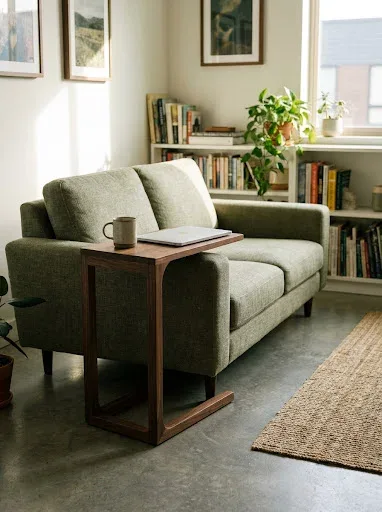
A C-table is one of the most practical options when the room has almost no spare space beside the sofa. Its base can slide partially underneath the furniture while the tabletop extends over the seat edge.
Why it works
The table uses space the sofa already occupies. Instead of adding a completely separate furniture footprint, it partially overlaps the sofa zone.
Useful for
This works particularly well for:
- laptop
- coffee
- snacks
- phone because the surface can sit closer to you than a traditional end table.
Check sofa clearance
Not every sofa allows a C-table base to slide underneath. Measure:
- clearance beneath sofa
- arm width
- seat height before buying.
Keep the design lightweight
A bulky C-table defeats some of the advantage. Look for:
- narrow metal frame
- slim top where suitable.
3. The Narrow Drawer End Table
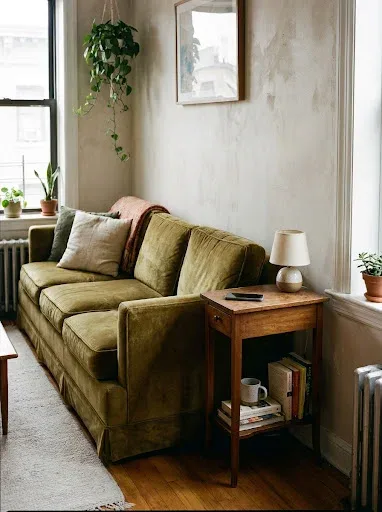
Sometimes you genuinely need a little closed storage. In that case, a narrow table with one drawer can be more useful than a completely open design.
What the drawer can hold
Use it for:
- remote
- charging cable
- glasses
- small notebook rather than trying to make it a general storage cabinet.
Depth matters
A narrow table can still be too deep. Measure how far it projects beyond the sofa arm. If the table sticks significantly into the walkway, it may not be helping.
One drawer is often enough
A three-drawer mini cabinet may provide more storage, but it also adds:
- bulk
- visual weight For daily essentials, a single shallow drawer may be all you need.
Keep the lower section open if possible
Visible floor beneath the table can help it feel lighter.
4. The Floating Wall-Mounted Table
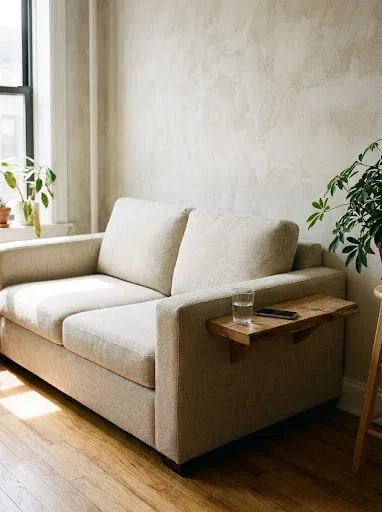
When floor space is the real problem, take the legs away completely. A small wall-mounted bedside-style shelf can work as a side table in a living room.
Why it works
The floor beneath remains completely open. That can be especially helpful near:
- narrow sofa edge
- radiator
- tight corner Keep the surface modest You may only need enough room for:
- drink
- phone A small floating ledge can handle that.
Think carefully about placement
Because the table is fixed to the wall, it cannot move when the sofa moves. Measure the sofa position first.
Installation matters
The shelf needs appropriate support for:
- wall type
- expected load and should be installed according to the hardware and wall requirements.
Renter considerations
If wall mounting is not permitted, choose a freestanding alternative instead.
5. The Nesting Side Table Pair
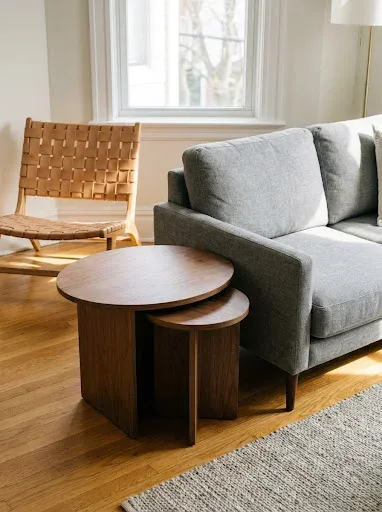
Nesting tables are useful when you occasionally need more surface but do not need it permanently.
Daily setup
Keep the smaller table tucked:
- underneath
- beside the larger one.
When needed
Pull the second table out for:
- guest
- snacks
- laptop
- extra drink surface
Why this works
The living room can temporarily expand its surface area without permanently carrying two separate tables.
Use a compact pair
Avoid sets with:
- three
- four
- five pieces if the room is already visually busy. Two is often enough.
Return them after use
The entire value comes from being able to collapse the arrangement again.
6. The Sofa-Arm Table
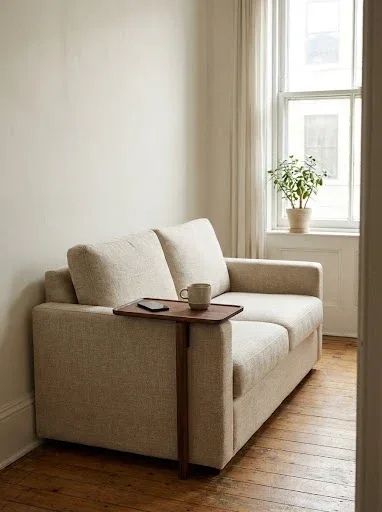
If you only need a tiny landing surface, the sofa itself can sometimes provide the support. A purpose-designed sofa-arm table or tray can sit over the arm.
Why it works
You add almost no new floor footprint. That is useful in rooms where there is literally no space beside the sofa.
Best for
Use it for:
- drink
- phone
- remote rather than trying to turn it into a full end table.
Check compatibility
The surface needs to:
- sit securely
- fit the arm width
- remain stable during use
Keep it simple
The whole advantage is disappearing into the sofa footprint. Avoid oversized trays that look like another piece of furniture.
7. The Tiny Round Accent Table
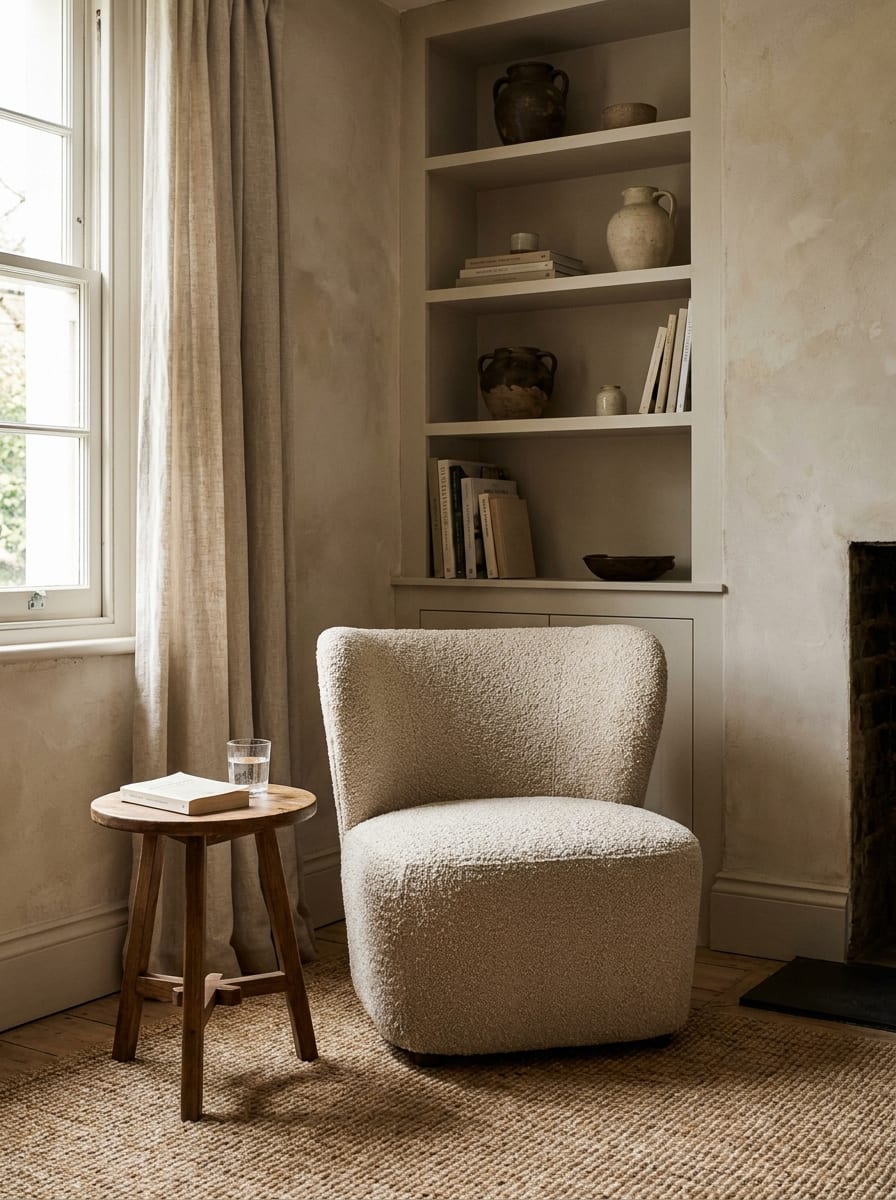
A small round table can fit into awkward corners where a square end table feels too rigid. Why round works There are no corners projecting into:
- walkway
- chair clearance and it can visually soften a room full of straight furniture.
Keep the diameter practical
You still need enough surface to be useful. A table that can only hold one vase may look good but not solve the actual problem.
Try it beside an accent chair
Round tables work especially well next to:
- reading chair
- small lounge chair where only a drink and book may need to fit.
Use a visually light base
Thin legs or a narrow pedestal can prevent the table from feeling bulky.
8. The One-Side-Only Table Layout
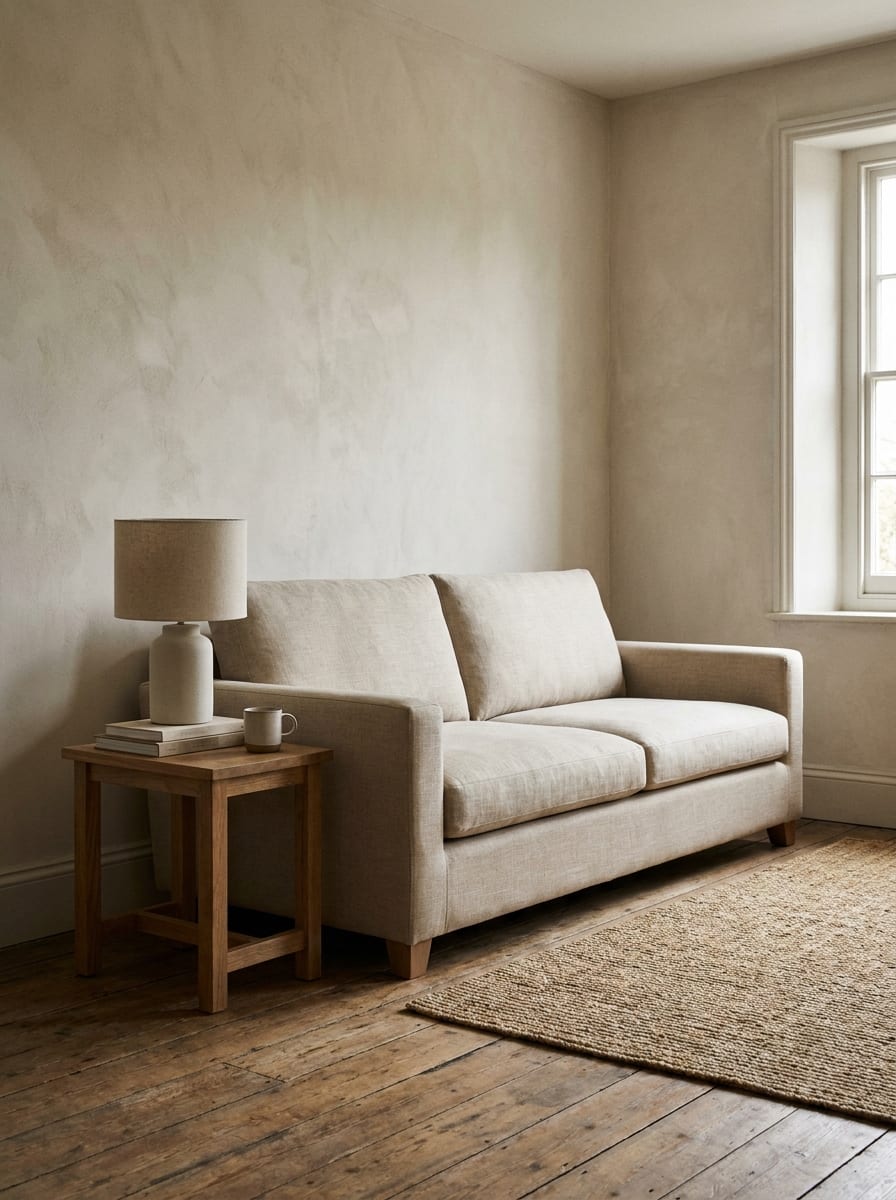
Matching tables on both ends of the sofa can create symmetry. They can also waste space. In a small living room, one side table may be enough.
Put it where it is used most
Choose the side nearest:
- main seat
- outlet
- lamp
- chair
Let the other sofa end breathe
That open edge can help:
- walkway
- furniture spacing
- visual openness
Symmetry is not mandatory
A balanced room does not need identical objects on both sides. You might have: One side Table + lamp. Other side Nothing. That can look cleaner than forcing a matching pair.
Use the open side strategically
It may create easier access to:
- balcony
- dining zone
- entry
9. The Chair-Sharing Side Table
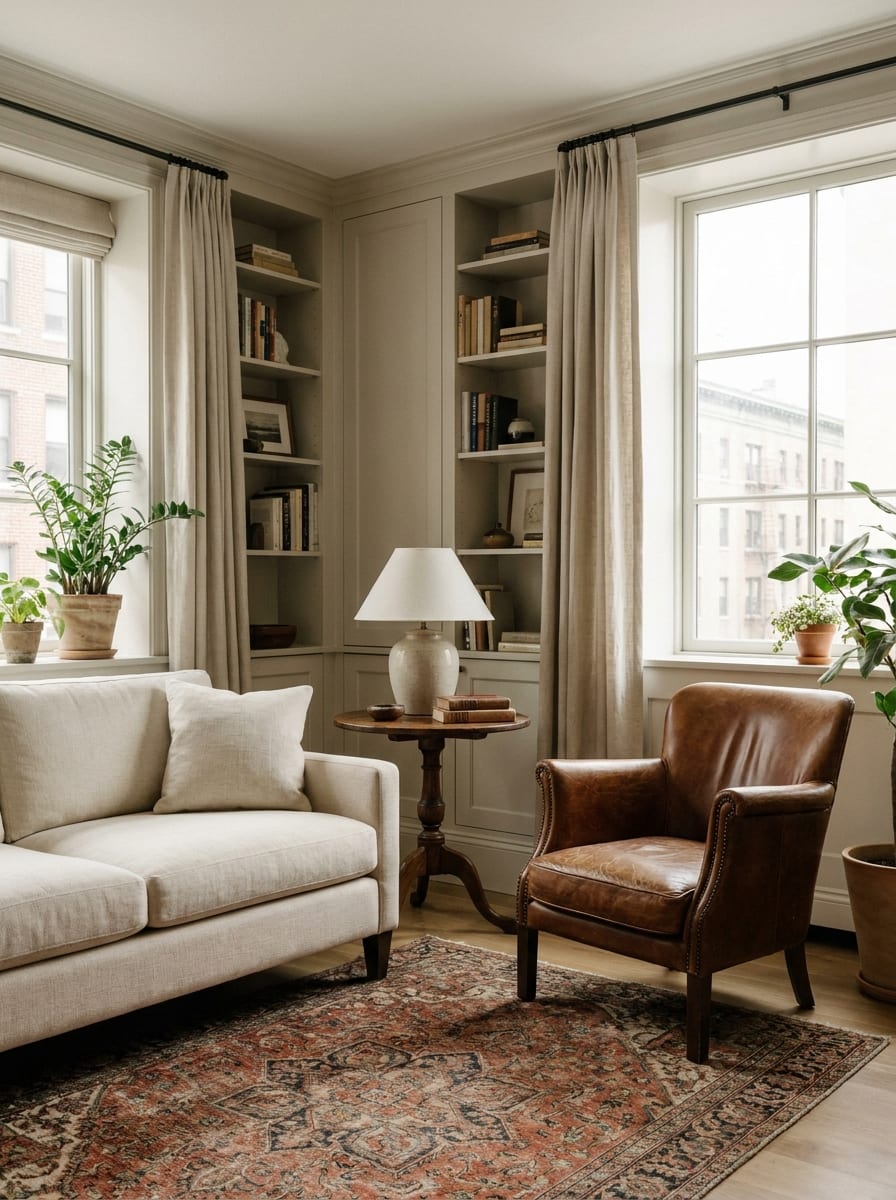
One table can sometimes serve both the sofa and a nearby chair. This is one of the easiest ways to reduce furniture count.
Place it between seats
A small side table can sit between:
- sofa arm
- accent chair so both people can reach it.
Why it works
Instead of:
- sofa table
- chair table you use one shared surface. Keep reach comfortable The table should not sit so far away that either person has to lean awkwardly.
Good for conversation layouts
This works especially well when the chair is angled slightly toward the sofa.
Keep the table visually neutral
Because it sits between two pieces, a simple form usually works best.
10. The Storage-Stool Side Table
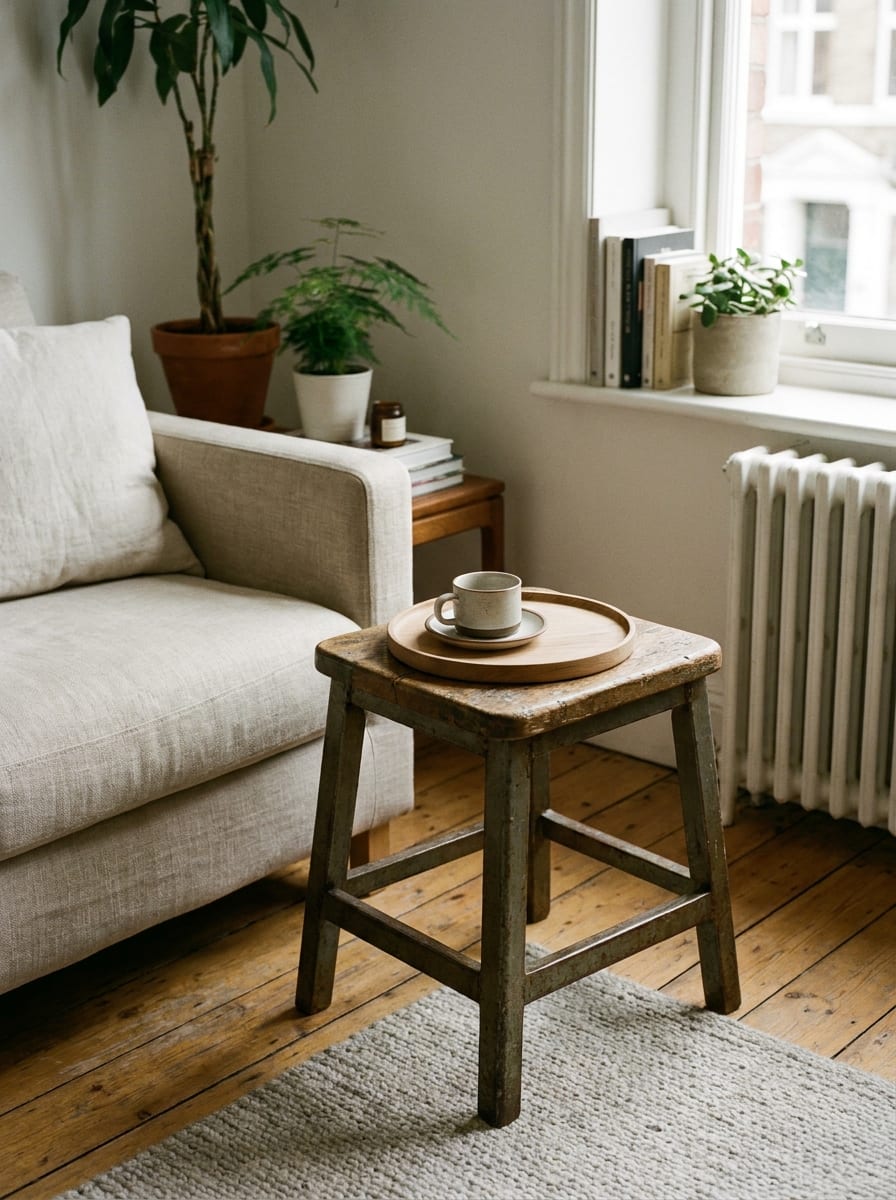
A compact stool can sometimes work as:
- side table
- extra seat
- occasional storage surface depending on its design.
Why it works
One small piece can serve several roles. That can be valuable in a living room where spare seating is occasionally useful.
Use a stable top
If you plan to put drinks on it, the surface needs to be:
- flat
- secure A small tray can help where appropriate.
Do not choose something too tall
It still needs to work comfortably beside the sofa.
Keep storage optional
If it has interior storage, use it for light items such as:
- throw
- small accessories rather than overfilling it.
11. The Right-Size Side Table Formula
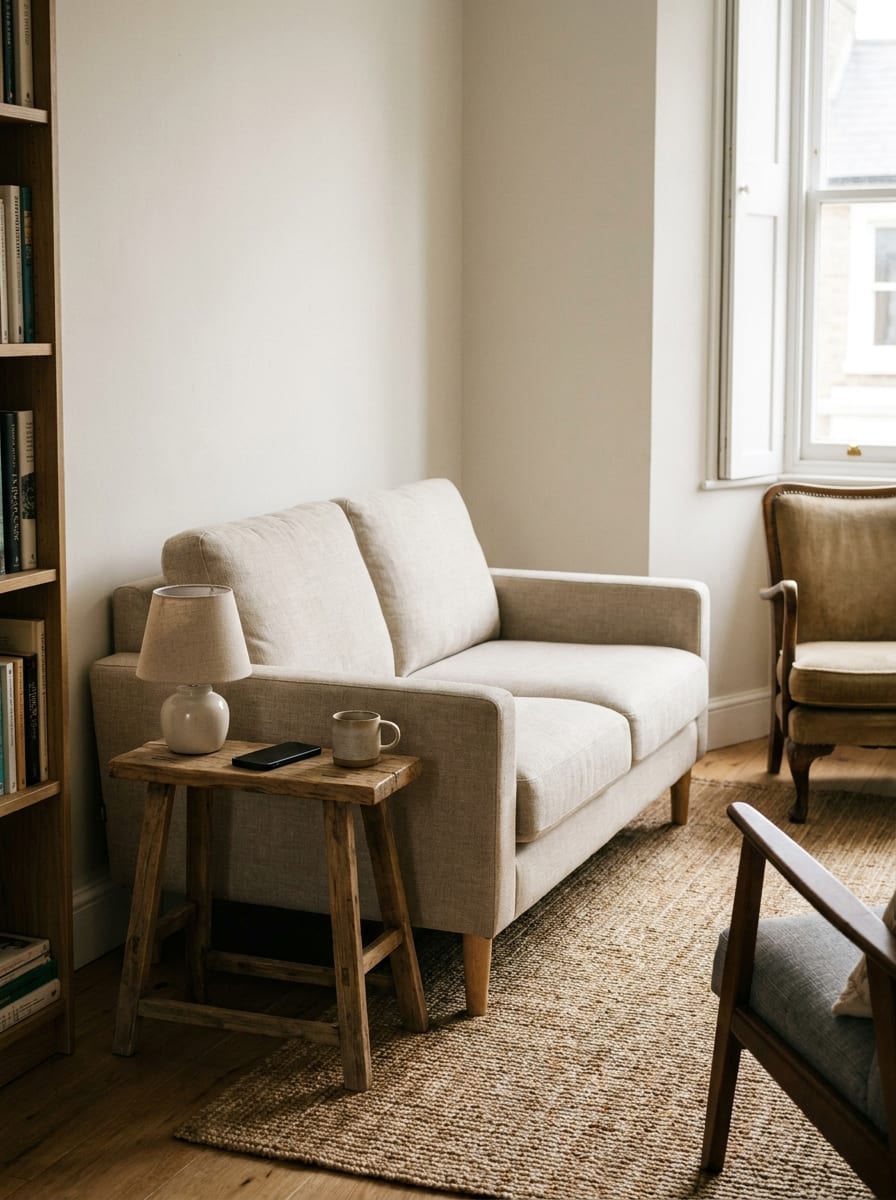
If you are not sure what kind of side table you need, start with the seat rather than the table. Use this order: seat -> reach -> walkway -> function -> table
Step 1: Choose the seat
Decide which seat actually needs a nearby surface. Maybe it is:
- sofa
- reading chair
- both
Step 2: Check reach
Sit normally. Where does your hand naturally reach? That tells you approximately where the tabletop should be.
Step 3: Protect the walkway
Measure the available gap between:
- sofa
- wall
- chair
- doorway
Step 4: Decide what needs to fit
Do you need room for:
- one drink?
- lamp?
- laptop?
- storage?
Step 5: Choose the smallest table that does the job
Do not buy extra furniture surface simply because the space looks empty.
Surface Need vs Storage Need
These are different problems. Surface problem You need somewhere to put a cup. Solution may be:
- C-table
- pedestal
- sofa-arm tray Storage problem You need somewhere for:
- remote
- chargers
- notebook Then a small drawer may make sense. Do not buy storage furniture when what you actually need is only a landing surface.
Do You Need Two Side Tables?
Usually not automatically. Use two only if:
- both ends of the sofa are used regularly
- both sides genuinely need a surface
- the room has enough space Otherwise one may be better.
Matching Tables Are Optional
A small room often benefits from asymmetry. You can use:
- one side table beside sofa
- one C-table near chair instead of a matching pair. Function matters more than perfect symmetry.
Side Table Height Matters
A side table is easiest to use when the tabletop sits at a comfortable height relative to the sofa arm or seat. If it is far too low, you may need to reach down awkwardly. If it is too high, it can feel visually bulky. Test the actual height, not just the width.
Do Not Judge Width Alone
A narrow side table can still be too deep. This is particularly important when it sits between:
- sofa
- wall or near a doorway. Check: width + depth + height before buying.
Measure the Gap Beside the Sofa
Do not estimate. Measure from:
- sofa arm
- wall
- chair
- door trim depending on the location. Then preserve enough room for:
- walking
- cleaning
- furniture movement
Keep Tables Out of the Main Walkway
A table should support sitting, not become something you constantly walk around. If the table projects into the route between:
- living room
- kitchen
- hallway choose something shallower or remove it.
Watch Door Swing
A side table near:
- balcony door
- closet
- entry can interfere with the door even if the table itself fits the gap. Open the door fully before deciding.
Watch Curtain Movement
A table positioned beside a window should not make it difficult to:
- open curtains
- reach blinds unless that window is rarely adjusted.
Side Table Beside a Sofa Against the Wall
If the sofa is pushed very close to the wall, a traditional table may not fit. Better options include:
- C-table
- sofa-arm tray
- floating shelf depending on the setup.
Side Table Beside a Floating Sofa
If the sofa sits away from the wall, you have more flexibility. You may use:
- pedestal table
- small drawer table
- nesting pair but still keep circulation in mind.
Side Table Beside a Sectional
Sectionals can make side-table placement tricky because:
- one end may be beside a chaise
- another may face a walkway Try:
- one table at the open arm
- C-table near chaise
- shared table between sectional and chair instead of automatically adding two large end tables.
Side Table Beside an Accent Chair
A chair usually needs less surface than a sofa. A small:
- pedestal
- round table
- stool may be enough.
Side Table Between Sofa and Chair
This is one of the most efficient setups. One piece serves both seats. Place it where:
- both people can reach it
- it does not block their knees
Do You Need a Lamp on the Side Table?
Not necessarily. A lamp can consume most of a small tabletop. If the room already has good lighting, keep the table open. Or consider moving lighting to:
- wall
- floor where appropriate.
Wall-Mounted Lighting Can Free the Table
A properly installed wall light can remove the need to put a lamp on the table. That can let you choose a much smaller side surface. This is particularly helpful in reading corners.
Floor Lamps Can Also Work
A floor lamp can provide light while the side table handles only:
- drink
- phone But make sure the floor lamp itself does not consume the exact floor space you were trying to save.
Keep Charging Practical
If the side table is where you charge a phone, check the nearby outlet. Avoid long loose cords crossing:
- walkway
- floor Cable routing should remain tidy and safe.
Tables With Built-In Charging
These can be convenient, but do not buy a larger table purely for that feature. A small normal table near an outlet may work just as well.
Open vs Closed Side Tables
Open Feels lighter. Better when:
- storage is not essential
- room feels visually crowded Closed Hides everyday items. Better when:
- remote
- cables
- small clutter need a home.
A Side Table With a Lower Shelf
A lower shelf can add storage without a drawer. But keep it mostly clear. If you fill it with:
- books
- baskets
- magazines the table can quickly look heavier.
Use Baskets Carefully
A small basket can hide:
- remote
- charger but it also occupies most of a tiny tabletop. Sometimes a drawer is more efficient.
What About a Magazine Rack Table?
This can work if magazines are something you actually keep nearby. Do not choose a specialized storage feature for an item you rarely use.
What About a Laptop Table?
If you occasionally use a laptop from the sofa, a C-table may be more practical than a small traditional side table. But for long work sessions, a proper desk setup may still be better.
Side Tables in a Very Narrow Living Room
Prioritize:
- C-table
- pedestal table
- sofa-arm tray
- one-side-only layout Avoid wide cabinet-style tables.
Side Tables in a Square Living Room
You may have more room beside the seating. But that does not mean you need to fill every side. Keep only the surfaces that support how the room is used.
Side Tables in a Studio Apartment
Furniture count matters even more because the whole apartment is visible at once. Choose pieces that are:
- small
- multifunctional
- visually light A nesting table or C-table often works well.
Side Tables in a Living-Dining Room
Pay special attention to the side facing the dining zone. A bulky table at the end of the sofa can reduce the passage between:
- sofa
- dining chair Very quickly.
Side Tables Near the Entry
Keep the area especially clear. A table near the entry can become:
- key drop
- bag drop
- side table all at once. If it starts collecting everything, the living room can look cluttered from the moment you enter.
Round vs Square Side Tables
Round Good for:
- tight walkways
- chairs
- softer edges Square Good for:
- wall alignment
- drawer storage
- larger lamp bases Choose based on the location.
Pedestal vs Four-Leg Table
Pedestal Can feel visually lighter. Four legs May offer more traditional stability and storage options. Neither is automatically better.
Clear Acrylic Side Tables
These can visually disappear into the room. They may work if the living room already contains:
- patterned rug
- darker sofa
- strong decor But remember: transparent furniture still takes up physical space.
Light Wood vs Dark Wood
Light wood can visually blend with:
- pale floors
- neutral furniture Dark wood can create useful contrast. Scale and shape matter more than color alone.
Avoid Oversized Table Lamps
A tiny table beneath a giant lamp can look top-heavy. Choose lighting proportional to:
- table
- sofa
- room
Keep Styling Minimal
A side table is a working surface. You probably do not need:
- lamp
- vase
- plant
- candle
- books
- tray all together. Leave some clear space for actual use.
The Two-Item Styling Rule
For very small side tables, start with:
1. one functional item
2. one optional decorative item
For example:
- lamp
- small book Then leave the rest open.
Make Sure a Drink Can Still Fit
This sounds obvious. But styled rooms often fill every available inch. If the table cannot hold a cup, it is not functioning as a side table anymore.
Avoid Matching Every Furniture Finish
The side table does not need to perfectly match:
- coffee table
- TV unit
- dining table A room often feels more natural when finishes coordinate without being identical.
Use Shape to Add Variety
If the room already has:
- rectangular sofa
- rectangular rug
- rectangular coffee table a round side table can introduce useful contrast.
Let One Table Be the Accent
If you want a stronger design moment, use one interesting side table rather than two decorative pieces fighting for attention.
Small-Space Furniture Should Earn Its Footprint
Ask: What does this table do? If the answer is only: It fills the gap beside the sofa, you may not need it.
Try Living Without the Second Table
If you already have matching end tables, temporarily remove one for a few days. Notice:
- does anyone miss it?
- is the room easier to move through?
- does the sofa area look lighter? That is a useful real-world test.
Use Painter’s Tape Before Buying
Mark the side table footprint on the floor. Then:
- sit down
- stand up
- walk past
- open nearby doors This is particularly useful for tables purchased online.
Use a Box as a Mockup
A cardboard box close to the proposed dimensions can show you:
- width
- height
- depth better than measurements alone.
Check Reach While Sitting Normally
Do not lean forward for the test. Sit exactly how you normally would. Can you comfortably reach:
- drink
- phone without twisting? If not, the location is wrong.
Check the Table From the Doorway
A small living room can feel crowded when furniture lines every edge. Look from the entrance. Ask whether the side table makes the seating area feel:
- complete
- or overfilled.
Check Cleaning Access
A table squeezed into a two-inch gap between:
- sofa
- wall may become annoying to clean around. Leave practical access where possible. Renter-Friendly Side Table Ideas Side tables are naturally renter-friendly because they usually require no modification. Good choices include:
- pedestal tables
- C-tables
- nesting tables
- narrow drawer tables
- stools Wall-mounted designs may require permission depending on the rental. Common Small Living Room Side Table Mistakes Buying matching tables automatically You may only need one. Choosing based on width but ignoring depth Projection into the room matters. Using the table only for decoration Function should come first. Filling every empty gap Open space is valuable. Choosing a giant lamp for a tiny table Scale should work together. Blocking a walkway Protect movement before surface area. Adding storage you do not need Cabinet tables create more visual weight. Ignoring sofa height The surface needs to be comfortable to reach. Putting a table beside every seat One table can often be shared. Styling away all the usable surface Leave room for real life. A Quick Side Table Decision Guide
Choose the Slim Pedestal Table if:
You want a traditional side surface with minimal visual bulk.
Choose the C-Table if:
There is almost no floor space beside the sofa.
Choose the Narrow Drawer Table if:
You need hidden storage for daily essentials.
Choose the Floating Table if:
Floor clearance is the main priority.
Choose Nesting Tables if:
You occasionally need extra surface.
Choose the Sofa-Arm Table if:
There is literally no room beside the sofa.
Choose the Tiny Round Table if:
The table sits near a walking path or chair.
Choose the One-Side-Only Layout if:
Two tables are unnecessary.
Choose the Shared Table if:
Sofa and chair sit close together.
Choose the Storage Stool if:
You also need occasional extra seating.
Use the Right-Size Formula if:
You are choosing furniture from scratch. The Simplest Small-Living-Room Side Table Formula Start with: easy reach + smallest useful surface + clear walkway Then add storage only if you genuinely need it. Final Thoughts A small living room does not need a matching end table at every sofa arm. It needs a few useful surfaces in the right places. Start by asking what people actually reach for. Then look at:
- sofa height
- available floor gap
- walkway
- outlets
- nearby chairs A narrow pedestal may be enough. A C-table may work better. One table may serve two seats. Or a sofa-arm tray may eliminate the need for another piece of furniture entirely. The goal is not to make the living room look fully furnished. It is to make everything you need easy to reach without making the room harder to move through.