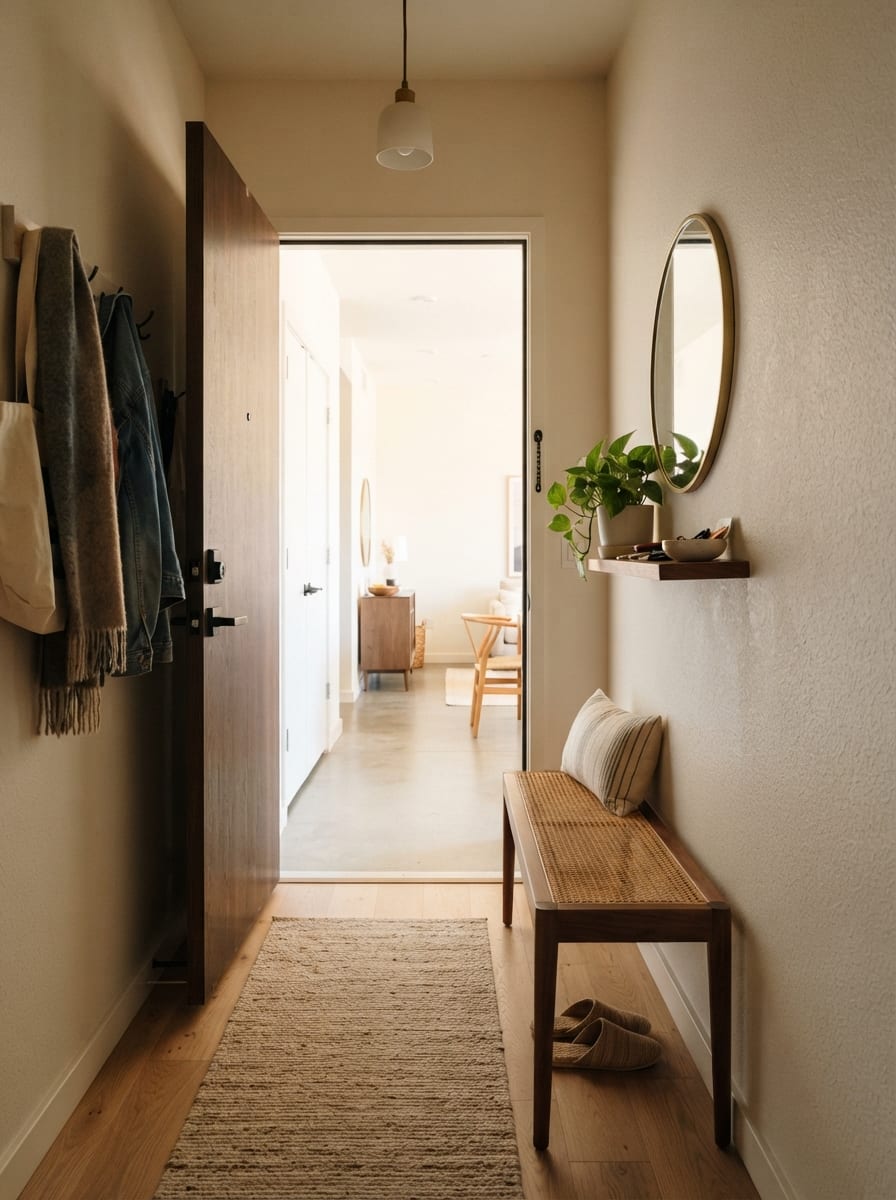
10 Small Apartment Entryway Bench Ideas That Add Seating Without Blocking the Door
Add seating without blocking the front door. Discover 10 small entryway bench ideas with shoe storage, narrow profiles, and wall-hugging frames for tight halls.
In This Guide
A bench can make an apartment entryway much easier to use.
It gives you somewhere to:
- sit while putting on shoes
- place a bag for a moment
- organize footwear
- create a visual landing zone.
But small apartment entrances usually have very little spare floor space.
The area around the front door may already need room for:
- door swing
- coat storage
- shoes
- bags
- closet doors
- hallway circulation.
That means a bench can solve one problem and create another.
The most common mistake is choosing the bench by width alone.
A bench may fit neatly along the wall but still project too far into the walkway.
Or it may look perfect when the front door is closed but block the door once it opens.
The best small-entryway bench should earn its footprint.
It should either:
- add seating
- replace another storage piece
- organize shoes
- define the entry zone
without making you navigate around it every time you come home.
Here are ten practical small apartment entryway bench ideas that make the entrance more functional without blocking the door.
1. The Wall-Hugging Slim Bench
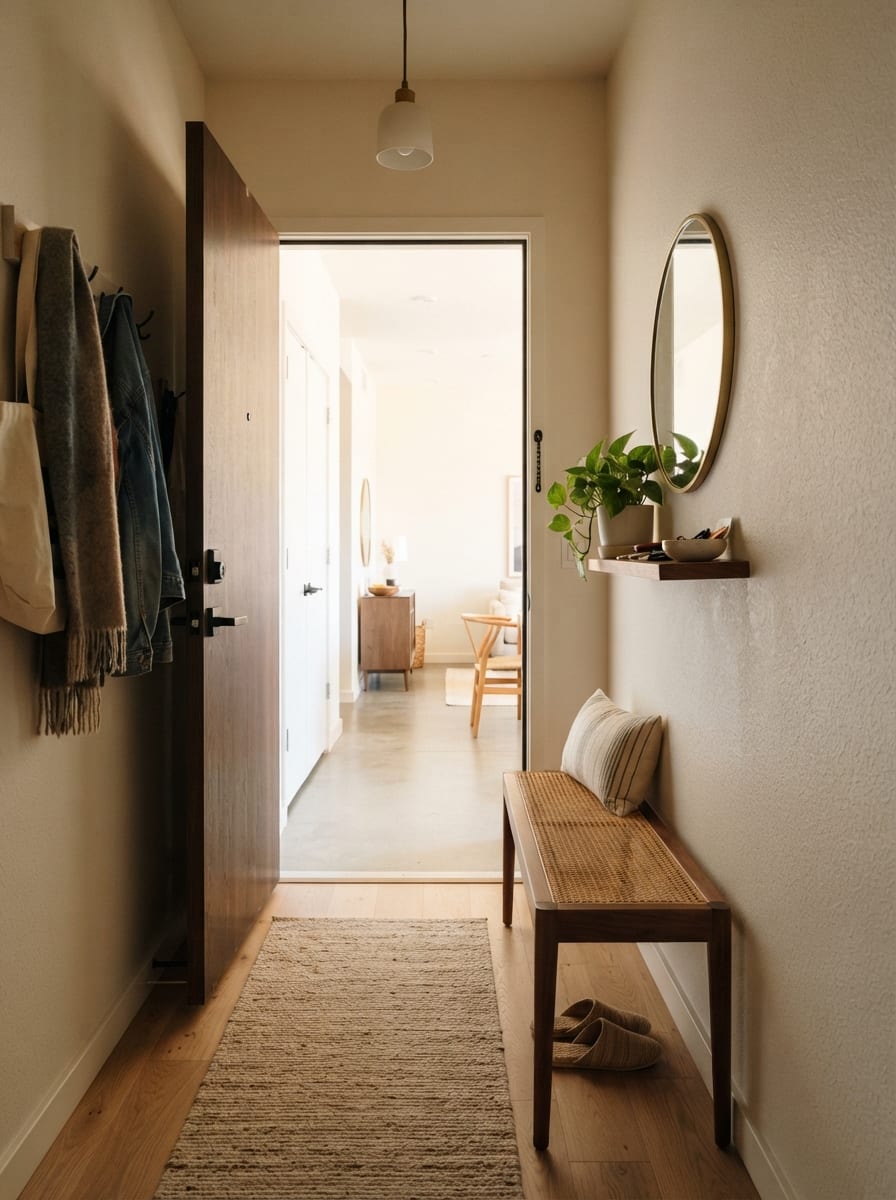
A shallow bench is usually the safest starting point for a tight apartment entrance.
Instead of choosing a deep furniture-style bench, look for a design that stays close to the wall.
Why it works
Depth often matters more than width in an entryway.
A wider bench can sometimes work if it remains shallow.
A short but deep bench may still:
- pinch the walkway
- crowd the door
- make the hallway feel narrower.
Keep the profile simple
Good features include:
- narrow seat
- slim legs
- minimal backrest
- no bulky arms.
A backless bench often takes up less visual and physical space.
Best placement
Use it along a wall that does not interfere with:
- front-door swing
- closet door
- utility cabinet
- main hall.
Measure from the wall into the room
This is the measurement that determines whether the bench actually works.
Do not judge from furniture photos alone.
2. The Shoe-Shelf Bench
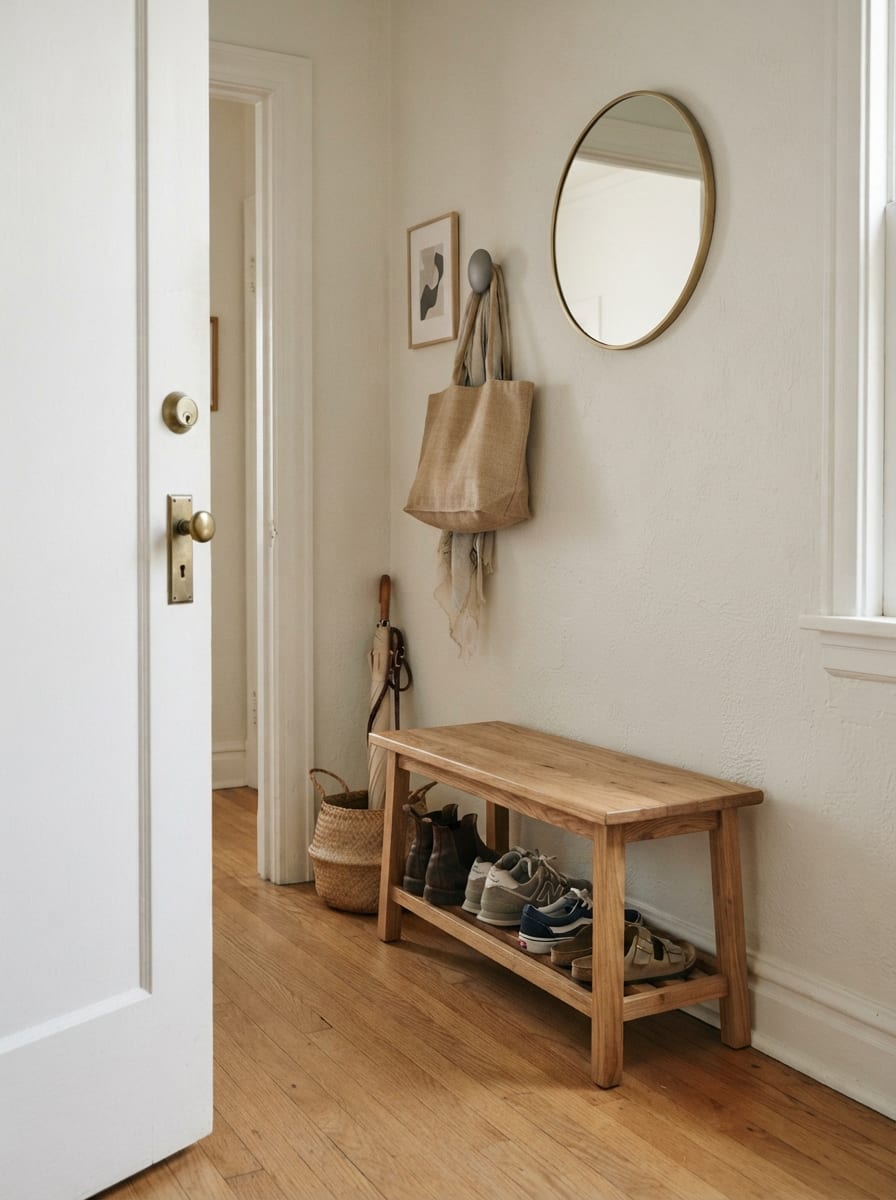
If shoes are already collecting near the front door, a bench with an open lower shelf can combine:
seating + shoe storage
in one footprint.
Why it works
Instead of using:
- separate shoe rack
- separate stool
you solve both needs with one piece.
Keep shoe capacity realistic
A small entry bench does not need to hold every shoe you own.
It should primarily hold:
- daily shoes
- current-season footwear
- guest shoes temporarily.
Store less-used pairs elsewhere.
Open shelves usually feel lighter
In a narrow entrance, open storage can make the bench look less bulky than a solid cabinet.
Keep the floor easy to clean
A raised shelf leaves some access underneath and keeps shoes off the main walkway.
Use trays where necessary
If wet footwear is common, a removable tray can help contain:
- water
- dirt
- grit
without turning the whole bench into a mudroom cabinet.
3. The Corner Entry Bench
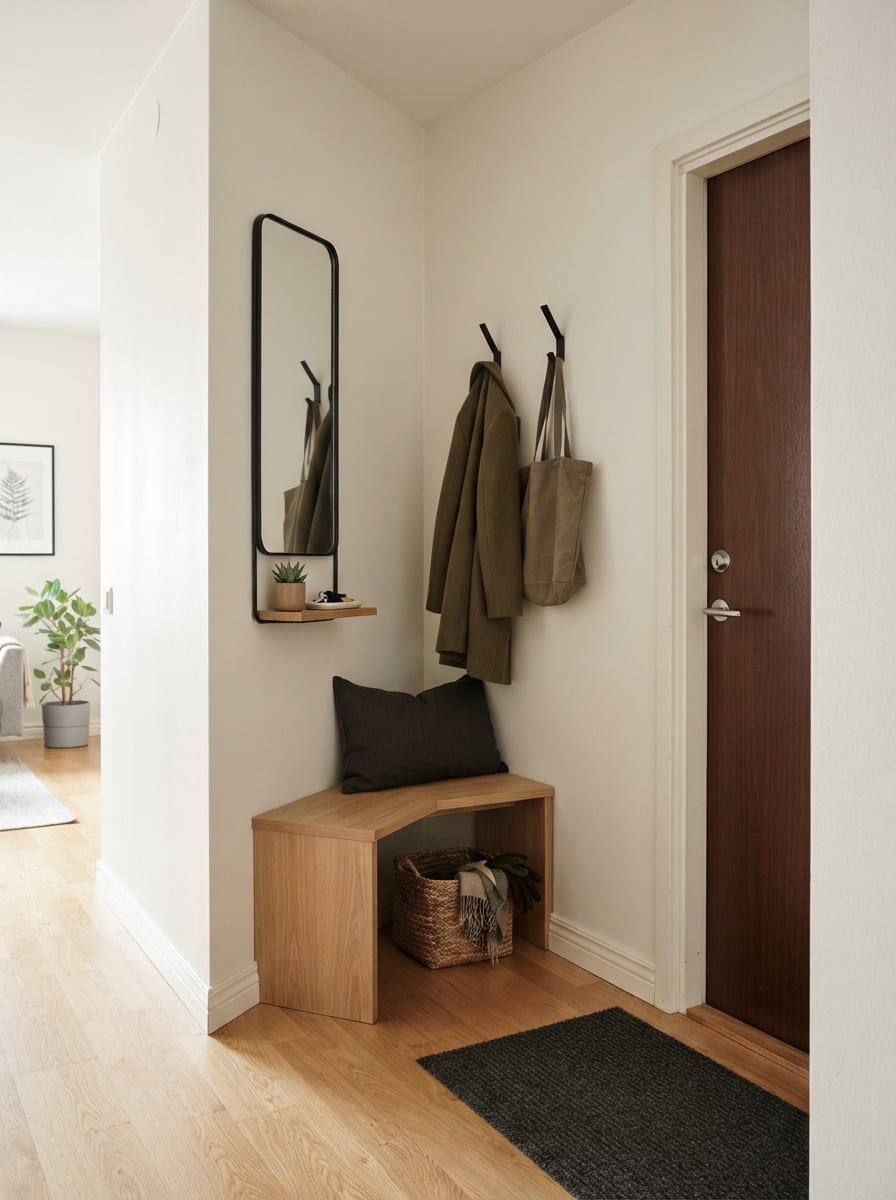
Some apartment entrances have one awkward corner near the door that is too small for a console but large enough for a compact seat.
A corner bench can turn that dead zone into a useful landing spot.
Why it works
You use floor area that might otherwise remain empty without projecting furniture into the center of the hall.
Watch the door carefully
Corner placement only works if the door can open completely.
Test:
- door edge
- handle
- bench corner.
Keep the bench compact
A small square or narrow rectangular bench can work better than an L-shaped built-in.
Use the wall above
A few hooks or a mirror can turn the corner into a complete landing zone.
Keep the upper wall edited so the space does not become visually packed.
4. The Floating Bench
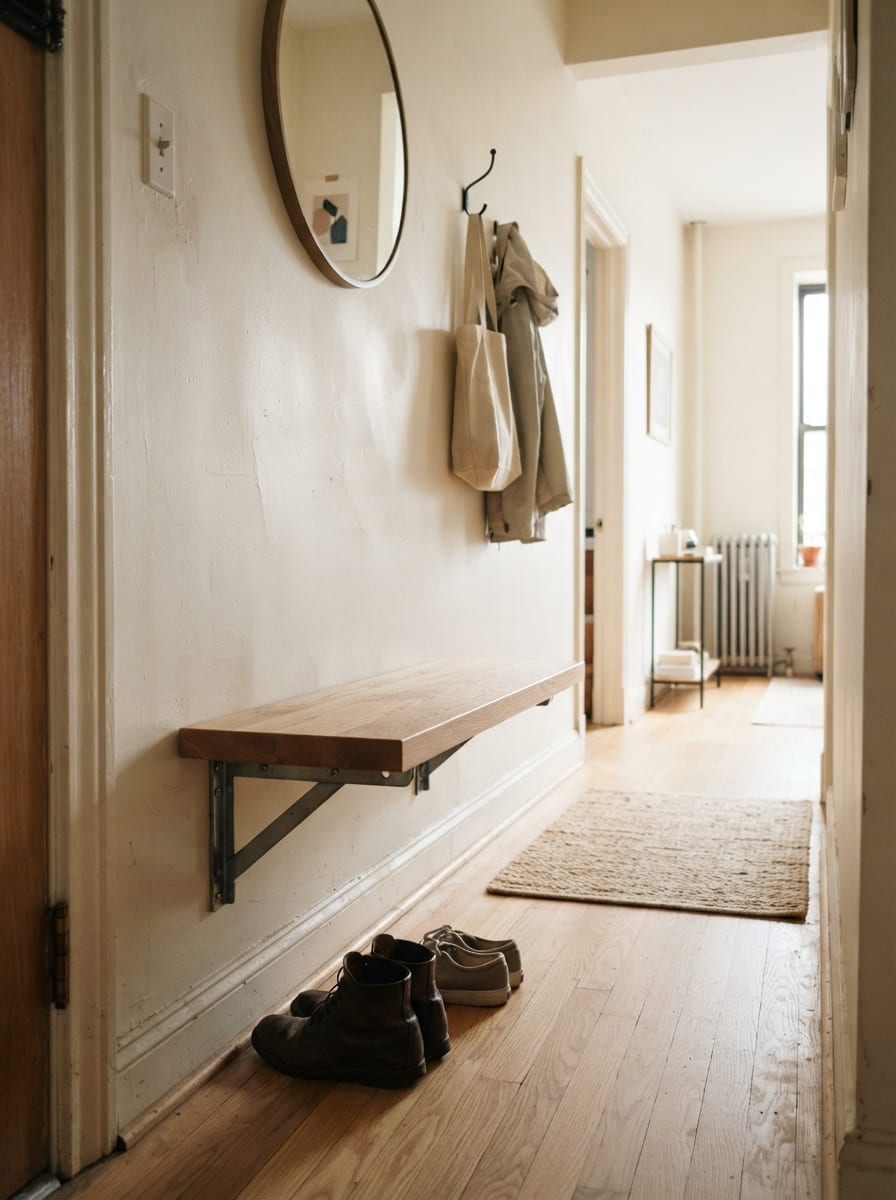
A wall-mounted floating bench can preserve visible floor underneath and make the entry feel lighter.
This is particularly useful when a freestanding bench looks too bulky.
Why it works
The floor continues visually under the seat.
That can make a narrow entrance feel less filled with furniture.
It also leaves space below for:
- one or two pairs of shoes
- a removable shoe tray
without adding another storage unit.
Mounting matters
A bench carries body weight, not just decor.
It must be installed with hardware appropriate for:
- wall type
- bench design
- expected load.
Follow manufacturer and installation guidance.
Rental considerations
A floating bench may require substantial wall attachment.
Check lease restrictions before installation.
Keep the underside uncluttered
Do not immediately fill the open area with:
- baskets
- boxes
- shoe piles.
That defeats much of the visual benefit.
5. The Open-Leg Bench
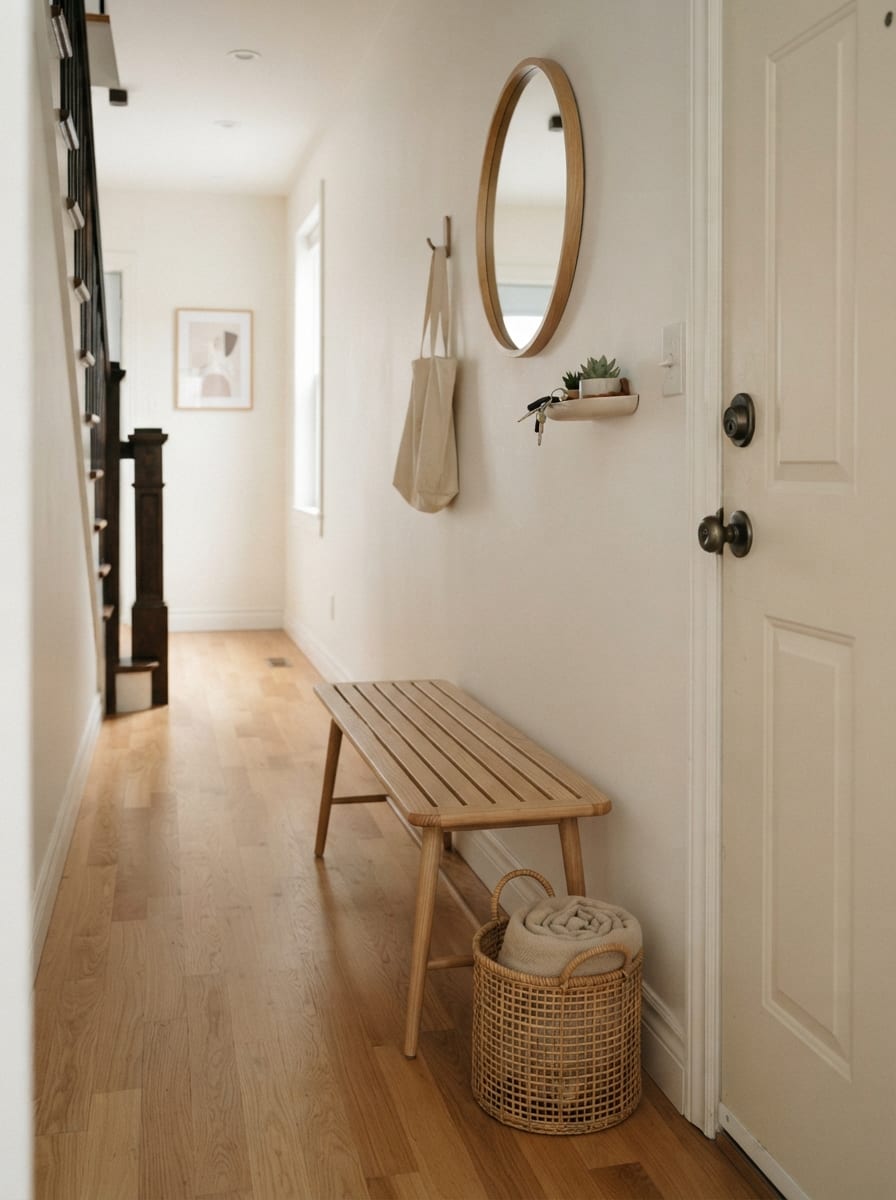
A bench with slim open legs can feel visually lighter than a piece with a solid base.
This is useful in an entrance where you want seating but do not need significant closed storage.
Why it works
You can see:
- wall behind
- floor below
- open space around the frame.
That reduces the feeling of one more large furniture block.
Keep the legs narrow but stable
Visual lightness should not come at the expense of stability.
Choose furniture designed for sitting.
Good for clean, simple entries
This works well if your main storage is already handled by:
- closet
- hooks
- shoe cabinet.
The bench only needs to provide seating.
Add one small basket at most
If you want a little storage beneath, one contained basket can work.
Do not pack the whole underside.
6. The Bench + Hook Zone
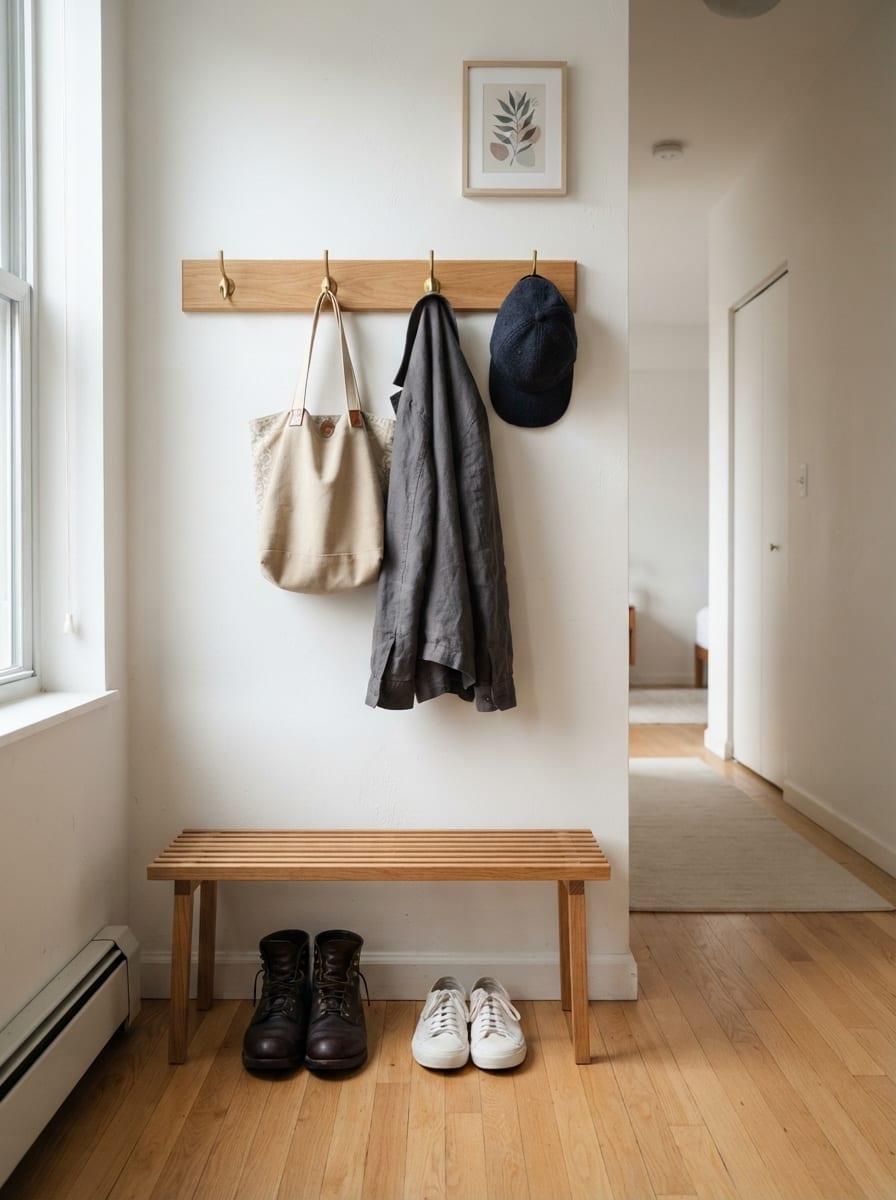
A bench becomes much more useful when the wall above it handles vertical storage.
This creates a full landing zone without adding another floor-standing cabinet.
Use the bench for
- sitting
- shoes
- bag landing.
Use the wall for
- coats
- tote bags
- hats
- keys
where appropriate.
Why it works
The storage expands upward instead of deeper into the room.
Keep hooks within reach
Place everyday hooks where they are easy to use.
Do not mount all storage unusually high just because the wall is tall.
Limit the number of hanging items
A small entry can look chaotic if every hook is loaded with:
- coats
- bags
- scarves.
Keep current daily items at the entrance and rotate seasonal extras elsewhere.
Leave visual space above the bench
The wall does not need to become a full pegboard.
7. The Bench With Hidden Storage
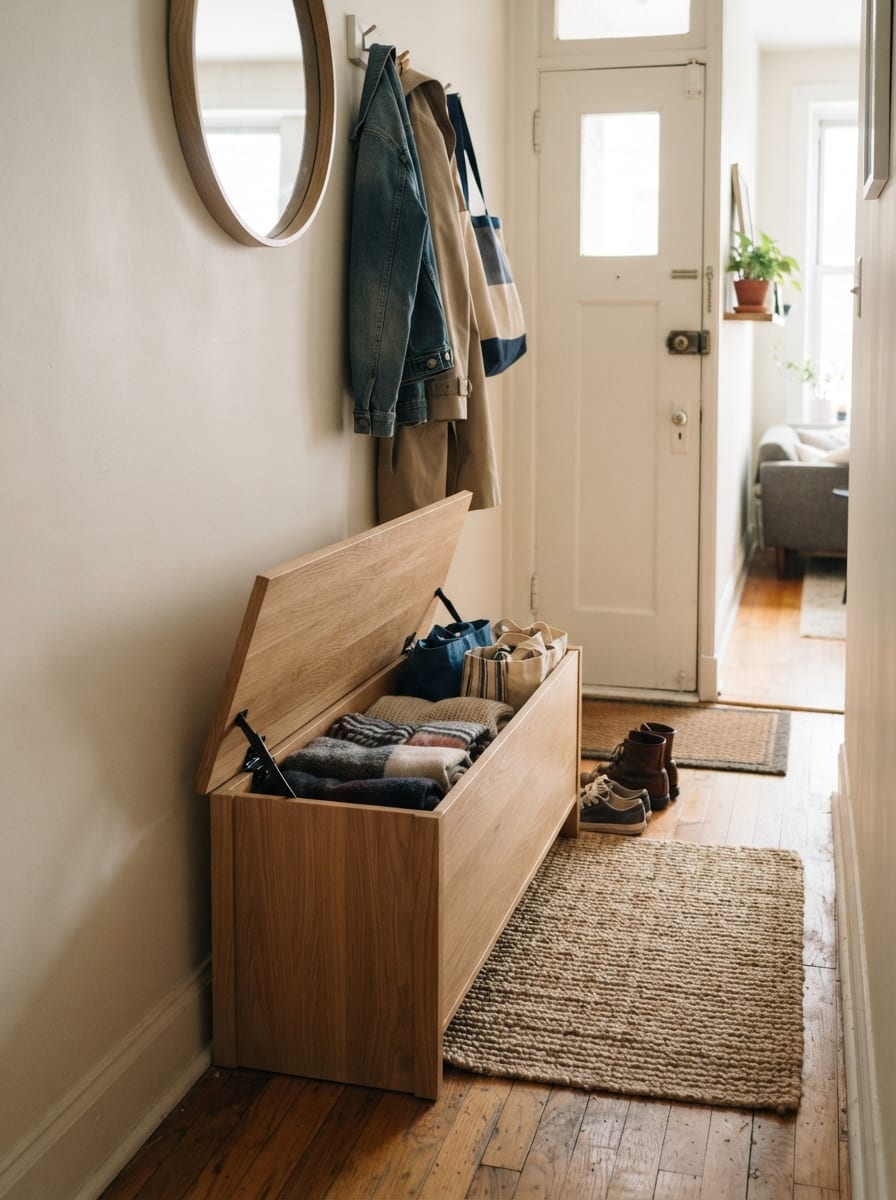
If the apartment truly lacks storage, a bench with a lift-up seat or contained drawers can make sense.
The key is choosing a storage bench that remains visually and physically compact.
Why it works
The furniture earns its floor space twice:
seating + concealed storage.
Good items to store
Depending on the bench design, it may work for:
- reusable bags
- scarves
- gloves
- umbrellas
- shoe-care items
- small seasonal accessories.
Do not turn it into a catch-all
Hidden storage becomes useless if every random object gets dropped inside.
Assign the compartment one or two clear functions.
Check lid clearance
A lift-up bench needs vertical room.
Make sure:
- coat hooks
- shelves
- wall decor
do not interfere with opening.
Drawers need front clearance
A bench with drawers may not work in a narrow hallway if the drawer itself blocks the passage when open.
8. The Narrow Upholstered Bench
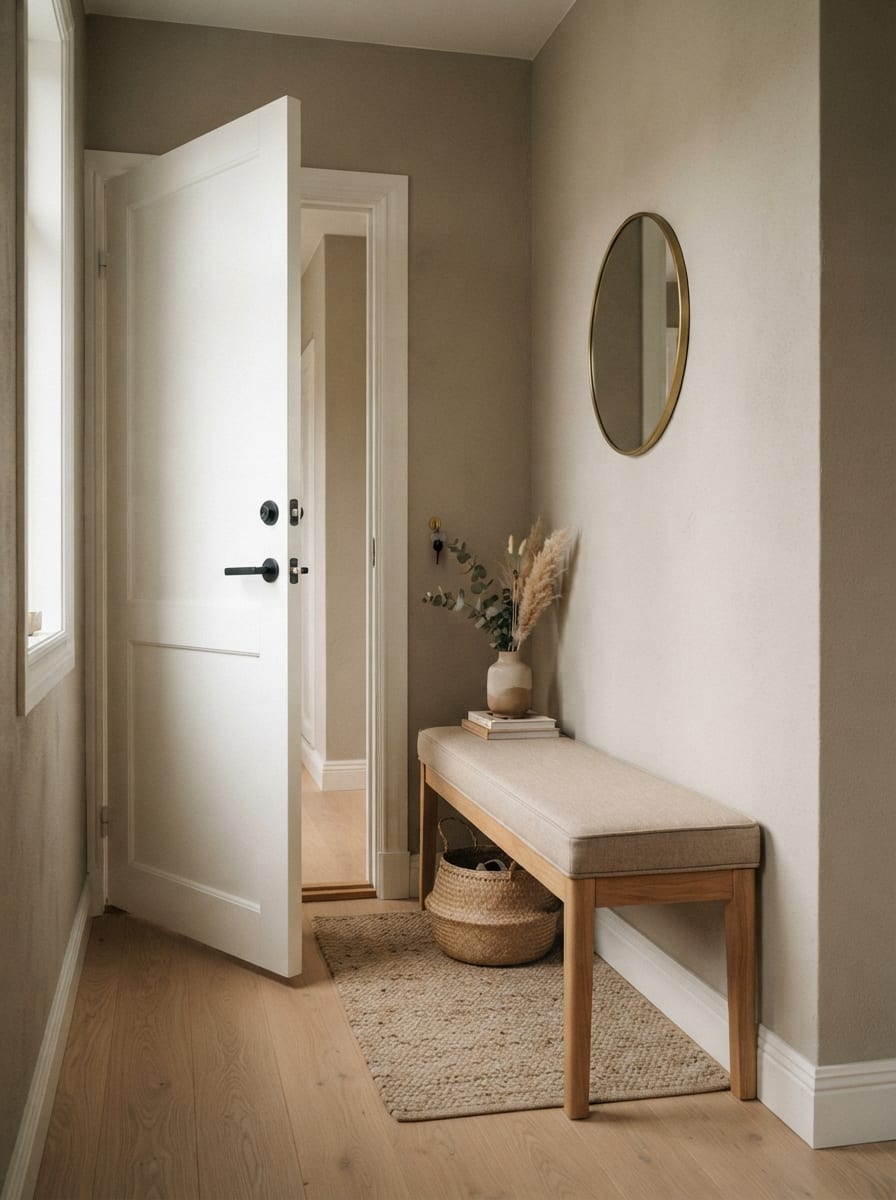
A bench does not need to look strictly utilitarian.
A slim upholstered seat can soften an entryway filled with hard surfaces.
Why it works
Apartment entrances often contain:
- hard flooring
- painted doors
- mirrors
- metal hooks.
A little upholstery can make the area feel more welcoming.
Keep the cushion controlled
Avoid an overly thick padded seat that visually bulks up the bench.
A thinner tailored cushion often works better.
Choose durable fabric
Entry seating encounters:
- bags
- coats
- shoes
- outdoor clothing.
Choose a surface appropriate for regular use and cleaning.
Keep the frame narrow
Let the fabric provide softness without increasing the furniture footprint.
9. The No-Entryway Bench Divider
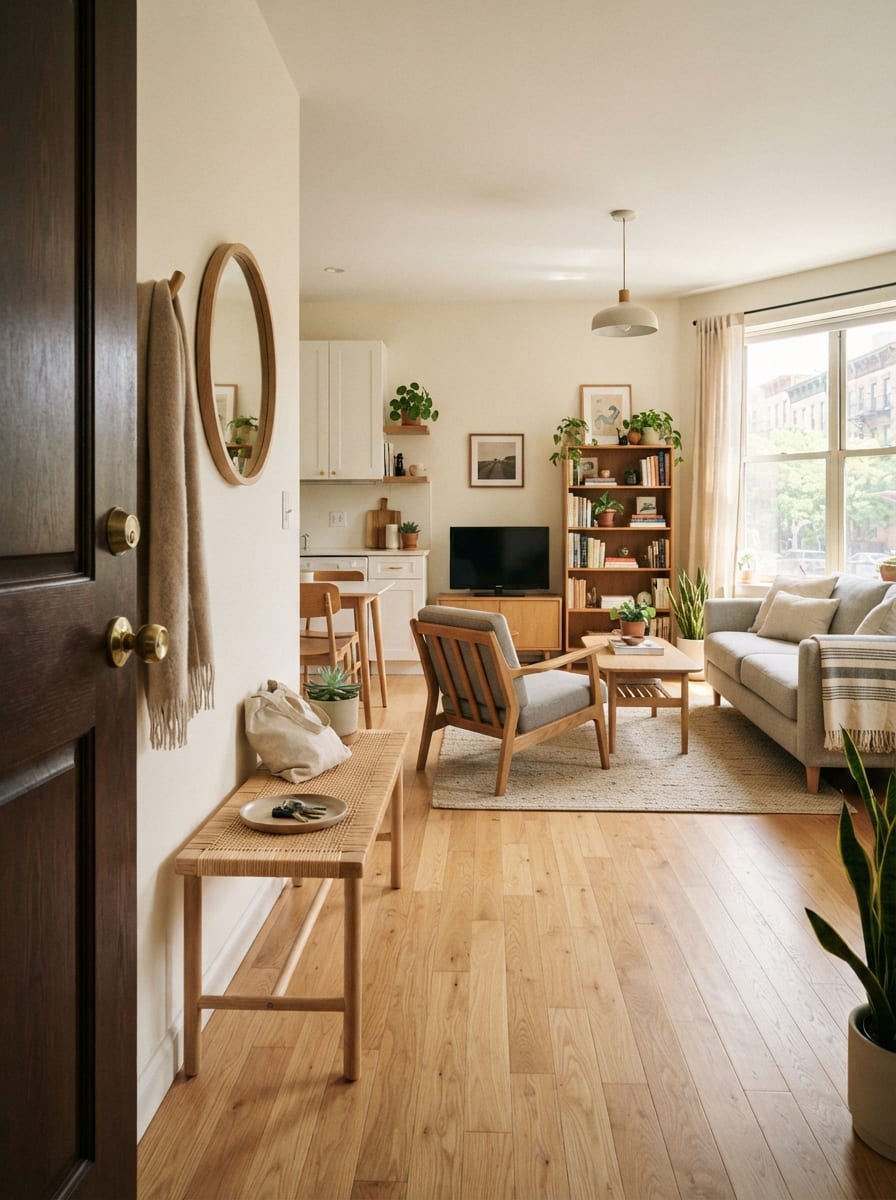
Some apartments open directly into the living room with no true foyer.
A bench can help define the entrance without building a wall or adding a tall divider.
Why it works
The bench establishes a subtle boundary between:
arrival zone
and:
living zone.
Because it stays low, it does not block sightlines.
Use it perpendicular only when space allows
A bench placed perpendicular to the wall can create a stronger boundary, but it uses more circulation space.
In tighter apartments, keeping it against the wall may be safer.
Coordinate it with the living room
Because the bench is visible from the main space, choose a finish related to:
- coffee table
- dining furniture
- shelving.
Keep the back simple
If the rear of the bench is visible, choose a design that looks finished from all sides.
10. The Door-Swing-First Bench Formula
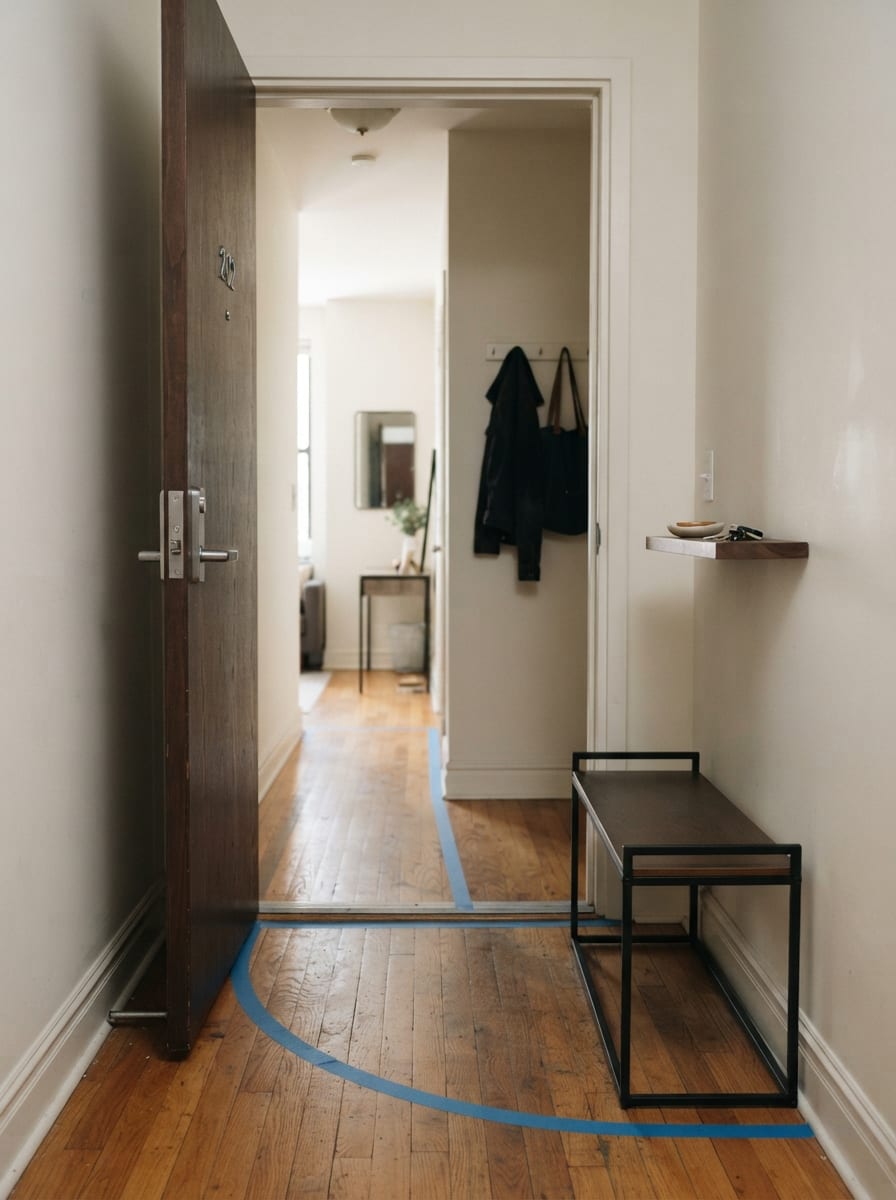
Before buying an entryway bench, plan the door and walking path first.
Use this order:
door swing → walkway → bench depth → seating function → storage
Step 1: Open the front door fully
Mark the arc on the floor mentally or with removable tape.
That zone belongs to the door.
Do not place furniture inside it.
Step 2: Identify the walking path
Ask where you move after entering.
Usually:
front door → hallway → living room
or:
front door → closet → main room.
Protect that route.
Step 3: Measure the remaining depth
This determines how shallow the bench must be.
Step 4: Decide what the bench needs to do
Is the priority:
- sitting
- shoes
- hidden storage
- entry definition?
Step 5: Choose the design
Only after the spatial test should you choose:
- upholstered
- wood
- open shelf
- storage bench.
Start With the Door, Not the Bench
Before measuring the wall, open the front door completely.
This sounds obvious, but it prevents one of the most common mistakes.
A bench may fit against the wall when the door is closed but interfere with:
- door edge
- handle
- lock
- entry movement
when someone comes home.
Mark the Door Swing
Use removable painter’s tape if necessary.
Mark where the door travels.
That floor area should stay clear.
Check the Door Handle
The door itself may miss the bench while the handle hits it.
Measure both.
Think About Entering With Bags
A normal entry test is not enough.
Imagine coming through the door carrying:
- groceries
- backpack
- packages
- umbrella.
Do you still have enough room to turn?
Protect the First Few Steps Inside
The area immediately inside the apartment should not feel like an obstacle course.
Bench Depth Is Often More Important Than Width
A long shallow bench can work surprisingly well.
A short deep bench can create a pinch point.
Measure From Wall to Walking Path
Determine how much floor depth you can give away while still preserving comfortable circulation.
Do Not Buy Based on Standard Bench Dimensions
Entry layouts vary too much.
Measure your actual space.
Use Painter’s Tape to Test the Footprint
Mark:
- bench width
- bench depth.
Then live with it temporarily.
Walk past it several times.
Put Shoes Inside the Tape
If you plan to store footwear under the bench, include the shoe projection in your test.
Shoes Can Stick Out Farther Than the Bench
This is a common problem with very shallow shoe benches.
Make sure footwear does not end up in the walkway.
Boot Storage Needs More Height
If tall boots will live underneath, check shelf spacing.
Limit the Entry to Daily Shoes
The bench does not need to become the entire household shoe closet.
Keep Seasonal Overflow Elsewhere
This prevents the area under the bench becoming crowded.
Check Closet Doors
An entry closet may use:
- hinged doors
- sliding doors
- bifold panels.
The bench should not interfere with any of them.
Check Utility Closets
Apartment entries often contain:
- electrical panels
- HVAC closets
- laundry cupboards.
Do not block required access.
Check Intercoms and Switches
A tall bench back or wall setup can interfere with:
- light switches
- thermostats
- intercom controls.
Bench Beside the Front Door
This works when the door swings away from it.
Bench Opposite the Front Door
This can create a strong focal point, but only if enough entry depth remains.
Bench Behind the Open Door
Sometimes possible if the wall zone remains accessible.
Check that the door does not trap access to:
- shoes
- storage
- coat hooks.
Bench at the End of a Hallway
A compact bench can terminate the sightline nicely.
But do not block the path into adjacent rooms.
Bench Under a Window
Useful when there is no radiator or window-access conflict.
Keep the bench low enough that it does not block:
- window operation
- natural light.
Bench Beside a Closet
This can create a complete getting-ready zone.
Protect closet door clearance.
Bench Near a Mirror
Very practical for:
- shoes
- last look before leaving.
Bench Under Wall Hooks
One of the most efficient small-entry combinations.
Bench Under a Shelf
Can work, but leave enough headroom for sitting.
Bench With a Coat Rack
Be careful with visual bulk.
A separate freestanding coat rack plus bench can consume too much floor area.
Wall hooks are usually more efficient.
No-Entryway Apartment
When the door opens directly into the living room, use the bench to signal:
arrival happens here.
Define the Zone With a Rug
A small washable runner or mat can reinforce the entry.
Do not crowd the floor with multiple rugs.
Use the Bench as the Boundary
A low piece can create separation without blocking sightlines.
Avoid Tall Room Dividers by Default
They may make a small open-plan apartment feel more enclosed.
Studio Apartment Entry
The bench should coordinate with the rest of the furniture because it is visible from almost everywhere.
Narrow Hallway Entry
Choose the shallowest workable option.
Wide but Short Entry
You may have room for a slightly wider bench.
Keep it from interfering with the door.
Tiny Entry With No Side Wall
A small stool may be more realistic than a full bench.
Do not force a bench if the layout cannot support it.
Bench vs Stool
Bench
Better when you need:
- two-person width
- shoe storage
- visual anchoring.
Stool
Better when:
- floor area is extremely limited
- one seating spot is enough.
Bench vs Shoe Cabinet
A bench provides seating.
A shoe cabinet may store more footwear in less depth.
Choose based on your actual problem.
Bench + Shoe Cabinet?
Usually too much furniture for a small entrance unless the layout is unusually generous.
Bench vs Console
A console provides:
- key drop
- decor
- mail surface.
A bench provides:
- seating
- shoe function.
If you need both, choose one multifunctional piece or use wall storage.
Add a Small Wall Shelf Instead of a Console
This can pair well with the bench without adding another floor footprint.
Bench + Mirror
This is one of the cleanest combinations.
The mirror adds:
- function
- light
- vertical interest.
Round Mirror
Softens the straight lines of a bench.
Vertical Mirror
Useful in narrow entries.
Keep the Mirror Proportionate
Do not pair a tiny bench with an enormous mirror unless you intentionally want it to dominate the wall.
Bench + Hooks
Ideal for daily items.
Bench + Peg Rail
Creates a clean horizontal line.
Bench + Closed Wall Cabinet
Possible if upper storage is needed.
Make sure it does not project into head space when sitting.
Bench + Shelf
Keep the shelf high enough to avoid head bumps.
Bench + Artwork
Works well if storage is handled elsewhere.
Bench + Basket
One basket can contain:
- scarves
- dog leash
- reusable bags.
Too Many Baskets
Several baskets under the bench can make the setup look like a storage unit rather than an open landing zone.
Open Storage
Best when you can keep contents edited.
Closed Storage
Better for visually messy items.
Drawers
Useful for small accessories.
But they require front-opening clearance.
Lift-Up Storage
Efficient but needs enough room above.
Shoe Shelf
Simple and practical.
Cubbies
Can work, but many tiny cubbies create more visual subdivision.
Avoid Overcomplicated Bench Systems
Small entries usually look better with fewer components.
Wood Bench
Adds warmth and works with many apartment styles.
Metal Bench
Can feel visually lighter.
Upholstered Bench
Adds softness.
Cane Bench
Can add texture, but check durability and product suitability for daily sitting.
Plastic or Molded Bench
Can be practical in high-traffic entries and easy to clean.
Dark Bench in a Light Entry
Creates a strong visual anchor.
Light Bench in a Narrow Entry
Usually recedes more.
Match the Bench to the Floor?
Not necessary.
Slight contrast can help define the zone.
Match the Bench to the Living Room?
In open-plan apartments, this often helps the spaces feel connected.
Keep the Bench Styling Minimal
A bench should still be usable.
Do not cover it with:
- pillows
- baskets
- folded throws
- decor.
One Small Cushion Is Enough
If comfort is needed, keep it slim.
Do Not Use Decorative Pillows as Permanent Seat Clutter
You should not have to remove three cushions every time you put on shoes.
One Bag on the Bench?
Temporary is fine.
Permanent bag piles are not.
The Bench Is Not a Mail Table
Keep paper clutter elsewhere.
Use a Tray on a Wall Shelf for Keys
This keeps the seat clear.
Keep the Seat Ready
A functional entry bench should be available immediately.
Add One Hook for Bags
Instead of letting bags occupy the bench.
Entryway Lighting
A small light can make the landing zone feel intentional.
Use:
- ceiling light
- wall light
- nearby lamp
without adding a floor lamp to an already tight space.
Bench Below a Sconce
Can work if electrical installation is appropriate.
Plug-In Sconces
May be renter-friendly depending on setup, but manage the cord carefully.
Entryway Rug + Bench
The rug should not interfere with bench legs or door clearance.
Keep the Front Door Mat Practical
You may not need a second decorative rug directly beside it.
Narrow Runner
Can visually connect the bench to the hallway.
Avoid Thick Rugs Under Doors
Check clearance.
Bench Near a Radiator
Follow heater clearance guidance.
Do not block heat output.
Bench Over a Vent
Avoid covering airflow.
Bench Near Electrical Panels
Maintain required access.
Bench Near a Fire Safety Device
Do not block or cover safety equipment.
Renter-Friendly Entry Bench Ideas
Freestanding benches are especially useful because they do not require permanent modification.
Pair them with:
- over-door storage where suitable
- approved hooks
- freestanding baskets
- removable decor.
Check Lease Rules Before Wall Mounting
Especially for:
- floating benches
- heavy shelves
- large mirrors.
Do Not Assume Adhesive Hooks Can Hold Heavy Coats
Follow load ratings.
Keep Heavy Items on Proper Supports
A coat loaded with:
- keys
- bag
- umbrella
can be heavier than expected.
Small Entry With Children
Prioritize:
- stable bench
- rounded corners where appropriate
- safe wall attachment for nearby furniture.
Entry Bench With Pets
Keep:
- leashes
- wipes
- waste-bag supplies
in one contained area rather than covering the whole bench.
Guest-Friendly Entry Bench
Leave some seating space open instead of filling it with household items.
Entry Bench for Two People
A wider bench may be useful if the wall supports it.
But do not sacrifice walkway depth just to gain a second seat.
One-Person Bench May Be Enough
In many apartments, the bench is used only briefly.
Bench Height
It should be comfortable for sitting and putting on shoes.
Avoid unusually low decorative benches if they are difficult to use.
Very High Benches
Can feel more like consoles and may be uncomfortable for footwear changes.
Backrest or No Backrest?
Backless
Usually better for:
- visual lightness
- tight walls
- open-plan entries.
Backrest
Can be more comfortable but adds visual mass.
Arms or No Arms?
Skip arms in very small entries.
They increase width and can make the bench feel bulkier.
Built-In Bench
Can be excellent if the apartment is owned or permanent modification is appropriate.
But built-ins should be carefully measured because they cannot move later.
Freestanding Bench
More flexible for renters and changing layouts.
Floating Bench
Best when you want the floor to remain visually open.
Bench With Legs
Easy to reposition and clean around.
Cleaning Access Matters
Entry floors collect:
- dirt
- dust
- grit.
Choose a bench that allows practical cleaning around or beneath it.
Keep Shoes Off the Main Path
Even a well-sized bench fails if shoes spill out into circulation.
Use a Shoe Tray
Helpful for wet weather.
Let Shoes Dry
Avoid sealing damp footwear immediately into closed storage without considering ventilation.
Rotate Seasonal Footwear
Do not store winter boots under the bench all summer.
Keep Umbrellas Contained
A slim umbrella holder may work beside the bench if it does not widen the zone too much.
Wall-Mounted Umbrella Storage
Can preserve floor space where appropriate.
Common Small Apartment Entry Bench Mistakes
Choosing by width but ignoring depth
The bench fits the wall but blocks circulation.
Ignoring the front-door swing
The door hits the bench.
Storing too many shoes underneath
Footwear spills into the hallway.
Using a bulky backrest
The entrance feels visually crowded.
Adding a console and bench
Too much floor furniture accumulates near the door.
Covering the seat with decor
The bench stops functioning as seating.
Blocking a closet
The entry becomes harder to use.
Using too many baskets
The setup becomes visually dense.
Installing wall storage directly over head space
Sitting becomes awkward.
Buying storage before deciding what actually needs to live at the door
The entry fills with unnecessary items.
Quick Small Entryway Bench Decision Guide
Choose a Wall-Hugging Bench if:
Depth is your biggest constraint.
Choose a Shoe-Shelf Bench if:
Daily footwear is creating floor clutter.
Choose a Corner Bench if:
You have an otherwise unused corner outside the door swing.
Choose a Floating Bench if:
You want seating while keeping the floor visually open.
Choose an Open-Leg Bench if:
You already have enough storage and only need seating.
Choose a Bench + Hooks if:
You need a complete landing zone without adding another cabinet.
Choose Hidden Storage if:
Small accessories need to disappear visually.
Choose an Upholstered Bench if:
The entry needs softness but you can keep the footprint slim.
Use the Bench as a Divider if:
Your apartment has no formal entryway.
The Small Apartment Entry Bench Formula
Before choosing a bench, solve these five things:
DOOR SWING
Where does the door travel?
WALKWAY
Where do people naturally move after entering?
DEPTH
How much wall-to-walkway space can the bench occupy?
FUNCTION
Does the bench need to provide:
- seating
- shoe storage
- hidden storage
- visual zoning?
OVERFLOW
Where will extra:
- coats
- shoes
- bags
go when the entry storage is full?
Only then choose:
- material
- cushion
- color
- decorative style.
A small entry bench works when it creates a useful landing zone without making the entrance itself harder to enter.
Frequently Asked Questions
Can you put a bench in a small apartment entryway?
Yes, if the bench is shallow enough to preserve:
- door swing
- circulation
- closet access.
What type of bench is best for a narrow entryway?
A slim backless bench with a shallow depth is often the easiest option.
Should an entryway bench have shoe storage?
It can be useful when shoes already collect near the door.
Keep storage limited to the pairs you use most often.
Where should an entryway bench go?
Good locations may include:
- along a side wall
- outside the door-swing area
- beside a closet
- in an unused corner.
Can a bench work in an apartment with no entryway?
Yes.
A low bench can help define the landing zone where the front door opens directly into the living room.
Is a floating bench good for a small entryway?
It can make the floor feel more open, but it requires appropriate structural mounting and may not suit every rental.
Should I put hooks above an entryway bench?
Hooks can make the wall more useful and reduce the need for another floor-standing storage piece.
How do I keep an entry bench from looking cluttered?
Limit the zone to:
- daily shoes
- a few hooks
- one basket if necessary.
Avoid turning the seat into permanent storage.
Should the bench match the living room furniture?
It does not need to match exactly, but coordinating the finish can help in an open-plan apartment.
Final Thoughts
A bench can make a small apartment entrance much more useful, but only when it respects the space around the door.
Start with the doorway.
Open it fully.
Trace the swing.
Then identify the walking path into the apartment.
Whatever floor area remains is the real zone available for the bench.
Choose a shallow design when circulation is tight.
Add a shoe shelf if footwear is the main problem.
Use hooks above the bench when vertical storage can replace another cabinet.
Choose hidden storage only when you genuinely need it.
And if the apartment does not have a formal entryway, let the bench create a low visual boundary instead of adding a tall divider.
The best small-entryway bench does not announce itself as another piece of furniture.
It simply makes coming and going easier without getting in the way.