9 Small Living Room Ottoman Ideas That Add Function Without Another Bulky Table
Discover 9 small living room ottoman ideas using storage, tray tops, poufs and compact layouts to add seating and table function without another bulky piece.
In This Guide
A small living room rarely has space for furniture that does only one thing.
The sofa already takes up most of the room.
A coffee table needs clearance around it.
Extra chairs need their own footprint.
Storage baskets collect along the walls.
And suddenly the room feels much more crowded than its furniture count suggests.
That is where an ottoman can help.
The right one can work as:
- footrest
- extra seat
- coffee-table substitute
- storage
- temporary side table
- flexible surface for guests.
But an ottoman is not automatically a space-saving choice.
A large square ottoman can occupy almost as much room as a conventional coffee table.
A tall one may be uncomfortable as a footrest.
A soft one may be unstable for drinks.
A storage ottoman may sound practical but become difficult to open if it is trapped between the sofa and rug.
The best choice starts with one question:
What job should this ottoman perform most often?
Then size and placement should follow that function.
Here are nine small living room ottoman ideas that add flexibility without turning the center of the room into another furniture obstacle.
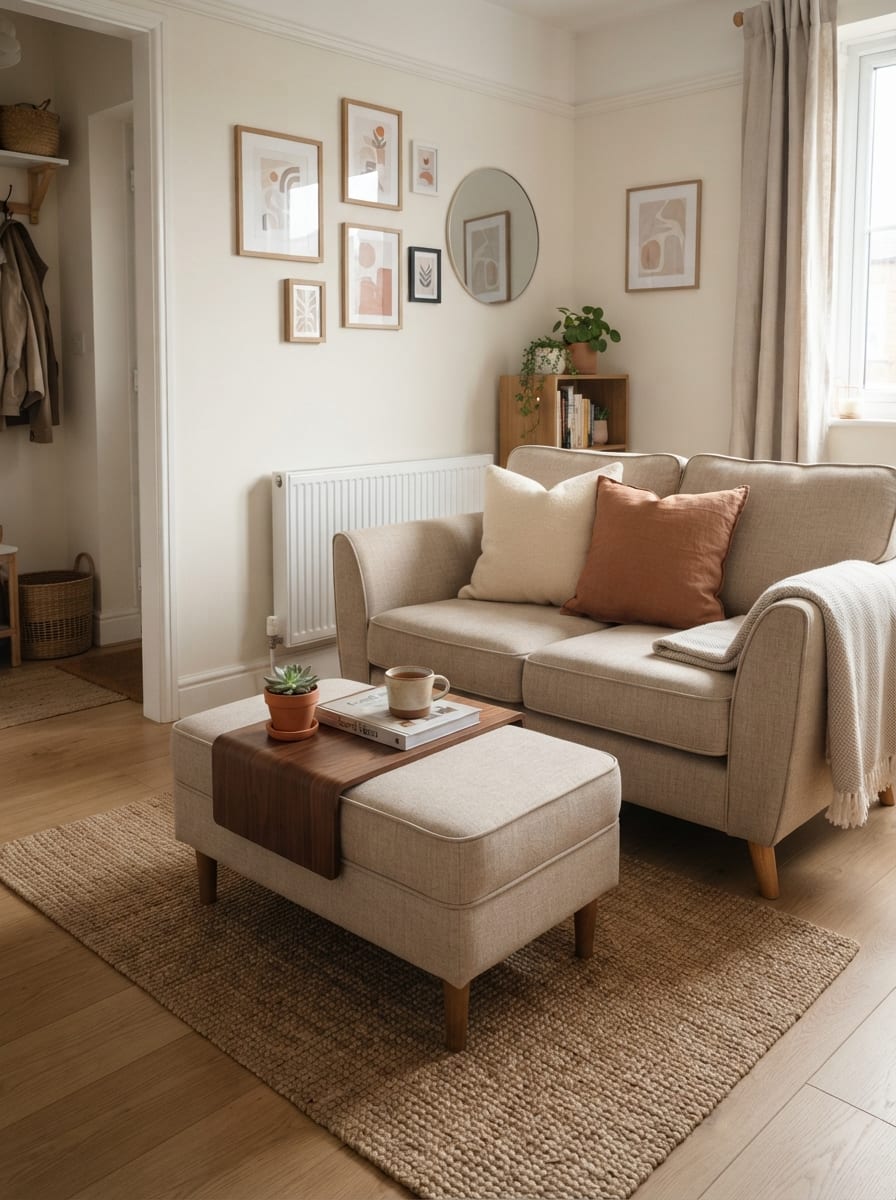
1. The Coffee-Table Ottoman
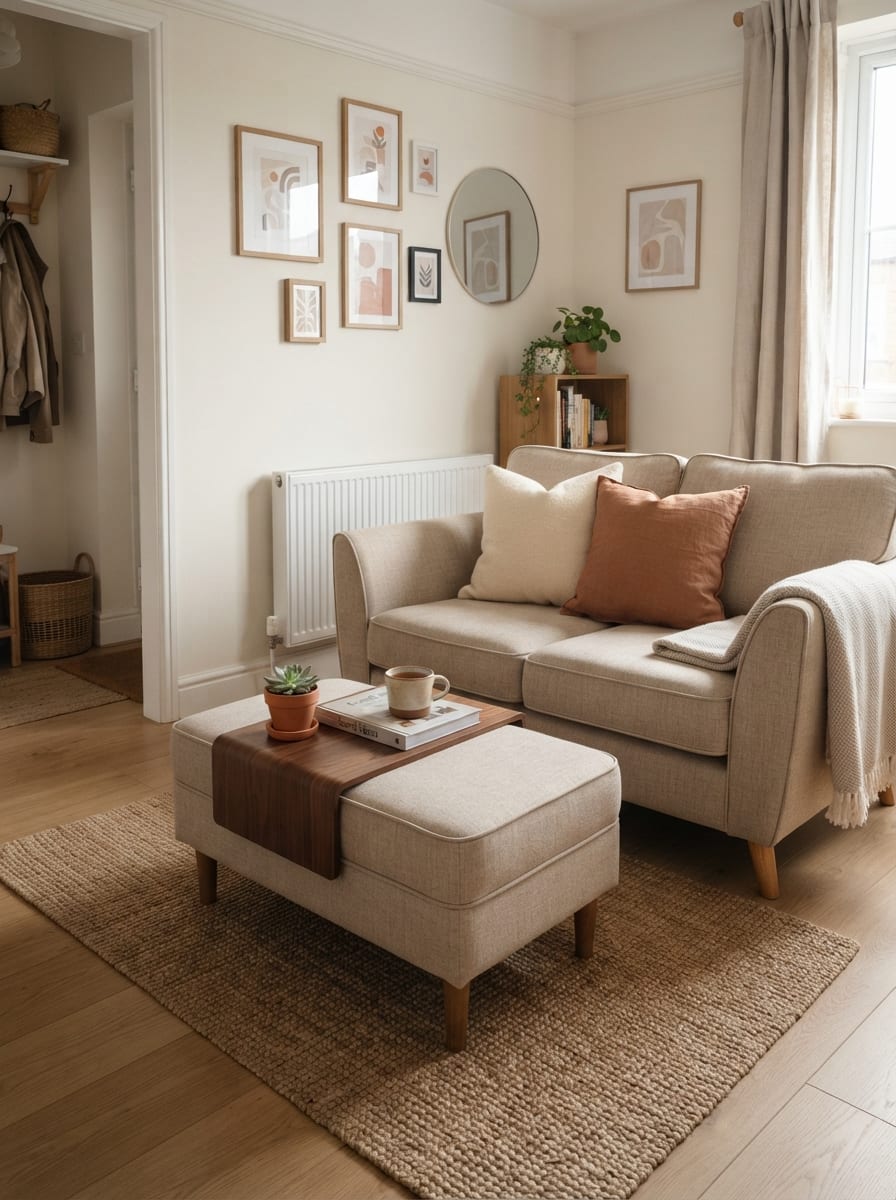
If your living room is too tight for both a coffee table and a separate footrest, one ottoman can handle both jobs.
Why it works
You reduce two potential furniture pieces to one.
The ottoman can provide:
- somewhere to put your feet
- a soft central surface
- occasional seating
- a place for a tray.
Choose the footprint carefully
Do not automatically buy a large square ottoman.
In a narrow room, a:
- small rectangle
- oval
- compact round ottoman
may preserve circulation better.
Keep enough space around it
You still need room to move between:
- sofa
- ottoman
- TV unit
- doorway.
Match the height to the sofa
An ottoman used primarily as a footrest should feel natural relative to the sofa seat.
Too high can feel awkward.
Too low can make it less useful for tray placement.
2. The Storage Ottoman
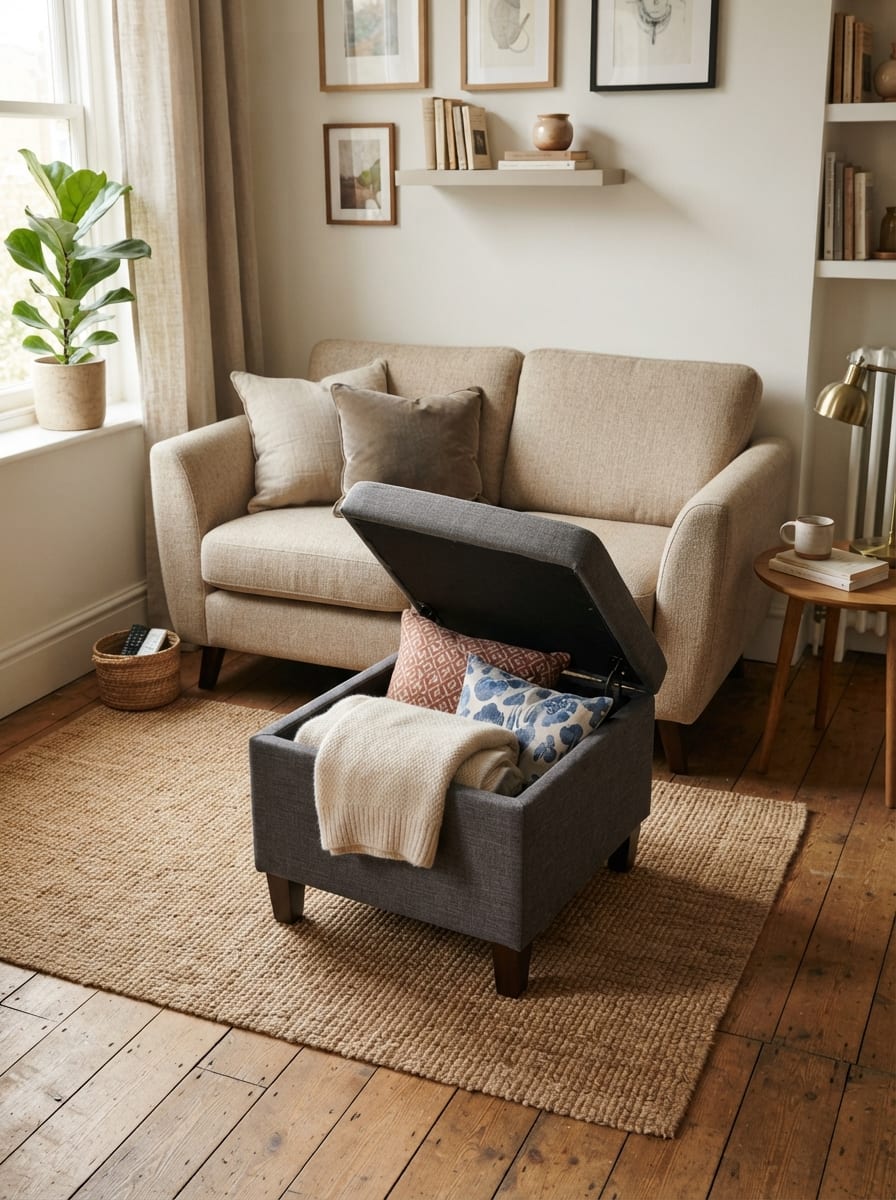
If the living room needs hidden storage, a lidded ottoman can make its footprint work harder.
Why it works
One piece provides:
seating or footrest + concealed storage.
Good storage categories
Use it for items that are bulky but not constantly needed, such as:
- throws
- extra cushions
- board games
- remote controls
- children’s toys
- seasonal accessories.
Avoid turning it into miscellaneous storage
If everything gets tossed inside, the ottoman becomes a clutter box.
Assign it one or two categories.
Test how it opens
Storage ottomans may use:
- lift-up lid
- hinged top
- removable top.
Make sure the opening mechanism works with the planned placement.
A hinged lid may need more clearance than expected.
Keep heavy items elsewhere
An ottoman is usually better for lighter household items than dense stacks of books or other heavy contents unless the product is designed for them.
3. The Tuck-Beside-the-Sofa Ottoman
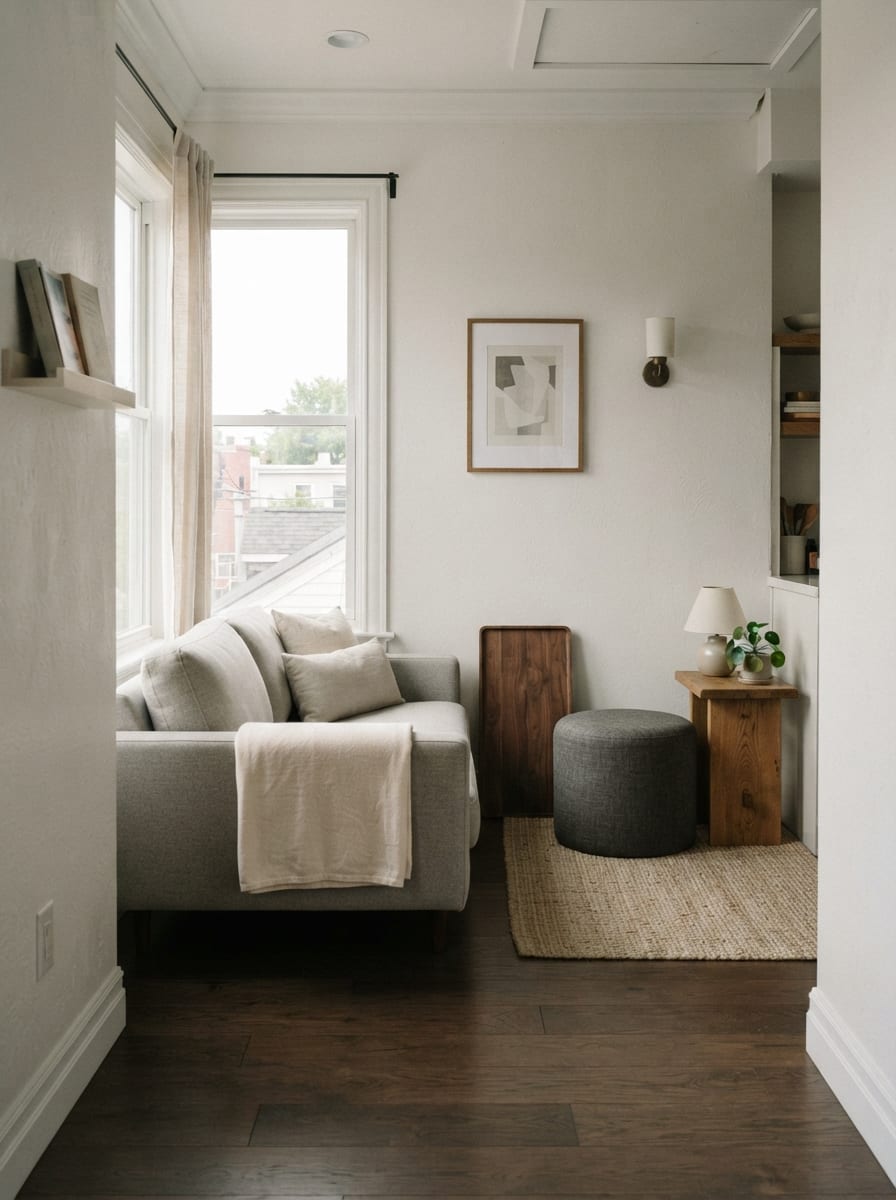
An ottoman does not always need to live in the middle of the room.
A smaller one can park beside the sofa when not in use.
Why it works
You reclaim the central floor area while keeping the ottoman close enough to pull forward when needed.
Use it as a flexible side surface
With a tray, it can temporarily hold:
- coffee
- book
- remote
- small lamp if the setup is suitable.
Keep the parked depth controlled
Do not choose an ottoman so wide that it blocks the gap between:
- sofa
- wall
- doorway.
Good for occasional use
This setup works particularly well when the ottoman is used only:
- in the evening
- while watching TV
- when guests visit.
4. The Pair-of-Poufs Setup
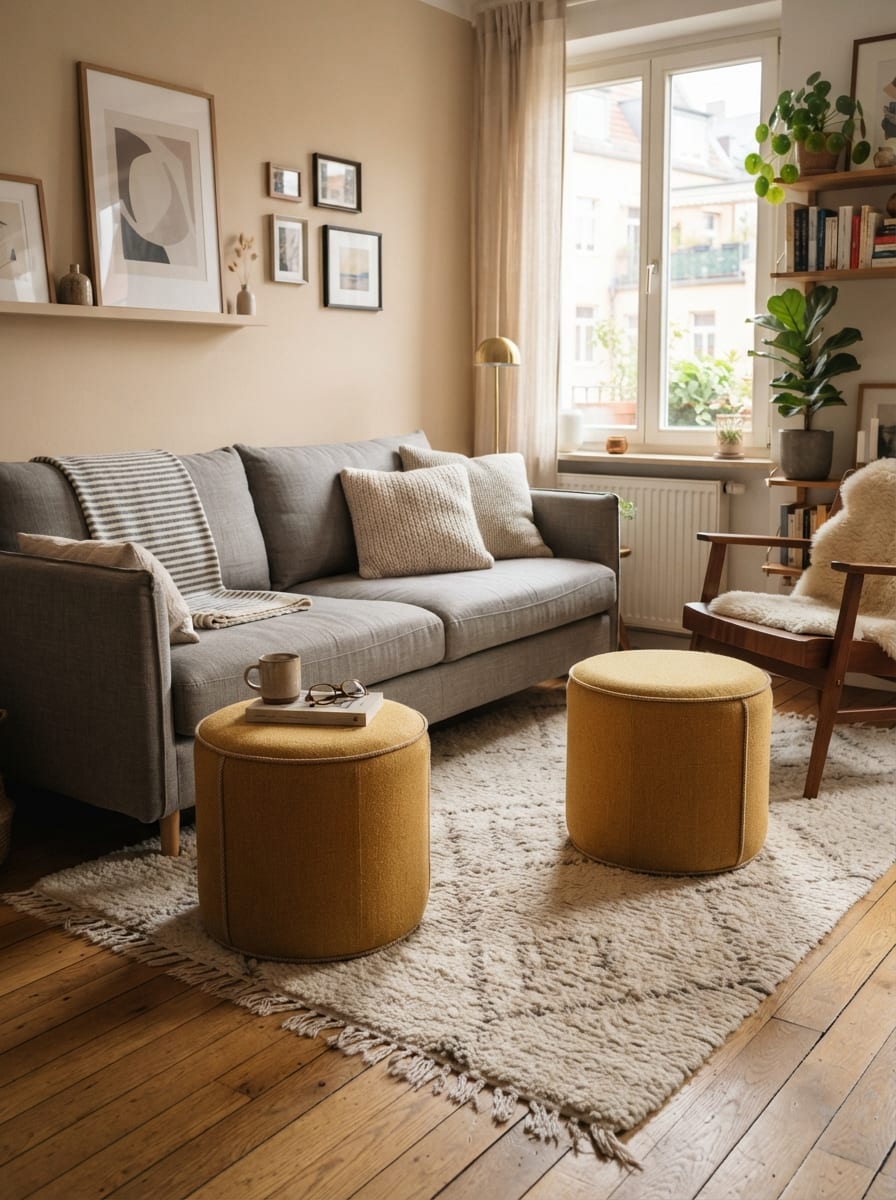
One large ottoman is not always the most flexible option.
Two small poufs can sometimes work better.
Why it works
You can separate them when needed.
Use them as:
- two extra seats
- two footrests
- one footrest plus one side surface.
Move them independently
That flexibility is useful when the living room changes function between:
- everyday lounging
- entertaining
- movie night.
Keep the shapes compact
Two oversized poufs can consume more total floor area than one ottoman.
Choose sizes that can:
- tuck under a console where possible
- sit beside the sofa
- stack or nest if designed to do so.
Avoid excessive texture
Chunky knitted poufs can look visually bulky in very small rooms.
A simpler upholstered surface often feels calmer.
5. The Tray-Top Ottoman
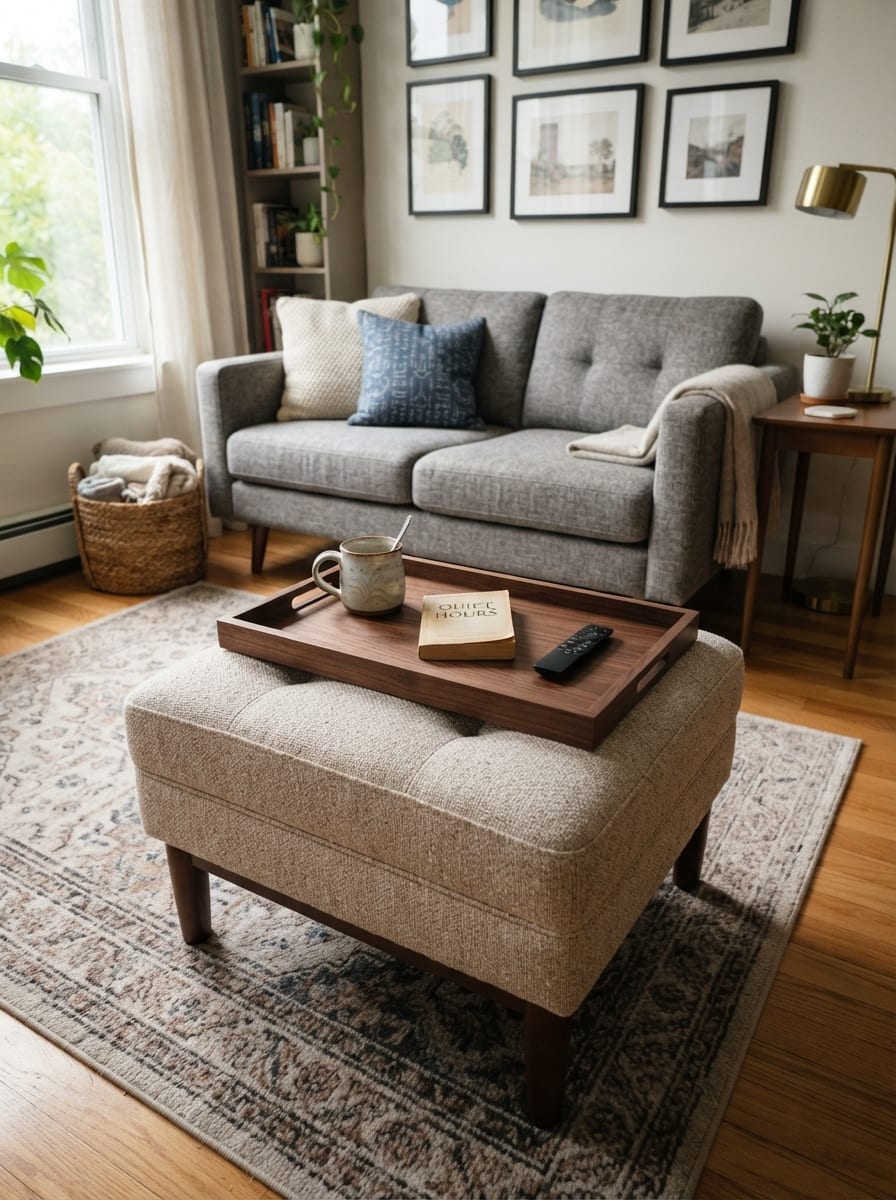
A soft ottoman becomes much more useful when paired with a rigid removable tray.
Why it works
The tray creates a stable surface for:
- mugs
- glasses
- small plates
- remote controls.
Remove the tray and the ottoman returns to:
- seating
- footrest.
Choose the tray proportion carefully
Do not cover the entire top.
Leave some soft surface exposed so the piece still reads as an ottoman rather than a coffee table.
Use a tray with an edge
A slight lip helps contain small objects.
Store the tray vertically when not needed
Possible locations include:
- beside media console
- in a cabinet
- behind sofa
where practical.
6. The Window-Side Extra Seat
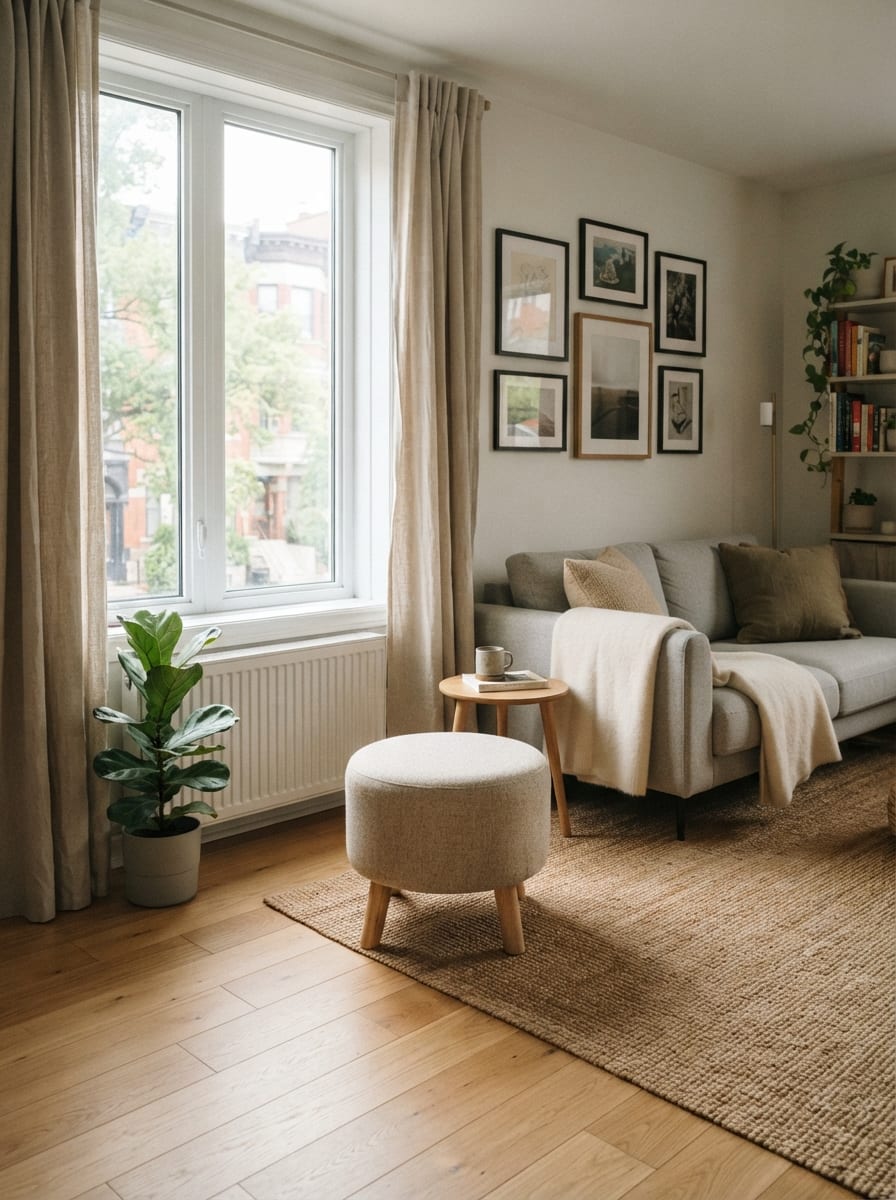
A compact ottoman can work as occasional seating near a window or empty corner rather than permanently sitting in front of the sofa.
Why it works
You gain an extra seat without committing to another armchair.
That can be useful for:
- guests
- reading
- putting on shoes
- moving closer to conversation.
Keep it movable
The point is flexibility.
Choose a piece you can move without needing to rearrange the entire room.
Do not block the window
Avoid positioning the ottoman where it prevents:
- curtains opening
- balcony-door access
- radiator airflow.
Let the space stay visually light
A backless seat preserves sightlines better than another chair.
7. The Nesting Ottoman Pair
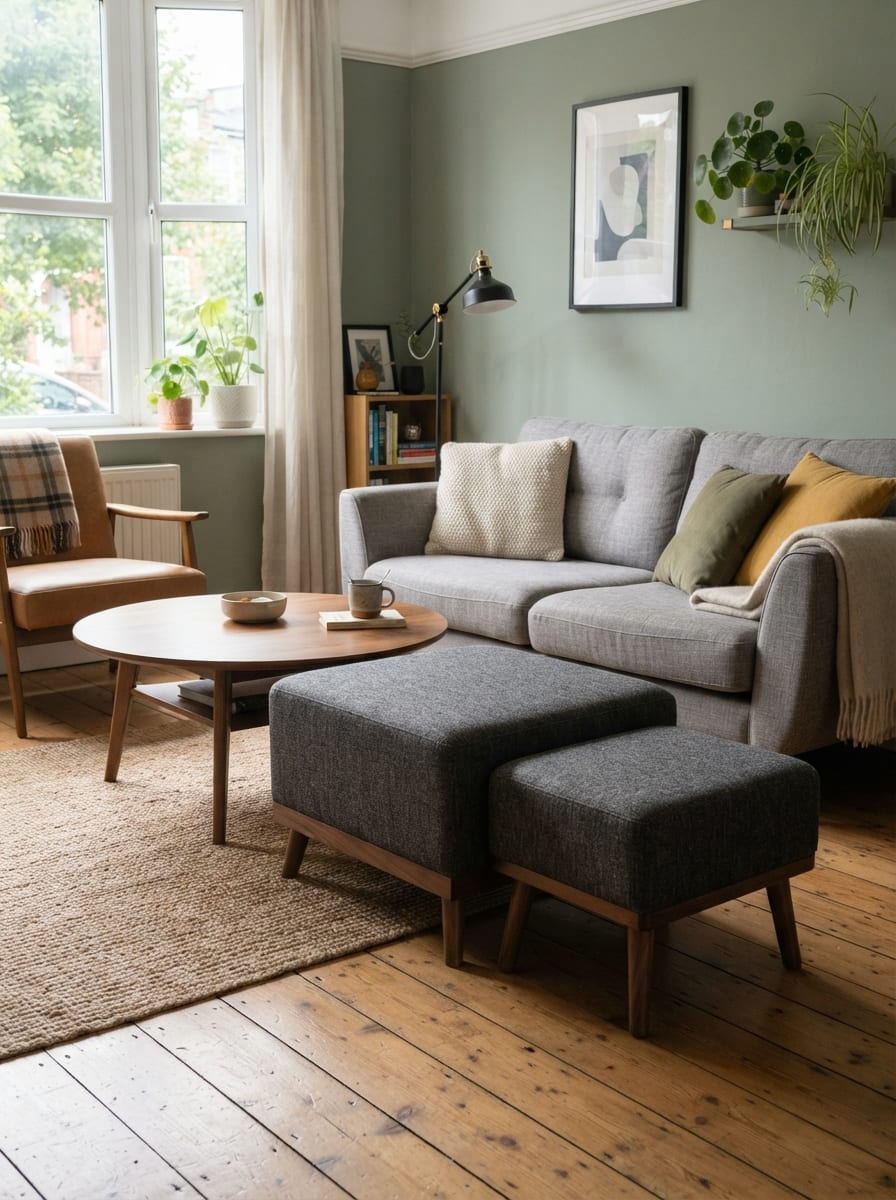
Some ottoman sets include one smaller piece designed to tuck beneath or beside another.
This can provide more flexibility without permanently increasing the room’s footprint.
Why it works
Most of the time, you see one compact unit.
When needed, the second ottoman can become:
- guest seat
- footrest
- side surface.
Keep the nesting mechanism simple
It should be easy to:
- pull out
- return
- clean around.
Do not overcomplicate the design
Pieces with too many moving sections can become annoying in a tiny room.
Best for occasional entertaining
The second ottoman earns its place by disappearing when it is not needed.
8. The Bench-Style Ottoman
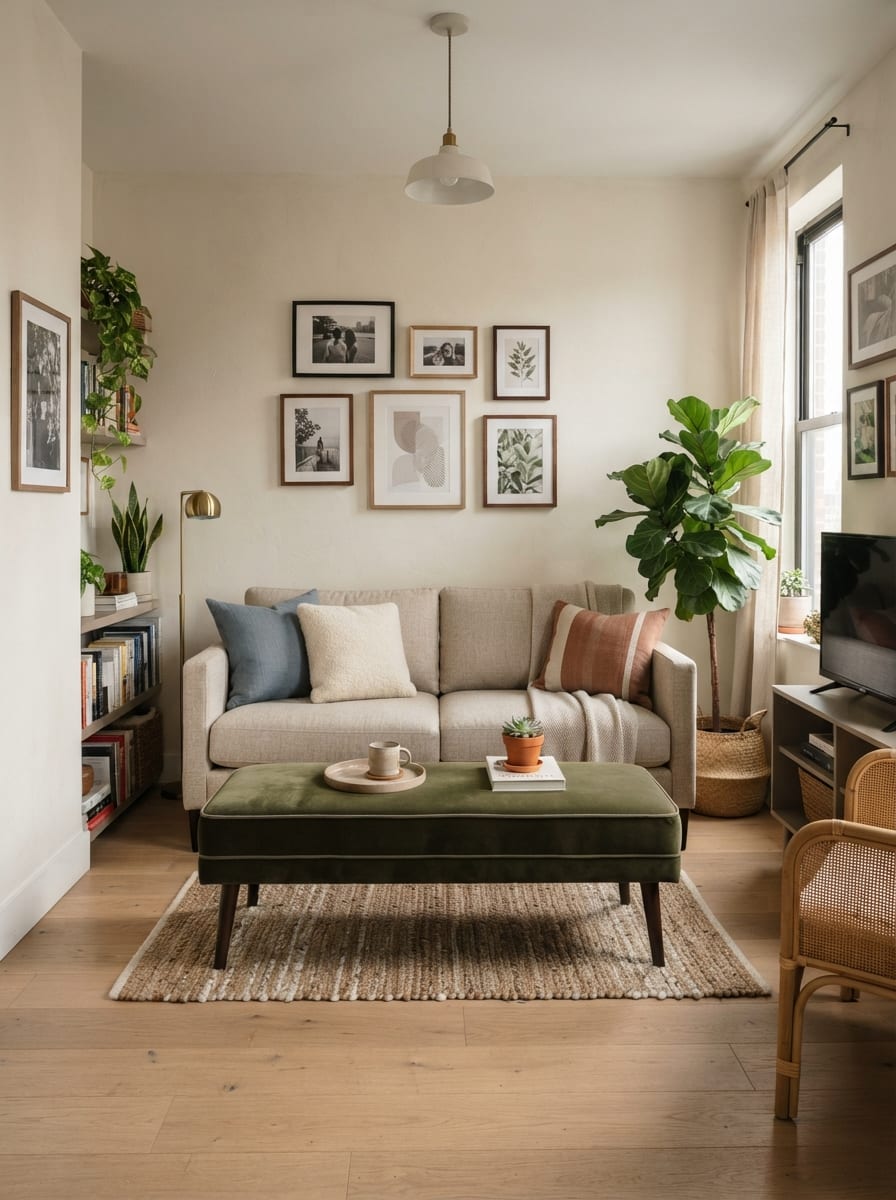
A long, narrow ottoman can work particularly well with a compact sofa because it provides width without excessive depth.
Why it works
You get a useful surface that can serve several people while preserving more walkway space than a deep square ottoman.
Good for narrow living rooms
The shape echoes the sofa rather than projecting heavily into the room.
Use it for
- shared footrest
- occasional seating
- tray surface.
Keep the depth modest
The main advantage disappears if the bench-style ottoman is too deep.
Watch the length
It does not need to match the full sofa width.
A slightly shorter piece usually feels lighter.
9. The Footprint-Function Formula
Before choosing an ottoman, decide what it needs to do most often.
Use this order:
primary function → footprint → height → parking spot → surface
Step 1: Choose the primary function
Is it mainly:
- footrest
- coffee-table substitute
- storage
- extra seating?
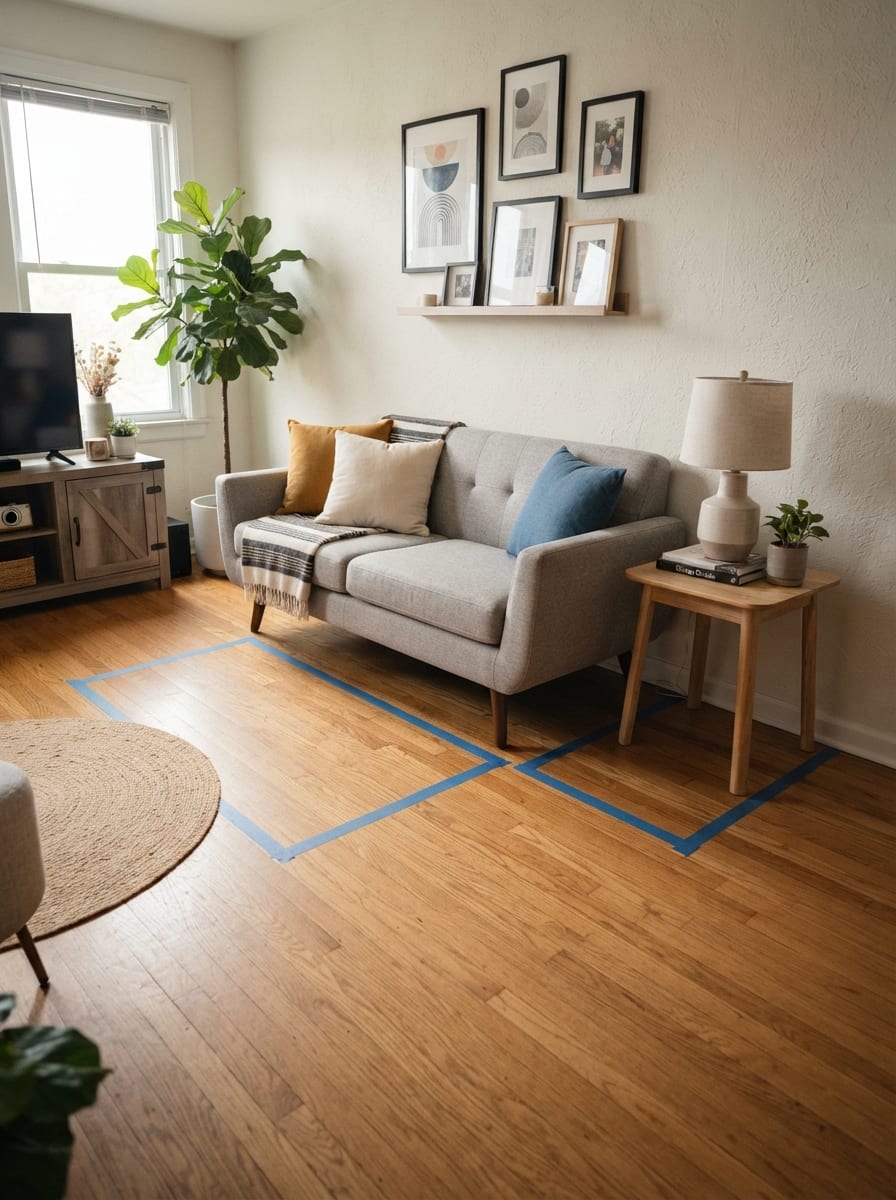
Step 2: Mark the footprint
Use painter’s tape on the floor.
Live with the shape for a day.
Step 3: Check height
Compare it with:
- sofa seat
- chair seat
- preferred tray height.
Step 4: Choose the parking position
Where will the ottoman live when you are not actively using it?
Step 5: Decide whether you need a tray
If drinks or dishes regularly sit on it, plan for a stable hard surface.
Start With the Job, Not the Shape
Ottomans come in:
- square
- round
- rectangular
- oval
- bench-style
- cube shapes.
But shape should come after function.
Ask first:
What problem am I trying to solve?
Need Somewhere to Put Your Feet?
Prioritize:
- comfortable height
- soft top
- easy reach from sofa.
Need a Coffee-Table Substitute?
Prioritize:
- stable top
- tray compatibility
- practical footprint.
Need Extra Seating?
Prioritize:
- structural suitability
- seating height
- firm enough cushion.
Need Hidden Storage?
Prioritize:
- easy opening
- internal capacity
- usable placement.
Need All Four?
You may need to compromise.
The most multifunctional piece is not always the best at every job.
Ottoman vs Coffee Table
Choose an ottoman when:
You want:
- softness
- footrest
- extra seat
- storage.
Choose a coffee table when:
You need a rigid surface most of the time.
Choose both?
In a very small living room, usually only if:
- both pieces are unusually compact
- layout still preserves circulation.
Often one should replace the other.
Ottoman vs Side Table
An ottoman may replace a side table occasionally with a tray.
But if you constantly need a:
- lamp
- drink
- charger
beside the sofa, a small dedicated side table may still be more convenient.
Ottoman vs Extra Chair
An ottoman saves visual space because it has:
- no back
- no arms.
That makes it useful for occasional guests.
A chair is better for longer seated comfort.
Ottoman vs Pouf
Ottoman
Usually:
- firmer
- more furniture-like
- sometimes includes storage.
Pouf
Usually:
- lighter
- softer
- easier to move.
Ottoman vs Bench
A bench-style ottoman can bridge both categories.
Measure the Sofa First
The ottoman should relate to the seating around it.
Check:
- sofa width
- seat height
- distance from sofa to TV
- walkway around the seating zone.
Do Not Size It Like a Large Coffee Table
The goal in a small room is not to fill every inch between sofa and TV.
Leave Breathing Room Around It
You need space for:
- legs
- walking
- vacuuming
- pulling the ottoman closer.
A Small Gap Is Still Necessary
Do not press the ottoman directly against the sofa unless you intentionally want a chaise-like setup.
Sofa Seat Height Matters
A footrest that sits dramatically above the sofa cushion may feel awkward.
Too-Low Ottoman
Can still work as a footrest but may be less convenient for table use.
Coffee-Table Height Is Not the Only Rule
If the piece is mainly a footrest, sofa comfort matters more.
Mark the Ottoman Footprint With Tape
This is one of the easiest ways to avoid buying something too large.
Mark:
- width
- depth
on the floor.
Test Everyday Movement
Walk:
- past the sofa
- toward the TV
- toward doorway
- toward balcony.
Test With Someone Sitting
Legs extend into the gap too.
Test the Room With Guests
Would an ottoman prevent another person from moving between seats?
Door Swing
Do not let it interfere with:
- entry door
- balcony door
- closet door.
Media Cabinet Doors
Check whether drawers and doors can still open.
Reclining Sofa
Allow room for:
- footrest
- reclining mechanism.
Sleeper Sofa
The ottoman needs somewhere else to go when the bed opens.
Plan the Parking Spot
This is particularly important for flexible furniture.
Possible parking spots include:
- beside sofa
- beneath console if size allows
- near window
- against wall.
Round Ottoman
Useful when circulation flows around several sides.
Soft corners can make movement easier.
Square Ottoman
Efficient when the seating arrangement is symmetrical.
But large squares can dominate tiny rooms.
Rectangular Ottoman
Often useful with standard sofas.
Oval Ottoman
Provides the length of a rectangle with softer circulation edges.
Cube Ottoman
Useful as compact:
- seat
- footrest
- side surface.
Bench Ottoman
Good for long narrow rooms.
Storage Ottoman
Excellent when hidden storage is genuinely needed.
Ottoman With Legs
Visible floor underneath can make the piece feel lighter.
Ottoman Without Legs
May look more solid and substantial.
Low Ottoman
Can maintain open sightlines.
Tall Ottoman
May work better as extra seating, but check sofa relationship.
Upholstered Ottoman
Adds softness and texture.
Leather or Faux-Leather Ottoman
Can be easier to wipe depending on the material and care requirements.
Velvet Ottoman
Adds richer texture but may look visually heavier in some rooms.
Bouclé Ottoman
Adds texture but can collect visual attention quickly.
Use it as one texture rather than repeating bouclé everywhere.
Woven Ottoman
Can create casual warmth.
Check durability if it will be used for seating.
Wood-Top Ottoman
Some designs combine upholstery and a hard surface.
This may reduce the need for a separate tray.
Ottoman With Reversible Lid
One side may be:
- upholstered
- hard tray surface.
This can be very useful in small rooms.
Storage Cube
A cube ottoman can often tuck beside furniture.
Folding Ottoman
Can be useful where storage and occasional seating are needed.
Check stability and intended load.
Large Ottoman
Only works if the room genuinely has room for it.
Do not assume multifunctional means oversized is acceptable.
Small Ottoman
May provide enough function without visually dominating the room.
Two Small Ottomans vs One Large Ottoman
Two small pieces provide greater flexibility.
One larger piece looks calmer and requires less rearranging.
Use Two When:
You frequently need:
- two extra seats
- flexible placement.
Use One When:
You want:
- simpler styling
- larger footrest
- storage.
Ottoman With Sectional Sofa
Avoid choosing one so large that it fills the entire open center.
Ottoman With Loveseat
A compact rectangular or round piece often works better.
Ottoman With Sofa + Chair
Use a shape that leaves circulation between both seating pieces.
Ottoman in a Studio Apartment
Choose something that can move easily because the room may change functions throughout the day.
Ottoman in a Narrow Living Room
Bench-style or oval shapes can reduce visual blockage.
Ottoman in a Square Living Room
Round or square options may fit the central geometry.
Ottoman in an Open-Plan Room
The piece may be visible from:
- kitchen
- dining area.
Coordinate it loosely with the wider space.
Ottoman Against a Wall
A small cube can park there between uses.
Ottoman Under a Console
Possible only if dimensions genuinely allow it.
Ottoman Near a Window
Check:
- curtain movement
- radiator
- balcony access.
Ottoman Near a Heater
Follow required clearance guidance.
Ottoman on a Rug
The rug can visually anchor it.
Entire Ottoman on Rug?
Often visually cohesive, but the rug needs enough size.
Half-On Rug?
Can look accidental if the ottoman moves frequently.
Small Rug + Ottoman
Avoid a setup where the ottoman is constantly catching the rug edge.
Casters?
Some ottomans include wheels or hidden casters.
Useful for mobility, but make sure the piece stays stable during sitting.
Lightweight Ottomans
Easy to move.
But extremely light pieces may shift when used as a footrest.
Heavy Ottomans
Stable but difficult to reposition.
Handles
Integrated handles can make moving easier.
Hidden Storage
Only valuable if you can access it easily.
Do Not Trap the Lid Under a Tray
If you frequently open storage, the tray must move first.
Storage for Throws
A natural use.
Storage for Toys
Useful in a family living room.
Storage for Board Games
Works when game night happens in the living room.
Storage for Electronics
Be careful with:
- ventilation
- battery devices
- cables.
Follow product guidance.
Remote Storage
A small internal tray or basket may help.
Blanket Storage
Do not overstuff the compartment.
Ottoman as Extra Seat
Confirm that the product is designed for sitting.
Decorative footstools are not automatically suitable for full seating loads.
Ottoman for Children
Soft edges can be useful, but stability still matters.
Ottoman for Pets
Choose upholstery appropriate for:
- claws
- shedding
- cleaning.
Ottoman as Coffee Table
A tray makes soft surfaces more practical.
Tray Material
Wood, metal, or other rigid material can work.
Tray Size
Keep it smaller than the ottoman top.
Tray With Handles
Easier to remove when someone wants to sit.
Avoid Too Many Objects on the Tray
The ottoman should remain flexible.
Good Tray Styling
Try:
- one mug
- remote
- small book
- candle where appropriate.
Bad Tray Styling
Avoid covering it with:
- several candles
- large vase
- sculpture
- books
- decorative beads
if the table needs to function.
Use the Ottoman, Do Not Stage It Permanently
The point is adaptability.
Keep the Surface Mostly Clear
Especially if the ottoman regularly becomes a seat.
One Throw?
Fine.
Three Decorative Pillows?
Usually unnecessary.
Ottoman Color
A similar tone to the sofa makes it visually recede.
Contrasting Ottoman
Can act as an accent.
Neutral Sofa + Dark Ottoman
Creates a defined center.
Neutral Sofa + Neutral Ottoman
Feels calmer.
Patterned Ottoman
Can add personality but may become visually dominant.
Texture Instead of Pattern
Often easier in small rooms.
Repeat One Existing Color
For example:
- olive cushion
- olive ottoman.
Do Not Match Every Fabric Exactly
Some variation makes the room feel more natural.
Ottoman With Wood Furniture
Upholstery can soften the hard surfaces.
Ottoman With Upholstered Sofa and Chair
A small wood tray can add contrast.
Visual Weight Matters
A large dark ottoman often looks heavier than the same shape in a lighter tone.
Legs Can Reduce Visual Weight
Visible floor underneath can help.
Rounded Corners Help Circulation
Especially near:
- tight walkways
- small children
- narrow sofa gaps.
Sharp-Framed Ottoman
Can feel more formal but requires more care in tight traffic zones.
Ottoman Under a Window
Can work as temporary seating.
Ottoman at the End of a Sofa
Useful if the sofa has no chaise.
Ottoman as a Movable Chaise
Pull it close when lounging.
Push it aside when floor space is needed.
This Works Particularly Well in Small Rooms
You gain some sectional-like comfort without permanently owning a sectional footprint.
Ottoman + Sofa Tray
Can create a flexible work or snack surface.
Ottoman as Laptop Surface
Only with a stable appropriate tray.
Ottoman as Dining Seat
Possible occasionally if the height and design are suitable.
Ottoman for Parties
Move it away from the sofa to create extra conversation seating.
Ottoman During Movie Night
Pull it closer as a shared footrest.
Ottoman During Cleaning
A manageable piece should be easy to move aside.
Common Small Living Room Ottoman Mistakes
Buying an oversized square ottoman
It replaces the coffee table but creates the same crowding problem.
Forgetting the parking spot
The ottoman has nowhere to go when extra floor space is needed.
Choosing based only on storage capacity
The piece becomes too deep for the room.
Using a soft ottoman for drinks without a tray
The surface is unstable.
Filling the tray with decor
The multifunctional surface becomes permanently occupied.
Choosing the wrong height
It does not work comfortably with the sofa.
Putting two large poufs in a tiny room
Flexibility turns into more clutter.
Blocking a balcony or doorway
The ottoman interferes with circulation.
Buying a storage ottoman that is difficult to open
The storage stops being useful.
Assuming every ottoman is rated for seating
Some are intended primarily as footrests.
Quick Small Living Room Ottoman Decision Guide
Choose a Coffee-Table Ottoman if:
You want one piece to handle footrest and occasional table duties.
Choose a Storage Ottoman if:
Throws, games, or toys need hidden storage.
Choose a Tuck-Beside-Sofa Ottoman if:
You want the center floor open most of the day.
Choose Two Small Poufs if:
Flexible guest seating matters most.
Choose a Tray-Top Ottoman if:
You regularly need a stable surface for drinks.
Choose a Window-Side Ottoman if:
You want an occasional extra seat without another chair.
Choose Nesting Ottomans if:
You entertain sometimes but want a smaller everyday footprint.
Choose a Bench Ottoman if:
The living room is long and narrow.
The Small Living Room Ottoman Formula
Before buying, solve these five things:
PRIMARY JOB
Is it mainly:
- footrest
- table
- seat
- storage?
FOOTPRINT
How much open floor can it occupy without damaging circulation?
HEIGHT
Does it work comfortably with the sofa?
PARKING SPOT
Where does it go when you need the center clear?
SURFACE
Do you need:
- soft upholstery
- hard top
- removable tray?
Only after that choose:
- fabric
- color
- leg style
- decorative details.
The best small-room ottoman is not the one with the longest feature list.
It is the one that performs two or three useful jobs without behaving like another bulky piece of furniture.
Frequently Asked Questions
Are ottomans good for small living rooms?
Yes.
They can combine functions such as:
- footrest
- storage
- extra seating
- occasional table
in one piece.
Can an ottoman replace a coffee table?
Yes, especially when paired with a rigid tray for drinks and other small items.
What shape ottoman is best for a small living room?
It depends on the layout.
- rectangular works well with sofas
- round can improve circulation
- bench-style works well in narrow rooms
- small cubes offer maximum flexibility.
Should an ottoman be the same height as the sofa?
It does not have to match exactly, but it should feel comfortable for its main use.
A footrest should relate naturally to sofa seat height.
Are storage ottomans worth it?
They can be valuable when the storage compartment solves a real problem and remains easy to access.
Can you sit on an ottoman?
Some ottomans are designed for seating and others are not.
Check the manufacturer’s intended use and weight guidance.
Can I put drinks on an upholstered ottoman?
A rigid tray is usually the better option for creating a stable surface.
Is one large ottoman or two small ottomans better?
One large ottoman looks simpler.
Two smaller pieces offer greater flexibility.
Choose based on how often you need:
- guest seating
- open floor
- shared footrest.
Should an ottoman match the sofa?
It does not need to match exactly.
Repeating one:
- tone
- material
- color
can help the room feel cohesive.
Where should I put an ottoman when I am not using it?
Possible parking locations include:
- beside the sofa
- near a window
- against a wall
- beneath a suitable console
depending on the room.
Final Thoughts
A small living room does not need more furniture.
It needs furniture that works harder.
That is why an ottoman can be so useful.
It can become:
- footrest at night
- coffee table with a tray
- hidden storage
- extra seat when friends visit.
But the key is keeping the footprint controlled.
Start with the ottoman’s main job.
Measure the open floor.
Compare the height with the sofa.
Decide where the piece will park when you want the middle of the room clear.
Then choose whether you need:
- storage
- tray
- pair of smaller pieces
- narrow bench-style shape.
The right ottoman should make the room more adaptable.
It should not simply replace one bulky table with another.
In a small living room, the strongest piece is the one that can change jobs without making the floor plan change around it.