11 Small Living Room Bookshelf Ideas That Add Storage Without Making the Wall Feel Heavy
Looking for small living room bookshelf ideas? These 11 space-smart options use vertical height, narrow depth, clever placement, and lighter visual weight to add storage without crowding the room.
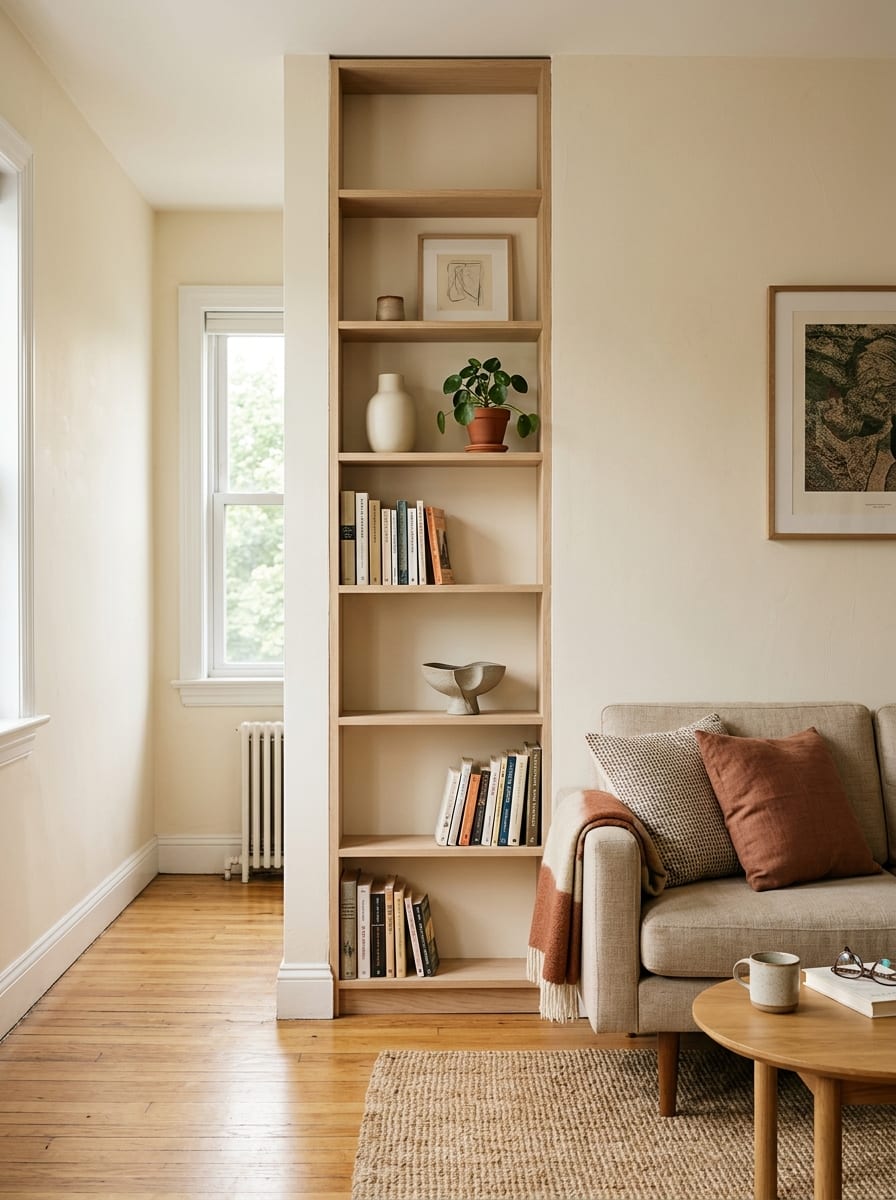
Tall, narrow pale oak bookcase set into a cream living room wall beside a linen sofa, styled with books, a vase, a small plant and framed art
In This Guide
A bookshelf can solve a lot of problems in a small living room.
It can hold books, display favorite objects, define a corner, create separation between areas, and even give a blank wall some much-needed character.
But there is a catch.
A bookshelf is also a large visual object. Choose one that is too deep, too wide, too dark, or too crowded, and the room can suddenly feel smaller than it did before.
The goal isn’t simply to find more shelving.
It is to find a bookshelf that gives you useful storage while keeping the room’s walking paths, light, and visual breathing room intact.
Here are 11 ways to do that, from narrow vertical shelving to low bookcases that double as furniture.
1. Choose a Tall, Narrow Bookcase for Unused Wall Height
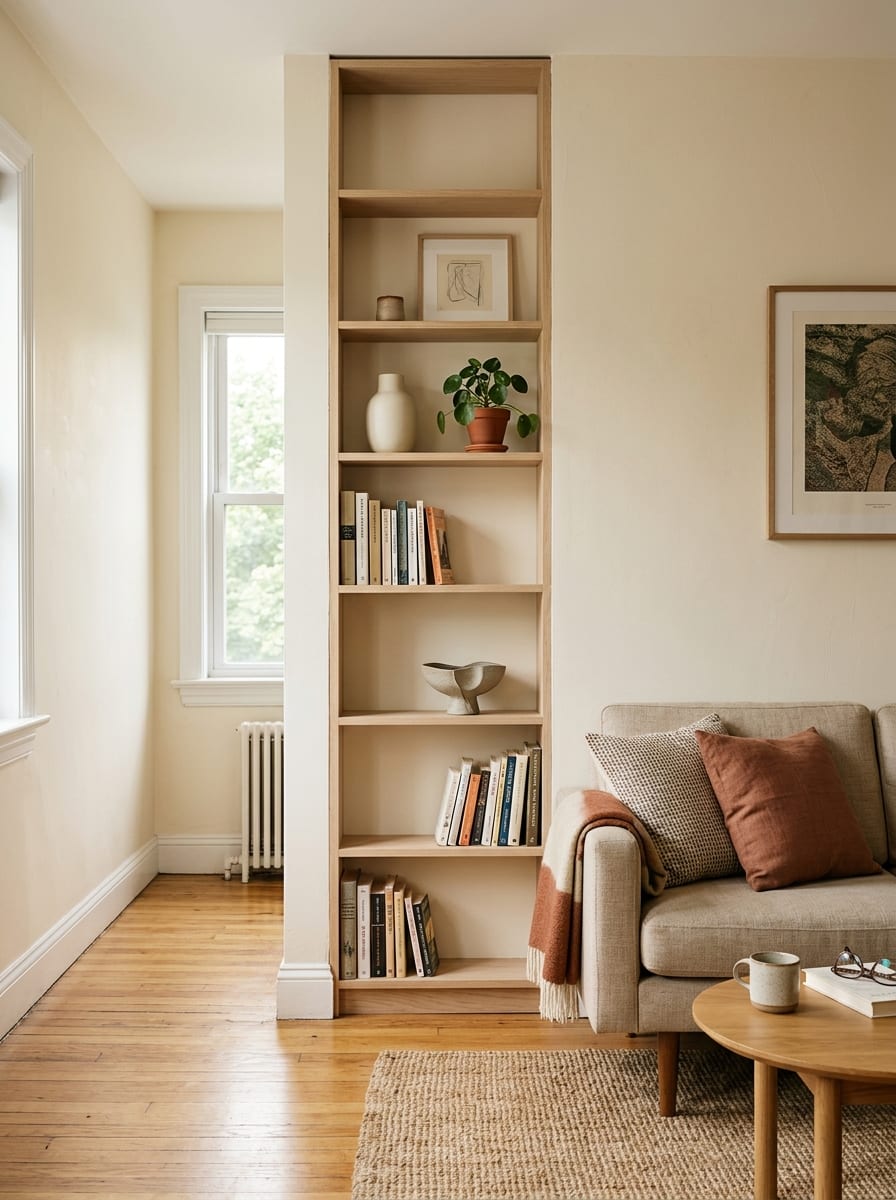
When floor space is limited, going upward is often more useful than going outward.
A tall, narrow bookshelf can provide several levels of storage while using only a small section of floor area. This makes it especially useful beside a sofa, near a doorway, or in a narrow corner where a wider bookcase would interfere with movement.
Look for a design that is visually light rather than extremely bulky.
Open sides, slim vertical supports, and relatively shallow shelves can help the unit feel more like part of the wall than a separate piece of furniture.
Use the lower shelves for heavier books and baskets, then gradually lighten the display as you move upward.
That creates a more balanced composition and prevents the top of the bookcase from becoming visually dense.
Best for: rooms with more unused wall height than floor space.
Watch for: doors, windows, ceiling trim, and nearby furniture that could make a tall unit feel squeezed into the room.
2. Use a Low Bookcase Under a Window
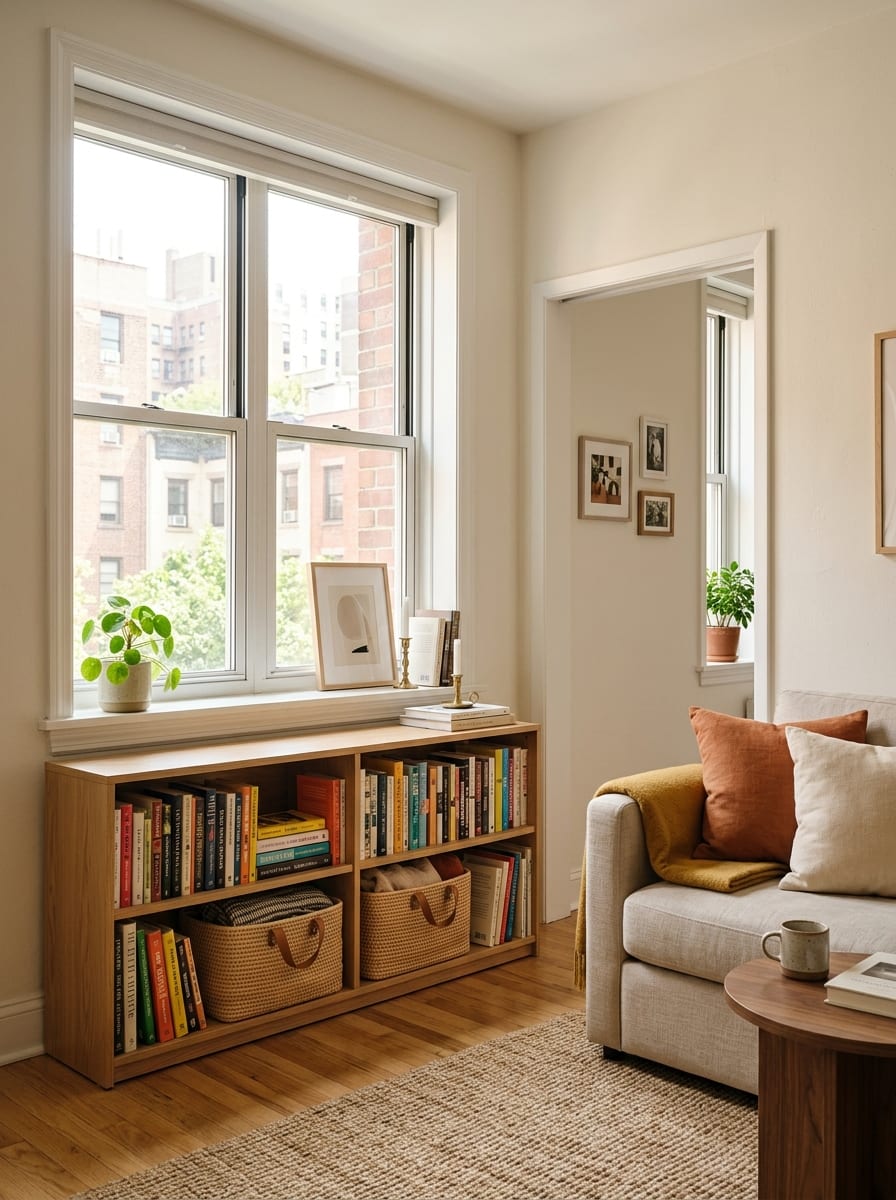
Not every bookshelf needs to be tall.
A low bookcase can be a better choice when your living room has a large window or when you want to preserve an open sightline across the room.
A low unit can sit beneath a window while providing storage for books, baskets, games, or decorative objects.
It also gives you an opportunity to use the top as a functional surface.
A few books, a small lamp, a plant, or framed art can turn the top into a secondary display area.
Just make sure the furniture doesn’t block the window’s operation or cover a radiator or vent.
A low profile can make a small room feel more open because the eye can travel across the room instead of hitting a tall wall of furniture.
Best for: living rooms where preserving light and sightlines matters more than maximizing vertical storage.
3. Try a Slim Ladder Shelf in a Tight Corner
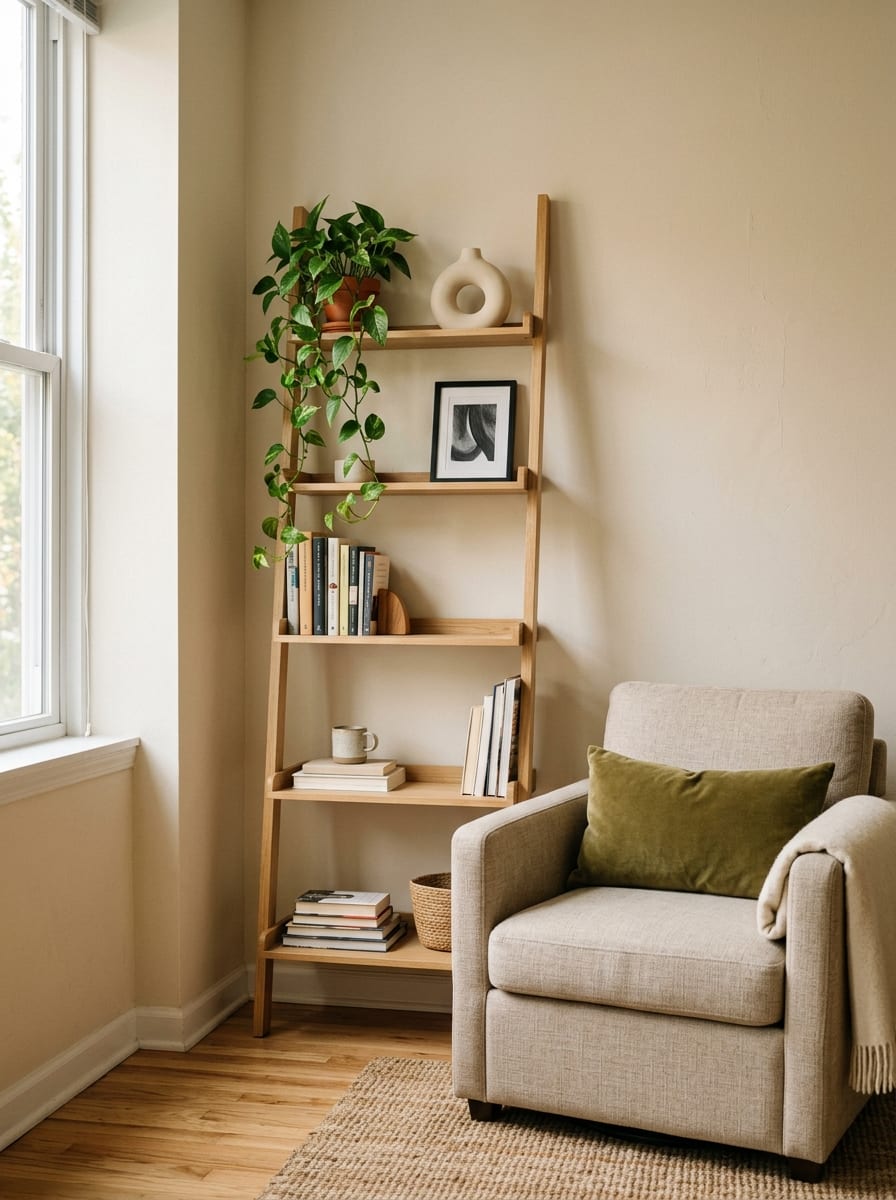
A ladder-style bookshelf can work surprisingly well in a small living room because its footprint is usually narrow and its upper shelves extend gradually outward.
That stepped shape creates storage without making the entire unit feel like a solid rectangular block.
Place one in an unused corner beside a sofa, reading chair, or floor lamp.
Keep the lowest shelf relatively functional and use the upper levels for lighter objects.
Books can be stacked horizontally in small groups instead of lining every shelf edge. This gives the unit more visual variety and prevents it from becoming a wall of text.
A ladder shelf is particularly useful when a conventional bookcase would feel too heavy for the room.
Best for: awkward corners and renters who want freestanding storage.
4. Build Storage Around the Television Instead of Beside It
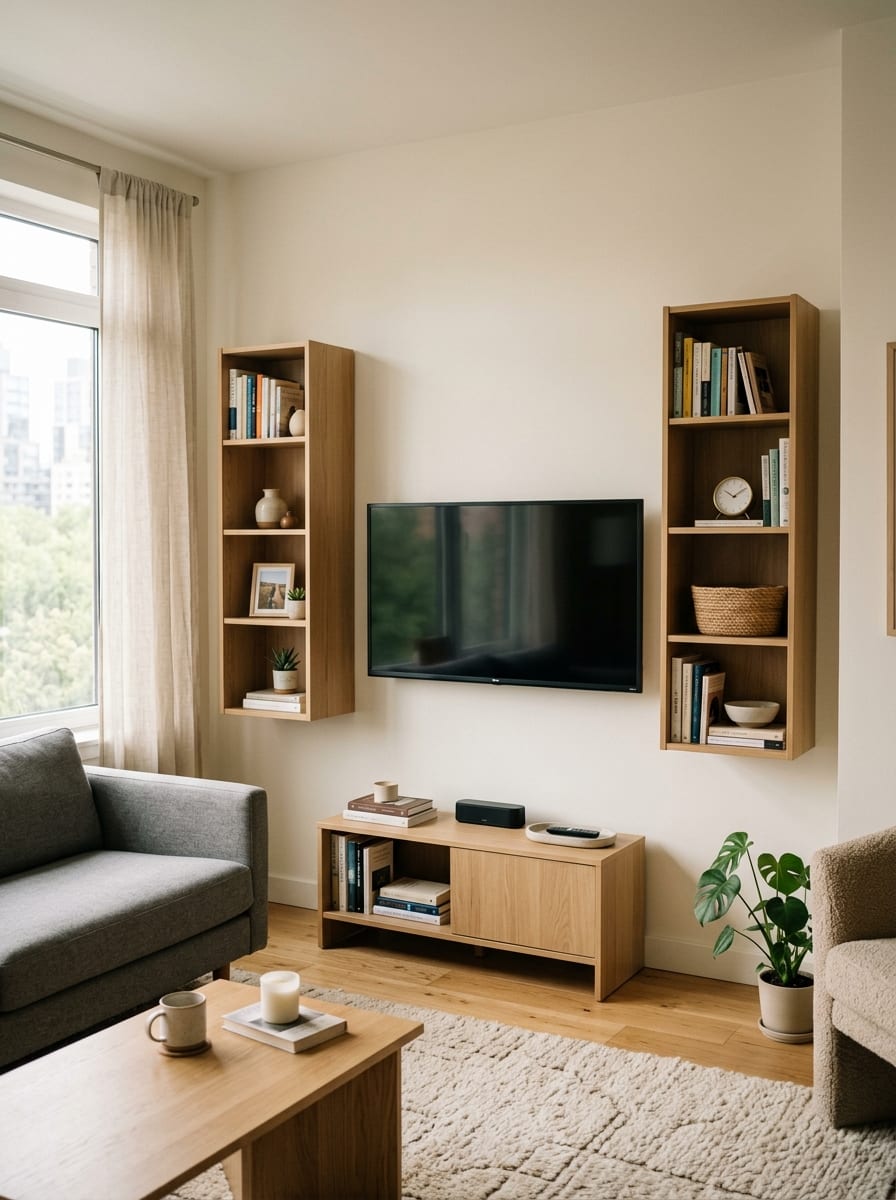
A television wall often becomes a collection of disconnected objects: TV, console, speakers, baskets, books, and decorative pieces.
Instead of adding a separate bookshelf somewhere else, use the television zone as the main storage wall.
A narrow bookcase on one or both sides of the TV can frame the screen while giving the room a more intentional focal point.
The important part is proportion.
The shelving should support the television rather than overwhelm it.
If the TV is mounted on the wall, slim shelves can provide the storage underneath and around it without requiring a deep media unit.
If you’re renting, a freestanding bookcase can create a similar effect without requiring built-in construction.
Best for: rooms where the TV already occupies the main wall.
Design rule: Keep the center of the TV wall relatively calm. Let the shelves carry the decorative variety.
5. Use Two Slim Bookcases Instead of One Massive Unit
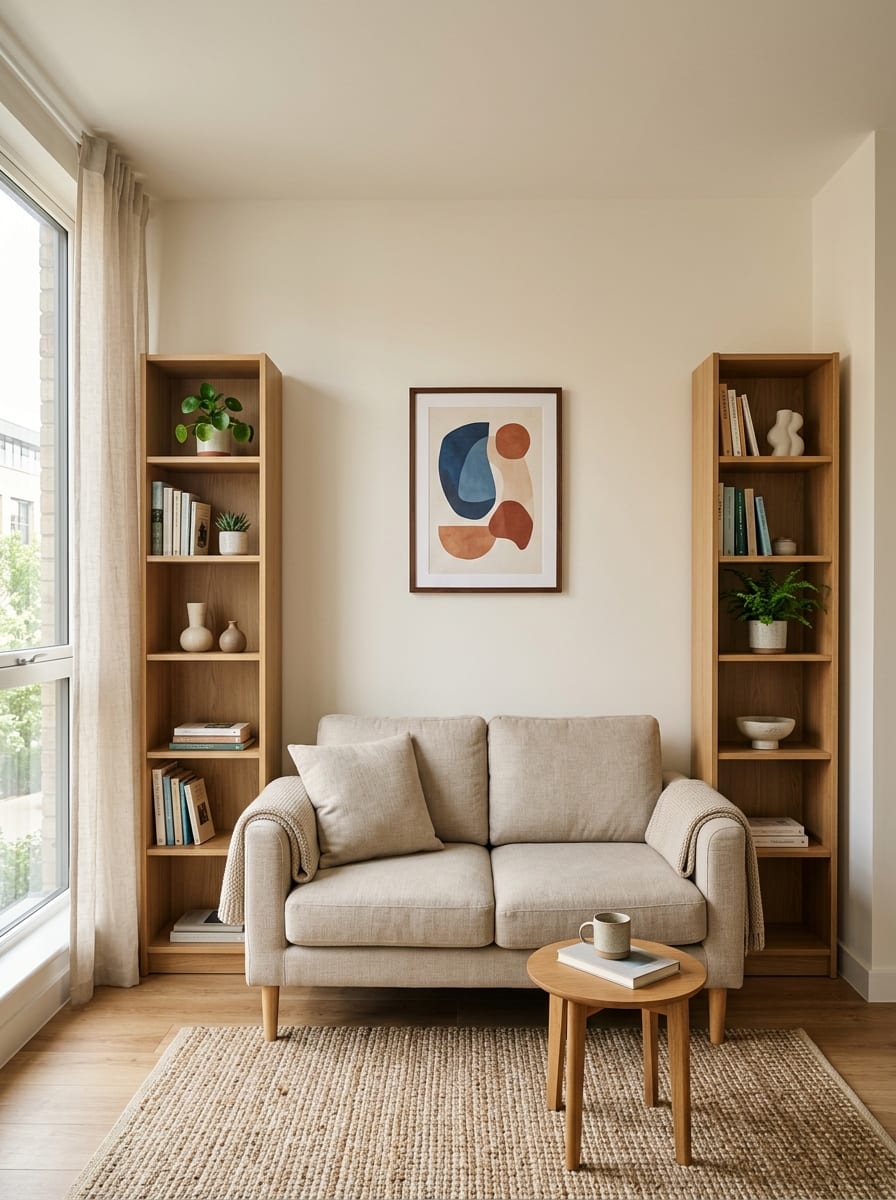
Sometimes the problem isn’t that you need less shelving.
You just need to distribute it differently.
Two narrow bookcases can frame a sofa, fireplace, media console, or artwork without creating the visual weight of one giant wall-to-wall unit.
The gap between them becomes part of the design.
You can leave that center area open, place a framed print there, or use it for a television.
This approach is also useful when the room has architectural interruptions that make one large bookshelf difficult to fit.
Two separate pieces are easier to position around outlets, windows, baseboards, and other fixed elements.
Best for: larger walls in small living rooms where a single bookcase would feel disproportionately heavy.
6. Pick a Bookcase With Legs to Keep the Floor Visible
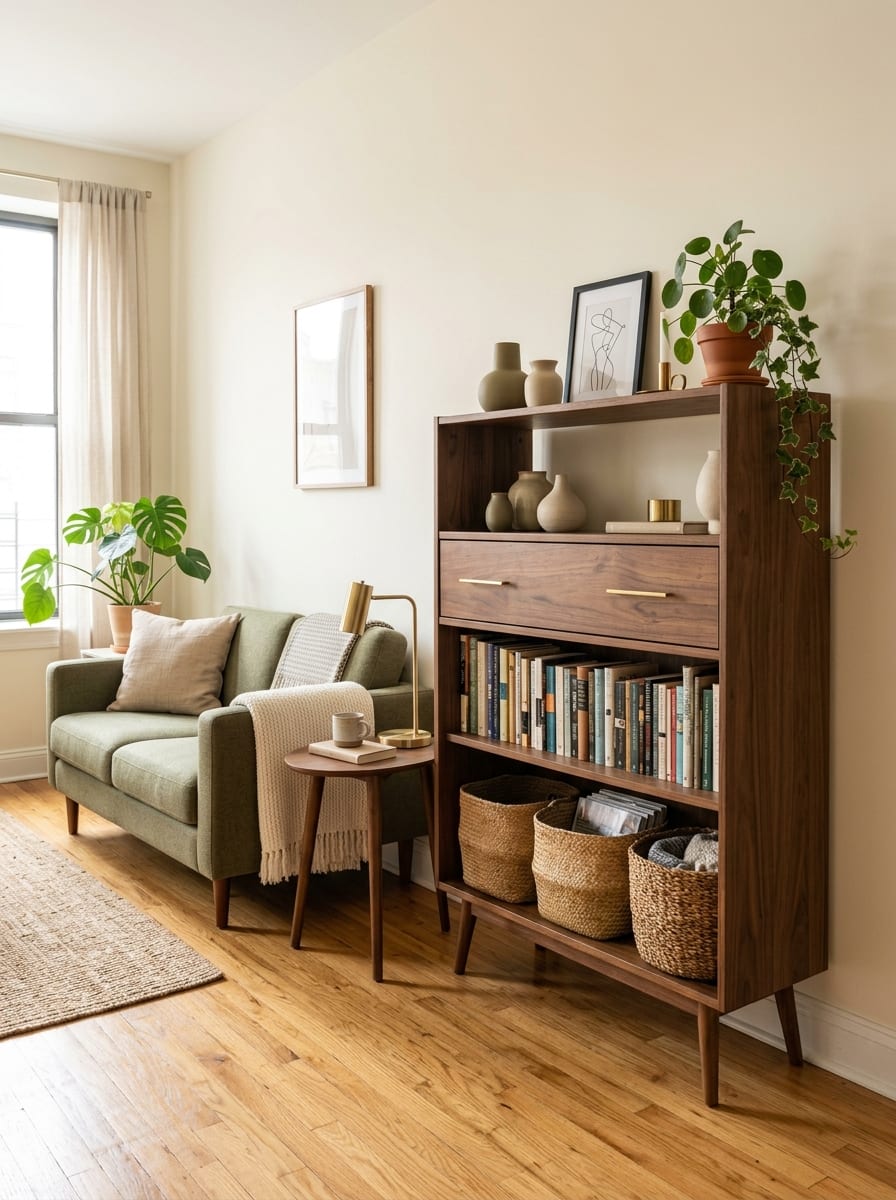
A bookshelf doesn’t always need to sit directly on the floor.
A unit with raised legs creates a visible strip of flooring underneath, which can make the furniture feel lighter.
This is especially effective in rooms with wood, laminate, or another continuous flooring surface because the eye can see more of that surface beneath the furniture.
The difference may seem small, but several inches of visible floor can change the perceived weight of a large piece.
Choose legs that complement the room rather than adding unnecessary visual complexity.
A simple raised frame often works better than ornate furniture in a compact modern apartment.
Best for: rooms where bulky furniture is already making the floor feel crowded.
7. Use a Narrow Wall-Mounted Shelf for a Small Book Collection
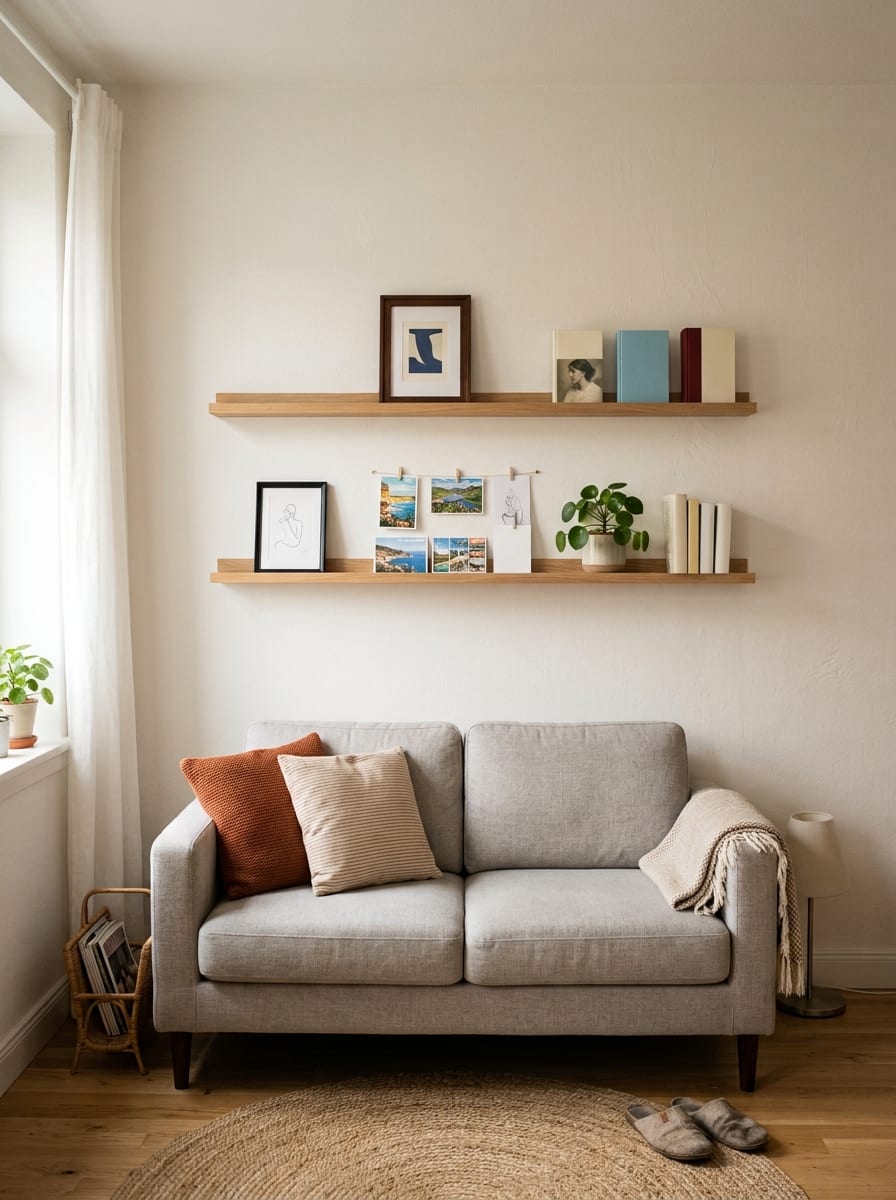
You don’t need a full bookshelf if you only own a modest number of books.
A slim wall-mounted shelf can give you the storage you need without committing an entire section of the living room to a large furniture piece.
One long shelf can hold a small collection of books alongside framed photographs and a few decorative objects.
Several shorter shelves can create a more playful arrangement.
The key is to avoid placing them at random heights simply because the wall is available.
Think about the furniture underneath them first.
A shelf above a sofa, for example, should relate visually to the sofa’s width and the available head clearance.
For renters, choose an installation method appropriate for the wall type and the weight of the shelf and its contents.
Best for: readers who want display space but don’t need full-size book storage.
8. Make a Corner Bookcase Work Harder
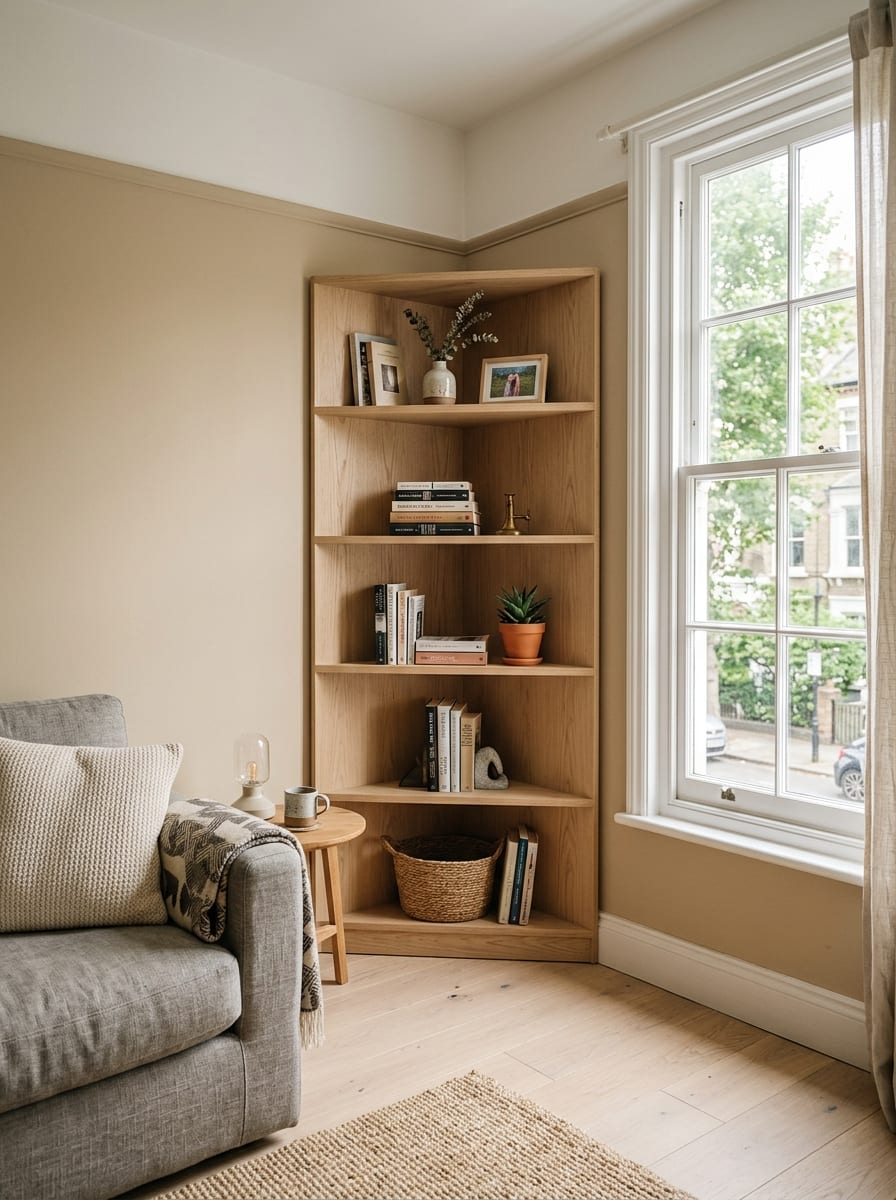
Corners are often difficult to furnish because standard rectangular furniture doesn’t always fit comfortably.
A corner bookshelf can turn that dead zone into useful storage without forcing a large piece into the center of the room.
Use the shelves for books, small plants, framed art, baskets, or objects you want to keep accessible.
Because corner shelves are naturally tucked away, they can also be a good place for items that don’t need to be part of the room’s main visual composition.
Be careful with depth.
A corner unit that projects too far into the room can create exactly the traffic problem you’re trying to avoid.
Measure from the corner toward the walking path before choosing the furniture.
Best for: awkward corners that are too useful to leave empty but too small for standard furniture.
9. Use a Bookcase as a Soft Room Divider
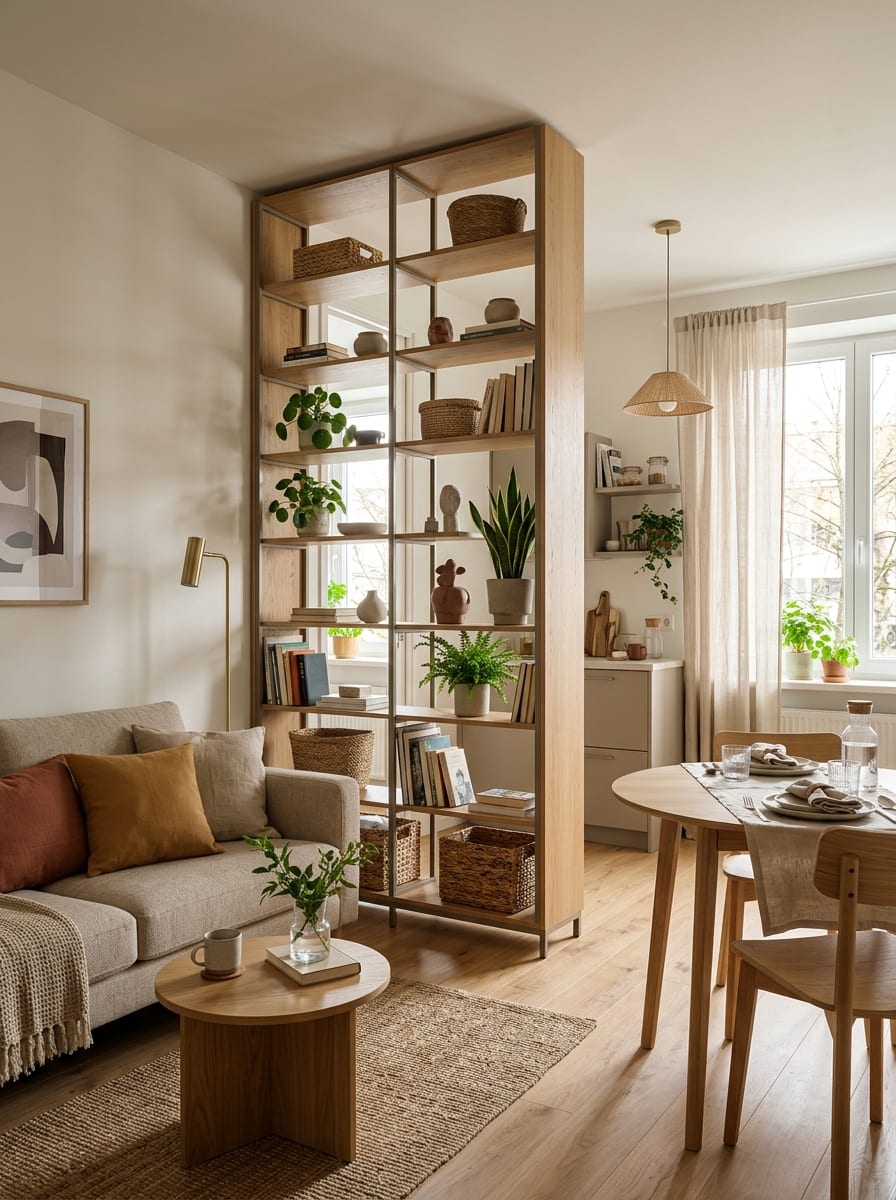
In an open-plan apartment, a bookshelf can do more than store books.
It can help visually separate the living room from a dining area, workspace, or entry zone.
Choose an open-backed or partially open design so light can still travel through it.
Position the unit perpendicular to the wall rather than pushing it against one.
This creates a subtle boundary without building a solid wall.
Keep the shelving relatively open.
If every shelf is packed with books and objects, the divider can become visually dense and defeat the purpose.
A mix of open space, books, baskets, and a few decorative pieces usually works better.
Best for: studio apartments and open-plan rooms that need definition without permanent walls.
10. Let a Bookcase Double as a Display Cabinet
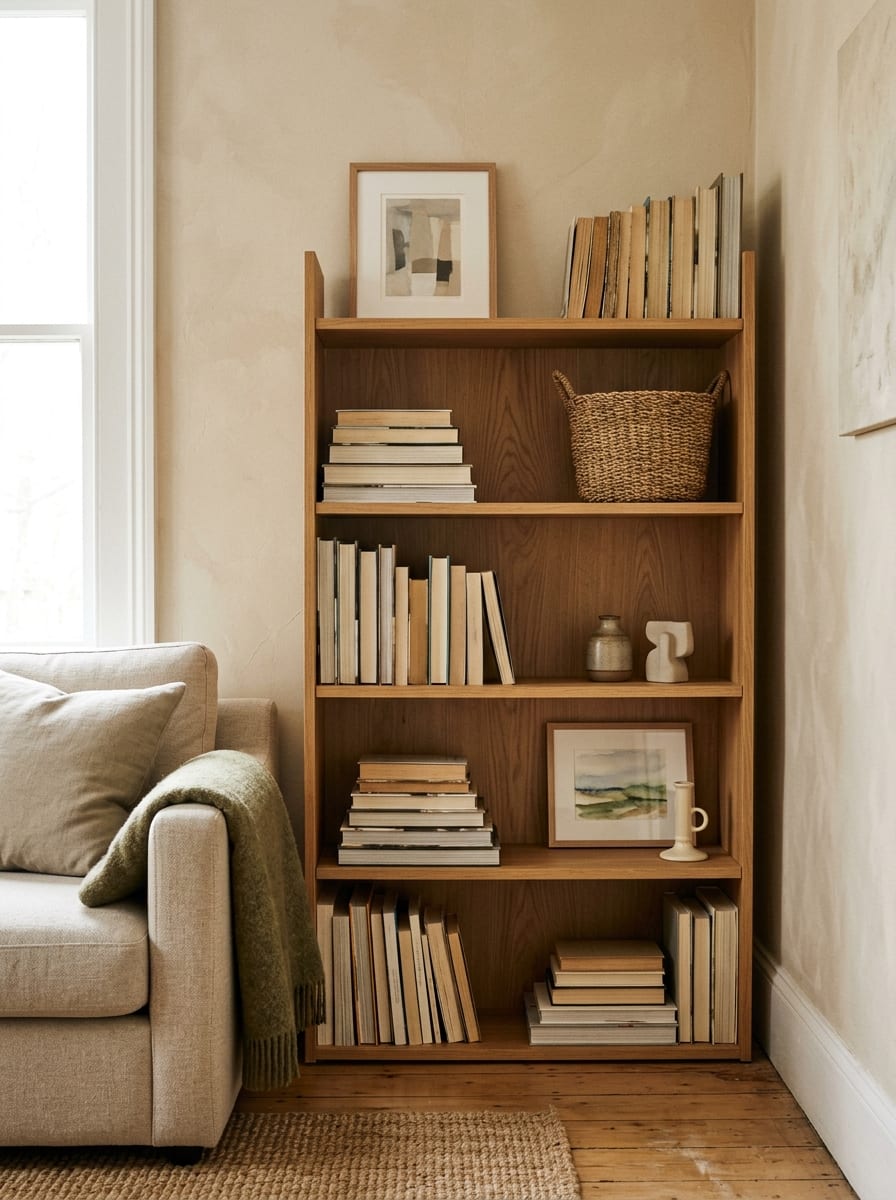
If you already need a place for books, don’t automatically separate your storage and decorating furniture.
A bookshelf can do both jobs.
Use some shelves for books and others for objects that add personality to the room.
The trick is to create visual rhythm.
Instead of putting books on every shelf, alternate between:
- vertical books
- horizontal stacks
- one decorative object
- an empty section
- a small basket
- framed art leaning against the back
The empty areas are important.
They prevent the bookshelf from reading as one solid mass.
If the room is already busy, use fewer decorative objects and let the books provide most of the visual interest.
Best for: anyone who wants storage and display without adding another piece of furniture.
11. Choose a Bookcase That Matches the Wall Instead of Fighting It
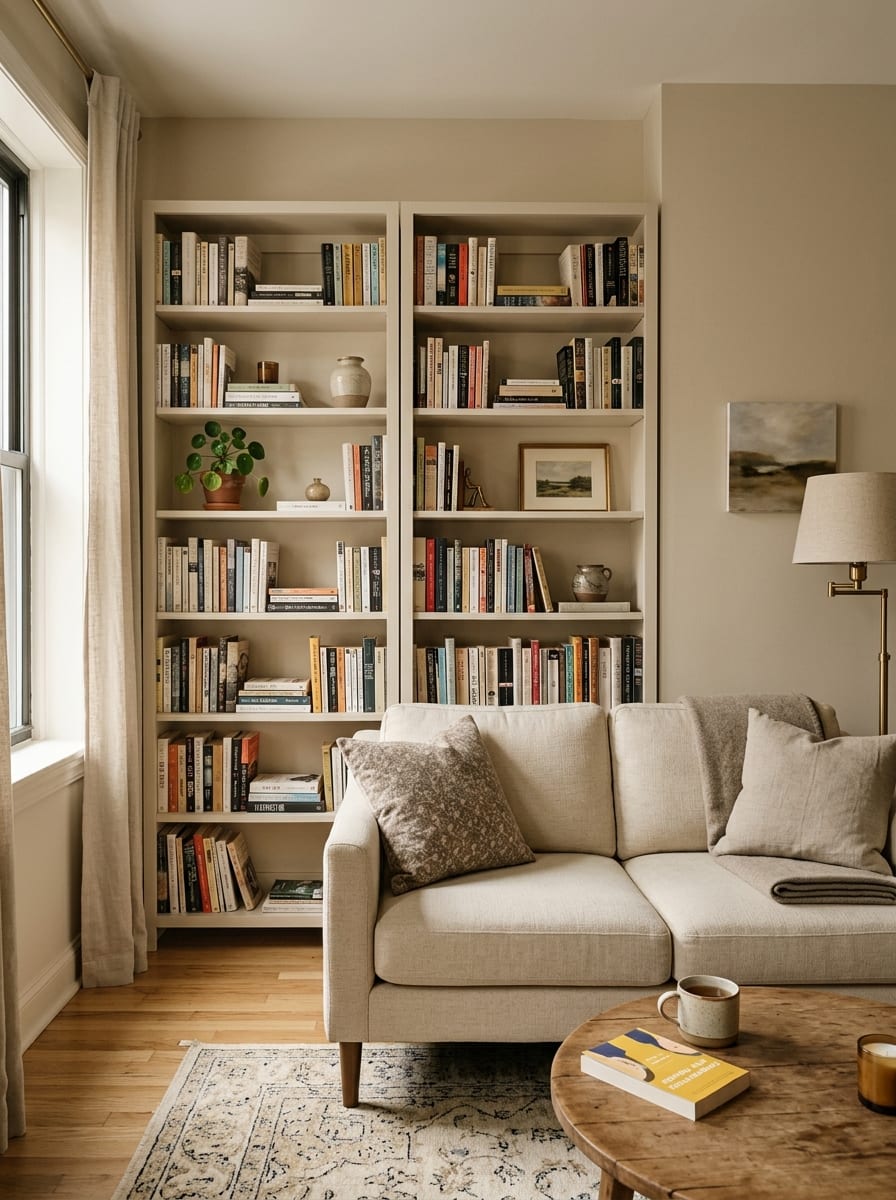
Sometimes the easiest way to make a bookshelf feel less bulky is to reduce its contrast with the wall behind it.
A light bookshelf against a light wall can visually recede.
The same principle can work with darker rooms when the shelf color closely relates to the surrounding architecture.
This doesn’t mean every bookshelf needs to be white.
A pale oak unit against a warm neutral wall can feel integrated. A charcoal bookcase against a deep wall color can create a more intentional built-in effect.
The important thing is to think about the bookshelf as part of the entire wall rather than as an isolated object.
This is especially useful when you need a larger storage piece but don’t want it to become the first thing you notice when you enter the room.
Best for: rooms where the bookshelf needs to be substantial but visually quiet.
How Deep Should a Small Living Room Bookshelf Be?
Depth matters more than many people expect.
A bookshelf that projects too far into a small living room can interfere with walking paths, make furniture feel closer together, and reduce the amount of visible floor.
Before buying one, measure:
- The available wall width.
- The maximum furniture depth.
- The walking path in front of the bookshelf.
- Door and drawer clearances nearby.
- Window and radiator locations.
- The depth of the objects you actually plan to store.
Don’t buy a deeper shelf simply because it offers more theoretical storage.
If most of your books and decorative objects don’t require the extra depth, you’re paying for floor space you may not have.
How to Keep a Full Bookshelf From Looking Heavy
A bookshelf becomes visually heavy when too much of the surface is filled with objects of similar size, color, and density.
Instead, create variation.
Use a combination of:
- Vertical books for height and structure.
- Horizontal stacks to create visual breaks.
- Open shelf space to give the eye somewhere to rest.
- Baskets to conceal smaller items.
- Plants to introduce a softer shape.
- Small framed art to break up rows of books.
You can also organize the shelves from heavy to light.
Put larger books and baskets toward the bottom, then use lighter objects higher up.
This keeps the furniture grounded while making the upper half feel less dense.
Three Bookshelf Mistakes That Make a Small Living Room Feel Smaller
Choosing depth based only on storage capacity
A deeper shelf may hold more, but it also takes more floor space.
Prioritize the storage you actually need.
Filling every shelf
An empty section isn’t wasted space.
It can be the difference between a bookshelf that feels styled and one that feels overcrowded.
Ignoring the walking path
A bookshelf may technically fit against the wall while still making the room uncomfortable to walk through.
Tape the proposed footprint onto the floor before buying the furniture.
Walk around it.
Open nearby drawers.
Pull out dining chairs if they’re nearby.
Then decide.
A Simple Way to Choose the Right Bookshelf
If your living room has limited floor space but plenty of wall height, start with a tall, narrow shelf.
If your room has a large window or low furniture, consider a low bookcase.
If you have an awkward corner, look at ladder or corner shelving.
If you have a large TV wall, integrate storage around the television.
If you need a visual boundary in an open-plan apartment, consider an open-backed divider.
And if you only need to display a small collection, don’t automatically buy a full bookcase. A slim wall shelf may be enough.
The right bookshelf isn’t necessarily the one with the most storage.
It’s the one that gives you the storage you need without taking more visual or physical space than the room can comfortably spare.
Final Thought
Small living rooms don’t have to choose between useful storage and an open feeling.
The key is to pay attention to depth, height, placement, and visual weight before you pay attention to how many shelves a bookcase has.
A tall narrow unit can use forgotten wall height. A low bookcase can preserve a window view. A pair of slim shelves can frame a room without dominating it. And a carefully edited display can make a bookshelf feel like part of the room instead of another obstacle inside it.
Before buying one, mark its footprint on the floor, check the walking path, and think about what you actually need to store.
That few minutes of planning can make the difference between a bookshelf that solves the room and one that makes the room feel smaller.