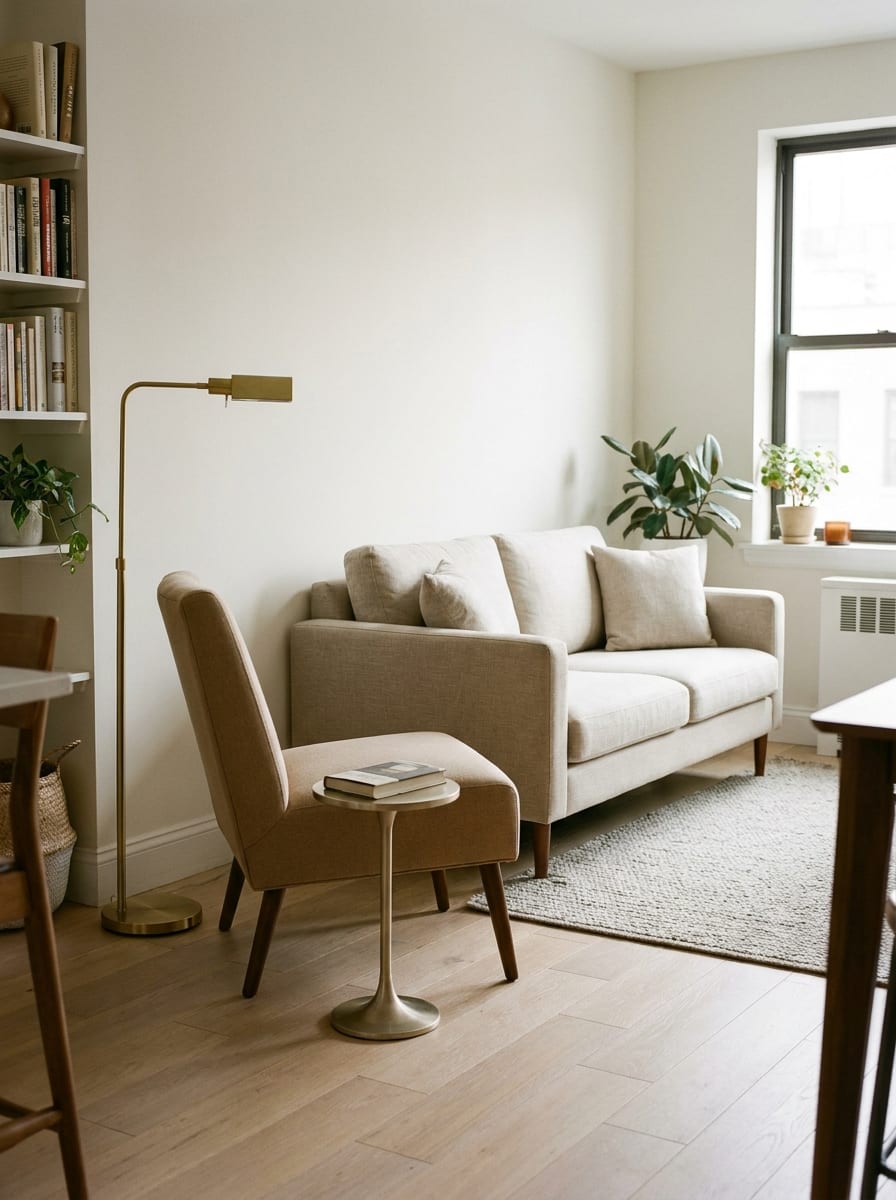
9 Small Living Room Accent Chair Ideas That Add Seating Without Blocking the Walkway
Need extra seating? Discover 9 compact accent chair ideas for small living rooms—from 28" swivel chairs to open-arm seats that keep walkways clear.
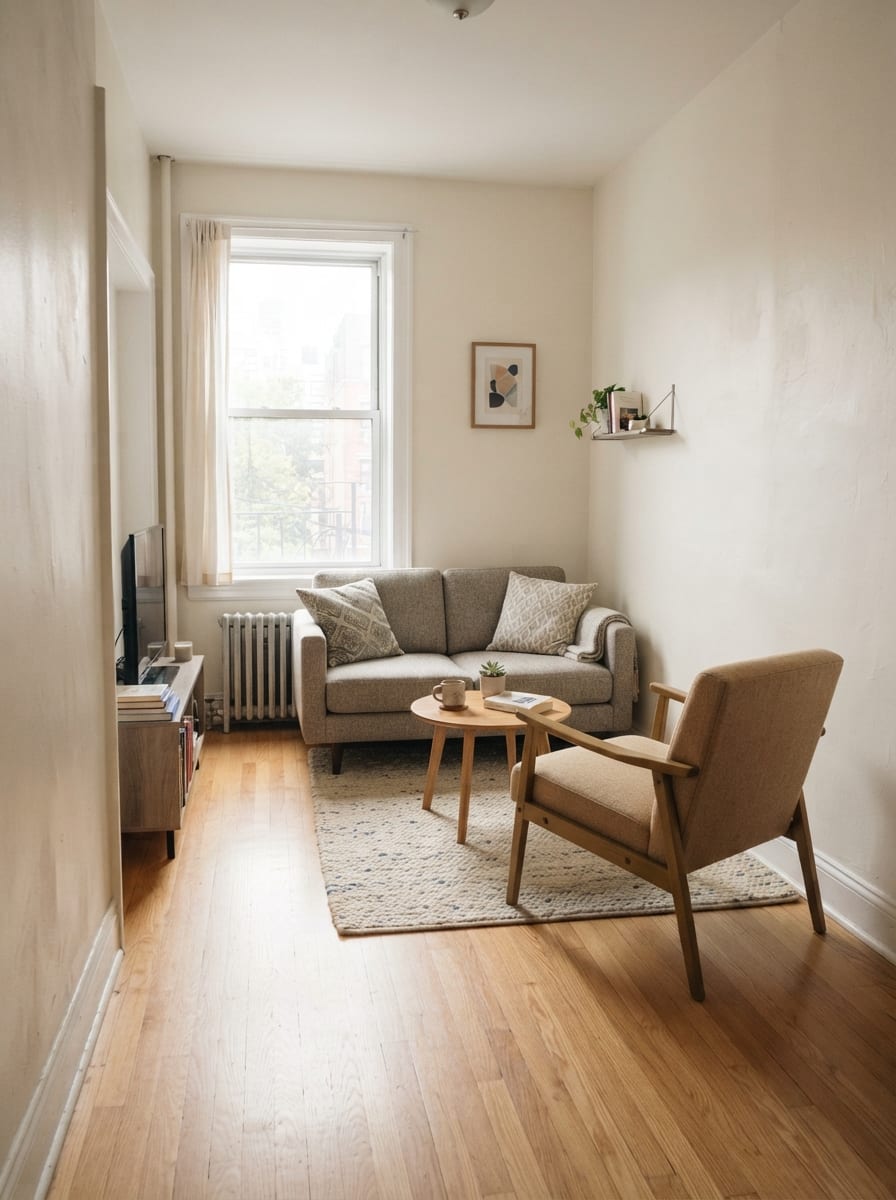
A compact open-arm accent chair placed in a small apartment living room corner with clear walkway clearance
In This Guide
Adding one more chair sounds simple until you are working with a small living room.
A chair that looks compact in a showroom can suddenly feel enormous once it sits beside a sofa, coffee table, media console, and the only path through the room. In small spaces, the issue is rarely just whether the chair physically fits. It is whether the room still feels easy to move through after you add it.
The most useful small living room accent chair ideas focus on three things: chair footprint, visual weight, and circulation.
A compact chair with open arms can feel lighter than a bulky upholstered chair with the same measurements. A chair tucked tightly into a corner may technically save floor area but create an awkward seat nobody wants to use. And sometimes moving the chair only a few inches can preserve the main walking route.
Here are nine ways to add an accent chair while keeping a small living room comfortable, functional, and visually open.
1. Choose an Open-Arm Chair for an Empty Corner
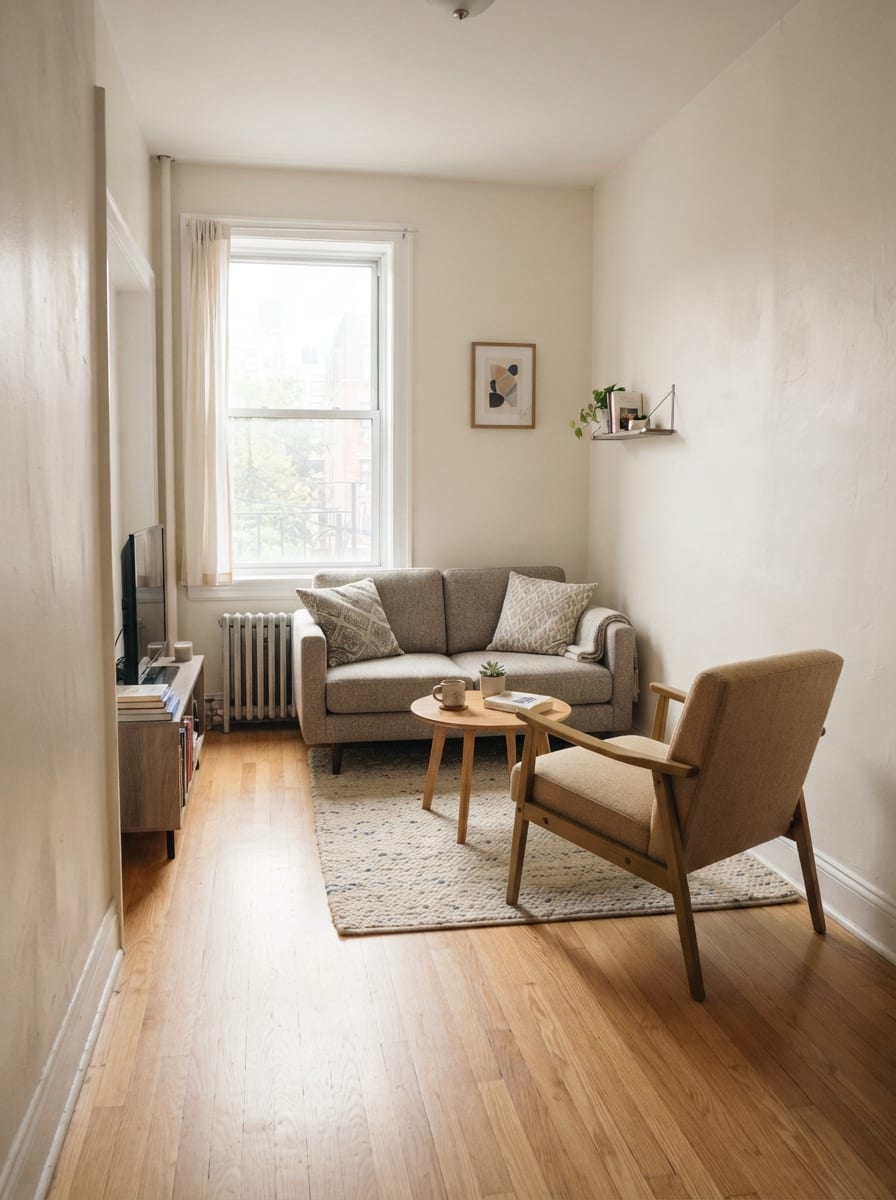
An unused living-room corner is one of the easiest places to add an extra seat, but the chair still needs to look appropriately scaled.
Instead of a chunky club chair, try a compact chair with slim legs and partially open arms. Seeing more floor and wall through the frame reduces its visual weight, which helps the corner feel furnished rather than filled.
A chair around 25 to 29 inches wide is often easier to work into a small living room than a wide lounge chair. Measure the actual footprint rather than trusting labels like “apartment size.”
Leave enough breathing room between the chair and nearby furniture. If it is beside a sofa, roughly 6 to 12 inches can be enough for visual separation when no one needs to walk between them.
Angle the chair slightly toward the sofa instead of pressing it flat against both walls. Even a subtle angle can make the seat feel part of the conversation area.
Best for
- Empty corners
- Living rooms with one sofa and no secondary seating
- Rooms where you want the chair to feel visually light
Watch out for
Do not place the front legs so far into the room that they interrupt the main path between the entry, sofa, and adjacent spaces.
2. Use an Armless Chair Beside the Sofa
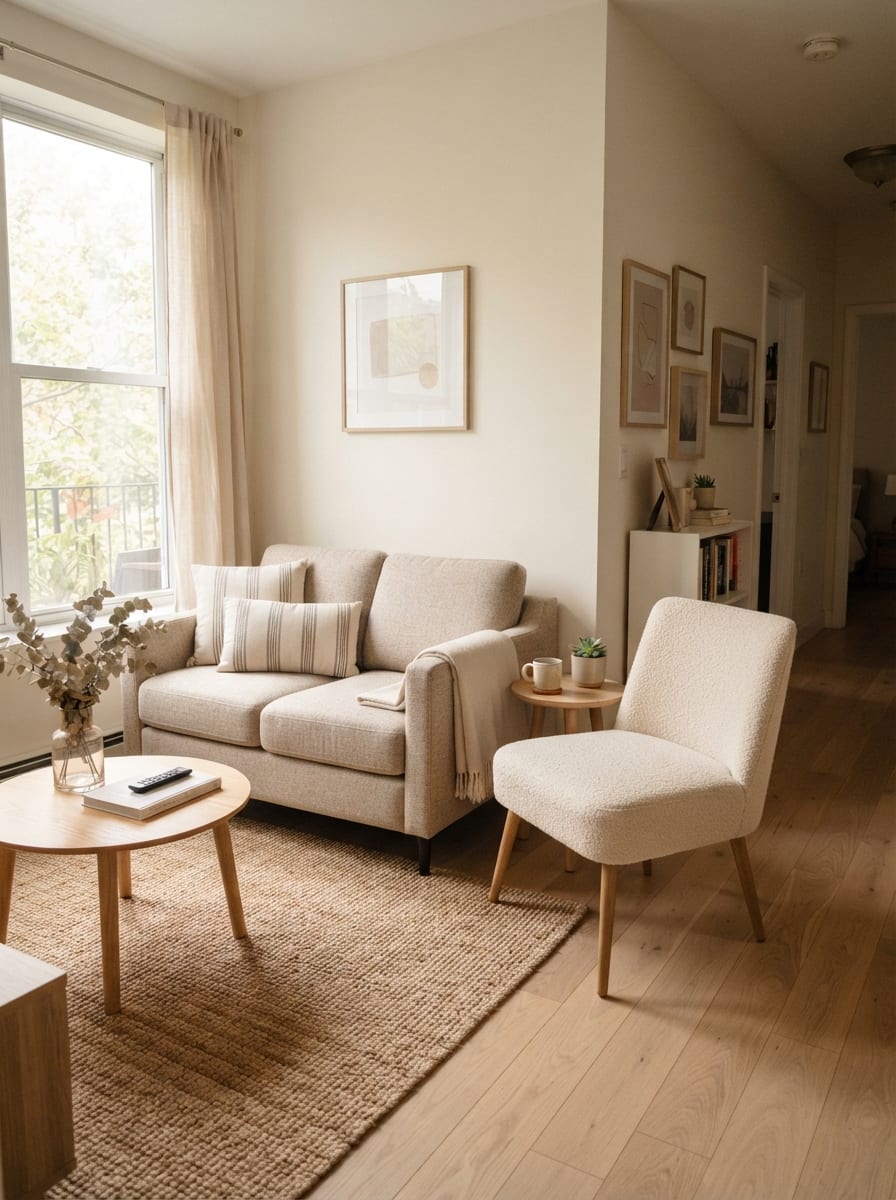
When every inch counts, removing the chair arms can make a surprisingly large difference.
An armless accent chair can provide a full seat while using less width than a conventional lounge chair. It also creates fewer visual barriers, which is helpful when the chair sits close to the end of a sofa.
This arrangement works especially well when the sofa already occupies most of the main wall.
Look for an armless chair with a seat width that is actually comfortable—roughly 20 to 24 inches is a useful range for many adults. Avoid making the chair so tiny that it functions more like decorative furniture than a real seat.
Place it near one sofa arm and turn it slightly inward. If there is a side table between the two seats, choose one with a small footprint instead of trying to squeeze in a full-size end table.
Why it works
The missing arms visually expose more floor and keep the furniture grouping from becoming one continuous heavy block.
Tradeoff
An armless chair is less supportive for lounging, so this is better for conversation seating than for long movie nights.
3. Try a Rounded Swivel Chair Where the Room Serves More Than One Purpose
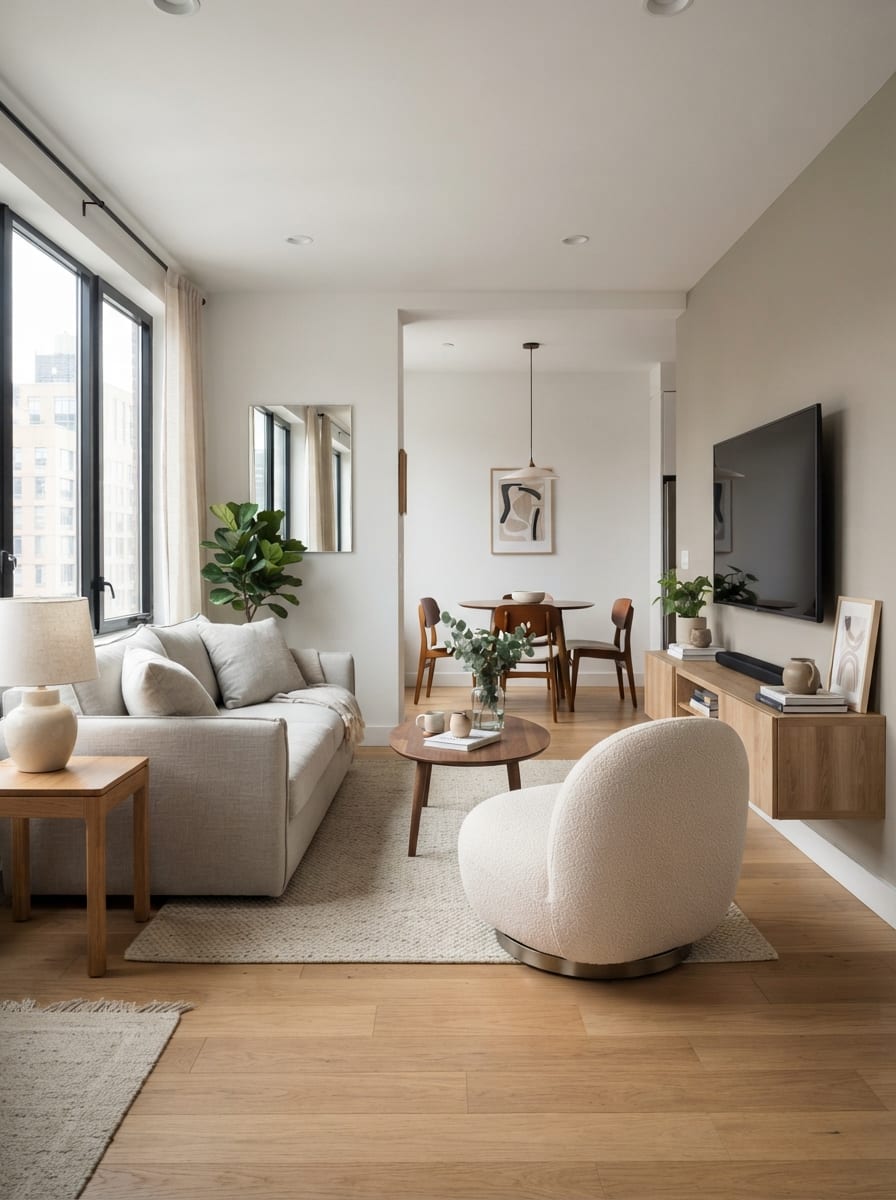
A swivel chair can be especially useful when your small living room needs to face more than one direction.
For example, the chair might face the sofa during conversation and turn toward the television later. In an open-plan apartment, it could rotate toward a dining area or kitchen without needing to be dragged across the floor.
The key is choosing a genuinely compact swivel chair. Many barrel chairs look small in photos but measure 32 inches or more across, which can overwhelm a tight layout.
For a small room, look for a relatively shallow model with a compact circular base. Before buying, measure not just the chair itself but also the space it needs while rotating.
A swivel chair should not clip:
- The coffee table
- The sofa arm
- Nearby shelving
- The wall
Leave a few extra inches around its rotation path.
Best placement
This works well at the open end of a sectional or near the boundary between the living room and another zone.
4. Turn the Window Corner Into a Real Reading Seat
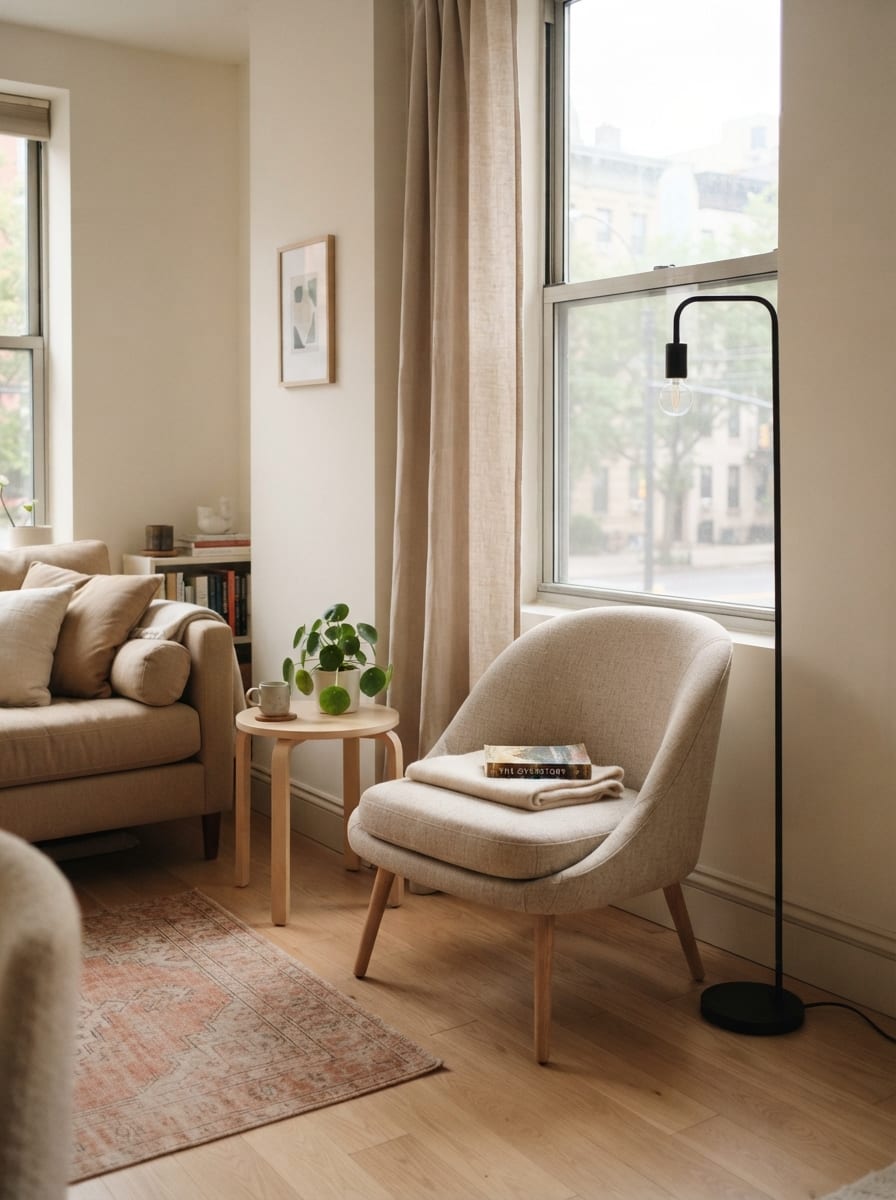
A window corner often becomes dead space because it is too small for a table or storage unit but large enough for a chair.
This can be one of the best places to create an extra seat without changing the main furniture layout.
Choose a chair with a relatively shallow depth, especially if curtains need room to hang behind it. The chair should not trap the drapery against the wall or block access to the window.
Keep roughly 2 to 4 inches between the back of the chair and the curtain when possible. If the window has a radiator, baseboard heater, or HVAC vent below it, follow the required clearance for that equipment instead of placing upholstery directly in front of it.
Add a narrow floor lamp or wall-mounted reading light rather than a bulky side table.
Small-space advantage
The chair uses an area that often sits empty while giving the room a purposeful reading zone.
5. Use a Slim Chair Beside the TV Wall Instead of Another Cabinet
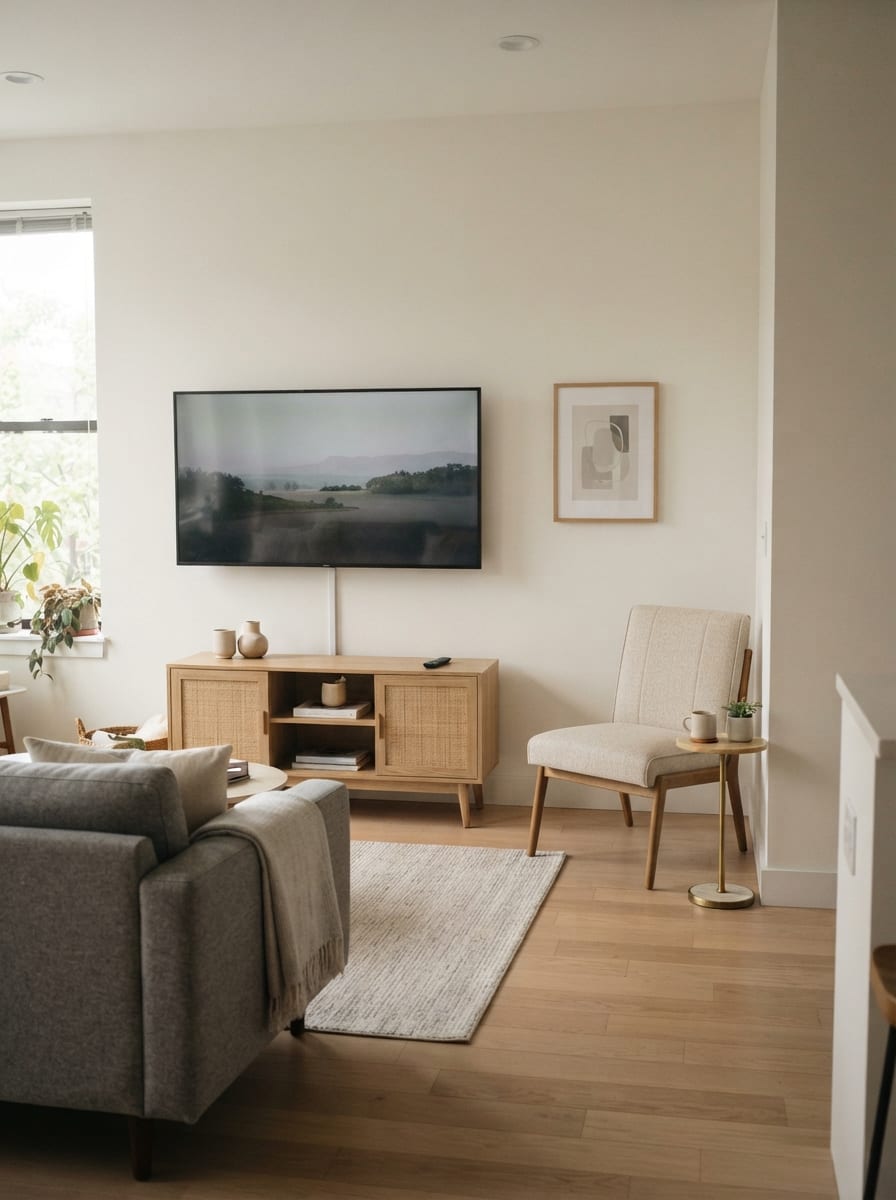
Some small living rooms have a narrow strip of unused floor beside the media console or television wall.
That space often gets filled with another storage unit simply because it is there. But if you already have enough storage, it can be a smart spot for a compact chair.
Choose something with:
- Narrow arms or no arms
- A relatively upright back
- Moderate seat depth
- Exposed legs
An upright chair usually projects less deeply into the room than a lounge chair.
Keep the chair far enough from the television that it does not make the media wall feel crowded. It should read as part of the seating arrangement, not as furniture wedged into leftover space.
If the TV is wall-mounted, avoid placing a chair where someone sitting in it would block another viewer’s sightline.
6. Angle the Chair Toward the Sofa Instead of Lining Everything Against the Walls
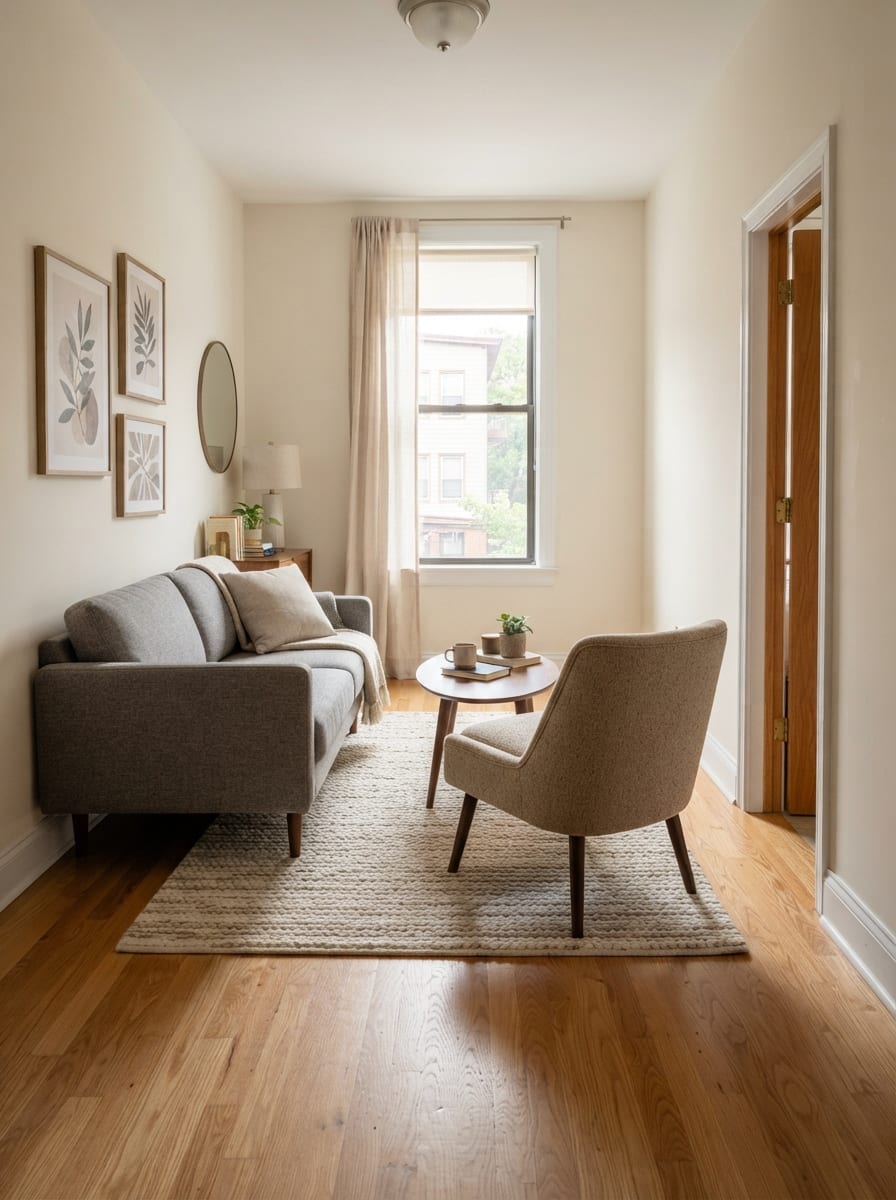
A small room does not automatically mean every piece of furniture should sit flat against a wall.
Sometimes a chair placed at a slight diagonal actually improves the layout because it creates a more natural conversation group and prevents the furniture from looking rigid.
A 20- to 30-degree angle is often enough. You do not need to rotate the chair dramatically.
The front of the chair should still relate to the rug and coffee table. If the chair sits completely outside the seating arrangement, it can look accidental.
For a rug-centered layout, let at least the chair’s front legs visually connect with the rug when possible.
Clearance check
After angling the chair, walk through the room normally. Make sure the outer back corner is not now projecting into the path. This is especially important near doorways.
7. Use a Beautiful Dining Chair as Occasional Living-Room Seating
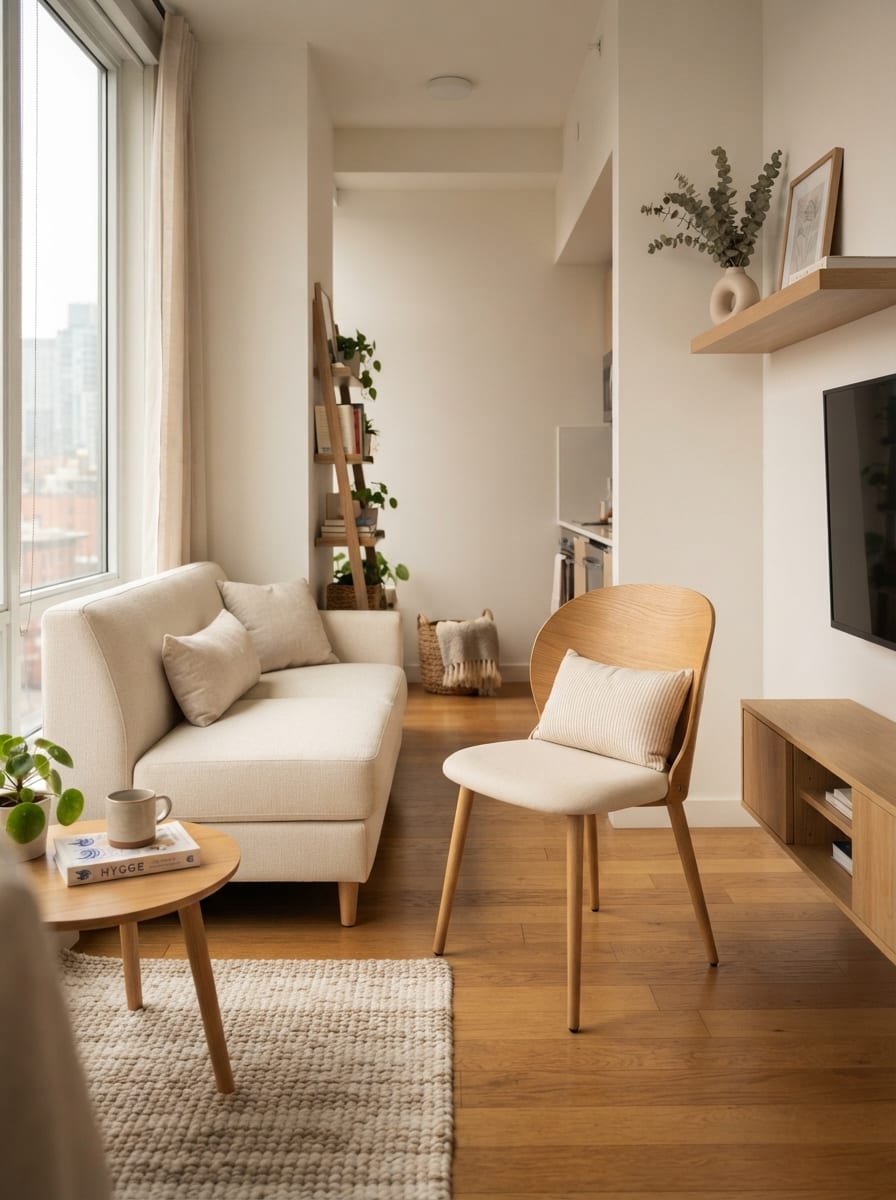
Not every accent chair needs to be a fully upholstered lounge chair.
A comfortable dining-style chair can work surprisingly well as occasional seating, especially when the living room is extremely tight.
This is useful when you want an extra seat for guests but do not need someone sitting there for hours every day.
Choose a chair with:
- A supportive back
- A slightly cushioned seat
- An attractive silhouette
- Enough width to feel comfortable
A dining chair typically has a shallower footprint than a lounge chair, which can preserve valuable circulation space.
You can soften it visually with a small lumbar cushion, but avoid adding a bulky throw that makes the chair look larger.
Good renter strategy
Because the chair is lightweight and movable, it can serve multiple purposes without requiring built-ins or permanent changes.
8. Pick a Low-Back Chair to Keep Sightlines Open
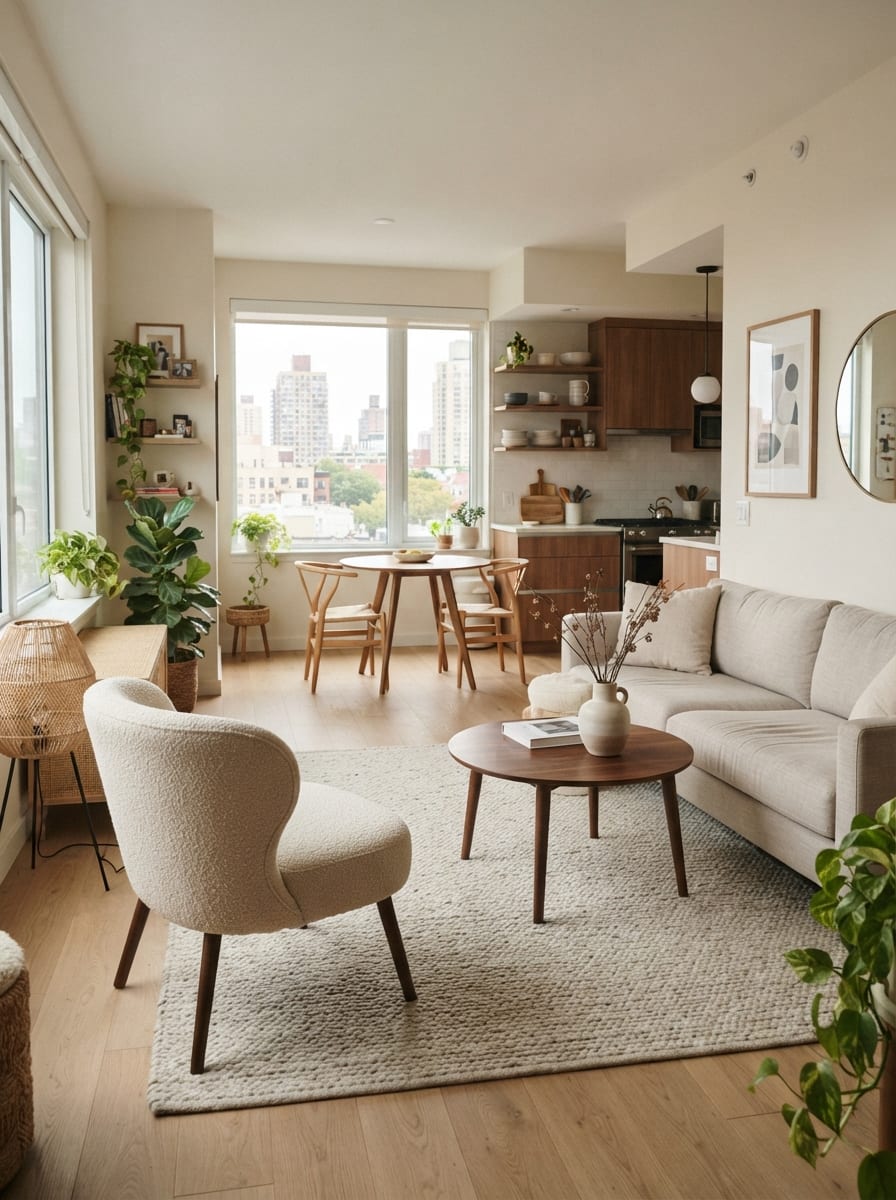
In a small room, furniture height affects how crowded the space feels almost as much as width.
A chair with a tall back can visually divide the room—especially in a studio or open-plan apartment. A lower-backed chair lets your eye travel across the space more easily.
This is particularly useful when the chair floats away from the wall.
Look for a back that sits around shoulder-blade height rather than extending high above the sitter. Pairing a low-back chair with raised legs makes the piece feel even lighter.
Do not sacrifice comfort completely, though. Very low chairs can be harder for some people to get in and out of, so seat height matters too. A seat height around 17 to 19 inches is common and tends to be more practical than very low lounge seating.
9. Float the Chair Only When You Can Preserve a Real Walkway Behind It
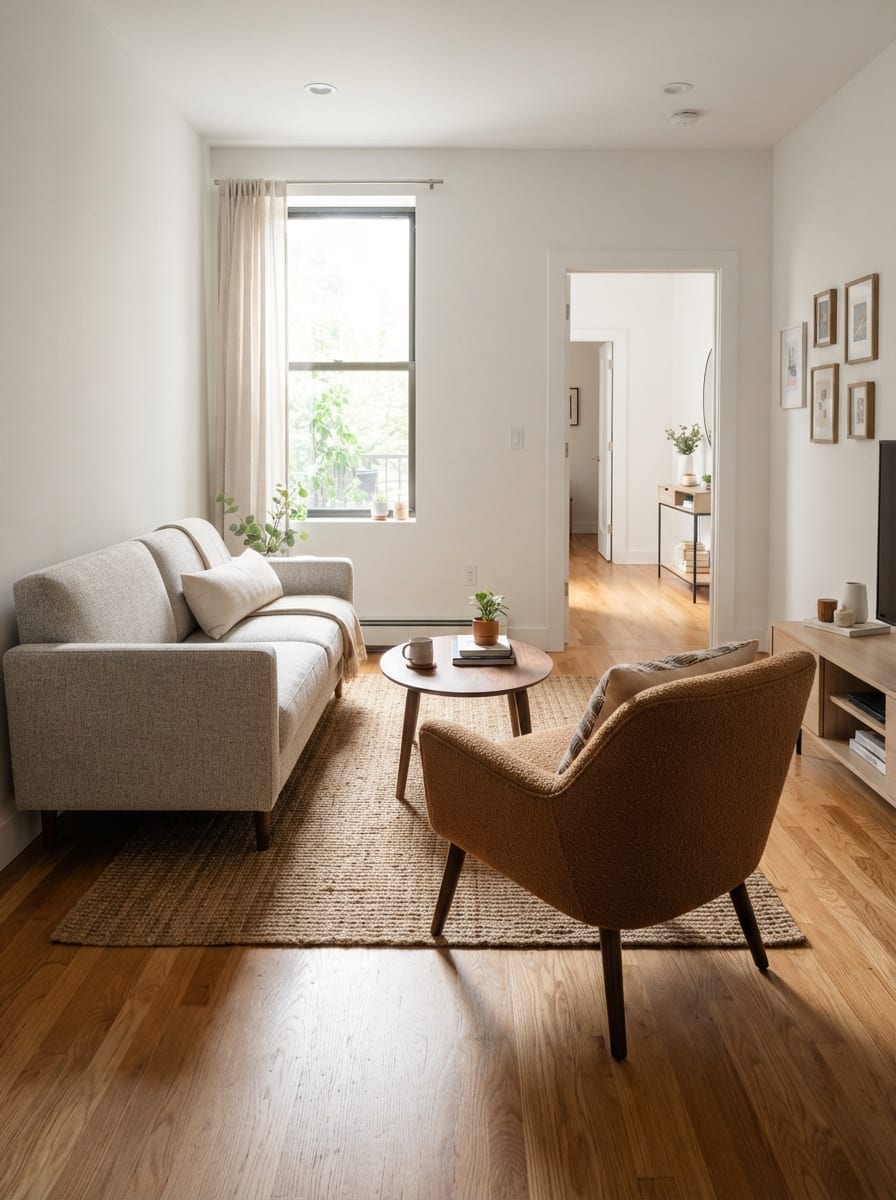
Floating an accent chair can create a polished layout, but it only works if the room still has enough circulation.
This is where measuring matters most.
For a main walking route, aim for about 30 to 36 inches of comfortable passage when the layout allows. In a very tight apartment, you may sometimes work with less, but a path that forces people to turn sideways around the chair is a sign the layout is too crowded.
Do not measure from the center of the chair. Measure from its furthest projecting point—the back, arm, or angled corner—to the wall or next piece of furniture.
If you cannot maintain a usable path behind the chair, move it closer to the perimeter instead. A floated chair should create a clear conversation zone, not an obstacle course.
How Big Should an Accent Chair Be in a Small Living Room?
There is no single perfect measurement because your sofa, doorway positions, and room shape matter more than the label on the chair.
But for many compact rooms, a useful starting point is:
| Measurement | Small-Space Starting Point |
|---|---|
| Chair overall width | About 25–30 in |
| Seat width | About 20–24 in |
| Overall depth | About 28–32 in where possible |
| Seat height | About 17–19 in |
| Chair-to-sofa gap | About 6–12 in if no walkway is needed |
| Main circulation path | Ideally about 30–36 in |
Treat these as planning guides rather than rigid rules. A 30-inch chair can sometimes work better than a 26-inch one if its arms are visually open and its depth is shallower.
Always tape the chair footprint onto your floor before ordering if the room is especially tight.
Where Should an Accent Chair Go in a Small Living Room?
Start by identifying your circulation route before looking for an empty furniture spot.
The path from the doorway to the sofa, balcony, kitchen, bedroom, or hallway should remain easy to use.
Then look for areas that can hold a chair without interfering with that path:
- An empty corner beside the sofa
- Beside a window
- At the open end of the sofa
- Near the media wall
- Opposite one end of the sofa
- At the edge of an open-plan seating zone
The chair should also have a reason for facing the direction it does. If it faces neither the sofa nor the television nor a view, its placement may look forced.
Accent Chair Shapes That Work Best in Small Spaces
Open-arm chairs
These expose more floor and visually reduce bulk.
Armless chairs
Useful when width is the main constraint.
Upright occasional chairs
Better than deep lounge chairs when floor depth is limited.
Compact swivel chairs
Useful when the chair needs to serve several directions.
Low-back chairs
Keep sightlines open in studios and open-plan layouts.
Raised-leg chairs
Visible floor underneath makes furniture feel lighter.
What to Avoid in a Small Living Room
Oversized barrel chairs
A rounded shape can look soft and compact in product photos while actually occupying a large circular footprint. Measure before buying.
Deep lounge chairs
Extra depth pushes farther into circulation paths than many people expect.
Matching every seat
Your accent chair does not need to match the sofa exactly. A lighter frame or different shape can actually make the room feel less bulky.
Filling every open corner
An empty corner is not automatically wasted space. Sometimes that openness is what makes the room comfortable.
Tiny chairs nobody wants to use
Small-space furniture still needs to function. Do not sacrifice seat depth, back support, and stability just to shave off a few inches.
Blocking door swings
Check room doors, closets, cabinets, and balcony doors before finalizing placement.
How to Make an Accent Chair Look Lighter
If your chair technically fits but still feels bulky, try reducing the visual weight around it:
- Exposed legs
- A lighter upholstery color
- One small cushion instead of multiple pillows
- A narrow side table
- Less wall decor directly behind it
- An open floor lamp rather than a bulky table lamp
Giving the chair some negative space can make nearly as much difference as buying a smaller chair.
Should the Accent Chair Sit on the Rug?
Ideally, the chair should visually relate to the main seating rug.
In many small living rooms, putting at least the front legs on the rug helps connect the chair to the sofa and prevents it from looking stranded in a corner.
However, do not pull a chair awkwardly into the room just to reach an undersized rug. If that happens, either move the chair to a better location, or consider whether the rug itself is too small for the seating arrangement.
Final Thoughts
The best accent chair for a small living room is not necessarily the smallest chair you can find. It is the chair that gives you another genuinely useful seat without damaging the way the room moves.
Start with circulation, then consider width, depth, arm shape, back height, and placement. An open-arm chair in a corner may work for one room, while an armless chair beside the sofa or a slim dining-style chair may be much better in another.
The goal is simple: add one more place to sit without making the room feel like it has one more obstacle to walk around.
FAQ
Can you put an accent chair in a small living room?
Yes. Choose a compact chair and place it where it does not interrupt the main walking route. Open-arm, armless, low-back, and upright chairs are often easier to fit into small rooms.
How wide should an accent chair be for a small space?
Many small-space layouts work well with chairs roughly 25 to 30 inches wide, although the correct size depends on the room. Always measure the full width and depth before buying.
How much space should be behind an accent chair?
If people need to walk behind it, try to maintain roughly 30 to 36 inches for a comfortable primary walkway when possible.
Should an accent chair face the sofa or TV?
It depends on how you use the room. For conversation, turn it toward the sofa. If the chair is also used for television viewing, a compact swivel chair can make both orientations possible.
Is an armless accent chair good for a small living room?
Yes. Removing the arms reduces overall width and visual bulk. Just make sure the chair is comfortable enough for how often it will be used.
Can I use a dining chair as an accent chair?
Yes, particularly when the chair is occasional seating. A comfortable dining-style chair can have a much shallower footprint than a traditional upholstered lounge chair.
How do I know if the living room has too much furniture?
Walk through the room using your normal routes. If you need to turn sideways, step around furniture corners, move pieces to open doors, or repeatedly bump into the chair, the layout is too crowded.