14 Small Kitchen Decor Ideas That Add Style Without Losing Counter Space
Discover 14 small kitchen decor ideas that add style without losing counter space — open shelves, warm accents, renter-safe swaps, and quick weekend upgrades.
In This Guide
Small kitchens have a decorating problem: anything you add to the counter takes away from the cooking. So most small kitchens end up in one of two states — cluttered with every gadget on display, or so stripped down they feel like a lab. Neither is what you pictured when you dreamed of a kitchen with personality.
The trick is that small kitchen decor is not about what sits on the counter. It is about walls, windowsills, hardware, and the vertical space you are already ignoring. Every idea below adds style somewhere that was not usable cooking space anyway — which means the counter you have stays a counter.
All 14 are renter-friendly: peel-and-stick, no-drill, or fully reversible. Here are 14 small kitchen decor ideas designed specifically for small apartments.
1. Open Shelves, Styled Sparingly
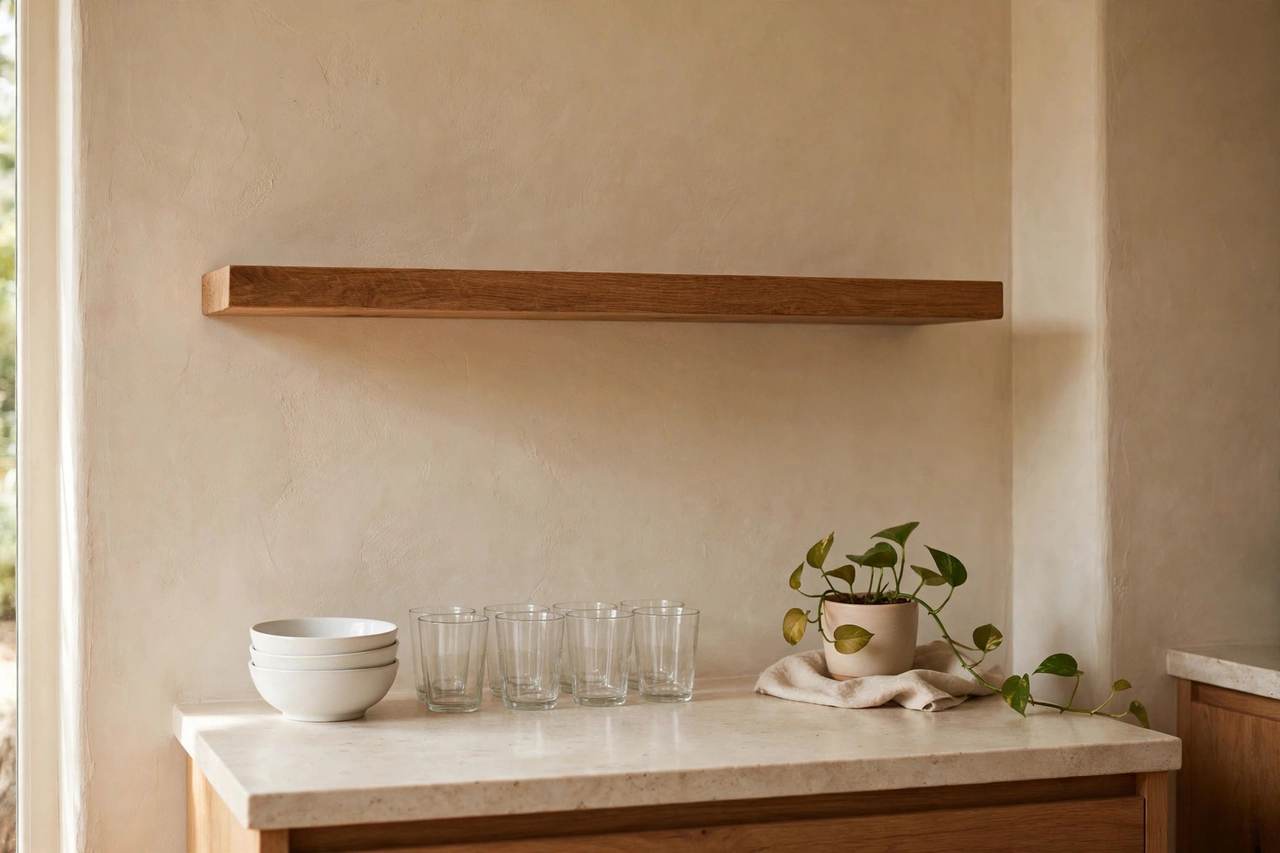
Take down one upper cabinet — or simply stop using one — and replace it with a single floating shelf. A 24- to 36-inch shelf, 10 inches deep, mounted 16 to 18 inches above the counter turns a dark cabinet box into display space.
The styling rule is 70 percent functional, 30 percent pretty: stack everyday bowls, line up drinking glasses, then add two decorative touches: a trailing plant and one handmade mug. Leave breathing room between groups; gaps read as styled, packing reads as storage overflow.
Why it works
Upper cabinets are heavy boxes that push a small kitchen’s walls inward. An open shelf breaks that wall and lets the eye travel further, which reads as more space — and since it holds dishes you use daily, it costs zero counter space.
Styling rules
- Group in odd numbers: three bowls, five glasses
- Two colors plus wood or green from the plant
- Everyday dishes only, not the good china
- An LED strip under the shelf adds task lighting
Best for
Galley kitchens and any small kitchen where one upper cabinet is a graveyard for things you never reach.
2. The Single Runner Rug
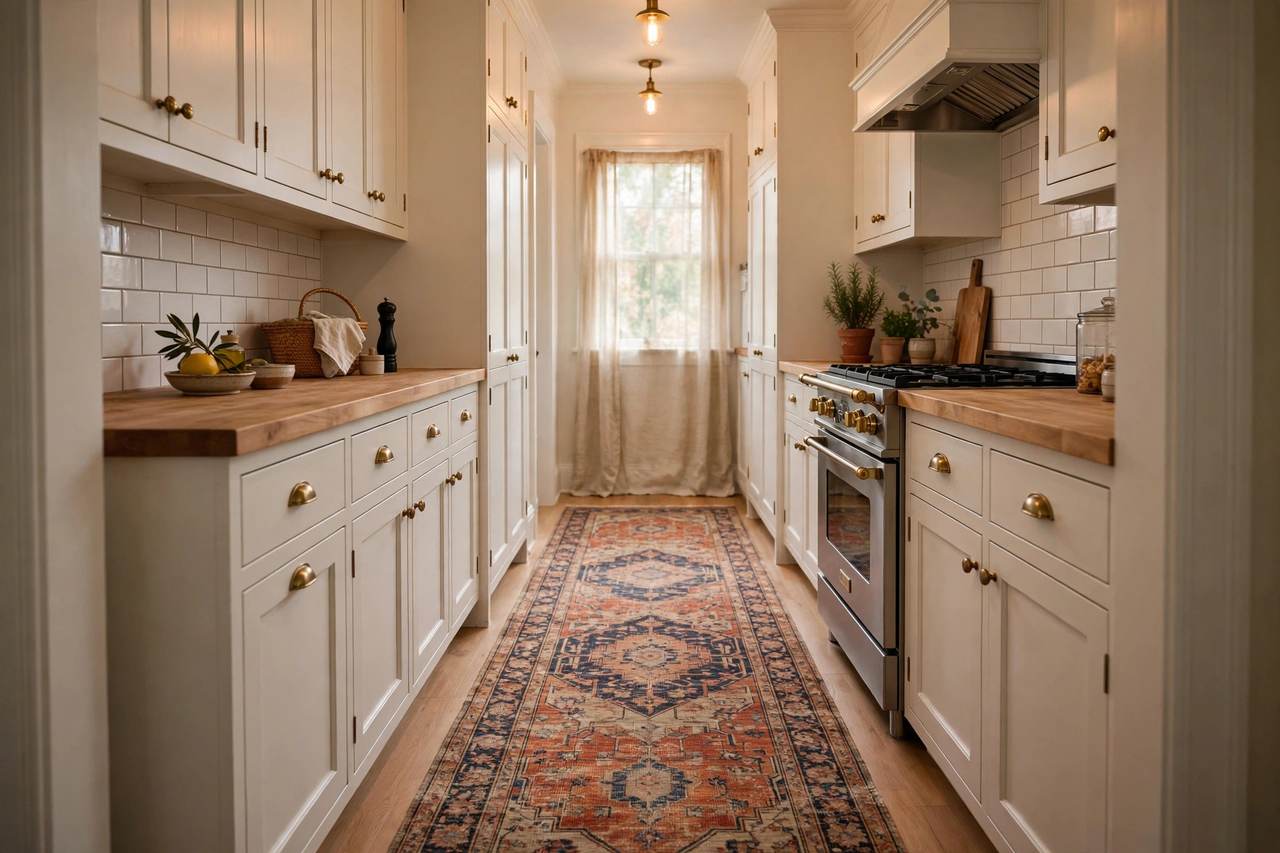
The floor is the largest unused surface in your kitchen, and one runner covers it for less than almost anything on this list. Measure the open floor between cabinets: a 2-by-5-foot runner suits a 5-foot galley, a 2.5-by-8-foot runner fits an 8- to 10-foot run. Low pile — quarter-inch or less — so doors and the dishwasher swing over it.
Pick a washable runner with warmth: a vintage-look persian print or a simple stripe. It hides daily crumbs, and a machine-washable one goes in the laundry every two weeks. Zero wall space, zero counter space, zero shelf space.
Why it works
A long runner draws the eye down the length of the kitchen, stretching it visually — the same trick hallways use. It adds the pattern and color the upper half of the kitchen usually lacks, balancing cabinets and counter without touching either.
What to buy
- Machine-washable, always — kitchen rugs get dirty
- Under a quarter inch so doors clear it
- Non-slip backing so it does not bunch underfoot
- Dark or mid-tone patterns hide daily wear best
Best for
Any small kitchen with at least 4 feet of open floor — which is nearly all of them.
3. The Windowsill Herb Garden
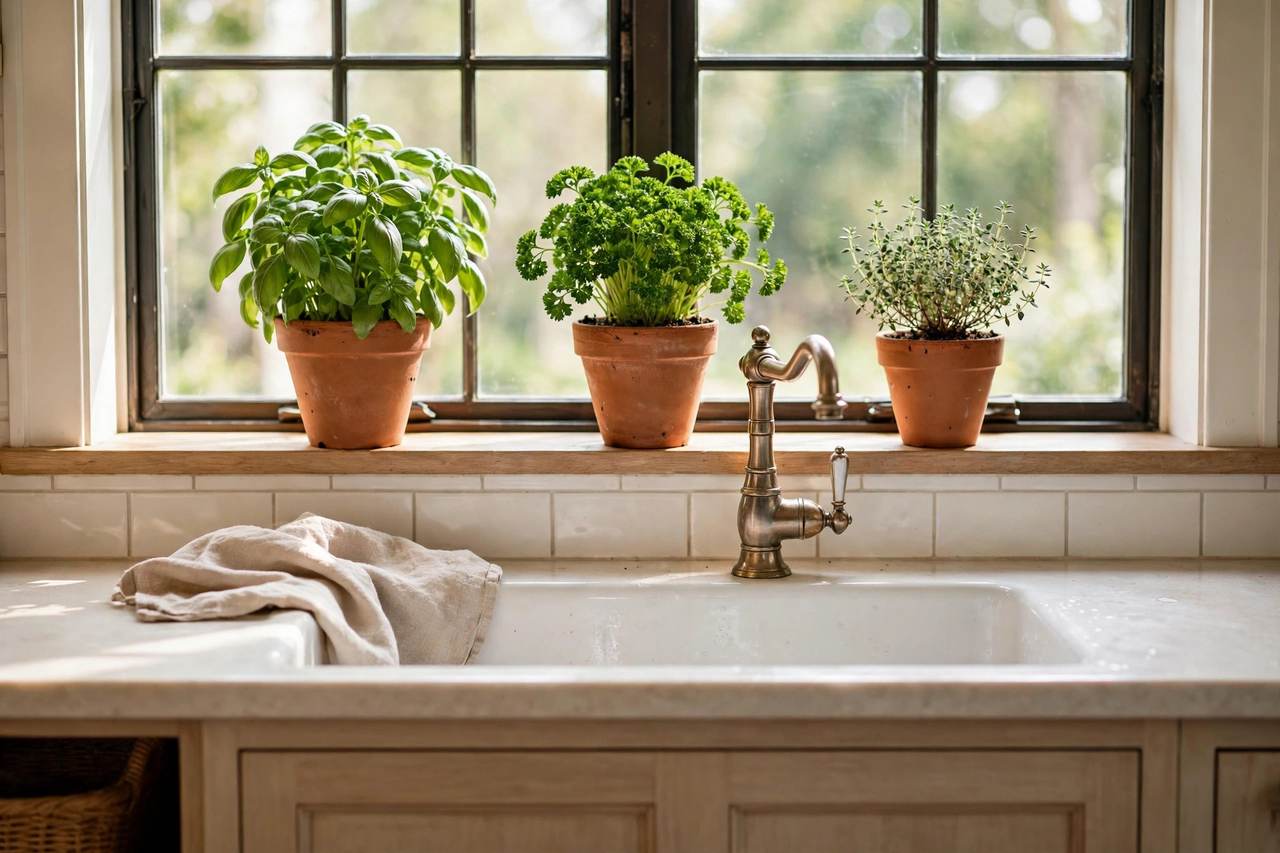
If your kitchen has a window over the sink, that sill is a garden waiting to happen — about 24 to 30 inches of ledge currently holding a sponge and a soap bottle. Three 4-inch pots fit comfortably: basil, parsley, and thyme cover 90 percent of weeknight cooking. Use self-watering pots or terracotta with a tray to protect the sill.
Herbs want four to six hours of light, so an east- or south-facing window is ideal. North-facing? Grow mint and chives, which tolerate low light. Rotate pots a quarter turn every few days so they grow evenly.
Why it works
Living green is the fastest way to make a small kitchen feel cared-for, and a windowsill garden earns its footprint twice: decor and a working ingredient supply. Harvesting basil mid-cook beats any decorative object.
Keeping them alive
- Water when the top inch of soil is dry — most herbs die from overwatering
- Pinch basil from the top; never strip more than a third at once
- Terracotta forgives heavy-handed watering
- Replace tired plants every 3 to 4 months
Best for
Kitchens with a window over the sink, and cooks who want decor that pulls its weight.
4. The Matching Canister Set
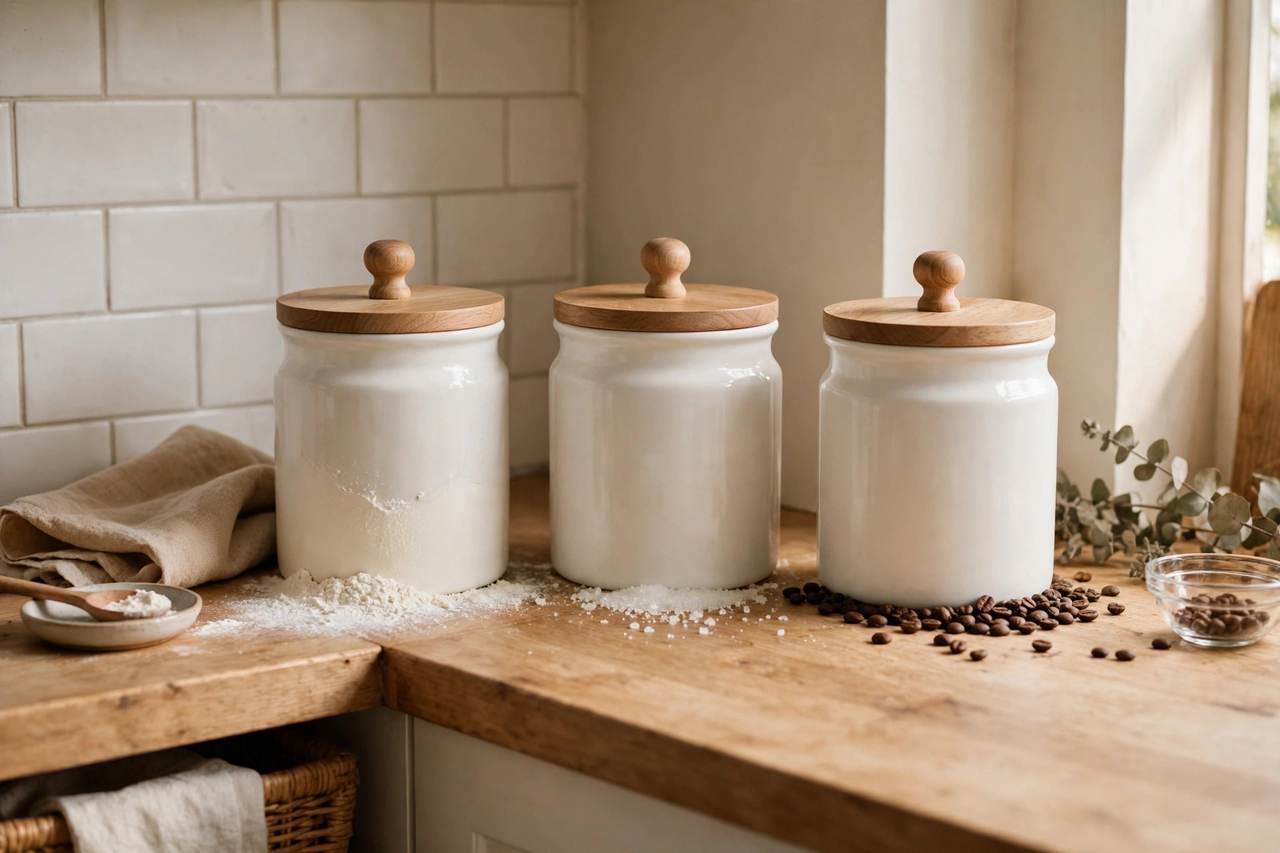
Flour, sugar, and coffee already live in your kitchen — decanting them into three matching canisters turns pantry clutter into intentional decor. Choose 6- to 8-inch canisters in one material: white ceramic, clear glass with wood lids, or brushed metal. They read as one unit instead of three random bags and boxes.
Three canisters occupy one tight corner — roughly a 12-by-12-inch footprint — while holding what used to sprawl across a shelf. Label opaque ones with a kraft label or chalk pen so they stay useful, not just pretty.
Why it works
Mismatched packaging is the number one source of visual clutter in a small kitchen. Matching containers convert noise into pattern — the eye reads three identical shapes as one calm object. Same principle as matching soap dispensers, applied to dry goods.
How to do it
- Three is the sweet spot; five starts looking like a collection
- Glass shows contents; ceramic hides the half-empty bag of flour
- Keep them in one corner — containment is the point
- Match lids to your faucet or hardware finish
Best for
Small kitchens where the counter doubles as pantry overflow.
5. One Bold Peel-and-Stick Backsplash
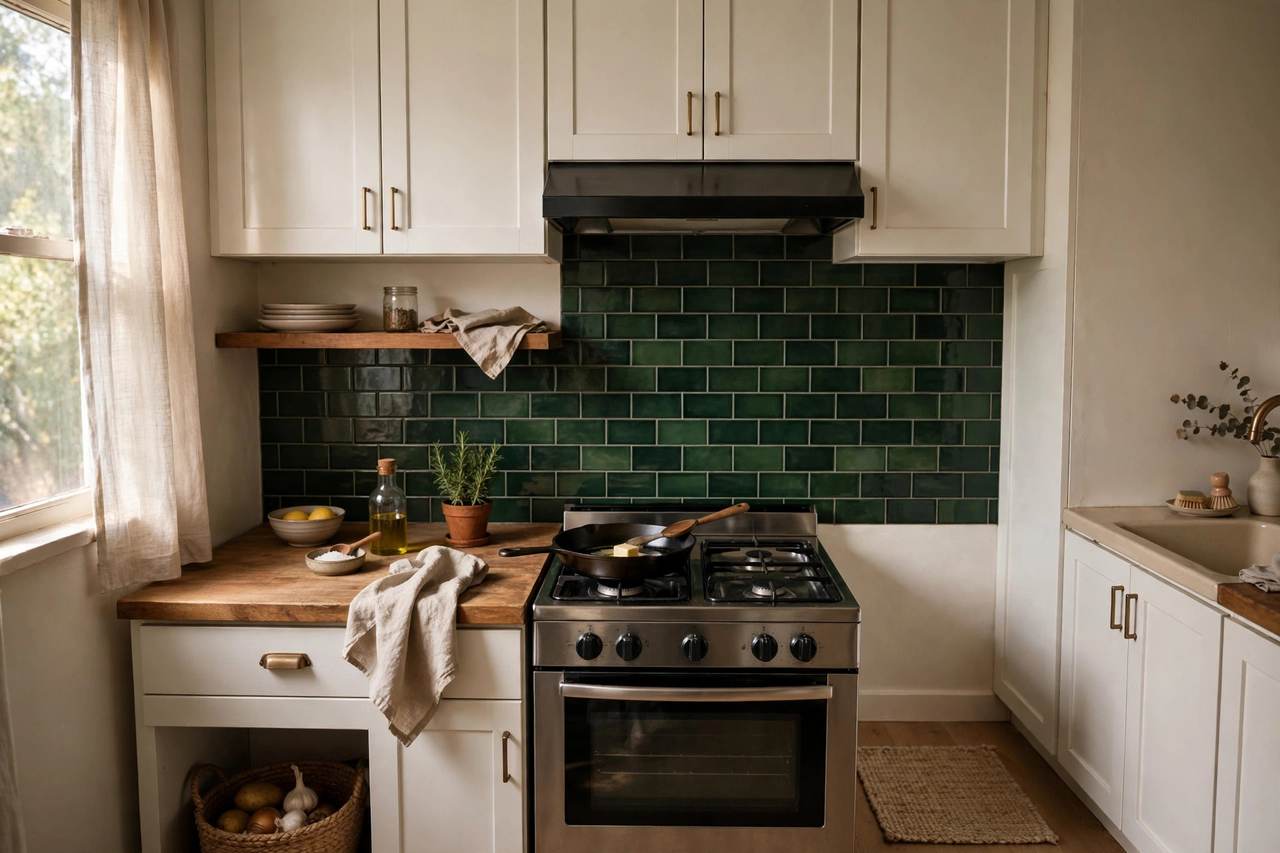
Apartment backsplashes are usually nothing — painted drywall that stains. Peel-and-stick tile covers the 18-inch strip between counter and upper cabinets for a whole small kitchen: most galleys need 10 to 18 square feet, one weekend afternoon, and $40 to $80 in material.
Go bolder than you think. In a small kitchen, a confident pattern — deep green subway, black-and-white geometric, warm terracotta zellige-look — reads as intentional design; timid beige reads as a failed attempt at invisibility. In small kitchen decor, the tile is the one big plane of color in the room, so let it work.
Why it works
The backsplash sits in your sightline every time you cook, wash, or pour coffee. One bold pattern does the work of five small objects with zero footprint — and it removes cleanly with a hairdryer, so the deposit survives.
Installation tips
- Degrease the wall with rubbing alcohol first — adhesion fails on greasy paint
- Start behind the stove, the most visible point, and work outward
- Press out air bubbles with a credit card as you go
- Buy 10 percent extra for miscuts around outlets
Best for
Renters with boring builder-grade kitchens who want one dramatic change.
6. Art in the Kitchen
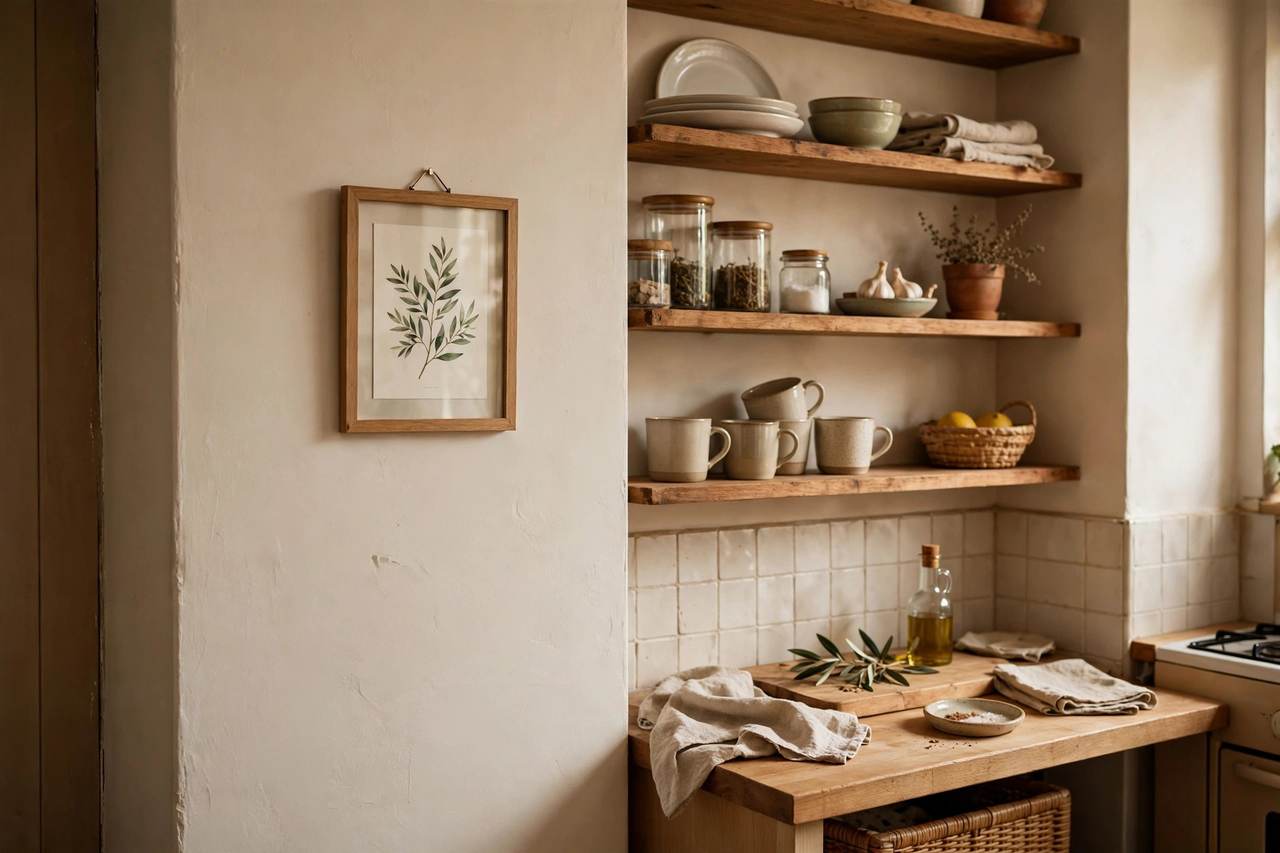
People hang art in every room except the kitchen, which is exactly why it lands so well there. One framed print — 8-by-10 or 11-by-14 inches — on the 12- to 24-inch wall strip beside a window, above the trash nook, or on a pantry cabinet side signals the kitchen is a room worth decorating.
Choose something food-adjacent or just something you love: a vintage market poster, a botanical print, a lemon line drawing. Frame it in glass or acrylic — kitchen humidity warps unframed paper within months. Damage-free strips hold up to 16 pounds: no drilling, no spackle.
Why it works
Art is pure wall decor: zero counter, zero shelf, zero floor. One deliberate piece on an empty wall does what five small counter objects cannot: it makes the room feel finished without shrinking it.
Placement rules
- Center the frame 57 to 60 inches from the floor
- Never above the stove — grease and heat ruin paper
- One piece, not a gallery wall; a small kitchen cannot absorb five frames
- Match one color from the rug or canisters
Best for
Kitchens with one bare wall or an awkward narrow strip that fits nothing else.
7. The Styled Cutting Board Display
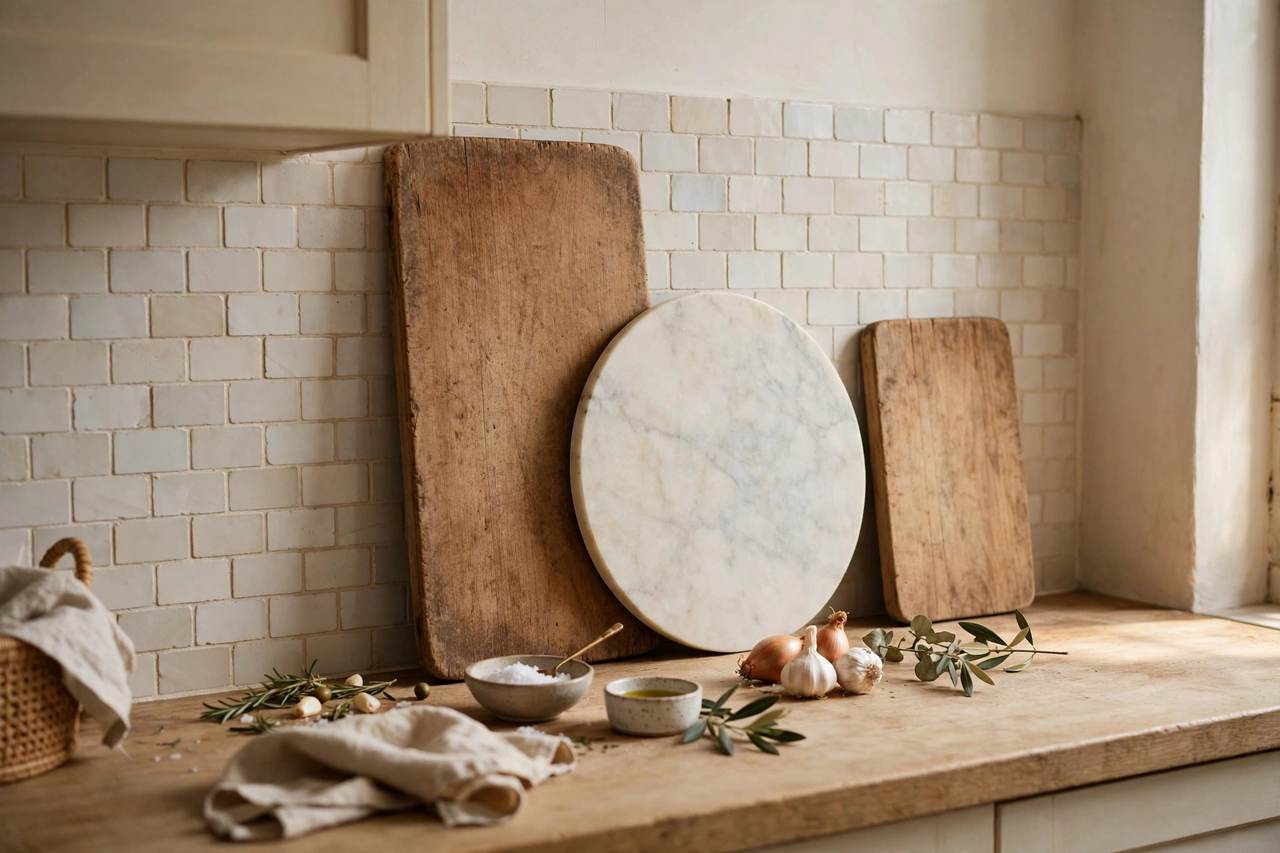
Lean two or three beautiful cutting boards against the backsplash — a 12-inch walnut board, an 18-inch acacia board with a handle, a round marble slab — and leave them there. They take up 2 inches of counter depth and 18 inches of width, and they look like a styled vignette that happens to be your most-used tools.
Vary shapes and materials: one round, one rectangular with a handle, one long and narrow. Oil the wood monthly so it stays rich, not pale gray. Daily-use boards stay grabbable; the pretty ones behind never move.
Why it works
Cutting boards have to live somewhere — in a drawer they are invisible, in a holder they are clutter. Leaned against the backsplash they add warmth exactly where the kitchen is hardest (tile, stone, steel), converting dead wall-adjacent inches into decor.
Styling tips
- Odd numbers, mixed sizes: small in front, tall in back
- Wood against a light backsplash; marble or dark walnut against a bold one
- Oil monthly to keep the color deep
- Hang one on an adhesive hook if counter depth is under 20 inches
Best for
Small kitchens with at least 20 inches of counter depth and a backsplash worth leaning against.
8. A Pendant Over the Sink
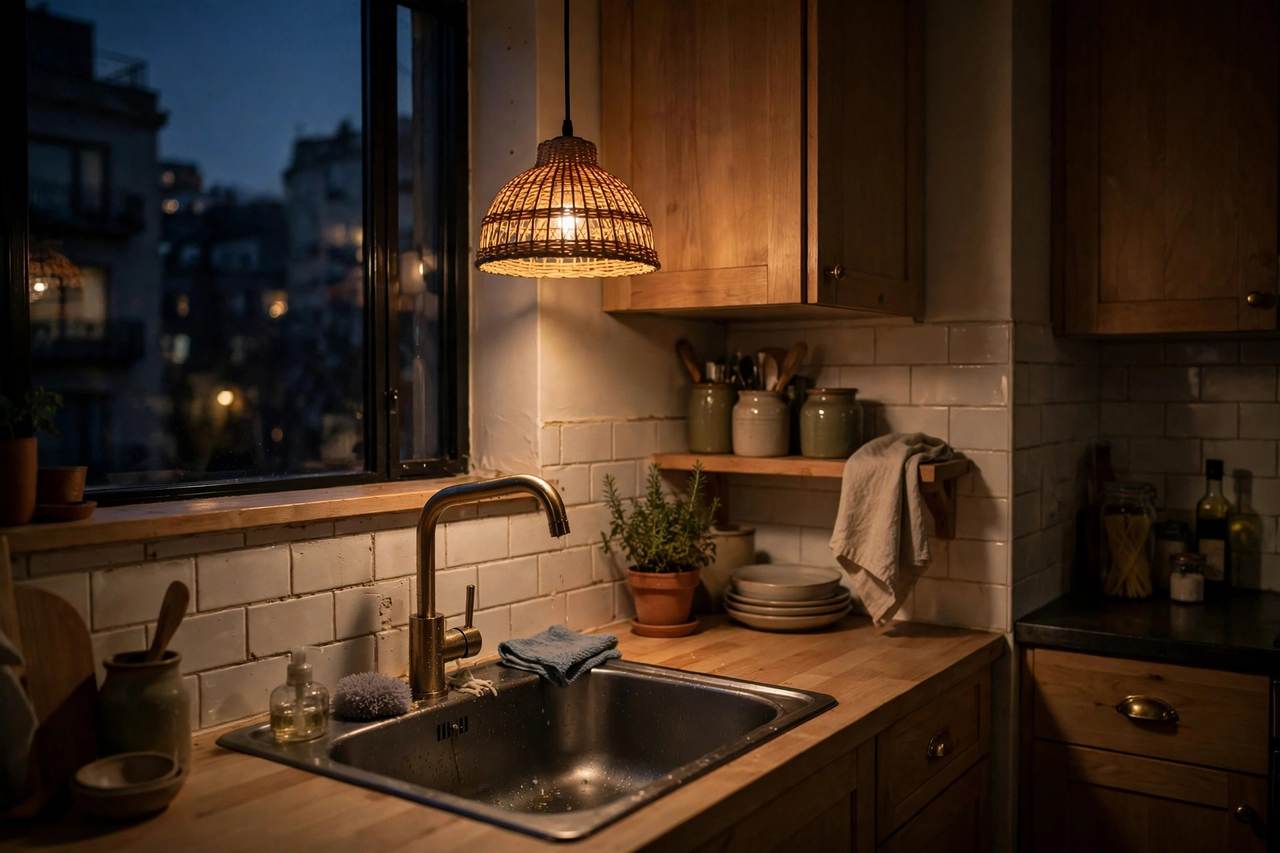
Most kitchens get one brutal ceiling light, and the sink gets the worst of it. A small plug-in pendant hung 30 to 36 inches above the sink changes the room’s evening mood. One ceiling hook holds the cord, run along the ceiling with cord clips to the nearest outlet.
Choose a 10- to 12-inch shade — rattan, linen, or smoked glass — with a warm 2700K bulb. It becomes the kitchen’s jewelry: the one object the eye lands on. At night it pools light where you wash and prep, so the overhead stays off.
Why it works
The sink is the visual center of most small kitchens, and a pendant turns it from chore station into focal point. It adds a vertical layer of light and style at zero counter cost — and in an open-plan apartment the kitchen reads as designed from the living room.
Renter notes
- Plug-in means no wiring; the cord is the only installation
- Run the cord tight along the ceiling corner and down the wall
- One small hook hole takes a single dab of spackle at move-out
- Keep the shade small; oversized shades eat visual space
Best for
Any kitchen with a ceiling over the sink — nearly every rental.
9. The Coordinated Hardware Swap
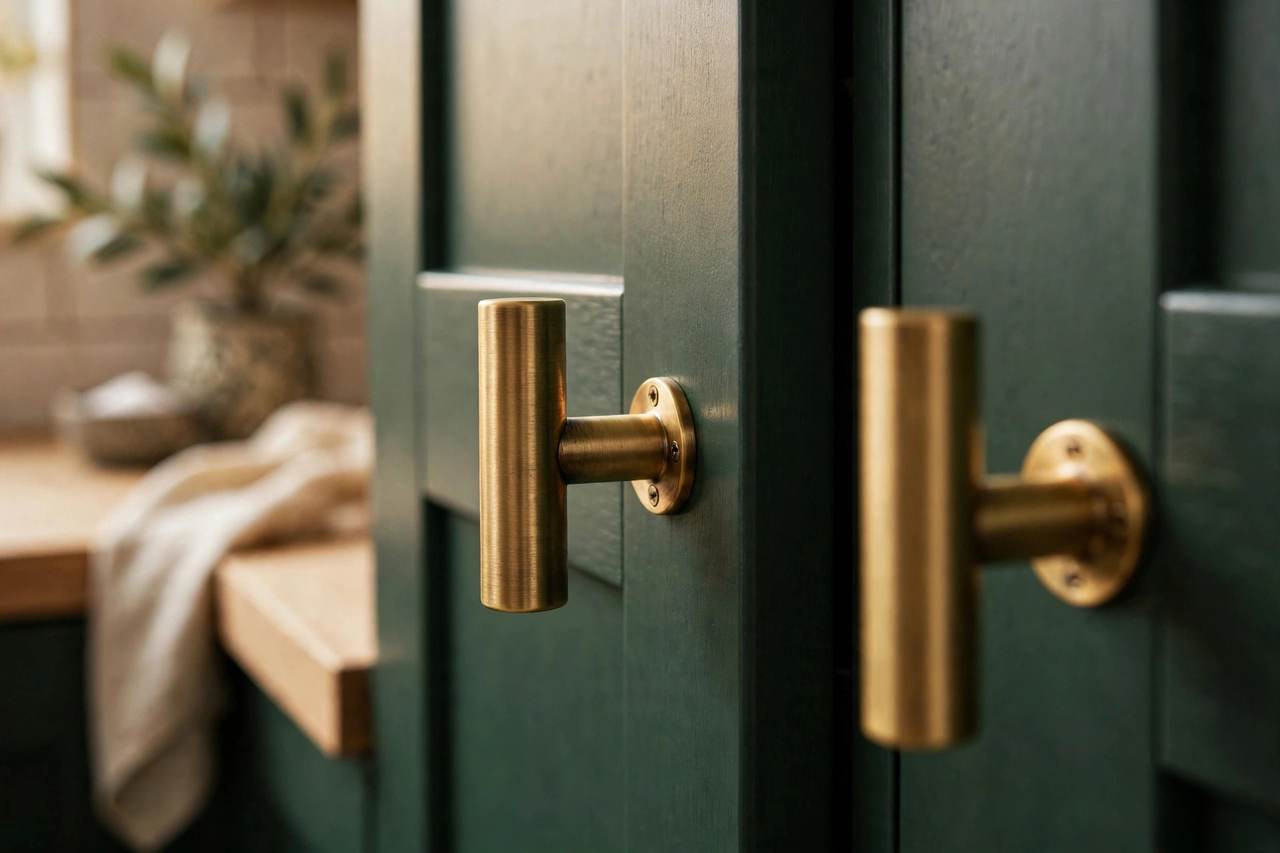
Builder-grade kitchens come with the cheapest possible knobs — swapping them is the highest-style-per-dollar move here. A standard knob is a 1.25-inch single screw; a standard pull uses 3-inch spacing. Measure yours, buy replacements at $2 to $4 each: a 15-cabinet kitchen costs $30 to $60 and one hour with a screwdriver.
Brass or matte black transforms white or gray cabinets instantly. Store the originals in a labeled bag taped inside a cabinet for a 20-minute move-out reversal. Match your faucet finish — coordination reads expensive, mismatch reads replaced.
Why it works
Hardware is the kitchen’s jewelry: small, at hand height, touched constantly, visible on every door. New pulls change the read of every cabinet face at once — a mini-renovation with zero counter space, zero wall space, and one afternoon.
How to do it
- Measure hole spacing before ordering — rentals vary
- Knobs for doors, pulls for drawers is the classic split
- Buy one sample first to check the finish in your light
- Keep the original screws; new ones can strip old holes
Best for
Every rental kitchen. If you pick one piece of small kitchen decor this weekend, do this before anything else — especially if the current knobs are plastic.
10. The Coffee Station Tray
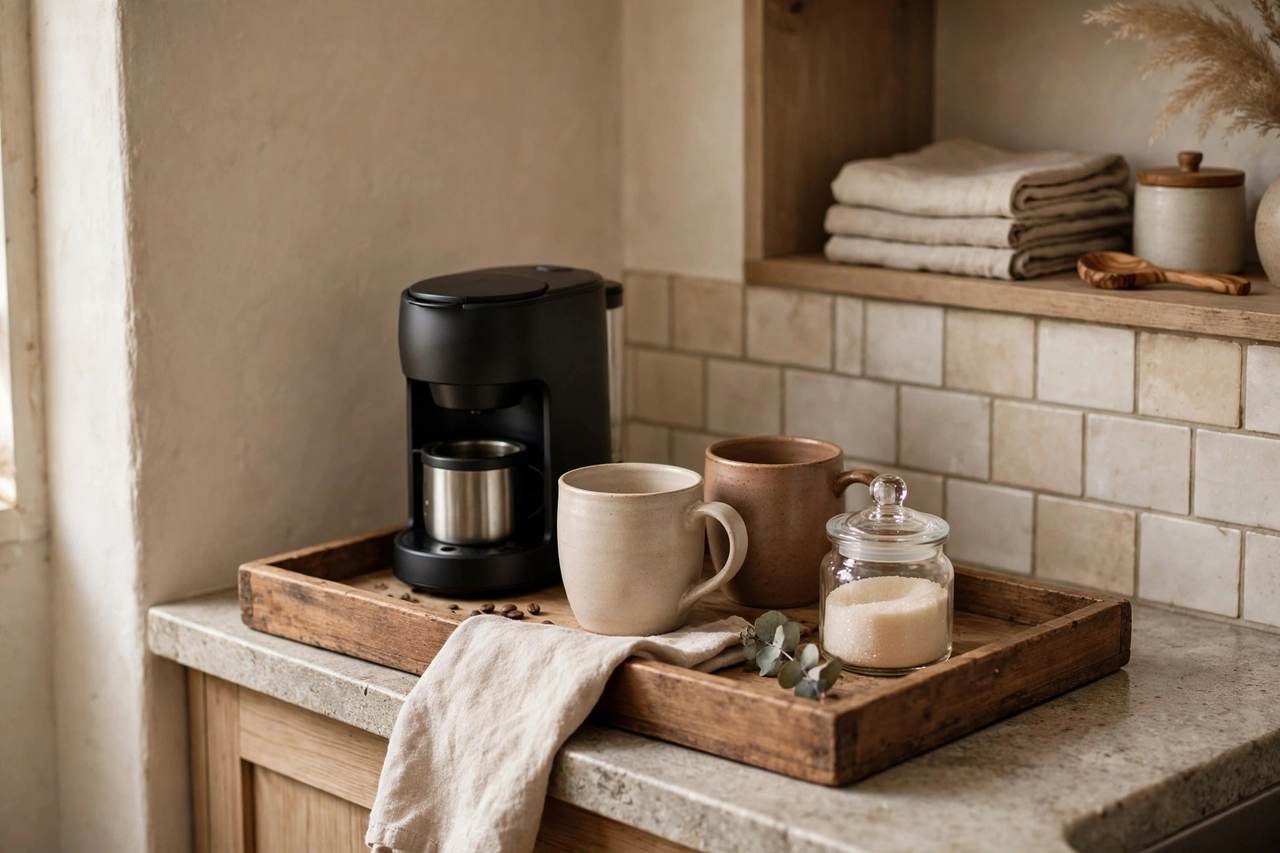
The coffee maker, the mugs, the sugar, the spoons — they sprawl. One tray, about 12 by 18 inches, corrals all of it into a single intentional zone. Wood, marble, or black metal: the tray’s edge is what makes scattered objects read as a station instead of clutter.
This is containment as decor. The coffee setup already took up the counter; the tray adds not an inch — it draws a border around what is there and calls it styled. Add one flourish: a tiny vase of eucalyptus. Lift the whole tray to wipe underneath.
Why it works
The brain reads grouped objects as one item. Four things on a tray occupy the same inches as four scattered things, but register as one intentional arrangement — which is why a tray calms a crowded counter without removing anything.
Setting it up
- 12-by-18 fits a machine plus two mugs and a jar; measure first
- Handles make the tray liftable for cleaning underneath
- Run the machine’s cord under the tray
- One decorative object per tray, max — the machine is the star
Best for
Countertop coffee setups, tea stations, and any small-appliance cluster that has colonized a corner.
11. Greenery Up High
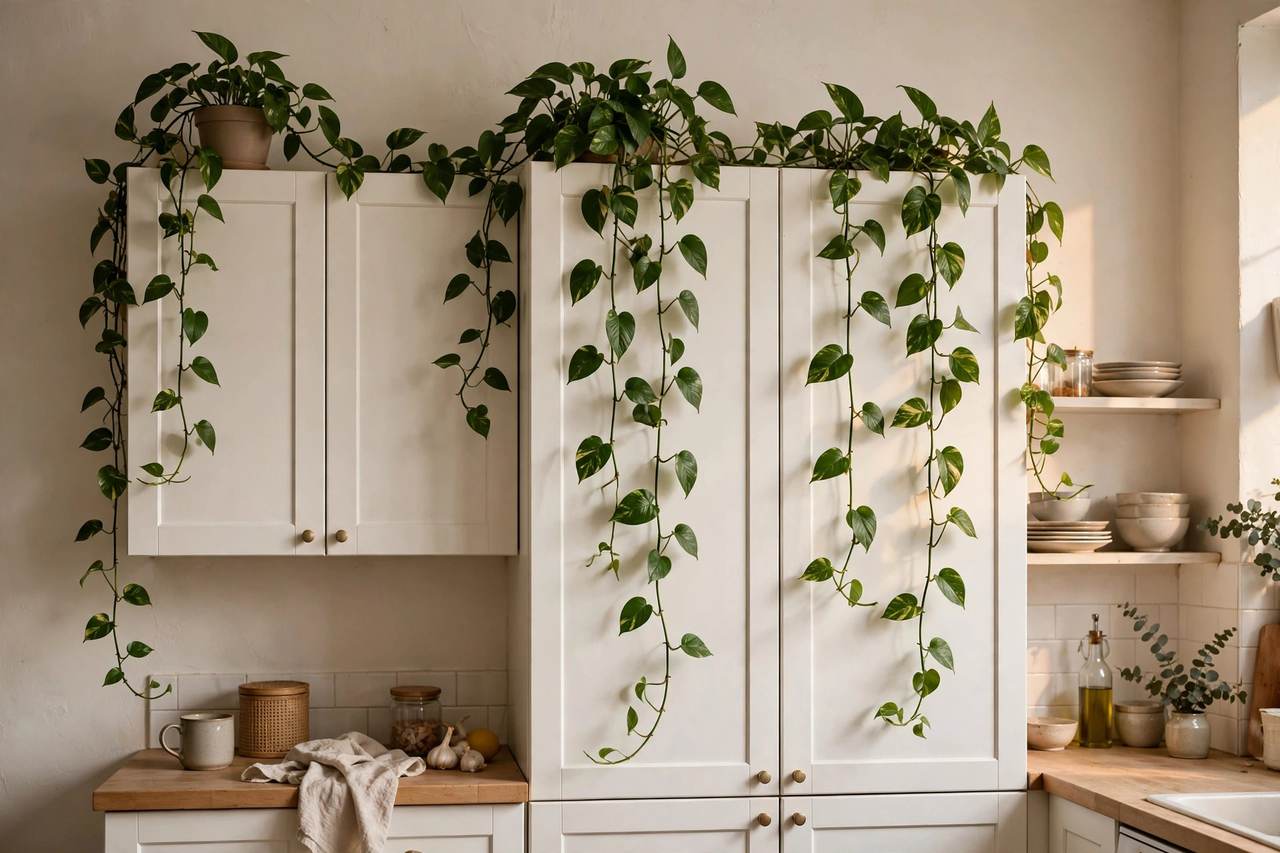
The top of your cabinets is dead space — a dust-collecting 6- to 18-inch gap between cabinet and ceiling. One or two trailing plants up there (pothos, philodendron, or a good faux one) turn that gap into a living canopy that softens the room.
A pothos needs almost nothing: water when the soil dries, and it tolerates the low light above cabinets. Vines cascade 2 to 3 feet down the fronts, drawing the eye upward and lifting the ceiling. A good faux trailing plant reads fine from six feet below — this is the one place faux is forgiven.
Why it works
Small kitchens are all hard surfaces at counter height. Greenery above eye level adds the soft, living layer the room is missing, using space that was literally collecting dust. Zero counter, zero shelf, zero floor.
Keeping it simple
- Pothos or philodendron: near-unkillable, fine with low light
- A simple neutral pot — the plant is the decor, not the pot
- Wipe leaves monthly; kitchen grease settles on them too
- Water with a long-spout can; do not try to reach and pour
Best for
Kitchens with a gap above the cabinets and anyone who wants plants without sacrificing counter space.
12. One Accent Wall, Renter-Safe
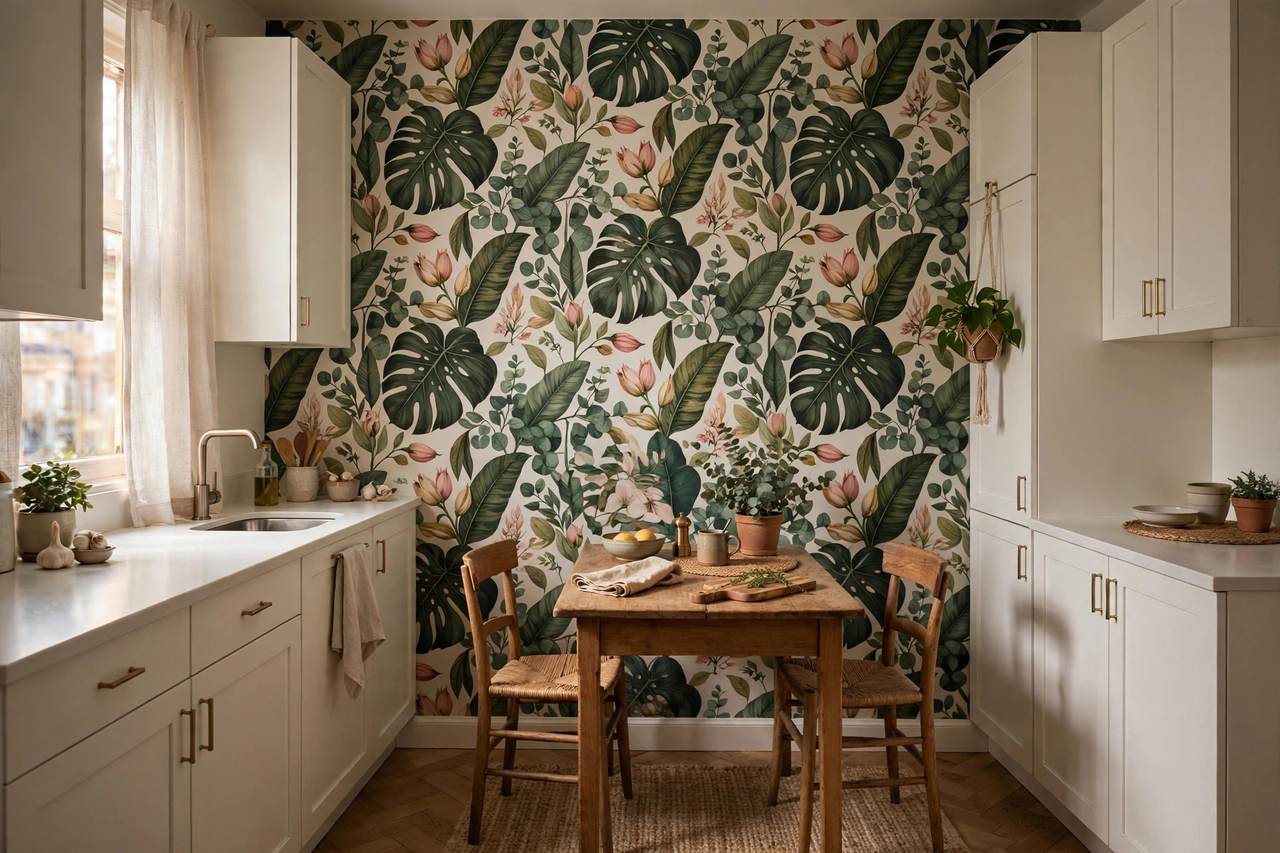
Pick the one wall the kitchen can spare — the wall the table sits against, or a pantry wall — and cover it in peel-and-stick wallpaper. A small kitchen accent wall is usually 60 to 100 square feet: 2 to 3 rolls and a Saturday morning. Choose with confidence: bold botanical, black-and-white stripe, warm terracotta.
One wall only. Papering every wall closes a small kitchen in; one wall reads as a deliberate feature while the rest stays light. Modern removable papers peel off cleanly — a real decor commitment with a renter-safe exit.
Why it works
A small kitchen usually has one wall doing nothing — no cabinets, no window, just paint. That wall is a free canvas, and pattern there gives the kitchen an identity no countertop styling can. For renters, this is the biggest-impact small kitchen decor move on the list — and it touches no usable space at all.
Application tips
- Start in the most visible corner; mismatches hide at edges
- Stripes and geometrics are far more forgiving than murals
- Smooth with a plastic smoother, not your hands, to avoid stretching
- Peel a test corner after a week to confirm clean release
Best for
Eat-in kitchens and any small kitchen with one underused wall.
13. The Magnetic Knife Strip
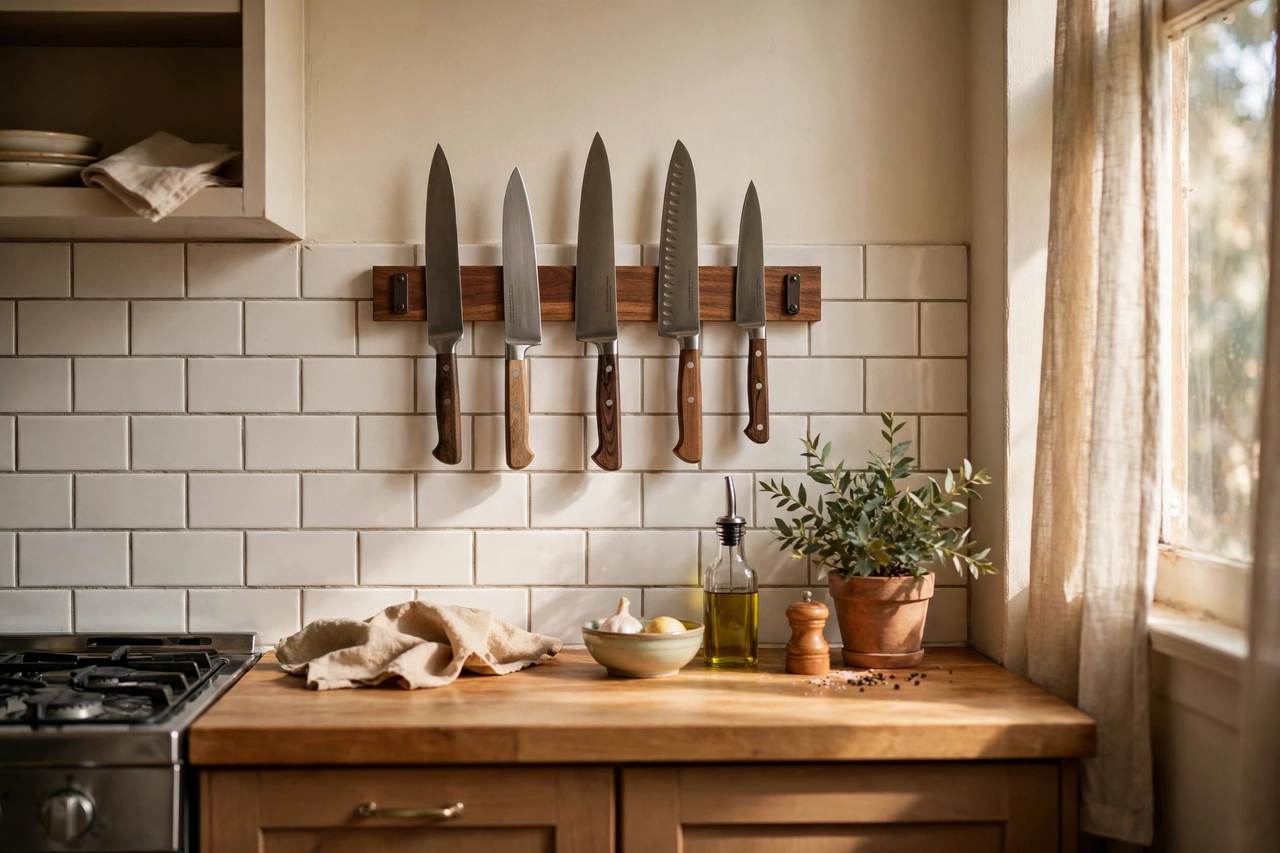
A knife block eats 6 by 10 inches of prime counter. A 12- to 18-inch magnetic strip holds 5 to 7 knives in the footprint of a picture frame. Mount it 50 to 55 inches up, within reach of your prep zone but above the splash line.
Wooden-front strips (walnut or acacia) look like decor; stainless reads commercial. Renters can use adhesive-mounted strips or two small screws into a stud. Slide knives on from the spine side, never blade-first.
Why it works
Knives are beautiful objects rentals force you to hide in a drawer or a bulky block. A magnetic strip turns them into wall art while freeing the most annoying counter hog in a small kitchen — and knives stay sharper when they are not rattling in a drawer.
Safety and placement
- Above the counter, never above the stove or sink
- Keep out of reach of small children — high placement or adult-only households
- Strong magnets only; cheap strips drop knives
- Wipe the strip monthly — kitchen grease builds up
Best for
Cooks with more than three good knives and less than 10 square feet of free counter.
14. The Fruit Bowl Centerpiece
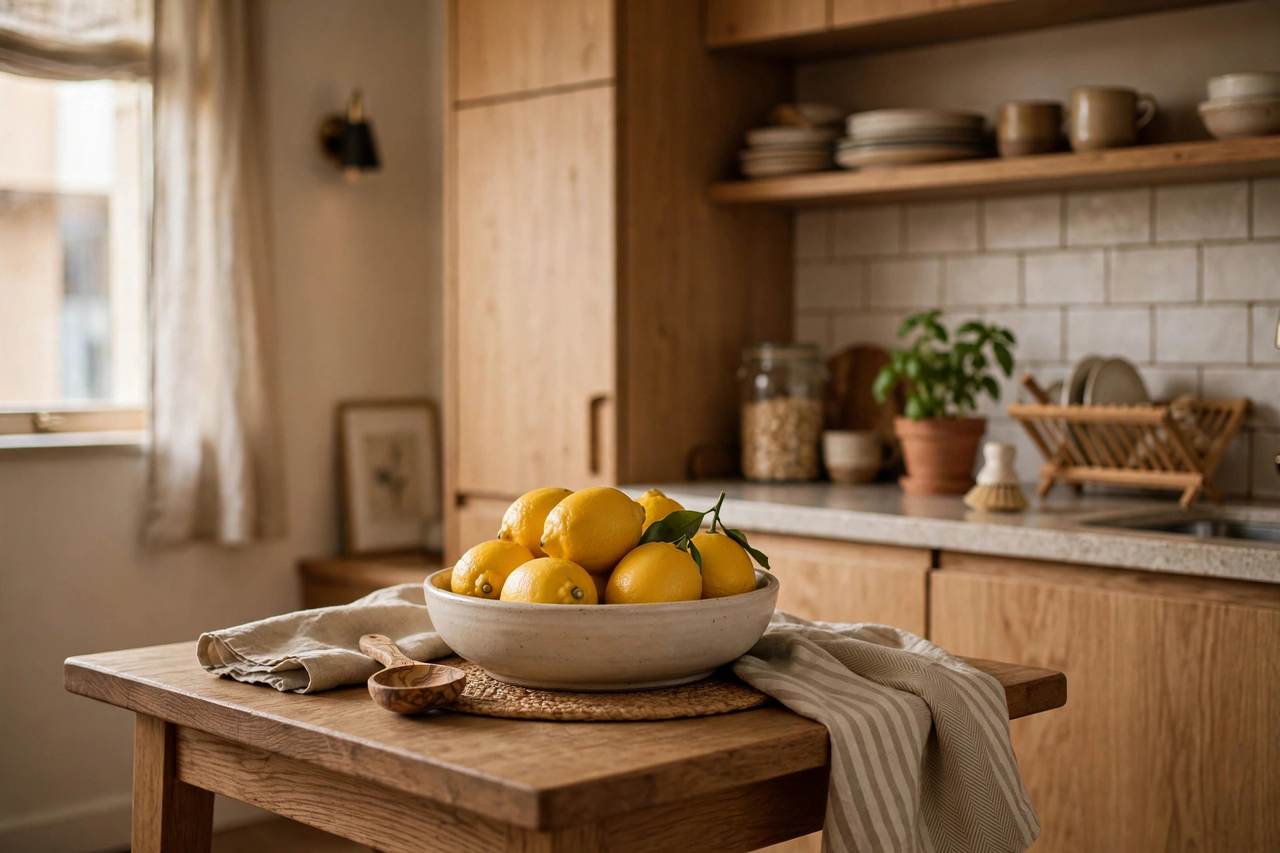
A shallow bowl of fruit is the only centerpiece that earns its footprint. A 12-inch bowl — ceramic, wood, or woven — holds a week’s worth of citrus or apples in a single low mound that reads as styled from across the room.
Keep it low and shallow: a deep bowl hides the bottom fruit until it rots, and a tall arrangement blocks sightlines. One fruit type looks more intentional than a mixed jumble — a bowl of lemons, a bowl of green apples. Restock when it empties.
Why it works
A centerpiece makes a kitchen feel inhabited rather than staged, and fruit is the one centerpiece that gets eaten and replaced — never dusty clutter. Color and organic shape on the hardest surface in the house, using one square foot that was already a drop zone.
Making it work
- 12 inches wide, under 4 tall: low enough to see over
- One fruit type for styled; mixed fruit for farmhouse
- Keep bananas separate — they ripen everything around them
- On a small table or island end, never in the prep zone
Best for
Eat-in kitchens, island ends, and anyone whose counter has one natural drop zone.
The Counter-Free Formula
You do not need all 14 ideas. You need one move from each of three categories — because in a small kitchen, every surface is either vertical, horizontal, or living:
- Go vertical — walls and dead air do the decorating: open shelves (idea 1), art (idea 6), the pendant (idea 8), hardware (idea 9), greenery up high (idea 11), the accent wall (idea 12), the knife strip (idea 13). These add all the style and cost zero counter.
- Claim the floor — the rug (idea 2) is the only decor that touches the floor, and it warms the whole room without touching a single surface you cook on.
- Contain the horizontal — whatever must sit on the counter gets corralled: canisters (idea 4), cutting boards (idea 7), the coffee tray (idea 10), the fruit bowl (idea 14), herbs on the sill (idea 3). Nothing sprawls; everything has a border.
Pick one from each category and the kitchen reads as decorated, not cluttered. The counter you came with is the counter you keep.
Where to Start
Start with the kitchen you cook in most, and start cheap:
- Under $30: idea 9 — swap the cabinet hardware. One screwdriver, one afternoon, and every cabinet looks new.
- Under $100: add idea 5 — a peel-and-stick backsplash, or idea 14 and idea 2 together: a runner plus the fruit bowl. Pattern underfoot, color at eye level.
- The big move: idea 1 — one open shelf styled sparingly, or idea 12 — the renter-safe accent wall. Either one gives the kitchen an identity in a single weekend.
Decorate the walls, the air, and the floor first. The counter is for cooking — keep it that way and the whole kitchen feels bigger than its square footage.
Frequently Asked Questions
How do you decorate a small kitchen without losing counter space?
Put the decor anywhere but the counter: walls (art, open shelves, a knife strip), the floor (a runner rug), dead vertical space (plants above cabinets, a pendant over the sink), and the windowsill (herbs). Whatever must live on the counter — coffee gear, canisters, fruit — gets corralled onto a tray or into matching containers so it reads as styled instead of sprawled.
What is the most renter-friendly way to upgrade a kitchen?
Peel-and-stick tile (idea 5) and removable wallpaper (idea 12) for the big visual change, plus a hardware swap (idea 9) for the highest style-per-dollar move. All three reverse cleanly at move-out: tile releases with a hairdryer, wallpaper peels off, and original knobs go back on with a screwdriver in 20 minutes.
Do open shelves make a small kitchen look cluttered?
Only if they are packed. One shelf with the 70/30 rule — 70 percent everyday dishes, 30 percent decor, with breathing room between groups — reads as styled, not stored. The clutter look comes from cramming every spare item onto the shelf; edit to what you use and love, and leave gaps.
What colors make a small kitchen feel bigger?
Light, receding colors on the big surfaces (white, warm gray, pale wood) with one confident accent (idea 5’s backsplash or idea 12’s accent wall). The trick is contrast in the right place: keep cabinets and walls light so the room stays open, and let the pattern live on one bold surface that draws the eye without closing the walls in.