10 Small Bedroom Desk Ideas That Create a Workspace Without Crowding the Bed
Discover 10 small bedroom desk ideas using shallow desks, bedside workstations, window placement and multifunctional furniture to create a workspace without crowding the room.
In This Guide
A desk can be one of the hardest pieces of furniture to add to a small bedroom.
The problem is not always the desktop itself.
A desk also needs space for:
- a chair
- chair movement
- your knees
- cables
- task lighting
- drawers or storage
- access to nearby doors and closets.
That means a desk that looks compact against the wall can still consume much more usable floor space once someone actually sits at it.
The best small-bedroom desk setup usually does one of three things:
uses a shallow footprint, replaces another furniture function, or occupies a wall zone that would otherwise stay underused.
Before buying a desk, think about where the chair goes when you are:
- working
- not working
- walking around the bed.
That single question prevents many cramped layouts.
Here are ten practical ways to add a bedroom workspace without letting it take over the room.
1. The Wall-Hugging Shallow Desk
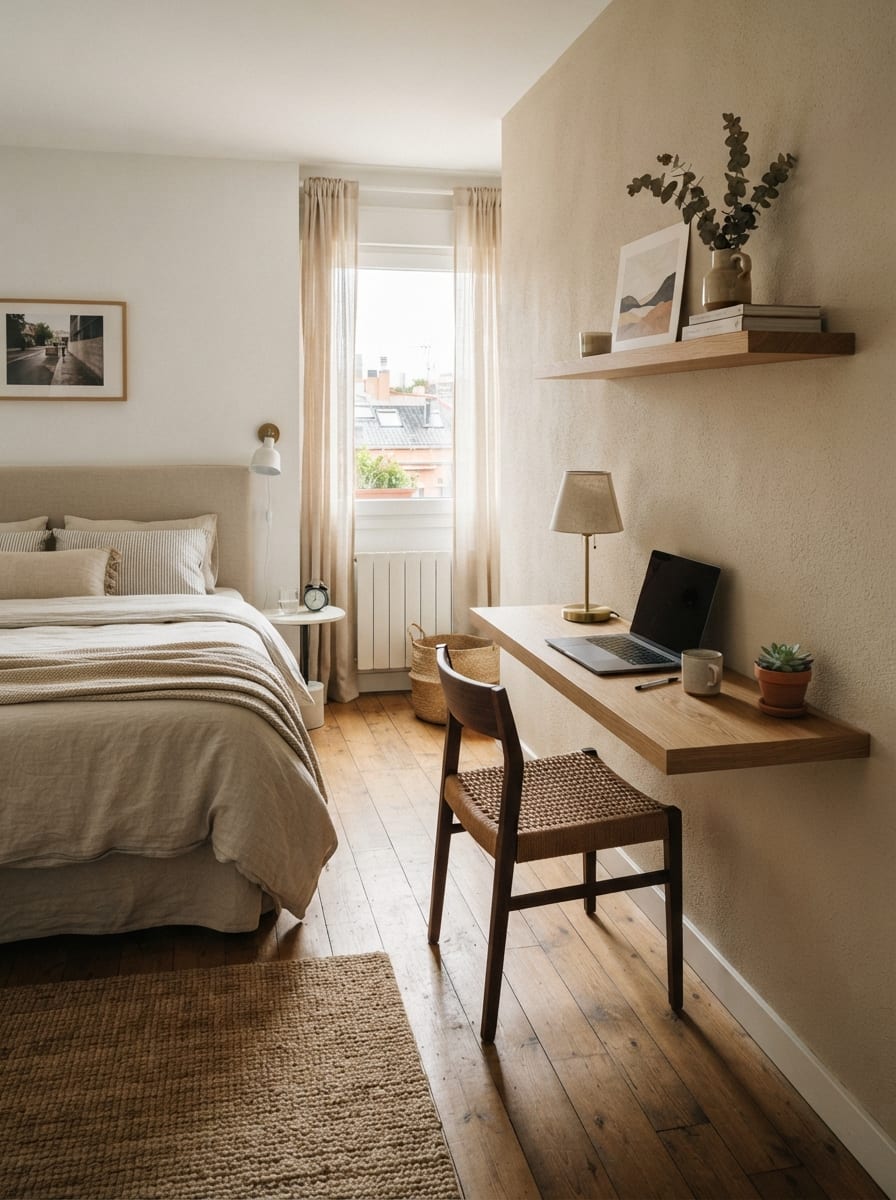
A shallow desk is often the easiest choice when the bedroom already has enough wall width but very little usable depth.
Instead of a standard large workstation, choose a surface sized around the tasks you actually perform.
Why it works
Every extra inch of desk depth comes out of:
- walkway
- chair space
- bed clearance.
A shallower desktop keeps more of the center of the room open.
Best for
This works well for:
- laptop work
- writing
- studying
- light admin tasks.
It may not be ideal if you need:
- multiple large monitors
- deep equipment
- large drawing surfaces.
Use the wall above it
If storage is needed, move some of it upward with:
- one shelf
- small wall organizer
- task light.
Do not automatically add a large drawer pedestal beneath the desk.
That can make a visually slim desk feel bulky again.
Keep the chair proportional
A huge executive chair defeats the point of choosing a shallow desk.
Look for a chair that can tuck reasonably close to or under the desktop.
2. The Bedside Desk-Nightstand
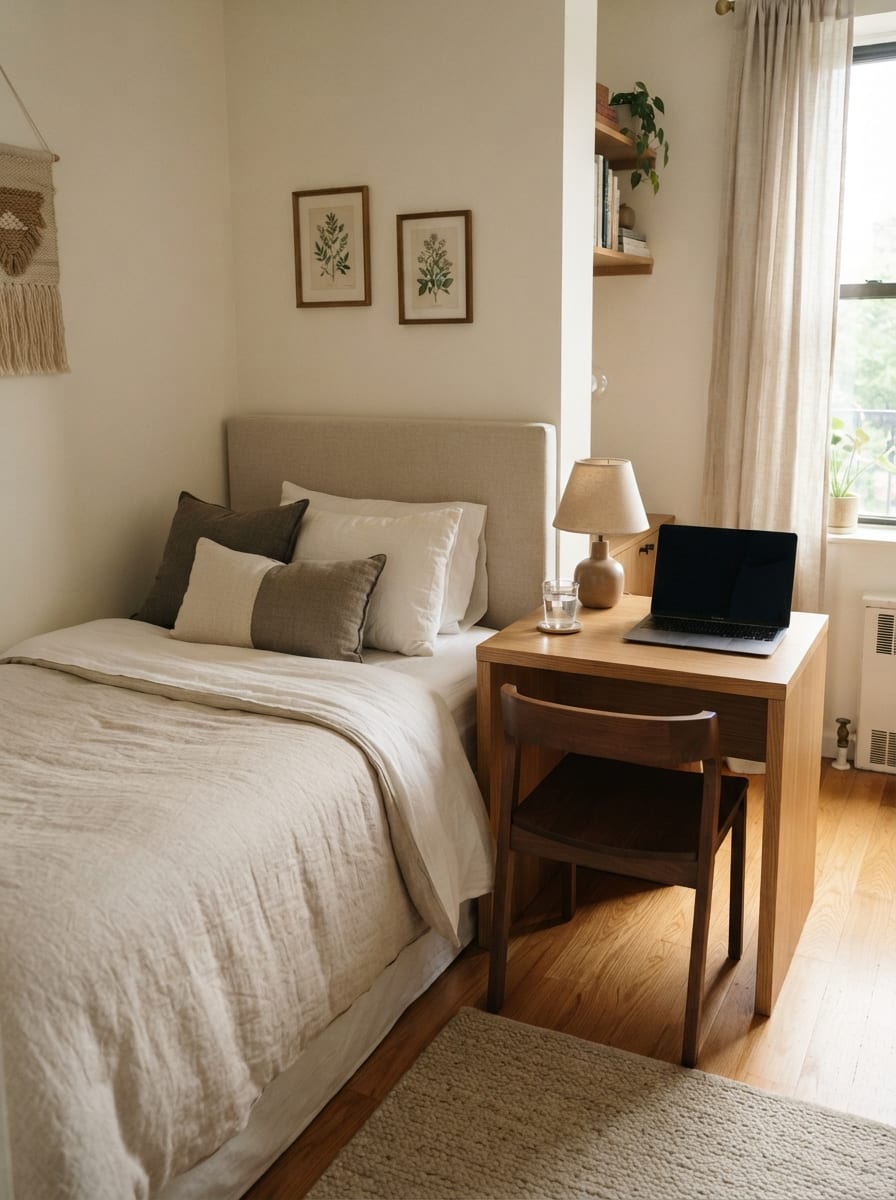
If the room does not comfortably fit both a:
- nightstand
- desk
combine the functions.
A compact desk beside the bed can become a bedside surface when work is finished.
Why it works
Small rooms benefit when one furniture footprint performs two jobs.
The desktop can hold:
- lamp
- phone
- water
at night and become a work surface during the day.
Height matters
The desktop should be practical both:
- from the chair
- from the bed.
If it sits far above or below the mattress, the nightstand function becomes awkward.
Protect the sleeping zone
Do not let the workstation spread across the entire bedside area.
At the end of the workday, clear:
- laptop
- papers
- charging accessories
into one contained zone if possible.
A desk-nightstand works best when it can visually switch roles.
Keep cables controlled
Cables beside a bed can quickly make the area look messy.
Use one deliberate charging route rather than several cords crossing the floor.
3. The Under-Window Workspace
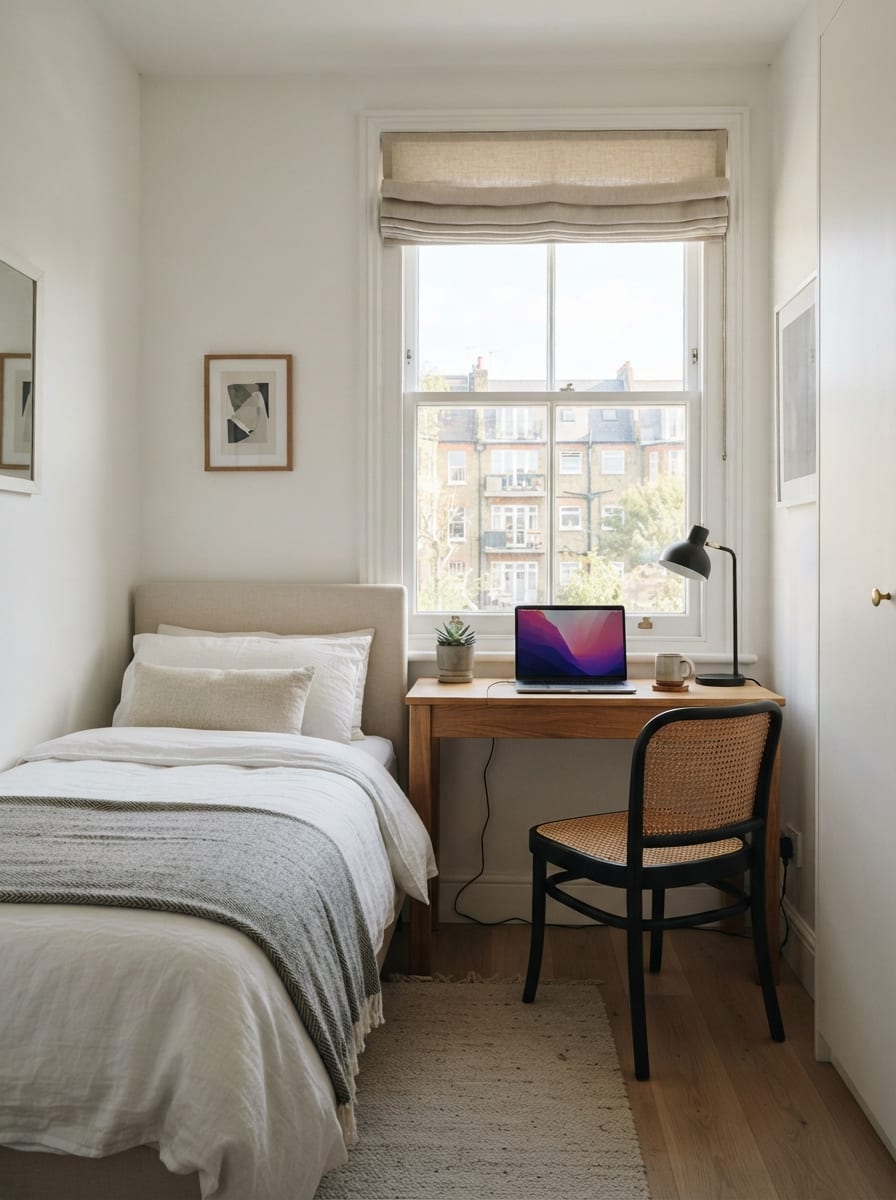
The wall under a bedroom window is sometimes difficult to use for tall furniture.
That can make it a useful desk location.
Why it works
A desk is naturally low enough to sit beneath many windows.
You also gain:
- daylight
- an outward view
- a visually lighter work zone.
Check sill height first
The desk should not interfere with:
- window handles
- opening sections
- ventilation.
Watch direct glare
A desk facing a bright window may cause glare on:
- laptop
- monitor
- tablet.
You may need:
- adjustable shade
- sheer curtain
- slightly angled screen.
Protect heating systems
Do not place a desk directly over or in front of a:
- radiator
- baseboard heater
- floor vent
if it interferes with safe operation or airflow.
Think about curtains
Full-length curtains behind a desk may become difficult to:
- open
- close
- hang properly.
A shade may be more practical at that window.
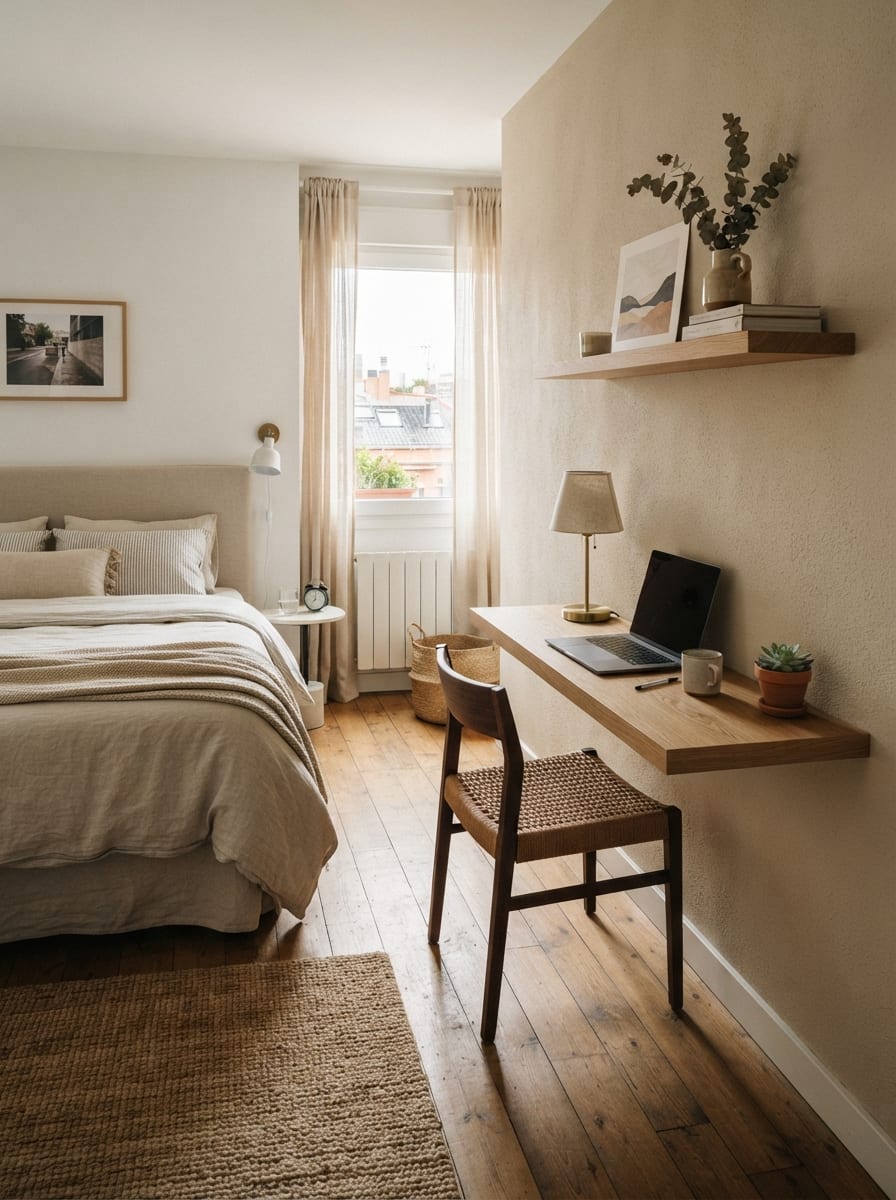
4. The Floating Wall Desk
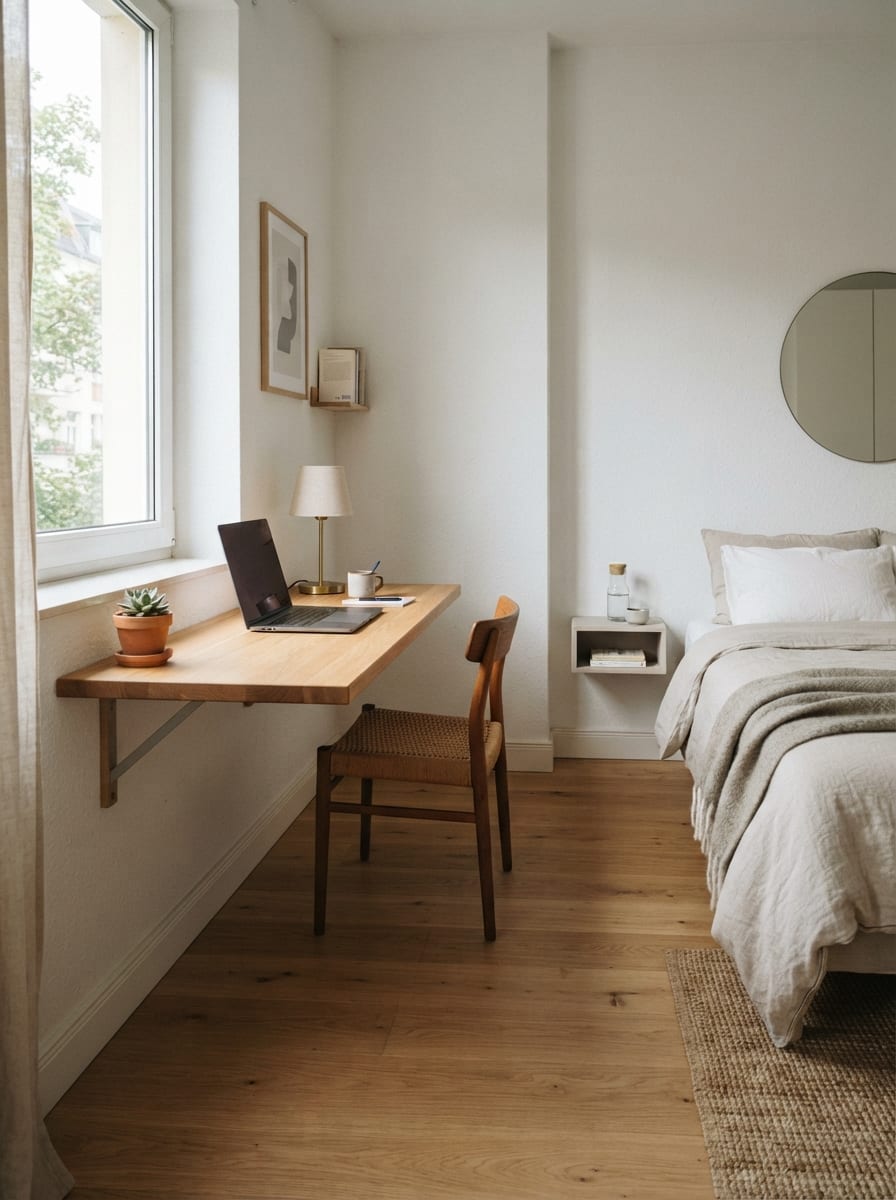
A wall-mounted desk can visually lighten a bedroom because the floor remains visible underneath.
That does not make the desk physically disappear, but it reduces the sense of a large furniture block.
Why it works
A floating surface can provide enough room for:
- laptop
- notebook
- small lamp
without adding legs or a bulky cabinet base.
Best for
It works particularly well when:
- storage needs are minimal
- the workspace is used part-time
- visible floor area matters.
Wall support is critical
A floating desk needs proper mounting for:
- desk weight
- equipment
- leaning force
- everyday use.
Follow the desk manufacturer’s installation requirements.
Renter considerations
If the desk requires substantial wall attachment, check your lease before installing it.
A freestanding shallow desk may be better if mounting is restricted.
Keep under-desk space usable
Avoid immediately filling the open floor below with:
- bins
- boxes
- drawers.
That removes much of the visual benefit.
5. The Closet-Edge Workstation
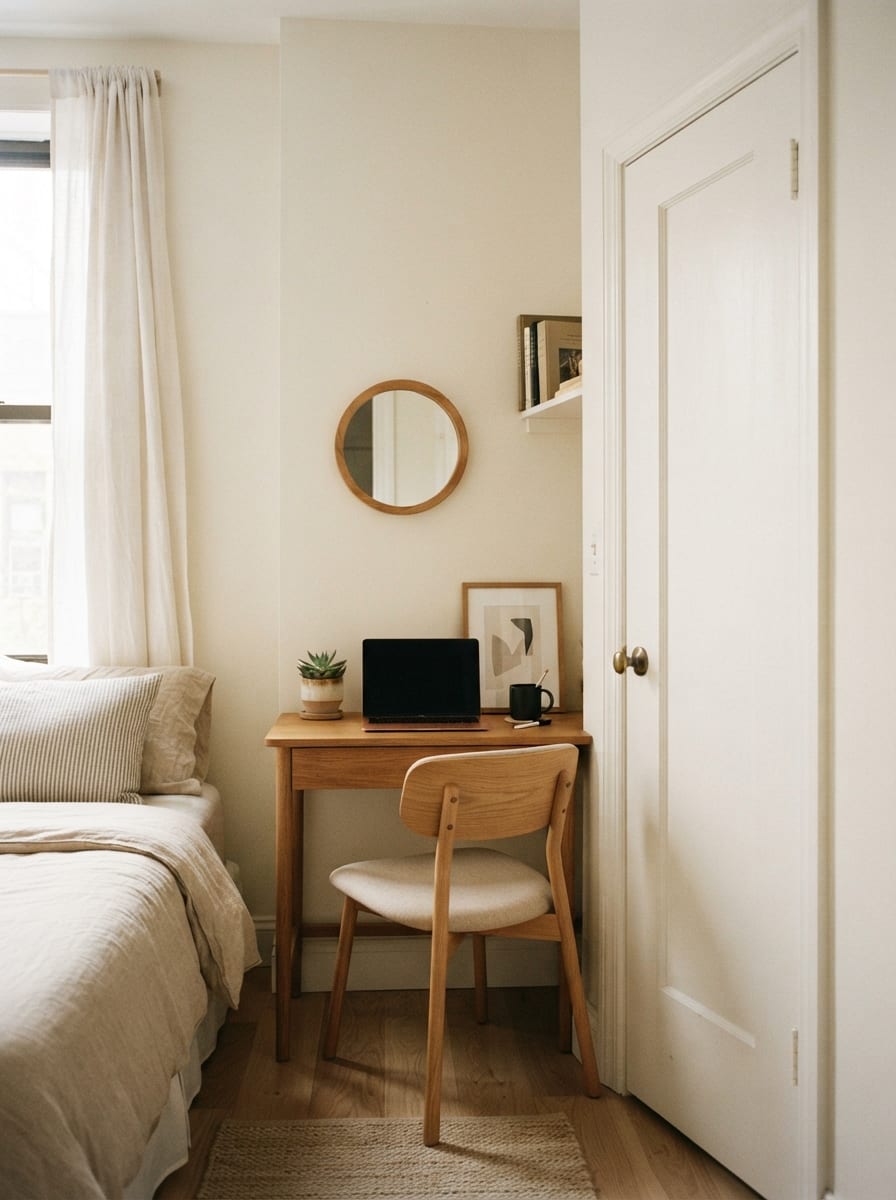
The short wall beside a closet is often too narrow for:
- dresser
- wardrobe
- large bookcase
but may accommodate a small desk.
Why it works
You turn a leftover wall section into a defined work zone without using the room’s primary furniture walls.
Protect closet access
This is only useful if the desk and chair do not interfere with:
- hinged closet doors
- sliding panels
- drawers
- getting dressed.
Test the chair position
A desk may fit perfectly while the chair sits directly in front of the closet.
That is not a functional layout.
Check both:
desk footprint
and:
occupied-chair footprint.
Keep the desk visually separate
A narrow desk with simple styling helps prevent the closet wall from becoming one heavy furniture zone.
6. The Corner-L Desk Lite
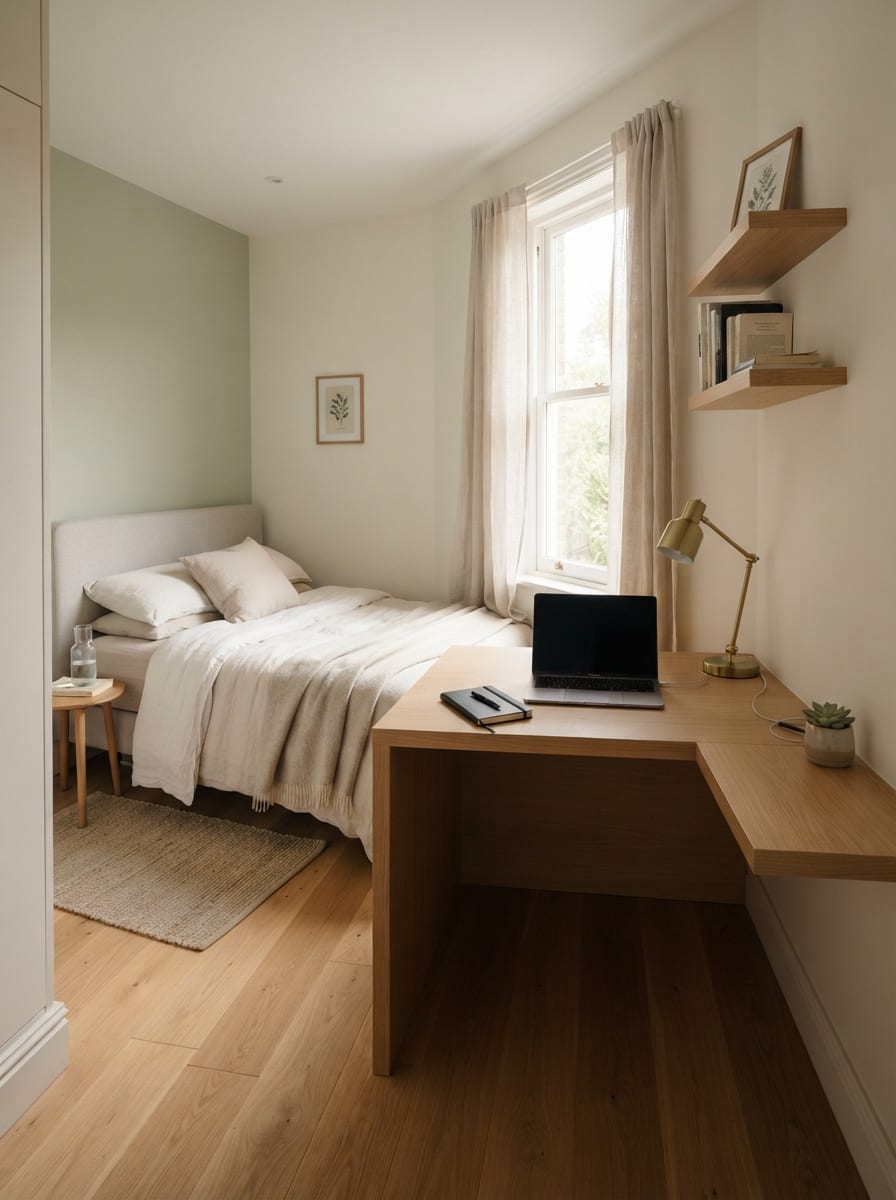
A corner can support a workspace without requiring a full-size traditional L-shaped desk.
Instead, use:
- one main shallow surface
- one smaller return surface.
Why it works
You gain an extra side zone for:
- notebook
- printer
- lamp
- frequently used supplies
without creating one deep rectangular desk.
Keep the return small
A traditional large L-shaped desk can overwhelm a bedroom.
The return should solve a specific need.
For example:
Main desk:
laptop
Small return:
notebook + lamp
Protect the corner visually
Do not stack both walls with:
- shelves
- pegboards
- cabinets
- decor.
The workspace still needs breathing room.
Good for awkward corners
This can work especially well when:
- one wall is too short for a standard desk
- the adjacent wall offers just enough extra surface.
7. The Fold-Down Desk
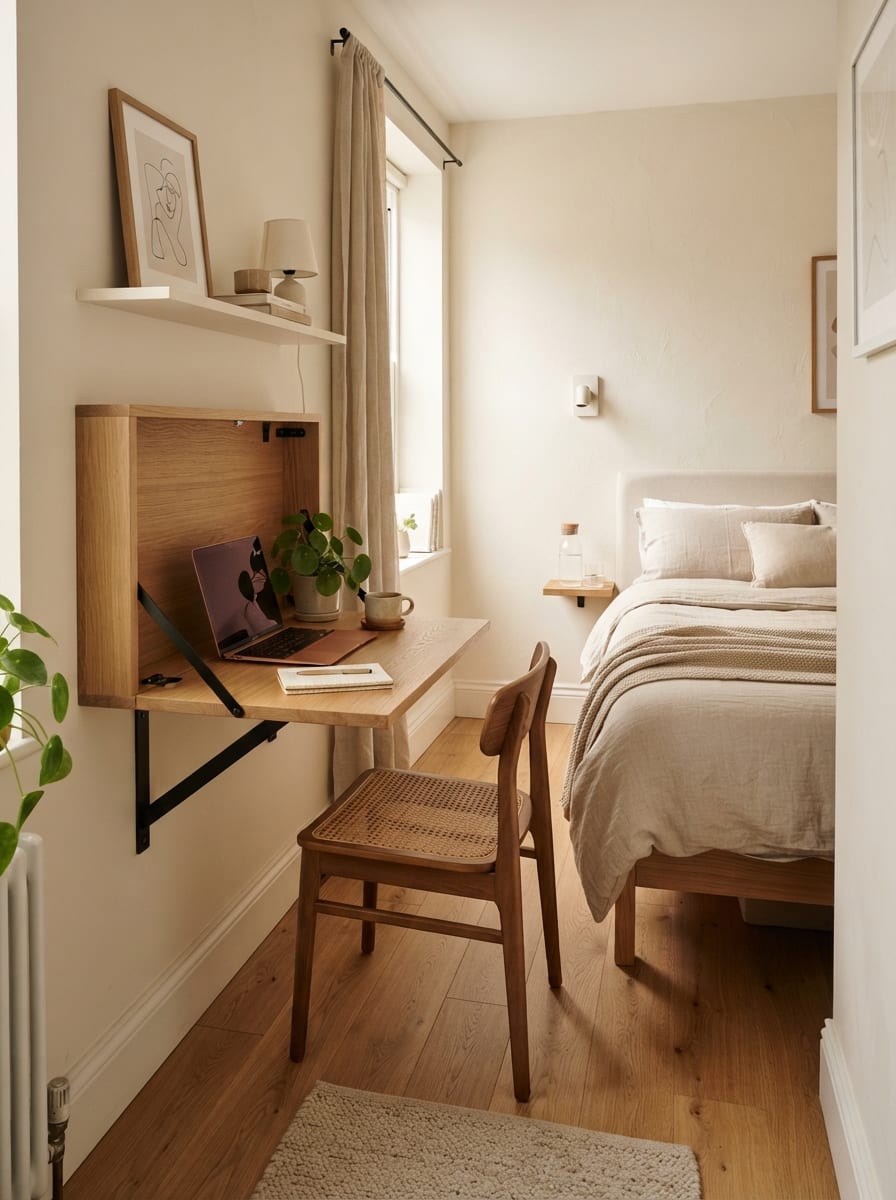
A fold-down desk is useful when you need a work surface only part of the day.
When closed, the room regains some of its usable space.
Why it works
Instead of permanently occupying the circulation zone, the desk expands only when needed.
This can be particularly useful in:
- very narrow bedrooms
- guest rooms
- multipurpose rooms.
Remember the chair still needs somewhere to go
A fold-down desk solves the desktop footprint.
It does not solve the chair automatically.
Plan where the chair lives when the desk is closed.
Possibilities include:
- beside the dresser
- under another surface
- as an occasional bedroom chair.
Check opening clearance
The folded desktop needs enough space to swing down without hitting:
- bed
- dresser
- door.
Wall mounting matters
As with any wall-mounted work surface, follow the installation guidance carefully.
8. The Dresser-Desk Combination
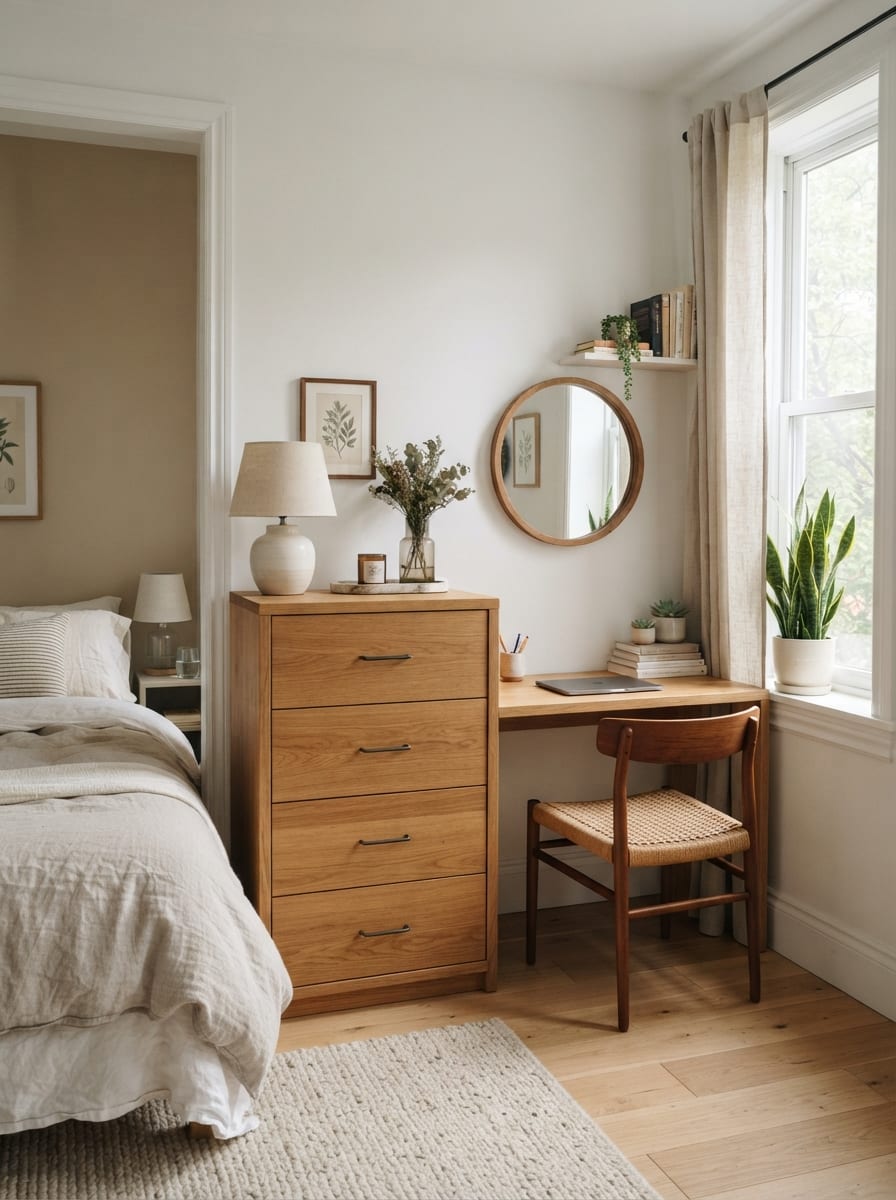
If the bedroom already needs a dresser, consider whether one section can also provide a work surface.
This does not mean trying to type directly on top of a standard chest of drawers.
Instead, look for furniture designed with:
- drawers on one side
- usable knee space on the other.
Why it works
One furniture footprint handles:
- clothing storage
- work surface.
That can be far more efficient than placing a separate:
- dresser
- desk
on two different walls.
Protect legroom
The work section must actually allow:
- knees
- chair
- comfortable sitting.
A surface with drawers underneath the entire width may not function as a desk.
Do not overload the surface
Because the piece already serves two purposes, clutter can build quickly.
Keep the desk half limited to work essentials.
Best for
This setup works well in bedrooms where clothing storage is necessary but wall space is limited.
9. The Foot-of-Bed Slim Desk
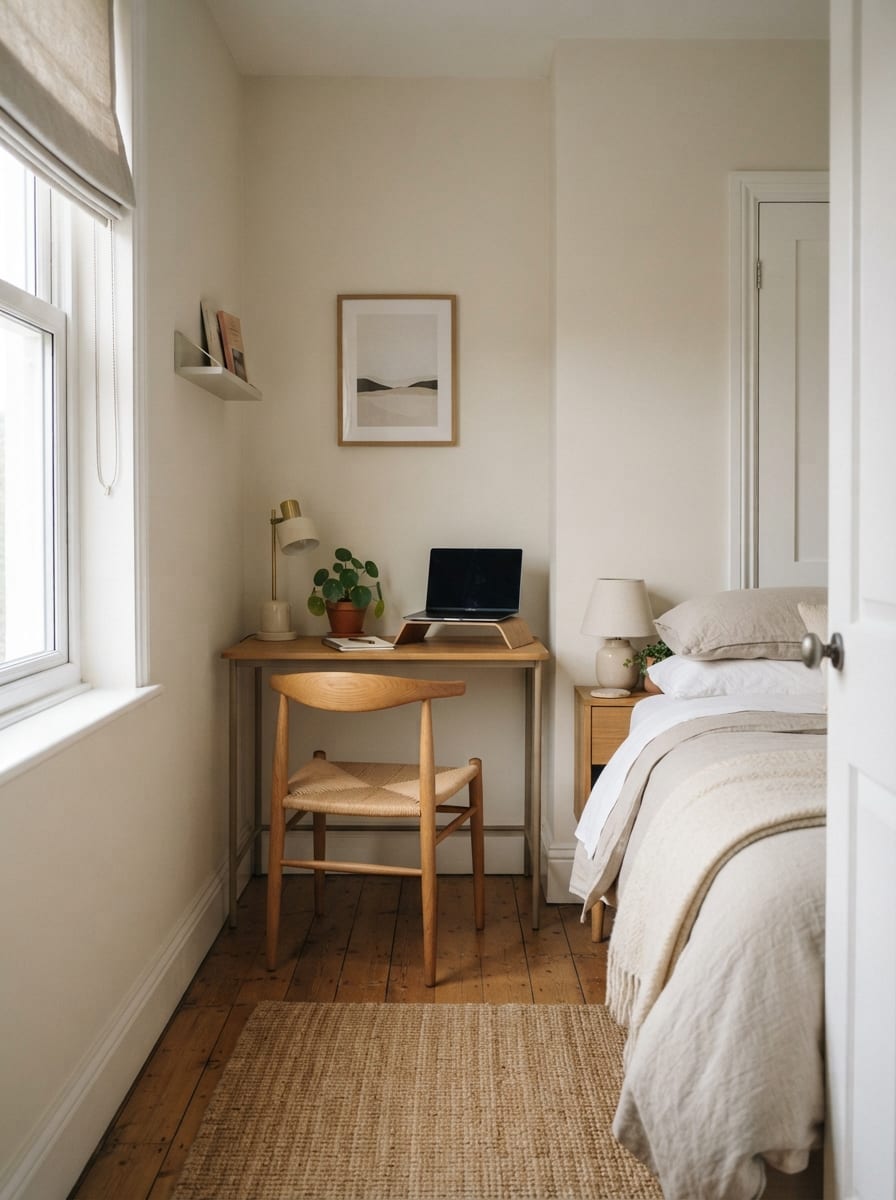
The wall or zone opposite the foot of the bed sometimes has just enough depth for a very shallow desk.
This can work—but only after checking circulation carefully.
Why it works
The desk can occupy a wall that might otherwise remain empty.
It may also provide a direct sightline toward the room rather than the bed.
This is a clearance-sensitive option
Measure:
bed end → desk front
Then account for:
- chair depth
- chair pull-out
- walking route.
A desk that fits while the chair is tucked in may completely block the room once someone sits down.
Use the shallowest practical setup
This is not the place for:
- deep drawers
- large filing cabinets
- bulky chair.
Keep the desk visually low
A low, simple desk helps prevent the foot of the bed from feeling boxed in.
10. The Desk-Placement Clearance Formula
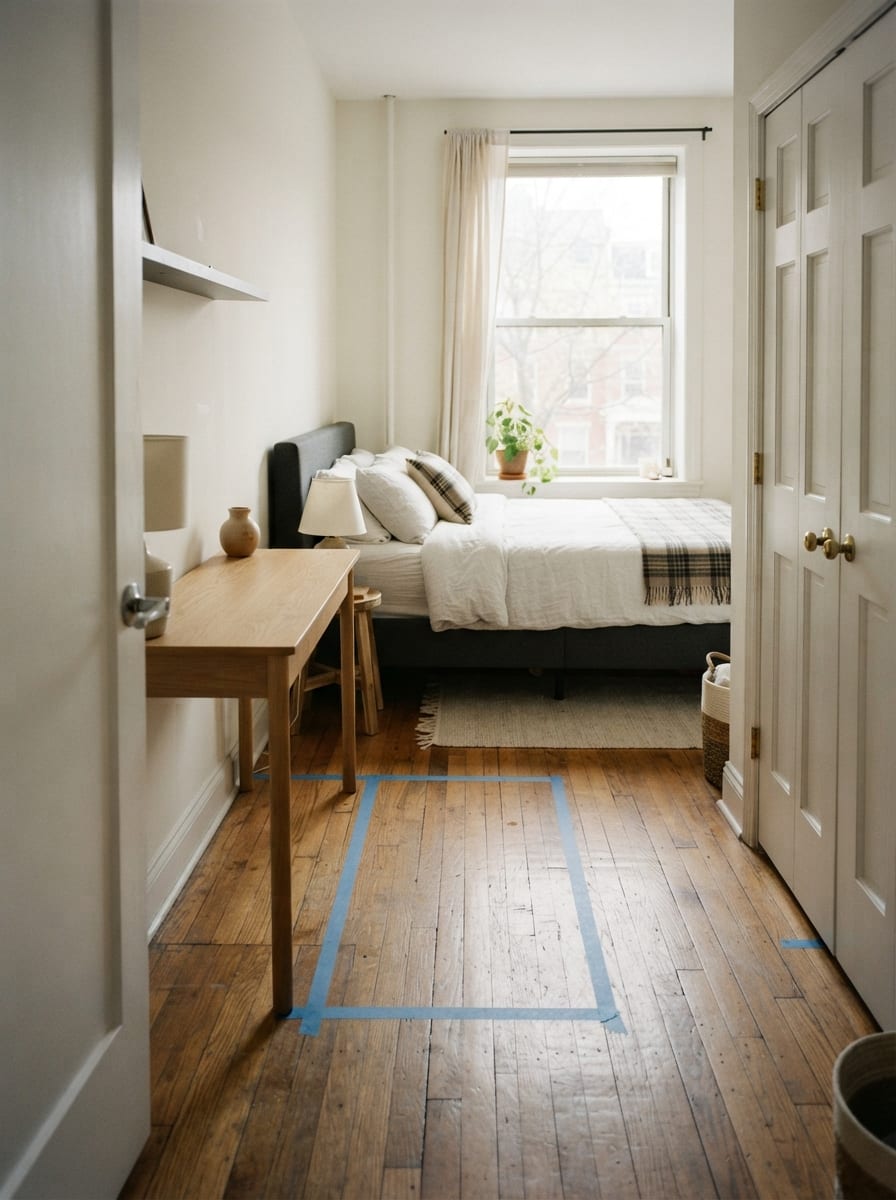
Before deciding which desk looks best, test whether the layout actually works.
Use this order:
desk footprint → chair position → chair movement → walking route → nearby doors
Step 1: Mark the desk
Use painter’s tape to mark:
- desk width
- desk depth
on the floor.
Step 2: Mark the chair
Do not leave the chair out of the test.
Mark where it sits:
- tucked in
- occupied
- pulled back.
Step 3: Test the main bedroom path
Walk from:
door → bed → closet
Can someone still move naturally?
Step 4: Open everything
Test:
- closet doors
- bedroom door
- dresser drawers
- under-bed drawers
if relevant.
Step 5: Only then choose the desk
A slightly smaller desk that preserves movement is usually better than a larger desk that technically fits.
Start With What You Actually Do at the Desk
Not every bedroom workspace needs the same amount of surface area.
Ask what the desk is actually for.
Laptop work
Usually needs less depth.
Studying with books
Needs more clear surface.
Desktop computer
May require more:
- depth
- cable space
- monitor distance.
Creative work
May need a larger uninterrupted surface.
Do not buy a full-size desk for a task that only needs a laptop.
Desk Depth Is Often More Important Than Width
People tend to focus on how long a desk is.
In a narrow bedroom, depth often causes the bigger problem.
A deep desk projects into the room and consumes:
- walking space
- chair space
- visual openness.
A slightly wider but shallower desk may function better.
Measure the Chair Too
A chair is part of the workstation footprint.
Consider:
- chair width
- chair depth
- armrests
- wheels
- recline
- how far it needs to move backward.
The Tucked-In Layout Is Not the Real Layout
Furniture stores often show chairs perfectly tucked under desks.
But the room must work when somebody is sitting there.
Always evaluate:
desk + occupied chair
not merely:
desk alone.
Protect the Door-to-Bed Route
Most bedrooms have one dominant path from the entrance toward the bed.
Avoid forcing people to:
- squeeze around the chair
- turn sideways
- move furniture
to reach the bed.
Protect Closet Access
Do not solve your work problem by creating a clothing-access problem.
Open the closet fully before committing to the desk position.
Protect Dresser Drawers
A chair can easily block dresser drawers even when the desk itself does not.
Test the room in use.
Watch the Bedroom Door
A desk near the entrance can interfere with:
- door swing
- handle
- entry path.
Under-Bed Drawers Need Clearance Too
If the bed includes storage drawers, make sure the desk or chair does not make them unusable.
Desk Beside the Bed
This is one of the most efficient layouts when:
- desk height is compatible
- the chair has somewhere to go
- bedside essentials still fit.
Desk Opposite the Bed
This can work well if the room is wide enough.
But the chair clearance becomes critical.
Desk Under the Window
Great for daylight.
Potential problems include:
- glare
- curtain interference
- heating equipment.
Desk in the Corner
Useful when the corner is otherwise awkward.
Keep the workspace visually contained so it does not spread across two entire walls.
Desk Inside a Closet
A closet office can work if the closet is genuinely expendable as clothing storage.
Do not create a desk there if it simply moves wardrobe clutter into the bedroom.
Desk Next to a Closet
Often easier than putting the desk inside it.
Just protect door and drawer access.
Desk at the Foot of the Bed
Possible in some rooms.
Usually a poor choice when the remaining aisle is already narrow.
Desk Behind the Headboard Wall?
Usually impractical unless the bedroom layout is unusually large or the desk occupies a separate nook.
Do not force a desk behind the bed just to create novelty.
Small Bedroom With a Queen Bed
Because the bed already occupies a large footprint, prioritize:
- shallow desks
- corner placements
- dual-purpose pieces.
Small Bedroom With a Full Bed
You may have more flexibility, but that does not mean every free wall should be filled.
Small Bedroom With a Twin Bed
A slightly larger work zone may be possible.
Keep the workspace proportionate to the rest of the room.
Narrow Bedroom
Favor:
- shallow desks
- wall-mounted desks
- desk-nightstand combinations.
Depth is the biggest risk.
Square Bedroom
You may have more placement choices.
Use:
- door
- closet
- window
- bed orientation
to identify the least disruptive wall.
Bedroom With No Closet
You may need to prioritize wardrobe storage over a large desk.
A smaller fold-down or bedside workspace may work better.
Bedroom With a Large Closet
You have more flexibility because fewer clothing-storage pieces may be needed in the room.
Studio Sleeping Area
A bedroom desk may also be visible from the living zone.
Choose something that can visually blend with:
- dining furniture
- living-room furniture
- overall apartment finishes.
Working From Bed Is Not the Same as Having a Workspace
A dedicated desk can help separate:
- work
- sleep.
But it only improves the room if it does not destroy circulation.
Keep the Desk Visually Quiet
A bedroom should still feel like a sleeping space.
Avoid turning the desk into a wall of:
- cables
- files
- equipment
- supplies.
Use One Main Work Surface
If the room contains:
- desk
- vanity
- dresser top
- bedside table
all covered in work items, the workspace has spread too far.
Contain it.
Move Storage Up Carefully
A shelf above the desk can help.
But do not build a dense tower of shelving that makes the work wall feel heavy.
One Shelf May Be Enough
Use it for:
- books
- small box
- decor
rather than installing several shelves automatically.
Pegboards Can Work—But Stay Edited
A pegboard can hold:
- headphones
- small supplies
- notes.
Do not cover the entire wall with equipment unless the workspace genuinely requires it.
Closed Storage Can Calm the Bedroom
If work materials are visually messy, one:
- drawer
- cabinet
- box
can make the room feel calmer after work hours.
Avoid Large Filing Cabinets
Unless you genuinely need paper storage, a full filing cabinet is usually too much furniture for a small bedroom.
Use the Desk Drawer for Daily Work Clutter
Good candidates include:
- charger
- notebook
- pens
- headphones.
Keep Cables Off the Floor
Loose cables make a tiny work zone feel messier.
Route them along:
- back of desk
- cable tray
- one power point
where appropriate.
Do Not Run Cables Across the Main Walkway
This creates both visual clutter and a tripping problem.
Check Outlet Placement Before Choosing the Desk Wall
A beautiful workspace is frustrating if every device needs an extension cord crossing the room.
Avoid Overloading Electrical Outlets
Use electrical equipment according to manufacturer and electrical-safety guidance.
Task Lighting Matters
A desk does not need to rely entirely on the bedroom’s main ceiling light.
A compact task lamp can provide more focused illumination.
Wall-Mounted Lighting Can Save Desktop Space
This can work when:
- installation is permitted
- the light is properly mounted
- wiring is safe.
Clamp Lamps Can Be Useful
A clamp light can preserve desktop space if the desk construction supports it.
Daylight Is Helpful—but Control Glare
Placing the desk near a window is useful until the screen becomes difficult to see.
Use adjustable window treatments where necessary.
Avoid Sitting With Harsh Backlight Behind the Monitor
A bright window directly behind the screen can make viewing uncomfortable.
Slightly adjust:
- desk angle
- screen position
- shade.
Choose a Chair That Matches the Room Scale
You may need:
- decent back support
- comfortable seat
without choosing the largest office chair available.
Armless Chairs Usually Tuck More Easily
That can reduce the unused footprint.
But comfort still matters for longer work periods.
A Dining-Style Chair May Work for Short Sessions
If the desk is used only occasionally, a compact upholstered chair may be enough.
For long workdays, ergonomic support becomes more important.
Wheels Need Floor Clearance
A rolling chair needs enough room to:
- move
- turn
without hitting the bed.
Rugs Can Interfere With Chair Movement
If a chair crosses the rug edge repeatedly, it may become annoying.
Plan:
- rug placement
- chair position
together.
Keep the Desk Surface Mostly Clear
A small desk becomes unusable quickly when covered with:
- decor
- organizers
- books
- electronics.
Leave actual work area.
One Organizer Is Better Than Six
Contain small supplies in:
- one drawer
- one cup
- one tray
instead of several decorative organizers.
Use Vertical Monitor Space Carefully
A monitor riser can create storage beneath the screen.
But it also adds another object to the desk.
Use one only if it solves an actual problem.
Laptop Stand + External Keyboard
This can improve a laptop workstation but requires additional desktop depth.
Make sure the setup still fits comfortably.
Monitor Arms Can Free Surface Space
But they require:
- compatible desk
- secure mounting
- enough rear clearance.
Printer Placement
If you rarely use a printer, it may not deserve permanent bedroom desk space.
Consider keeping it elsewhere if practical.
Desk Decor Should Stay Minimal
A small work area does not need:
- several frames
- multiple plants
- candles
- sculpture
- trays.
One decorative object is usually enough.
One Small Plant Can Work
Choose a plant that suits the room’s:
- light
- temperature
- care conditions.
Avoid Work Clutter Beside the Pillow
If the desk doubles as a nightstand, clear the working surface at the end of the day.
That helps preserve a calmer sleeping zone.
Create a Work-Shutdown Routine
At the end of work:
- close laptop
- put papers away
- return supplies
- clear chair
- turn off task light.
This matters more when the workspace and bedroom share one small room.
Use the Chair as Part of the Room—Not Storage
Do not let it become a pile for:
- clothes
- bags
- blankets.
A chair covered in clothing makes the workspace unusable.
Common Small Bedroom Desk Mistakes
Buying a desk based only on width
Depth may create the real circulation problem.
Forgetting the chair footprint
A desk can fit perfectly while the chair blocks everything.
Blocking the closet
The workspace makes clothing storage harder to use.
Using an oversized office chair
The chair becomes larger than the desk zone.
Filling the desk with storage
The work surface disappears.
Building too much shelving overhead
The wall becomes visually heavy.
Putting the desk in the best walking path
You solve workspace needs by damaging the room layout.
Ignoring window glare
A bright window becomes uncomfortable rather than useful.
Letting cables cross the floor
The room becomes messier and less safe.
Treating the workspace as permanent clutter
Work items spread into the sleep zone.
Quick Small Bedroom Desk Decision Guide
Choose a Shallow Wall Desk if:
You have wall width but limited room depth.
Choose the Desk-Nightstand if:
You cannot fit both pieces separately.
Choose an Under-Window Desk if:
The sill height works and you want natural light.
Choose a Floating Desk if:
You need a visually lighter footprint and can mount it safely.
Choose a Closet-Edge Desk if:
A narrow wall beside the closet is currently unused.
Choose a Small Corner Desk if:
Two short wall sections can work better together than one.
Choose a Fold-Down Desk if:
You only need the workspace part of the day.
Choose a Dresser-Desk Combination if:
You need both clothing storage and a workstation.
Choose the Foot-of-Bed Desk if:
There is enough depth for both chair movement and walking clearance.
The Simplest Small-Bedroom Desk Formula
Before buying anything, calculate:
DESK DEPTH
plus
CHAIR DEPTH WHILE IN USE
plus
THE WALKING SPACE THE ROOM STILL NEEDS.
Then ask:
Can the closet, door and bed still function normally?
If not, the desk is too large or in the wrong location.
The goal is not:
the largest desk that fits.
It is:
the smallest desk that comfortably handles the work you actually do.
Frequently Asked Questions
Where should I put a desk in a small bedroom?
Good possibilities include:
- beside the bed
- under a window
- against a shallow wall
- beside a closet
- in an unused corner.
The best location depends on circulation and door clearance.
Is it okay to put a desk next to the bed?
Yes.
A compact desk can even replace a nightstand if the height and surface function work for both uses.
Can I put a desk under a bedroom window?
Yes, if it does not block:
- window operation
- heating
- ventilation.
Also consider screen glare.
What type of desk is best for a small bedroom?
Usually one with:
- shallow depth
- limited visual weight
- appropriate width
- enough legroom.
The exact design depends on the task.
Are floating desks good for small bedrooms?
They can visually reduce bulk and preserve visible floor area, but they require appropriate wall mounting.
How do I fit a desk and dresser in a small room?
Look for:
- a combined desk-dresser piece
- bedside desk
- inside-closet clothing storage
before adding two large independent pieces.
Should I use a corner desk?
A small corner setup can work well.
Avoid oversized L-shaped desks that dominate two walls.
How do I keep a bedroom desk from looking cluttered?
Limit the surface to daily work essentials and use one small closed storage zone for:
- cables
- pens
- notebooks.
How much room should I leave behind the desk chair?
There is no single measurement that works for every chair and room.
Test the actual chair in its:
- tucked
- occupied
- pulled-back positions
and preserve the main walking route.
Final Thoughts
A desk does not have to turn a small bedroom into an office.
The key is to plan around the working footprint, not just the furniture footprint.
Measure the desk.
Then measure the chair.
Then look at:
- the bed
- closet
- doorway
- main walkway.
Use a shallow desk when depth is tight.
Combine the desk with a nightstand or dresser when furniture count is the problem.
Use an under-window or corner location when those zones are otherwise underused.
And if the workspace is only needed occasionally, consider something that can fold away.
The best small-bedroom desk is not the biggest surface you can squeeze against a wall.
It is the one that gives you enough room to work without making the bedroom harder to sleep, dress, and move through.