9 Small Bedroom Mirror Ideas That Make the Room Feel Brighter Without Adding Clutter
Discover 9 small bedroom mirror ideas using smart placement, full-length mirrors and better reflections to make a compact bedroom feel brighter without adding clutter.
In This Guide
A mirror is one of the easiest things to add to a small bedroom.
It does not require much floor space.
It can help with:
- getting dressed
- reflecting daylight
- creating visual depth
- filling a narrow wall
- replacing some decorative artwork.
But mirrors are also easy to place badly.
A mirror that reflects:
- a cluttered dresser
- an open closet
- a blank dark wall
- a bright lamp directly into your eyes
can make the room feel less calm rather than more spacious.
The most useful question is not:
“Where can I fit a mirror?”
It is:
“What will this mirror reflect from the places I actually see it?”
That single question changes the entire approach.
Here are nine small bedroom mirror ideas that use reflection intentionally rather than treating mirrors as automatic space-expanding decor.
1. The Window-Bounce Mirror
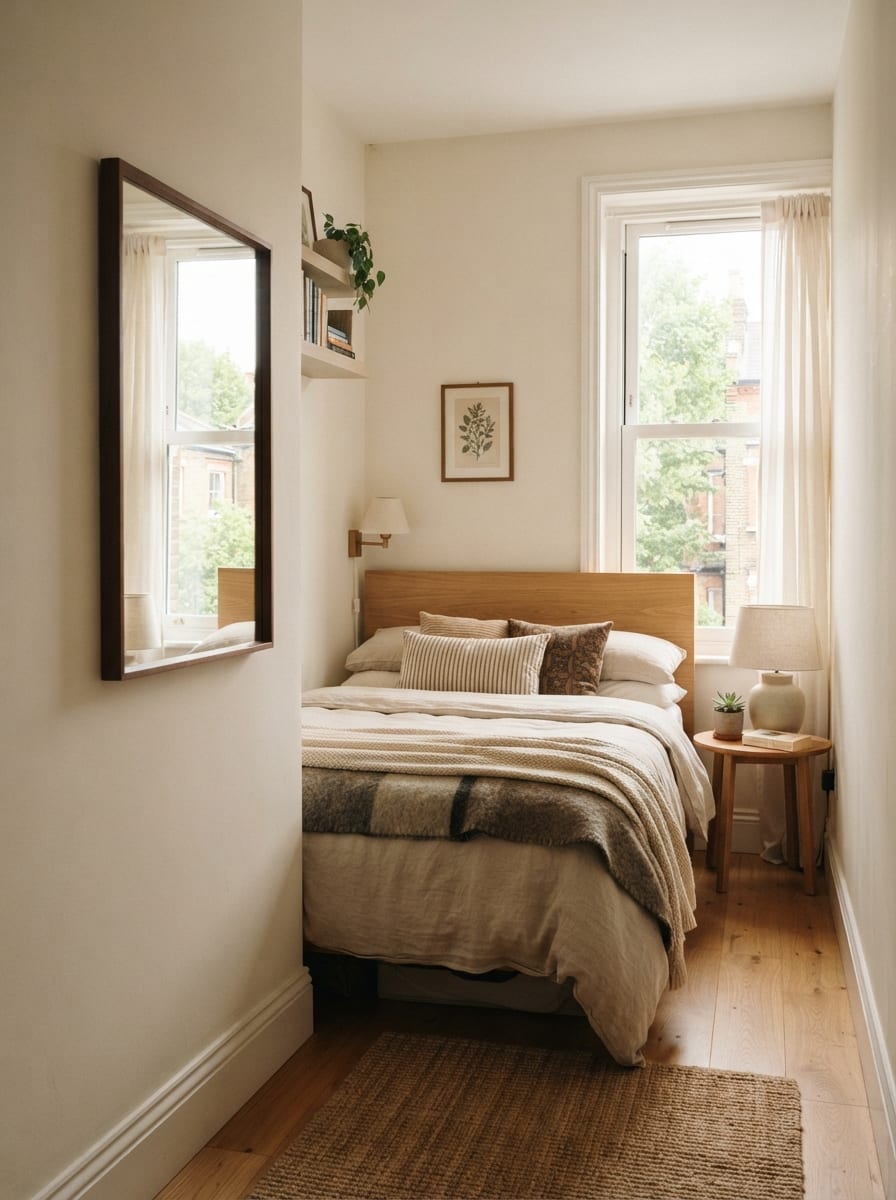
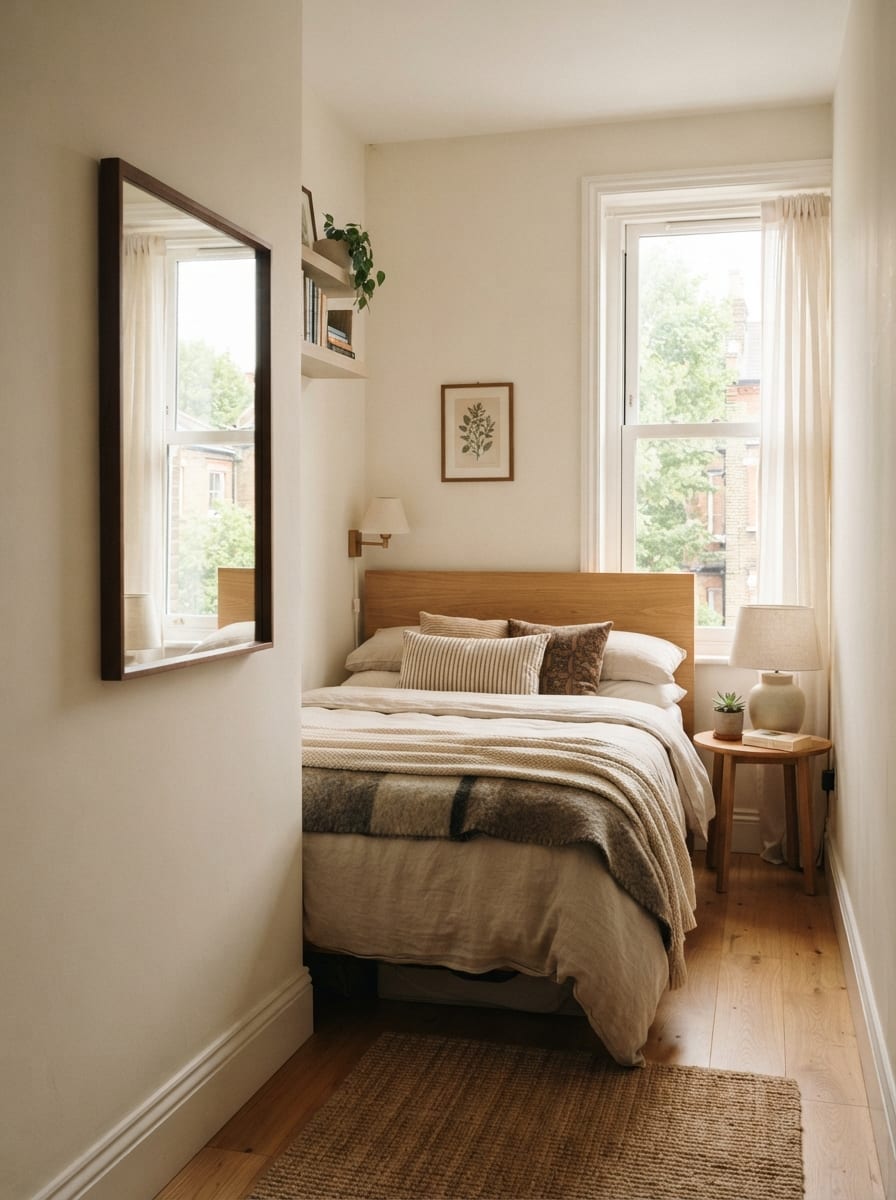
If your bedroom gets useful natural light from one window, a mirror can help redistribute some of that brightness.
The best placement is often:
- across from the window
- diagonally across from it
- on an adjacent wall
depending on the room layout.
Why it works
The mirror reflects the bright window area and some of the light around it.
That can make a dimmer part of the room feel more visually connected to the window.
Do not chase perfect symmetry
The mirror does not need to sit precisely opposite the center of the window.
In many small bedrooms, that would put it:
- behind the bed
- above a desk
- in the middle of a closet wall.
Choose the location that works functionally first.
Watch glare
A mirror reflecting direct sunlight can create uncomfortable brightness at certain times of day.
Test the reflection:
- morning
- afternoon
- evening.
Reflect the window, not only the curtain
If most of the mirror view is heavy curtain fabric, the brightening effect is weaker.
Keep the actual glass or bright window area visible in the reflection where possible.
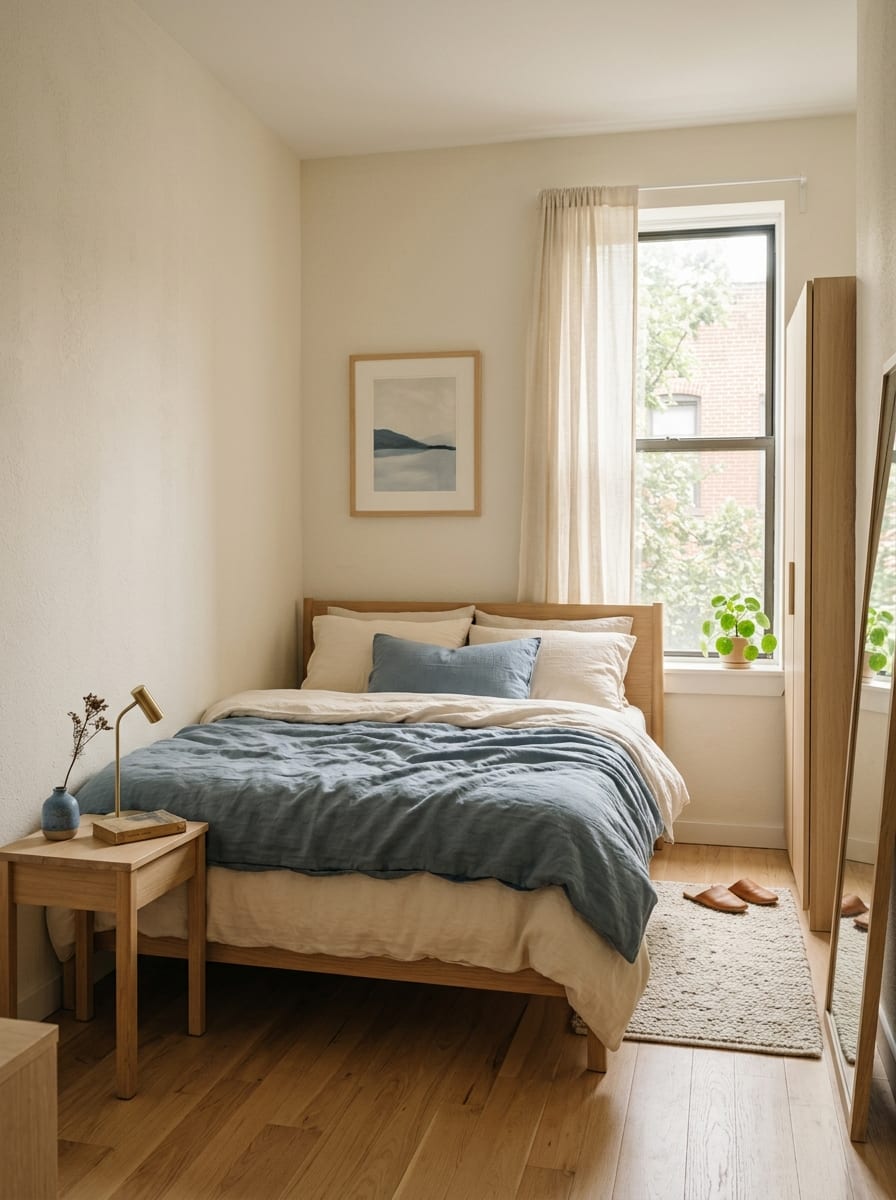
2. The Tall Leaning Mirror
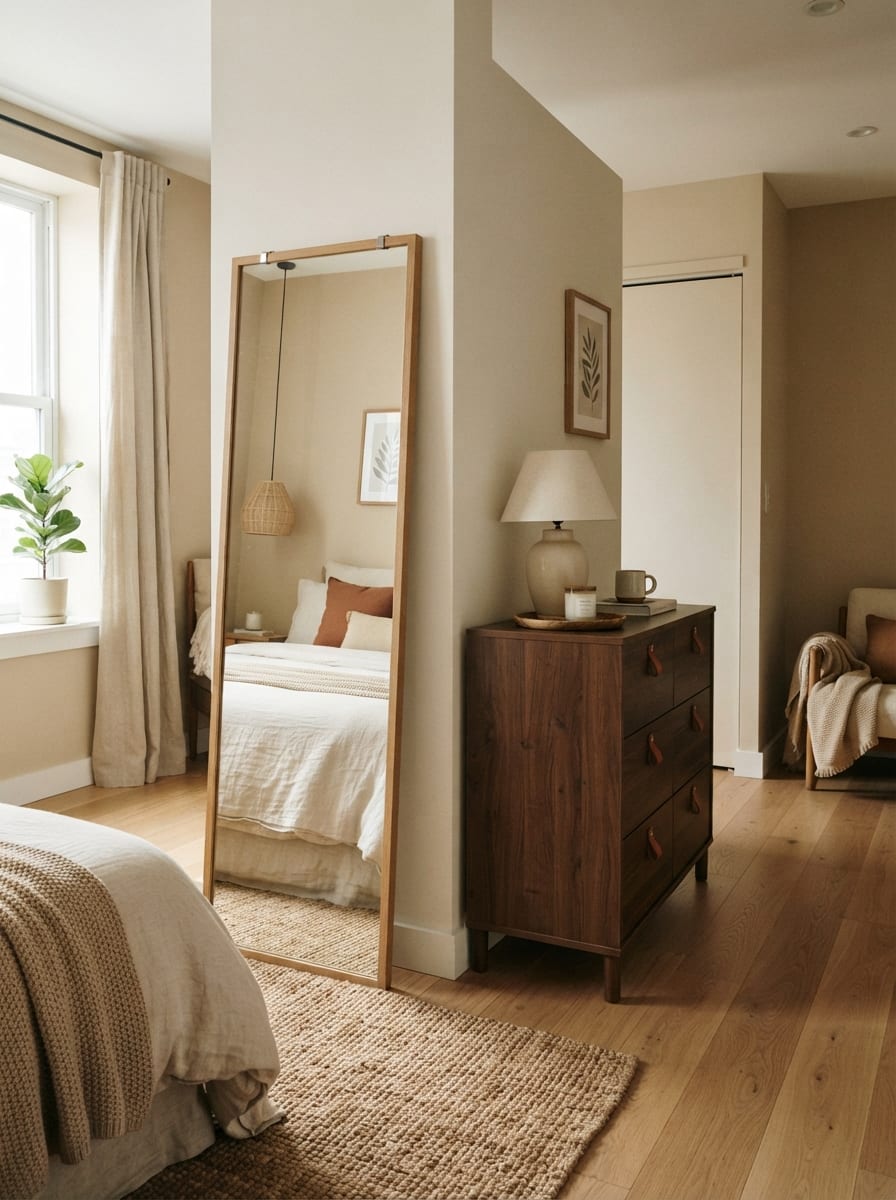
A tall floor mirror can provide a full-length view while creating a strong vertical line.
That can work well in a small bedroom where the available wall section is:
- narrow
- tall
- otherwise unused.
Why it works
The mirror emphasizes height more than width.
It can also reflect a larger portion of the room than a small wall mirror.
Keep the footprint controlled
A leaning mirror still occupies floor space.
The bottom can project farther into the room than expected.
Do not place it where it:
- narrows the walkway
- blocks a drawer
- interferes with the bedroom door.
Stability matters
Large leaning mirrors need to be secured appropriately according to the product’s installation or anti-tip guidance.
Do not rely on the wall lean alone if the product requires additional restraint.
Best locations
Useful spots may include:
- beside a dresser
- near the closet
- on a short wall near the bedroom entrance
- in an unused corner.
3. The Dresser-Top Mirror
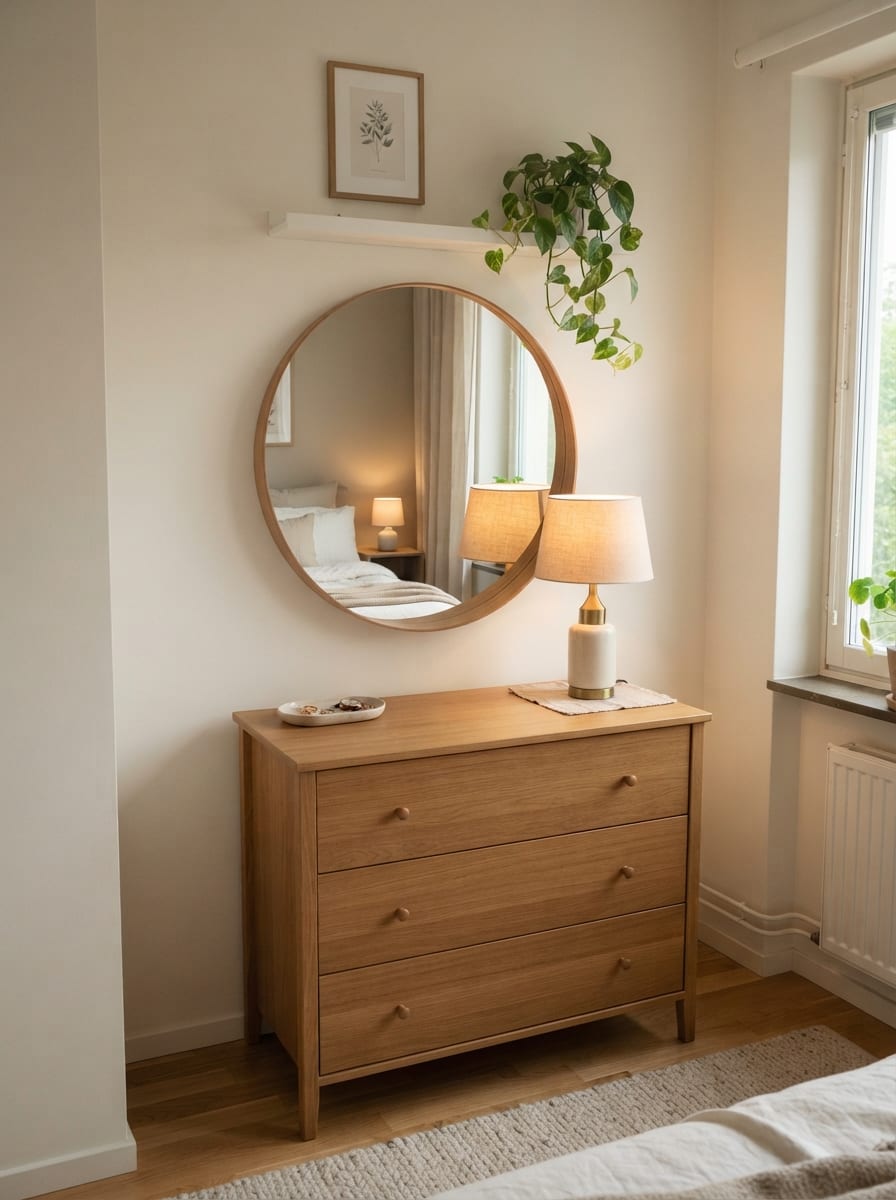
If the bedroom already contains a dresser, placing the mirror above it can combine two functions into one wall zone.
The dresser becomes:
- clothing storage
- getting-ready area.
Why it works
You avoid using another separate wall just for the mirror.
That is especially valuable when the room already needs:
- bed wall
- closet access
- desk
- doorway clearance.
Scale the mirror to the dresser
A very tiny mirror above a wide dresser can look disconnected.
A mirror nearly as wide as the dresser can also feel heavy.
Aim for a balanced relationship rather than exact matching.
Keep dresser clutter low
A mirror doubles whatever sits in front of it.
If the dresser is covered with:
- bottles
- jewelry
- papers
- chargers
the mirror visually repeats that clutter.
Use one contained tray
A small tray can help organize everyday items without covering the entire surface.
4. The Bedside Vertical Mirror
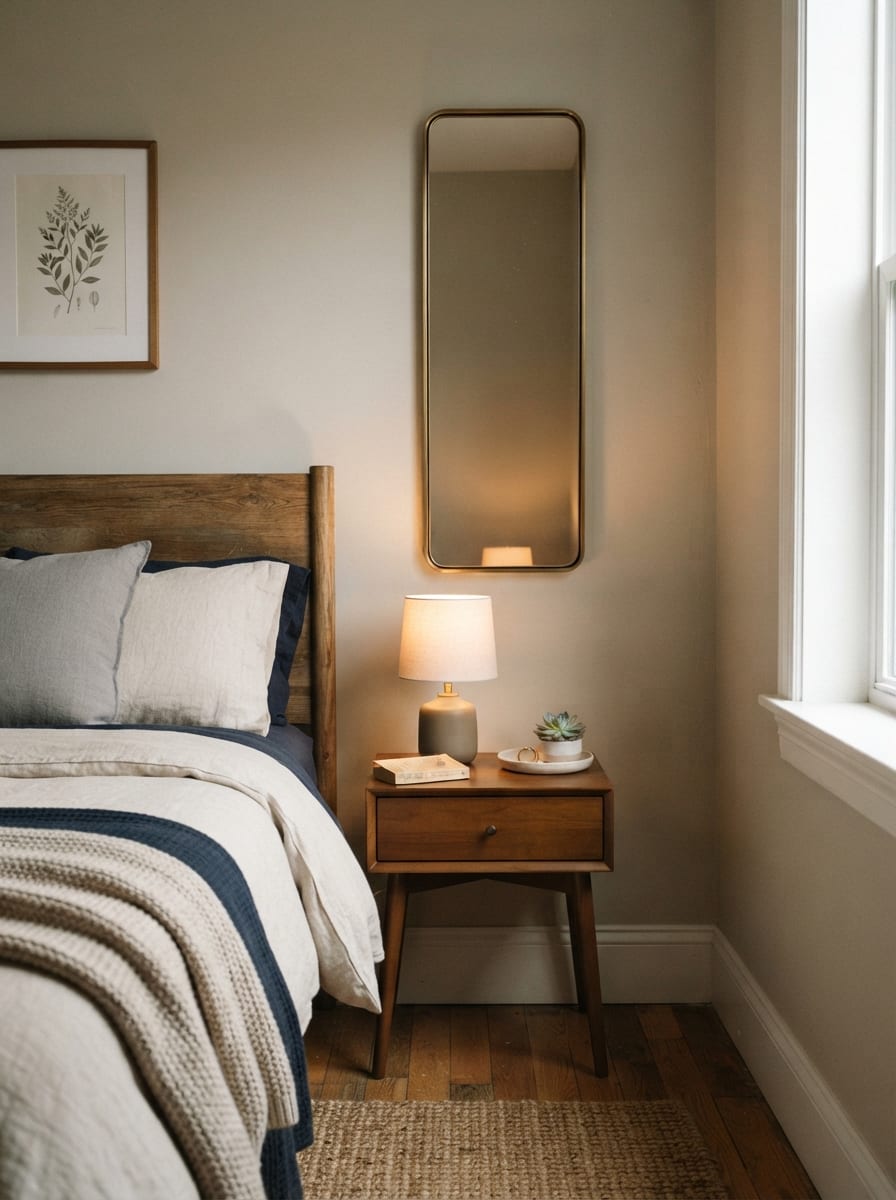
A narrow vertical mirror beside the bed can fill a tight wall strip that may be too small for:
- artwork
- shelves
- furniture.
Why it works
The vertical format adds height without requiring much wall width.
This can be useful between:
- bed and closet
- bed and window
- bed and corner.
Keep it away from the pillow zone
Do not crowd the sleeping area with a mirror that feels too close or visually dominant.
Leave enough wall breathing room.
Watch bedside lighting
If a lamp sits nearby, the mirror may reflect:
- exposed bulb
- bright shade
- strong glare.
Test the angle from the bed.
Keep the frame slim
A heavy ornate frame can overwhelm a narrow wall.
A simple frame usually works better.
5. The Closet-Door Mirror
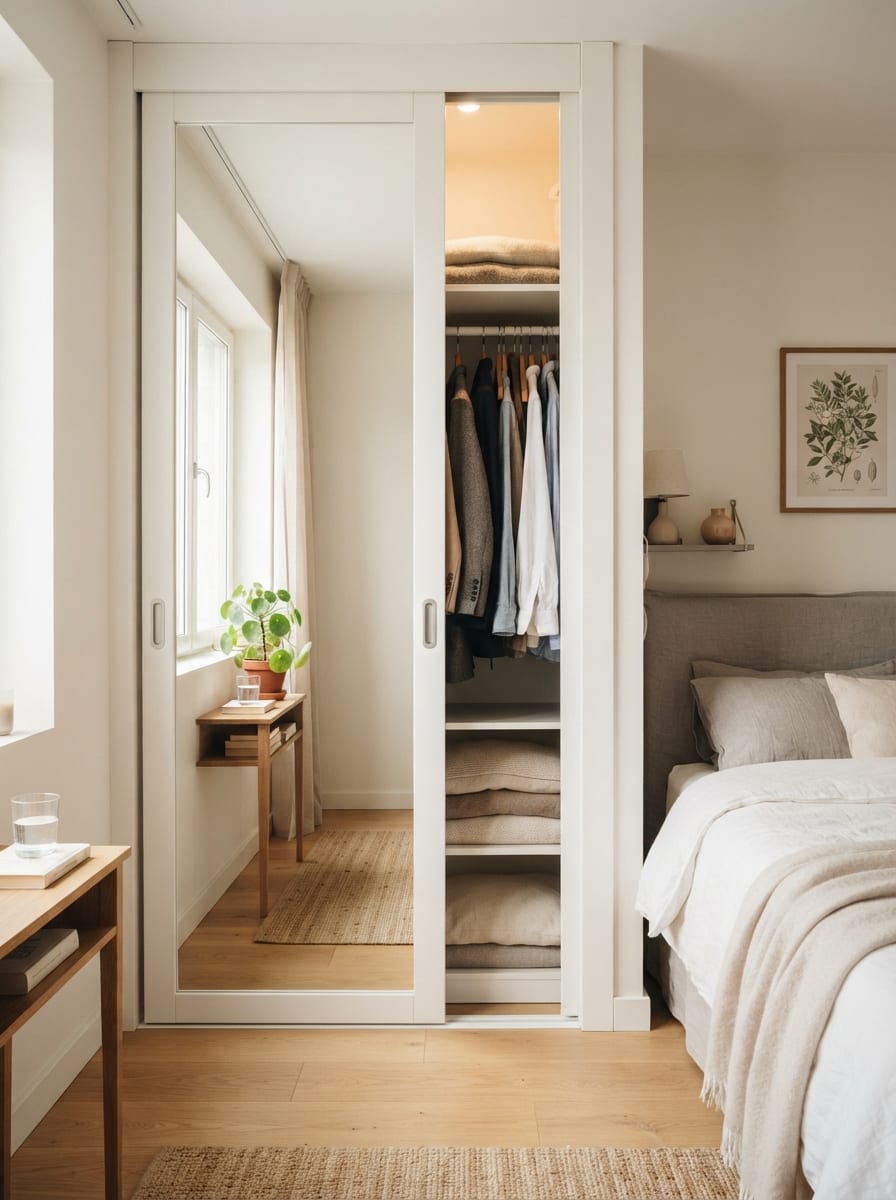
In a very small bedroom, the closet door may be one of the only large vertical surfaces available.
A mirror integrated with or safely mounted to a suitable closet door can add function without using another wall.
Why it works
You combine:
- dressing mirror
- existing door surface.
That keeps the room from accumulating extra furniture.
Best for
This can work particularly well on:
- sliding closet doors
- hinged doors designed to support an appropriate mirror
- existing mirrored closet systems.
Do not add weight casually
Doors are designed around specific:
- hinges
- tracks
- load limits.
Use mirror products and installation methods appropriate for the door.
Check door movement
A mirror should not interfere with:
- handles
- sliding tracks
- adjacent doors.
Think about what appears when the closet is open
A mirror may face a different direction once the door moves.
Check the reflection in both positions.
6. The Corner Depth Mirror
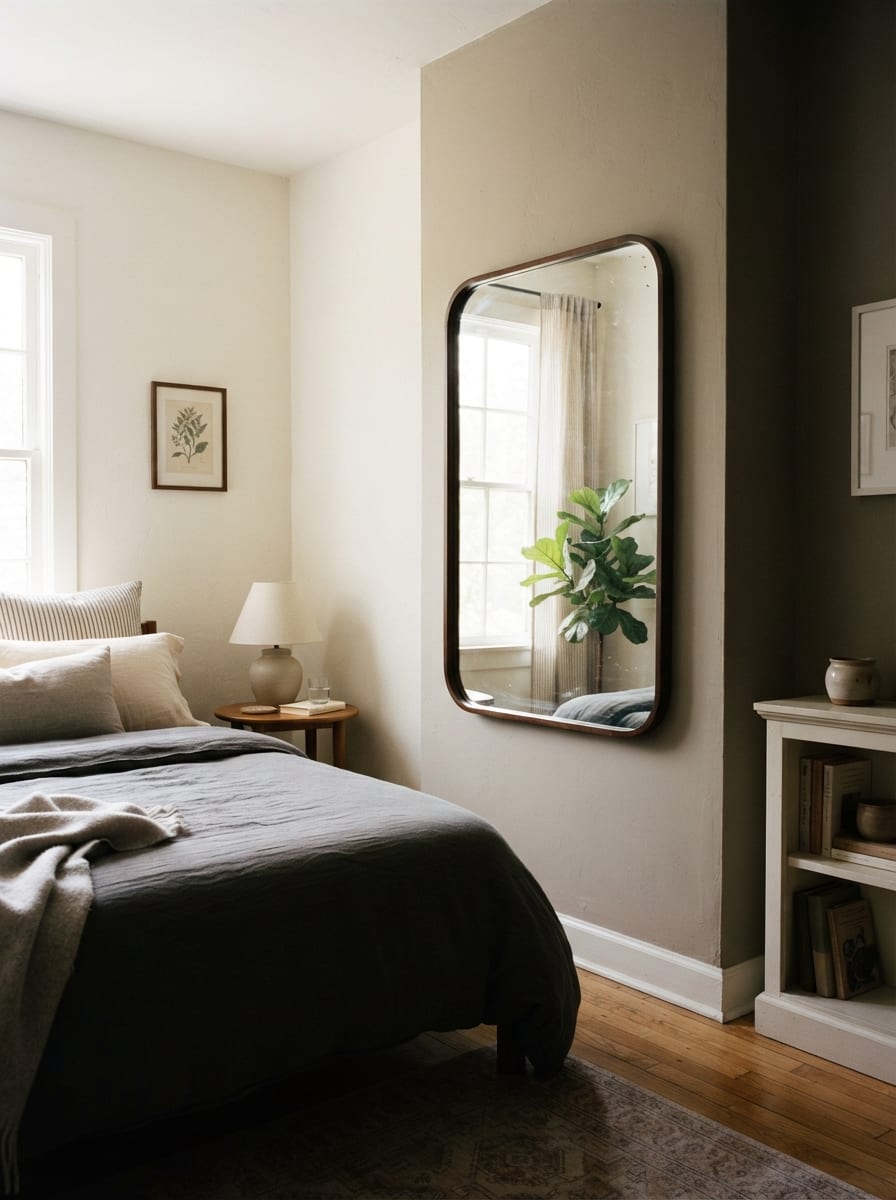
A mirror placed near a room corner can visually open that transition point.
This is useful when the corner otherwise feels:
- dark
- narrow
- visually closed.
Why it works
The reflected room extends beyond the actual wall plane.
That can make a tight corner feel less abrupt.
Use one wall, not both
You do not need mirrors wrapping the entire corner.
One well-placed mirror is usually enough.
Reflect the brighter side of the room
Angle the placement so the mirror catches:
- window light
- a lighter wall
- open floor
rather than a dark closet interior.
Keep nearby decor minimal
A corner mirror plus:
- tall plant
- lamp
- shelf
- basket
can quickly become too much.
Let the mirror do most of the visual work.
7. The Full-Length Wall Mirror
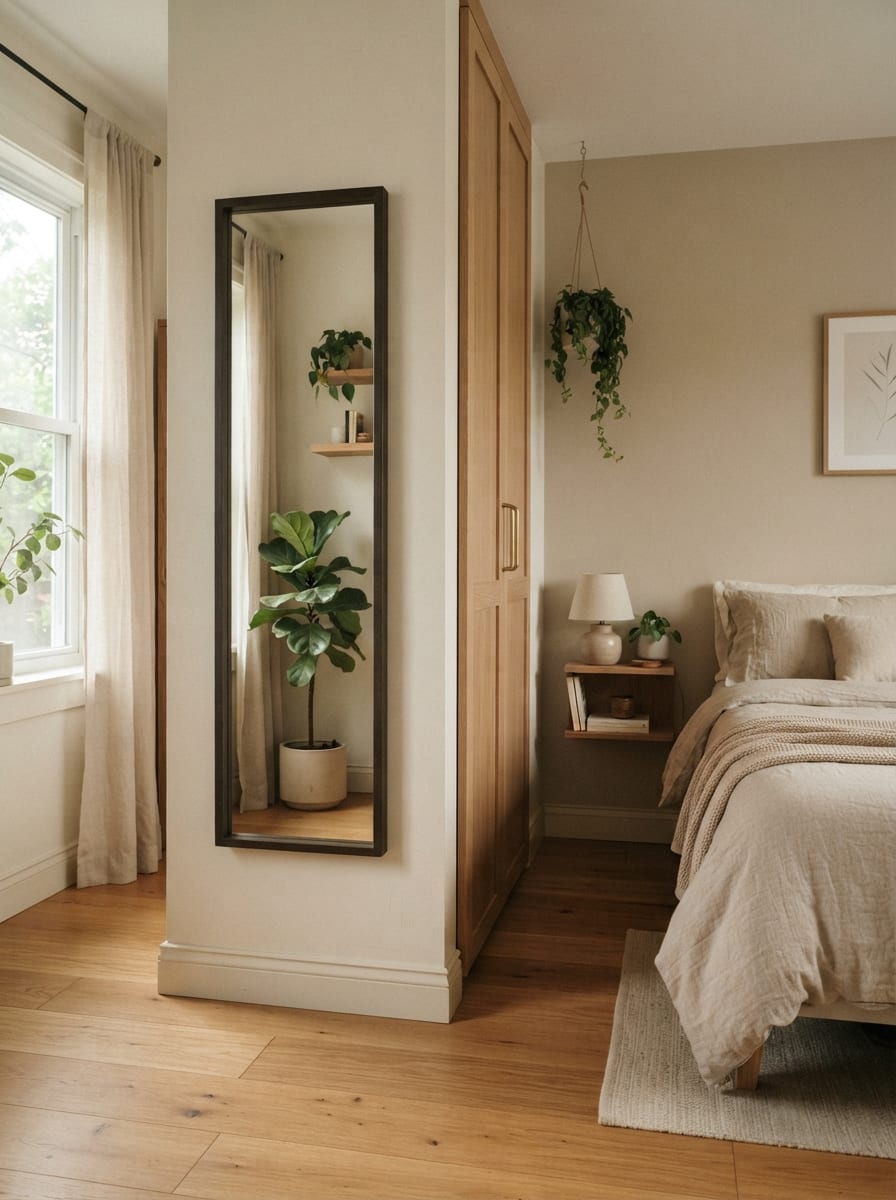
A wall-mounted full-length mirror gives you dressing function without the floor footprint of a freestanding mirror.
This can be especially useful when the room has a narrow wall near:
- closet
- entry
- dresser.
Why it works
You gain full-body reflection while keeping the floor below available.
Mounting height matters
The mirror should be positioned so it is actually useful from normal standing distance.
Do not mount it purely according to decorative symmetry.
Check viewing distance
A full-length mirror may technically fit on the wall but still be difficult to use if you cannot step back far enough.
Choose a narrow profile
A slim rectangular mirror usually works well in tight spaces.
Keep the wall below uncluttered
Avoid adding:
- baskets
- stool
- plant stand
directly beneath it if the purpose is preserving open floor.
8. The Tonal Frame Mirror
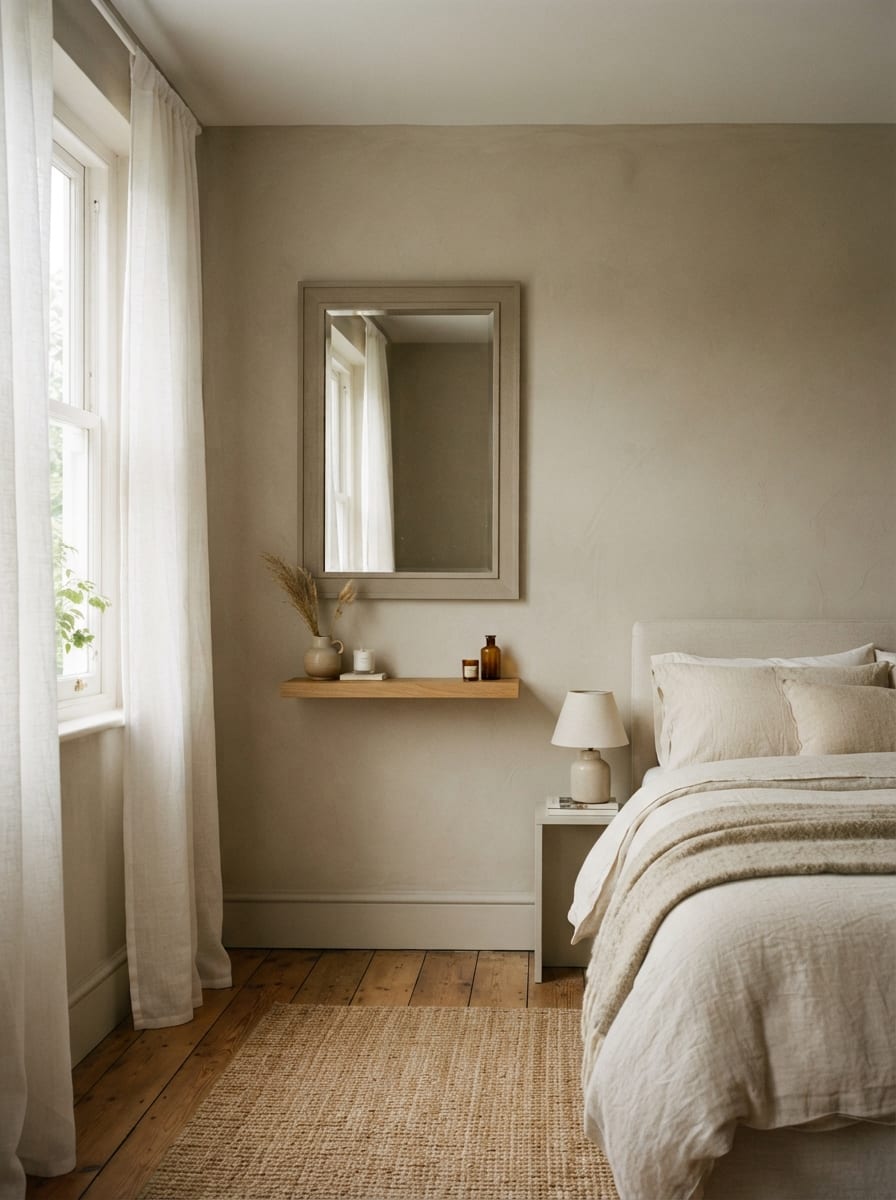
The frame can make a mirror feel either visually light or heavy.
If you want the mirror to blend into the room, choose a frame close to the wall color or nearby furniture tones.
Why it works
A low-contrast frame allows the reflective surface to do the work without creating another strong outline on the wall.
Good combinations
Warm white wall:
ivory frame
Greige wall:
taupe frame
Pale wood room:
light-oak frame
Muted green wall:
soft sage or warm-metal frame
Use contrast intentionally
A black frame can still work beautifully.
It simply becomes a stronger graphic element.
In a room with several dark lines already, that may be unnecessary.
Keep ornamentation controlled
A very detailed frame can visually compete with:
- bedding
- artwork
- furniture.
Small bedrooms often benefit from simpler mirror profiles.
9. The Reflection-First Mirror Formula
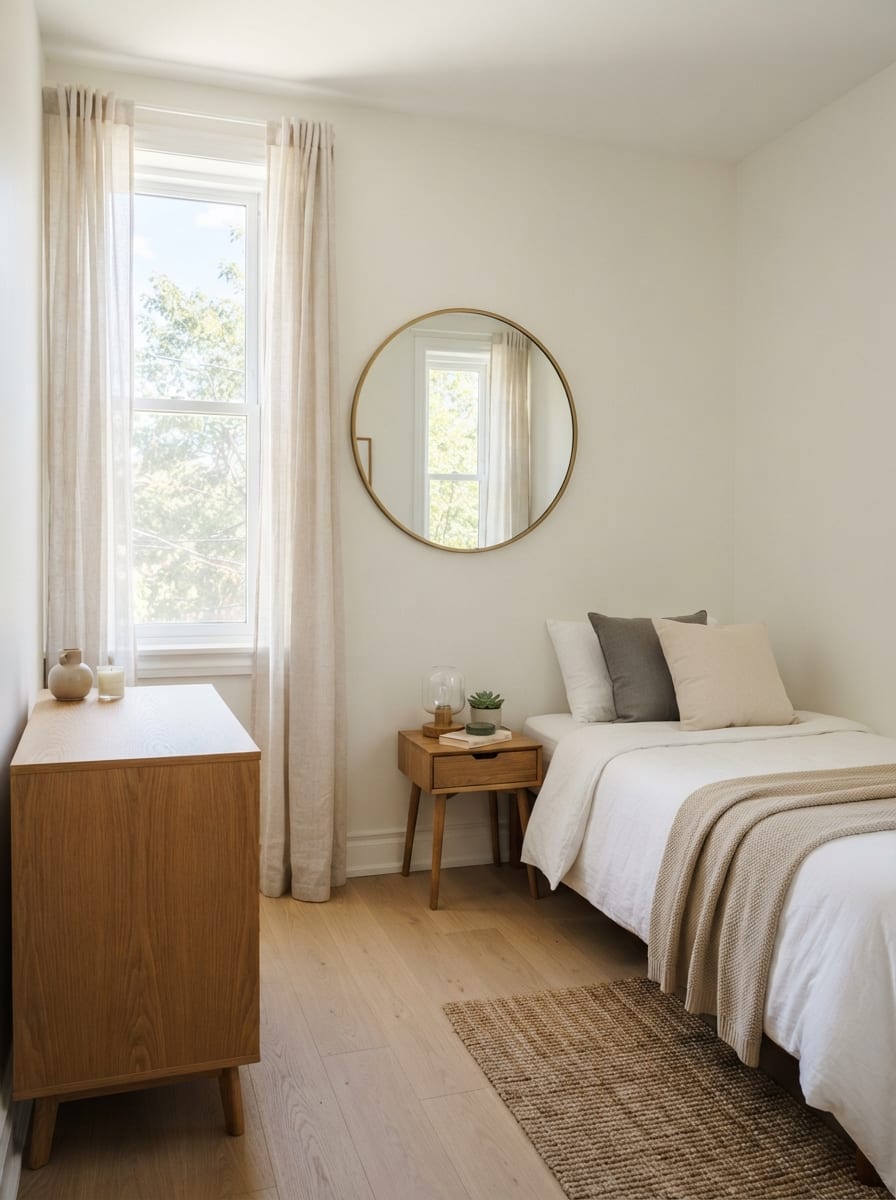
Before choosing the shape or frame, decide what the mirror should reflect.
Use this order:
reflection → viewing angle → size → position → frame
Step 1: Stand where you will see the mirror most
This may be:
- doorway
- bed
- desk
- closet.
Step 2: Look at the proposed mirror wall
Imagine what the mirror will face.
Will it reflect:
- window
- open floor
- attractive wall
- cluttered dresser
- open closet?
Step 3: Fix the reflection before the mirror
If the view is poor, choose another wall.
Step 4: Choose the size
Larger is not automatically better.
Choose enough reflective area to solve the purpose without dominating the wall.
Step 5: Choose the frame
The frame comes last.
Its job is to support the room, not determine placement.
Start With the Reflection, Not the Mirror
This is the most important rule in a small bedroom.
A mirror does not create new visual information.
It repeats what is already there.
If it reflects:
- clutter
- laundry
- an open wardrobe
- messy cables
you have doubled the visual noise.
Ask What You Want the Mirror to Do
There are four common jobs.
Add brightness
Reflect:
- window
- bright wall
- daylight.
Add depth
Reflect:
- open floor
- long sightline
- room corner.
Help with dressing
Use:
- full-length
- closet-door
- dresser mirror.
Add decoration
Use a mirror as a simpler replacement for artwork.
One Mirror Can Do More Than One Job
For example, a full-length mirror near the closet may also reflect the bedroom window.
That is ideal.
Do Not Add Mirrors Just Because the Room Is Small
A small bedroom does not automatically need several mirrors.
One useful mirror is often enough.
Too Many Mirrors Can Create Visual Noise
Multiple reflections can repeat:
- furniture
- lighting
- windows
- clutter.
That may make the room feel busier rather than more spacious.
Mirror Opposite the Window
This can increase perceived brightness.
But test direct sunlight and glare.
Mirror Beside the Window
This can still reflect daylight without bouncing the window directly back at you.
Mirror Diagonal From the Window
Often a practical compromise in small bedrooms.
Mirror Behind the Bedside Table
Can work if it does not create distracting glare from the lamp.
Mirror Above the Dresser
A classic functional placement.
Mirror Beside the Dresser
Useful when the dresser is already visually heavy.
Mirror Near the Closet
Ideal for dressing.
Mirror on Closet Door
Excellent when wall space is limited and installation is appropriate.
Mirror Behind the Bedroom Door
Sometimes possible, but check:
- door movement
- wall clearance
- viewing distance.
Mirror Opposite the Bed
Some people prefer this, others do not.
From a design perspective, the important question is still what it reflects.
Mirror Above the Bed
This can work decoratively but is usually less useful for dressing.
Secure installation is especially important above furniture and sleeping areas.
Mirror Beside the Bed
A narrow vertical mirror may work better than a large horizontal one.
Mirror in the Corner
Can improve a dark or visually compressed corner.
Mirror Near a Desk
Useful if the desk doubles as a getting-ready area.
Mirror Over a Desk
Check computer-screen glare and lighting reflection.
Mirror Near a Window With Curtains
Make sure the mirror does not prevent the curtains from stacking fully.
Mirror Near a Radiator
Avoid interfering with heating equipment and follow clearance guidance.
Mirror Over a Heater
Use only if the location and mirror product are suitable and installation does not create a safety issue.
Mirror Behind a Door
The door may constantly hit or hide it.
Check movement first.
Floor Mirror Behind a Door
Usually impractical in a very small room.
Tall Mirror Between Two Furniture Pieces
Can work if the remaining floor gap is still usable.
Mirror Width Matters
A mirror that is too wide can make a narrow wall feel overfilled.
Mirror Height Matters
A tall mirror often uses small rooms efficiently because it adds function without consuming much wall width.
Full-Length Mirror
Best for dressing.
It needs enough:
- height
- viewing distance.
Half-Length Mirror
Useful above:
- dresser
- desk
- vanity.
Round Mirror
Can soften a room filled with:
- rectangular bed
- dresser
- wardrobe
- windows.
Rectangular Mirror
Usually easier to fit into tight wall zones.
Arched Mirror
Adds softer architectural shape.
Keep the frame simple if the room already has many decorative elements.
Oval Mirror
Can work above a dresser or narrow console.
Irregular Organic Mirror
Adds personality but may become visually dominant.
Use it as the main wall feature rather than combining it with lots of other decor.
Large Mirror vs Several Small Mirrors
One large mirror often feels calmer than a cluster of smaller ones.
Mirror Gallery Wall
Possible, but usually not the best first choice for a very small bedroom.
Several separate reflections can create visual fragmentation.
Frameless Mirror
Can appear visually light.
This may suit:
- minimal bedrooms
- very tight spaces.
Thin Black Frame
Adds definition.
Works best when black is already repeated elsewhere.
Brass Frame
Can warm up:
- cream
- beige
- green
- taupe rooms.
Light Wood Frame
Works naturally with:
- pale wood furniture
- warm neutrals.
Dark Wood Frame
Adds more visual weight.
White Frame
Can blend into a light wall and visually recede.
Frame Thickness Matters
A thick frame makes the mirror occupy more visual territory than the reflective surface alone.
Keep Heavy Frames Away From Tiny Walls
A narrow wall can become overwhelmed quickly.
Mirror and Bedding
The mirror will reflect the bed in many layouts.
Keep the bedding visually controlled if that is the primary reflection.
Mirror and Open Closet
Usually avoid this if possible.
An open closet is already visually dense.
Reflecting it doubles the effect.
Mirror and Dresser Clutter
Again, anything on the dresser appears twice.
Mirror and Desk
Work clutter can become the visual focus.
Mirror and Laundry Basket
A practical object can become a major repeated element in the room.
Mirror and Window
Usually one of the most useful reflections.
Mirror and Artwork
Can effectively duplicate artwork.
This can be attractive if intentional.
Mirror and Plant
One plant reflected in a mirror can visually feel like more greenery without adding another object.
Mirror and Lamp
The reflected lamp can amplify warm evening light.
But avoid exposing the bulb directly in the reflection.
Mirror and String Lights
Can create a festive effect, but may become busy if many lights are reflected.
Mirror and Ceiling Light
Check whether a harsh ceiling fixture becomes the brightest thing in the mirror.
Mirror and Natural Light
Daylight reflections can change throughout the day.
Test more than one time.
Small Bedroom With One Window
Prioritize a mirror that can capture some of that light.
Small Bedroom With Two Windows
You may not need as much reflective help.
Use the mirror primarily for function.
Dark Bedroom
A mirror can help redistribute existing light but cannot replace actual lighting.
Use it alongside:
- task light
- ambient light.
Bright Bedroom
Focus more on:
- dressing function
- visual depth
- decoration.
Narrow Bedroom
A tall narrow mirror often works better than a wide horizontal one.
Square Bedroom
You may have more flexibility with:
- dresser wall
- closet wall
- corner.
Low-Ceiling Bedroom
Vertical mirror proportions can reinforce height.
Bedroom With Large Bed
Protect the remaining wall space carefully.
Use the mirror in a narrow leftover zone rather than adding another large horizontal element.
Bedroom With Dresser
Combining the mirror with the dresser is often efficient.
Bedroom Without Dresser
Use:
- wall-mounted full-length mirror
- closet-door mirror
- narrow floor mirror.
Bedroom With Desk
A mirror above the desk can create a secondary vanity function if the setup works.
Studio Sleeping Area
The mirror may reflect the living space too.
Use that intentionally.
Mirror Facing the Living Area
Can make the studio feel more connected.
Mirror Facing the Kitchen
May reflect visual kitchen clutter.
Consider another angle.
Mirror Facing the Entry Door
Can visually extend the sightline, but check whether the reflection is useful.
Mirror Near the Bedroom Entrance
A good option for:
- last look before leaving
- filling a narrow wall.
Small Bedroom Mirror and Rug
A mirror reflecting part of the rug can visually repeat texture and color.
Mirror and Accent Wall
If the room has one strong accent wall, a mirror can either:
- sit on it
- reflect it.
You may not need both.
Black Accent Wall
A mirror can help break up the dark surface and reflect brighter areas.
Wallpapered Wall
Choose a simpler mirror frame so it does not compete with the pattern.
Mirror on Patterned Wallpaper
Can work well if the frame is restrained.
Mirror Against Beadboard or Paneling
Align it carefully with the architectural lines.
Mirror With Wainscoting
Avoid mounting it so awkwardly that it almost—but not quite—aligns with the panel cap.
Mirror Above a Nightstand
Can create a vertical composition.
Keep it narrow enough that it does not extend behind the bed.
Pair of Bedside Mirrors
Can work in larger rooms.
In a very small bedroom, two mirrors may be more than necessary.
One Bedside Mirror
Asymmetry can be more practical.
Mirror and Side Table Lamp
Check glare from the lampshade.
Mirror and Pendant Light
A reflected pendant can become a strong visual feature.
Make sure it looks intentional.
Mirror and Floor Lamp
A reflected lamp can make the room appear brighter.
Again, hide the raw bulb from direct reflection.
Full-Length Mirror and Chair
Do not place a chair directly in front if you need to see your full reflection.
Full-Length Mirror and Clothing Rack
A clothing rack reflected in the mirror can make the room look busier.
Floor Mirror and Curtain
Leave enough space for the curtains to open fully.
Floor Mirror and Outlet
Do not trap electrical cords behind the mirror.
Wall-Mounted Mirror and Studs
Follow manufacturer installation requirements and use appropriate wall hardware.
Heavy Mirrors Need Proper Support
Do not improvise mounting.
Renters Should Check Wall Rules
Large mirrors may require:
- anchors
- screws
- substantial wall mounting.
Check the lease before installation.
Adhesive Mirror Tiles
These can create a reflective surface, but they may:
- distort reflections
- damage finishes
- create many seams.
Use only when appropriate for the wall and desired look.
Removable Does Not Automatically Mean Damage-Free
Surface quality and adhesive matter.
Over-the-Door Mirror
Can be useful for renters when compatible with the door.
Check:
- door closure
- hardware
- clearance.
Leaning Mirror
Can reduce wall mounting but may still require anti-tip stabilization.
Freestanding Mirror
Uses more floor space.
It is usually better when the room has a genuine unused corner.
Mirrored Furniture
A mirrored dresser or nightstand creates many reflections.
This can feel glamorous but may also add visual noise.
One Clear Mirror Is Usually Enough
Use mirrored furniture sparingly in tiny rooms.
Mirrored Closet Doors
Can make a bedroom feel substantially brighter.
But they also reflect the entire room.
Keep the reflected view calm.
Keep the Area in Front of the Mirror Clean
The floor beneath a full-length mirror should remain open enough to use it comfortably.
Do Not Place a Laundry Pile in the Reflection Zone
Anything regularly left there becomes visually doubled.
Reflection Maintenance Is Part of Styling
A mirror changes the room most when the reflected area is also intentional.
Keep the Mirror Itself Clean
Dust, fingerprints and water marks reduce the brightening effect.
Use a Mirror Instead of Extra Artwork
If the wall already feels crowded, a mirror can replace decor rather than being added on top of it.
One Mirror + One Artwork
Often enough for a small bedroom.
Avoid Filling Every Blank Wall
Some empty wall helps the bedroom feel calmer.
Mirror Frame Color Can Repeat Existing Finishes
For example:
- light wood frame with dresser
- brass frame with lamp
- black frame with curtain rod.
Repeat, Do Not Over-Match
The mirror does not need to perfectly match every furniture piece.
Keep the Reflection Calm at Night
Mirrors can reflect bright screens, LEDs and lamps.
Check how the room looks after dark.
Common Small Bedroom Mirror Mistakes
Hanging the mirror where it reflects clutter
The room looks twice as busy.
Choosing a mirror that is too wide
The wall feels overcrowded.
Using several mirrors because the room is small
Too many reflections create visual noise.
Ignoring glare
Sunlight or lamps become uncomfortable.
Blocking closet access
The mirror solves one problem and creates another.
Using a floor mirror in the main walkway
It steals valuable circulation space.
Mounting a full-length mirror where you cannot step back
It looks useful but does not function well.
Choosing a heavy ornate frame for a tiny wall
The frame becomes more dominant than the reflection.
Reflecting an open closet
Storage clutter becomes the visual focal point.
Adding a mirror instead of editing the wall
Sometimes the room already has enough visual elements.
Quick Small Bedroom Mirror Decision Guide
Choose a Window-Bounce Mirror if:
You want to improve perceived daylight.
Choose a Tall Leaning Mirror if:
You need full-length function and have one unused wall edge.
Choose a Dresser Mirror if:
You want to combine storage and getting-ready functions.
Choose a Bedside Vertical Mirror if:
You have a narrow strip of unused wall.
Choose a Closet-Door Mirror if:
Wall space is limited and the door can safely support it.
Choose a Corner Mirror if:
A dark or compressed corner needs more visual depth.
Choose a Wall-Mounted Full-Length Mirror if:
You need dressing function without using floor space.
Choose a Tonal Frame if:
You want the mirror to visually recede.
The Small Bedroom Mirror Formula
Before choosing a mirror, solve these five things:
REFLECTION
What will it show?
LIGHT
Can it reflect daylight or useful ambient light?
FUNCTION
Do you need:
- full-length dressing
- getting-ready mirror
- decorative reflection?
CLEARANCE
Will it interfere with:
- bed
- closet
- door
- curtains?
SCALE
Is the mirror proportionate to the wall and nearby furniture?
Only then choose:
- shape
- frame
- finish.
A mirror does not automatically make a small bedroom look bigger.
A useful reflection does.
Frequently Asked Questions
Where should I put a mirror in a small bedroom?
Good locations include:
- opposite or diagonal from a window
- above a dresser
- near the closet
- beside the bed
- on an unused narrow wall.
The best location depends on what the mirror will reflect.
Does a mirror make a small bedroom look bigger?
It can create more perceived depth and reflect light, but placement matters.
A mirror reflecting clutter may make the room feel busier instead.
Should a bedroom mirror face the window?
It can, especially if you want to reflect daylight.
Test for glare before committing.
Is a full-length mirror good for a small bedroom?
Yes.
Wall-mounted or narrow full-length mirrors can provide dressing function without using much space.
Are leaning mirrors good for small bedrooms?
They can be, but they still occupy floor area and should be stabilized according to product guidance.
Can I put a mirror above a dresser?
Yes.
This is one of the most space-efficient arrangements because the dresser and mirror share one wall zone.
Should the mirror be wider than the dresser?
It does not need to be.
A mirror somewhat narrower than the dresser often creates a balanced composition.
Can I put a mirror on a closet door?
Potentially, if the door and mirror system are designed for the weight and installation method.
What color mirror frame is best for a small bedroom?
A frame close to the wall or furniture tone will visually recede.
A dark frame creates stronger contrast.
How many mirrors should a small bedroom have?
There is no fixed number, but one well-placed mirror is often enough.
Final Thoughts
A mirror can make a small bedroom feel brighter and more open, but only if it reflects something worth seeing.
Start by standing where you normally:
- enter the room
- sit on the bed
- get dressed
- use the desk.
Then look at the possible mirror wall and ask:
What would I see twice?
If the answer is:
- daylight
- open floor
- calm bedding
- a clean wall
you probably have a useful placement.
If the answer is:
- clutter
- laundry
- open storage
- tangled cables
choose another location.
Use a tall mirror when wall width is limited.
Combine the mirror with a dresser when you need to save wall space.
Use the closet door when appropriate.
And avoid adding multiple mirrors simply because the room is small.
The best mirror does not just decorate the wall.
It makes the room feel brighter, deeper, and calmer without adding another layer of visual clutter.