10 Small Bathroom Shower Tile Ideas That Make the Shower Feel Larger, Not Busier
Make a small shower feel twice as large. Discover 10 small bathroom shower tile ideas, vertical patterns & grout tricks that make compact showers feel bigger.
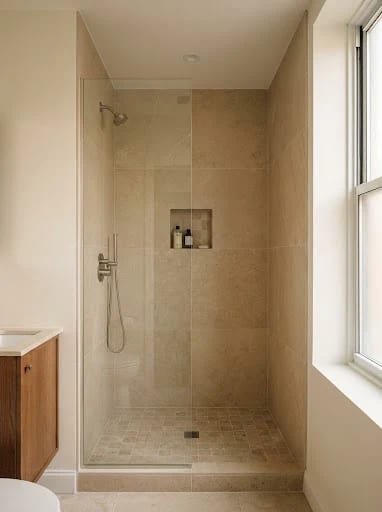
A compact apartment bathroom shower with large-format warm limestone-look tile and minimal grout lines
In This Guide
A tiny shower does not automatically need tiny tile.
That is one of the most useful things to understand before choosing tile for a small bathroom.
Many compact showers end up feeling busier because several visual elements are competing at once: small tiles, dark grout, niche trim, decorative borders, contrasting floors, patterned walls, metal fixtures, and a shower curtain or glass enclosure layered over everything.
None of those choices is necessarily wrong on its own. The problem is visual fragmentation.
Every grout line, color transition, trim piece, and pattern creates another boundary for the eye to process. In a large bathroom, that amount of detail may feel rich. In a narrow shower measuring only a few feet across, it can make every surface feel closer.
The best small bathroom shower tile ideas therefore are not simply about finding the lightest tile possible. They are about controlling:
- Tile scale
- Grout contrast
- Pattern direction
- Transitions
- Material changes
- Visual focal points
- The relationship between the shower and the rest of the bathroom
You can absolutely use color, pattern, and texture in a small shower. The key is deciding where the visual activity belongs and where the eye should be allowed to rest.
Here are ten approaches that create character while keeping a compact shower visually calm.
1. Use Large-Format Tile to Reduce the Number of Visible Lines
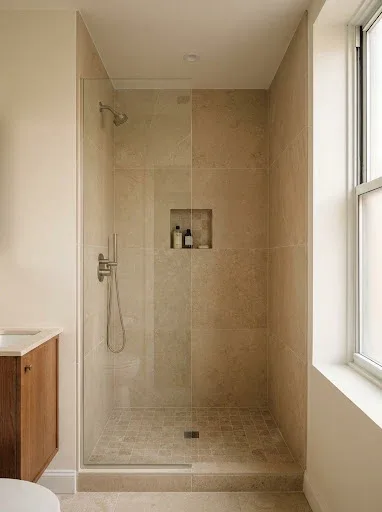
Large-format tile can work extremely well in a small shower because fewer tile joints create fewer visual interruptions.
That does not mean installing enormous slabs that look out of scale. The goal is simply to reduce the dense grid effect produced by lots of small tiles.
A warm stone-look porcelain tile in a larger rectangular format can create broad, uninterrupted planes across the shower walls. When the grout color stays close to the tile color, individual pieces visually blend together and the surface begins to read almost like one continuous material.
This can be particularly effective in a shower with:
- A fixed glass panel
- Simple chrome or brushed-nickel fixtures
- Minimal wall niches
- Limited decorative trim
Why it can make a small shower feel larger
The eye notices fewer boundaries. Instead of reading: tile → grout → tile → grout → tile, it reads a broader field of color and texture. That gives the wall a calmer visual rhythm.
Where this works best
Use it when your bathroom already contains several smaller visual elements, such as open shelving, patterned textiles, decorative lighting, wood cabinetry, or framed mirrors. The simpler shower surface balances the rest of the room.
Important detail
Large-format wall tile does not automatically mean large-format shower-floor tile. A shower floor often needs sufficient slope and appropriate slip resistance, so the floor tile choice may have different practical requirements from the walls.
Design direction
Try:
- Warm limestone look
- Pale travertine look
- Soft concrete
- Creamy marble-look porcelain
- Muted greige stone
Avoid highly dramatic veining across every wall if your goal is visual calm.
2. Stack Rectangular Tile Vertically to Emphasize Height
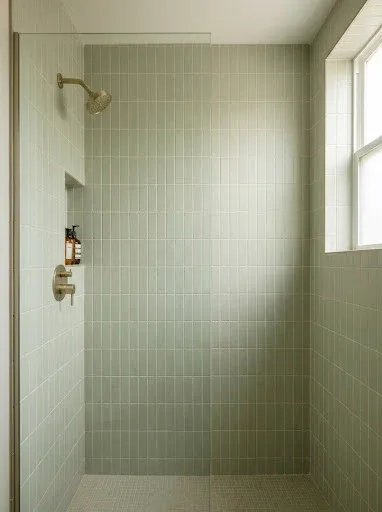
A vertical tile layout can be useful in a shower that feels short, compressed, or visually squat.
Instead of laying rectangular tile horizontally, rotate it so the longer dimension runs upward. Then use a stacked pattern rather than offsetting every row.
The result is a cleaner series of vertical lines that pulls the eye from the shower floor toward the ceiling.
This works especially well with simple tiles such as:
- 2 × 8
- 3 × 12
- 4 × 12
- Elongated handmade-look ceramic tile
The exact size matters less than the proportion.
Why stacked tile works differently from traditional subway tile
Traditional running-bond subway tile creates a lot of horizontal movement. Vertical stacking does the opposite. It emphasizes height and creates a more contemporary rhythm. In a tiny shower, this can make the wall feel taller without requiring bold pattern.
Keep the grout quiet
If the tile is cream, choose cream or warm-white grout. If the tile is sage, choose a muted green-gray or low-contrast neutral. A high-contrast grout would turn every tile edge into a graphic line, which can overpower a very small shower.
Best placement
This layout works particularly well:
- On all shower walls
- Behind a wall-mounted showerhead
- Around a narrow vertical niche
- In bathrooms with low or average ceiling height
3. Use Horizontal Tile When You Want a Narrow Shower to Feel Wider
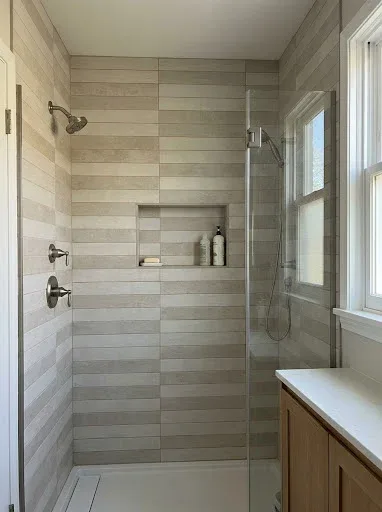
Vertical tile is not automatically the best layout for every small shower. If your shower feels unusually narrow, horizontal lines can be useful.
A rectangular tile laid in a calm running-bond or straight horizontal stack visually moves the eye from side to side. That can make the shower feel less like a tall narrow shaft.
The effect is strongest when the wall contains long uninterrupted rows.
Keep the pattern simple
Avoid combining horizontal tile, strong contrast grout, decorative borders, accent niches, patterned floors, and dramatic curtains all in the same shower. The orientation itself is already doing visual work.
Good tile choices
Try a slightly elongated tile with subtle variation rather than a tiny classic subway tile. For example, a longer rectangle can create fewer horizontal grout lines while still giving you the width-enhancing effect.
When to choose this instead of vertical tile
Choose horizontal emphasis when:
- The shower is visibly narrower than it is tall
- The back wall feels compressed
- The room has a high ceiling already
- You want to visually stretch the shower sideways
4. Use Tonal Zellige-Style Tile for Texture Without Strong Pattern
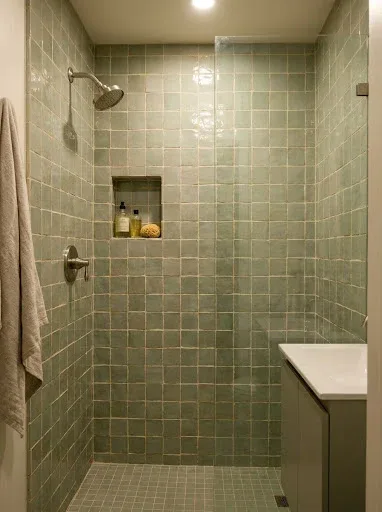
Small showers do not have to be completely flat or minimal. Texture can add richness without creating the same visual busyness as a high-contrast pattern.
A handmade-look zellige-style tile is a good example. Each tile may vary slightly in tone, gloss, edge, and reflection, but if all the pieces stay within the same color family, the wall still reads as one cohesive surface.
That gives you depth without introducing multiple colors or complicated geometry.
The key is tonal consistency
Think:
- Cream with cream
- Sage with muted sage
- Dusty blue with soft blue-gray
- Warm white with ivory
The variation should come from the tile surface and glaze, not from extreme color shifts.
Light matters
Glossy or softly reflective tile can bounce light around a small shower, especially when natural light is limited. But highly reflective surfaces will also show highlights and irregularities more clearly. That can be beautiful if you want an artisanal feel.
Avoid over-accessorizing
If the tile itself has movement, keep the niche, hardware, floor, and surrounding decor restrained.
5. Continue One Tile Beyond the Shower to Reduce Visual Chopping
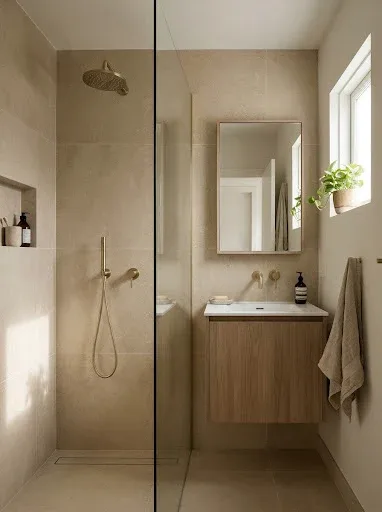
A small bathroom can feel even smaller when every zone uses a different finish: one wall color outside the shower, another tile inside, a different floor, a contrasting niche, a separate backsplash, and decorative trim. Each transition creates another visual stop.
One way to reduce that fragmentation is to let the shower tile continue beyond the enclosure.
You might extend the same tile:
- Across the vanity wall
- Behind the toilet
- Along one continuous bathroom wall
- Partially outside a walk-in shower
This makes the shower feel like part of the bathroom rather than a box placed inside it.
Why continuity helps
The eye follows one material farther through the room. That visually expands the shower zone and reduces the number of boundaries.
Use restraint
You do not necessarily need to tile every wall. One continuous tiled plane is often enough.
Best candidate
This approach works particularly well with stone-look porcelain, simple matte ceramic, lightly textured neutral tile, and vertically stacked tile.
6. Match the Grout Closely When the Tile Shape Is Already Busy
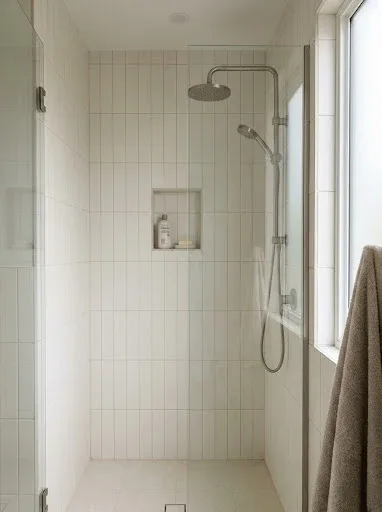
Grout is one of the most underestimated design choices in a small shower.
A dark grout line around a light tile emphasizes every individual piece. That can be useful when you deliberately want a graphic effect. But if the shower already contains small tiles, unusual shapes, handmade edges, or strong texture, high-contrast grout may make the wall feel much busier.
A closely matched grout softens the geometry:
- White tile + warm-white grout: Much quieter than charcoal grout
- Sage tile + pale gray-green grout: Tonal and cohesive
- Terracotta-look tile + warm beige grout: Softer than bright white
When contrast can still work
Use contrasting grout selectively if the rest of the room is extremely simple, the tile layout is intentionally architectural, or the shower is the only patterned element in the room. But do not assume contrast is required to make beautiful tile noticeable.
7. Put the Pattern on One Wall Instead of Wrapping the Entire Shower
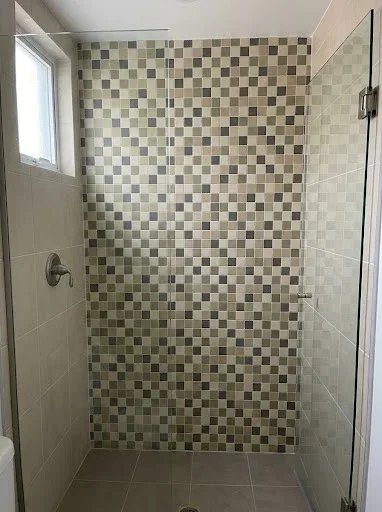
Pattern can absolutely work in a tiny shower. The mistake is often using it everywhere.
If every wall contains a strong geometric or colorful pattern, the shower can become visually enclosed. A more controlled approach is to use the pattern on one wall and allow the other surfaces to stay quiet.
The best accent wall is often:
- The wall directly visible from the bathroom entrance
- The wall behind the shower fixtures
- The far wall of a walk-in shower
Good accent-tile directions
Consider:
- Restrained checkerboard
- Muted vertical stripe
- Small geometric
- Softly patterned encaustic-look porcelain
- Tonal mosaic
Then choose a plain companion tile that pulls one color from the patterned tile.
Avoid decorative borders
A single accent wall usually looks more contemporary than adding a patterned stripe around the entire enclosure.
Make the transition intentional
The accent tile should stop at a clear architectural boundary, such as an inside corner, glass edge, or wall return. Random partial transitions can make a compact shower look unfinished.
8. Use a Narrow Mosaic Stripe Instead of a Full Mosaic Wall
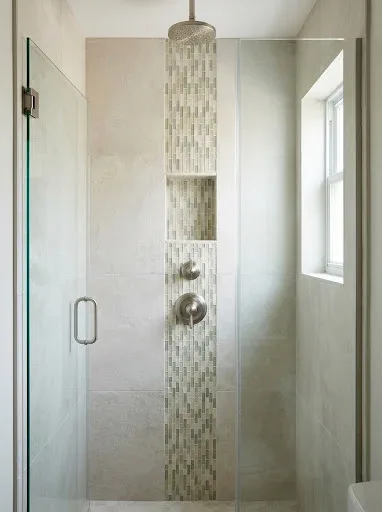
Mosaics are visually dense because they contain many grout lines. That does not mean you have to avoid them in a small shower. Use them in a narrower, more controlled way.
A vertical mosaic stripe can add texture and help emphasize height without covering the entire wall.
For example, run a narrow band:
- Behind the shower controls
- Through the niche
- From floor to ceiling on one narrow section
The surrounding wall tile remains simple.
Why vertical is useful here
A narrow vertical strip behaves almost like an architectural line. It can make the shower feel taller while concentrating detail in one place.
Keep the mosaic related to the main tile
Choose a mosaic that shares color, material tone, finish, or undertone with the larger wall tile. That keeps the stripe integrated rather than looking applied afterward.
9. Take the Tile All the Way to the Ceiling
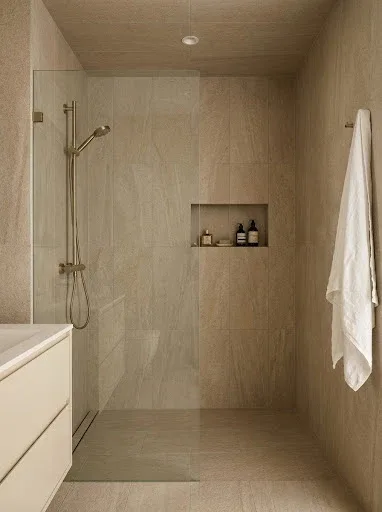
Stopping shower tile at an arbitrary height can visually divide the wall. In some small bathrooms, extending the tile all the way to the ceiling creates a cleaner envelope.
This is particularly effective when:
- The ceiling is not extremely high
- The tile color is light or mid-tone
- The grout is restrained
- The shower enclosure is simple
The uninterrupted vertical surface can make the shower feel taller and more complete.
This does not mean the ceiling itself needs tile
The goal is simply to avoid creating an unnecessary horizontal stop several inches below the ceiling.
Combine with vertical orientation
If you want the strongest height effect, pair full-height installation with vertically oriented tile.
Keep upper-wall details minimal
Do not add decorative trim at the top, a contrasting border, or a second tile pattern near the ceiling. Let the full-height plane do the work.
10. Limit the Shower to Two Coordinating Tiles
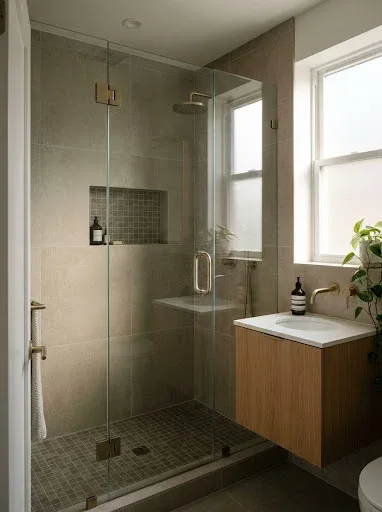
One of the easiest ways to keep a small shower from feeling chaotic is to reduce the number of tile decisions. A simple two-tile palette is often enough.
For example:
- Tile 1: Main shower wall | Tile 2: Shower floor and niche
- Tile 1: Plain side walls | Tile 2: Accent back wall
This gives the shower contrast without turning every surface into a separate design statement.
A useful formula
Try pairing:
- Large warm stone walls + small tonal mosaic floor
- Cream vertical tile + muted green floor mosaic
- Soft white ceramic walls + charcoal hex floor
- Beige porcelain walls + matching textured floor tile
The strongest combinations usually share at least one undertone.
Why this is especially effective in apartments
Small bathrooms already contain many materials: vanity finish, countertop, faucet, mirror, wall paint, flooring, towels, shower glass, and hardware. The shower does not need four additional tile types.
How to Choose Tile Size for a Small Shower
There is no rule that says small bathroom equals small tile. Instead, consider where the tile is going:
Shower walls
Larger tiles can reduce visual fragmentation because they create fewer grout lines. Medium rectangular tile is also useful when you want to manipulate direction with vertical or horizontal layouts.
Shower floors
The floor has different functional requirements. Because shower floors need proper drainage and slope, smaller tiles or suitable mosaics are often easier to work across those changes in plane. Whatever you choose for the shower floor should also be appropriate for wet-area use and provide suitable slip resistance.
Niches
A niche does not automatically need a third decorative tile. Continuing either the wall tile or shower-floor tile into the niche often creates a cleaner result.
Vertical Tile vs. Horizontal Tile in a Small Shower
Neither is universally better. Choose based on what the room needs visually:
Choose vertical when:
- The ceiling feels low
- The shower feels squat
- You want a cleaner contemporary look
- You want the eye to travel upward
Choose horizontal when:
- The shower feels extremely narrow
- The ceiling already feels tall
- You want to visually stretch the back wall
- You prefer a more traditional layout
Choose large-format when:
- The bathroom already contains several patterns
- You want fewer visible grout lines
- You prefer a calmer architectural look
Direction should solve a spatial problem, not simply follow a trend.
Should Small Bathroom Tile Be Light?
Light tile is useful because it reflects more light and often makes a compact bathroom feel airy. But a small bathroom does not have to be white.
Beautiful compact showers can use olive, slate blue, terracotta, taupe, mushroom, charcoal, or dusty green.
The important question is how the color is handled. A medium or dark tile can still feel sophisticated if you control grout contrast, lighting, surrounding wall color, and the number of competing patterns.
How Much Pattern Is Too Much?
A practical way to judge pattern is to count the competing visual elements.
In a small bathroom, give the eye a clear hierarchy. Choose one dominant feature, then let the surrounding surfaces support it:
- Patterned wall = hero: Everything else stays quiet.
- Handmade tile = hero: Keep the grout, floor, and hardware simple.
Grout Color Can Change the Entire Shower
In a small shower, grout deserves thoughtful attention:
- Matching grout: Creates a softer, more continuous surface. Best when the tile has texture or when you want visual calm.
- Contrasting grout: Makes every tile edge visible. Best when the layout itself is the design feature and the rest of the bathroom is simple.
The question is whether you want the viewer to notice the surface or the grid.
What About Shower Niches?
A recessed niche can be useful, but visually it creates another rectangle inside an already small wall. Keep it simple:
- Continue the main wall tile through the niche
- Use the floor mosaic only on the niche back
- Align the niche dimensions with tile joints when possible
- Avoid thick contrasting borders
Sometimes the most elegant small-shower niche almost disappears into the wall.
How to Combine Shower Wall and Floor Tile
Your floor and wall tiles should relate without necessarily matching:
- Large + small: Larger-format wall tile with smaller coordinating floor mosaic.
- Matte + subtle gloss: Matte floor tile with softly reflective wall tile.
- Plain + texture: Plain wall tile with textured tonal floor tile.
- Light + slightly deeper: Light walls with floor tile one or two shades darker.
Small Shower Tile Mistakes to Avoid
Using three or four competing tile styles
The bathroom starts feeling visually fragmented. Limit the palette.
Choosing grout only for contrast
A dramatic grout color may overpower a small shower. Consider how much grid you actually want to see.
Adding a decorative border by default
Borders can visually cut the wall into horizontal sections and make a compact shower feel shorter.
Making the niche a completely different design
The niche already creates architectural contrast. It does not always need contrasting tile too.
Assuming tiny tile makes the room bigger
More small tiles usually mean more grout lines. That may create more visual activity, not less.
Ignoring the shower floor requirements
A wall tile you love may not be appropriate for the shower floor. Choose floor material based on wet-area suitability and installation requirements.
Stopping tile at an awkward height
A random horizontal termination can visually shorten the wall. Full-height tile often looks cleaner where the room and budget allow it.
How to Make Shower Tile Feel More Expensive Without Using Luxury Material
The feeling of quality often comes from restraint rather than price:
- Clean alignment
- Thoughtful tile direction
- Consistent grout
- Fewer unnecessary trim transitions
- Coordinated metal finishes
- Well-integrated niche placement
- Controlled color palette
A simple ceramic tile installed thoughtfully can feel more polished than an expensive patterned tile combined with five competing materials.
A Simple Tile Formula for a Tiny Bathroom
If you want a straightforward starting point, use:
- Main wall tile: Light or mid-tone rectangular porcelain or ceramic
- Layout: Vertical stack or large-format calm grid
- Grout: Low contrast
- Shower floor: Smaller coordinating slip-resistant tile
- Niche: Repeat either wall or floor tile
- Accent: One maximum
That gives you enough detail to make the shower interesting without overwhelming the room.
Final Thoughts
The best small bathroom shower tile ideas are not really about choosing the “smallest-looking” tile. They are about creating a surface that your eye can understand quickly.
Fewer material changes make the shower calmer. Low-contrast grout makes the walls more continuous. Vertical layouts can emphasize height. Horizontal layouts can emphasize width. Large-format tile can reduce visual fragmentation. And one controlled accent can add character without turning the shower into a patchwork of competing ideas.
Before choosing tile samples, look at the bathroom as a whole. Ask: Where do I want the eye to stop? A small shower usually feels more spacious when one element gets attention and everything else supports it.
FAQ
What tile looks best in a small shower?
Large-format neutral tile, elongated rectangular tile, tonal handmade-look tile, and simple coordinating mosaics can all work well. The best option depends on whether you want to emphasize height, width, texture, or visual continuity.
Does large tile make a small shower look bigger?
It can. Larger tile generally creates fewer grout lines, which can make the wall feel more continuous and visually calm.
Should small shower tile be vertical or horizontal?
Use vertical tile when you want to emphasize height. Use horizontal tile when you want to visually widen a narrow shower. Neither orientation is automatically better.
What grout color makes a small bathroom look bigger?
Grout that closely matches the tile usually creates a quieter, more continuous surface. High-contrast grout emphasizes every tile edge and can make the wall feel busier.
Can you use dark tile in a small shower?
Yes. Dark tile can work beautifully if lighting is adequate and the rest of the design remains controlled. Avoid combining several dark patterned surfaces if the bathroom already receives little light.
Should shower tile go all the way to the ceiling?
Full-height tile often creates a cleaner vertical line and can help a small shower feel taller and more complete. Whether it is appropriate depends on the room, installation, and budget.
Should the shower niche use different tile?
Not necessarily. Continuing the wall tile into the niche often creates the cleanest look. If you want contrast, repeating the shower-floor tile on the niche back can keep the overall material palette limited.
Is small mosaic tile good for a tiny shower?
Yes, particularly on shower floors or as a controlled accent. Covering every wall with a high-contrast mosaic can create a dense visual grid, so consider using it selectively.
How many different tiles should a small bathroom have?
There is no strict rule, but two coordinating tile types are often enough for a compact shower: one primary wall tile and one secondary tile for the floor, niche, or limited accent area.