9 Narrow Hallway Runner Rug Ideas That Make the Passage Feel Wider, Not Busier
Choose a runner that helps a narrow hallway feel more balanced. These 9 ideas cover runner width, length, pattern scale, color, door clearance, and placement for small apartment hallways.
In This Guide
A runner can make a narrow hallway feel finished almost immediately.
It can also make the same hallway feel tighter.
That difference usually has less to do with whether the rug is “pretty” and more to do with proportion.
A runner that is too wide can make the walls seem closer together.
A runner that is too narrow can look like a strip floating in the middle of the floor.
A busy repeating pattern can create visual noise from one end of the hall to the other.
A thick pile can interfere with doors.
And a runner that stops in an awkward place can make an already narrow hallway feel chopped into several short sections.
In a compact apartment, the runner should help the hallway read as one calm passage.
Before choosing a design, think about five things:
- how much floor should remain visible at each side
- where the runner begins and ends
- whether the pattern pulls the eye forward or sideways
- whether nearby doors can open over it
- whether the rug will stay safely in place
The goal is not to fill as much floor as possible.
It is to use the runner to create a clear center line while allowing enough surrounding floor to keep the hallway visually open.
Here are nine approaches that work especially well in tight hallways.
1. Leave a Visible Floor Border on Both Sides of the Runner
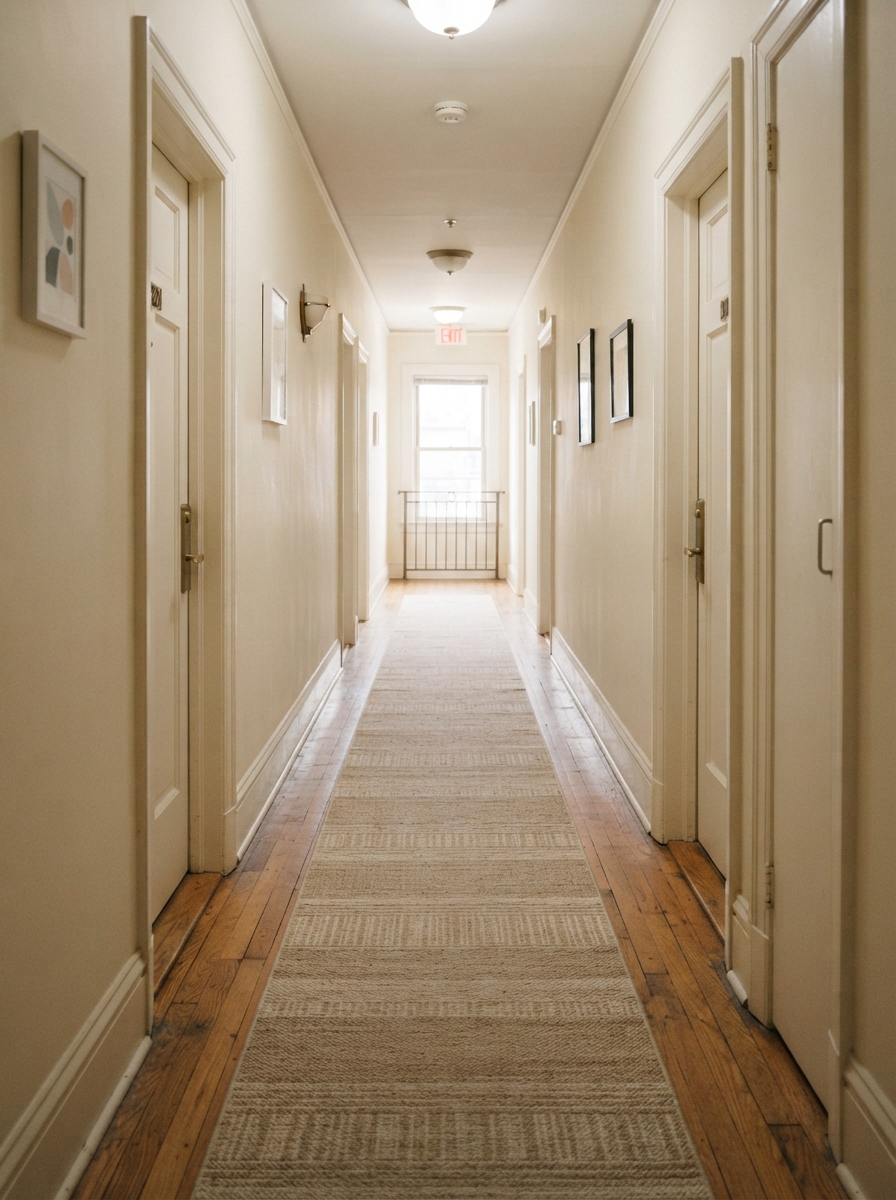
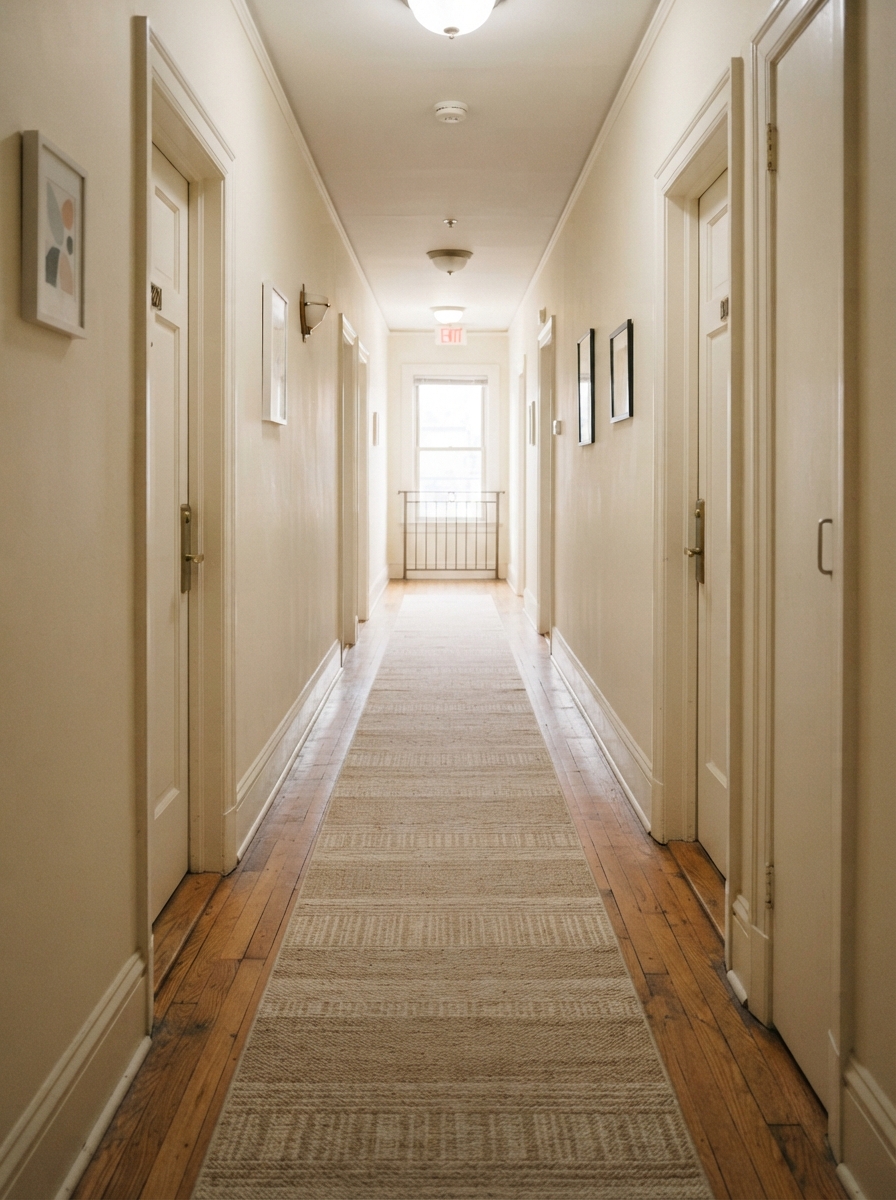
One of the easiest ways to make a narrow hallway feel more balanced is to avoid covering nearly the entire floor width.
You should still be able to see the flooring running along both sides of the runner.
That visible border acts almost like a frame.
It tells the eye that the hallway is wider than the rug.
How much floor should show?
There is no single measurement that works for every hallway, but in many compact spaces, something around 3 to 6 inches of visible floor on each side creates a useful starting point.
The key is consistency.
If the runner nearly touches one wall but leaves a large gap on the other, the hallway can look crooked even when the rug itself is straight.
Measure the actual hallway width
Do not choose a runner by guessing.
Measure between the baseboards at the narrowest usable point.
Then subtract enough width to preserve a deliberate strip of flooring on both sides.
For example, if your hallway is roughly 36 inches wide, a runner close to 24–28 inches may work better than one approaching the full width. (Planning connected rooms? Use our interactive Rug Size Calculator to match rugs across open living zones).
Actual door frames, radiators, thresholds, and architectural details can change what fits.
Why this makes a difference
When the flooring remains visible around the rug, the runner feels like an object placed within the hall rather than wall-to-wall coverage.
That little bit of breathing room can make a compact corridor feel much less compressed.
2. Use One Long Runner to Create a Continuous Sightline
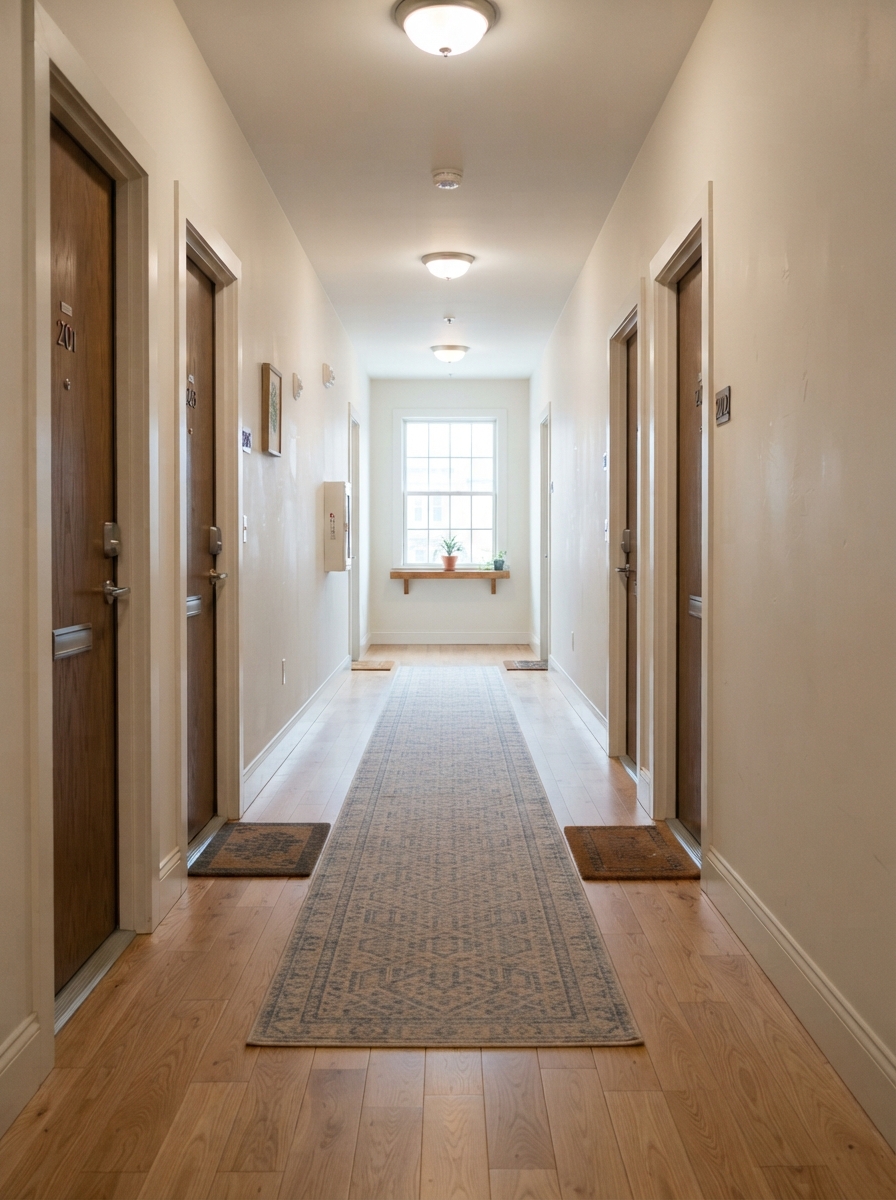
Long narrow hallways often benefit from one continuous runner rather than several small rugs.
A single uninterrupted line encourages the eye to travel through the hall.
Two or three short rugs can create visual breaks that make the passage feel segmented.
Let the hallway determine the length
The runner does not need to touch the walls at either end.
In fact, leaving a small amount of flooring visible before the runner begins and after it ends often looks more intentional.
The exact gap depends on:
- hallway length
- doorway placement
- transitions between rooms
- furniture at either end
The important thing is avoiding an arbitrary stop in the middle of a major doorway.
Center the runner on the visual path
A hallway may not be perfectly symmetrical.
One side might contain several doorways while the other is mostly wall.
Still, the runner should usually align with the main walking path rather than shifting around every architectural interruption.
When one long runner is especially useful
Use it when:
- the hallway is straight
- the flooring is continuous
- there are no major level changes
- you want the hall to read as one connected zone
3. Choose Soft Linear Patterns Instead of Harsh High-Contrast Stripes
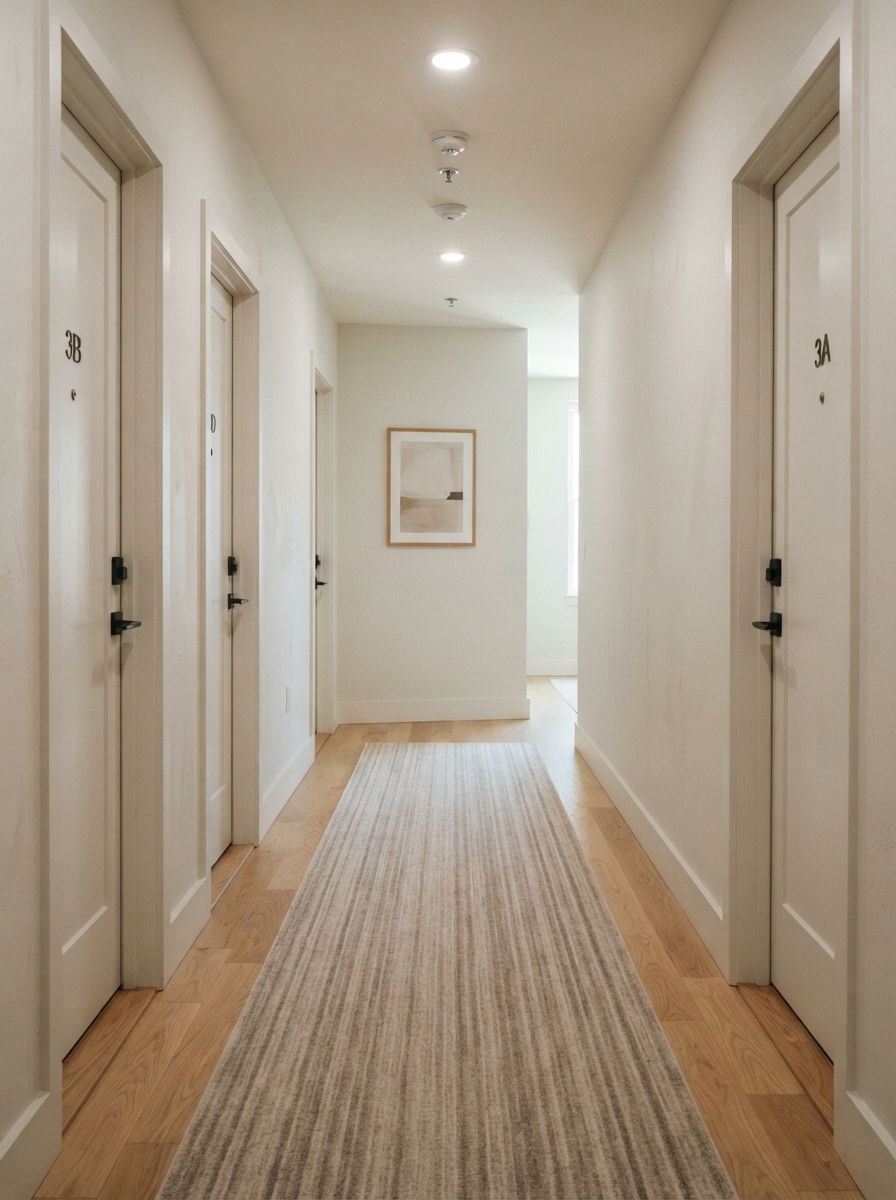
Lines naturally influence how we read a space.
A runner with subtle lengthwise movement can emphasize the long axis of the hallway and create a cleaner visual path.
But that does not mean you need bold black-and-white stripes.
High-contrast stripes can become visually aggressive in a narrow corridor because they repeat across a large percentage of the visible floor.
Better linear patterns
Try:
- faint woven lines
- broken stripes
- tonal pinstripes
- elongated motifs
- faded geometric bands
These give the eye direction without dominating the hall.
Run the strongest direction lengthwise
If the runner has a clear directional pattern, align it with the hallway rather than across it.
Lengthwise movement reinforces the passage.
A strong crosswise pattern can visually divide the floor into many short sections.
Keep adjacent decor quieter
If the rug already has noticeable lines, avoid combining it with:
- heavily striped wallpaper
- busy gallery walls
- multiple patterned door mats
Let the runner carry the repetition.
4. Use a Larger Faded Pattern Instead of Tiny Repeating Motifs
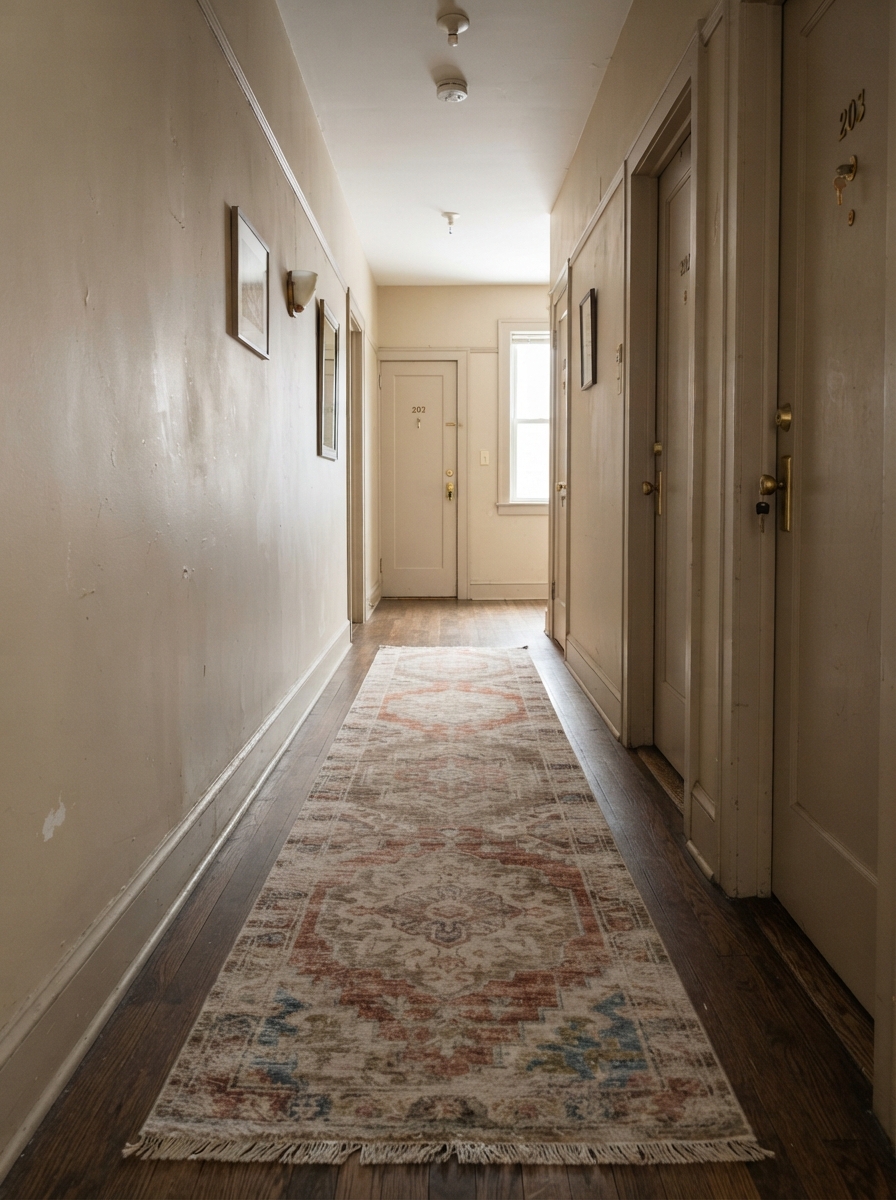
Small-scale patterns contain many repeated details.
In a narrow hallway, those repeated details can become especially noticeable because the rug occupies such a long strip of floor.
A larger, softened motif often looks calmer.
Think:
- faded medallions
- broad abstract shapes
- oversized traditional motifs
- washed geometric forms
rather than dozens of tiny diamonds or dense repeating flowers.
Why larger scale can feel less busy
A large motif gives the eye fewer pattern changes to process.
Even though the design itself may be decorative, it can read as one broad composition rather than hundreds of small elements.
Distressed designs can be forgiving
A softly faded runner is also practical for a high-traffic hallway because minor wear and small marks may blend more naturally into the surface.
Keep contrast moderate
A huge motif in black and white can still dominate the hallway.
Scale and contrast need to work together.
The safest combination is:
larger pattern + softened contrast
5. Use a Tonal Runner When the Hall Already Has Strong Visual Details
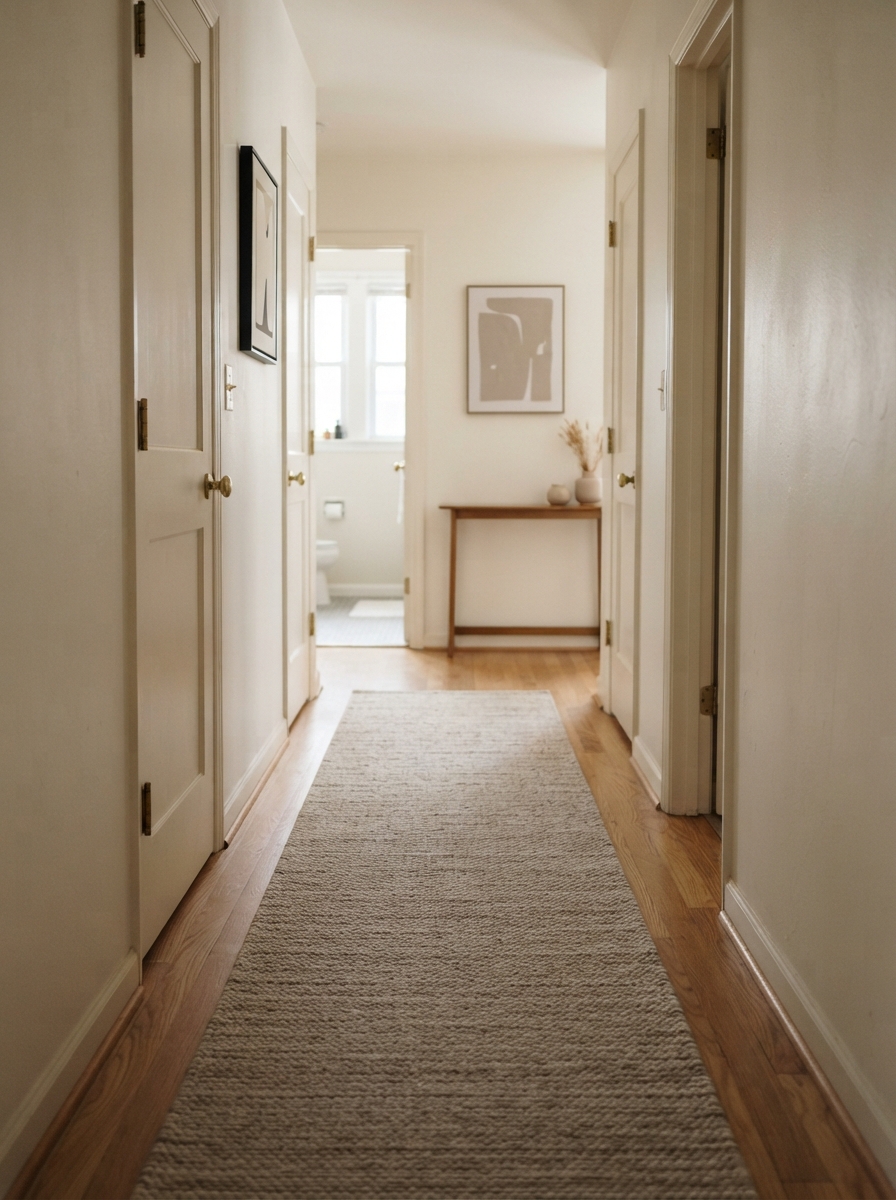
Some hallways already contain plenty of visual activity.
Maybe you have:
- several doorways
- dark trim
- wall art
- patterned flooring
- hooks
- a console at one end
In that case, the rug does not need to become another focal point.
A tonal runner can soften the floor and define the path without adding much visual competition.
Tonal does not mean flat
Look for texture instead of strong color contrast.
For example:
- cream + oatmeal
- taupe + warm gray
- olive + sage
- charcoal + softened black
- beige + brown
Subtle changes in weaving can create depth.
Match the undertone of the floor
Warm oak usually works comfortably with:
- oatmeal
- beige
- muted rust
- olive
- warm gray
Cool gray flooring may pair better with:
- charcoal
- blue-gray
- cooler beige
You do not need a perfect match.
You just want the runner and floor to feel related rather than visually disconnected.
6. Use a Dark Runner When You Can Keep a Light Border Around It
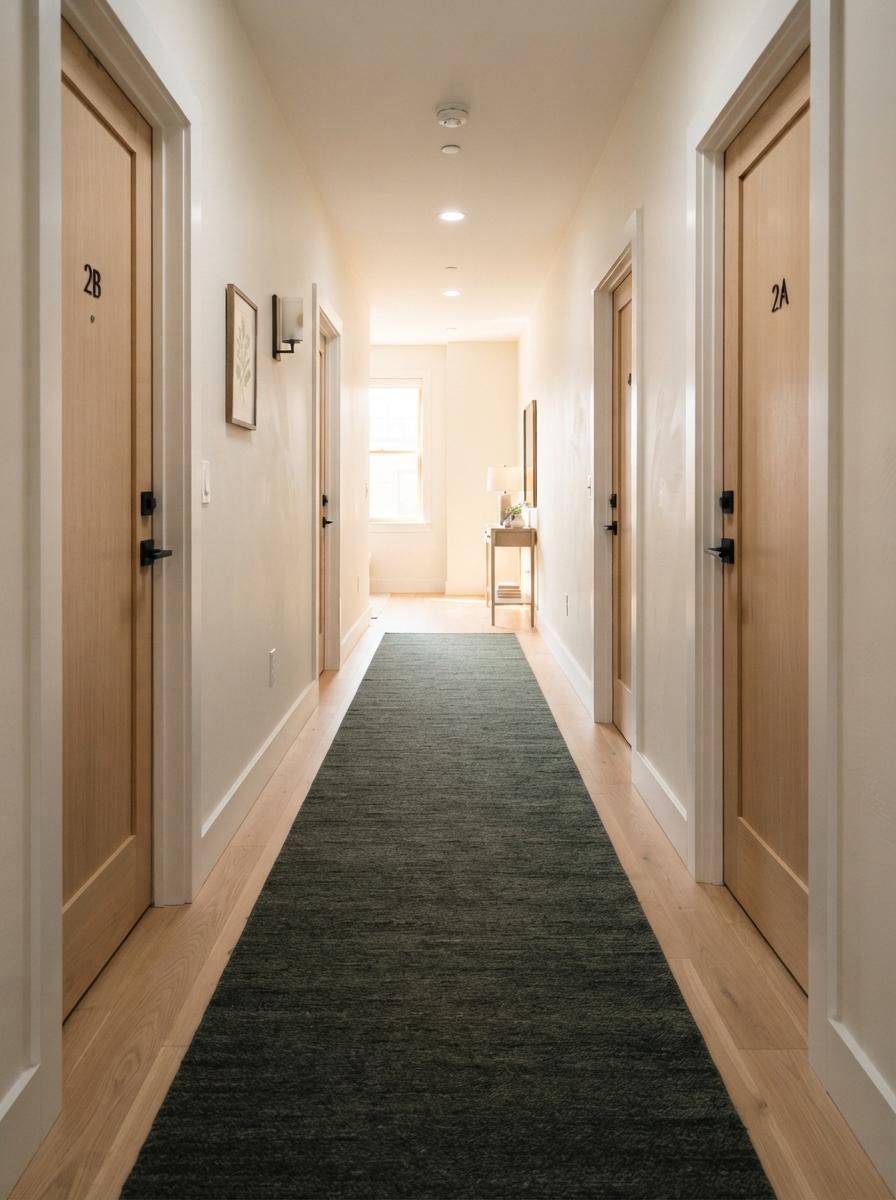
A dark runner can work surprisingly well in a narrow hallway.
The mistake is assuming every tight space needs a pale rug.
Deep colors such as:
- charcoal
- navy
- forest green
- espresso
- muted burgundy
can create a strong center path when lighter flooring remains visible around them.
The floor border becomes more important
A dark runner that nearly touches both walls can create one heavy strip filling the entire corridor.
But a dark runner surrounded by visible pale flooring creates contrast that can actually clarify the hallway’s width.
Keep the walls relatively light
Dark runner + dark walls + dark doors may create a dramatic look, but it can also increase visual density.
For most compact apartments, pairing a deeper rug with lighter surrounding surfaces is easier to balance.
Practical benefit
Medium-to-dark runners can also disguise everyday marks in busy entry-adjacent hallways better than very pale rugs.
That said, highly solid dark rugs can show lint.
A subtle woven variation usually works better.
7. Choose a Flatweave or Low-Pile Runner Where Doors Open Into the Hall
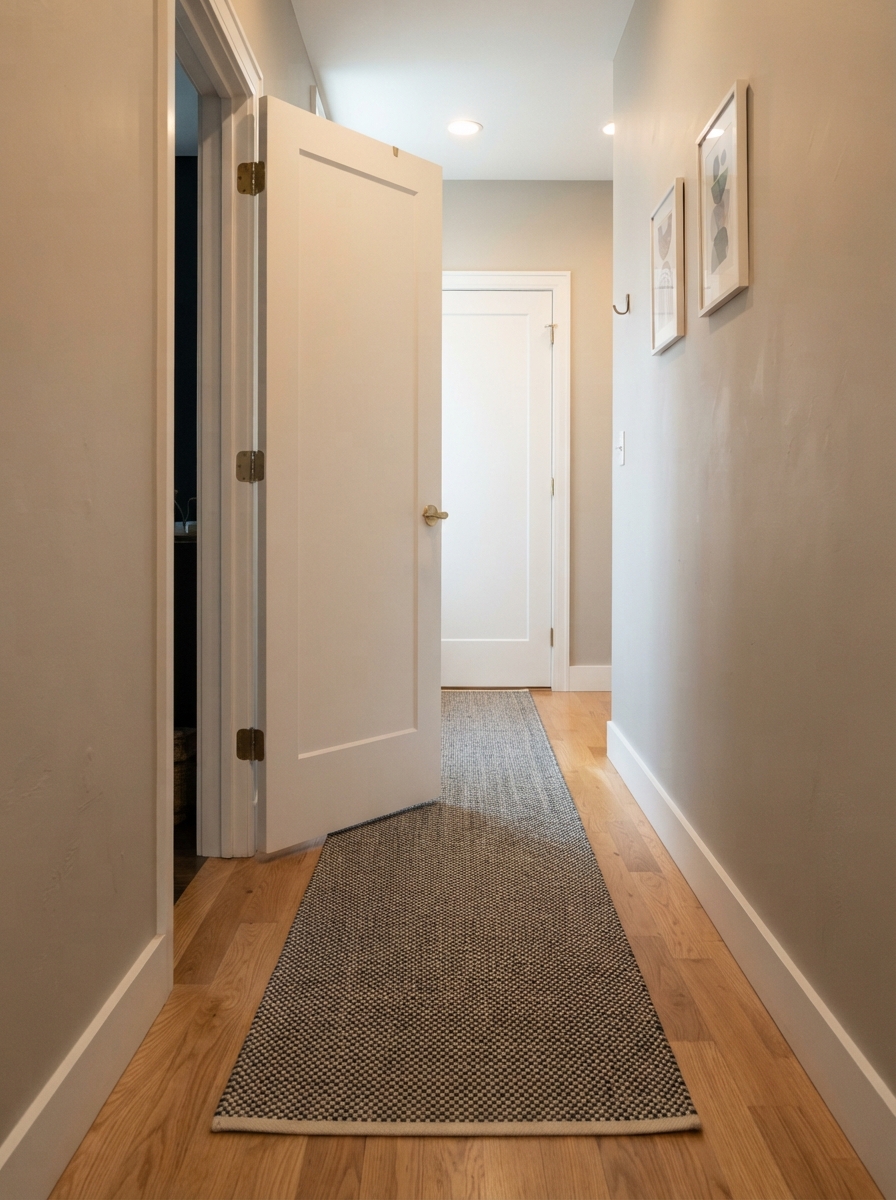
A runner can look perfect and still fail if the nearby doors cannot open over it.
This is one of the most practical issues in narrow apartment hallways.
Bedroom, bathroom, closet, and entry doors may all interact with the rug.
Measure door clearance before buying
Open the door slowly and check the space between the bottom edge and the floor.
A thick rug plus a rug pad may be higher than you expect.
Low-profile materials usually work best
Consider:
- flatweave
- low-pile wool
- tightly woven synthetic runner
- thin washable runner
Avoid thick shag or very plush pile in a passage with multiple swinging doors.
Do not forget the rug pad
If you are adding a non-slip pad underneath, include its thickness when checking clearance.
A runner that barely clears the door without a pad may become unusable once the pad is added.
Door friction is not a small problem
If the door drags across the runner every time it opens, the rug may:
- shift
- bunch
- fray
- become a trip hazard
Function comes first.
8. Use a Shorter Runner When the Hall Contains a Distinct Landing Zone
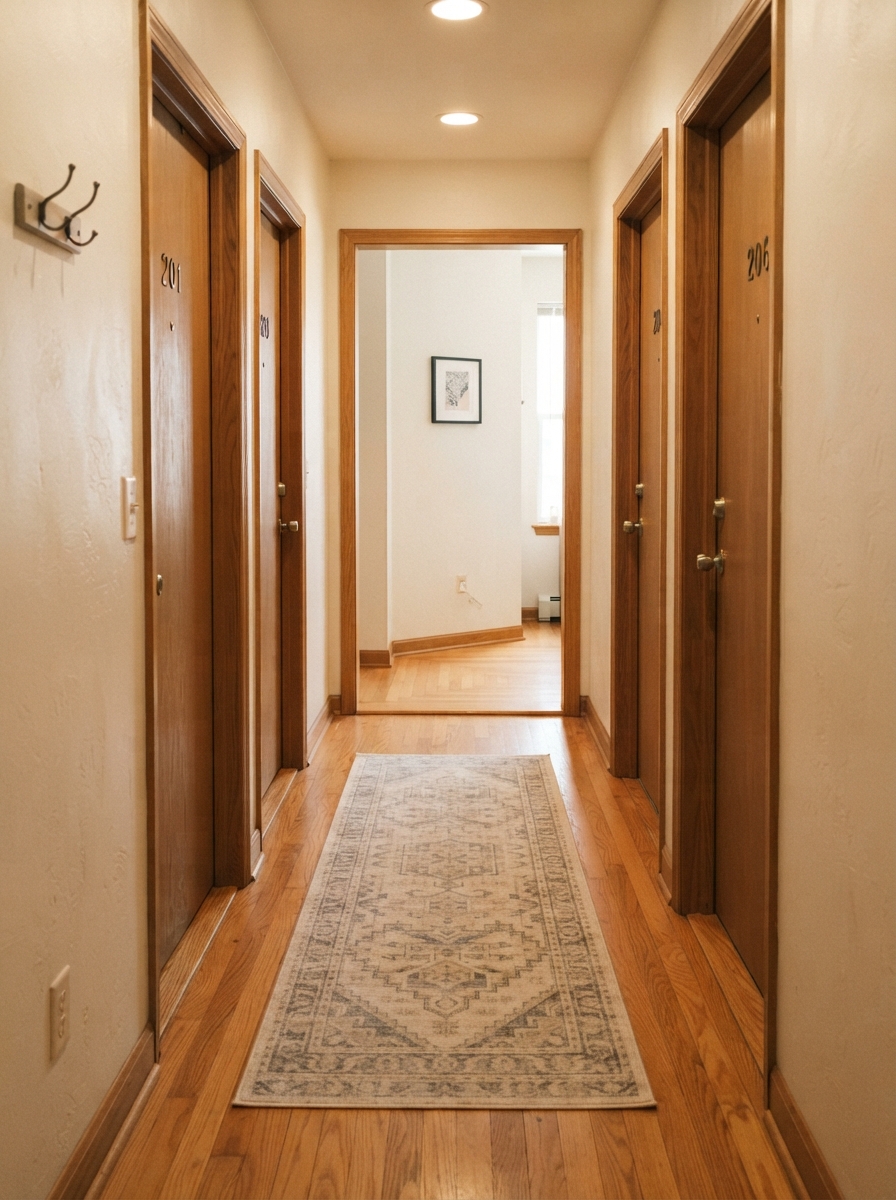
Not every hallway needs the longest rug possible.
Sometimes the architecture creates a natural zone.
For example:
- a short hall outside two bedrooms
- a landing between entry and living room
- a small corridor ending at a closet
- an L-shaped hall with a visual break
In those cases, a shorter runner can look more intentional than trying to force one rug through several transitions.
Let architecture determine the stopping point
Good stopping points include:
- before a major turn
- before a flooring change
- before a wider landing
- outside a door cluster
Bad stopping points are usually arbitrary locations with no architectural reason.
Avoid tiny floating rugs
Shorter does not mean miniature.
The rug should still feel proportional to the hallway zone.
A 2-foot rug sitting in the middle of a 10-foot passage usually looks accidental.
Consider the view from adjacent rooms
Stand in the living room or bedroom and look into the hallway.
The runner’s beginning and end should look purposeful from those sightlines too.
9. Use a Washable Runner in High-Traffic Apartment Hallways
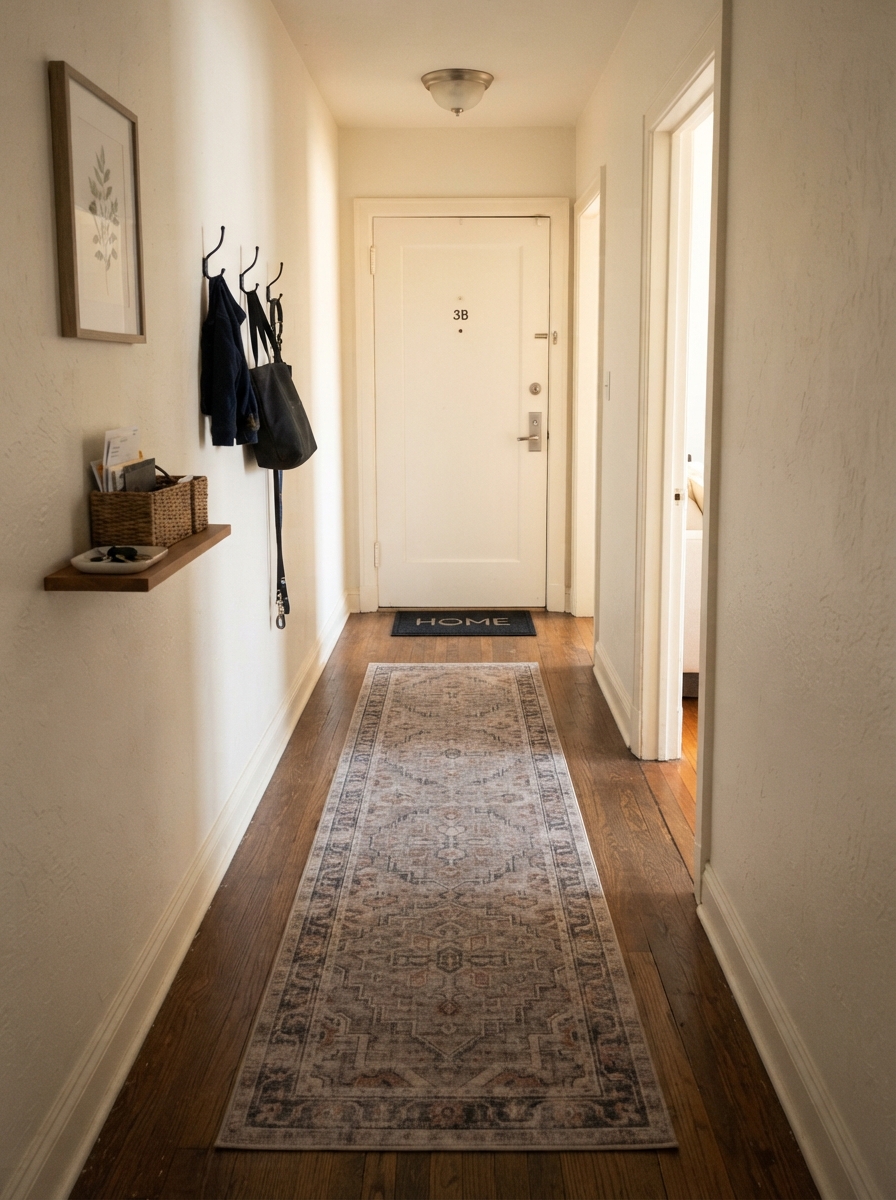
The hallway may be one of the hardest-working floors in the apartment.
You walk through it carrying:
- shoes
- laundry
- groceries
- cleaning supplies
- bags
If it connects to the entry, it may also collect outdoor dirt.
That makes maintenance part of the design decision.
Washability can matter more than perfect material
If you know spills and tracked-in dirt are common, a machine-washable or easily cleanable runner may be more useful than a delicate rug you are afraid to walk on.
Check washing requirements before purchasing
“Washable” does not always mean the same thing.
Check:
- machine capacity requirements
- whether a separate rug pad is used
- drying instructions
- maximum rug size your washer can handle
A very long runner may technically be washable but still be too large for a small household machine.
Choose forgiving color variation
Mid-tone, subtly patterned runners often conceal everyday dust better than:
- pure white
- completely solid black
- very pale flat colors
Secure it properly
Washable runners can be lightweight.
Use the recommended non-slip backing or pad to prevent movement.
How Wide Should a Runner Be in a Narrow Hallway?
Start with the hallway width.
Measure from baseboard to baseboard at the narrowest point where the rug will sit.
Then decide how much floor you want visible.
A common visual target is to leave several inches of exposed flooring on each side.
For example:
36-inch hallway
A runner around 24 to 28 inches wide may work well.
40-inch hallway
A runner around 27 to 30 inches may feel balanced.
Very narrow hallway
You may need a runner closer to 20 to 24 inches.
These are starting points, not fixed rules.
Always account for:
- baseboards
- thresholds
- radiator covers
- door frames
- uneven walls
The important thing is that the exposed floor looks intentional rather than accidental.
How Long Should a Hallway Runner Be?
The runner should relate to the architecture.
It does not need to run from wall to wall.
A better approach is usually to leave visible flooring at both ends.
Try to avoid ending the rug:
- halfway through a doorway
- directly underneath a door swing
- a few inches before an obvious architectural transition
Instead, align the rug with the hallway as a complete zone.
For a long straight corridor, one long runner usually looks calmer than several separate rugs.
Should a Hallway Runner Go All the Way to the Door?
Not necessarily.
At an entry door, check:
- door swing
- threshold height
- weather seal
- mat placement
- rug thickness
If the runner interferes with the door, stop it before the swing zone.
In interior hallways, you can often extend closer to the end wall as long as a small amount of exposed floor remains.
What Pattern Makes a Narrow Hallway Look Wider?
There is no magic pattern that physically changes the hallway, but some patterns create less visual compression than others.
Generally, look for:
- softened contrast
- larger motifs
- tonal designs
- subtle lengthwise movement
Use strong crosswise stripes cautiously.
They can divide a long corridor into repeated horizontal bands.
That may work in some designs, but in an already narrow passage it can increase visual fragmentation.
Should Hallway Runner Stripes Run Lengthwise?
Usually, yes, if your goal is to emphasize the hallway’s long axis.
Lengthwise lines guide the eye forward.
However, avoid extremely bold contrast.
A subtle stripe or elongated weave can provide direction without making the rug dominate the room.
Light Runner or Dark Runner?
Both can work.
Light runner
Useful when you want:
- low contrast
- soft visual weight
- airy styling
But extremely pale rugs may show dirt quickly.
Dark runner
Useful when you want:
- strong definition
- richer contrast
- more forgiving mid-to-dark tones
Dark rugs work especially well when enough lighter floor remains visible around them.
The best choice depends on the floor, walls, lighting, and traffic level.
Low Pile Matters More Than You Think
A hallway is not the ideal place for a very plush rug.
Higher pile can:
- interfere with doors
- catch shoes
- make vacuuming harder
- increase edge movement
- create a visually heavier strip of flooring
Low-pile or flatwoven rugs usually suit tight passages better.
They create color and softness without adding much physical bulk.
Runner Placement Around Doorways
Doorways are where hallway runners often become awkward.
Before buying, sketch the hall from above.
Mark:
- every door
- direction each door swings
- thresholds
- closets
- entry door
- hallway turns
Then place the proposed rug on the sketch.
This helps you see whether the runner will sit cleanly within the circulation path.
Painter’s tape on the actual floor works even better.
Tape the proposed dimensions and open every door.
One Long Runner or Two Short Runners?
For a straight hallway, one long runner usually creates the cleaner result.
Two runners may make sense when:
- the hallway turns
- a large landing interrupts it
- the flooring changes
- the architecture clearly divides the passage
Do not divide one simple straight hallway into multiple rugs just because you cannot find the exact length immediately.
That can make the corridor look more fragmented.
How to Make a Runner Look Centered
Measure instead of eyeballing.
Check the distance between:
- left rug edge and wall
- right rug edge and wall
at several points down the corridor.
Older apartments may have slightly uneven walls.
In that case, prioritize how the runner looks along the main sightline rather than trying to correct every tiny construction variation.
Should the Runner Match the Entry Rug?
It does not need to match exactly.
If the entry and hallway are visible together, coordinate them through:
- color family
- pattern style
- texture
- undertone
For example:
entry mat: charcoal + brown
hall runner: faded charcoal + oatmeal
This creates connection without looking like a matching set.
Rug Pads Are Especially Important in Hallways
A shifting runner is irritating anywhere.
In a hallway, it can also become a safety issue because the rug sits directly in a traffic route.
Choose a non-slip solution appropriate for:
- the rug type
- flooring material
- floor finish
The pad should stay fully underneath the rug rather than protruding beyond the edges.
Check manufacturer guidance, particularly on delicate or specialty flooring.
Avoid Curling Corners
Runner corners that lift can catch shoes.
If a rug arrives rolled tightly, give it time to flatten according to the manufacturer’s instructions.
If corners remain raised, use a rug-safe solution designed for your rug and floor type.
Do not simply ignore repeated edge curling in a narrow passage.
Narrow Hallway Runner Mistakes to Avoid
Choosing a runner almost as wide as the hallway
It can visually remove the floor border and make the passage feel more compressed.
Picking a rug that is too narrow
An extremely skinny strip can look undersized and disconnected from the hall.
Ending the rug randomly
Let architectural features determine where it starts and stops.
Using very dense tiny patterns everywhere
Too much small-scale repetition can make a long narrow floor look visually noisy.
Forgetting door clearance
Always test doors with both rug and pad thickness.
Using thick pile
Bulky runners are usually less practical in busy narrow corridors.
Letting the runner slide
Use appropriate non-slip support.
Layering multiple small rugs in one straight hallway
This can visually break the passage into shorter pieces.
A Simple Runner Formula for a Narrow Apartment Hallway
If you want a straightforward starting point:
Width:
Leave several inches of flooring visible on both sides.
Length:
Use one continuous runner for a straight hall where possible.
Pattern:
Choose one medium or large-scale low-contrast design.
Pile:
Keep it low.
Placement:
Center it on the walking path.
Ends:
Leave intentional exposed floor rather than pushing the rug against walls.
Safety:
Secure it with an appropriate non-slip backing or pad.
This formula works with many decorating styles because it begins with proportion rather than trend.
How to Choose a Runner for a Very Dark Hallway
If your hallway receives little natural light, you do not automatically need a white rug.
Very pale colors can become dirty quickly.
Instead, consider mid-tone colors such as:
- warm beige
- muted olive
- faded terracotta
- taupe
- medium gray
These can lighten the floor visually without creating harsh contrast or difficult maintenance.
Also improve the hallway lighting rather than expecting the rug to solve a lighting problem.
How to Choose a Runner for a Rental Apartment
For a rental, prioritize:
- easy removal
- low profile
- washable or easy-clean material
- no permanent floor attachment
- appropriate non-slip backing
Avoid making permanent changes to the floor to keep a runner in place.
A well-sized rug with a suitable rug pad should do the work.
What if the Hallway Has Several Doors?
Keep the runner visually simple.
Multiple door frames already create repeated vertical lines.
Adding a dense rug pattern beneath them can create excessive visual rhythm.
A tonal runner, faded traditional design, or quiet stripe often works especially well in door-heavy corridors.
What if the Hallway Is L-Shaped?
Treat each leg as a separate visual zone unless one rug can turn naturally without bunching—which most standard runners cannot.
Usually it is cleaner to use:
- one runner on the longer section
- perhaps another coordinated rug on the shorter section
Do not force one straight runner around a corner.
Keep the two rugs related, but they do not need to be identical.
Final Thoughts
A runner should make a narrow hallway easier to read, not give the eye one more thing to fight with.
Start with the hallway dimensions.
Then protect a visible strip of flooring on both sides.
Choose one length that relates to the architecture.
Keep pile low enough for doors and daily traffic.
Use pattern intentionally.
And secure the rug properly.
The best hallway runner is not necessarily the boldest or most decorative one.
It is the runner that makes the corridor feel longer, calmer, and more deliberate while still handling everyday apartment life.
In a narrow hallway, a few inches of exposed floor and one well-proportioned runner can make a much bigger difference than another layer of wall decor.
FAQ
What size runner is best for a narrow hallway?
Measure the hallway first and choose a runner that leaves a visible border of flooring on both sides. Several inches of exposed floor on each edge is a useful starting point in many apartments.
Should a hallway runner cover most of the floor?
It should cover the main walking path without looking like wall-to-wall carpet. Keeping some flooring visible at both sides usually creates a more balanced look.
What pattern works best in a narrow hallway?
Tonal patterns, larger faded motifs, and subtle lengthwise stripes often work well because they create less visual clutter than tiny high-contrast repeated patterns.
Do stripes make a hallway look longer?
Lengthwise stripes can emphasize the hallway’s long axis. Softer, lower-contrast stripes usually work better than very bold graphic ones in a narrow corridor.
Should a hallway runner be light or dark?
Either can work. Light and tonal runners feel softer, while dark runners can create a strong center path when lighter flooring remains visible around them.
What pile height is best for a hallway runner?
Low-pile or flatweave rugs are usually the most practical because they are easier around doors, easier to clean, and less likely to become bulky in the walking path.
How far should a runner be from the walls?
There is no universal rule, but aim for a deliberate strip of visible flooring along both sides rather than allowing the rug to nearly touch the baseboards.
Should a hallway runner go under door swings?
Only if there is enough clearance for both the rug and any rug pad. Test every nearby door before committing to the runner.
Can I use two runners in one hallway?
Yes when the architecture clearly divides the hallway, such as an L-shaped corridor or landing. In a straight hallway, one continuous runner usually looks calmer.
Do I need a rug pad under a hallway runner?
A suitable non-slip rug pad or backing is usually helpful because hallways are high-traffic areas. Choose one compatible with both your rug and flooring.