9 Narrow Hallway Lighting Ideas That Make a Tight Hall Feel Brighter and Wider
Make a narrow hallway feel brighter and more open with these 9 lighting ideas, from shallow ceiling fixtures and wall sconces to layered renter-friendly lighting.
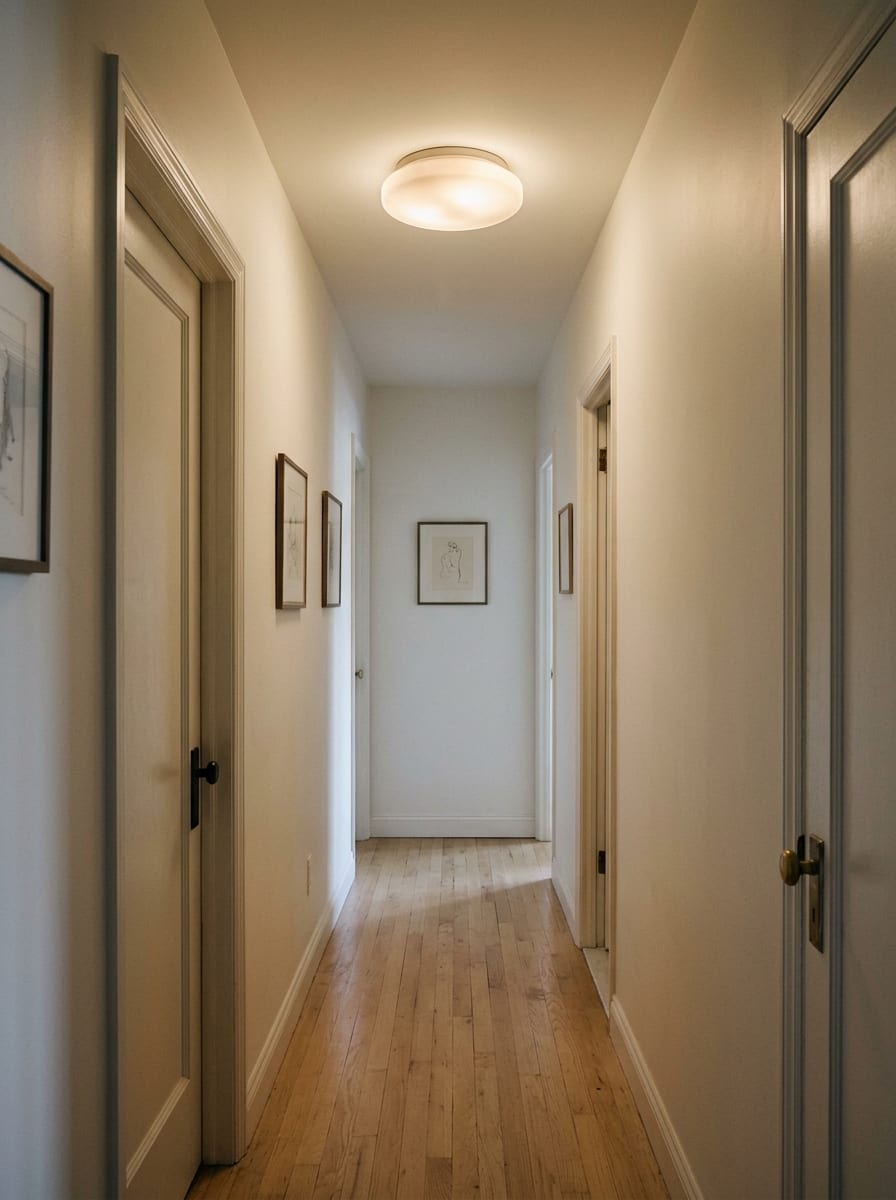
A narrow apartment hallway with warm low-profile flush-mount ceiling lighting illuminating the walls evenly
In This Guide
A narrow hallway can feel darker and smaller than it actually is because it often has very little natural light, long uninterrupted walls, and a ceiling fixture placed wherever the electrical box happened to be.
That makes lighting especially important.
In a tight hallway, the goal is not simply to install the brightest bulb possible. Harsh light can make a corridor feel flat and institutional, while an oversized pendant can make the ceiling feel lower and physically intrude into the walkway.
The most successful narrow hallway lighting ideas do three things: spread light evenly, keep fixtures visually shallow, and prevent the ends of the hallway from disappearing into shadow.
You also want enough contrast to give the space depth. That might mean combining ceiling light with a subtle wall light, illuminating artwork, or bouncing light from a mirror.
Here are nine ways to light a narrow hallway without making it feel even tighter.
1. Use a Low-Profile Flush Mount Instead of a Hanging Fixture
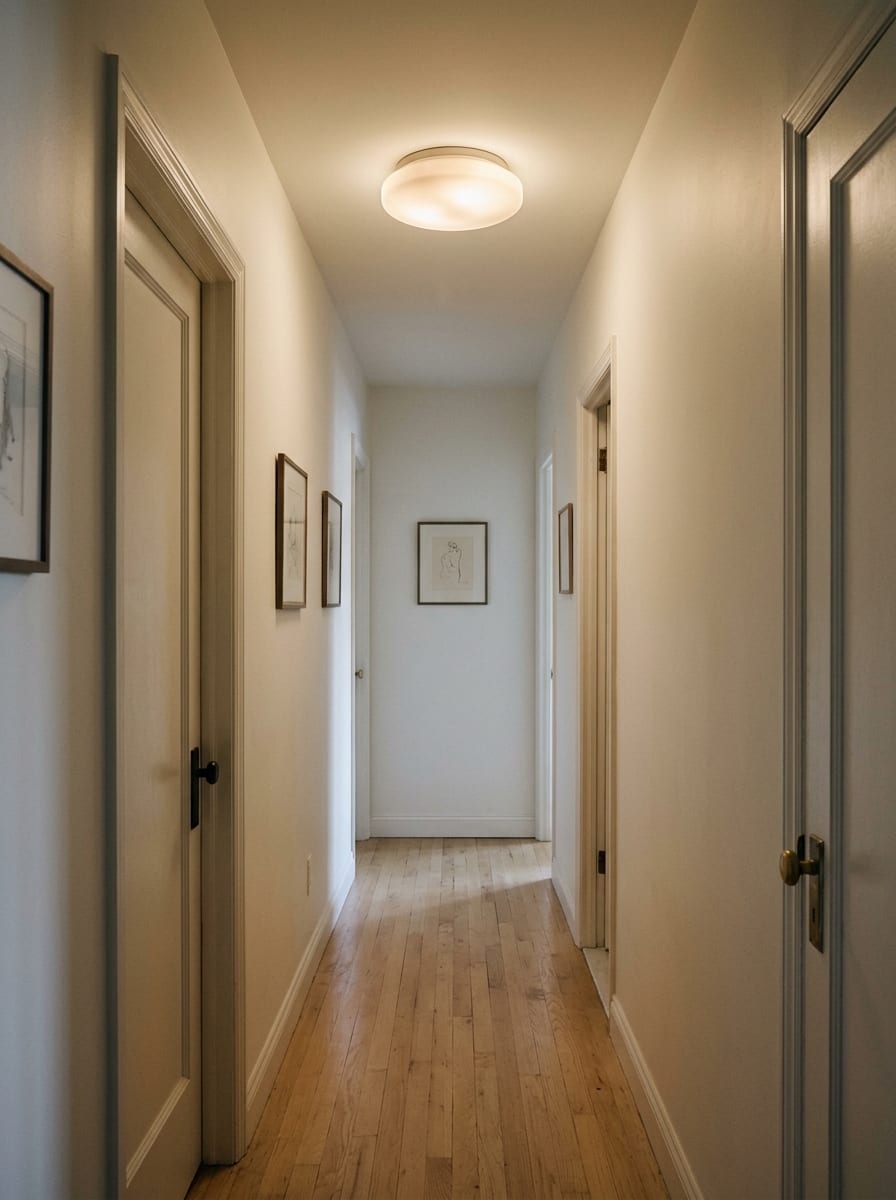
If your hallway has a standard-height or low ceiling, the safest starting point is usually a shallow flush-mount fixture.
A pendant or large semi-flush light might look beautiful in isolation, but in a narrow hallway it can hang directly within your visual field and make the ceiling feel lower. A flush mount keeps the ceiling plane cleaner.
Look for a fixture that is:
- Relatively wide rather than deep
- Softly diffused
- Simple in shape
- Proportional to the hallway width
For many apartment hallways, a fixture projecting only around 3 to 6 inches from the ceiling feels less intrusive than a deep lantern-style light. A frosted or diffused shade is particularly useful because it spreads light instead of producing a harsh bright spot directly beneath the fixture.
Best for
- Standard-height ceilings
- Short apartment corridors
- Hallways with one existing ceiling electrical box
- Minimal interiors
Avoid
Very small exposed-bulb fixtures that create strong glare without actually illuminating the walls.
2. Space Multiple Small Ceiling Lights Down a Long Hallway
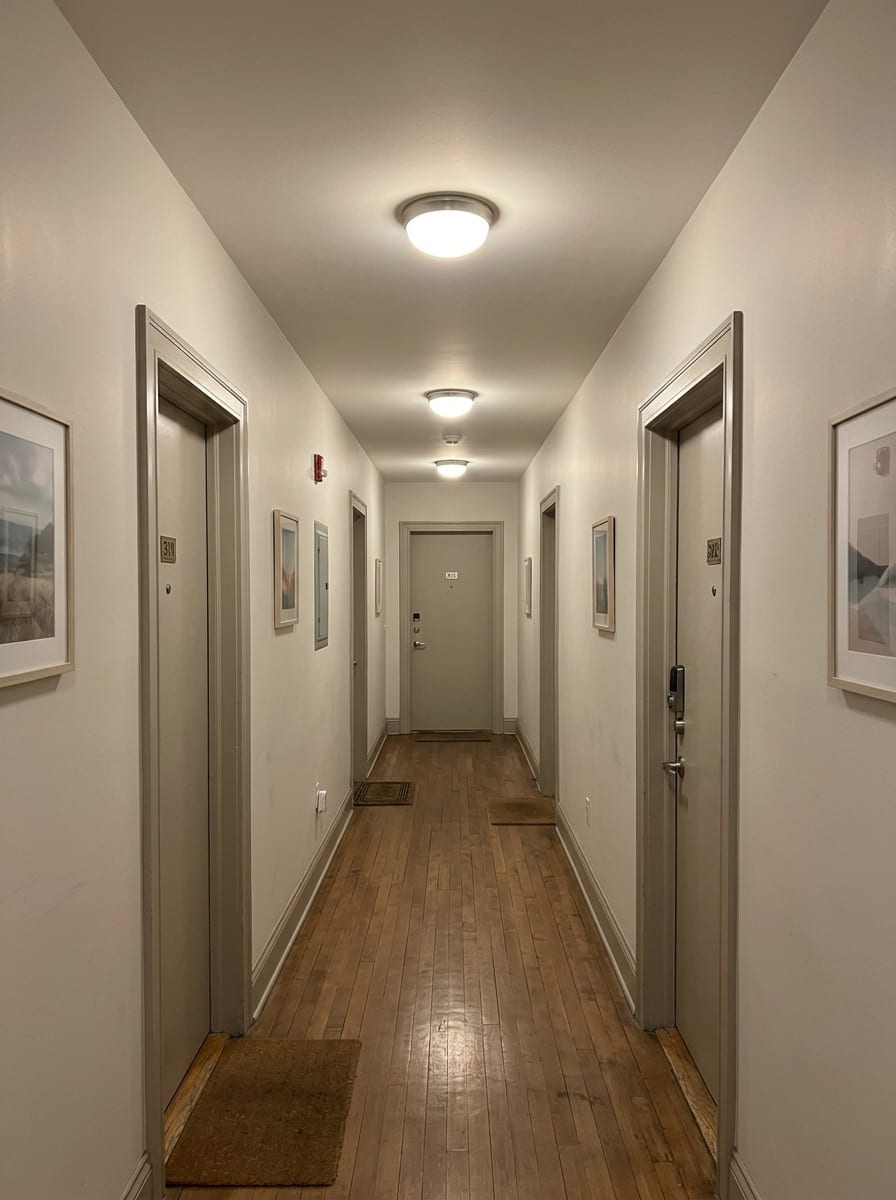
One ceiling fixture in the middle of a long hallway often creates a bright center and dark ends. If the electrical layout allows it, several smaller fixtures spaced along the length of the corridor can produce a much more even result.
This does not mean filling the ceiling with dozens of downlights. Two or three modest fixtures may be enough, depending on the hallway length.
The visual rhythm also helps lead the eye forward, which can make the hallway feel longer and more deliberate. Keep the fixtures aligned with one another and centered along the hallway rather than staggering them unnecessarily.
Placement principle
You want overlapping pools of light rather than isolated circles of brightness. If one section of wall becomes noticeably dark between fixtures, the spacing is probably too wide. (Tip: Estimate the exact lumens and fixture counts needed for your space with our free Room Lighting Estimator).
Works especially well with
- Long hallways
- Hallways with several doorways
- Modern apartments
- Corridors with little daylight
3. Add Slim Wall Sconces That Throw Light Upward
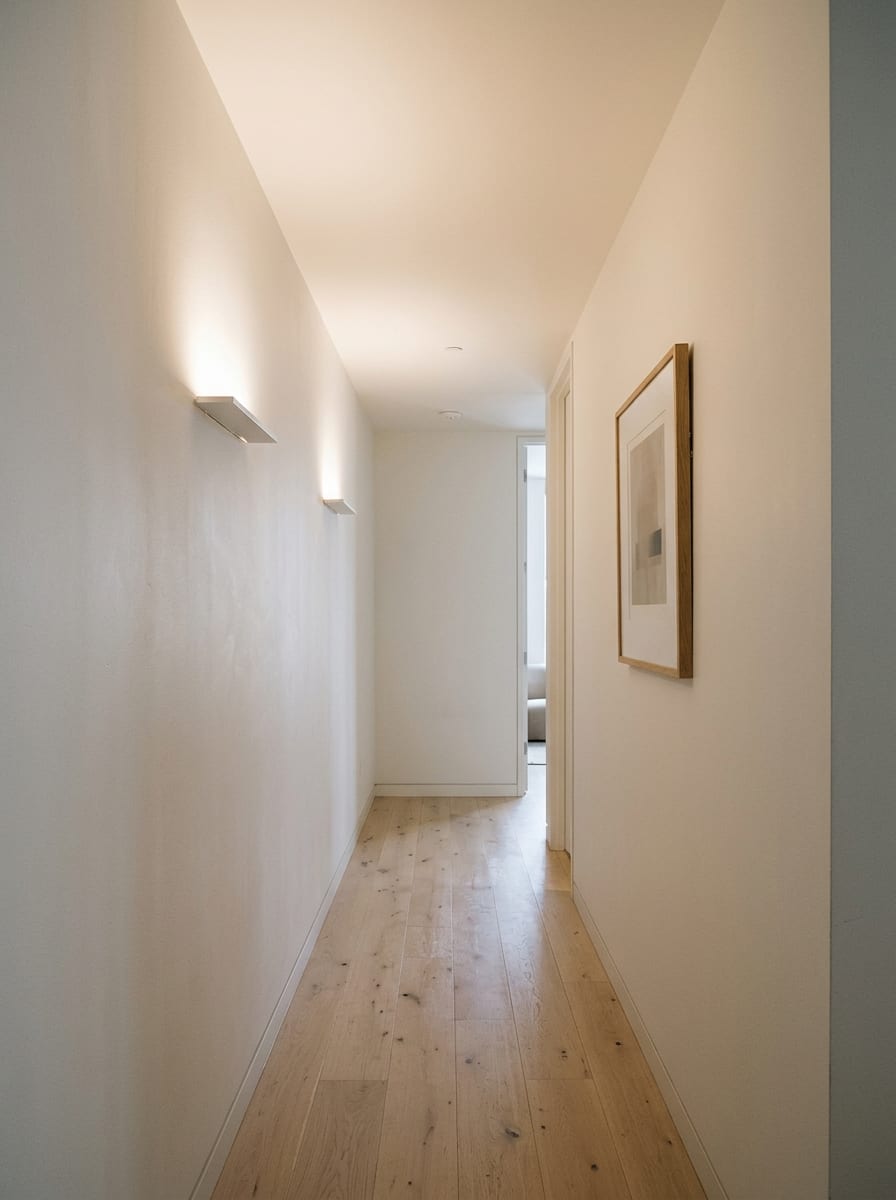
Wall lighting can make a narrow hallway feel much more atmospheric—but fixture depth matters. A large projecting sconce can become an obstacle in a passage that is already tight.
Instead, look for slim wall lights that sit close to the wall and direct light upward, downward, or both. Upward light is particularly useful because it brightens the ceiling and softens the boundary between wall and ceiling. That can make the hallway feel less enclosed.
Choose fixtures with a shallow profile, especially in corridors where people regularly carry laundry baskets, bags, or furniture through the space.
Placement tip
Wall sconces generally feel more comfortable when mounted high enough that the brightest portion of the bulb is not directly at eye level. The exact height depends on the fixture, but around 60 to 72 inches from the floor to the fixture center is a useful starting range for many hallway sconces. Always follow the manufacturer’s installation instructions.
4. Light the End Wall So the Hallway Does Not Disappear Into Darkness
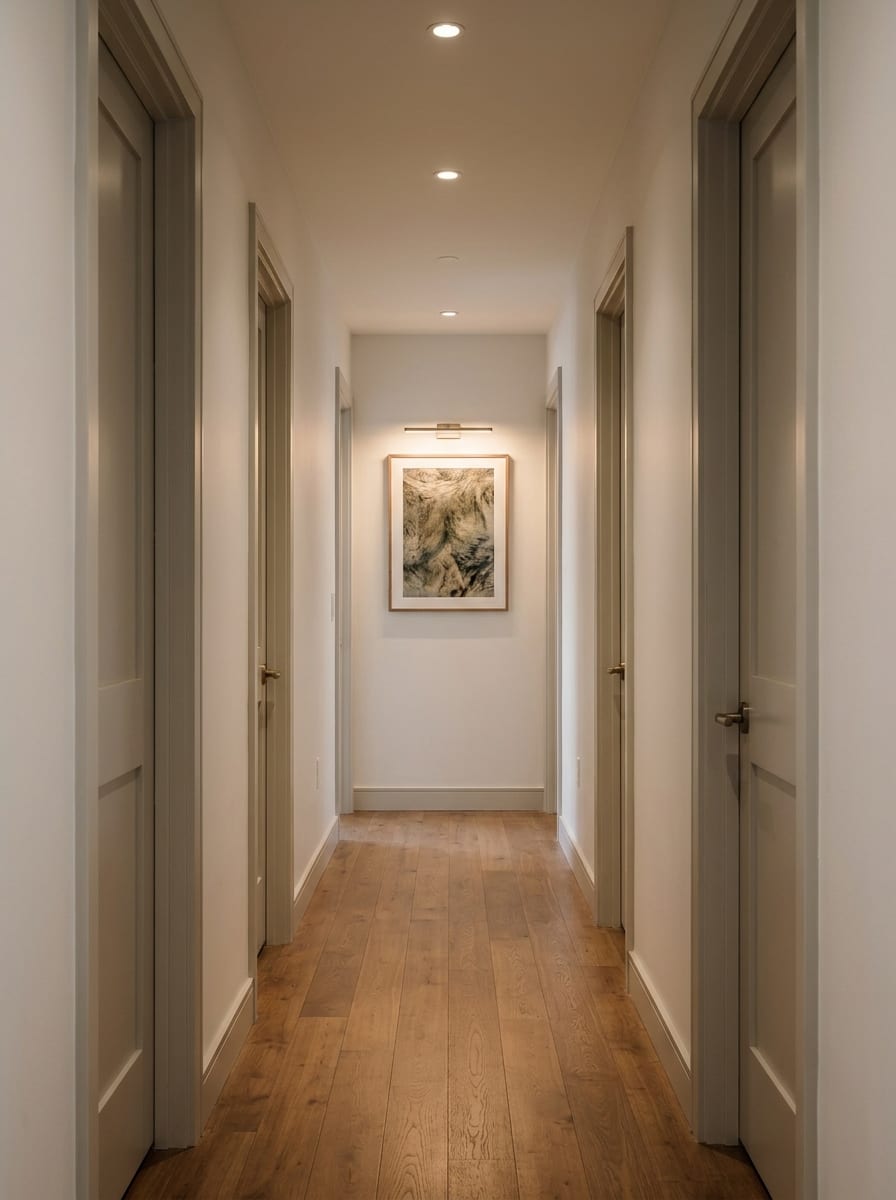
A dark end wall can make a hallway feel like a tunnel. One of the simplest fixes is to intentionally light whatever sits at the far end.
That could be:
- A piece of artwork
- A narrow console
- A decorative wall
- An architectural detail
- A framed photograph
A small picture light, ceiling spotlight, or lamp can create a destination for the eye. Instead of seeing a dark corridor that seems to close in, you see a brighter focal point drawing you forward. This approach is particularly effective when your hallway is long and straight.
Keep it restrained
You do not need to flood the end wall with dramatically brighter light. It only needs to be slightly more visually prominent than the surrounding corridor.
5. Pair a Mirror With Nearby Lighting to Bounce More Light Around
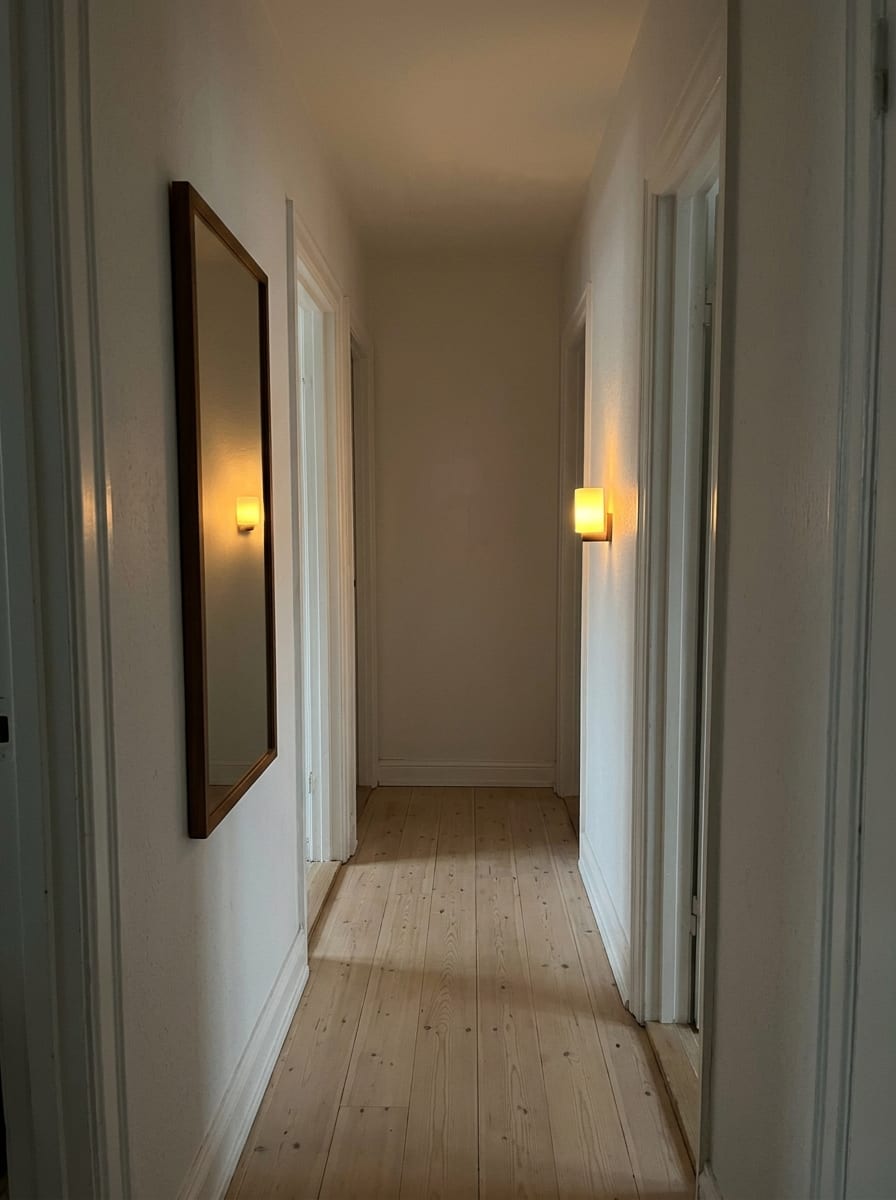
A mirror cannot create light, but it can help redistribute the light you already have. In a narrow hallway, this is useful when one wall feels especially dark.
Place a mirror where it can reflect:
- A ceiling fixture
- A nearby wall light
- Daylight from an adjacent room
- Light from an open doorway
The mirror does not need to cover the whole wall. A medium vertical mirror can often do enough while maintaining open wall space around it.
Avoid positioning a mirror where it reflects a cluttered doorway, utility area, or harsh bare bulb. The reflected view matters almost as much as the mirror itself.
Best combination
A vertical mirror with a soft wall light nearby can both brighten the wall and make the corridor feel visually deeper.
6. Use Hidden LED Lighting for a Soft Indirect Glow
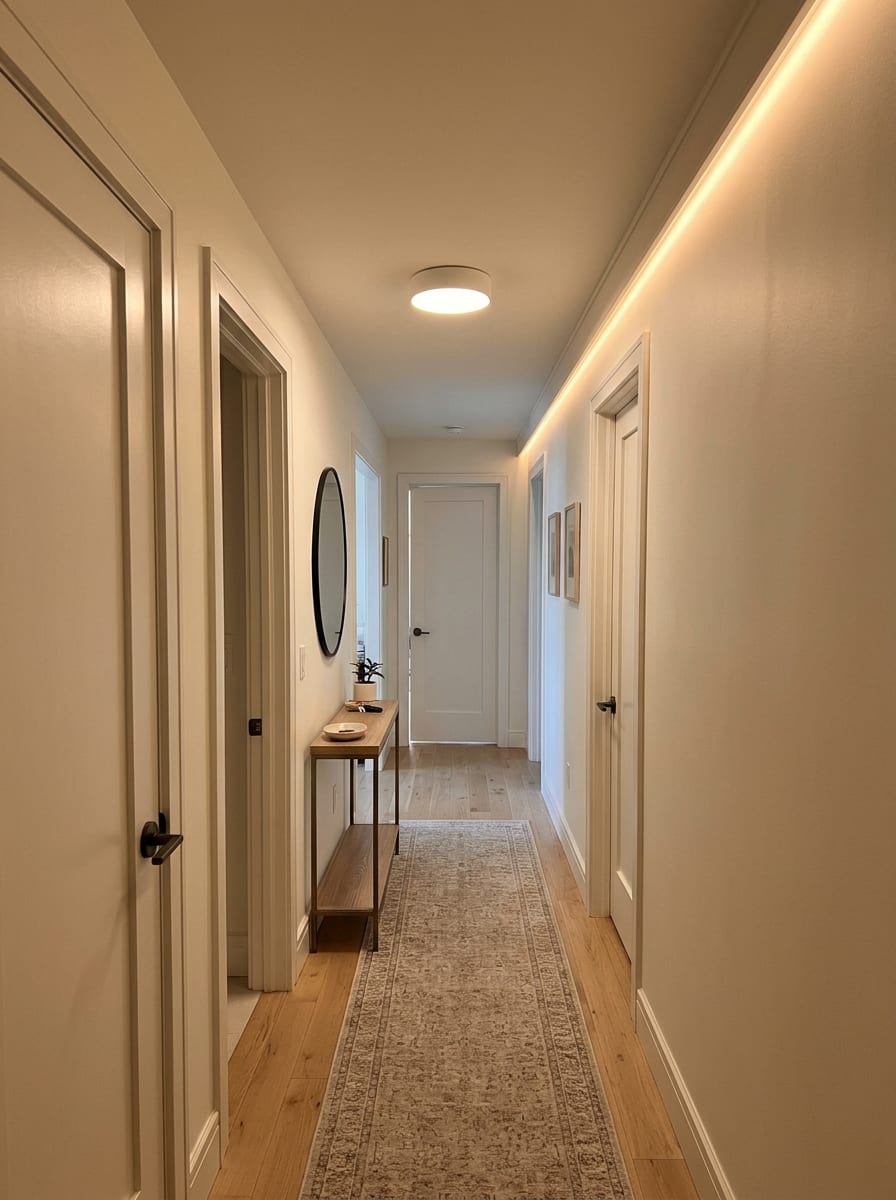
Indirect light can make a hallway feel more architectural without adding bulky fixtures.
LED strips can be hidden:
- Above picture molding
- Beneath a shallow shelf
- Inside a small ceiling recess
- Along the underside of built-in storage
- Behind a decorative trim detail
The goal is not to see individual LED dots. You should see the glow rather than the light source. This works especially well as evening lighting because it creates enough orientation light without requiring the main ceiling fixture to be at full brightness.
Choose a warm or neutral white rather than a cold blue tone if you want the hallway to feel residential.
Important
Do not run loose visible LED strips along the wall simply because the hallway is small. Without a diffuser or concealed channel, they often look temporary and can create uneven points of light.
7. Try Plug-In Wall Sconces for a Renter-Friendly Solution
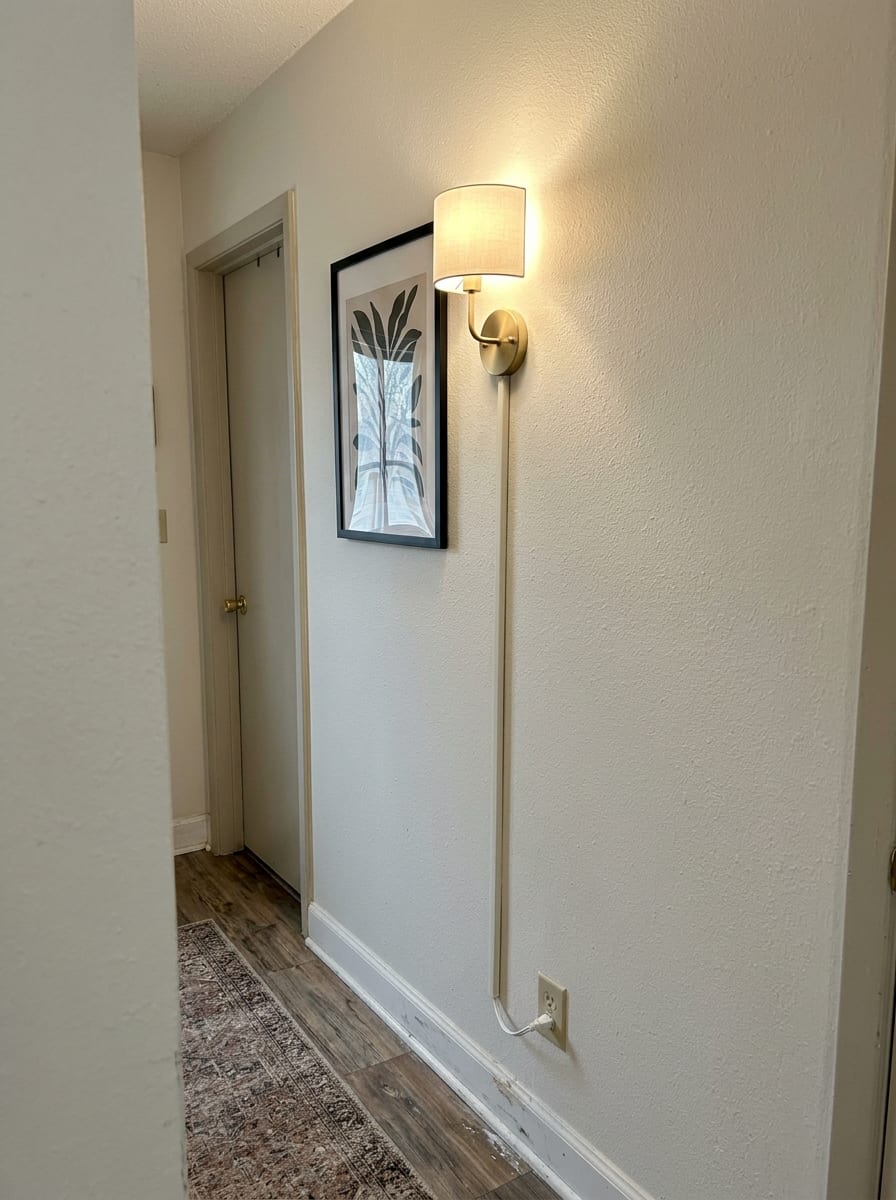
You do not necessarily need new electrical wiring to add wall lighting. Plug-in sconces can give renters many of the same benefits as hardwired fixtures, particularly if the hallway has an outlet nearby.
Choose designs with:
- Shallow projection
- Tidy cord routing
- Adjustable light direction
- Wall-mounted switches or easy controls
A paintable cord cover can make the installation look more intentional. If drilling is not permitted, check whether the fixture is compatible with a manufacturer-approved removable mounting solution. Do not improvise adhesive mounting for a heavy fixture unless the mounting method is specifically rated for the weight.
Plug-in sconces work especially well beside:
- Mirrors
- Small artwork
- A narrow console
- The far end of the hallway
8. Use Picture Lights to Make the Hallway Feel Like a Small Gallery
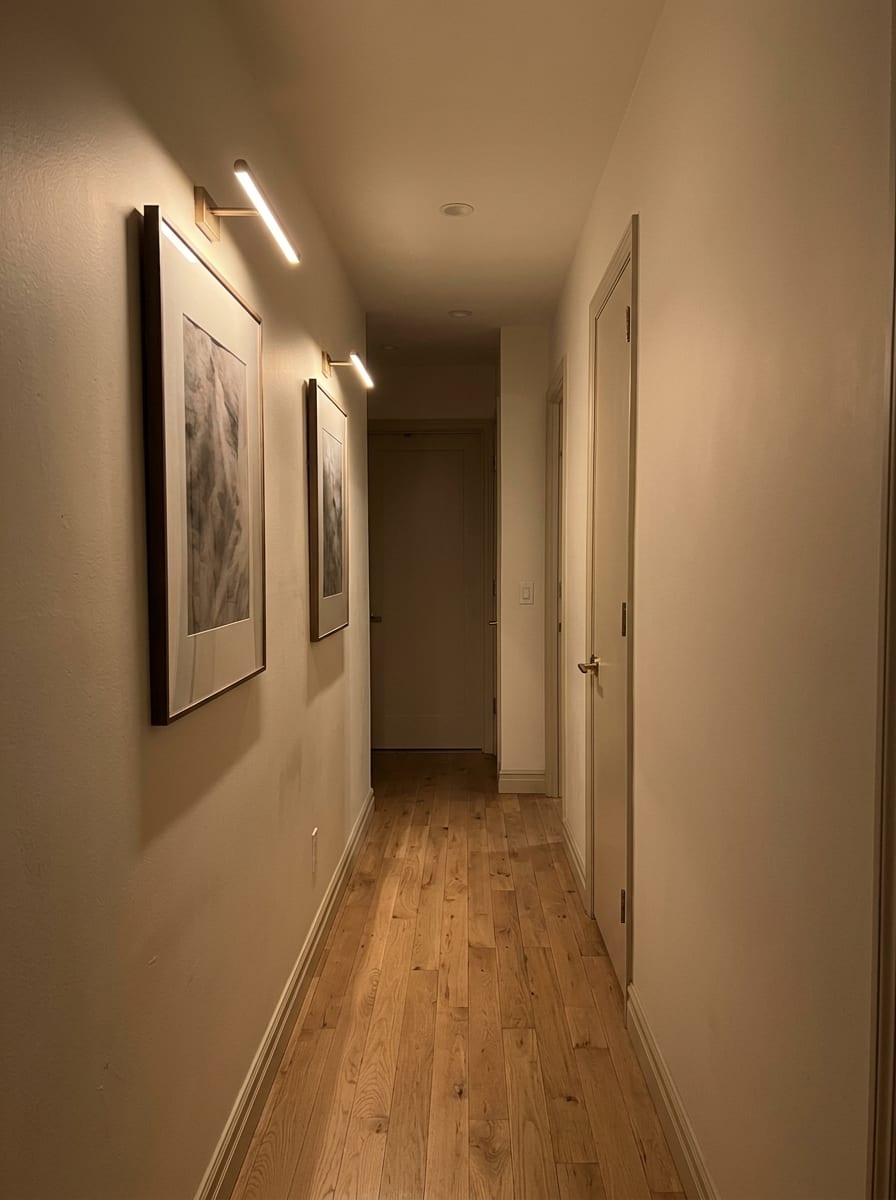
If your hallway already holds artwork or photographs, picture lights can turn the display into part of the lighting plan. This is particularly effective when you want a cozy evening atmosphere rather than bright overhead illumination.
A picture light directs attention toward the wall rather than the center of the corridor. That creates visual layers and can reduce the tunnel-like feeling of a narrow passage.
Keep the art arrangement simple. One larger piece or two intentionally spaced works will generally feel calmer than a dense gallery wall in a very narrow hallway.
Battery-operated picture lights can be useful where hardwiring is not practical, though their brightness and runtime vary.
9. Layer Ceiling, Wall, and Accent Light Instead of Relying on One Source
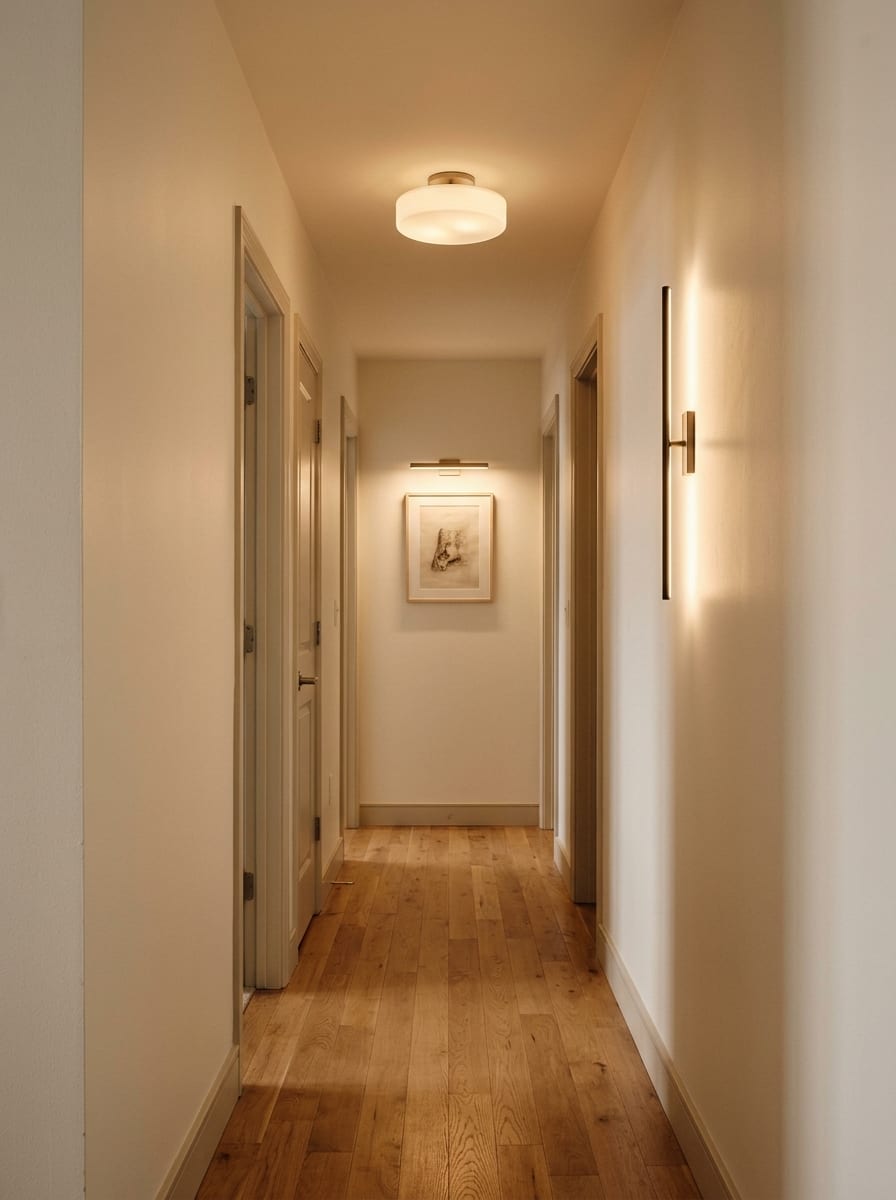
The biggest improvement often comes from combining a few modest sources rather than making one fixture extremely bright.
Think of hallway lighting in three layers:
- General light: A flush mount or several small ceiling fixtures help you move through the hallway safely.
- Wall light: A sconce or indirect glow brightens vertical surfaces and makes the space feel less enclosed.
- Accent light: A picture light, lamp, or illuminated end wall creates depth.
You do not necessarily need all three switched on at the same time. During the day, reflected daylight plus a wall light might be enough. At night, ceiling and accent lighting may work better.
If possible, use dimmers or independently controlled lights so you can adjust the hallway instead of choosing between completely dark and aggressively bright. This layered approach makes a narrow hallway feel like part of the home rather than just a passage between rooms.
How Bright Should a Narrow Hallway Be?
A hallway needs enough illumination to move through safely, but brighter is not automatically better.
The problem with a single very bright fixture is that it can create:
- Glare
- Hard shadows
- Bright centers with dark ends
- An institutional feeling
It is usually more comfortable to distribute moderate light along the length of the hall. If you are choosing bulbs, pay attention to lumens rather than relying only on wattage.
The exact amount you need depends on:
- Hallway length
- Wall color
- Ceiling height
- Number of fixtures
- Natural light
- How reflective the finishes are
Dark paint absorbs more light than white or pale walls, so the same bulb can feel much dimmer in a dark hallway.
What Color Temperature Works Best in a Hallway?
For most residential hallways, something around 2700K to 3000K creates a warm, comfortable appearance. Around 3000K can be especially useful when you want a slightly cleaner look without making the hallway feel cold.
Very cool lighting can exaggerate shadows and make an apartment corridor feel more commercial.
The most important rule is consistency. If the ceiling fixture is very warm but the wall sconces are cool white, the hallway can feel visually disconnected. Try to keep the major light sources reasonably close in color temperature.
How to Light a Hallway With a Low Ceiling
Low ceilings require extra care because any hanging fixture becomes more visually prominent.
Prioritize:
- Flush mounts
- Recessed or surface-mounted downlights
- Slim wall sconces
- Uplighting
- Concealed LEDs
Avoid deep pendant fixtures unless there is unusually generous ceiling height and clearance. Also consider illuminating the ceiling itself. When the upper wall and ceiling stay bright, the vertical boundary becomes less obvious and the hallway can feel taller.
How to Make a Dark Hallway Feel Wider With Lighting
Lighting cannot physically increase hallway width, but it can change how clearly you perceive the boundaries.
A few strategies help:
- Brighten the walls: Light bouncing across vertical surfaces keeps the corridor from feeling like a dark tunnel.
- Avoid one harsh central beam: Even illumination reduces strong contrast between the center and sides.
- Light the end of the hallway: A brighter destination adds visual depth.
- Reflect light: Mirrors and lighter wall finishes can redistribute existing light.
- Keep fixtures shallow: Bulky wall or ceiling lights visually intrude into the corridor.
Narrow Hallway Lighting Mistakes to Avoid
Using an Oversized Pendant
A large pendant can dominate both the ceiling and the sightline. In a narrow corridor, shallow usually works better.
Making the Middle Bright and the Ends Dark
This exaggerates the tunnel effect. Spread light down the entire length instead.
Installing Wall Lights That Project Too Far
Even a beautiful sconce can become annoying if shoulders, bags, or furniture constantly pass close to it. Check fixture depth before buying.
Choosing Exposed Bulbs at Eye Level
Bare bulbs can create uncomfortable glare in a narrow passage because you cannot move very far away from them. Use diffusers or shielded fixtures where possible.
Mixing Several Different Light Temperatures
One blue-white bulb and two warm bulbs can make the hallway feel inconsistent. Coordinate the major sources.
Treating Lighting as Decoration Only
The hallway still needs to be safe and practical. Make sure changes do not reduce visibility near stairs, thresholds, doors, corners, and floor-level obstacles.
Ceiling Light or Wall Light: Which Is Better?
For most hallways, this is not really an either-or decision. A ceiling light is usually better for general illumination, while a wall light is better for adding atmosphere, depth, and vertical brightness.
If your hallway is extremely small, one good diffused ceiling fixture may be enough. If it is long, dark, or visually flat, adding a wall or accent layer usually makes a bigger difference than simply installing a brighter ceiling bulb.
What If You Cannot Change the Electrical Fixtures?
Renters still have several options:
- Approved plug-in sconces
- Rechargeable picture lights
- Battery-operated accent lights
- Lamps at the hallway end where space allows
- Mirrors positioned to reflect adjacent-room light
- Brighter but appropriately rated bulbs in existing fixtures
Always stay within the fixture manufacturer’s maximum bulb rating and installation instructions. If an electrical change requires wiring, use a qualified professional rather than improvising.
Final Thoughts
The best narrow hallway lighting does not try to overpower the space. It distributes light carefully.
A shallow ceiling fixture can preserve headroom. Wall lighting can brighten vertical surfaces. A lit end wall can create depth. Mirrors can bounce existing light, while subtle accent lighting gives the corridor a more finished feel.
Start by identifying the real problem: is the hallway too dark overall, dark at the ends, visually flat, or dominated by one harsh ceiling light? Once you know that, you can add the right layer instead of simply adding more brightness.
FAQ
What lighting is best for a narrow hallway?
Low-profile flush mounts, slim wall sconces, evenly spaced ceiling fixtures, and subtle accent lighting work particularly well because they provide illumination without physically crowding the passage.
How do you make a narrow hallway look wider with lights?
Brighten the walls as well as the floor, reduce dark areas at the end of the hallway, use indirect light where possible, and avoid bulky fixtures that visually project into the corridor.
Are wall sconces good for narrow hallways?
Yes, provided they have a shallow profile and are positioned so they do not obstruct movement. Uplighting sconces can also make the ceiling feel more open.
What color light is best for a hallway?
Warm white light around 2700K–3000K generally works well in residential hallways. Keeping all major fixtures close to the same color temperature is more important than choosing one exact number.
What lighting works in a hallway with a low ceiling?
Flush-mount ceiling lights, shallow surface lights, wall sconces, and indirect LED lighting are usually better choices than hanging pendants.
How can renters improve hallway lighting?
Plug-in sconces, rechargeable picture lights, strategically placed mirrors, and better bulbs in existing fixtures can all improve hallway lighting without extensive rewiring.
Should hallway lights point up or down?
Either can work, but upward light is useful in narrow hallways because it brightens the ceiling and can make the space feel less enclosed. A combination of general downward illumination and softer upward light often works especially well.