How to Create a Boho Living Room in a Small Apartment Without Making It Feel Cluttered
Create a warm boho living room in a small apartment with the right rug, wood furniture, textiles, plants, lighting and decor without making the space feel cluttered.
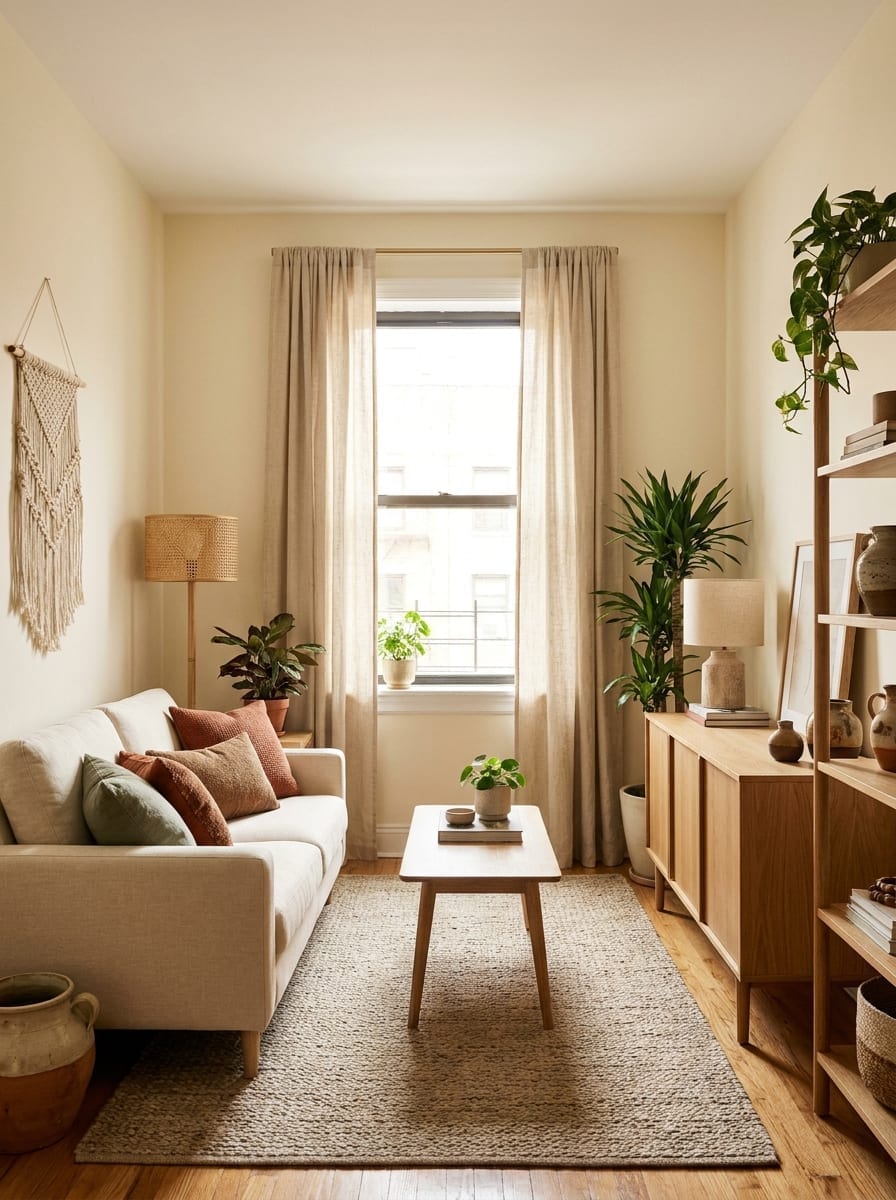
Restrained boho living room in a small apartment with warm ivory walls, linen curtains, and natural oak furniture
In This Guide
Boho rooms look effortless in photos.
Then you try creating one in a small apartment and suddenly there are three baskets on the floor, six pillows on the sofa, plants covering the window, a gallery wall competing with a patterned rug, and nowhere left to put your coffee.
That is the problem with copying boho style literally.
The best small-space version is not about fitting more things into the room. It is about getting the warmth, texture and collected feeling of boho interiors with fewer, better layers.
You still want:
natural materials relaxed textiles warm wood greenery personality vintage character
You simply need more restraint around them.
A good small boho living room should feel collected over time, not filled all at once.
Here is the order I would use.
1. The Warm Neutral Foundation
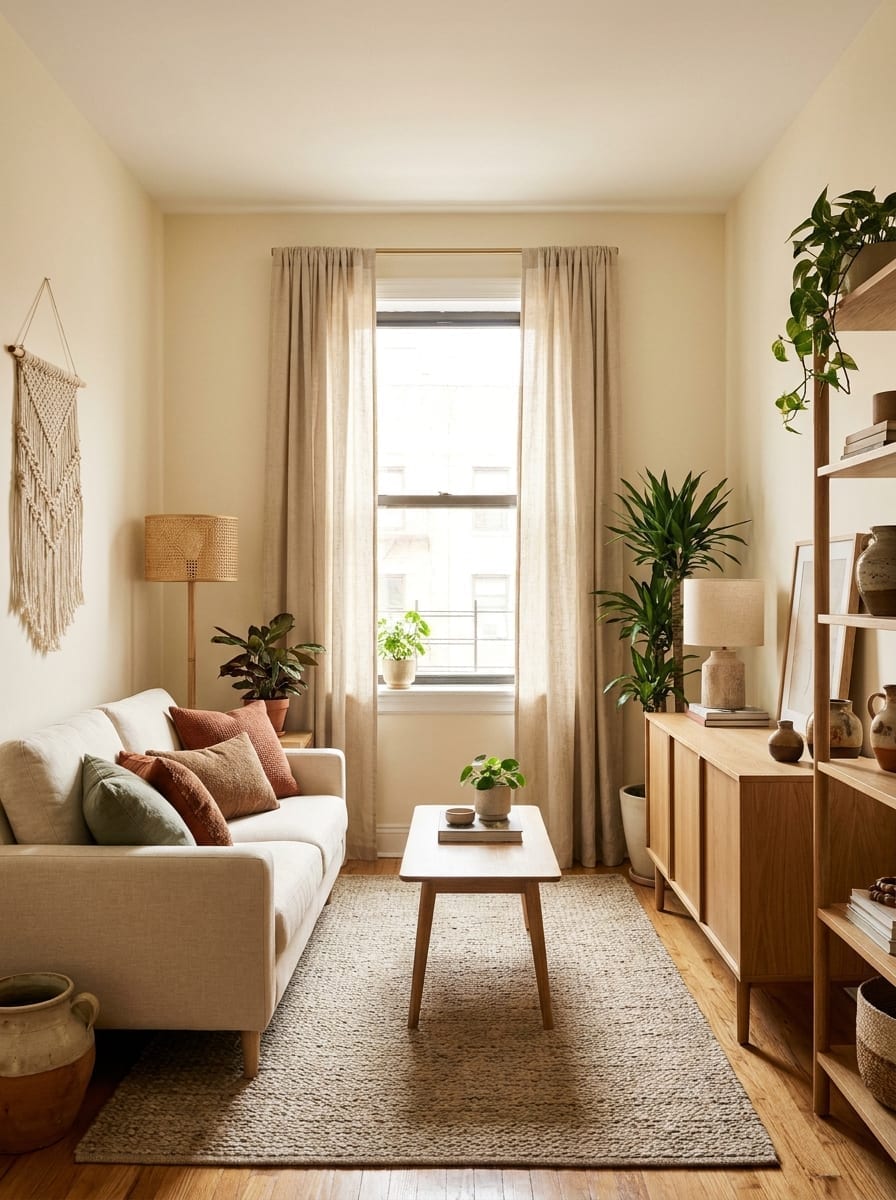
Start quieter than you think.
Boho rooms often contain plenty of pattern and texture later, so the background does not need to compete with them.
For a small living room, a warm neutral base gives you room to add personality without making the walls feel busy.
Good starting colors include:
warm ivory oatmeal sand pale taupe creamy beige soft clay-tinted white
You do not need every wall to be beige.
The goal is simply to create a backdrop that lets wood, textiles, plants and artwork become the interesting part.
If your apartment already has plain white walls, that is completely workable too.
Instead of fighting them, warm the room through:
curtains rug upholstery wood tones lamps What makes this work in a small apartment
Keep the largest surfaces relatively calm.
That means the sofa, walls, curtains and large rug should not all be competing for attention at the same time.
You can introduce stronger color later in smaller doses.
2. The One-Rug Anchor
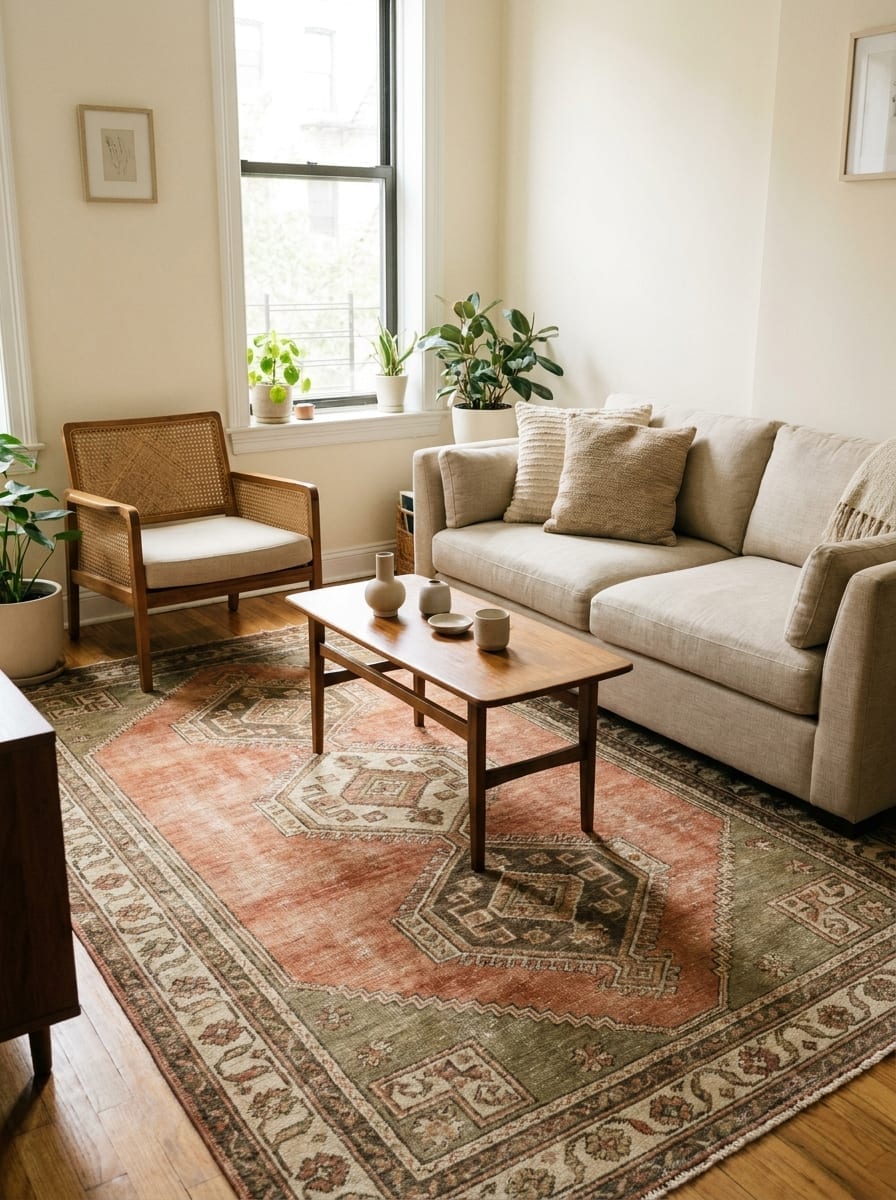
If you only buy one strongly boho-looking piece for the room, make it the rug.
A rug can introduce:
faded pattern muted terracotta rust olive dusty rose deep brown vintage character
without requiring you to repeat those patterns everywhere else.
The common mistake is using a small decorative rug floating in front of the sofa.
That can actually make a compact living room feel more fragmented.
Instead, choose a rug large enough to visually connect the main seating area.
At minimum, the front legs of the sofa and nearby chair should usually sit on it.
Choose pattern carefully
In a small room, look for a rug that has:
faded rather than sharp pattern several related earthy colors visible neutral space moderate contrast
A highly saturated rug with dozens of tiny shapes can become visual noise.
A slightly washed, vintage-style pattern is much easier to layer around.
3. The Light-Scale Wood Furniture Layer
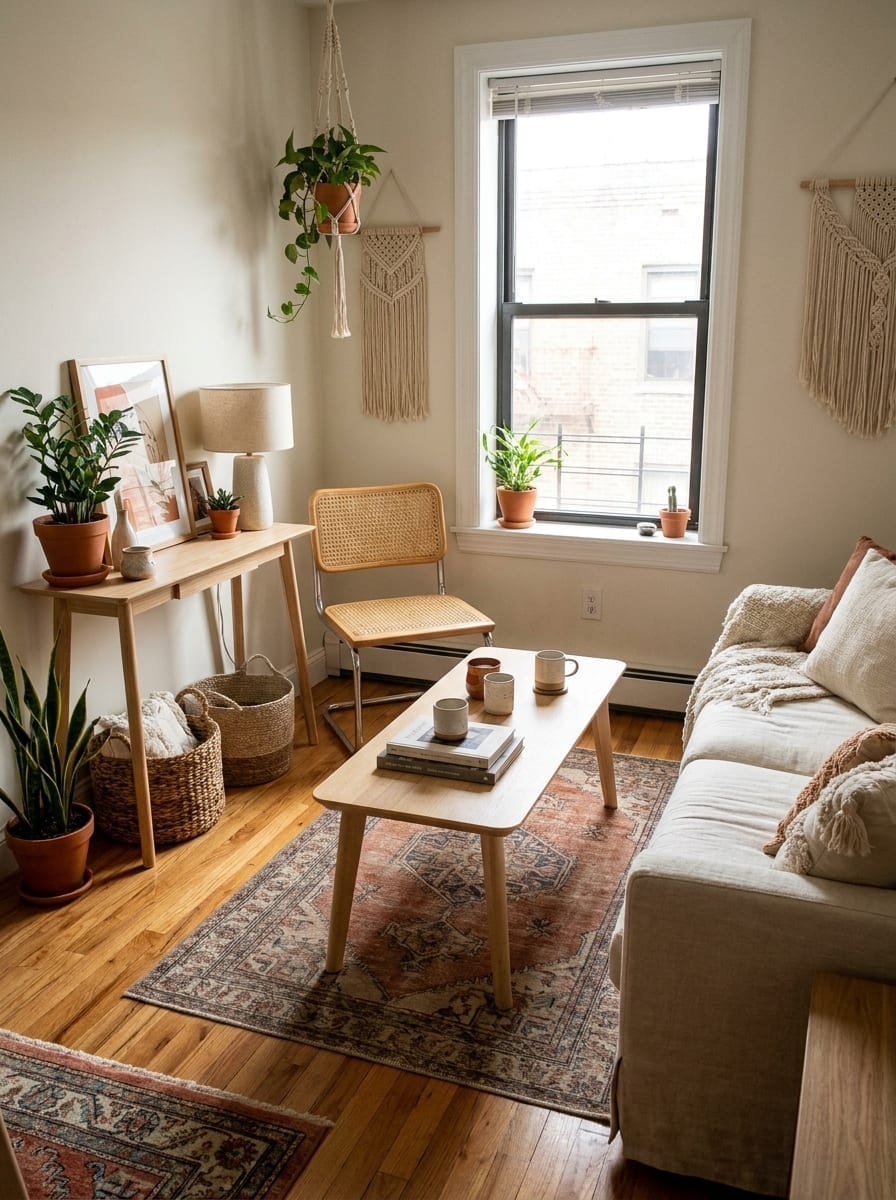
Boho style loves wood, but bulky furniture is where small boho rooms often go wrong.
A huge reclaimed-wood coffee table may look beautiful on its own while consuming half the usable floor.
Instead, look for furniture that has visual openness.
Think:
exposed legs slim profiles rounded edges cane details lighter or medium wood smaller footprints
A coffee table with legs will usually feel lighter than a solid storage block.
An open-leg side table feels less dense than a cabinet.
A slim wood console can provide warmth without becoming another heavy object.
Mixing wood tones
Your wood does not need to match perfectly.
In fact, slight variation often helps boho spaces feel more natural.
But try to keep the undertones related.
For example:
Works well: oak + medium walnut + cane
Harder to balance: orange pine + cool gray wood + nearly black espresso
The room should feel collected, not accidental.
4. The Controlled Textile Mix
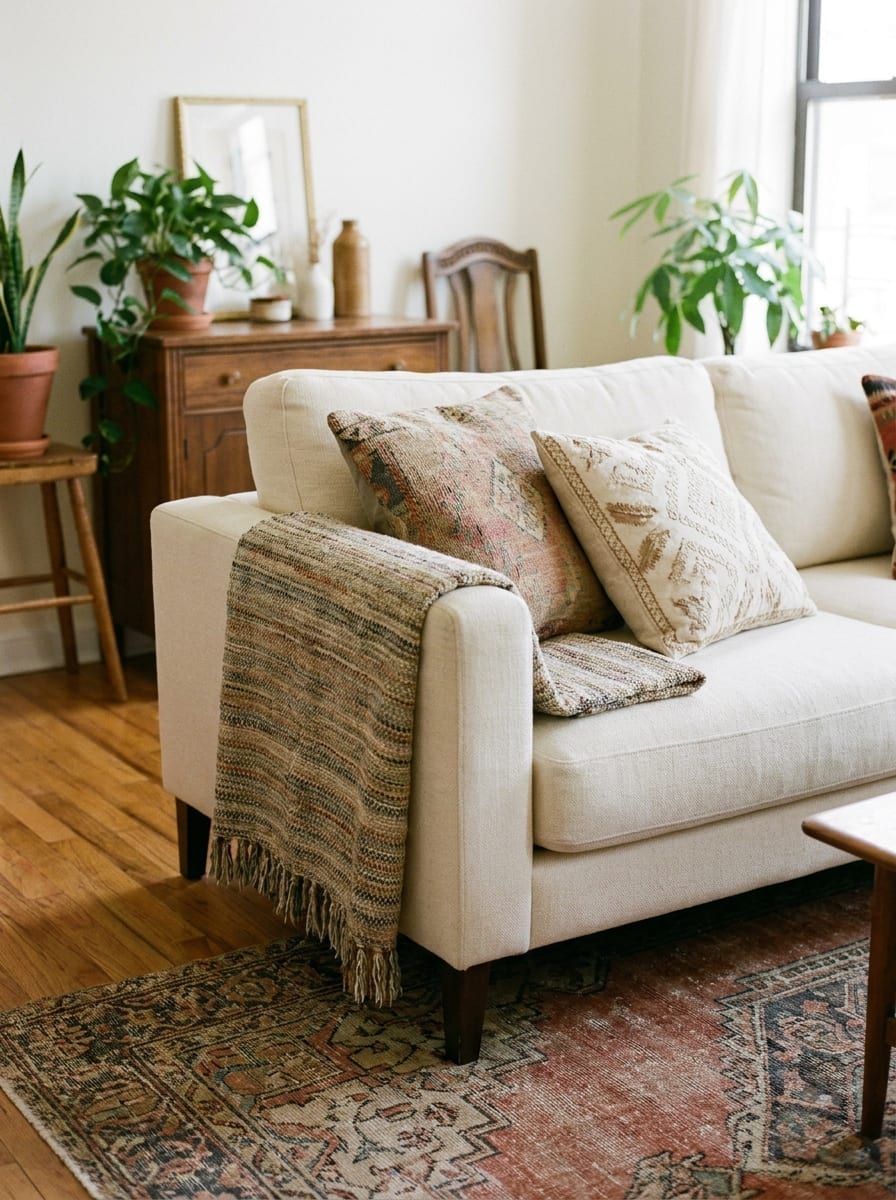
Texture is essential to boho style.
But texture does not mean covering every surface.
In a small living room, I would start with only three major textile layers:
-
The rug Your strongest patterned element.
-
Sofa pillows Two or three, not seven.
-
One throw Something tactile like linen, cotton or a light woven texture.
That is enough to create softness.
You can mix:
stripes block prints subtle geometric patterns woven texture tassels
but they should not all be equally loud.
A useful rule is:
one pattern leads, the others support it.
If the rug is already detailed, make the pillows simpler.
If the rug is plain, you have more freedom with cushions.
Avoid the “boho starter pack” look
You do not automatically need:
macramé cushion tasseled blanket Moroccan pouf patterned rug floor cushion woven throw fringe on everything
Choose the pieces because the room needs them, not because they appear on a boho checklist.
5. The Vertical Greenery Layer
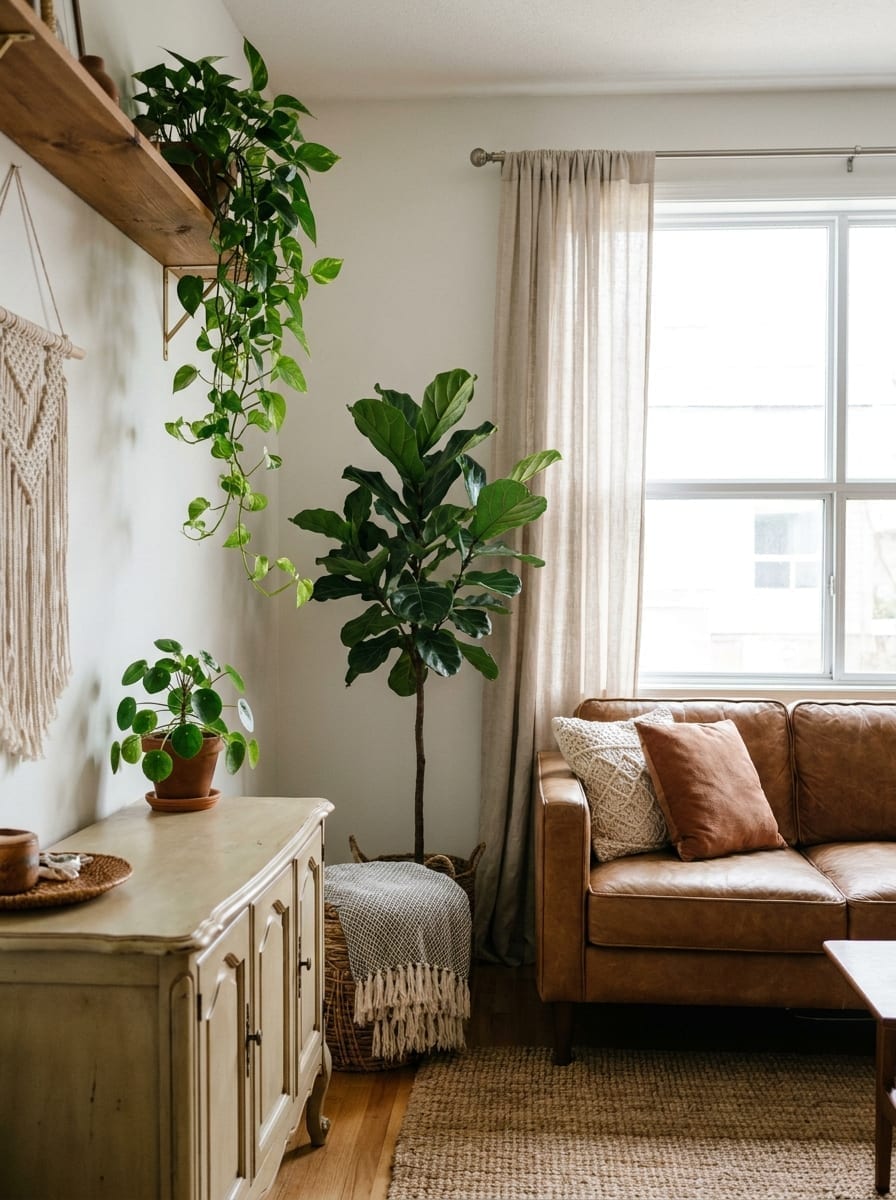
Plants work beautifully with boho interiors, but floor plants can consume valuable apartment space quickly.
Use vertical space first.
Instead of placing five pots around the room, try:
one taller plant one trailing plant on a shelf one small plant on a console
That is often enough.
A single tall plant beside the sofa can create more impact than several small pots scattered throughout the room.
Keep the window usable
Do not turn every window into a plant shelf.
The room still needs natural light.
If plants crowd the glass, the entire space may feel darker and visually heavier.
Choose locations that add greenery without interrupting:
curtains windows walking paths seating
And choose plants according to the actual light conditions in the room rather than appearance alone.
6. The Collected Wall Story
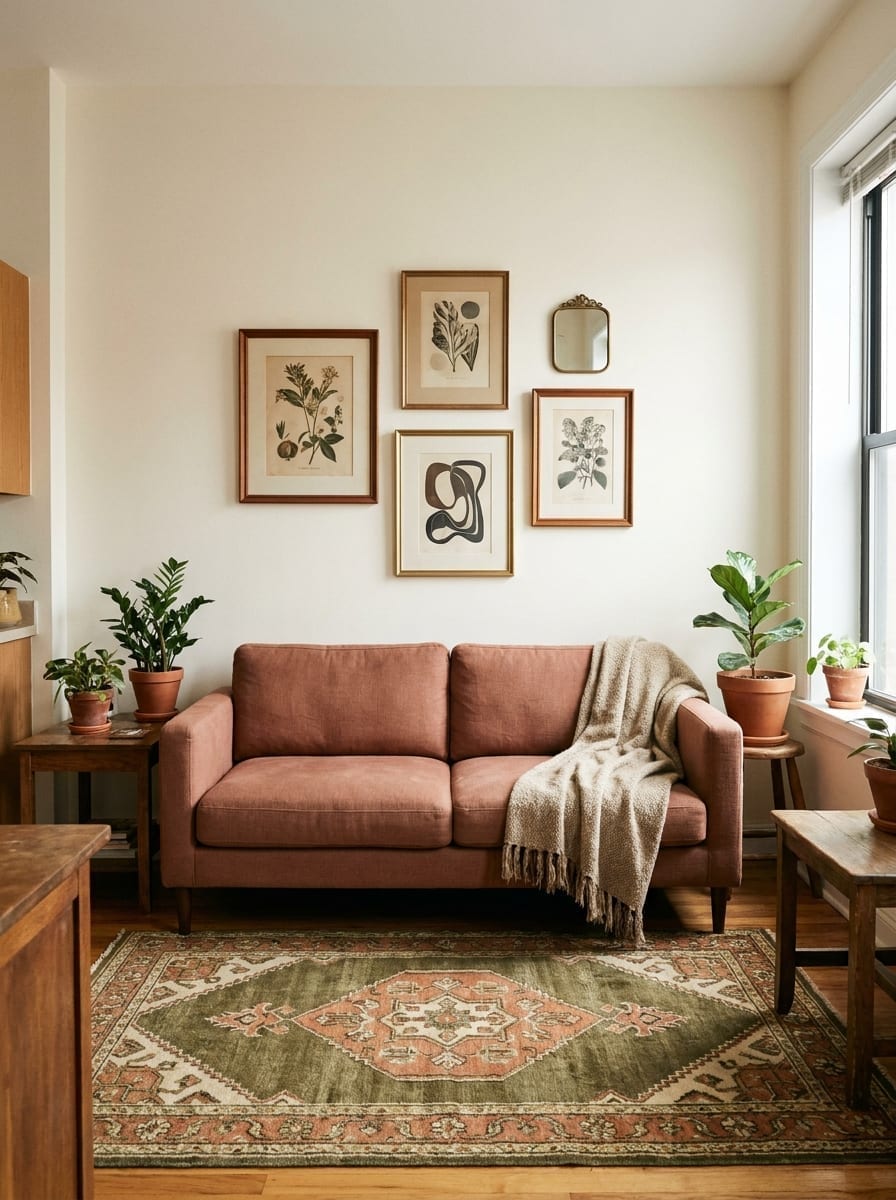
Boho wall decor is often where clutter starts.
You find:
prints baskets mirrors textiles photographs vintage art
and try putting all of them on the same wall.
You do not need to.
In a small room, I prefer one concentrated wall story.
That could be:
Option 1: A small gallery grouping
Use four to six pieces with different sizes but related colors.
Option 2: One large vintage-style textile
This gives you softness and pattern without lots of frames.
Option 3: Art + mirror
One meaningful print beside a warm wood or brass mirror can be enough.
Option 4: Two oversized pieces
Often cleaner than ten small ones.
Leave visible wall around the arrangement.
That empty space is part of the composition.
A useful trick
Pull colors from the rug into the wall art.
If your rug contains muted terracotta and olive, a little of either color appearing in the artwork makes the room feel connected without looking matched.
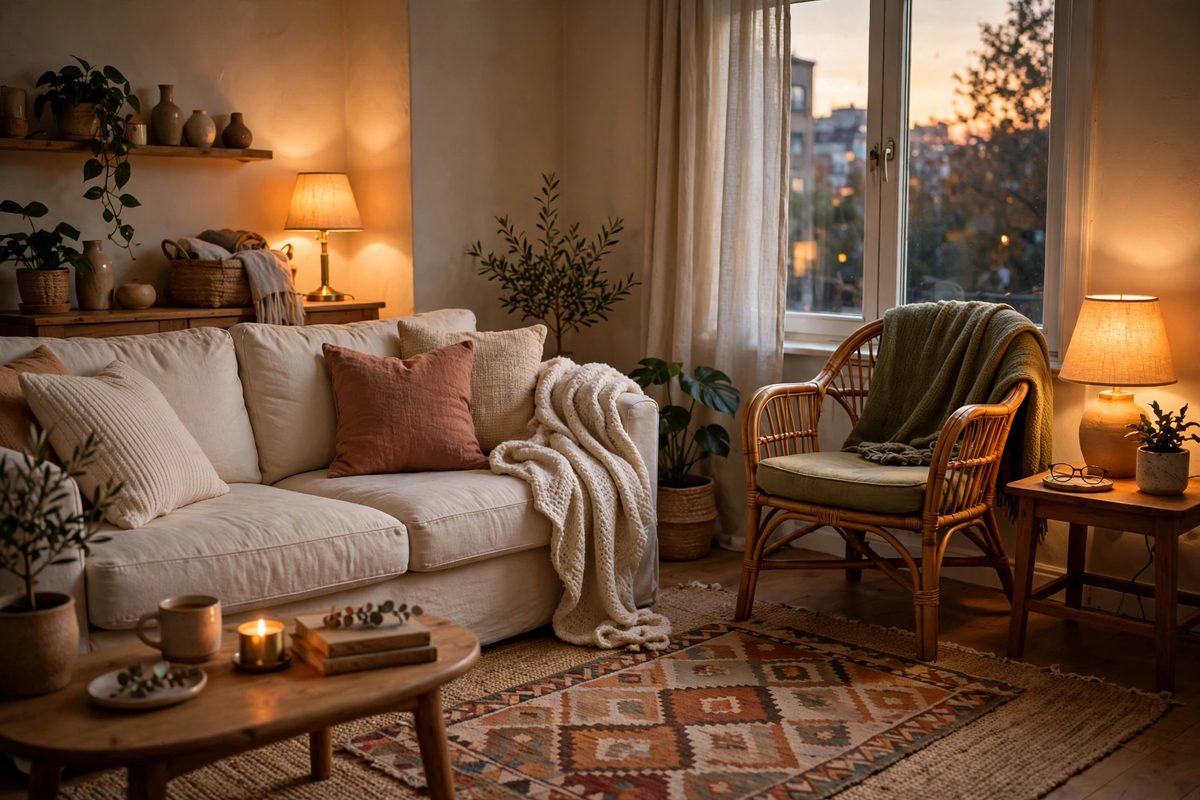
7. The Warm Lighting Triangle
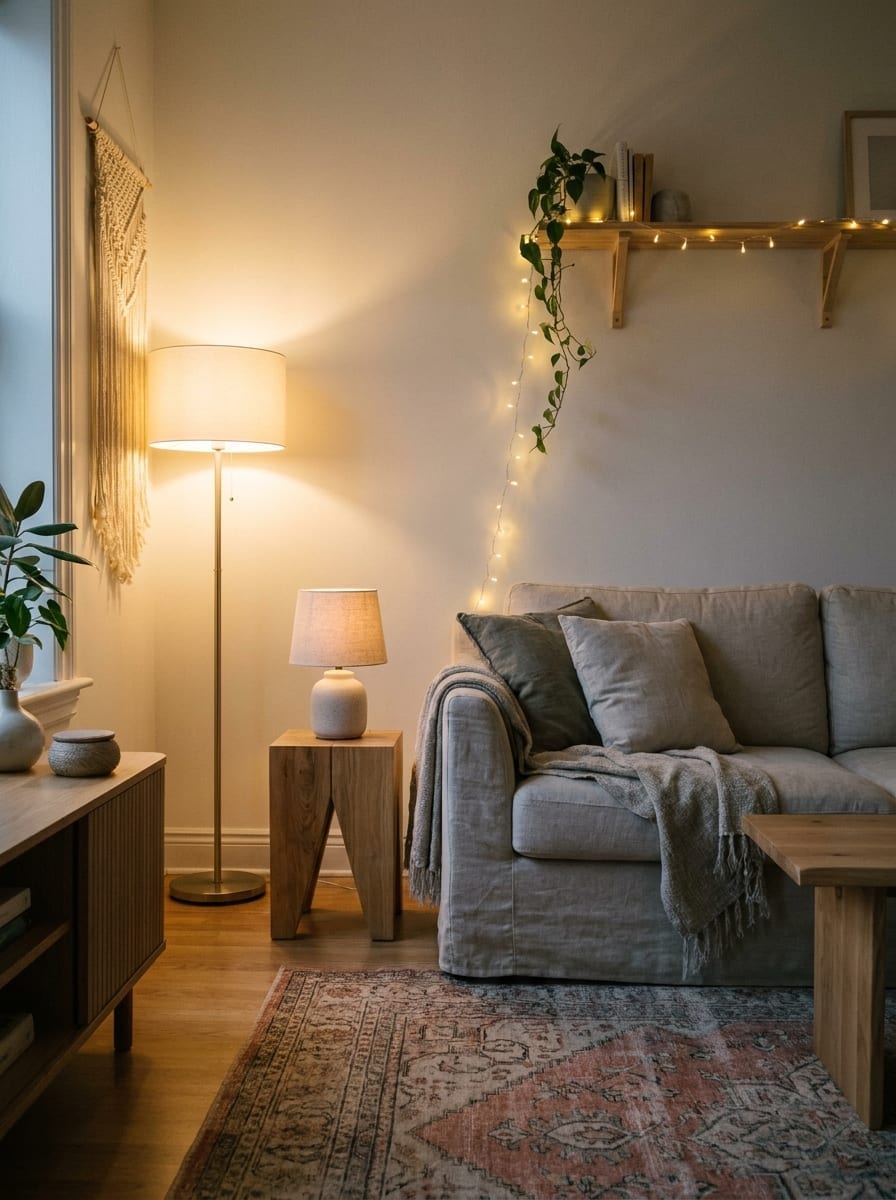
A boho room can have beautiful furniture and still feel flat under one harsh ceiling light.
Use several smaller light sources instead.
For a compact living room, three points are often enough:
-
Floor lamp near the sofa For general evening light.
-
Small table lamp Creates a lower, warmer glow.
-
One atmospheric source Such as a small shaded lamp or warm decorative light.
The lights should sit at different heights.
That creates depth after sunset.
Keep the lamps compact
Small apartments do not need oversized sculptural lamps everywhere.
Look for:
narrow floor lamp bases small ceramic lamps woven or linen shades warm metal details
The light itself matters more than the size of the fixture.
Choose bulbs and fixtures appropriate for the room and follow manufacturer safety guidance.
8. The One-of-a-Kind Finishing Piece
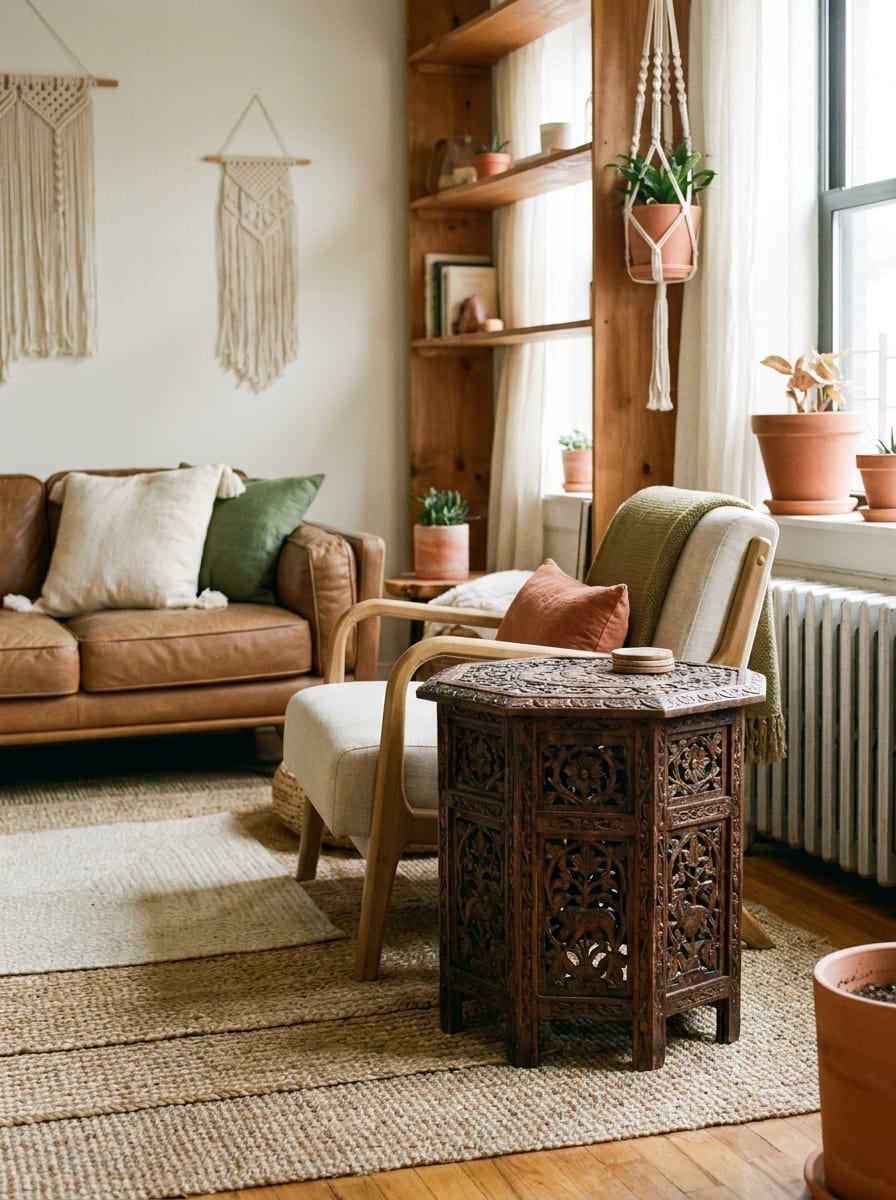
The room becomes personal when something does not look as if it came from the same furniture set.
Choose one piece with character.
It could be:
vintage side table handmade ceramic lamp carved wood stool old framed artwork unusual mirror woven wall piece thrifted chair small trunk
One is enough.
This piece should make the room feel collected rather than decorated from a catalog.
Do not confuse personality with quantity
You do not need ten vintage pieces for the room to feel personal.
In a small space, one interesting object often becomes more noticeable because it is not surrounded by other statement pieces.
Give it room.
That is one of the biggest differences between a warm boho room and a cluttered one.
The Small-Apartment Boho Formula
If you want a simple formula to follow, think of the room in this order:
Calm base → one patterned rug → warm wood → restrained textiles → greenery → wall personality → layered lighting → one special object
You do not need to complete all eight layers in one shopping trip.
Actually, the room will probably look better if you do not.
Add the foundation first.
Live with it.
Then add whatever feels missing.
That is how you avoid buying five decorative pieces that eventually have nowhere to go.
What Makes a Boho Living Room Look Cluttered?
Usually, it is not one item.
It is several competing layers happening at once.
For example:
busy rug patterned curtains heavily patterned sofa lots of pillows full gallery wall multiple baskets many small plants open shelving packed with objects
Each one can look good individually.
Together, they remove the visual resting points that a small room needs.
The solution is not necessarily removing personality.
It is deciding which element gets to be strongest.
If the rug is bold, calm the sofa.
If the wall is busy, simplify the shelves.
If you own a lot of plants, keep the textiles quieter.
Boho Colors That Work Well in Small Apartments
A small boho room does not have to be entirely beige.
The easiest palette starts neutral and then adds a few earthier accents.
Warm earthy
cream terracotta olive walnut faded rust
Soft natural
warm white oatmeal camel sage light oak
Moodier boho
ivory deep olive burgundy dark wood muted brass
Sun-washed boho
cream dusty peach muted ochre pale green medium wood
Choose a base plus two or three accents.
You generally do not need every earthy color at once.
Can Boho Style Work in a Very Small Living Room?
Yes.
The smaller the room, the more important scale becomes.
Instead of removing boho character, scale down the objects carrying it.
For example:
Instead of a huge carved coffee table, use a slim wood table.
Instead of six plants, use one tall plant and one trailing plant.
Instead of a large gallery wall, use four pieces.
Instead of six throw pillows, use two.
Instead of several floor baskets, keep one useful basket.
You still get the style.
You simply stop paying for it with floor space.
What Furniture Works Best?
Look for pieces that leave some visible floor around them.
Useful features include:
exposed legs slim arms smaller seat depth rounded coffee tables nesting tables lightweight side chairs wall-mounted shelving compact consoles
This is especially important if you also want the layered textiles and decorative objects associated with boho interiors.
The furniture should create room for those details rather than competing with them.
Should Everything Match?
No.
A little mismatch is part of the appeal.
But there should still be repetition.
For example, you might repeat:
warm wood three times muted terracotta twice brass in two small details black only in thin frames
That creates cohesion without making the room feel purchased as a set.
Think related, not matching.
What to Skip in a Small Boho Living Room Too many floor baskets
One useful basket is charming.
Five become obstacles.
Excessive tiny decor
Small objects create a lot of visual information without adding much impact.
Every boho trend at once
Rattan, macramé, pampas grass, Moroccan poufs, kilim rugs and mushroom lamps do not all need to live in one room.
Furniture pushed into every available corner
Empty floor is useful.
It gives the room breathing space.
Too many competing patterns
Choose a pattern hierarchy.
Buying decor before solving the layout
The sofa, walking path and lighting should work before you start filling shelves.
A Better Way to Build the Room
Start with what you already own.
Ask:
What is missing from the feeling of the room?
If it feels cold, add wood.
If it feels flat, add texture.
If it feels generic, add one vintage or personal piece.
If it feels dark, improve the lighting.
If it feels empty, add greenery.
If it already feels busy, do not buy anything.
Edit first.
That is especially important in a small apartment.
A relaxed boho living room should feel as though it evolved naturally.
It should not feel as though every inch was assigned a decorating job.
The most convincing version has texture, warmth and personality, but still gives you somewhere to put your coffee.