10 Under-Kitchen-Sink Organization Ideas That Make a Tiny Cabinet Actually Work
Discover 10 under-kitchen-sink organization ideas using pull-out caddies, narrow bins, shelf risers and cabinet-door storage to organize around plumbing without overcrowding the cabinet.
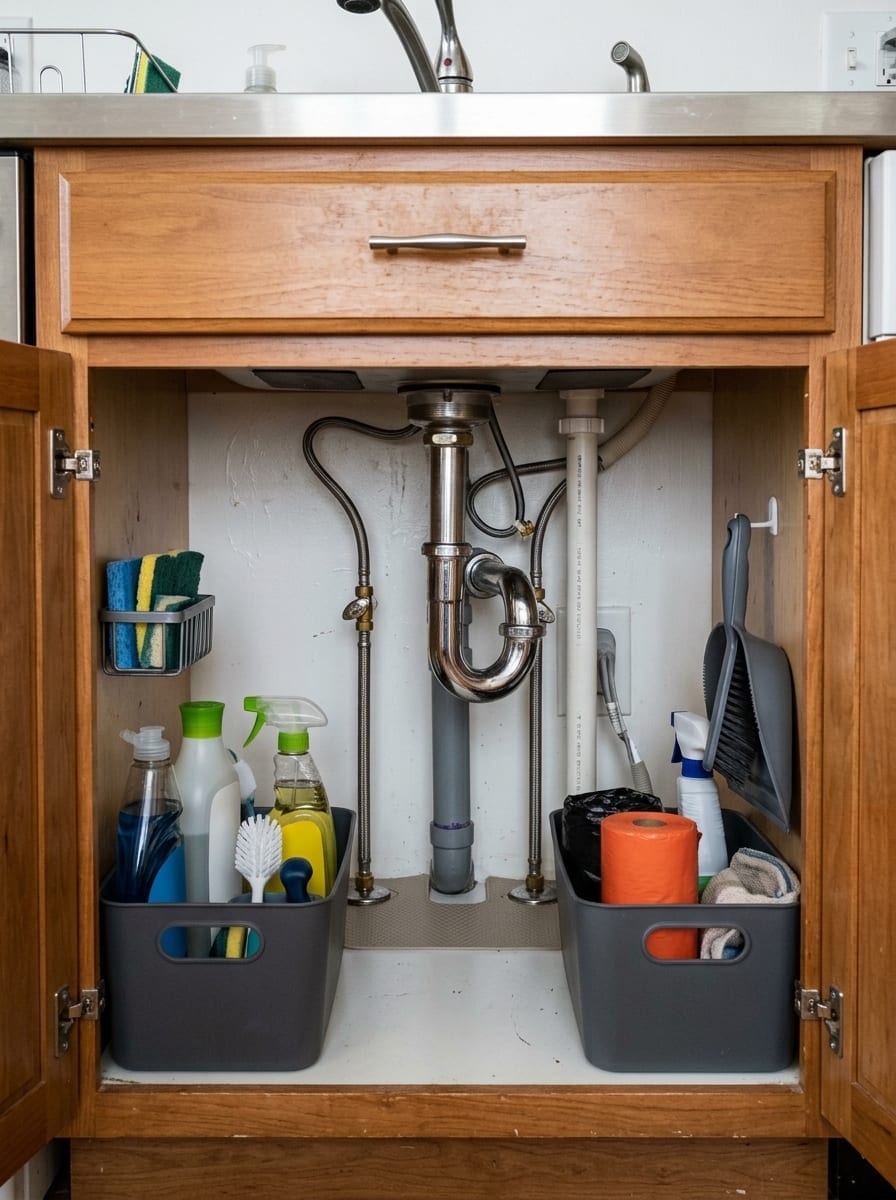
Organized under kitchen sink cabinet with plumbing-first layout, pull-out caddy and side storage bins
In This Guide
The cabinet under the kitchen sink looks like storage space.
Then you open it.
Suddenly you are dealing with:
plumbing pipes garbage-disposal hardware water lines cabinet hinges awkward corners deep shadows cleaning bottles of every height
That is why under-sink cabinets become chaotic so easily.
The problem is not simply that the cabinet is small.
The problem is that it is irregular.
Unlike a normal cabinet, you cannot use the whole rectangle.
Some areas are blocked.
Some are hard to reach.
Some need to remain accessible in case of a leak or plumbing issue.
So the best under-sink organization system does not try to fill every inch.
It creates a few clear zones around the obstacles that already exist.
The goal is:
easy access + visible supplies + clear plumbing + simple cleanup
Here are ten ways to make that awkward cabinet work much better.
1. The Plumbing-First Layout
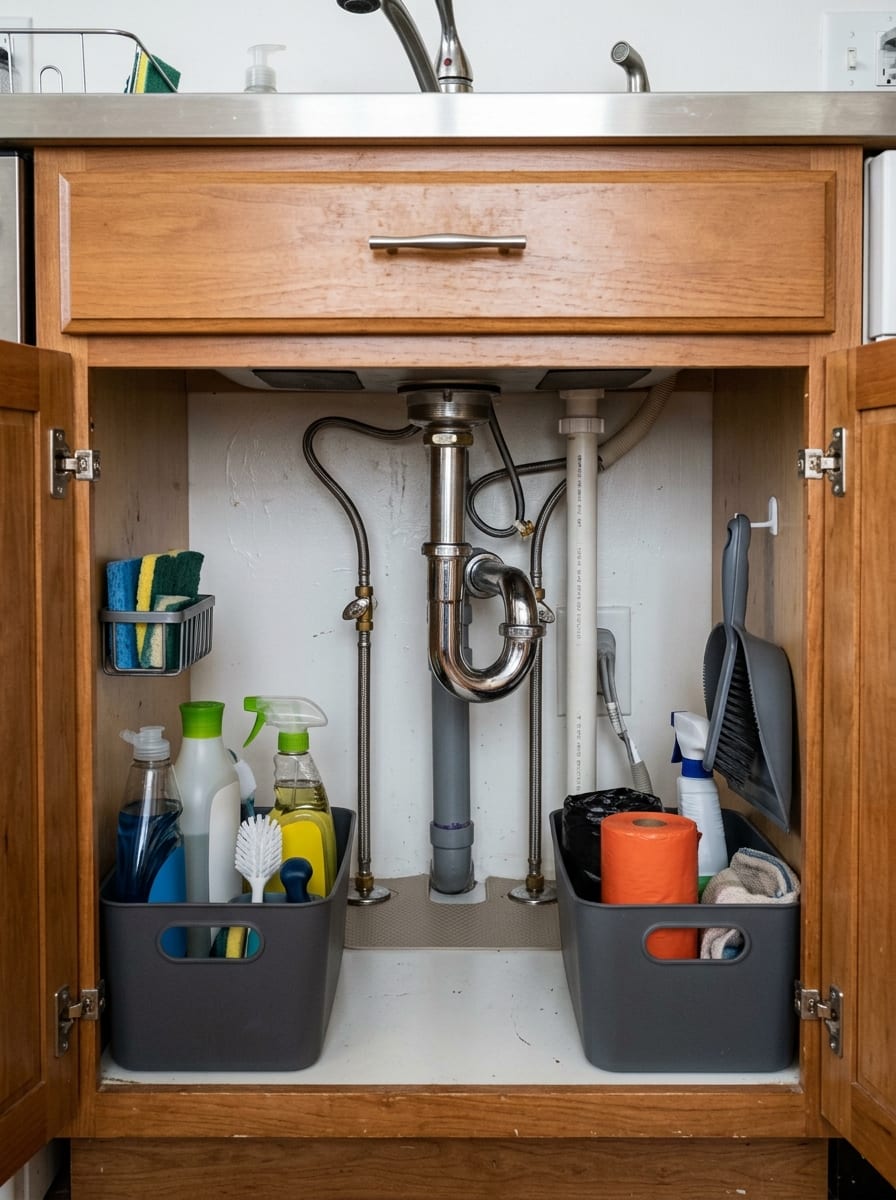
Before buying any organizer, start with the pipes.
This is the most important step.
Look at exactly where your cabinet loses usable space.
Notice:
drainpipe water lines garbage disposal shutoff valves filtration equipment if present
Those elements determine the layout.
Divide the cabinet into usable zones
Instead of imagining one large storage space, think of it as:
Left zone
One side of the plumbing.
Right zone
Other side.
Front zone
Easy-access daily storage.
Back zone
Only if it remains reachable.
Why this works
Most under-sink clutter comes from putting rectangular organizers into a cabinet that is no longer rectangular.
The organizer looks good in a product photo but collides with:
pipe disposal cabinet door
in real life.
Measure the interruptions
Do not only measure:
width height depth
Measure:
pipe location pipe diameter height beneath pipe side clearance door opening
Leave valves visible
Do not bury shutoff valves behind:
baskets stacked bottles fixed shelving
You may need quick access someday.
2. The Pull-Out Cleaning Caddy
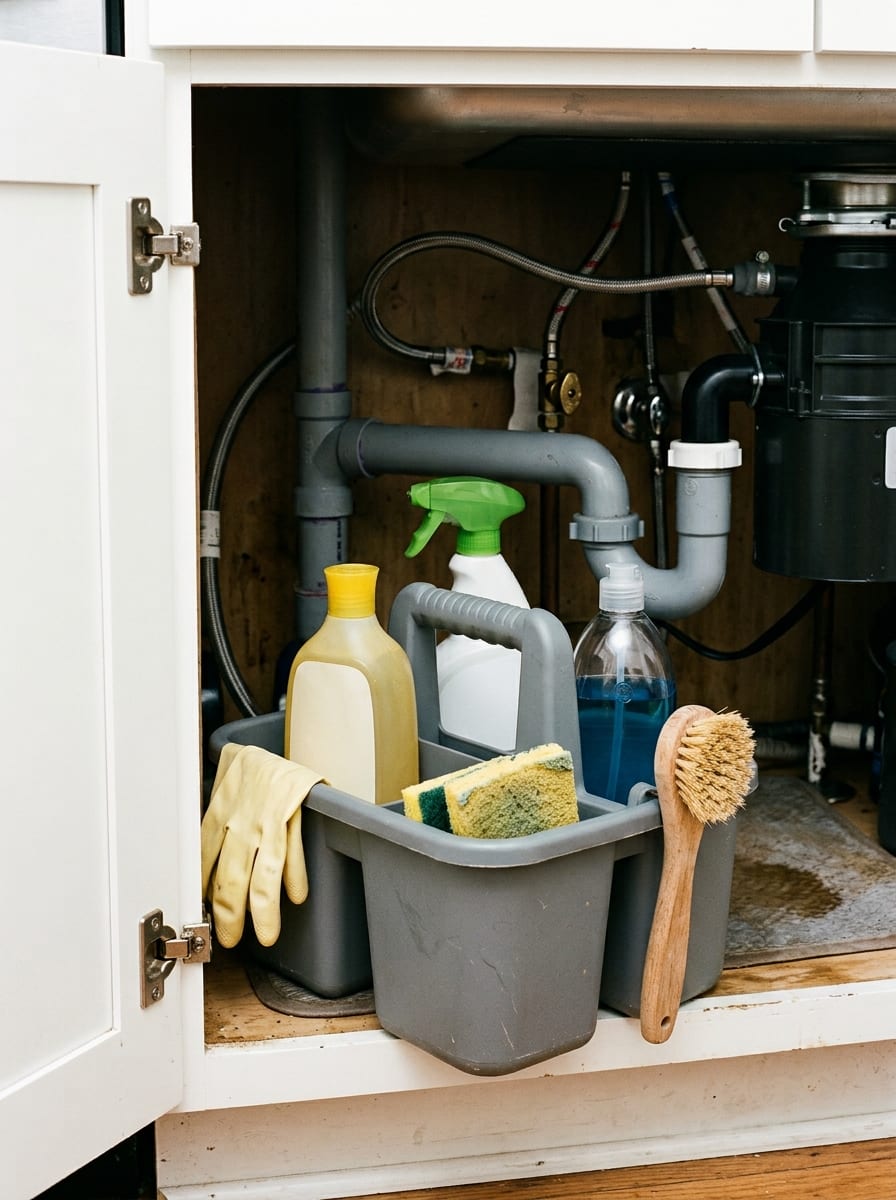
A handled caddy is one of the simplest under-sink organizers because it solves two problems at once.
It groups supplies and lets you remove them all together.
What belongs inside
Use it for everyday cleaning products such as:
multipurpose cleaner glass cleaner dish spray sponge scrub brush gloves
Why this works
Instead of reaching behind five bottles individually, you pull out one container.
That gives you immediate access to both:
the products the cabinet space behind them
Keep the category focused
Do not put every household cleaning product into the same caddy.
The under-sink cabinet should primarily serve the kitchen.
Bathroom cleaners and specialty products can live elsewhere.
Choose a low enough handle
A very tall handled caddy may collide with:
sink bowl plumbing cabinet frame
Measure first.
Store liquids upright
The caddy should be stable enough that bottles stay vertical.
3. The Double-Level Shelf Zone
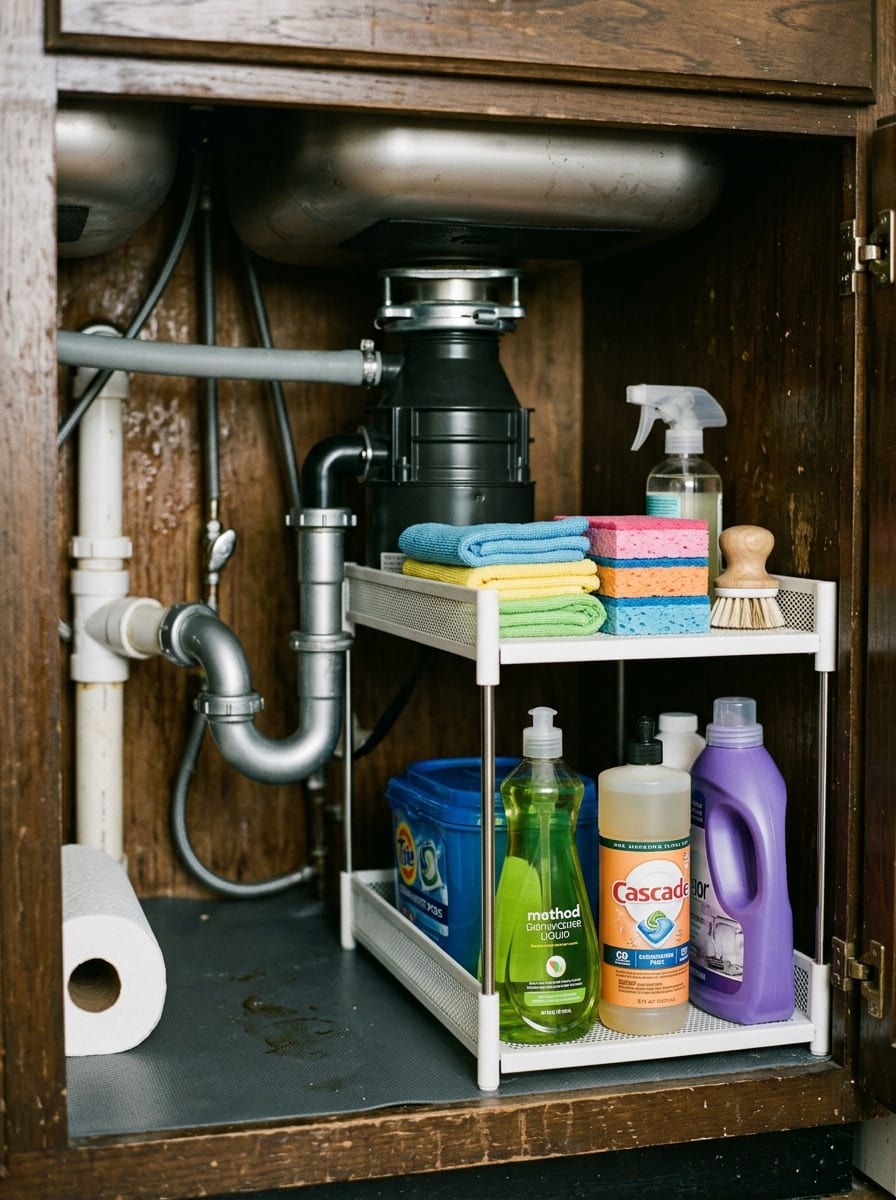
One of the biggest wastes of under-sink space is unused vertical height.
A small shelf riser can create a second usable level without requiring built-in cabinetry.
Best location
Place it where plumbing does not interfere.
Usually:
one side of the cabinet toward the front beneath an open section
works better than trying to span the whole cabinet.
Use the lower level for taller or heavier items
For example:
dishwasher tabs cleaning bottles refill packs
Use the upper level for lighter items
Such as:
sponges cloths small bins gloves
Why this works
You are using height that would otherwise remain empty.
Avoid stacking too high
The shelf needs enough clearance for you to remove products comfortably.
A second level is helpful.
Three or four stacked tiers usually become annoying under a sink.
Check sink-bowl depth
The sink itself may hang lower into the cabinet than expected.
Measure from:
cabinet floor → lowest sink point
before choosing shelf height.
4. The Cabinet-Door Storage Layer
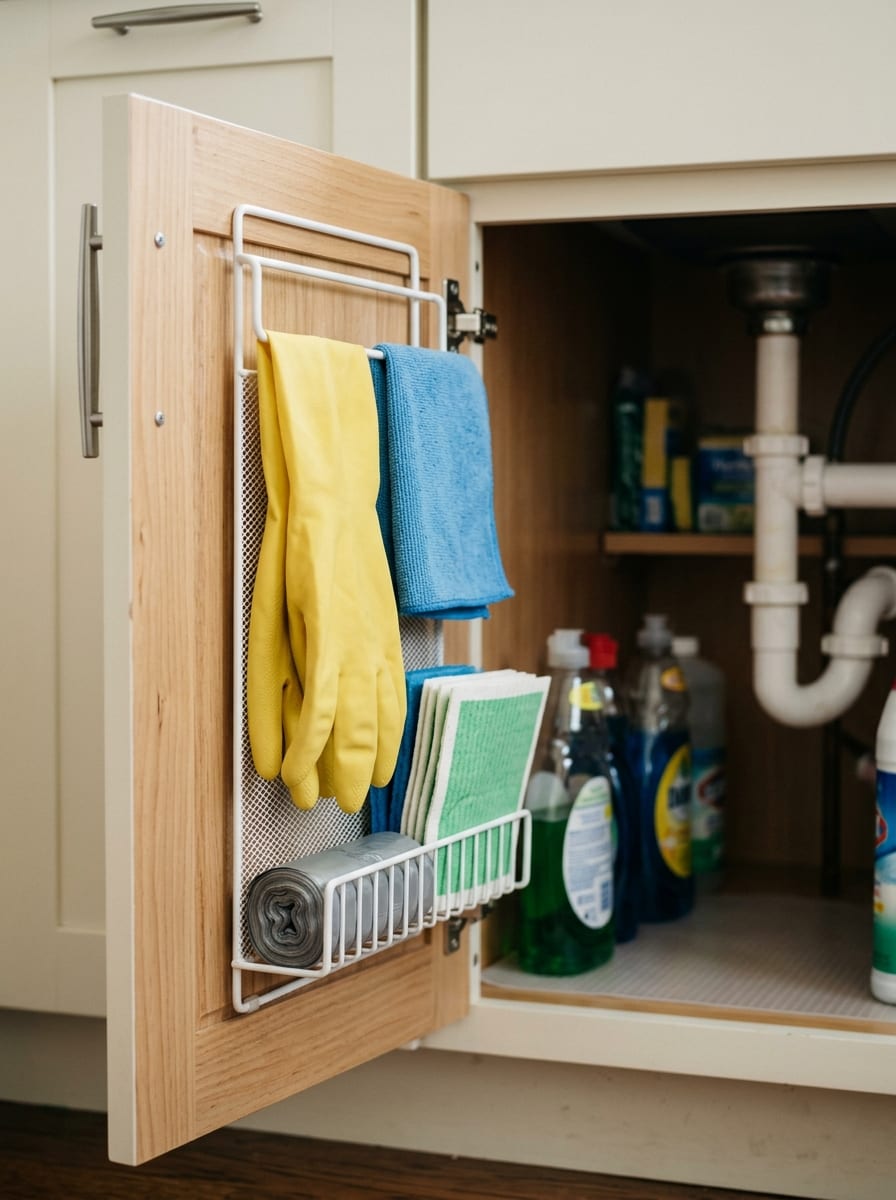
The inside of the cabinet door can hold lightweight, shallow items.
This is useful because it creates storage without competing with the plumbing.
Good items for the door
Consider:
cleaning gloves sponge dish brush lightweight cloths small trash-bag roll dishwasher tablets in an appropriate container
Keep the organizer shallow
The cabinet still needs to close.
Check whether the organizer collides with:
bottles shelf riser pipe inner cabinet frame
Why this works
You gain an additional storage plane without shrinking the main cabinet floor.
Choose the attachment carefully
Options may include:
over-door hooks manufacturer-approved adhesive organizer built-in door rack where already present
If using adhesive in a rental, test the surface and follow the product instructions.
Avoid heavy storage here
The cabinet door is better for lightweight supplies.
Do not turn it into a shelf for large liquid bottles.
5. The Narrow Side-Bin System
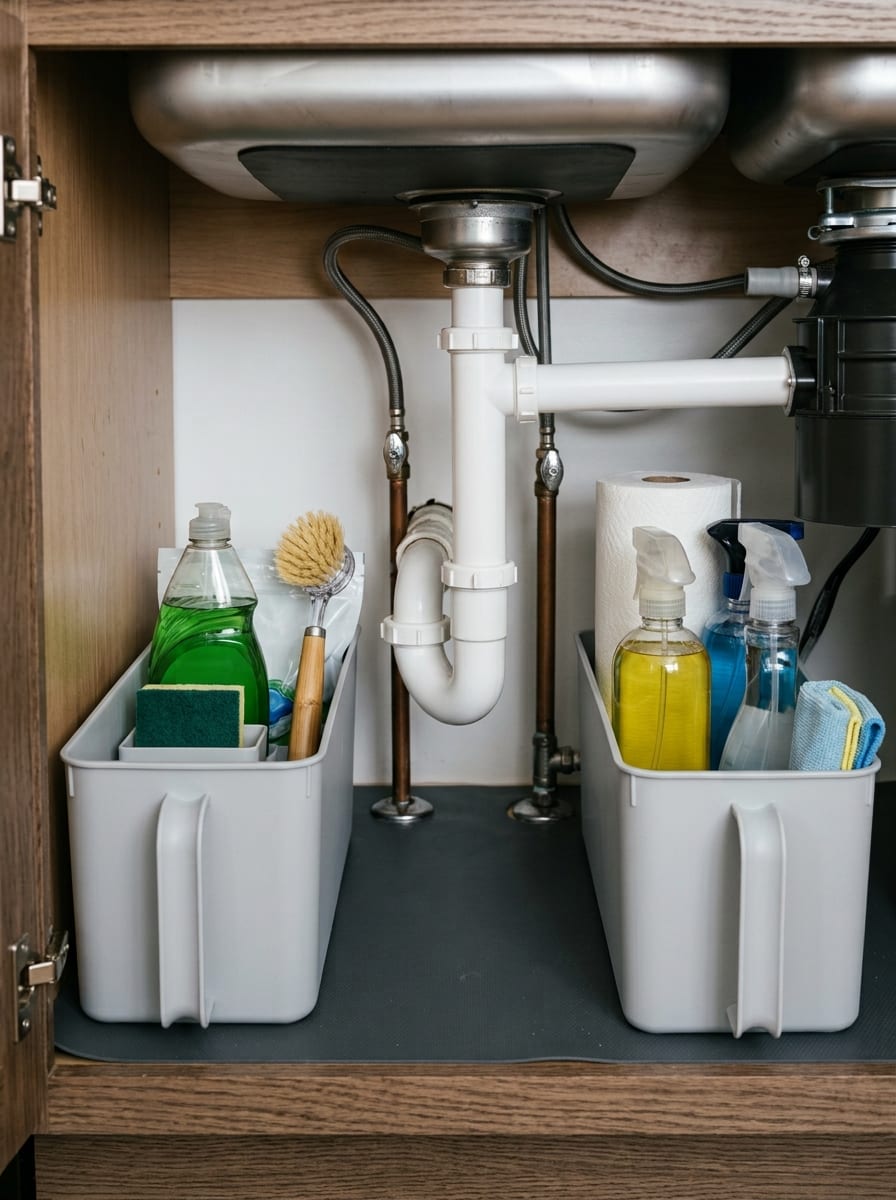
The spaces beside the plumbing are often the most usable parts of the cabinet.
Narrow handled bins can turn those awkward strips into clear categories.
Use one bin per function
For example:
Bin 1
Dishwashing supplies.
Bin 2
Surface cleaning.
Bin 3
Extra sponges and cloths.
Do not create ten tiny categories.
Why handled bins help
You can pull out the entire bin instead of reaching into the back.
This is especially useful in deep base cabinets.
Keep labels optional
If the categories are obvious, you may not need labels.
The system should be easy to maintain without turning into a project.
Choose rectangular bins carefully
Make sure the bin can clear:
hinges pipes door opening
while being pulled forward.
6. The Lazy-Susan Corner
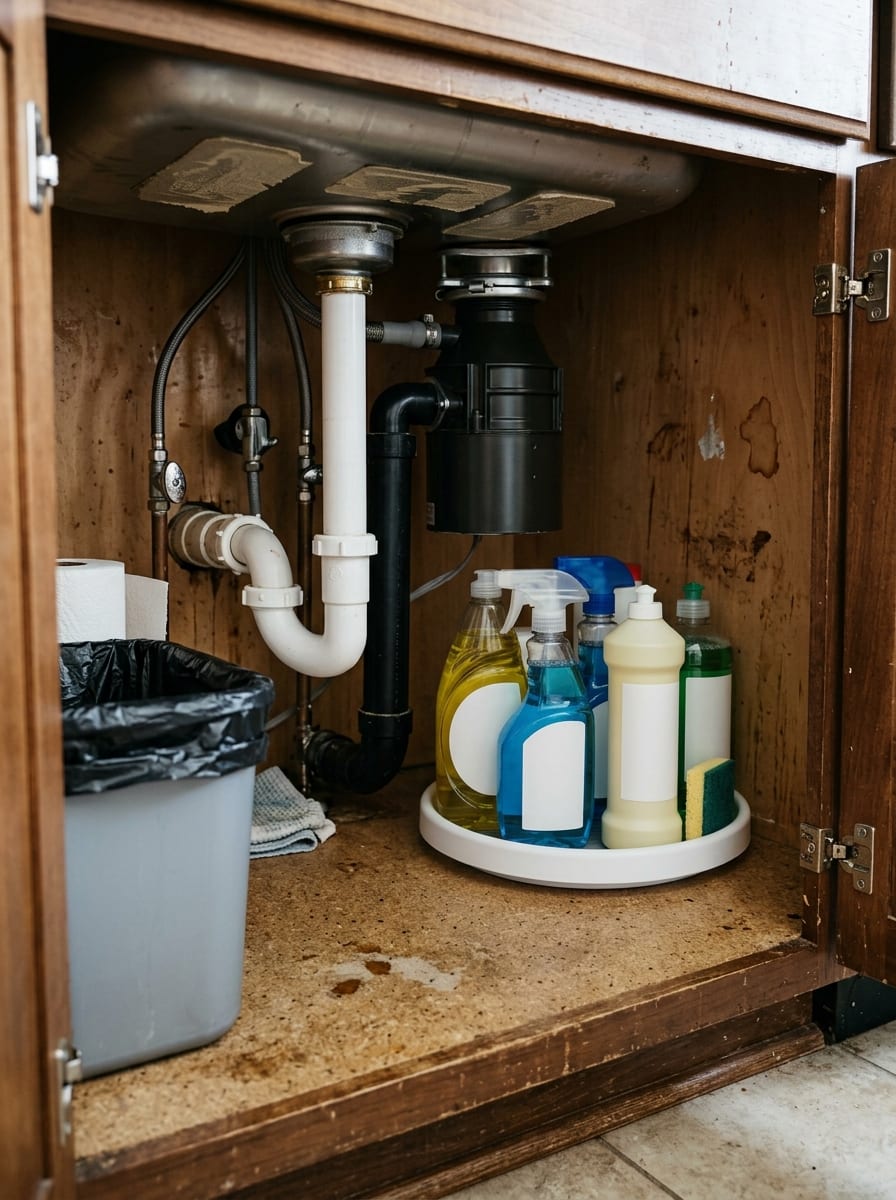
Deep under-sink cabinets can hide products in the back corners.
A small turntable can make one of those areas much easier to access.
Best for
Use it for:
spray bottles dishwasher additives cleaning concentrates small bottles
Why this works
Instead of reaching behind everything, rotate the tray.
You bring the back items forward.
Keep height consistent
A turntable works best when the bottles are not extremely different in height.
Very tall items may become unstable while rotating.
Use only where it can spin freely
The turntable must not collide with:
plumbing cabinet wall neighboring bin
Do not put heavy gallon bottles on it
Keep the load manageable.
7. The Cleaning-Cloth Drawer Bin
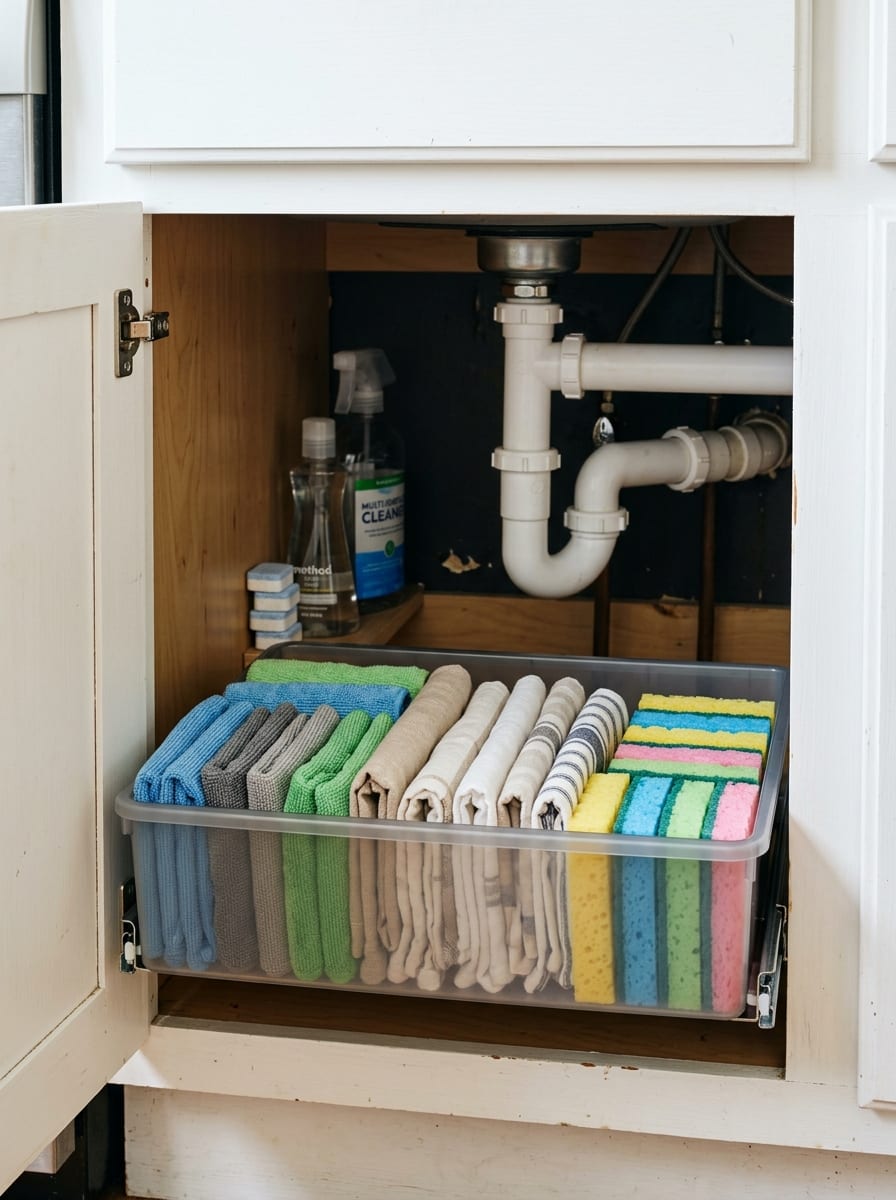
Cleaning cloths can take over an under-sink cabinet because they are soft and shapeless.
They get pushed:
behind bottles into corners under supplies
Give them one dedicated container.
Use a shallow bin
Good for:
microfiber cloths dish towels reusable cleaning wipes spare sponges
Fold vertically if possible
This lets you see each cloth without digging through a pile.
Keep wet cloths out
Do not store damp cloths in a closed bin.
Allow them to dry properly first.
Otherwise you may create:
odor mildew moisture problems
Limit quantity
You probably do not need dozens of cleaning cloths under the sink.
Keep a practical working set.
Store excess elsewhere.
8. The Backstock-Free Sink Cabinet
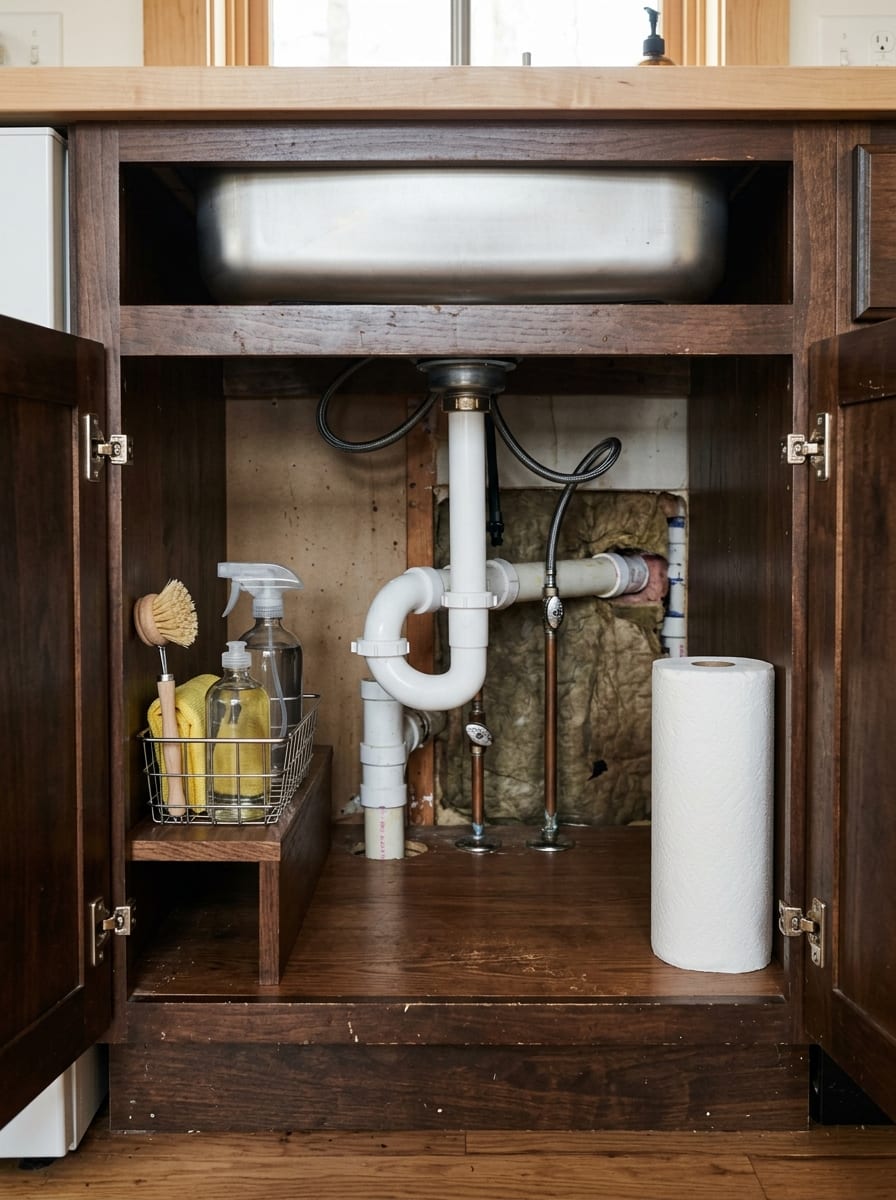
One of the easiest ways to make the under-sink cabinet unusable is to store too many duplicates.
For example:
three backup cleaners five dish soaps giant refill bottle extra trash bags bulk sponges
all compete for the same space.
Keep only what is active
A good rule is:
one active product + one backup maximum
for items you genuinely use frequently.
Move bulk storage elsewhere
If you buy large refills, store them in:
pantry cabinet utility closet laundry area secondary household storage
if appropriate.
Why this matters
The under-sink cabinet should be a working cabinet, not a warehouse.
You need room to:
access products inspect plumbing clean spills
Use the cabinet for frequency, not quantity
High-use items deserve this prime location.
Bulk extras do not.
9. The Leak-Ready Storage Tray
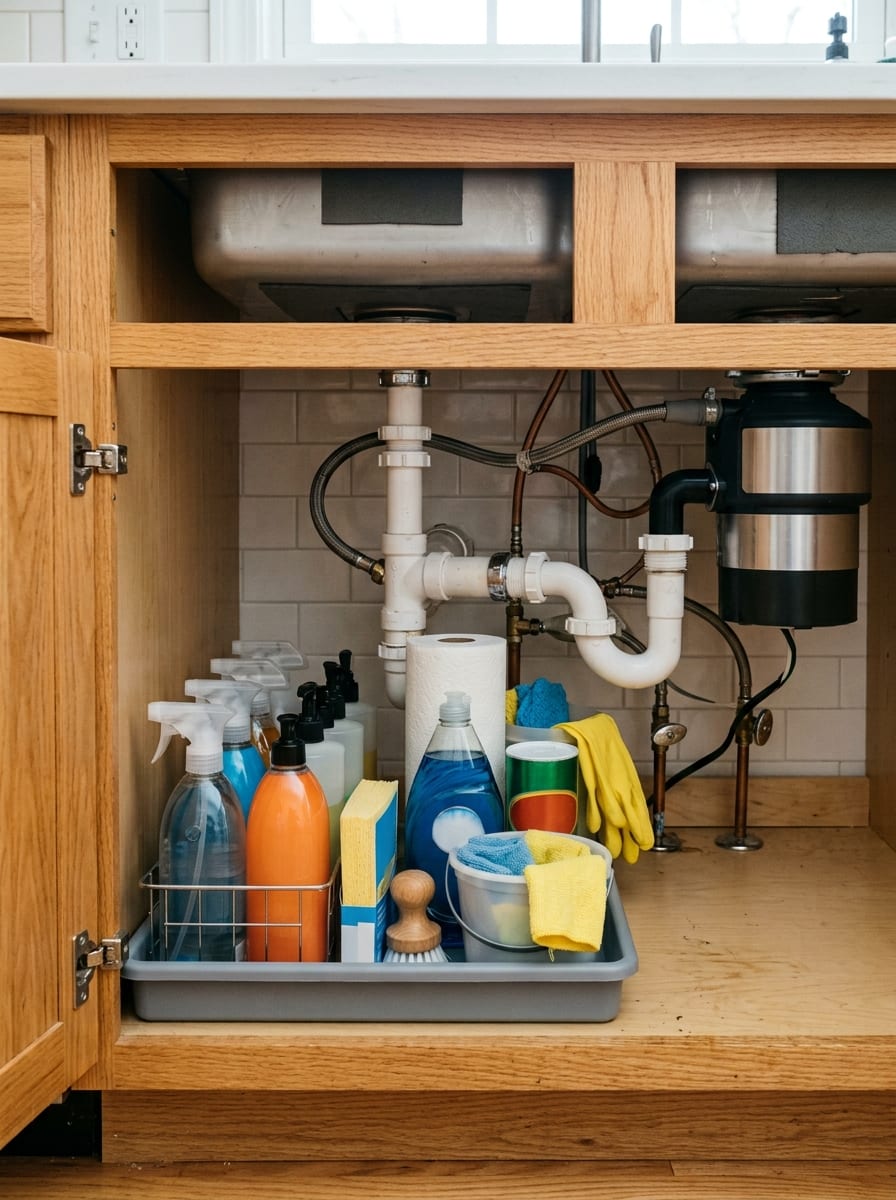
Under-sink storage has one risk most other cabinets do not.
Water.
Even a minor leak can damage:
cardboard paper packaging cleaning cloths cabinet base
Use a waterproof or water-resistant tray
A shallow tray or liner can sit beneath the main storage zone.
It can help contain minor drips long enough for you to notice the problem.
Keep the cabinet base visible
Do not completely cover the floor with layers of baskets and containers.
You want to be able to see:
moisture discoloration leaks
Avoid cardboard storage
Cardboard can:
absorb water soften hide moisture
Plastic or other moisture-resistant containers are generally more practical under a sink.
This is organization and maintenance
An organized cabinet should also make problems easier to spot.
10. The One-Minute Reset Rule
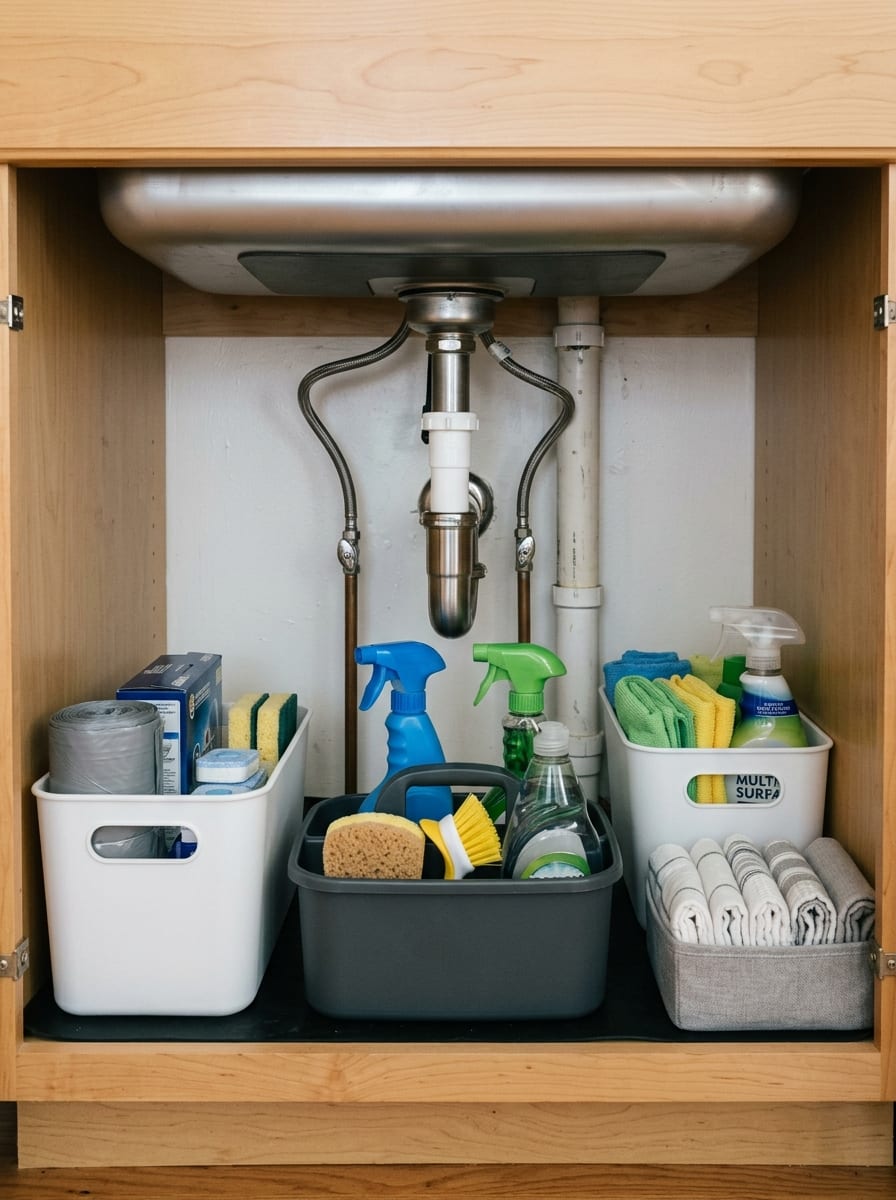
The best organization system is the one that returns to order quickly.
Under-sink cabinets get messy because products are used constantly.
So build a system that can be reset in about one minute.
Every item should have one obvious destination
For example:
sprays → caddy cloths → shallow bin dish supplies → side bin trash bags → door organizer
Do not create complicated categories
If putting something away requires:
removing a bin opening another container moving another product placing it behind something
the system is too complicated.
Keep the front for daily use
Frequent products should be easiest to reach.
Occasional supplies can sit farther back.
Reset once a week
Check for:
empty bottles duplicate products damp cloths spills leaking containers
A tiny cabinet stays functional when clutter is removed early.
Start by Emptying the Entire Cabinet
Do not organize around the current mess.
Take everything out.
Then clean the cabinet floor and inspect:
plumbing water stains leaks damaged liners loose fittings
If there is evidence of an active plumbing issue, address that before reorganizing.
Storage should never hide a maintenance problem.
Group What You Actually Use
Create simple categories.
For example:
Daily cleaning dish soap spray cleaner sponge
Weekly cleaning stronger surface cleaner scrub brush gloves
Disposable supplies trash bags dishwasher tablets
Cleaning textiles cloths sponges
If an item does not fit one of the categories and is rarely used, consider moving it elsewhere.
What Should Not Live Under the Kitchen Sink?
Avoid using this cabinet as a random storage area.
Items that may be better elsewhere include:
food pet food paper goods susceptible to moisture medications unrelated household supplies large bulk refill packages
The exact storage rules depend on the product, so always follow manufacturer guidance.
How to Organize Around a Garbage Disposal
A garbage disposal can consume a significant portion of the cabinet.
Treat the disposal body as a fixed obstacle.
Use:
narrow bins on each side door storage front-zone caddy
rather than trying to place one large organizer underneath it.
Keep wiring and plumbing accessible.
How to Organize Around a Large Drainpipe
If the drainpipe runs through the center, create two separate storage columns.
For example:
Left side
Cleaning caddy.
Right side
Bins and cloths.
Do not fight the pipe.
Design around it.
What About Stackable Drawers?
Small pull-out drawers can work if they fit around the plumbing.
They are useful for:
sponges tablets gloves cloths
But be cautious with tall drawer towers.
The sink bowl often hangs lower into the cabinet than expected.
Measure first.
Pull-Out Organizer vs Simple Bin
Pull-out organizer
Best if:
cabinet is deep plumbing leaves a clean rectangular zone you need frequent access
Simple bin
Best if:
plumbing is irregular cabinet is very small you rent you want flexibility
Simple bins are often easier to adapt.
How Many Cleaning Products Do You Really Need Under the Sink?
Usually fewer than the cabinet contains.
Many households accumulate:
specialty cleaner another specialty cleaner duplicate spray half-empty bottle discontinued product
Keep the products you actually use.
A less crowded cabinet is easier to maintain.
Should You Decant Cleaning Products?
Usually, original packaging is preferable for many household chemicals because it includes:
instructions safety information warnings identification
Do not transfer cleaning products into food or beverage containers.
Follow the product label and storage guidance.
The under-sink cabinet should be organized safely, not just aesthetically.
How to Store Trash Bags
Trash bags often become a bulky cardboard box under the sink.
Possible options include:
compact dispenser door-mounted holder small bin original roll in one side zone
Keep only the active roll in the prime cabinet if bulk storage is taking too much room.
How to Store Dishwasher Tablets
Keep them:
dry sealed safely stored according to manufacturer instructions
A small closed container or original packaging can work.
If children or pets have access to the area, follow all required safety precautions.
Use Clear Containers Selectively
Clear bins can help because you can see contents.
But you do not need every organizer to be transparent.
The important thing is that each category is easy to recognize and retrieve.
A mix of:
clear bin handled caddy shallow tray
can work perfectly.
Do You Need Labels?
Not necessarily.
If one bin clearly contains:
cloths
and another clearly contains:
dish supplies
labels may add nothing.
Use labels only if they reduce confusion.
Organization should simplify the cabinet, not create more maintenance.
Avoid Overfilling the Cabinet
A useful target is to leave some visible empty space.
That makes it easier to:
move products see plumbing notice leaks clean the cabinet
Storage efficiency is not the same as filling every cubic inch.
A Simple Under-Sink Setup
For a very small cabinet:
Front
One cleaning caddy.
Side 1
Dishwashing bin.
Side 2
Cloth bin.
Door
Lightweight accessories.
Floor
Water-resistant tray.
That may be enough.
A More Complete Setup
If the cabinet is larger:
Front center
Cleaning caddy.
One side
Shelf riser.
Other side
Two narrow bins.
Back corner
Small turntable.
Door
Gloves and trash bags.
Still leave the plumbing visible.
Common Under-Sink Organization Mistakes
Buying organizers before measuring the pipes
The products may not fit.
Filling every empty inch
You still need access.
Storing too much backstock
Bulk products crowd out daily supplies.
Putting heavy bottles on the cabinet door
Keep door storage light.
Hiding shutoff valves
Always preserve access.
Storing wet cloths in closed bins
Let them dry first.
Using cardboard boxes
Moisture makes them a poor long-term choice.
Over-decanting cleaning chemicals
Safety and product information matter.
Ignoring leaks
Organization should make them easier to notice, not easier to hide.
The Best Order for Organizing Under the Sink
Use this sequence:
1. Inspect plumbing
Understand the obstacles.
2. Remove unnecessary products
Reduce volume first.
3. Assign daily-use zone
Usually the front.
4. Add bins around the pipes
Not across them.
5. Use vertical space selectively
Shelf riser or drawer only where it fits.
6. Add door storage
For lightweight items.
7. Leave some space empty
For access and maintenance.
That order keeps function ahead of appearance.
Which Idea Fits Your Cabinet?
Choose Plumbing-First Layout if:
Your pipes dominate the cabinet.
Choose a Pull-Out Caddy if:
You use the same cleaning products every day.
Choose a Shelf Riser if:
You have unused vertical height on one side.
Choose Door Storage if:
The cabinet floor is crowded.
Choose Narrow Bins if:
You have usable strips beside the plumbing.
Choose a Turntable if:
Products disappear in the back corner.
Choose a Cloth Bin if:
Sponges and towels are scattered everywhere.
Remove Backstock if:
The cabinet is simply holding too much.
Add a Waterproof Tray if:
You want easier leak detection and cleanup.
Use the One-Minute Reset if:
The cabinet keeps returning to chaos.
Final Thoughts
The space under the kitchen sink will probably never be perfectly symmetrical.
It does not need to be.
The best system works with the awkward parts.
Start with:
plumbing → daily supplies → side zones → vertical space → cabinet door
Keep valves accessible.
Limit backstock.
Use bins that can be removed quickly.
And leave enough open space to see what is happening inside the cabinet.
When every product has an obvious place and the plumbing is still easy to reach, even a very small under-sink cabinet can work surprisingly well.