9 Small Kitchen Drawer Organization Ideas That Make Every Inch Easier to Use
Make cramped kitchen drawers easier to use with these 9 organization ideas for utensils, spices, wraps, food containers, deep drawers, dividers, and everyday cooking tools.
In This Guide
Small kitchen drawers are easy to underestimate.
They look simple because they are shallow rectangles, but they often become some of the least efficient storage in the entire kitchen.
One drawer holds utensils.
Another becomes a mix of measuring cups, batteries, rubber bands, takeaway menus, bottle openers, tape, and two mystery keys.
A deep lower drawer gets filled with pots but becomes impossible to close because lids slide sideways.
A narrow drawer becomes a graveyard for foil boxes, clips, scissors, and oven thermometers.
The problem is usually not that the drawer is too small.
It is that the drawer has no clear category, boundary, or access logic.
Good drawer organization should make one question easy to answer:
Can you find and remove the item you need without moving five other things first?
That is the standard.
Not whether every compartment matches.
Not whether every utensil has a custom slot.
Not whether the drawer looks perfect in a photograph.
In a small kitchen, drawer organization works best when you think about:
- drawer depth
- drawer width
- item frequency
- tool length
- nesting ability
- category overlap
- how often the contents change
Here are nine ways to make small kitchen drawers easier to use without stuffing them with unnecessary organizers.
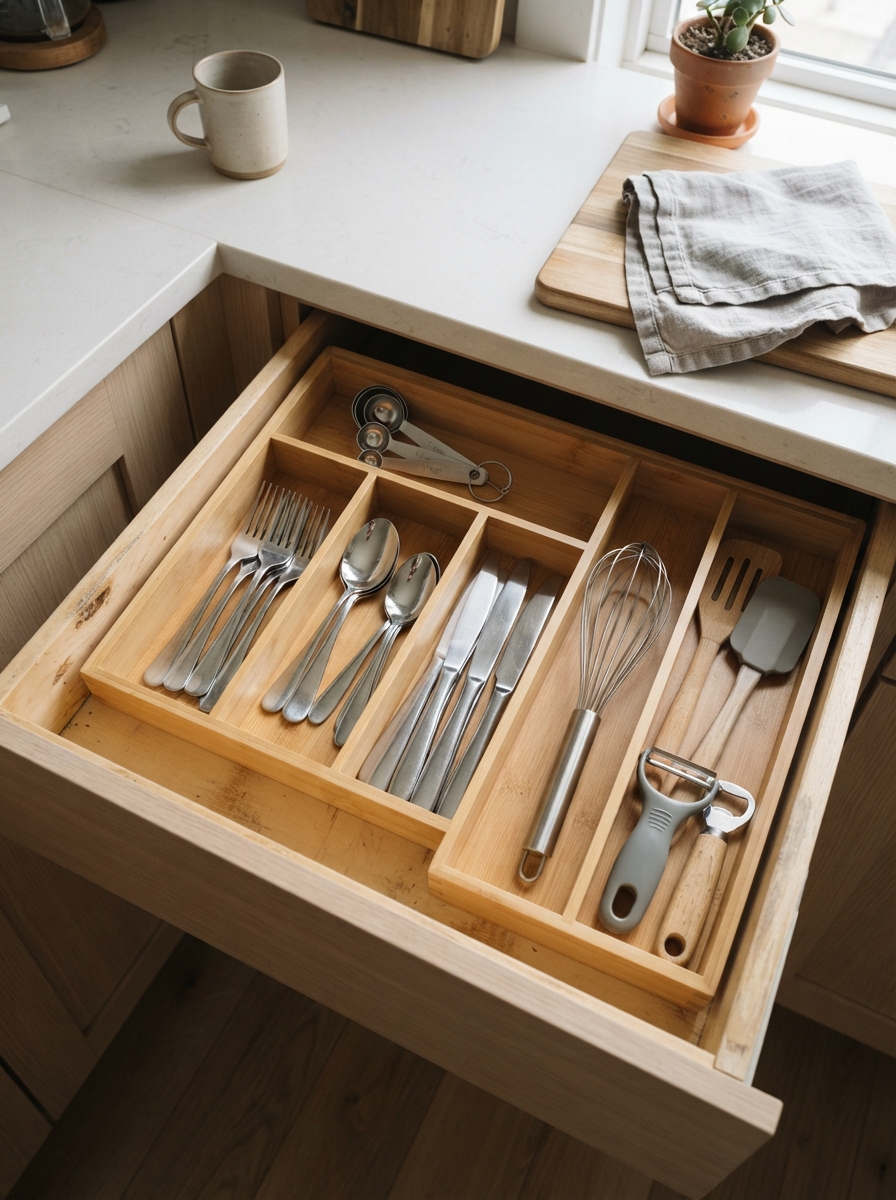
1. Give One Drawer to Everyday Utensils Only
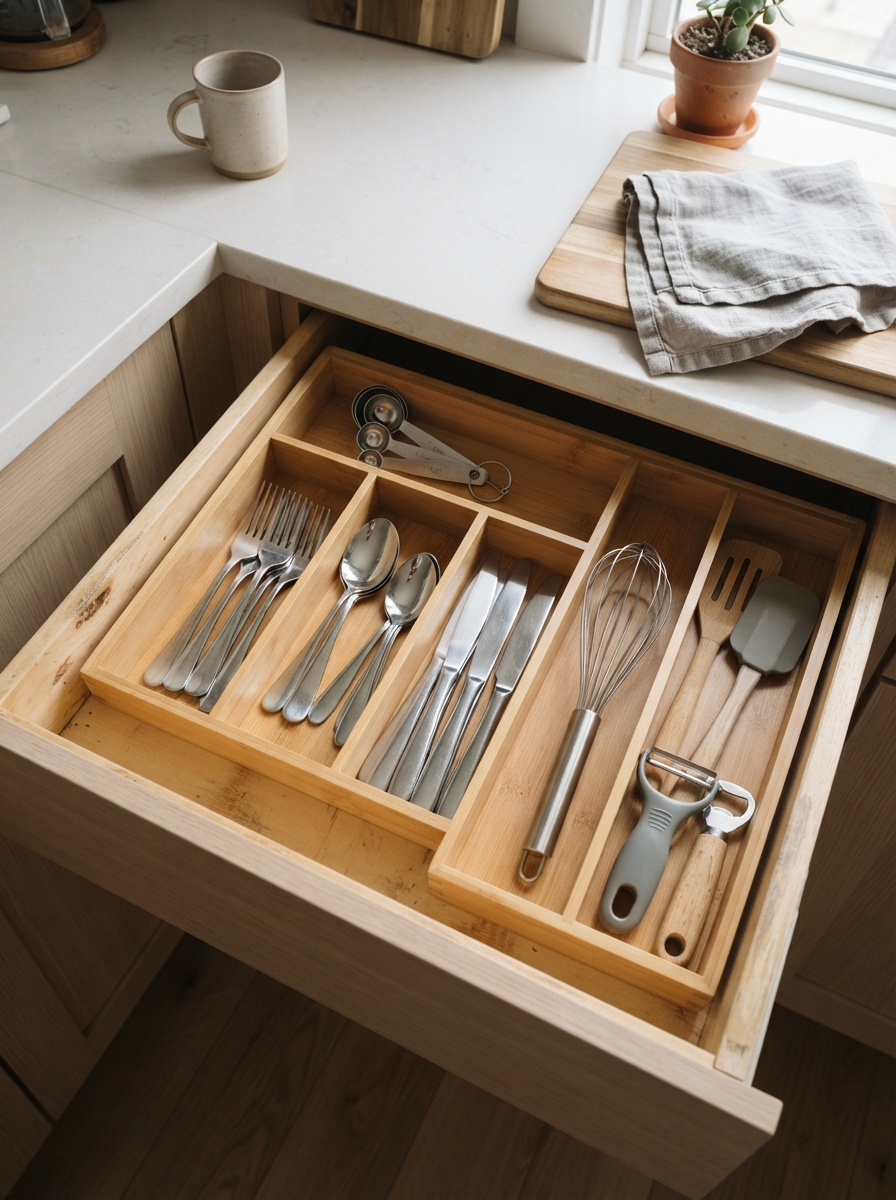
The most-used utensil drawer should not contain every cooking tool you own.
It should contain the tools you reach for constantly.
Think:
- everyday cutlery
- cooking spoon
- small spatula
- vegetable peeler
- bottle opener
- measuring spoons
If something is used once a month, it probably does not need to occupy the prime-access drawer.
Why this matters in a small kitchen
The easiest drawer is valuable storage.
When rarely used gadgets fill it, the everyday tools become harder to reach.
That creates the familiar problem where you open the drawer and everything slides around because too many categories are sharing the same space.
Use fewer compartments
A cutlery tray with five or six sections is often enough.
You do not need a separate slot for every individual utensil type.
Keep similar objects together:
- forks
- spoons
- knives
- small cooking tools
- miscellaneous daily-use pieces
Leave a little empty room
A drawer packed to 100% capacity becomes harder to maintain.
Leave enough space that items can be returned without forcing them into place.
2. Use Expandable Dividers When the Drawer Width Is Awkward
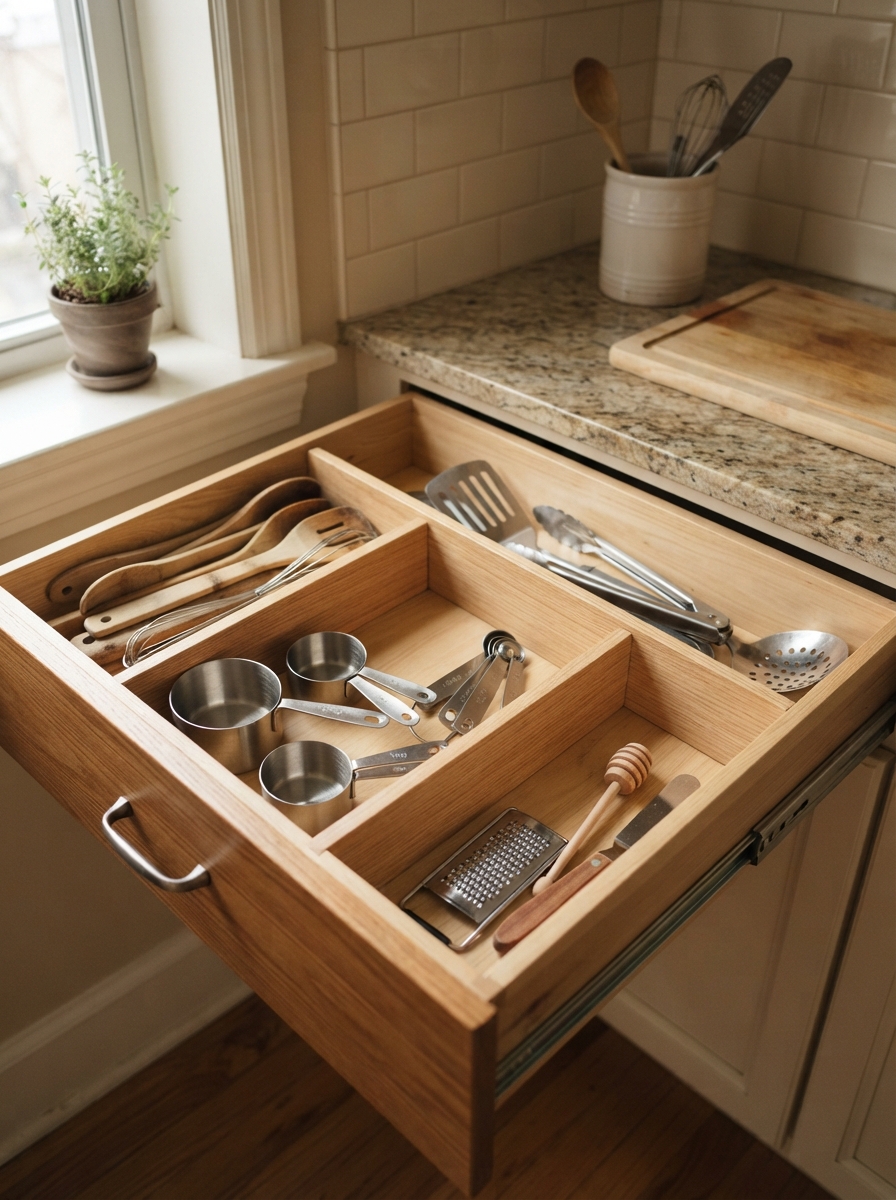
Pre-made trays are convenient, but they often waste space around the edges.
If your drawer is unusually narrow or wide, adjustable dividers may use the interior width more efficiently.
Instead of inserting one fixed organizer, create custom lanes for the tools you actually own.
For example:
Lane 1: long wooden spoons
Lane 2: spatulas and tongs
Lane 3: measuring tools
Lane 4: open space for changing needs
Why adjustable dividers work
They respond to the drawer rather than forcing the drawer to respond to the organizer.
That matters in apartment kitchens where cabinet dimensions may be older, non-standard, or unusually tight.
Keep categories broad
Do not create twelve tiny compartments.
Too many narrow lanes make the system inflexible.
A better approach is three or four clear zones.
Check tool length
Measure the longest utensil before installing dividers.
Some drawers are wide enough but not deep enough for long spatulas placed front-to-back.
In that case, organize them side-to-side instead.
3. Store Food-Container Lids Vertically Instead of Stacking Them
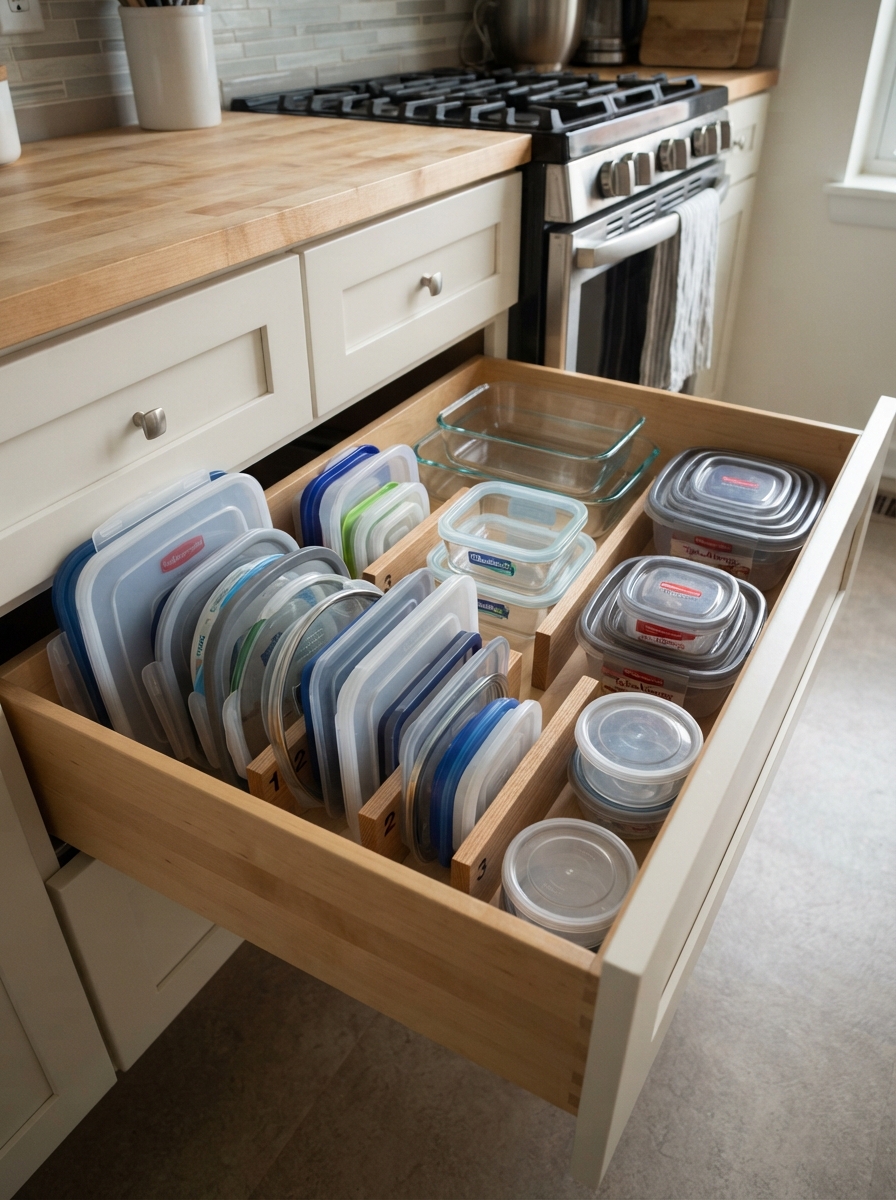
Food-storage lids are one of the fastest ways to make a drawer feel chaotic.
When stacked horizontally, the lid you need is almost always underneath several others.
Vertical storage works better.
Use a narrow divider or simple file-style organizer so the lids stand upright.
Group them by size:
- small
- medium
- large
If possible, keep matching containers nearby in another drawer or cabinet.
Do not organize every lid individually
You do not need one slot per lid.
The goal is simply to stop them collapsing into a pile.
Check whether you still need all of them
Before organizing, match every lid to a container.
Discard or recycle damaged pieces appropriately and remove orphaned lids that no longer fit anything.
Organization cannot fix unnecessary duplicates.
Best drawer type
A medium or deep drawer usually works better than a very shallow one because lids need enough height to stand upright.
4. Turn a Shallow Drawer Into a Flat Spice Library
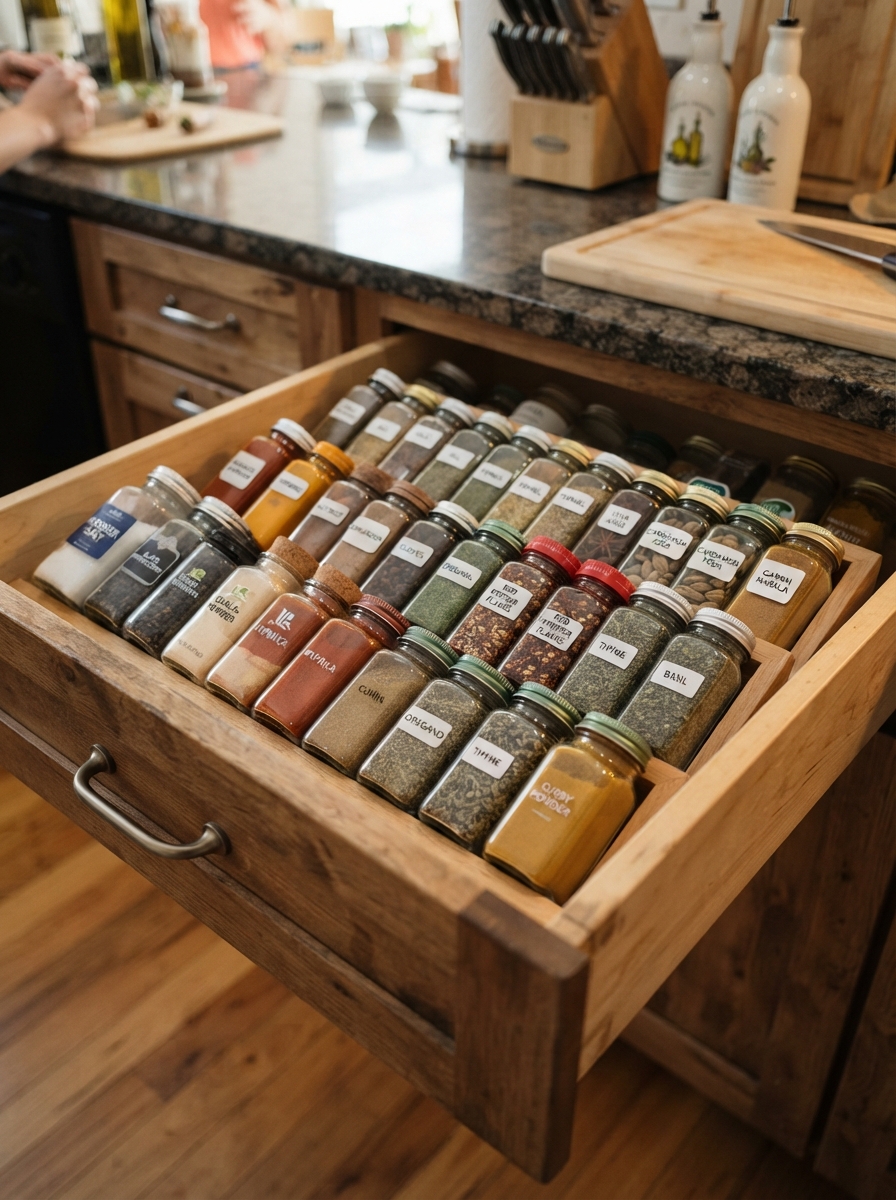
Spices often disappear in upper cabinets because labels are difficult to read from the front.
A shallow drawer can solve that.
Lay jars at a slight angle or flat with labels facing upward.
This lets you scan the entire collection at once.
Best location
Place the spice drawer near the main food-prep or cooking zone, but not where excessive heat could affect the contents.
Follow normal storage guidance for the specific products.
Alphabetical vs. use-based organization
You can organize spices alphabetically, but many small kitchens benefit more from frequency.
For example:
front: salt, pepper, garlic, paprika, cumin
middle: regular baking and cooking spices
back: specialty spices
The system should match how you cook.
Avoid filling the drawer with duplicates
Before buying more jars, check what you already have.
Several half-used containers of the same spice can waste more drawer space than poor organization.
5. Make One Narrow Drawer a Foil, Wrap, and Bag Station
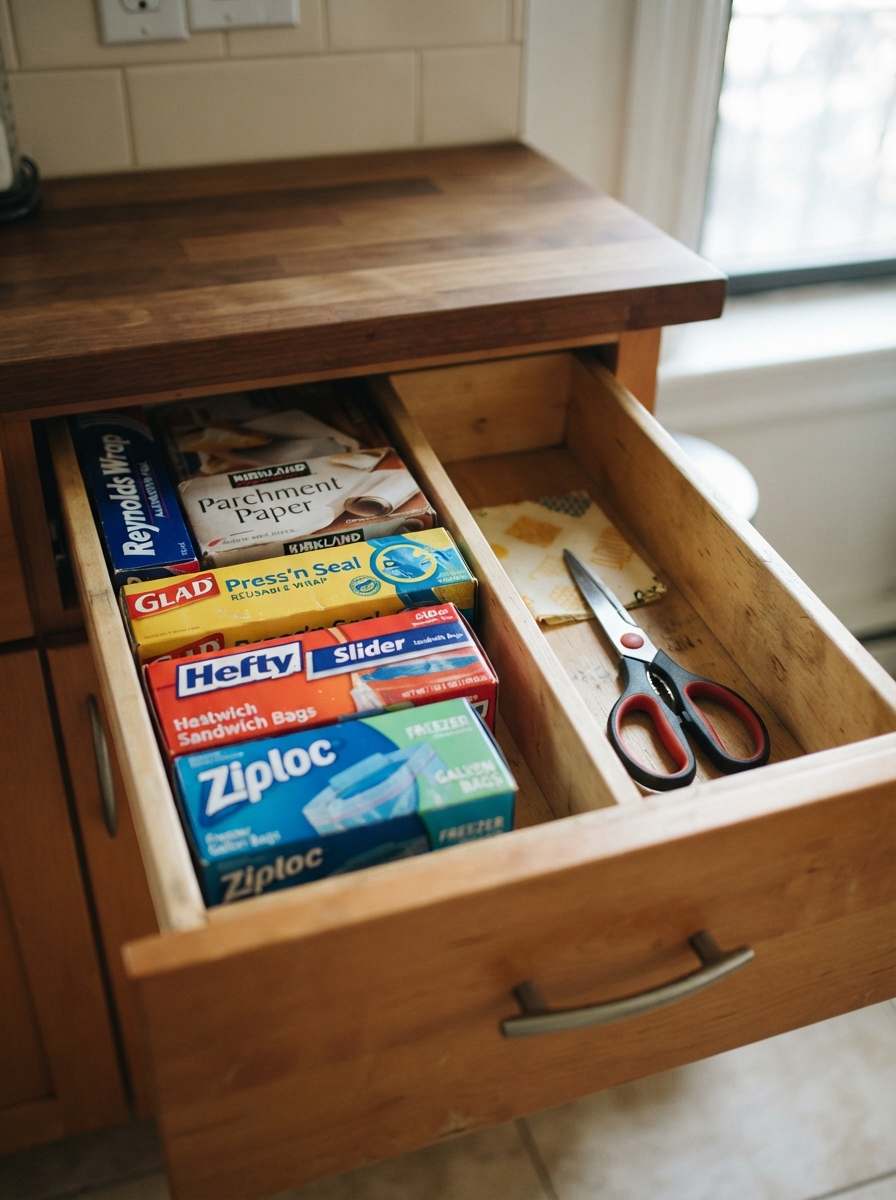
Boxes of foil, parchment, plastic wrap, and food-storage bags often get scattered across several cabinets.
A narrow drawer can hold these efficiently because most packages are long and relatively flat.
Group:
- aluminum foil
- baking paper
- reusable food wraps
- sandwich bags
- freezer bags
- bag clips
Do not transfer everything unnecessarily
You may see custom built-in wrap dispensers online.
They look clean, but transferring rolls into another holder is not always more practical.
If the original boxes already fit the drawer and cut properly, keep them.
The objective is easy access, not removing packaging for aesthetic reasons.
Store the most-used roll nearest the front
If parchment paper is used constantly and freezer bags are occasional, organize by frequency rather than package type.
Keep sharp items separated
If scissors live in the same drawer, give them a separate zone so they do not disappear underneath boxes.
6. Use Deep Drawers for Pots and Pans—But Store Lids Separately
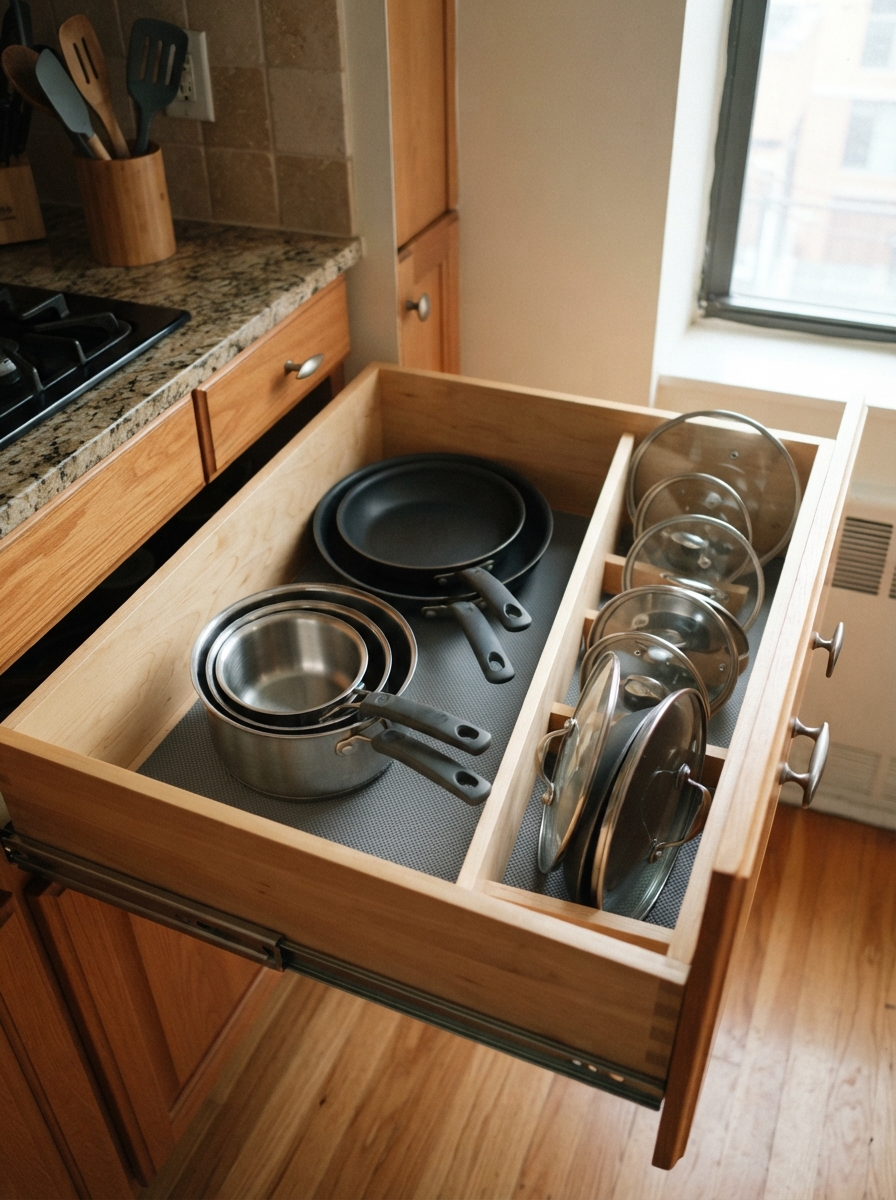
Deep drawers can be more useful than lower cabinets because the entire contents move toward you.
But pots and pans quickly become difficult to manage if lids are thrown into the same pile.
Use the deep drawer for nested cookware and create a separate vertical section for lids.
Nest by diameter
Place:
- largest pot at bottom
- smaller pot inside
- frying pans nested together where finish allows
- protective separators between delicate surfaces if needed
Keep lids upright
Use a divider near the side or back.
This makes lids visible without stacking them on top of the cookware.
Do not create a dangerous stack
If a nested pile becomes so tall that cookware shifts when the drawer opens, reduce the stack.
The drawer should move smoothly.
Consider weight
Heavy cast iron or very large cookware can create substantial drawer loads.
Follow the cabinet hardware’s load rating and avoid exceeding what the drawer is designed to support.
7. Nest Cooking Tools by Shape Instead of Giving Each One a Slot
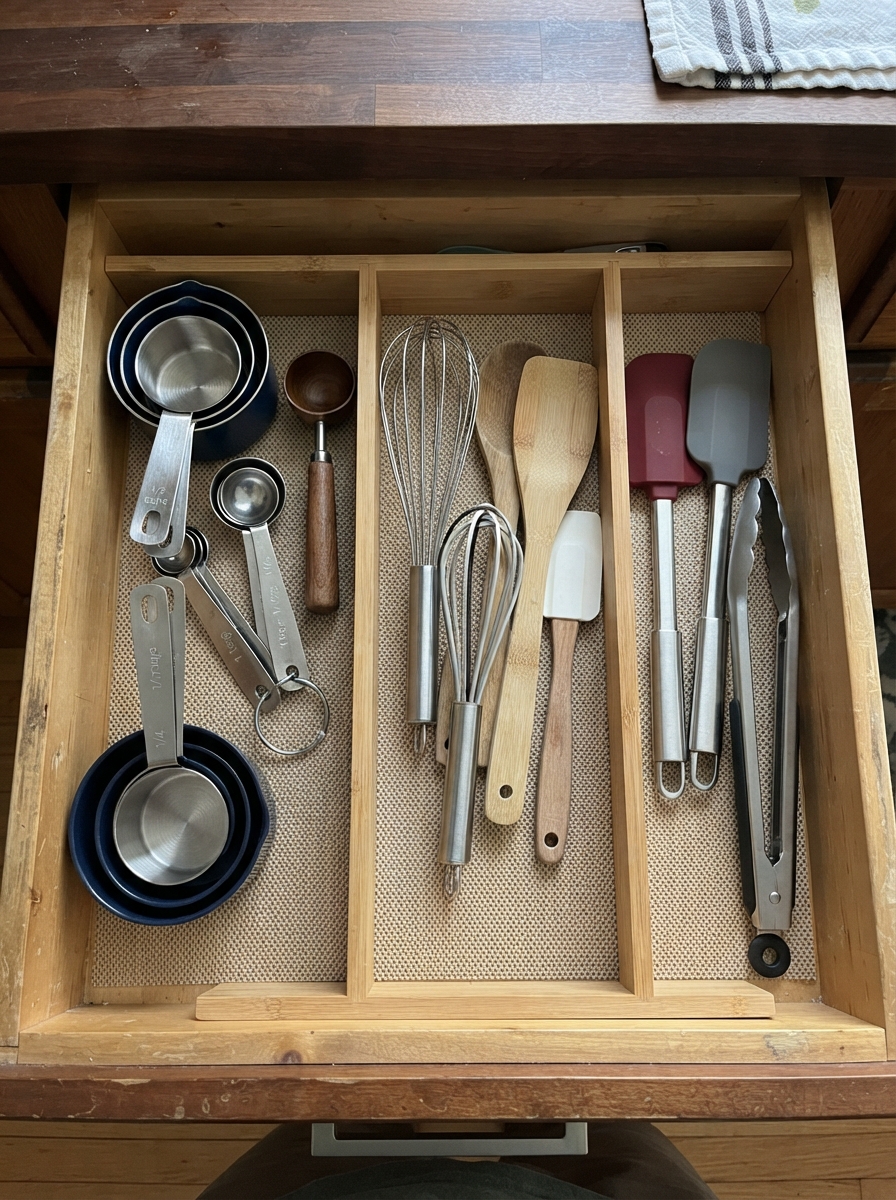
Not every cooking tool needs an individual compartment.
That approach often wastes space.
Instead, organize odd-shaped tools by how they nest.
For example:
- measuring cups nest together
- measuring spoons clip together
- whisks share one zone
- silicone spatulas sit together
- tongs lie in one long section
Why shape-based grouping works
Small drawers often contain tools that are not uniform.
A rigid tray may leave unusable pockets around each object.
A broader zone allows related tools to overlap slightly without becoming chaotic.
Watch tool handles
Very long handles can prevent the drawer from closing or cause utensils to jam.
If a tool is too long, store it:
- diagonally
- in a deeper drawer
- in a countertop crock if frequently used
Avoid the “everything kitchen gadget” drawer
If you own:
- avocado slicer
- cherry pitter
- egg separator
- melon baller
- pastry wheel
ask how often each one is actually used.
Specialty gadgets can consume an entire drawer.
8. Give the Junk Drawer Strict Boundaries Instead of Eliminating It
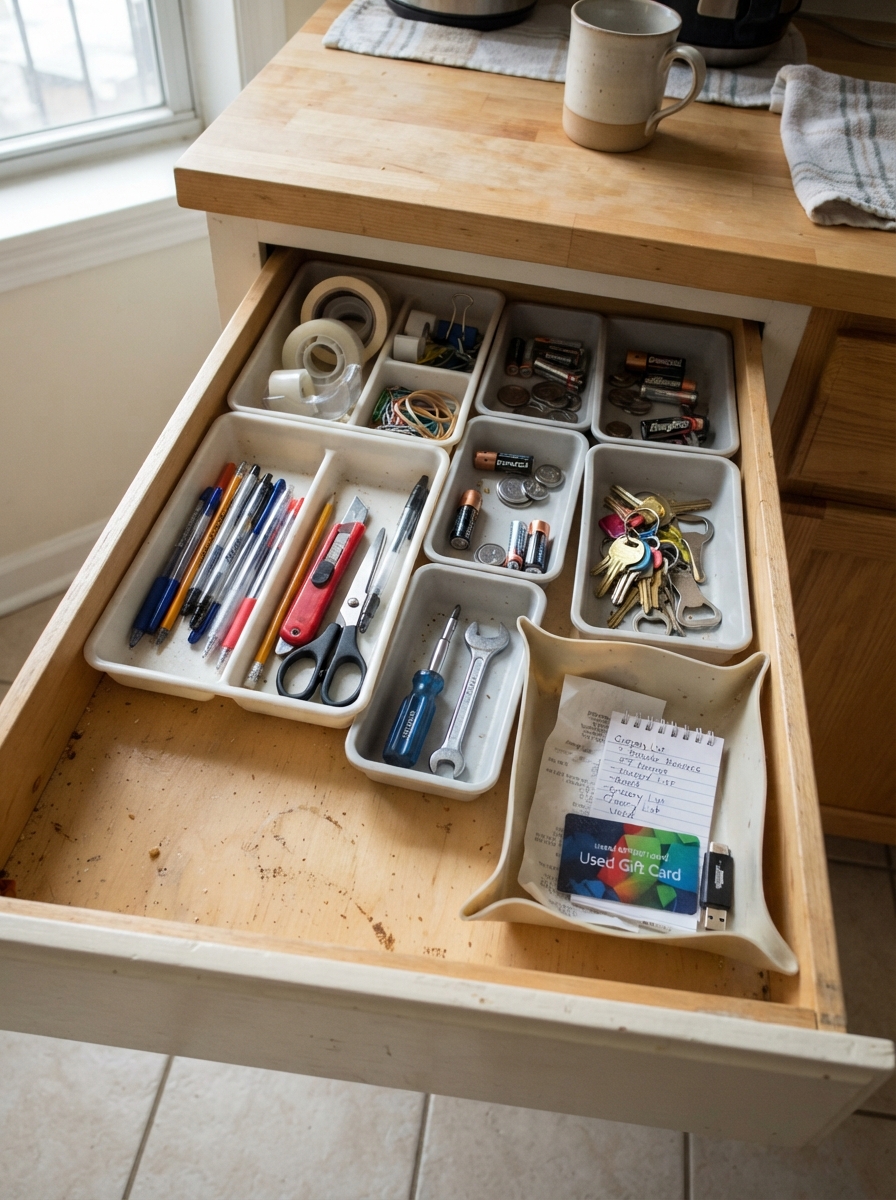
A junk drawer is not automatically bad.
Most homes need a place for small miscellaneous objects.
The problem is when “miscellaneous” becomes unlimited.
A functional small-kitchen junk drawer should have a defined list of categories.
For example:
- pens
- small tape roll
- scissors
- clips
- batteries
- spare keys
- one small screwdriver
- takeaway clips
That is enough.
Use small removable trays
Unlike utensil drawers, the junk drawer benefits from smaller compartments because the objects are tiny and unrelated.
But avoid buying an organizer that fills every millimeter.
Leave one flexible compartment for temporary items.
Do a monthly reset
The junk drawer attracts things that do not belong anywhere.
Receipts, loose screws, expired coupons, random cables, and packaging accumulate quickly.
A one-minute reset occasionally keeps the drawer useful.
Keep unrelated paperwork elsewhere
The junk drawer should not become a filing cabinet.
9. Organize Drawers by Frequency, Not by What Fits
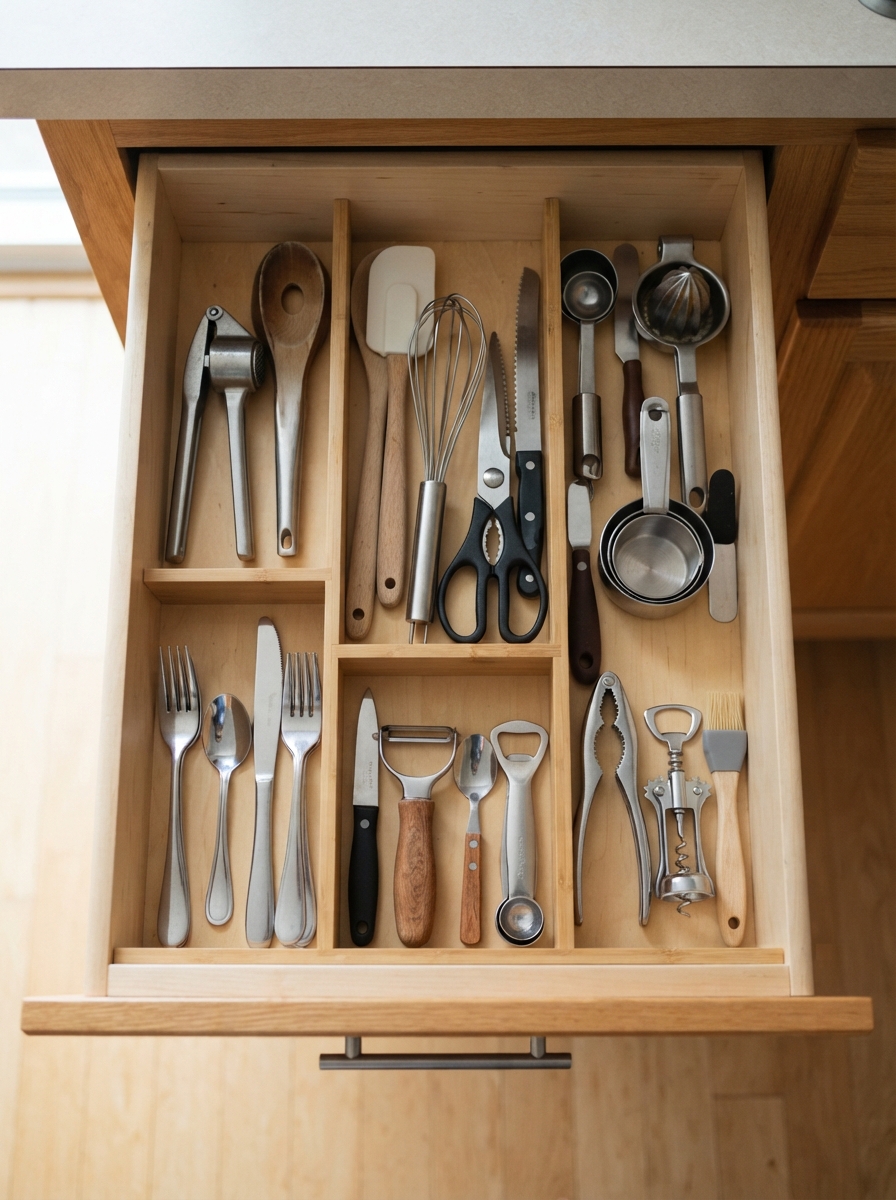
This is the most important principle.
A perfectly neat drawer can still be badly organized if the things you use every day are buried in the back.
Think of each drawer as having three access zones.
Front zone
Store the most-used items.
Examples:
- everyday cutlery
- cooking spoon
- peeler
- measuring spoons
- can opener
Middle zone
Use for regular but not constant items.
Examples:
- whisk
- grater
- bottle opener
- clips
- specialty spoons
Back zone
Use for lower-frequency pieces.
Examples:
- cake server
- specialty baking tool
- unusual opener
- holiday utensils
Why this works
Your hand naturally reaches into the front of a drawer first.
Use that behavior.
Do not place your most-used item behind a collection of things used once per month simply because they all belong to the same category.
Start by Emptying the Drawer Completely
Do not organize around existing clutter.
Remove everything first.
Then sort the contents into four groups:
daily
weekly
occasional
does not belong here
That last category is often the biggest improvement.
A drawer may feel too small because it contains:
- duplicate tools
- rarely used gadgets
- office supplies
- random packaging
- batteries
- appliance accessories
that should live elsewhere.
Only put things back once you know the job of the drawer.
Measure the Inside of the Drawer, Not the Cabinet Front
Drawer fronts are larger than usable drawer interiors.
Measure:
- internal width
- internal depth
- internal height
Also check whether the drawer sides taper or whether hardware intrudes into the interior.
An organizer that looks perfect online may waste an inch around every edge.
In a very small kitchen, those inches matter.
Shallow vs. Deep Drawers: Use Them Differently
Not every kitchen drawer should store the same type of item.
Shallow drawers
Best for:
- cutlery
- spices
- wraps
- flat tools
- measuring pieces
Medium drawers
Best for:
- cooking utensils
- containers
- lids
- towels
- small food-storage supplies
Deep drawers
Best for:
- cookware
- mixing bowls
- appliances
- nested containers
The deeper the drawer, the more important it becomes to organize vertically rather than piling things horizontally.
When Should You Use Drawer Dividers?
Use dividers when items:
- slide into each other
- become difficult to distinguish
- belong to separate categories
- need to stay upright
Do not use dividers simply because empty space exists.
A divider takes up some room itself.
If one category already stays neat without it, leave the space flexible.
Fixed Tray vs. Adjustable Dividers
Fixed tray
Best when:
- the drawer is a standard size
- the contents rarely change
- you need lots of small compartments
Ideal for cutlery.
Adjustable dividers
Best when:
- the drawer is unusual
- utensils vary in length
- categories change over time
- you want fewer broad zones
Ideal for cooking tools.
In many small kitchens, using both styles in different drawers works better than choosing one system everywhere.
How to Stop Tools From Sliding Every Time the Drawer Opens
If tools constantly shift:
- reduce the amount in the drawer
- use broader divider zones
- add a non-slip drawer liner
- orient long tools consistently
- avoid very loose oversized compartments
The organizer should keep items generally in place without gripping them so tightly that removal becomes difficult.
What Should Not Live in Your Main Utensil Drawer?
Move out items that are:
- rarely used
- extremely bulky
- too long for the drawer
- duplicates
- appliance-specific
- difficult to stack safely
For example, a large immersion-blender attachment probably does not need to compete with your everyday spatula.
Prime drawer space should support daily cooking.
A Better Way to Organize Measuring Cups and Spoons
Loose measuring tools create surprising clutter.
For spoons:
- clip the set together if practical
- keep it in one narrow compartment
For cups:
- nest by size
- store handles in the same direction
If you use certain sizes constantly, consider whether separating them from the complete set makes your routine easier.
The best system is the one that matches actual use.
Should You Decant Spices Into Matching Jars?
Not necessarily.
Matching jars can create a uniform spice drawer, but they also create extra work.
Only decant if:
- labels become easier to read
- jar size is more space-efficient
- you will maintain the system
If your existing spice jars already fit and are clearly labeled, an angled organizer may solve the problem without transferring anything.
How to Organize a Drawer With Very Little Height
A very shallow drawer needs low-profile storage.
Avoid organizers with thick raised walls.
Use:
- flat cutlery trays
- thin dividers
- low spice inserts
- shallow trays
Measure the tallest organizer before buying.
Even half an inch can prevent the drawer from closing.
Kitchen Drawer Organization Mistakes to Avoid
Buying organizers before decluttering
You may end up organizing things you do not need.
Filling every available inch
A completely packed drawer is difficult to maintain.
Using too many tiny compartments
Over-segmentation reduces flexibility.
Organizing by appearance instead of frequency
Pretty does not automatically mean practical.
Ignoring tool length
A utensil that jams the drawer ruins the entire system.
Treating deep drawers like shallow ones
Deep storage usually works better with vertical or nested organization.
Keeping duplicates “just in case”
Three identical spatulas may be using the space you actually need.
Creating a junk drawer with no limits
Miscellaneous should still have boundaries.
A Simple Drawer Setup for a Small Apartment Kitchen
If your kitchen has only a few drawers, try this structure:
Drawer 1
Everyday cutlery + most-used small tools
Drawer 2
Cooking utensils + measuring tools
Drawer 3
Wraps + bags + small food-storage supplies
Deep drawer
Pots, pans, lids, or food containers
If you have fewer drawers, combine categories based on how often they are used rather than forcing every category to have its own dedicated drawer.
How to Keep Kitchen Drawers Organized Long-Term
Good drawer organization should be easy to reset.
If putting an item away requires:
- opening the drawer
- lifting a tray
- moving another item
- opening a container
- placing the item
- rebuilding the stack
the system is too complicated.
Aim for one-motion storage whenever possible.
Open drawer.
Put item in zone.
Close drawer.
That is what makes an organization system survive everyday life.
Final Thoughts
Small kitchen drawer organization is not about fitting more things into smaller rectangles.
It is about reducing friction.
You should be able to:
- see what is there
- reach the things you use often
- remove one item without disturbing five others
- return tools quickly
- close the drawer without rearranging it
Start with categories.
Then organize by frequency.
Use dividers only where they solve a real problem.
Store lids vertically.
Nest items that naturally nest.
Give deep drawers different jobs from shallow ones.
And do not let “more organizers” become another form of clutter.
The best small kitchen drawer is not the one with the most compartments.
It is the one you can open, use, and close without thinking about it.
FAQ
How do I organize small kitchen drawers?
Give each drawer a clear job, remove duplicates, group related tools, and place the most frequently used items toward the front. Use dividers only where they improve access.
What is the best organizer for a small utensil drawer?
A compact fixed cutlery tray works well for everyday flatware, while adjustable dividers are often better for cooking utensils of different lengths.
How do I organize deep kitchen drawers?
Use deep drawers for nested cookware, mixing bowls, food containers, or larger tools. Store lids vertically and avoid building unstable horizontal stacks.
How should I organize food-storage lids?
Stand lids upright in a divider or file-style organizer and group them roughly by size. Match them to their containers before organizing so you are not storing orphaned lids.
Is a spice drawer better than a spice cabinet?
It can be, especially if the drawer lets you read every label from above. A shallow drawer with angled or flat jars often provides better visibility than a deep upper cabinet.
What should go in a kitchen junk drawer?
Keep it limited to useful small household items such as pens, scissors, clips, tape, batteries, spare keys, and one or two small tools. Avoid turning it into storage for random paperwork and packaging.
Are drawer organizers worth it?
Yes when they prevent items from sliding, mixing, or becoming inaccessible. An organizer that simply consumes space without improving retrieval is not useful.
How full should a kitchen drawer be?
Leave enough open space that items can be removed and returned easily. A drawer packed completely full is usually harder to maintain than one with a little breathing room.
How do I keep kitchen drawers from getting messy again?
Use broad, obvious categories and make items easy to put away in one motion. Systems with too many tiny rules are harder to maintain.