9 Small Bathroom Shower Storage Ideas That Keep Bottles Organized Without Crowding the Shower
Discover 9 small bathroom shower storage ideas using corner shelves, hanging caddies, wall baskets and smart product zones to keep bottles organized without crowding the shower.
In This Guide
A small shower can become cluttered surprisingly fast.
Add:
- shampoo
- conditioner
- body wash
- face cleanser
- razor
- scrub
- soap
and suddenly every available surface is occupied.
The problem is not only visual.
Poor shower storage can also create:
- bottles falling over
- slippery floor clutter
- blocked drains
- water collecting under containers
- awkward reaching
- difficult cleaning.
The best shower storage does not simply hold products.
It keeps them:
off the floor, within reach, able to drain, and easy to clean around.
That usually means using the shower’s:
- corners
- walls
- vertical height
- existing fixtures
more intentionally.
Here are nine practical ways to organize a small shower without making the wet zone feel even more crowded.
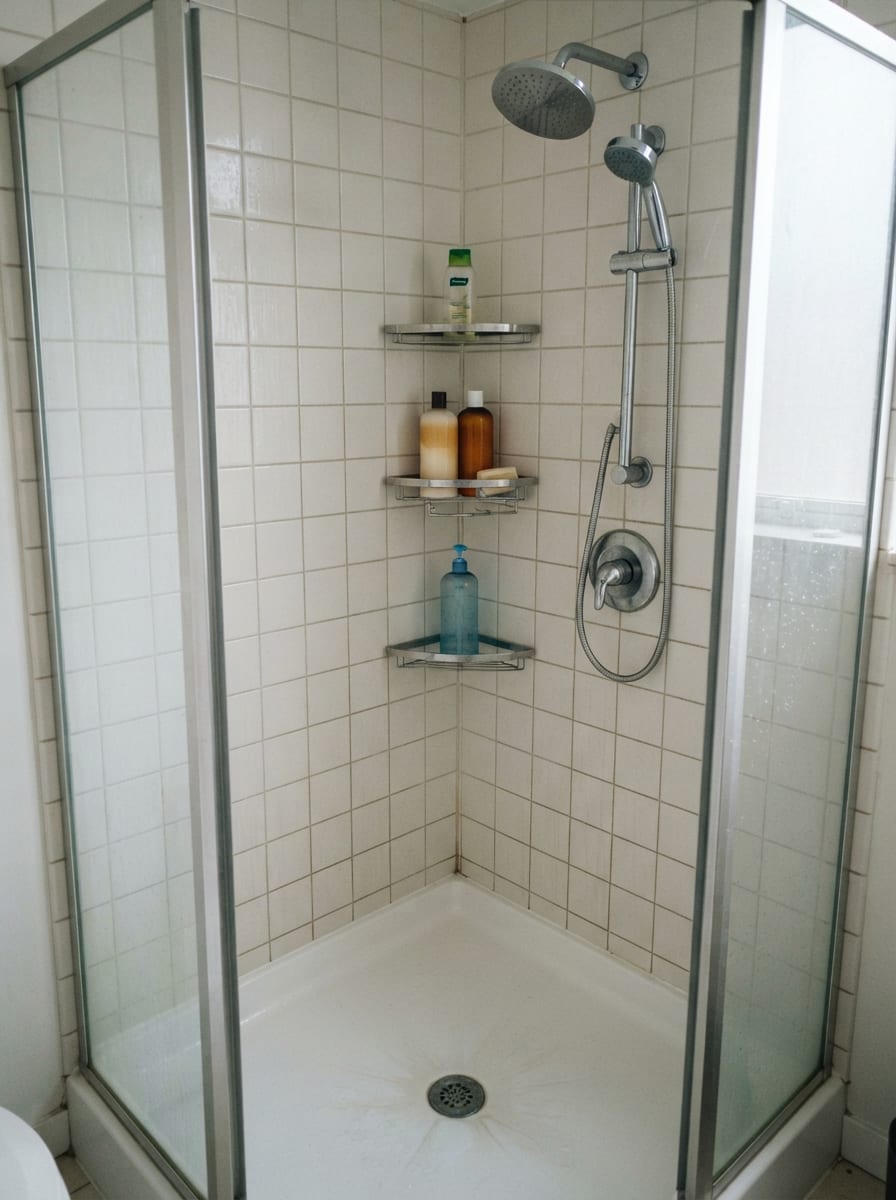
1. The Corner-Stack Shelf
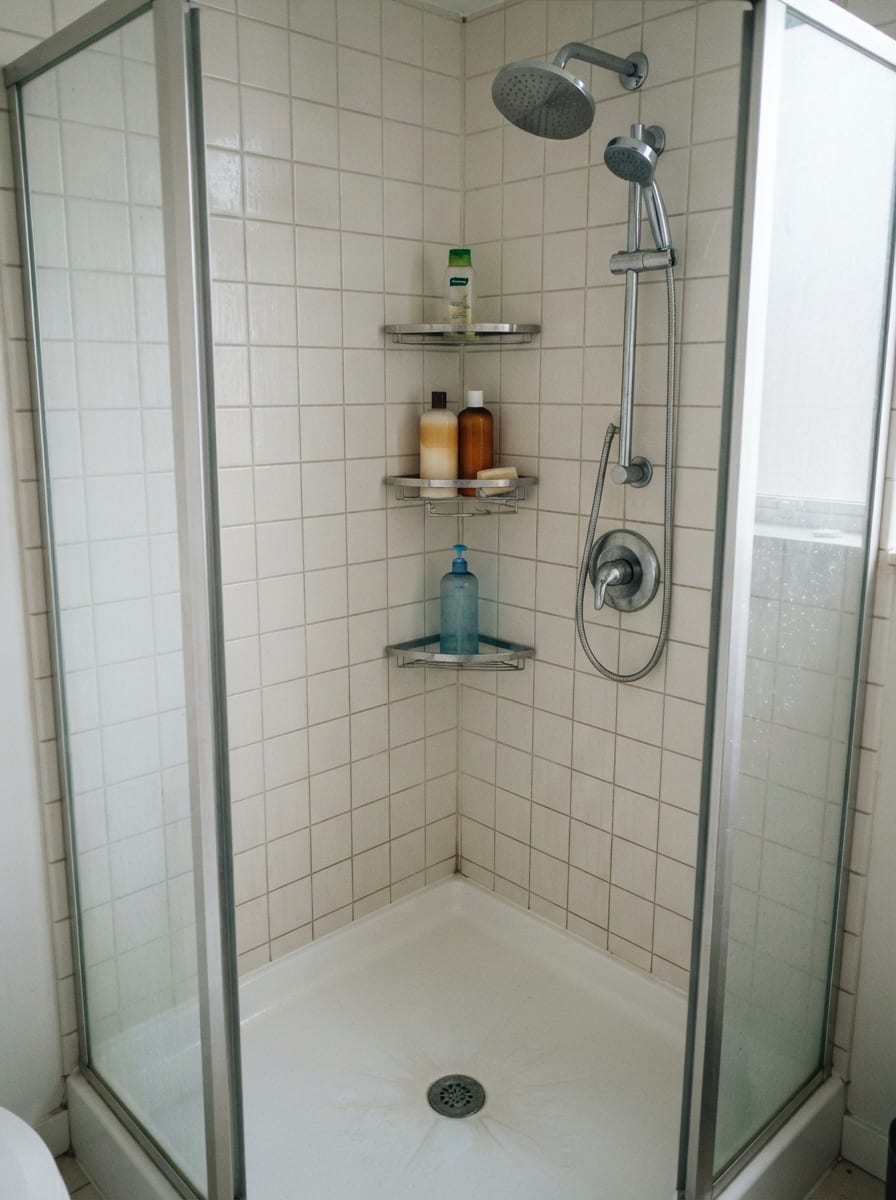
Corners are often the easiest place to add shower storage because they use space that is difficult to use for anything else.
A compact corner shelf can hold several bottles while leaving the main shower area open.
Why it works
A corner unit keeps storage out of the center of the shower.
That helps protect:
- standing space
- arm movement
- water flow.
It also visually consolidates products into one zone rather than spreading them around the shower.
Choose depth carefully
A shelf can look compact on a product page but still project too far into a tiny shower.
Before installing or buying anything, check:
- shelf depth
- shoulder clearance
- elbow room
- door movement.
Use vertical spacing
Several smaller shelves placed above one another are often more useful than one very deep shelf.
You can separate:
- hair products
- body products
- razors
without taking more floor area.
Keep the lowest shelf off the floor
This makes cleaning easier and prevents the unit from visually merging with floor clutter.
2. The Over-Showerhead Caddy
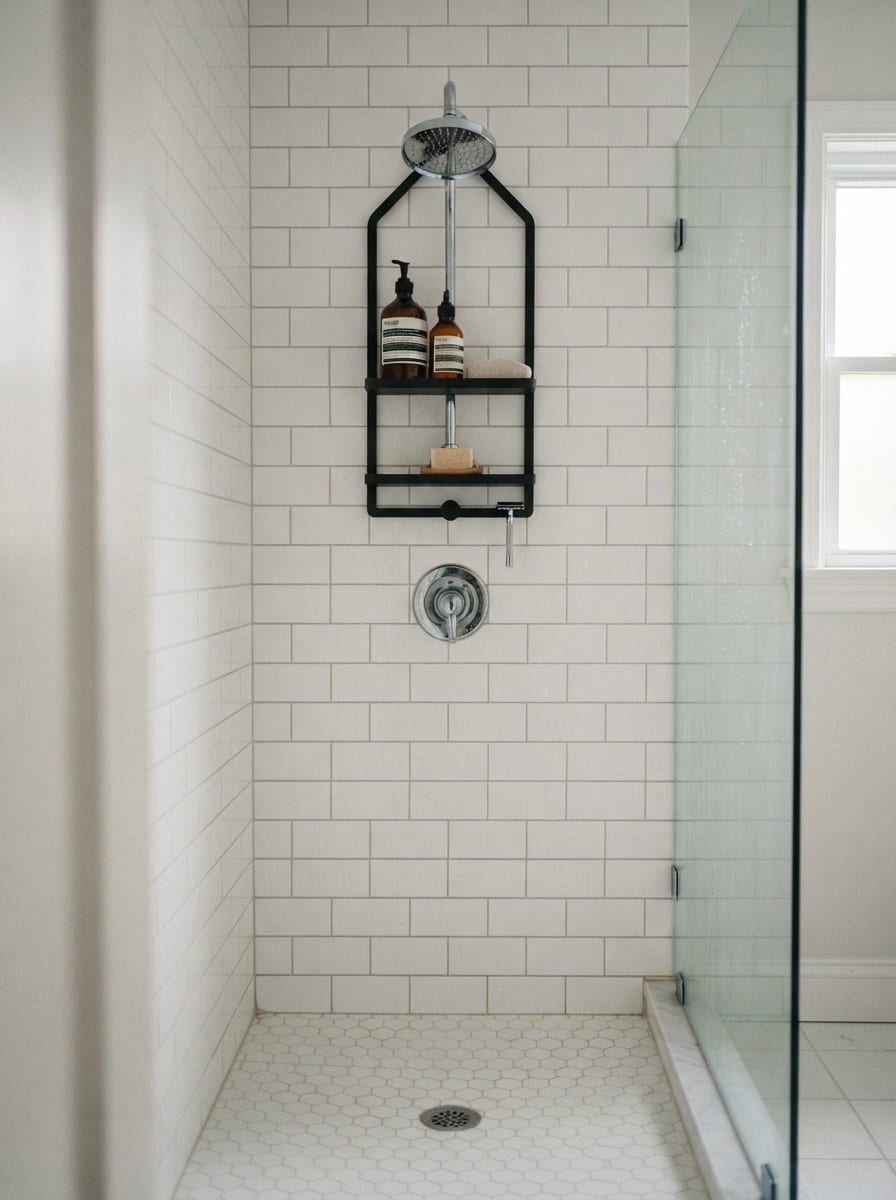
An over-showerhead caddy uses an existing vertical fixture rather than adding storage at floor level.
It can work well when the shower has:
- no niche
- no tub ledge
- limited wall space.
Why it works
The caddy occupies a zone that is already centered around the shower plumbing.
That can keep storage compact.
Watch the showerhead clearance
The caddy should not interfere with:
- spray direction
- adjustable showerhead movement
- handheld hose
- controls.
If the showerhead needs to pivot frequently, a bulky caddy can become frustrating.
Prevent sliding
Some showerhead caddies include:
- suction stabilizers
- wall rests
- grips.
These can reduce swinging.
Follow the product installation instructions rather than improvising support.
Keep heavy bottles low
If the caddy has multiple levels, heavier products are usually more stable lower down.
3. The Tension-Pole Tower
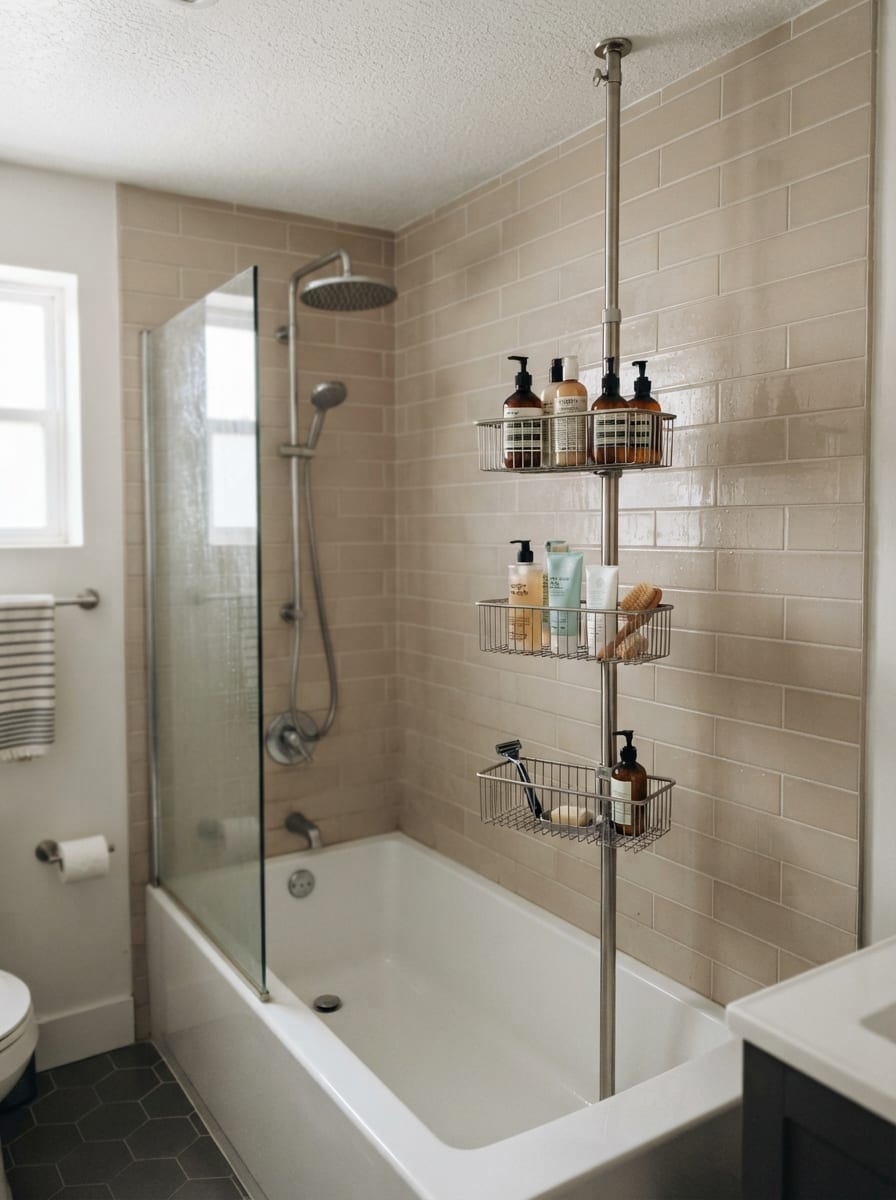
A tension-pole organizer can turn one shower corner into a vertical storage column.
This can be useful in rentals where you want to avoid drilling into tile.
Why it works
The system uses height instead of floor width.
Multiple baskets can hold:
- hair products
- body wash
- facial products
in one narrow vertical zone.
Check ceiling and tub conditions
A tension unit needs suitable surfaces above and below.
Before using one, verify:
- ceiling condition
- tub or shower base surface
- manufacturer height range
- installation instructions.
Do not overtighten
Too much tension can damage some surfaces.
Follow the product’s specified installation method.
Keep baskets distributed
Avoid loading every heavy bottle onto the top shelf.
Balanced storage is easier to use and visually calmer.
Good for shared bathrooms
One basket can be assigned per:
- person
- product category.
This prevents the entire tower becoming one mixed pile.
4. The Wall-Basket Rail
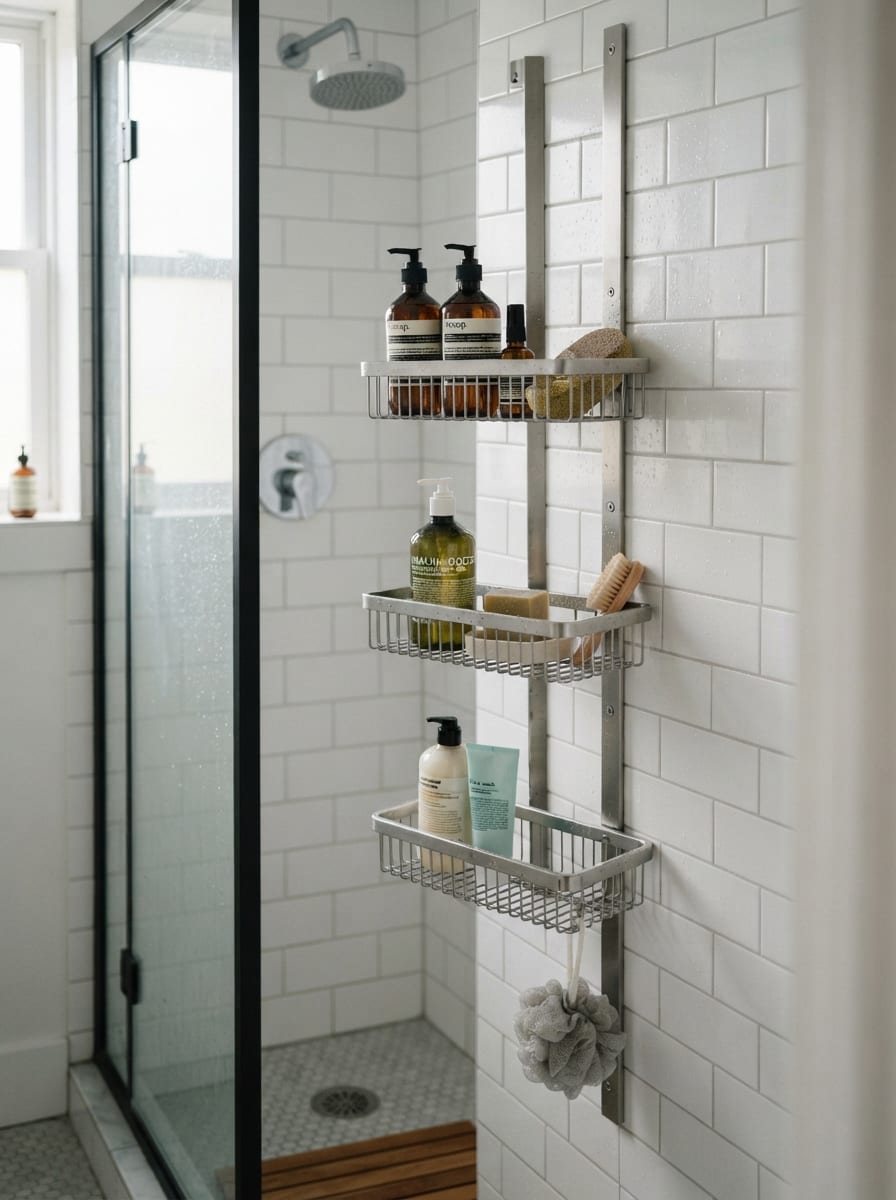
A vertical rail with small baskets can create flexible storage without using a large shelving block.
Why it works
Instead of one oversized caddy, products are distributed vertically along a narrow strip of wall.
That can make the storage feel lighter.
Keep it narrow
A wall-mounted system works best when it stays close to the tile.
Look for:
- shallow baskets
- open drainage
- minimal brackets.
Installation matters
Wet areas are not the place to improvise mounting.
Use:
- hardware
- anchors
- adhesives
only when they are rated for the surface, weight and wet environment.
Renters should be careful
Do not assume an adhesive shower basket is automatically damage-free.
Tile finish, grout condition, adhesive type and humidity can all affect removal.
Follow product guidance and lease restrictions.
Separate products by function
For example:
Upper basket:
less-used products
Middle basket:
daily shampoo + conditioner
Lower basket:
body wash + razor
5. The Shower-Door Hanging Caddy
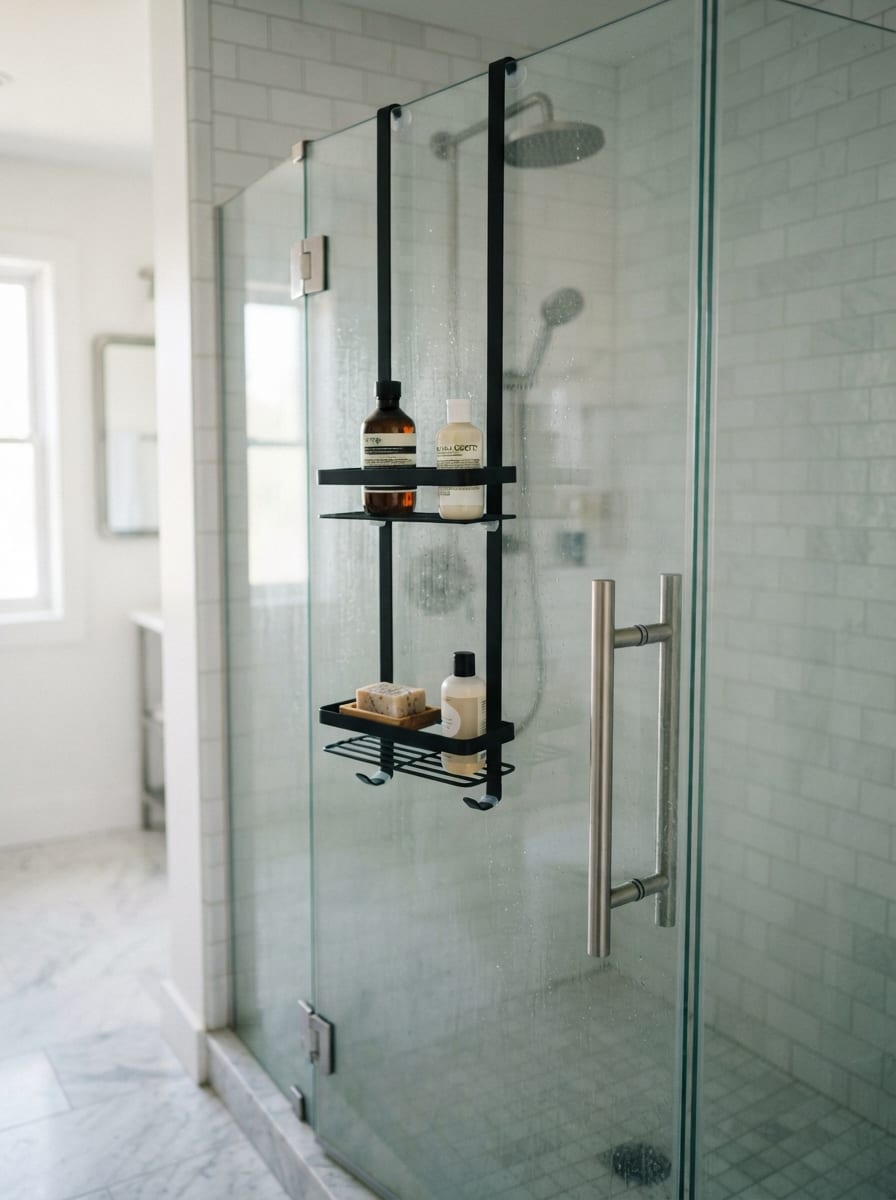
If the shower has a glass enclosure, the door or fixed panel may provide another possible storage zone.
A slim hanging caddy can use that vertical surface without taking up floor space.
Best for
This can work well when:
- the enclosure is structurally suitable
- the organizer is designed for glass shower doors
- door movement remains unobstructed.
Protect door operation
Do not use a caddy that:
- blocks the handle
- prevents full opening
- causes the door to swing unevenly.
Use padded contact points
A suitable product should protect the glass and reduce:
- rattling
- scratching
- metal-on-glass contact.
Keep the profile slim
A deep basket can make a narrow enclosure feel even tighter.
Choose a caddy that holds only what you actually use.
6. The Existing-Niche Organizer
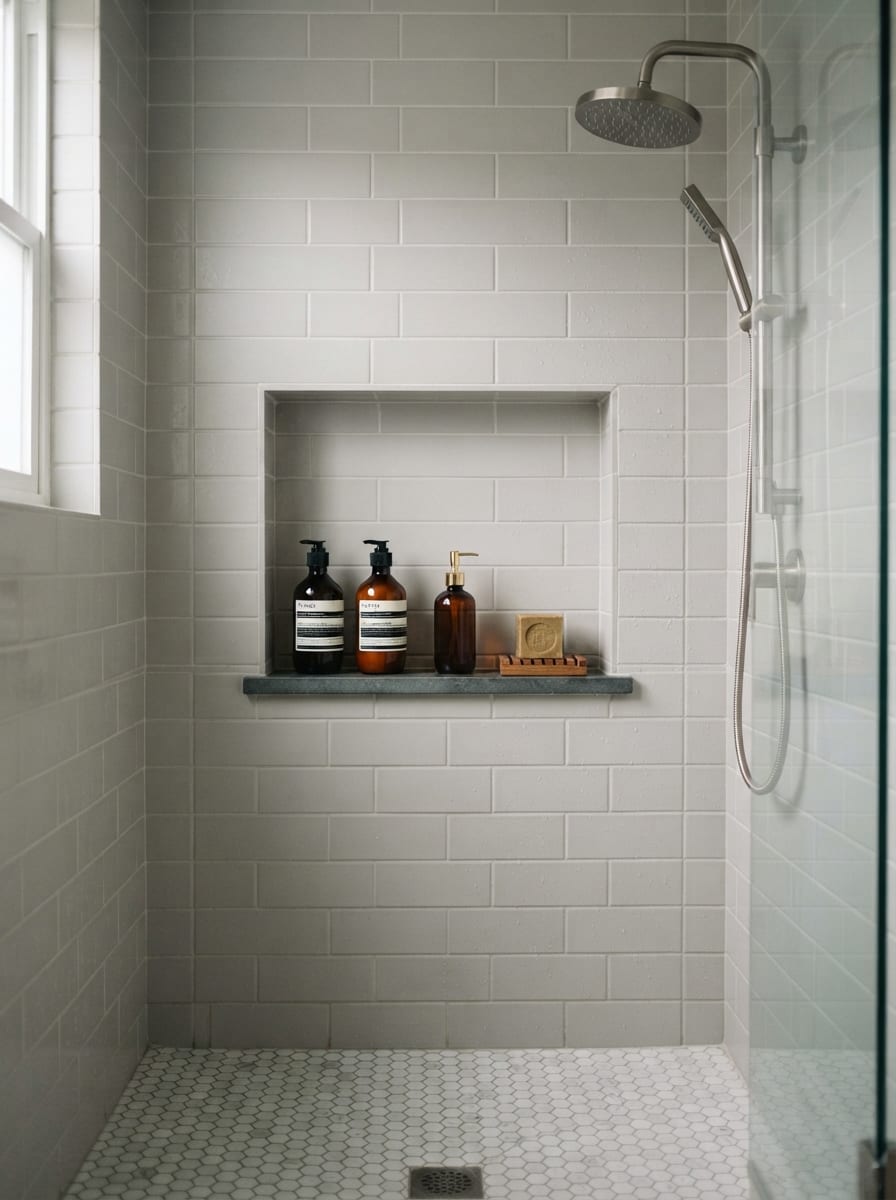
If your shower already has a recessed niche, use it intentionally rather than immediately adding more hardware.
A niche can provide excellent storage because it sits inside the wall instead of projecting into the shower.
The common problem
Many niches become overcrowded.
Products get stacked:
- behind each other
- on top of each other
- along every inch of ledge.
That makes the niche harder to use.
Divide it by category
One side can hold:
hair products
The other:
body products
A small tray or divider may help if it is suitable for wet conditions and does not trap water.
Keep bottle height in mind
A niche that looks large can become awkward if tall pump bottles do not fit.
Measure:
- interior height
- depth
- usable shelf width.
Protect drainage
Do not completely fill the bottom with objects that prevent water from moving away.
7. The Slim Wall-Ledge Shelf
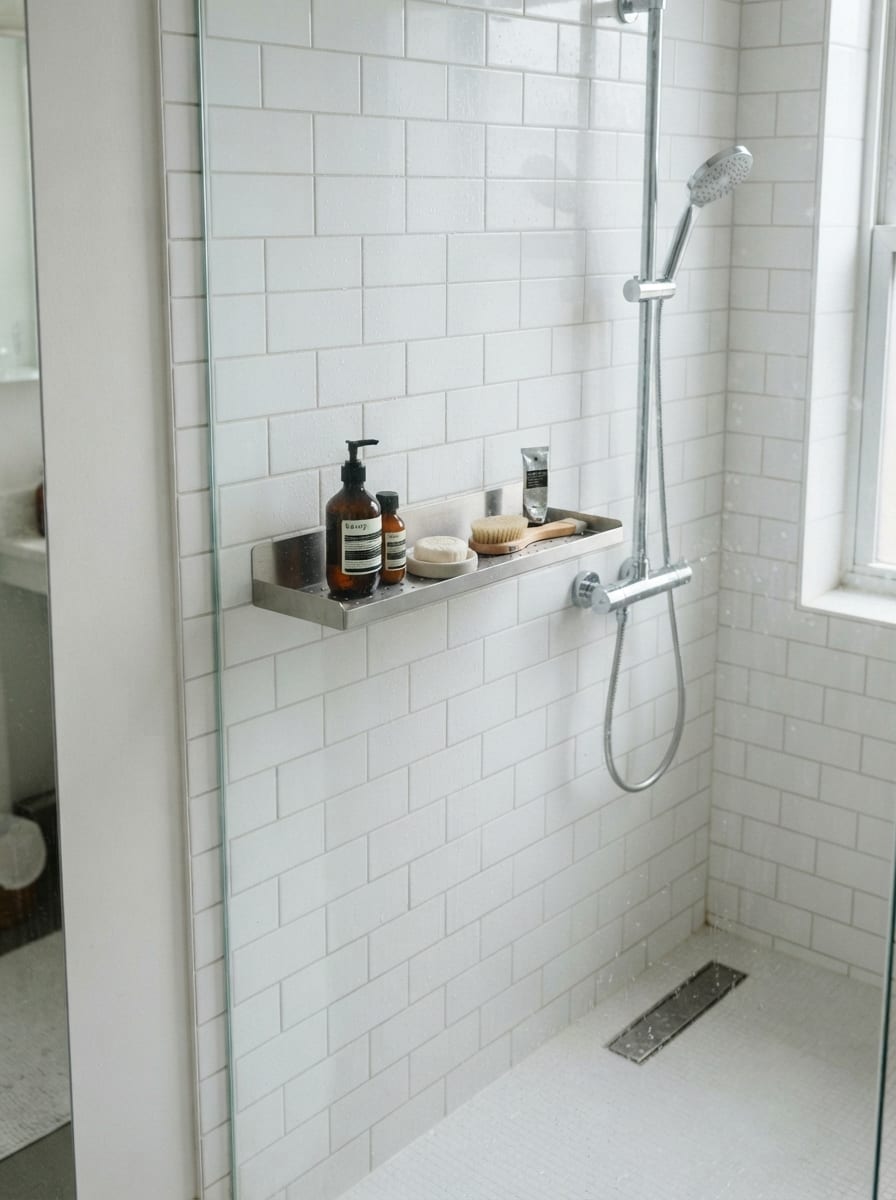
A shallow ledge can work when full baskets project too far into the shower.
The key word is:
shallow.
Why it works
A slim shelf can hold:
- bottles
- bar soap
- small products
without feeling like a large cabinet inside the shower.
Add a retaining edge where needed
A small lip or rail can help prevent bottles from falling.
But make sure the design still allows:
- drainage
- cleaning.
Avoid an overly long ledge
A shelf extending across the entire shower may become a place where every product gets stored.
One shorter ledge can encourage better editing.
Place it at a comfortable reach height
You should not need to:
- crouch
- stretch
- lean into the water stream
every time you reach for shampoo.
8. The Floor-Free Hanging Basket
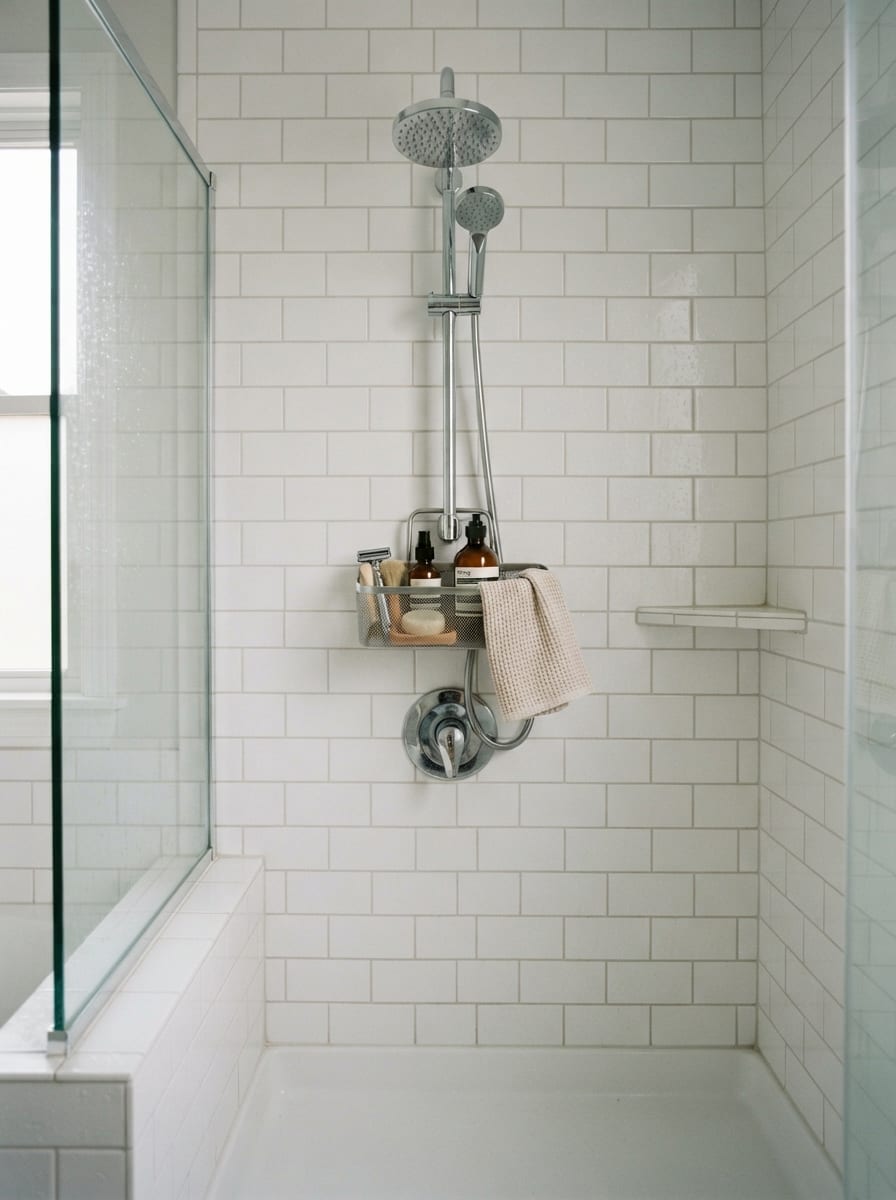
Sometimes you do not need permanent shelving at all.
A compact hanging basket can hold smaller shower products while keeping them off:
- floor
- tub edge.
Good for
Items such as:
- razor
- facial cleanser
- soap
- shower cap
- small washcloth.
Why it works
You create a small flexible storage pocket without adding another large structure.
Do not overload it
Hanging storage works best for lighter items.
If you fill it with several full-size pump bottles, it may:
- sag
- swing
- become difficult to clean around.
Choose quick-drying materials
Wet-zone storage should not hold water unnecessarily.
Look for:
- open mesh
- perforations
- wire
- other materials designed for shower conditions.
Wash it regularly
Even well-draining storage still needs cleaning.
9. The Two-Zone Shower Storage Formula
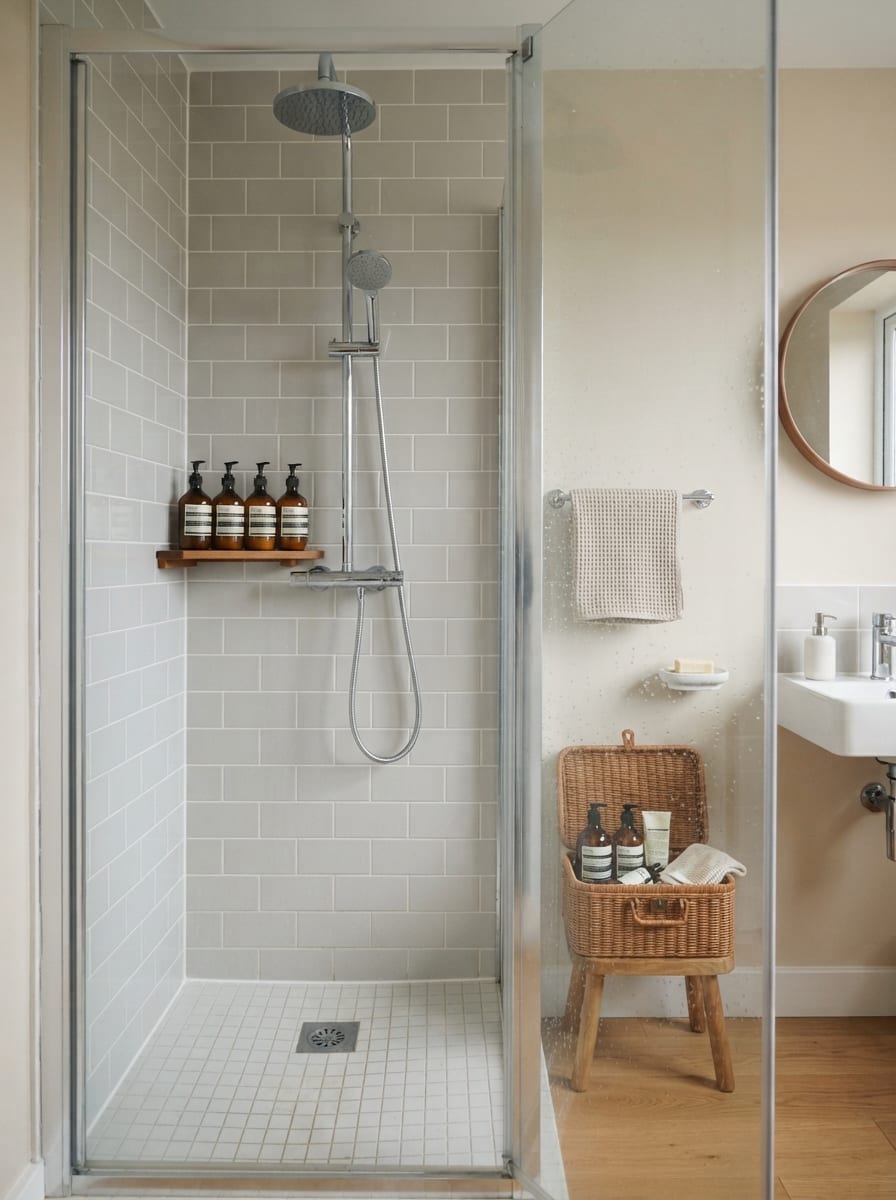
The most useful shower-storage upgrade may not be another shelf.
It may be deciding what actually belongs inside the shower.
Use two zones:
daily-use
and
occasional-use.
Zone 1: Daily-use products
Keep only the products you use nearly every shower within immediate reach.
For example:
- shampoo
- conditioner
- body wash
- razor.
Zone 2: Occasional-use products
Move items such as:
- treatment masks
- extra bottles
- backup soap
- specialty scrubs
to nearby dry storage if possible.
Why it works
Most shower clutter comes from storing every bathroom product in the wet zone.
Reducing the quantity can make even a very small storage system work.
Do not use the shower as backup-product storage
Full replacement bottles usually do not need to live inside the shower.
Keep one working bottle in the wet zone and store the backup elsewhere.
Reassess regularly
If something has not been used for weeks, ask whether it needs to occupy premium shower space.
Start With the Shower Floor
Before buying storage, remove everything from the shower floor and tub ledges.
Then sort the products.
You may discover that the storage problem is partly a quantity problem.
Ask:
Which products actually need to live inside the shower?
Separate Daily Products From Backup Products
A shower does not need to hold:
- three shampoos
- two extra body washes
- backup conditioner
- unopened bottles
unless they are genuinely being used.
Keep backups somewhere dry when possible.
Count the Products Before Buying the Organizer
Do not buy a giant caddy because it has more shelves.
Buy storage for the number of products you actually use.
Otherwise, empty shelf space often gets filled simply because it exists.
Keep the Shower Floor Clear
The shower floor is one of the worst places to store bottles.
Floor storage can:
- reduce standing space
- make cleaning harder
- collect water
- create slipping or tripping obstacles.
Get products onto:
- wall
- corner
- hanging system
- niche
where appropriate.
Tub Ledges Are Not Always Good Storage
A bathtub edge looks convenient.
But bottles can:
- fall into the tub
- collect water underneath
- interfere with cleaning
- make the area feel cluttered.
Use the ledge sparingly.
Think in Reach Zones
Not every storage position is equally convenient.
Your most frequently used products should sit where you can reach them comfortably.
Avoid putting shampoo somewhere that requires:
- twisting
- bending deeply
- reaching above your head.
Keep Daily Products Around the Main Reach Zone
That does not mean everything must sit at exactly the same height.
It means the most-used products should be accessible without awkward movement.
Less-Used Products Can Go Higher
Higher shelves are better for:
- masks
- occasional treatments
- less-used products
than for something you reach for every day.
Very Low Shelves Can Be Annoying
If you constantly need to crouch for products, the storage may technically fit but function poorly.
Shower Controls Need Clear Access
Do not mount storage directly over:
- handles
- temperature controls
- diverters.
You should be able to adjust the shower easily.
Protect the Shower Spray
A caddy should not interfere with:
- showerhead angle
- handheld hose
- spray pattern.
Handheld Showers Need Extra Clearance
If you regularly remove the showerhead from its holder, make sure the storage does not trap:
- hose
- handle
- mounting bracket.
Drainage Matters as Much as Capacity
A beautiful solid-bottom shelf can become annoying if water pools beneath every bottle.
Wet storage should encourage water to leave.
Look for:
- perforated shelves
- wire baskets
- slatted surfaces
- drainage gaps.
Avoid Deep Water-Trapping Trays
If you use a tray, make sure it is designed appropriately for wet conditions and can be cleaned easily.
Leave Space Around Bottles
Packing bottles tightly together makes it harder for surfaces to dry.
A little open space helps:
- airflow
- visibility
- cleaning.
Lift Bottles When Cleaning
Even on draining shelves, residue can accumulate underneath products.
Regularly move everything and clean the shelf itself.
Soap Needs Drainage Too
Bar soap sitting in water quickly becomes messy.
Use a soap holder that allows water to drain.
Razors Should Dry Properly
Avoid leaving razors sitting in standing water.
A dedicated holder or hook can keep them more accessible and easier to dry.
Washcloths Need Airflow
A wet washcloth stuffed into a basket of bottles dries slowly.
Give it:
- hook
- rail
- open hanging area.
Do Not Store Towels Inside the Shower
Clean bath towels generally belong outside the active wet zone.
Inside-shower storage should stay focused on products actually used while showering.
Open Storage Works Better Than Closed Storage Inside the Shower
In most showers, open baskets and shelves make more sense because they:
- drain
- dry
- reveal contents.
Closed storage can trap moisture unless specifically designed for wet conditions.
Metal Storage Needs the Right Finish
Not every metal rack is suitable for constant water exposure.
Choose products designed for bathroom or shower conditions.
Plastic Can Be Practical
Plastic shower organizers are often:
- lightweight
- water-resistant
- easy to wipe.
But choose designs with good drainage.
Wood Needs Wet-Area Suitability
Do not assume decorative wood shelving is appropriate inside a shower.
Constant moisture can damage many materials.
Use only materials designed for that environment.
Tile-Mounted Storage
If drilling into tile, installation quality matters.
Incorrect drilling can:
- crack tile
- damage waterproofing
- create long-term moisture issues.
If you are unsure, professional installation may be appropriate.
Adhesive Shower Storage
Adhesive systems can be useful, particularly for renters.
But performance depends on:
- tile texture
- grout position
- surface preparation
- adhesive rating
- product weight
- humidity.
Follow the manufacturer’s instructions exactly.
Do Not Mount Adhesives Over Grout Unless Designed for It
Uneven grout can prevent full contact.
Mounting surfaces should match the product requirements.
Suction Storage
Suction cups tend to perform best on smooth, nonporous surfaces.
They may work poorly on:
- textured tile
- uneven surfaces.
Again, follow the actual product instructions.
Tension Storage
Tension poles are another no-drill option.
They can work very well but need:
- secure contact
- appropriate ceiling height
- correct tension.
Renter-Friendly Does Not Mean Risk-Free
Before installing anything, check:
- lease rules
- surface compatibility
- removal guidance.
Do not assume every “removable” product is guaranteed to leave no marks.
Avoid Too Many Storage Systems
One of the easiest ways to make a small shower feel cluttered is using:
- corner shelf
- hanging caddy
- suction basket
- floor rack
all at once.
Try to solve the problem with one main system.
One Main Storage Zone Usually Looks Calmer
Consolidating products into one vertical area often makes the shower feel more organized.
Use a Secondary Mini-Zone Only When Necessary
For example:
Main caddy:
bottles
Small hook:
razor
That is more controlled than several unrelated shelves.
Decanting Can Help—But It Is Optional
Matching bottles can reduce visual clutter.
But decanting is not necessary for organization.
If you do decant products:
- label them clearly
- use containers compatible with the product
- clean them appropriately.
Do not sacrifice safety or identification purely for aesthetics.
Original Packaging Is Fine
A shower can still look organized with normal product packaging.
Spacing and quantity matter more than matching bottles.
Reduce Visual Noise by Grouping
Keep similar products together.
For example:
hair care
body care
face care
This helps the shower feel less random.
Keep Tall Bottles Together
Grouping similar heights can make a shelf feel calmer and prevent smaller items disappearing behind larger ones.
Pumps Need Headroom
Measure enough vertical space above pump bottles so they can actually be used.
Flip-Top Bottles Need Access Too
Make sure lids can open without hitting the shelf above.
Check Bottle Diameter
Some narrow caddies cannot hold wide pump bottles.
Measure the products you already own.
Do Not Organize Around Travel-Size Containers Unless You Actually Use Them
The storage should fit real daily products.
Shampoo Bars and Soap Bars Need Their Own Drainage
If you use solid products, give them a separate draining holder.
Shared Shower Storage
If several people use the shower, assign:
- one basket per person
or:
- one category per shelf.
The system should be obvious enough that products return to the same place.
Children’s Shower Products
Keep products used by children at an appropriate height and follow household safety considerations for anything that should remain out of reach.
Guest Bathroom Shower Storage
Keep the setup simpler.
You may only need:
- shampoo
- conditioner
- body wash
- soap.
Do not fill the guest shower with your entire backup inventory.
Tiny Walk-In Shower
Prioritize shallow wall-mounted or corner storage.
Deep baskets can reduce shoulder room surprisingly quickly.
Small Tub-Shower Combination
Watch:
- tub edge
- curtain movement
- showerhead location.
A corner or over-showerhead solution often works well.
Glass Shower Enclosure
Avoid putting too many storage elements on the glass.
The transparent enclosure helps the room feel visually open.
One slim hanging system may be enough.
Shower Curtain Setup
Make sure storage does not interfere with the curtain sliding completely closed.
Corner Shelf + Shower Curtain
Check that bottles and shelves do not catch the curtain when it moves.
Narrow Shower
Use the shallowest storage possible.
A few extra inches of shelf depth can make a narrow enclosure feel much tighter.
Wide but Shallow Shower
You may have more wall width than depth.
A longer shallow ledge can work better than a deep corner basket.
Low Ceiling Shower
Avoid a tall tension tower that makes the top feel crowded.
A mid-height wall storage system may feel more balanced.
High Ceiling Shower
Do not use the extra height simply because it exists.
Products placed too high become inconvenient.
Dark Shower
Too many dark storage accessories can make the enclosure feel visually heavy.
A lighter or simple metal system may keep the space more open.
Light Shower
You have more flexibility with contrast.
One black or dark metal caddy can create a clean focal point.
Keep Storage Away From the Main Water Stream When Possible
Constant direct spray can increase:
- residue
- water collection
- maintenance.
Place storage where products remain accessible without receiving unnecessary water.
Watch for Splash Outside the Shower
Do not mount products where bottles or baskets direct water toward:
- bathroom floor
- drywall
- nearby cabinetry.
Cleaning Access Is Part of Storage Design
Ask:
Can I clean behind and under this organizer?
If not, the system may eventually create more work.
Removable Organizers Can Be Easier to Deep-Clean
Being able to lift off or remove a basket can simplify cleaning.
Permanent Shelves Need Enough Gap Around Them
A shelf mounted too close to another surface can create a difficult-to-clean seam.
Keep Grout Lines Visible Where Possible
Storage covering every grout line makes routine cleaning more awkward.
Avoid Clutter Above Eye Level
A wall packed with bottles from floor to ceiling can make a tiny shower feel like a storage closet.
Use only the vertical height you genuinely need.
Do Not Fill Empty Shelf Space Automatically
An empty section is not wasted.
It can make the shower:
- easier to clean
- easier to scan
- calmer visually.
Common Small Shower Storage Mistakes
Leaving bottles on the floor
They reduce usable standing space and complicate cleaning.
Using a shelf that projects too far
The storage solves one problem and creates a circulation problem.
Storing backup bottles in the shower
Wet-zone space gets wasted on products not currently in use.
Ignoring drainage
Water sits beneath bottles and baskets.
Mounting daily products too high
Storage becomes inconvenient.
Mounting products too low
You constantly bend to reach them.
Blocking the showerhead or hose
The organizer interferes with normal use.
Using several unrelated caddies
The shower becomes visually fragmented.
Assuming adhesive means renter-safe
Surface and product instructions still matter.
Choosing capacity over footprint
The biggest organizer is not necessarily the best organizer.
Quick Small-Shower Storage Decision Guide
Choose a Corner-Stack Shelf if:
You have an unused corner and want compact vertical storage.
Choose an Over-Showerhead Caddy if:
You have little usable wall space and the showerhead setup allows it.
Choose a Tension-Pole Tower if:
You need several shelves and want to avoid drilling.
Choose a Wall-Basket Rail if:
You want flexible shallow storage along one vertical zone.
Choose a Shower-Door Caddy if:
You have a suitable glass enclosure and want floor-free storage.
Use the Existing Niche if:
Your shower already has recessed storage.
Optimize it before adding another organizer.
Choose a Slim Wall Ledge if:
Deep baskets make the enclosure feel too narrow.
Choose a Hanging Basket if:
You only need storage for a few lightweight items.
Use the Two-Zone Formula if:
Your shower looks crowded even though you already have enough shelving.
The Simplest Small-Shower Storage Formula
Use:
one main vertical storage zone
plus:
one small accessory hook if necessary
and keep:
the floor completely clear.
Then store only:
daily-use products
inside the shower.
Everything else can move to dry bathroom storage.
Frequently Asked Questions
What is the best storage for a very small shower?
Usually something that uses vertical wall or corner space without projecting too far into the enclosure.
The exact choice depends on:
- shower shape
- surface
- fixtures
- rental restrictions.
How do I store shampoo without a shower niche?
Options can include:
- corner shelves
- hanging caddies
- tension poles
- wall-mounted baskets
depending on the shower.
Are adhesive shower shelves good for renters?
They can be useful, but they are not automatically damage-free.
Follow:
- lease restrictions
- surface compatibility guidance
- product removal instructions.
How do I keep shower bottles from looking cluttered?
Reduce the number of products, group them by category and keep them in one main storage zone.
Should shower storage be high or low?
Daily-use items should sit within comfortable reach.
Occasional-use products can go higher.
Avoid storage so low that you constantly crouch.
Is it okay to keep bottles on the shower floor?
It is usually better to move them off the floor when possible because floor storage can interfere with:
- standing space
- drainage
- cleaning.
What shower storage drains best?
Open wire baskets, perforated shelves and slatted surfaces generally allow water to drain more easily than solid-bottom containers.
What should I keep outside the shower?
Usually:
- backup bottles
- extra soap
- replacement razors
- specialty products
- clean towels
can stay in dry storage until needed.
Can I use a tension-pole organizer in a rental?
Often, if the surfaces and dimensions are appropriate and the product is installed correctly.
Check both the lease and manufacturer’s instructions.
Final Thoughts
The best small-shower storage system is not the one that holds the most products.
It is the one that keeps the shower easier to use.
Start by clearing the floor.
Remove backup products.
Identify the bottles you actually use every day.
Then choose one compact storage zone that gives those items:
- comfortable reach
- good drainage
- enough space to dry
- easy cleaning access.
Use corners and vertical wall space before sacrificing standing room.
And resist the temptation to add another organizer every time the shower gets messy.
In a small shower, less storage used well usually works better than more storage filled completely.