9 Small Bathroom Rug Ideas That Make a Tiny Bathroom Feel More Finished
Discover 9 small bathroom rug ideas using smart sizing, runners, tonal colors and practical placement to make a tiny bathroom feel warmer without crowding the floor.
In This Guide
A small bathroom does not have many opportunities to add softness.
Most of the room is made from hard surfaces:
- tile
- porcelain
- stone
- glass
- metal
- cabinetry.
That is why even one rug can change the feeling of the space.
It can add:
- warmth
- texture
- color
- comfort
- visual structure.
But small bathrooms are also unforgiving.
A rug that is only slightly too large can interfere with:
- the door
- vanity drawers
- toilet clearance
- shower access.
A rug that is too small can look like it was dropped randomly in the middle of the floor.
And several tiny mats can break one already-limited floor area into even smaller pieces.
The best approach is usually to use one clearly placed rug or bath mat with a footprint that relates to the fixtures around it.
Here are nine small bathroom rug ideas that make a compact space feel more finished without making the floor look crowded.
1. The Vanity-Width Rug
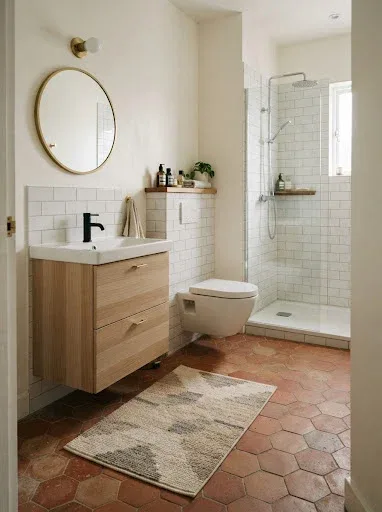
One of the simplest ways to make a bathroom rug feel intentional is to relate its width to the vanity.
Instead of dropping a tiny mat directly in front of the sink, choose one that visually connects with the main vanity zone.
Why it works
The rug and vanity begin to read as one composition.
That creates more structure than a small isolated mat.
Keep the edges controlled
The rug should not interfere with:
- cabinet doors
- vanity drawers
- shower door
- bathroom entry door.
A slightly narrower rug is better than one that constantly catches on moving parts.
Consider the vanity style
A floating vanity already leaves more floor visible.
A vanity-width rug underneath or slightly in front of that area can make the zone feel anchored.
A floor-standing vanity may need more visual breathing room.
Do not force exact matching
The rug does not need to be precisely the same width as the vanity.
It should simply feel related to it rather than randomly undersized.
2. The Long Narrow Runner
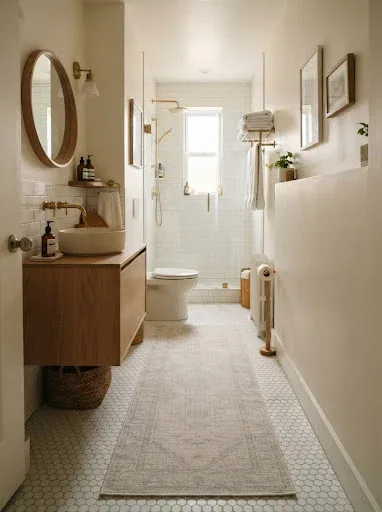
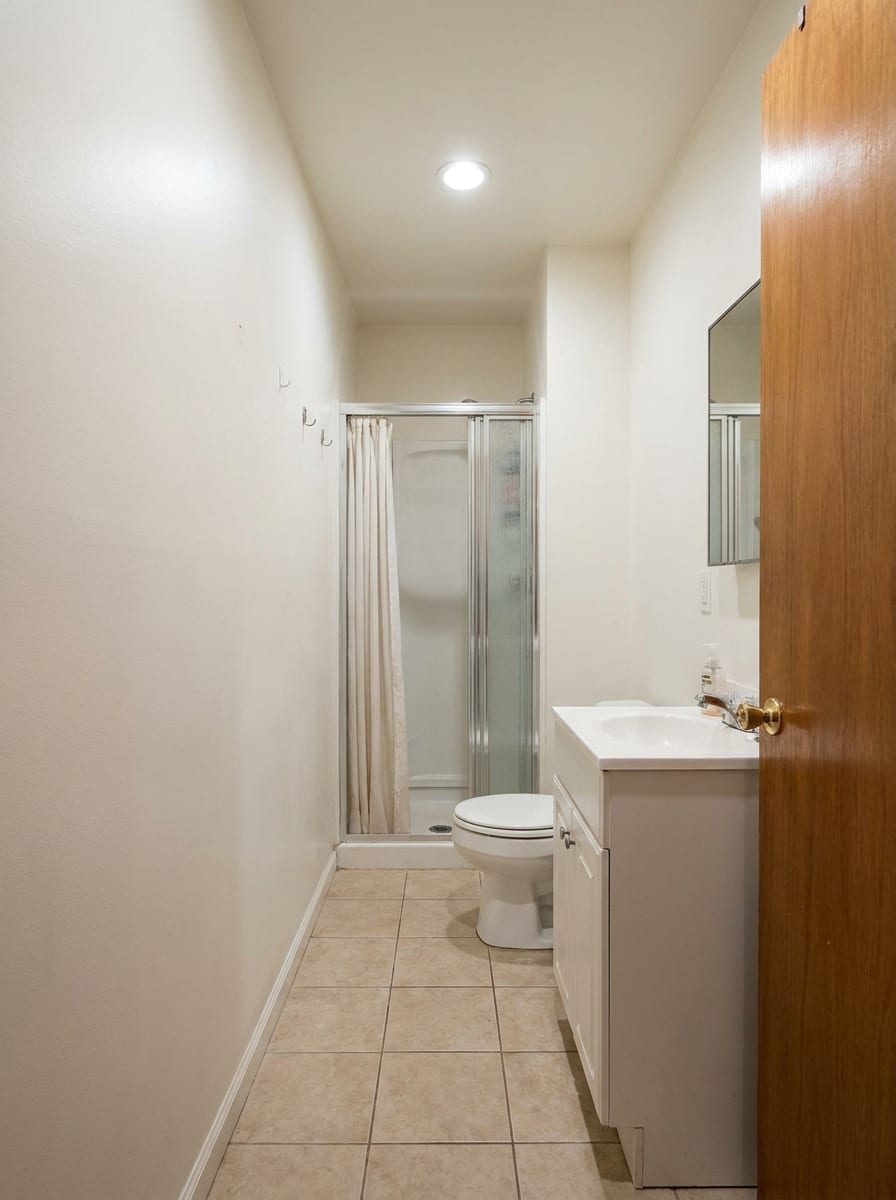
A narrow bathroom often has more length than width.
A runner can work with that shape instead of fighting it.
Why it works
One long rug can visually connect:
- vanity
- toilet zone
- shower entrance
without breaking the floor into several separate mats.
That can make the room feel more continuous.
Best for
A runner works particularly well in:
- galley-style bathrooms
- narrow apartment bathrooms
- bathrooms with fixtures lined along one wall.
Keep it slim
The runner should not touch every fixture.
Leave enough exposed floor around it so the room still feels breathable.
Watch door swing
A long rug can become frustrating if it catches under:
- entry door
- linen closet
- shower door.
Test those movements before committing.
Avoid excessive pile
A very thick runner can make a tiny room feel visually heavy and may interfere with doors.
3. The Tone-on-Tone Bathroom Rug
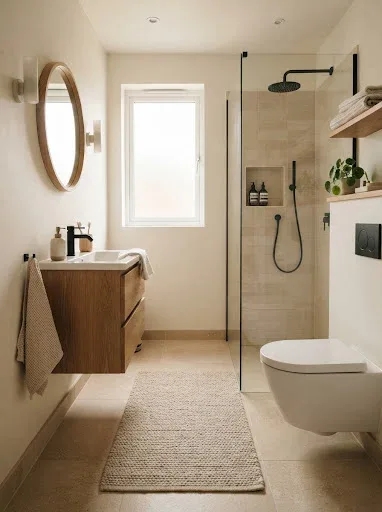
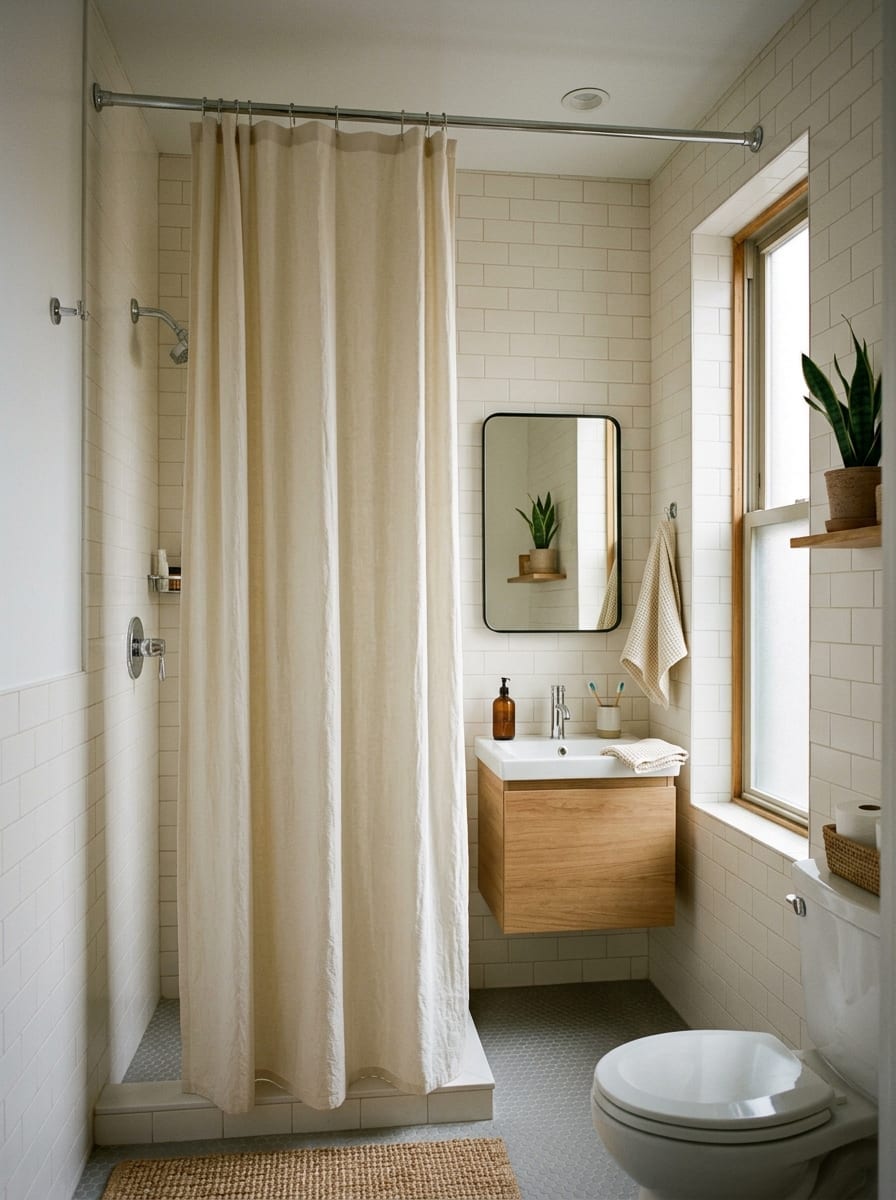
If the floor is already visually busy, a high-contrast rug can add another strong element.
A tone-on-tone rug keeps the floor calmer.
Examples
Warm beige tile:
oatmeal or sand rug
Soft gray tile:
charcoal-gray or pale-gray rug
Cream tile:
ivory or warm-white rug
Muted green floor:
sage or gray-green rug
Why it works
The rug adds softness without becoming a visual block in the middle of the floor.
That can help preserve the feeling of one continuous surface.
Use texture instead of contrast
A tonal rug can still feel interesting through:
- loops
- subtle ribbing
- woven texture
- restrained pattern.
Especially useful in tiny bathrooms
When very little floor is visible, too much contrast can make the room look chopped into small geometric sections.
4. The Low-Contrast Pattern Rug
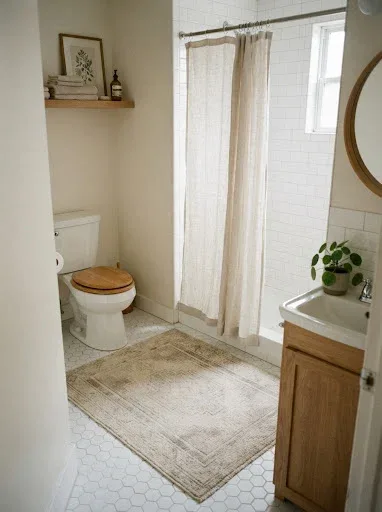
A small bathroom can still handle pattern.
The key is controlling:
- scale
- contrast
- number of competing surfaces.
Why it works
A subtle pattern adds character without visually taking over the floor.
Good options may include:
- faded stripe
- small geometric repeat
- tonal border
- restrained vintage-inspired motif.
Watch the tile pattern
If the bathroom already has:
- patterned floor tile
- bold shower tile
- high-contrast grout
the rug may need to be simpler.
Let one surface lead
If the rug is patterned, keep nearby textiles quieter.
For example:
patterned rug + solid shower curtain
usually feels calmer than:
patterned rug + patterned curtain + patterned tile.
Avoid extremely tiny busy motifs
Small repeated patterns can become visual noise when packed into a limited floor area.
5. The Shower-Step Mat
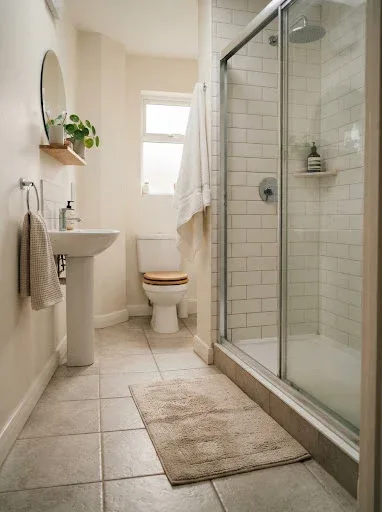
Sometimes the bathroom does not need a decorative rug across the whole floor.
It needs one practical mat exactly where your feet land after a shower.
Why it works
You solve the moisture and comfort problem without occupying unnecessary floor area.
Position it deliberately
Place it so someone can step safely from:
- tub
- shower
- glass enclosure
onto the mat.
Keep it outside the active wet area
A bath mat should not obstruct:
- shower drainage
- tub edge
- door movement.
Prioritize drying
Choose materials appropriate for repeated bathroom use and wash them regularly.
A mat that stays damp for long periods can become unpleasant quickly.
Do not add another rug unless necessary
If this mat solves the functional problem, you may not need a second decorative rug elsewhere.
6. The Floating-Vanity Rug
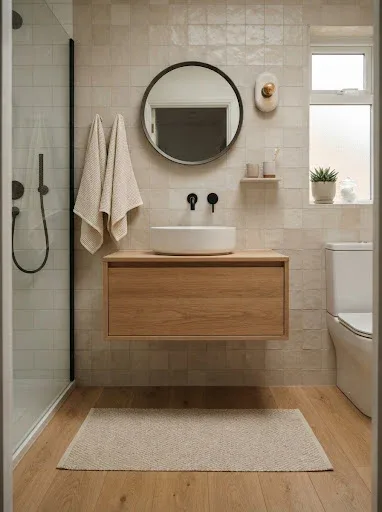
A floating vanity exposes more floor than a floor-mounted cabinet.
That extra visible floor can make a small bathroom feel lighter—but it also creates an opportunity for better rug placement.
Why it works
A low-profile rug beneath the visual footprint of the vanity can anchor the area without making the cabinet look heavier.
Keep the rug from disappearing underneath
Do not push so much of the rug beneath the vanity that only a thin strip remains visible.
The rug still needs to look intentional.
Protect cleaning access
Floating vanities are useful partly because the floor underneath is easier to clean.
Choose a rug that is easy to move and wash.
Keep the vanity visually floating
Avoid a thick or dark rug that makes the open area below look filled in.
7. The One-Rug Bathroom
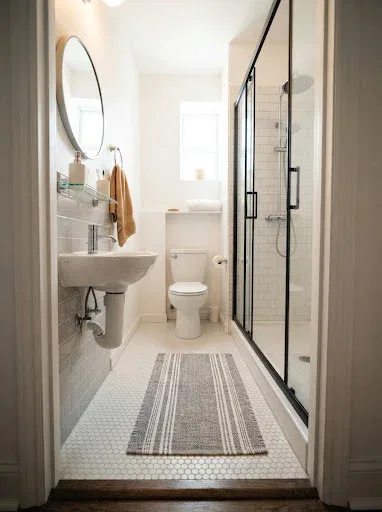
One of the easiest ways to make a tiny bathroom look cluttered is using:
- sink mat
- toilet mat
- shower mat
- decorative runner
all at once.
In many small bathrooms, one good rug works better.
Why it works
The floor reads as one continuous surface instead of several small zones.
That can make the room feel:
- calmer
- wider
- easier to clean.
Pick the most important location
Usually that will be:
- outside the shower
- in front of the vanity
- along the main center aisle.
Let the rest of the floor breathe
Visible tile around the rug is useful.
It creates separation from:
- toilet
- tub
- cabinetry.
Skip toilet-contour rugs
They often visually crowd the fixture zone and can complicate cleaning.
A simple rectangular rug is usually easier to integrate.
8. The Dark-Floor Light-Rug Contrast
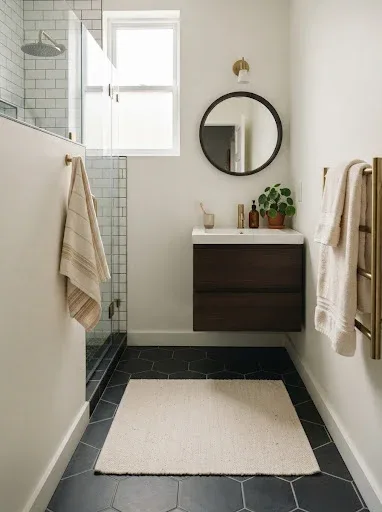
Contrast can work in a small bathroom when it is used strategically.
If the bathroom has a dark floor, a lighter rug can visually separate the walking zone and prevent the lower half of the room from feeling too heavy.
Why it works
The light rug creates a clear focal area against:
- charcoal tile
- deep slate
- dark terrazzo.
Keep the rug simple
Because the contrast is already strong, the rug does not also need:
- bold pattern
- fringe
- several colors.
Repeat the light tone above
Connect the rug to something else in the room, such as:
- towels
- shower curtain
- wall color.
That prevents it from feeling isolated.
Reverse the idea carefully
A dark rug on a light floor can also work, but it becomes a stronger visual block.
Use it when you intentionally want more grounding.
9. The Size-Placement-Moisture Formula
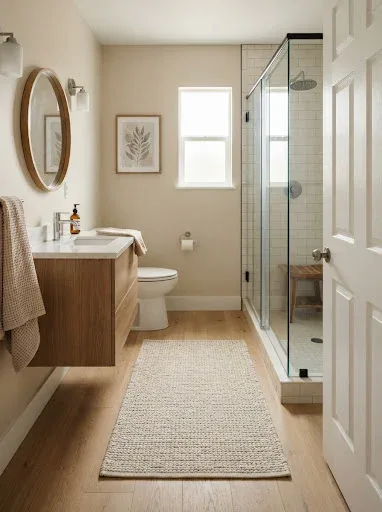
Before choosing a color or pattern, solve three practical questions.
Step 1: Size
How much floor should the rug occupy?
Look at:
- room width
- vanity width
- shower entrance
- toilet position
- door swing.
Step 2: Placement
Where do you actually need softness or water absorption?
Usually this is where you:
- stand at the sink
- step out of the shower
- walk most frequently.
Step 3: Moisture
How quickly will the rug dry?
Consider:
- ventilation
- material
- pile
- frequency of washing.
Why this formula works
It prevents you from buying a rug because it looks good in isolation.
You choose it based on:
room shape + function + maintenance
first.
Then choose:
- pattern
- color
- texture.
Start With the Floor Plan, Not the Rug
Before shopping, look at the bathroom floor as a layout.
Identify:
- entry door
- shower or tub
- toilet
- vanity
- storage
- vents.
Then locate the floor area that is genuinely available.
Small Bathrooms Have Very Little Flexible Floor Space
Unlike a living room, you cannot simply slide fixtures around.
That means rug placement needs to work around fixed elements.
Measure Door Clearance
The bathroom door may swing directly over the rug area.
Check the gap under the door before choosing a thick mat.
Check Shower Door Clearance
Glass shower doors can also sweep across the floor.
A thick rug may stop them from opening fully.
Check Vanity Drawers
Deep drawers close to floor level may catch thick rugs.
Check Cabinet Doors
Do not assume a rug fits just because the floor area is wide enough.
Open everything.
Toilet Clearance Matters
Keep the rug from bunching around the toilet base.
This simplifies:
- cleaning
- movement
- visual balance.
Avoid Several Tiny Mats
Three small mats often make a tiny bathroom look even smaller.
They create multiple visual stopping points.
One Larger Rug Can Feel Calmer
When layout allows, one well-proportioned piece often feels more intentional.
But Bigger Is Not Automatically Better
A rug should not extend underneath every fixture simply to cover more floor.
Leave visible flooring around it.
Floating Rugs Look Accidental
A rug that is much smaller than the available floor zone can look disconnected.
Relate it to:
- vanity
- runner axis
- shower entrance.
Rug Shape Matters
Rectangle
Usually easiest in small bathrooms.
Runner
Useful in long narrow layouts.
Round Rug
Can soften a boxy room, but it needs enough open floor to make the shape readable.
Irregular Shape
Can add personality, but may visually complicate a tiny floor plan.
Rectangle Is Usually the Safest Starting Point
It works naturally with the rectangular geometry of:
- vanity
- tile
- tub
- shower.
Long Narrow Bathroom
Consider one runner instead of several small mats.
Square Bathroom
A compact rectangular rug may work best in front of the vanity or shower.
Tiny Powder Room
You may not need a rug at all unless it adds meaningful:
- softness
- warmth
- visual interest.
Do not add one automatically.
Tub-Shower Bathroom
The most functional location may be directly outside the tub.
Walk-In Shower Bathroom
Think carefully about:
- door swing
- splash zone
- step-out location.
Bathroom With No Shower
In a powder room, rug placement is more decorative.
Keep it away from the toilet base when possible.
Rug in Front of the Vanity
This is a good choice if you spend time:
- getting ready
- washing
- styling hair.
Rug Outside the Shower
Best when moisture management is the main priority.
Rug Between Vanity and Shower
This can work if both zones are close together and one rug serves both.
Runner Through the Middle
Useful in narrow bathrooms where fixtures line the edges.
Rug Near the Toilet
Usually avoid making the toilet the visual center of the rug layout.
Let the rug relate more strongly to the vanity or main walking path.
Bath Mat vs Decorative Rug
These are not always the same thing.
Bath Mat
Designed primarily for:
- absorption
- stepping out of the shower
- easy washing.
Decorative Bathroom Rug
May focus more on:
- color
- pattern
- styling.
The Best Small-Bathroom Choice May Combine Both
Look for something that is:
- visually attractive
- practical around moisture
- washable.
Washability Matters
Bathroom textiles deal with:
- humidity
- water
- hair
- skincare products
- dust.
A rug that is difficult to clean may become frustrating.
Check Manufacturer Care Instructions
Some rugs can be:
- machine washed
while others may require:
- spot cleaning
- special care.
Choose based on your actual cleaning routine.
Quick Drying Matters
A mat that stays damp can become unpleasant.
Ventilation matters just as much as material.
Hang Damp Mats When Needed
If the rug becomes saturated after showers, allowing it to dry properly can help.
Do Not Leave Wet Rugs Bunched Up
Flat, ventilated drying is preferable.
Ventilate the Bathroom
Use existing ventilation appropriately to reduce persistent moisture.
Low Pile Works Well in Tight Rooms
A thinner rug is less likely to interfere with:
- doors
- drawers
- visual openness.
Thick Plush Mats
These can feel comfortable but may be bulky.
Use them where clearance allows.
Very High Pile Can Hide Floor Scale
In a tiny bathroom, a thick shag-like surface can visually consume a lot of space.
Natural-Fiber Look
Textures inspired by:
- cotton
- woven linen
- soft flat weave
can look lighter.
Use materials specifically suitable for the bathroom environment.
Cotton Bath Rugs
Often practical because many are washable.
Check the specific care instructions.
Microfiber Mats
Can be absorbent and soft but may look more utilitarian.
Choose a restrained design if visual polish matters.
Wood or Stone Bath Platforms
These can create a clean spa-like look, but they behave differently from absorbent textiles.
They need to be appropriate for:
- water exposure
- drainage
- floor surface.
Safety Matters
Bathroom floors can become slippery.
Choose rug products designed for bathroom use where appropriate.
Check the Backing
A rug that slides easily on tile can create a hazard.
Use suitable non-slip backing or rug support according to the manufacturer’s guidance.
Do Not Improvise With Unsafe Underlays
Use products compatible with:
- wet environments
- tile
- vinyl
- other bathroom flooring.
Some Backings Can Affect Flooring
Check compatibility, especially with specialty floor finishes.
Never Let the Rug Curl at the Edges
Raised corners create both:
- visual mess
- tripping risk.
Replace Damaged Backing
If grip material breaks down, address it rather than continuing to use a sliding mat.
Rug Color Can Change Perceived Floor Area
High contrast makes the rug’s boundaries more visible.
Low contrast allows the floor to read more continuously.
Light Rug on Light Floor
Creates a soft, expansive effect.
Dark Rug on Light Floor
Creates a stronger visual anchor.
Light Rug on Dark Floor
Can brighten the lower part of the room.
Dark Rug on Dark Floor
Creates a moodier continuous look.
Tone-on-Tone Is Often Easiest
Especially when the bathroom already contains multiple materials.
Match the Rug to the Vanity?
It can coordinate, but exact matching is unnecessary.
Match the Rug to the Towels?
Again, coordination works better than identical matching.
Repeat One Tone
For example:
- sage rug
- sage hand towel
can create enough connection.
Avoid Matching Every Textile
Perfectly matching:
- rug
- towels
- shower curtain
can make the bathroom feel overly coordinated.
Use a Color Family Instead
For example:
- ivory rug
- beige towel
- oatmeal curtain.
Small Bathrooms Can Handle Dark Rugs
The important question is how much contrast and visual weight the rug adds.
Pattern Scale Matters
A rug may look subtle online and much busier once placed in a tiny room.
Large Simple Motifs
Can sometimes feel calmer than tiny repetitive pattern.
Faded Pattern
Works well when you want visual interest without strong edges.
Stripes Can Change Perception
Longitudinal stripes may reinforce the length of a narrow bathroom.
Crosswise stripes can emphasize width.
Border Rugs
A simple border can frame the floor zone without adding complex pattern.
Avoid Busy Fringe in Wet Zones
Decorative fringe can:
- stay damp
- collect dust
- look messy.
Texture Can Replace Pattern
A ribbed or woven rug can add interest without additional colors.
White Bathroom + Neutral Rug
This is a simple way to warm an all-white room.
Gray Bathroom + Warm Rug
A beige or taupe textile can keep gray tile from feeling cold.
Beige Bathroom + Tonal Rug
Use slight tonal variation rather than another unrelated color.
Green Bathroom + Cream Rug
A light neutral can calm a colorful bathroom.
Black-and-White Bathroom
A warm neutral rug can soften the graphic contrast.
Small Bathroom With Patterned Floor Tile
Choose a quieter rug.
Do not cover beautiful tile unnecessarily.
Small Bathroom With Plain Tile
You have more freedom to introduce:
- pattern
- texture
- color.
Rug and Shower Curtain Should Cooperate
If one is visually strong, let the other be quieter.
Patterned Shower Curtain + Solid Rug
Usually a safe combination.
Solid Shower Curtain + Patterned Rug
Also works well.
Pattern on Both
Can work, but keep:
- scale
- color
- contrast
coordinated.
Rug and Vanity Color
A dark vanity may benefit from a lighter rug to separate it from the floor.
Light Vanity + Light Rug
Creates a softer continuous look.
Rug Under a Floating Vanity
Can emphasize the open floor if used carefully.
Do Not Stuff the Rug Deep Under Furniture
Bathroom rugs should remain easy to remove and clean.
One Decorative Rug Can Replace Extra Decor
If the rug already introduces:
- color
- pattern
- texture
you may need less styling on:
- vanity
- shelves
- walls.
Avoid Styling Every Surface
Tiny bathrooms become cluttered quickly.
Let the rug carry some decorative weight.
Renter-Friendly Bathroom Styling
A rug is one of the easiest ways for renters to change the look of a bathroom without altering permanent surfaces.
It can soften:
- dated tile
- plain floors
- builder-basic finishes.
Work With the Existing Floor
Do not try to completely hide every dated floor with a giant rug.
That can make the bathroom harder to maintain.
Use Color to Redirect Attention
If the floor is not your favorite, choose a rug that introduces a more intentional palette.
Avoid Permanent Adhesives
A normal bathroom rug should remain removable for:
- cleaning
- drying
- maintenance.
Bathroom Rug Near a Vent
Do not cover floor ventilation.
Keep airflow clear.
Bathroom Rug Near a Heater
Follow heating-equipment clearance guidance.
Heated Floors
Use only rugs or mats compatible with the specific floor-heating system and manufacturer guidance.
Bathroom Rug Near a Door Threshold
Avoid bunching the rug at elevation changes.
Bathroom Rug Beside a Laundry Area
If the bathroom also contains laundry appliances, protect:
- appliance door swing
- access
- ventilation.
Shared Bathroom
Choose something:
- washable
- durable
- easy to reposition.
Guest Bathroom
You can prioritize visual styling slightly more because the rug may receive less daily moisture.
Children’s Bathroom
Prioritize:
- stability
- washability
- safe placement
over decorative complexity.
Small Bathroom With Pets
Choose materials and backing that suit the household’s cleaning needs.
Keep Backup Rugs
If practical, having a second washable bathroom rug can make cleaning rotation easier.
Do Not Store Damp Rugs in a Closed Basket
Dry them first.
Clean Under the Rug
Moisture and dust can accumulate underneath even when the top looks clean.
Lift the rug during routine cleaning.
Clean the Floor Before Replacing It
Do not place a freshly washed rug onto a still-wet floor.
Check Grout Under the Rug
Persistent dampness around grout should not be ignored.
Common Small Bathroom Rug Mistakes
Choosing a rug that is too small
It looks disconnected from the fixtures around it.
Choosing one that is too large
It interferes with doors and visually swallows the floor.
Using several tiny mats
The room becomes fragmented.
Blocking the bathroom door
A thick mat catches every time the door opens.
Ignoring shower-door movement
The rug prevents the enclosure from functioning properly.
Choosing high pile without checking clearance
Drawers and doors drag across it.
Using too much pattern
The rug competes with the tile and shower curtain.
Ignoring moisture
The rug stays damp longer than expected.
Choosing style without checking washability
Maintenance becomes inconvenient.
Letting the rug slide
A decorative improvement becomes a safety problem.
Quick Small Bathroom Rug Decision Guide
Choose a Vanity-Width Rug if:
You want the sink area to feel more visually anchored.
Choose a Runner if:
The bathroom is long and narrow.
Choose Tone-on-Tone if:
You want the floor to feel more continuous.
Choose a Low-Contrast Pattern if:
The rest of the room is relatively simple.
Choose a Shower-Step Mat if:
Absorption is more important than decorative floor coverage.
Choose a Rug With a Floating Vanity if:
You want to anchor the sink zone while keeping the open floor visible.
Choose One Rug Only if:
Several mats are making the room feel fragmented.
Choose a Light Rug on a Dark Floor if:
You want to lift the visual weight of the lower half of the room.
The Small Bathroom Rug Formula
Before choosing the design, solve these four things:
SIZE
How much floor can the rug occupy without touching everything?
PLACEMENT
Which zone actually needs softness?
CLEARANCE
Can:
- doors
- drawers
- shower panels
still move normally?
MOISTURE
Can the rug:
- dry
- be washed
- stay stable on the floor?
Only then choose:
- color
- pattern
- texture.
The best small-bathroom rug is not simply the prettiest one.
It is the one that looks deliberate without interfering with how the bathroom works.
Frequently Asked Questions
What size rug is best for a small bathroom?
There is no single size that works for every bathroom.
Choose based on:
- available floor
- vanity width
- shower position
- door clearance.
The rug should look connected to a fixture or floor zone rather than randomly floating in the middle.
Should a small bathroom have one rug or several mats?
In many small bathrooms, one well-placed rug creates a calmer result than several small mats.
Can I use a runner in a small bathroom?
Yes.
A narrow runner can work particularly well when the bathroom is long and has fixtures arranged along the sides.
Should a bathroom rug match the floor?
It does not need to match exactly.
A similar tonal family can help the floor feel more continuous.
Do dark rugs make bathrooms look smaller?
Not automatically.
They create more visual weight and contrast, so the effect depends on:
- floor color
- wall color
- lighting.
Should the rug go in front of the vanity or shower?
Put it where it solves the most important practical need.
If stepping out of the shower is the main issue, prioritize that zone.
If you spend more time standing at the vanity, that may be the better location.
Are thick bath mats good for tiny bathrooms?
They can be comfortable, but check whether the thickness interferes with:
- doors
- drawers
- shower panels.
Can I use a decorative rug in a bathroom?
Yes, provided the rug and backing are appropriate for the environment and your cleaning routine.
How do I keep a bathroom rug from sliding?
Use a rug or backing system designed for the flooring and bathroom environment, following the manufacturer’s guidance.
Final Thoughts
A small bathroom does not need several rugs to feel cozy.
It needs one intentional textile in the right place.
Start with the floor plan.
Check:
- door swing
- shower access
- vanity clearance
- toilet position.
Then decide where you actually need:
- softness
- absorption
- visual warmth.
Use a runner when the room is long.
Use a vanity-width rug when you want to anchor the sink area.
Choose tonal color when you want the floor to feel continuous.
Use controlled contrast when the room needs more definition.
And do not cover every patch of tile simply because the bathroom is small.
A little exposed floor helps the room breathe.
The best small-bathroom rug makes the space feel warmer and more finished without becoming another thing you have to work around.