9 Renter-Friendly Shelf Wallpaper Ideas That Add Pattern Without Overwhelming a Small Room
Discover 9 renter-friendly shelf wallpaper ideas using removable backing, subtle patterns and smart styling to give basic shelves more character without making a small room feel busy.
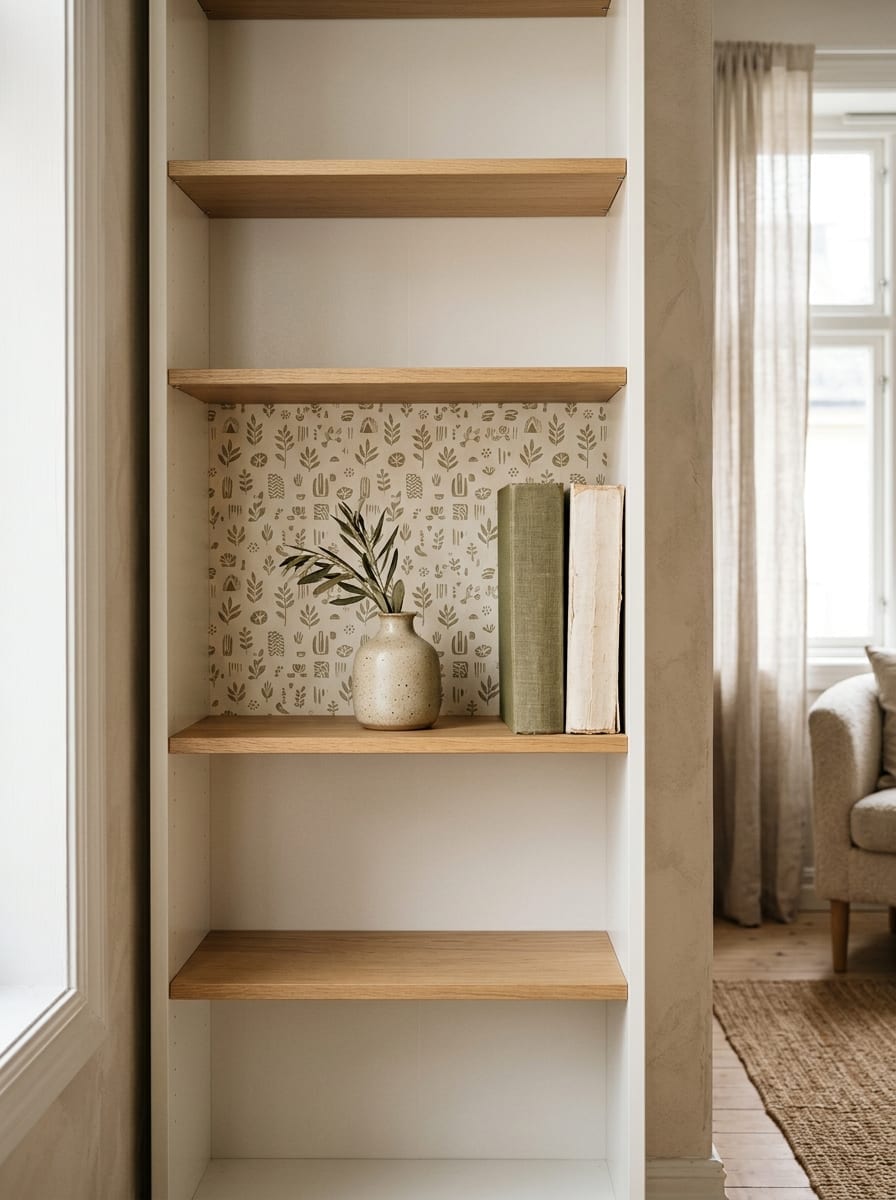
Small apartment bookcase with one central shelf backed in muted beige and olive patterned wallpaper, styled with two books and one ceramic object
In This Guide
Basic shelves can make a room feel unfinished. But wallpapering the entire wall behind them can feel like too much commitment, especially in a rental or small apartment. That is where shelf wallpaper becomes useful. Instead of covering a whole room, you can use pattern in a much smaller area:
- behind a bookcase
- inside a cabinet
- on the back panel of floating shelves
- inside one shelving section
- on a removable insert
This gives you:
- color
- depth
- contrast
- personality
without turning the whole room into one large pattern. But small spaces need restraint. A busy wallpaper behind:
- books
- baskets
- decor
- frames
can quickly create visual overload. The goal is not to make the shelf louder. It is to make it feel more intentional. Here are nine ways to use wallpaper on or behind shelving without making a compact room feel busier.
1. The One-Shelf Accent Back
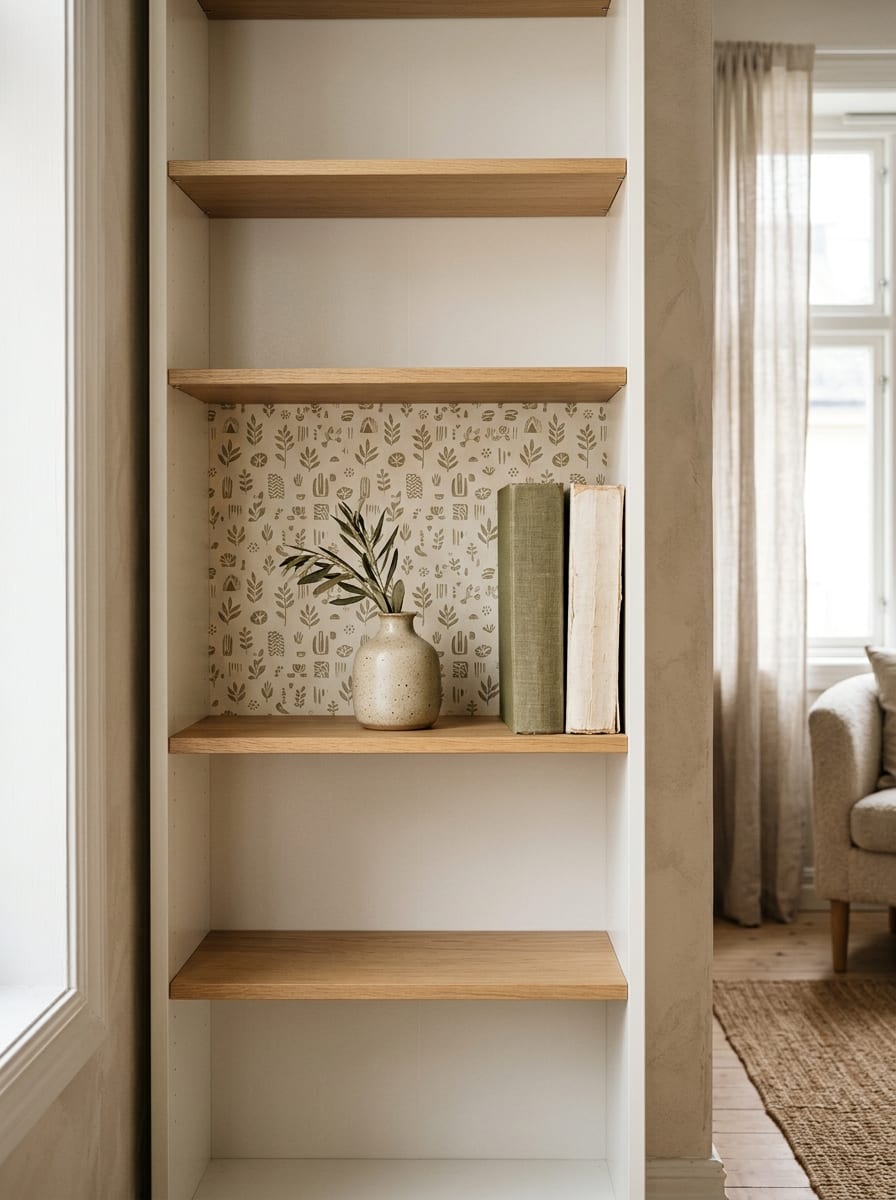
You do not need to wallpaper the entire bookcase. One shelf section can be enough.
Why it works
A single patterned zone becomes a focal point. The rest of the shelving stays visually quiet. This works especially well in a small room where the shelf already contains:
- books
- baskets
- framed photos
- decorative objects
Choose the most visible shelf
Use the section around:
- eye level
- center of the bookcase
- strongest styling vignette
instead of choosing a random lower shelf.
Keep the pattern distinct but controlled
Try:
- simple botanical
- small geometric
- stripe
- soft abstract print
You want enough contrast to notice it, but not so much that it competes with every object in front.
Style less in front of the wallpaper
If the backing has pattern, use fewer items on that shelf.
2. The Full Bookcase Backing
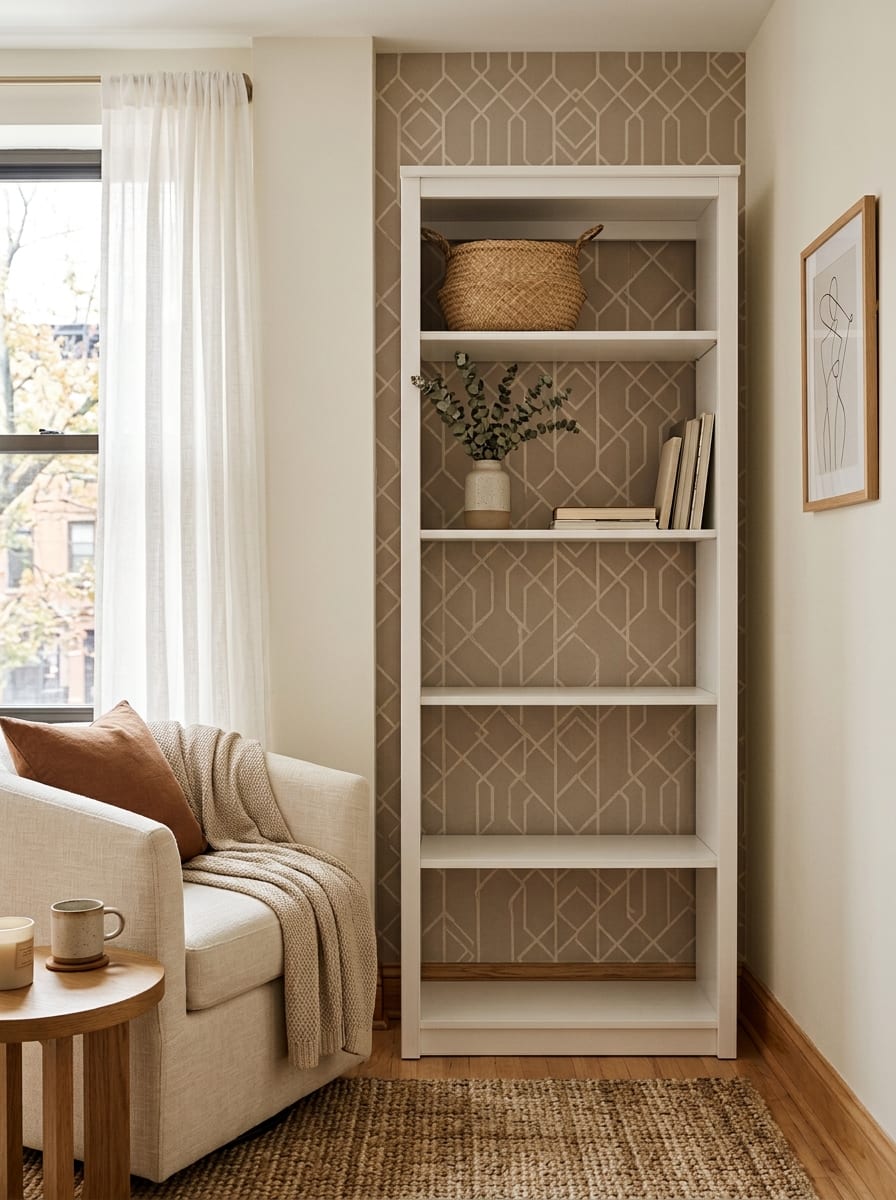
If the shelving unit itself is simple, covering the entire back panel can turn it into a stronger feature.
Why it works
The pattern reads as one continuous backdrop rather than several unrelated accents. That can make:
- basic shelving
- inexpensive bookcase
- plain built-in
feel more finished.
Keep the wallpaper calmer if the whole back is covered
A full bookcase already contains many visual elements. Choose a pattern with:
- limited colors
- moderate or small scale
- low-to-medium contrast
rather than a highly detailed mural.
Let some shelves stay sparse
Wallpaper does not mean every shelf needs decor. Empty space becomes even more important.
Best for
This works particularly well when the shelf is:
- white
- pale wood
- simple in shape
because the pattern has a clear frame around it.
3. The Tonal Geometric Shelf
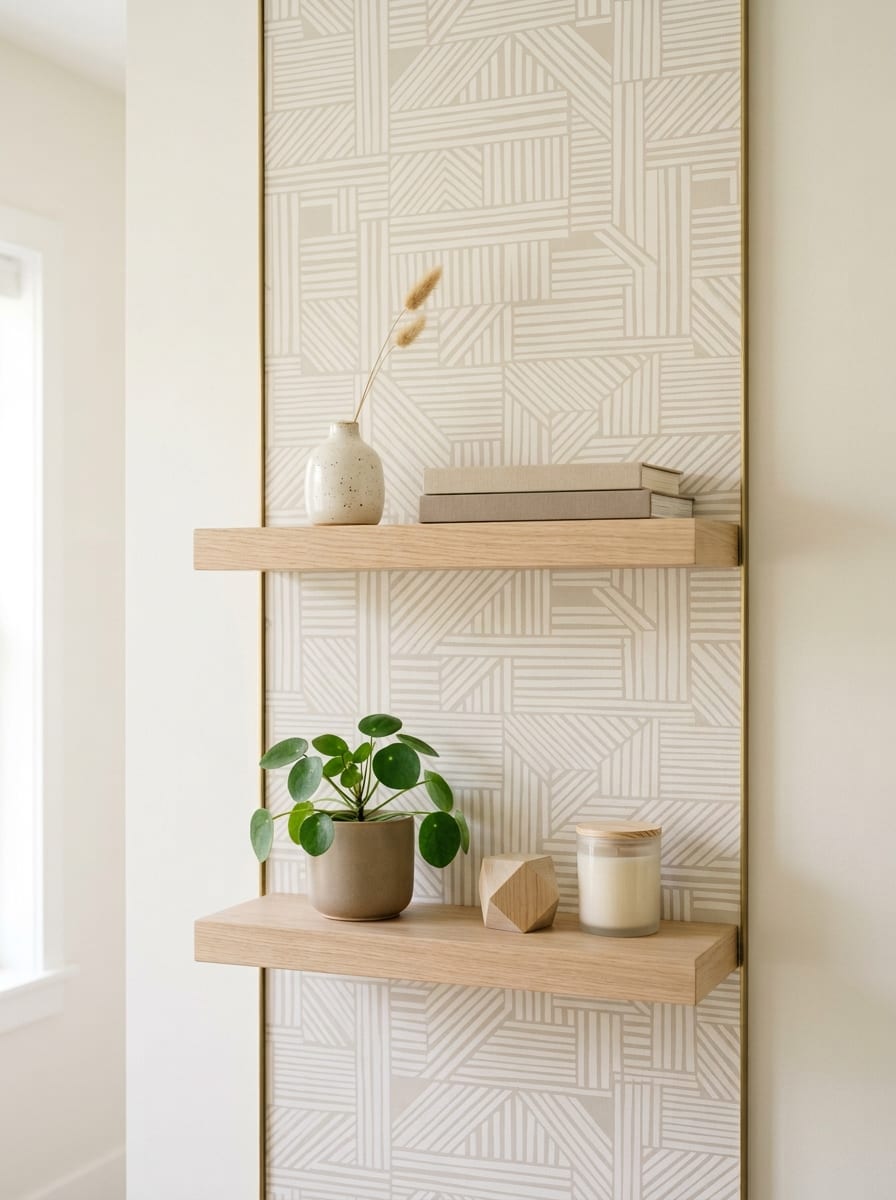
Geometric wallpaper can work beautifully in a small room if the contrast stays low.
Try combinations like
- cream + beige
- ivory + taupe
- sage + muted green
- pale blue + gray
Why it works
The geometry creates structure without adding lots of visual color. This makes it easier to pair with:
- books
- ceramics
- baskets
Avoid extremely high contrast
Black-and-white geometric wallpaper can become dominant very quickly. That may work in a larger room, but behind a small shelf it can feel busy.
Keep shapes medium or small
Large dramatic shapes can make a narrow shelf feel chopped into sections.
4. The Tiny Botanical Backdrop
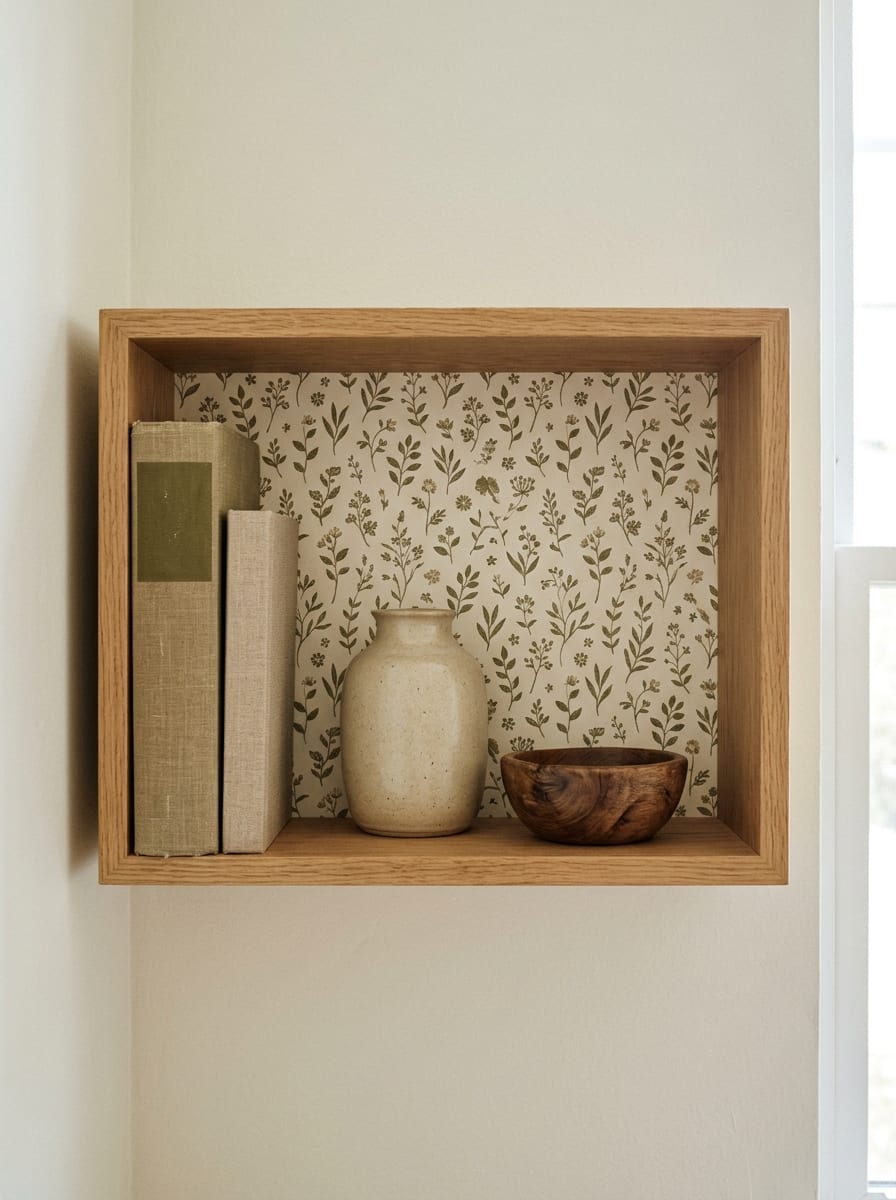
A small botanical print can add softness without becoming too decorative.
Good botanical directions
Try:
- tiny leaves
- fine branches
- simple line-drawn flowers
- muted herb pattern
Why it works
Botanical patterns introduce movement and organic shape. That can soften shelving filled with:
- straight books
- square baskets
- rectangular frames
Keep the color palette limited
A small floral with:
- five colors
- strong contrast
- dense repeats
can become very visually active. A two- or three-tone print is often easier in small spaces.
Keep foreground decor simple
Avoid putting:
- floral vase
- botanical print
- leafy wallpaper
- patterned basket
all in the same shelf zone. One motif is enough.
5. The Warm Stripe Shelf
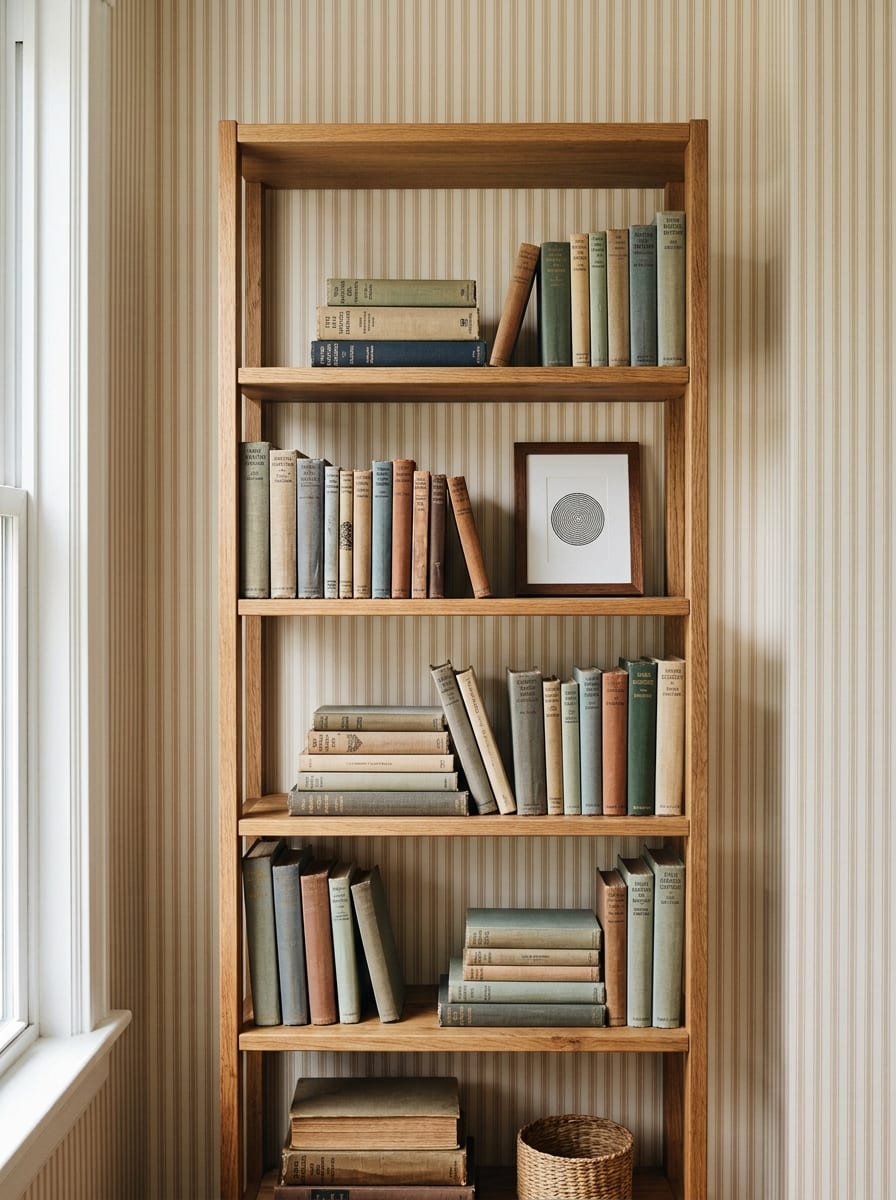
Stripes are one of the simplest ways to use wallpaper because the pattern is easy to control visually.
Vertical stripes
Can make the shelf backing feel taller.
Horizontal stripes
Can emphasize width.
For a small room
Soft vertical stripes usually work well because they create a clean direction without adding too much detail.
Use low contrast
Try:
- cream + camel
- white + warm gray
- beige + muted terracotta
Why it works
The repeated line adds structure while remaining simple.
6. The Cabinet-Interior Wallpaper Moment
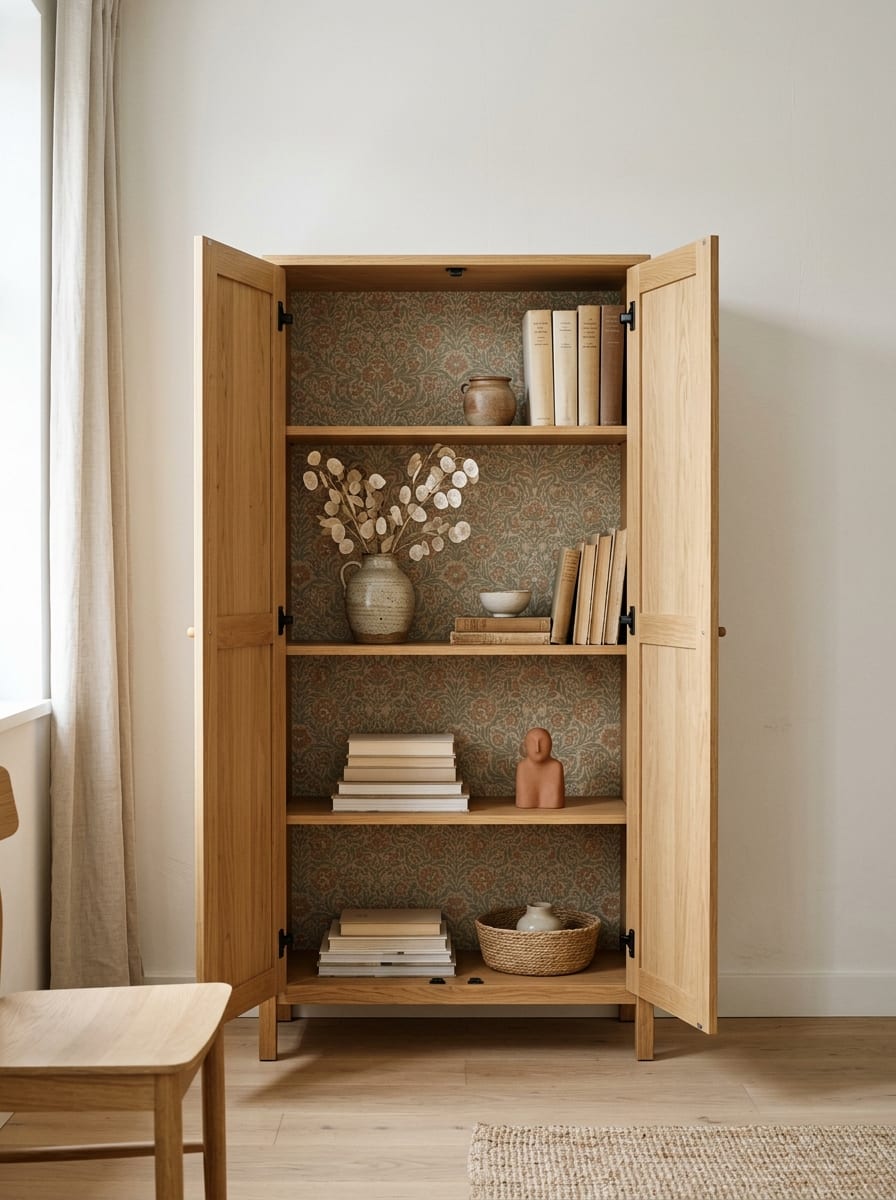
Wallpaper does not need to be visible across the whole room. Inside a cabinet can be a more subtle place to use it.
Good locations
Try:
- glass-front cabinet
- open upper cabinet
- media cabinet interior
- display cabinet
Why it works
The pattern appears only in a controlled frame. That makes it easier to use something slightly more decorative.
Keep the cabinet contents edited
If the cabinet contains:
- dishes
- books
- decor
do not overcrowd it. The wallpaper should still be visible.
This works well for renters
If the cabinet is freestanding, you may be able to modify only the furniture rather than the wall. Still follow the wallpaper and furniture surface guidance.
7. The Removable Panel Method
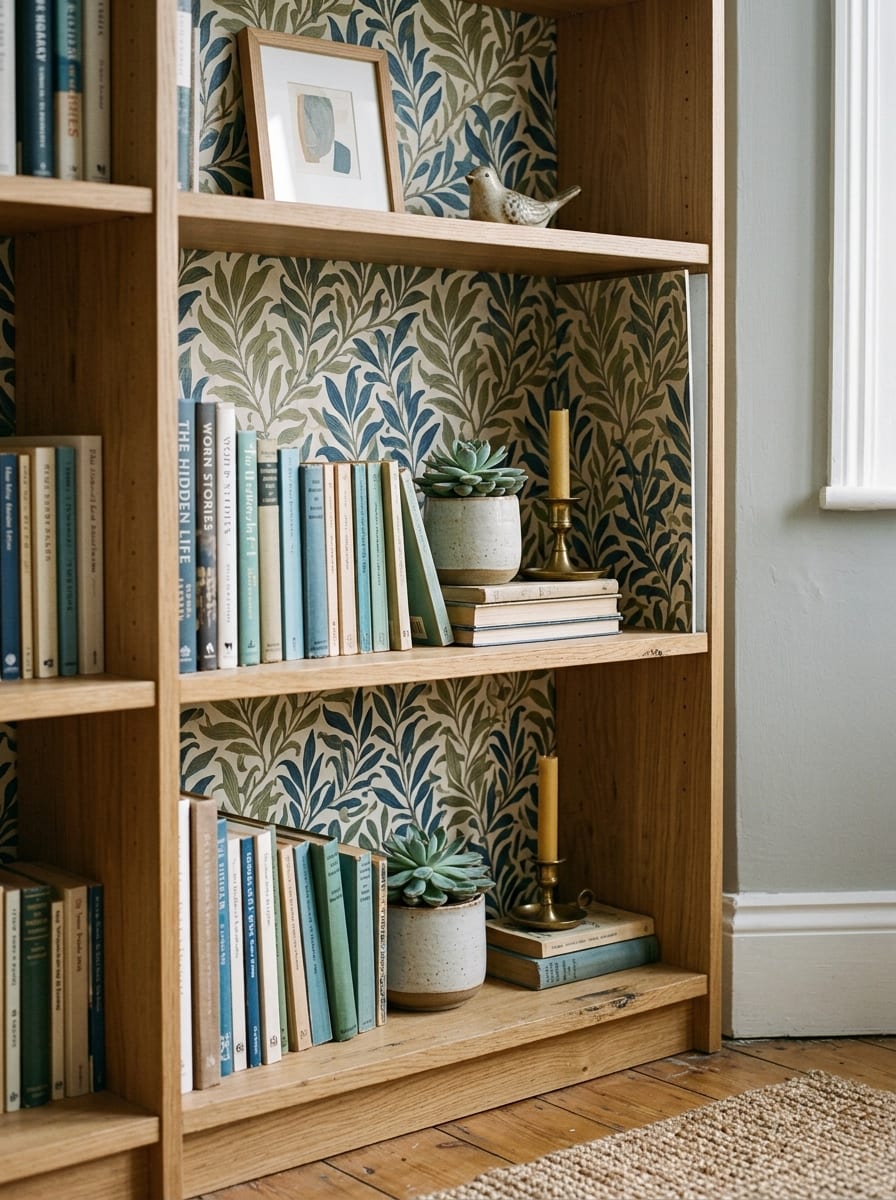
If you do not want adhesive directly on:
- wall
- furniture
- shelf backing
create a removable insert.
How the idea works
Wallpaper can be applied to a separate lightweight panel sized to fit the back of the shelf. The panel can then sit behind the shelving display.
Why it works
You can:
- remove it
- replace it
- change the pattern
without permanently altering the shelf surface.
Materials vary
Possible panel materials may include lightweight:
- foam board
- thin hardboard
- removable backing panel
depending on the shelf size and safe installation.
Measure carefully
The panel should fit cleanly without:
- bowing
- interfering with shelves
- blocking outlets
- becoming unstable
Rental advantage
This can be useful if the lease limits changes to walls or built-ins.
8. The Shelf-Wallpaper + Neutral Decor Formula
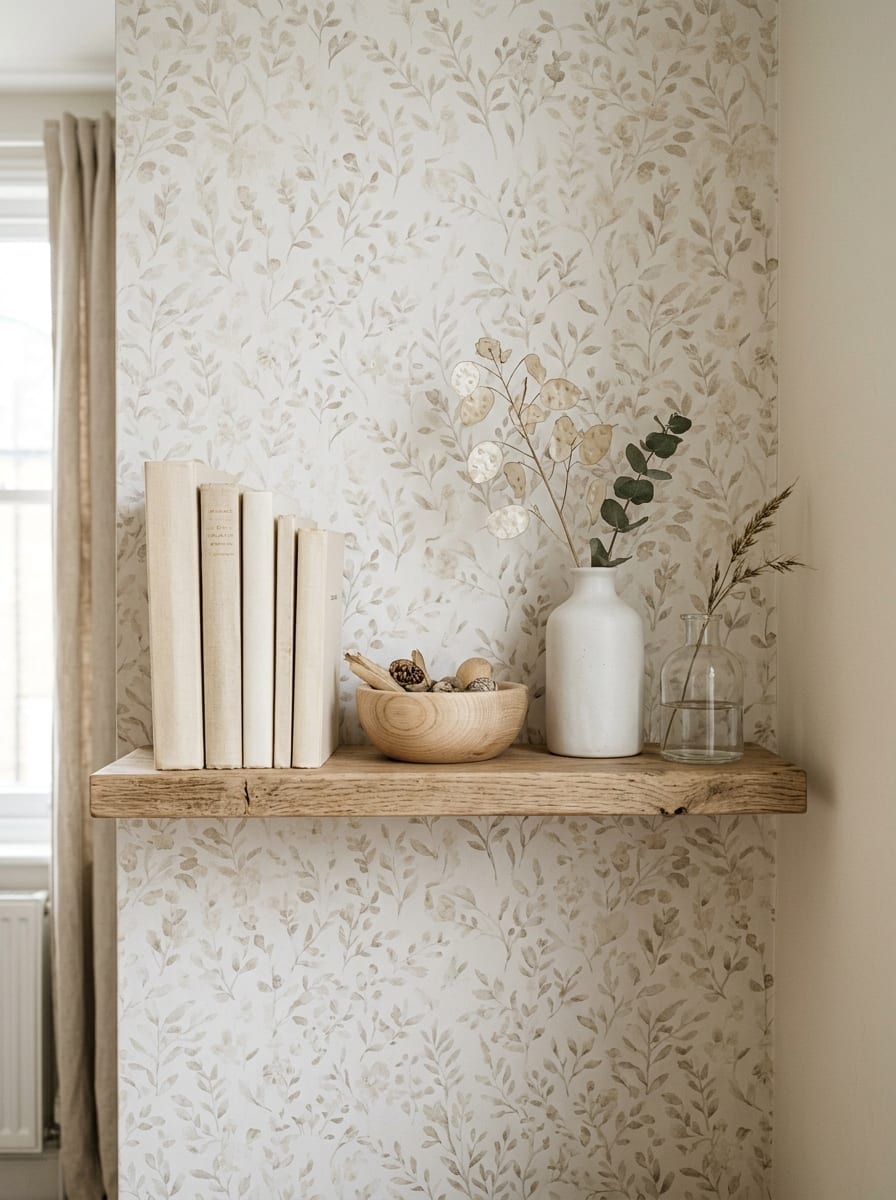
The easiest way to keep wallpaper from becoming overwhelming is to simplify everything in front of it. Use: patterned background + mostly solid foreground For example Wallpaper:
- sage botanical
Decor:
- cream books
- wood bowl
- white ceramic
Why it works
The eye does not have to process:
- patterned wallpaper
- patterned books
- patterned basket
- patterned artwork
all at once.
Use texture instead of extra pattern
Add interest through:
- wood grain
- matte ceramic
- woven basket
- glass
instead.
Keep color repetition limited
Pull one or two colors from the wallpaper into the shelf styling. That is enough.
9. The One-Pattern Shelf Styling Rule
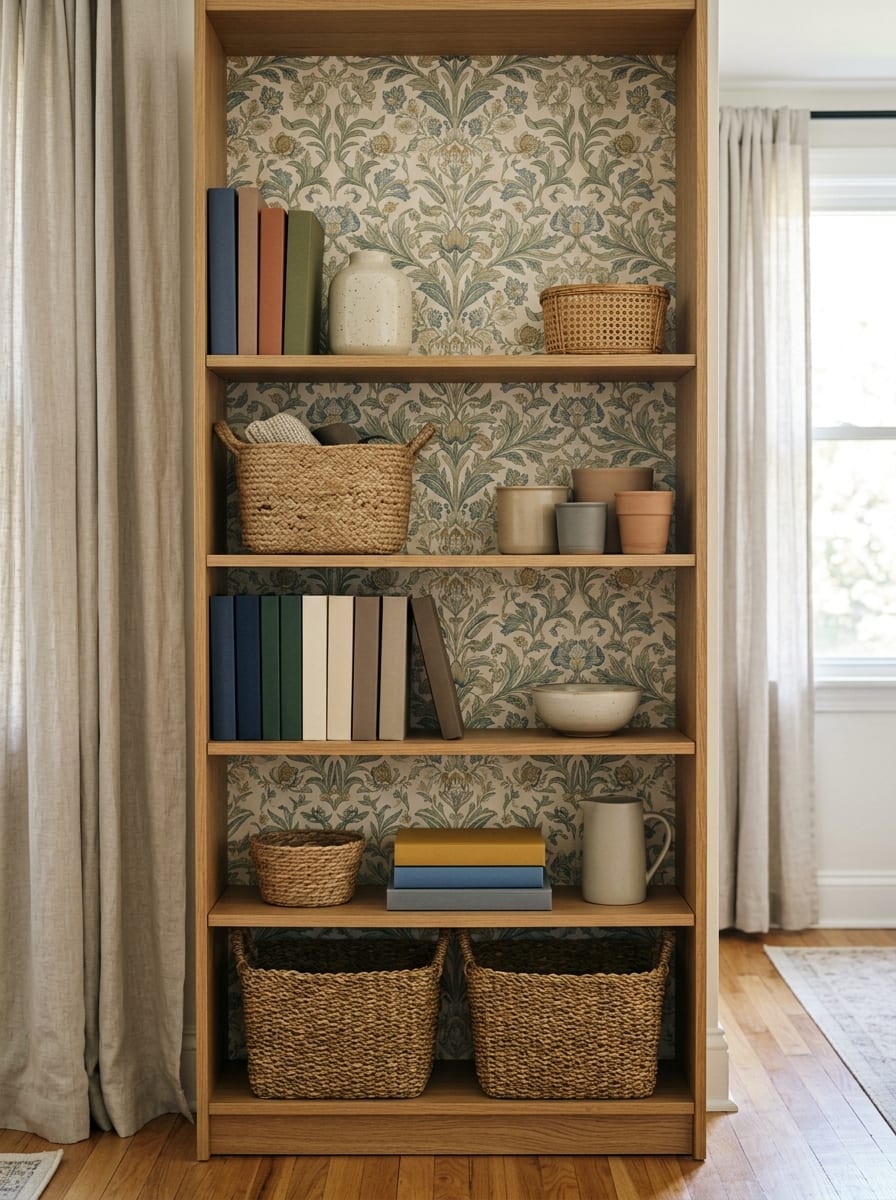
If the wallpaper is patterned, let it be the main pattern in that zone. This single rule can prevent most shelf styling from becoming too busy.
Avoid combining
- patterned wallpaper
- patterned baskets
- patterned boxes
- patterned artwork
on the same shelf. Instead use Wallpaper: pattern Foreground: solid shapes + texture
Why it works
The wallpaper gives the shelf personality. The decor supports it rather than competing with it.
This also makes changes easier
You can swap:
- books
- vases
- frames
without constantly redesigning the whole shelf.
Start With the Shelf, Not the Wallpaper
Before choosing a pattern, look at the shelving itself. Ask:
- Is the shelf light or dark?
- Is it open or closed?
- How many objects are displayed?
- How much of the backing is actually visible?
- Is the room already patterned?
The wallpaper should work with the shelf, not fight it.
Decide How Much Pattern You Actually Need
You do not automatically need to cover:
- whole wall
- whole bookcase
- every shelf
Sometimes one small section is enough.
Use One Accent Zone First
If you are uncertain, start with:
- one shelf
- one backing panel
- one cabinet interior
before committing to the full unit.
Pattern Scale Matters
The same wallpaper can feel completely different depending on the size of the repeat.
Tiny repeat
Can feel detailed and busy.
Large repeat
Can feel bold and graphic.
Medium repeat
Often gives a good balance. There is no universal best scale. The right choice depends on:
- shelf size
- room size
- foreground decor.
Contrast Matters More Than Pattern Type
A floral can feel calm if it is:
- cream + beige
while a simple stripe can feel strong if it is:
- black + white.
Always evaluate contrast.
Small Rooms Usually Benefit From Limited Colors
A wallpaper with two or three main colors is easier to integrate than one with:
- six
- seven
- eight
different tones.
Match the Wallpaper to the Room Undertone
Warm room? Try:
- cream
- camel
- terracotta
- olive
Cooler room? Try:
- soft blue
- gray
- muted green
This helps the shelf feel connected to the rest of the room.
Do Not Match Every Decor Item to the Wallpaper
You do not need every object to repeat the exact palette. That can feel overly coordinated. One or two echoes are enough.
Use Wallpaper Behind Books Carefully
If shelves are packed with books, much of the wallpaper may disappear. That is not necessarily bad. But it means a very expensive or complex pattern may not be worth it.
Keep Books From Covering Everything
Leave a little visible backing around:
- book stacks
- decor objects
so the wallpaper can still do its job.
Wallpaper Behind Floating Shelves
This can create a framed vertical accent zone. You do not need to wallpaper the entire wall. Try one narrow section behind the shelves.
Wallpaper Behind a Freestanding Bookcase
This works especially well if the unit has:
- open back
- removable back panel
- simple frame
and the wall behind is visible.
Wallpaper Inside Built-Ins
Built-ins naturally frame wallpaper. But renters should confirm whether modifying permanent cabinetry is allowed.
Wallpaper Inside a Cabinet
This is often one of the safest visual uses because the pattern is contained. It also lets you experiment with slightly stronger prints.
Wallpaper on Shelf Surfaces
If using wallpaper or liner on the horizontal shelf surface, check whether the product is appropriate for:
- wear
- cleaning
- weight
- friction
Some products are better suited to vertical backing than horizontal use.
Peel-and-Stick Is Not Automatically Damage-Free
“Removable” does not guarantee zero damage on every surface. Results can depend on:
- paint quality
- wall preparation
- surface type
- installation time
- humidity
- product adhesive.
Always follow product instructions and test where appropriate.
Test a Small Hidden Area First
Before covering a large section, test the material on an inconspicuous area if the product guidance allows. Check:
- adhesion
- removal
- finish compatibility.
Check Your Lease
If you are renting, review rules about:
- wallpaper
- adhesive products
- built-ins
- wall modifications.
Avoid Applying Over Unstable Paint
Wallpaper can only be as secure as the surface underneath it. Flaking or poorly bonded paint can create problems.
Humidity Matters
In:
- bathrooms
- kitchens
choose materials suitable for the environment and follow manufacturer guidance.
Measure Twice Before Cutting
Shelf interiors can be slightly uneven. Measure:
- width
- height
- corner shape
before cutting.
Use a Template for Awkward Areas
For:
- curved corners
- outlets
- shelf supports
create a paper template first if needed.
Work One Section at a Time
Do not remove all backing at once. Smaller sections are easier to:
- align
- smooth
- adjust.
Follow the product’s application instructions.
Pattern Matching Can Matter
Some wallpaper repeats need to align between panels. Check the pattern repeat before cutting multiple pieces.
Use Leftover Wallpaper Strategically
Small shelf projects can be a great way to use wallpaper scraps. You may not need a full roll.
Do Not Mix Several Wallpaper Patterns on One Bookcase
It may sound creative, but in a small room it can become visually fragmented. One pattern is usually enough.
Wallpaper + Baskets
If the backing has a visible pattern, choose:
- solid
- natural
- neutral
baskets.
Wallpaper + Books
Books already bring many colors. If your shelf contains a large book collection, choose a quieter wallpaper.
Wallpaper + Plants
Plants add another organic pattern. Pairing them with a very busy botanical wallpaper can create too much visual movement. Use one or two plants max in the same zone.
Wallpaper + Artwork
If artwork sits directly in front of patterned wallpaper, keep the art:
- simple
- larger
- less detailed.
Wallpaper + Mirrors
A small mirror can reflect the pattern and visually double it. That can be interesting but also busier. Use carefully.
Wallpaper + Lighting
Shelf lighting can highlight:
- texture
- color
but do not over-light a very busy pattern.
Dark Wallpaper Behind Shelves
Dark wallpaper can create depth. It works especially well with:
- pale shelves
- white ceramics
- warm wood.
But it will carry more visual weight.
Light Wallpaper Behind Shelves
Light patterns usually feel softer and can help keep compact rooms visually open.
Bold Wallpaper Can Work in Small Spaces
Small does not mean every surface must be plain. The key is limiting the area. A bold pattern on one shelf may work better than a subtle pattern across an entire wall.
Use the 80/20 Idea
Think roughly: 80% calm 20% pattern You do not need exact measurements. The concept is simply to keep the patterned area controlled.
One Bookcase Can Be the Focal Point
If the wallpapered shelf becomes the room’s main focal point, let other walls stay quieter.
Avoid Competing Accent Walls
A patterned shelf beside:
- another wallpaper wall
- gallery wall
- heavily patterned curtains
may create too many focal points.
Shelf Wallpaper in a Small Living Room
Use the wallpaper to give one:
- bookcase
- media shelf
- floating shelf zone
more personality. Keep the rest of the room restrained.
Shelf Wallpaper in a Bedroom
Softer patterns usually work well. Try:
- muted botanical
- stripe
- tonal geometric.
Shelf Wallpaper in a Home Office
Wallpaper can add interest behind:
- books
- supplies
- desk shelves
without covering the whole work wall.
Shelf Wallpaper in a Kitchen
Try inside:
- open shelving
- upper cabinet
only if the material is appropriate for kitchen conditions. Keep it away from:
- heat
- grease
- moisture
unless specifically designed for that use.
Shelf Wallpaper in a Bathroom
Humidity makes product suitability especially important. Do not use ordinary paper products where moisture exposure is likely.
Shelf Wallpaper in an Entryway
A small backing panel can create a strong first impression. But keep practical storage:
- keys
- bags
simple around it.
Shelf Wallpaper in a Studio Apartment
Because more of the room is visible at once, choose:
- one controlled patterned zone
- a palette already used elsewhere.
Shelf Wallpaper Behind a TV Unit
Use carefully. The TV already creates a large black rectangle. A calm low-contrast wallpaper usually works better than something extremely busy.
Wallpaper Behind Open Shelves
Open shelves need more restraint because the wall remains visible through them. Use fewer decorative objects.
Wallpaper Behind Closed Shelving
The pattern may only show through:
- glass
- open door
- partial interior
so you can use slightly more detail.
Keep Shelf Decor Functional
Do not cover useful storage with decorative objects just because the wallpaper looks good behind them. The shelf still needs to work.
Use Books Horizontally and Vertically
Changing book orientation can reveal more wallpaper while keeping storage practical.
Leave Empty Shelf Space
This is one of the easiest ways to make patterned shelving feel more sophisticated. The wallpaper becomes part of the composition.
Avoid Filling Every Inch
Pattern + full shelves = visual overload. Pick one. If the backing is busy, the shelf should be simpler.
Use Larger Objects Instead of Many Tiny Ones
A few larger:
- books
- baskets
- ceramics
look calmer against pattern than many miniature items.
Repeating One Material Helps
If several shelves contain:
- pale wood
- cream ceramic
the repeated material helps unify the wallpapered background.
Keep the Shelf Palette Tight
Try choosing:
- one main neutral
- one wood tone
- one accent color
from the wallpaper.
Do Not Overstyle the Bottom Shelves
Lower shelves often already hold practical storage. Let them remain functional instead of forcing every level to become decorative.
Use Closed Boxes for Messier Items
If the wallpaper is visible, random clutter in front of it will stand out even more. Use plain boxes where appropriate.
The Wallpaper Should Still Be Visible
If you cannot see any wallpaper after styling, either:
- remove some objects
- or reconsider whether that shelf needed wallpaper.
Step Back After Styling
Look at the shelf from across the room. Ask:
- Does the pattern still feel controlled?
- Are there too many small objects?
- Is there enough empty space?
- Does the shelving compete with another focal point?
Take a Photo
A phone photo can reveal visual noise more easily than standing directly in front of the shelf.
Remove One Object
If the shelf feels almost right but slightly busy, remove one item. Do not replace it immediately.
Common Shelf Wallpaper Mistakes
Covering too much area immediately
Start smaller if you are uncertain.
Choosing pattern before considering shelf contents
Books and decor add pattern too.
Using high contrast in an already busy room
The shelf becomes visually heavy.
Filling every shelf after wallpapering
The background needs breathing room.
Mixing multiple wallpaper prints
The shelving can feel fragmented.
Assuming removable means zero-risk
Always follow product and surface guidance.
Ignoring humidity
Use material appropriate for the environment.
Matching every object to the wallpaper
It can look overly coordinated.
Using too many tiny decor pieces
Pattern already adds visual detail.
Forgetting the room around the shelf
One focal point is often enough.
Quick Shelf Wallpaper Decision Guide
Choose One-Shelf Accent if:
You want the lowest-commitment update.
Choose Full Bookcase Backing if:
The shelving itself is plain and needs more character.
Choose Tonal Geometric if:
You want structure without lots of color.
Choose Tiny Botanical if:
You want softness and organic movement.
Choose Stripes if:
You want a simple graphic effect.
Choose Cabinet-Interior Wallpaper if:
You want a contained patterned moment.
Choose a Removable Panel if:
You do not want adhesive directly on the shelf or wall.
Use Neutral Foreground Decor if:
The wallpaper already has enough visual interest.
Follow the One-Pattern Rule if:
Your shelves usually end up looking busy.
The Simplest Small-Space Shelf Wallpaper Formula
Use: one patterned backing plus: mostly solid decor plus: visible empty shelf For example: muted botanical wallpaper + cream books + wood bowl + empty space That is often enough.
FAQs
Can you put wallpaper on the back of a bookcase?
Yes, depending on the bookcase material and wallpaper product. Follow product guidance and check surface compatibility.
Is peel-and-stick wallpaper good for renters?
It can be useful because many products are designed to be removable, but it does not guarantee zero damage on every wall or furniture surface. Check:
- lease rules
- surface condition
- product instructions.
What wallpaper is best for a small shelf?
Low-to-medium contrast patterns with a limited color palette are often easier to use in compact rooms.
Should I wallpaper the whole bookcase?
Not necessarily. One shelf or one backing panel can create enough impact.
What pattern works behind books?
A quieter pattern often works best because book spines already add:
- color
- text
- visual detail.
Can I use wallpaper inside cabinets?
Yes, where the material and surface are appropriate. Cabinet interiors can be a good way to keep the pattern contained.
Can wallpaper make shelves look cluttered?
Yes, especially when combined with:
- many books
- patterned baskets
- small decor
- high-contrast artwork.
Keep foreground styling simpler.
What if I do not want adhesive on the furniture?
A wallpaper-covered removable panel can create a similar look without applying the material directly to the shelf backing.
Final Thoughts
Shelf wallpaper is one of those small changes that can make basic storage feel far more intentional. But more pattern is not automatically better. Start with the smallest area that will create enough impact. Choose a pattern based on:
- shelf size
- contrast
- room palette
- what will sit in front of it.
Use removable methods thoughtfully if you are renting. Keep the foreground decor quieter. Leave some of the wallpaper visible. And remember that the goal is not to turn every shelf into a statement. One controlled patterned backing can be enough to make the entire shelving unit feel more finished without making a small room feel busier.