10 No-Entryway Apartment Ideas That Create a Landing Zone by the Door
Discover 10 no-entryway apartment ideas using slim consoles, wall hooks, shoe storage, rugs and simple zoning to create a practical landing spot when the front door opens straight into the room.
In This Guide
Some apartments do not really have an entryway. You open the front door and immediately step into:
- the living room
- a studio
- the kitchen
- a combined living and dining space There is no foyer. No hallway. No obvious wall that says: keys go here, shoes go here, bag goes here.
That is why clutter from the front door tends to spread. Shoes move toward the sofa. Mail lands on the dining table. Keys disappear onto the kitchen counter. Bags end up on chairs. The goal is not to somehow build a traditional foyer inside a tiny apartment. It is to create a small behavioral boundary around the door. You need just enough structure to answer three questions:
1. Where do I put what I am carrying?
2. Where do shoes and outerwear go?
3. Where does the entry zone stop and the living room begin?
Here are ten ways to create that landing zone without sacrificing too much floor space.
1. The Slim Console Landing Zone
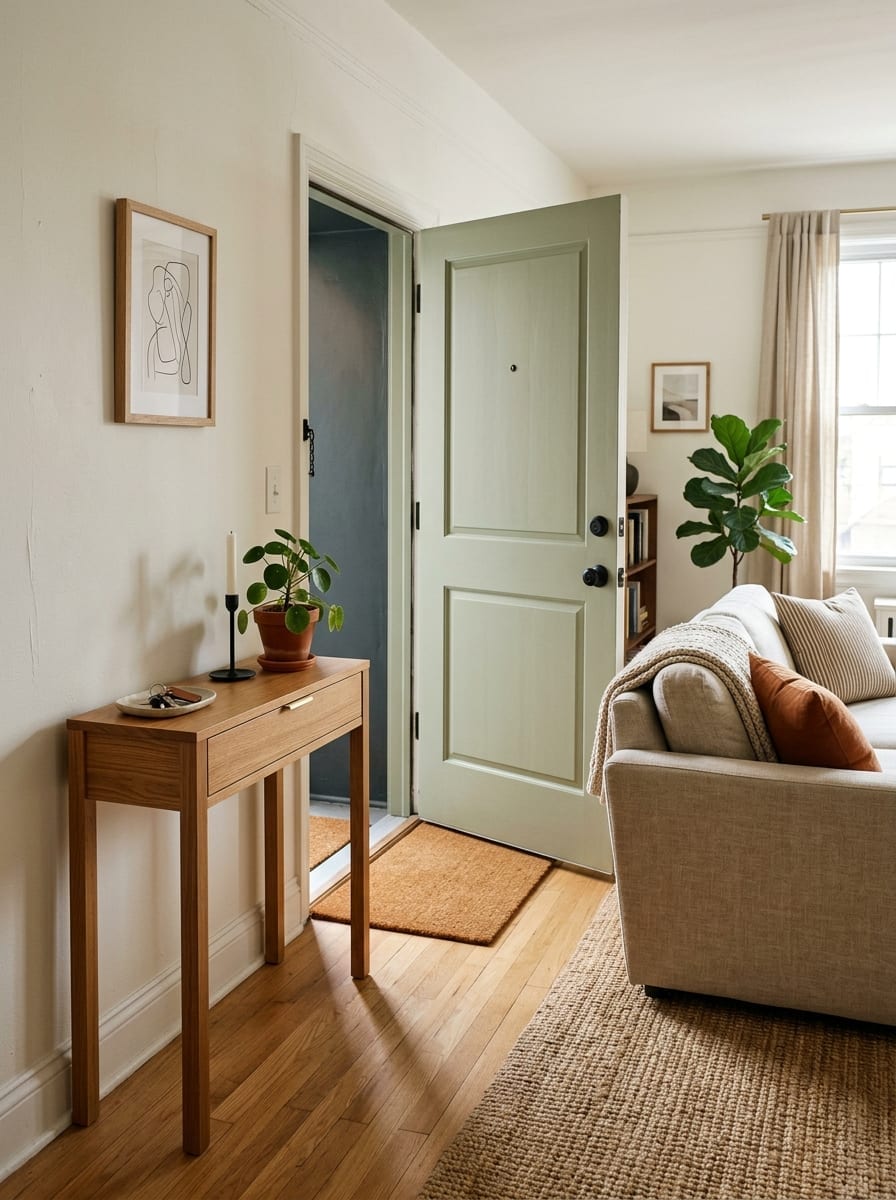
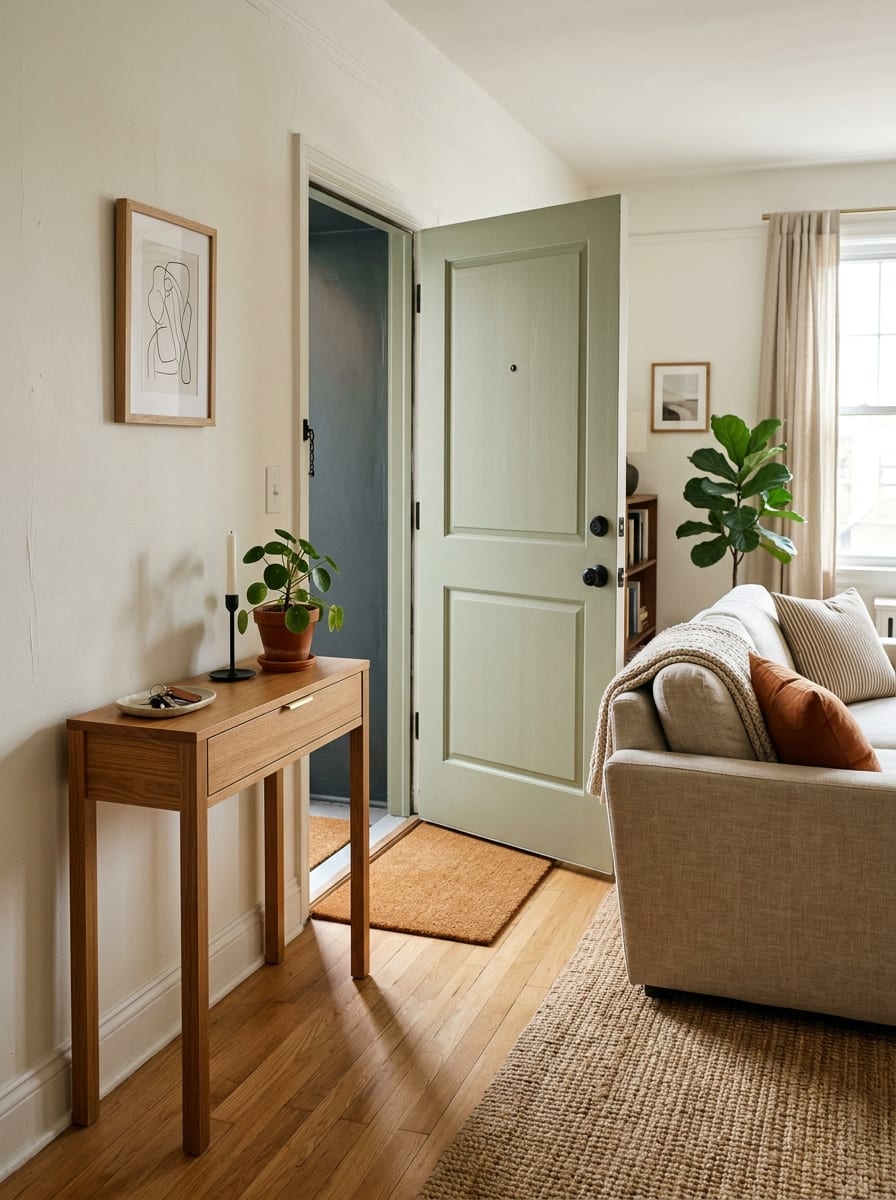
If you have even a narrow strip of wall beside the door, a slim console can create an instant entryway. It gives the arrival routine one specific surface.
What should live there
Keep it limited to things you actually need when leaving or coming home:
- keys
- wallet
- sunglasses
- small bag
Keep the console shallow
Depth matters more than width in a no-entryway apartment. A deep console may fit against the wall but still make the entrance feel tighter every time you walk past it. Look for a piece that provides:
- a usable top
- one or two drawers
- minimal projection into the room
Give keys one exact location
Use:
- small tray
- shallow bowl
- drawer Do not let the whole tabletop become the key zone.
Use closed storage below if possible
A console with a small drawer or cabinet can hide:
- dog leash
- reusable bags
- chargers
- sunglasses
- small household items This keeps the landing zone from becoming a clutter display.
Keep decor minimal
A tiny entry surface can disappear under:
- lamp
- vase
- books
- tray
- candle
- framed photo very quickly. One practical tray plus one decorative item is often enough.
2. The Wall-Hook Entry Strip
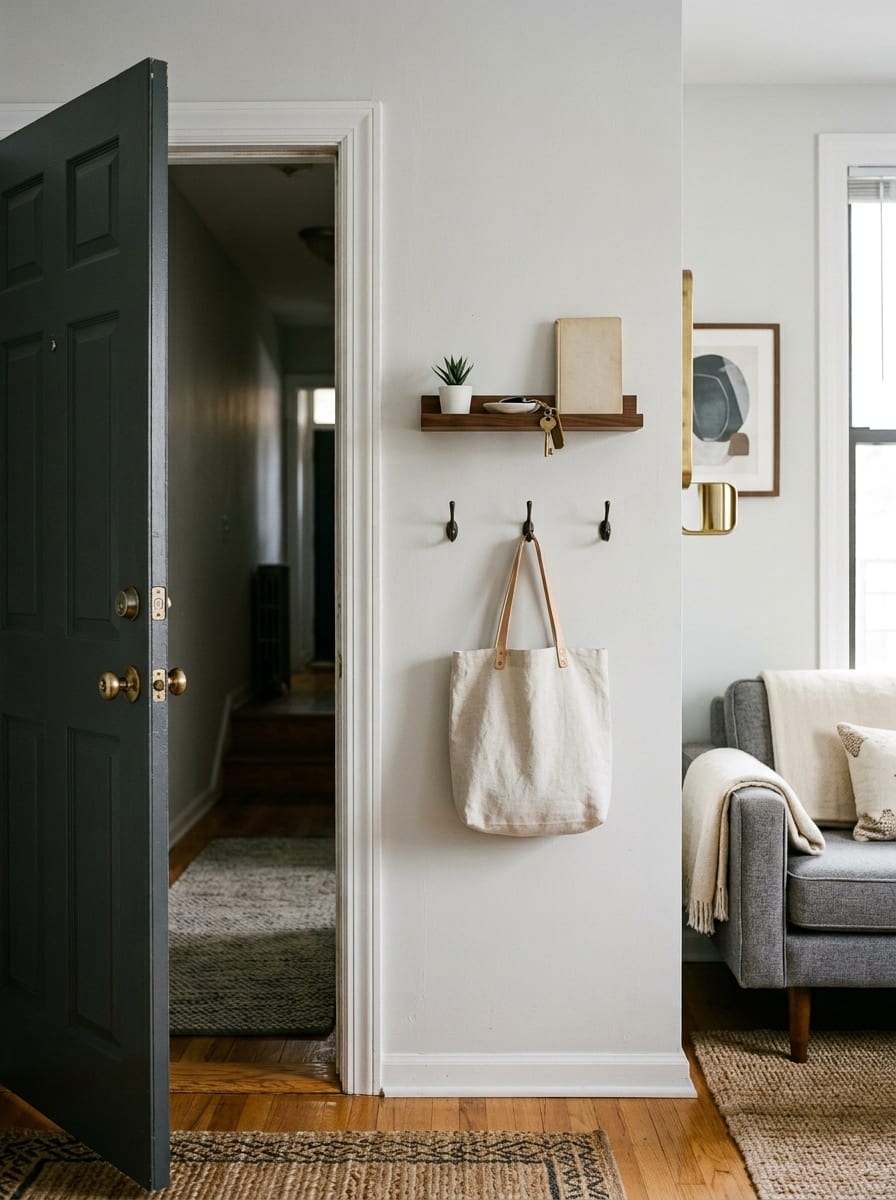
If there is no floor space for furniture, use the wall. A narrow vertical strip can become a functional entry zone.
Use only a few hooks
You do not need an entire mudroom wall. Try:
- 3 to 5 hooks
- one small shelf
- one basket below if space allows
Assign the hooks
For example: Hook 1 Daily jacket. Hook 2 Bag. Hook 3 Reusable shopping tote. That works better than filling every hook with several items.
Keep bulky coats elsewhere
A hook wall should handle current-use items, not your whole wardrobe. Too many coats make a small entrance visually heavy.
Use height carefully
Place frequently used hooks where they are comfortable to reach. Higher hooks can hold:
- hat
- light tote
- occasional item
Keep the door swing clear
Do not install hooks where hanging bags interfere with the door. Test the zone with:
- largest coat
- fullest bag not just empty hooks.
Renter note
Use an attachment method appropriate for the surface and load. Temporary does not always mean damage-free, so follow product instructions and lease requirements.
3. The Shoe-Cabinet Boundary
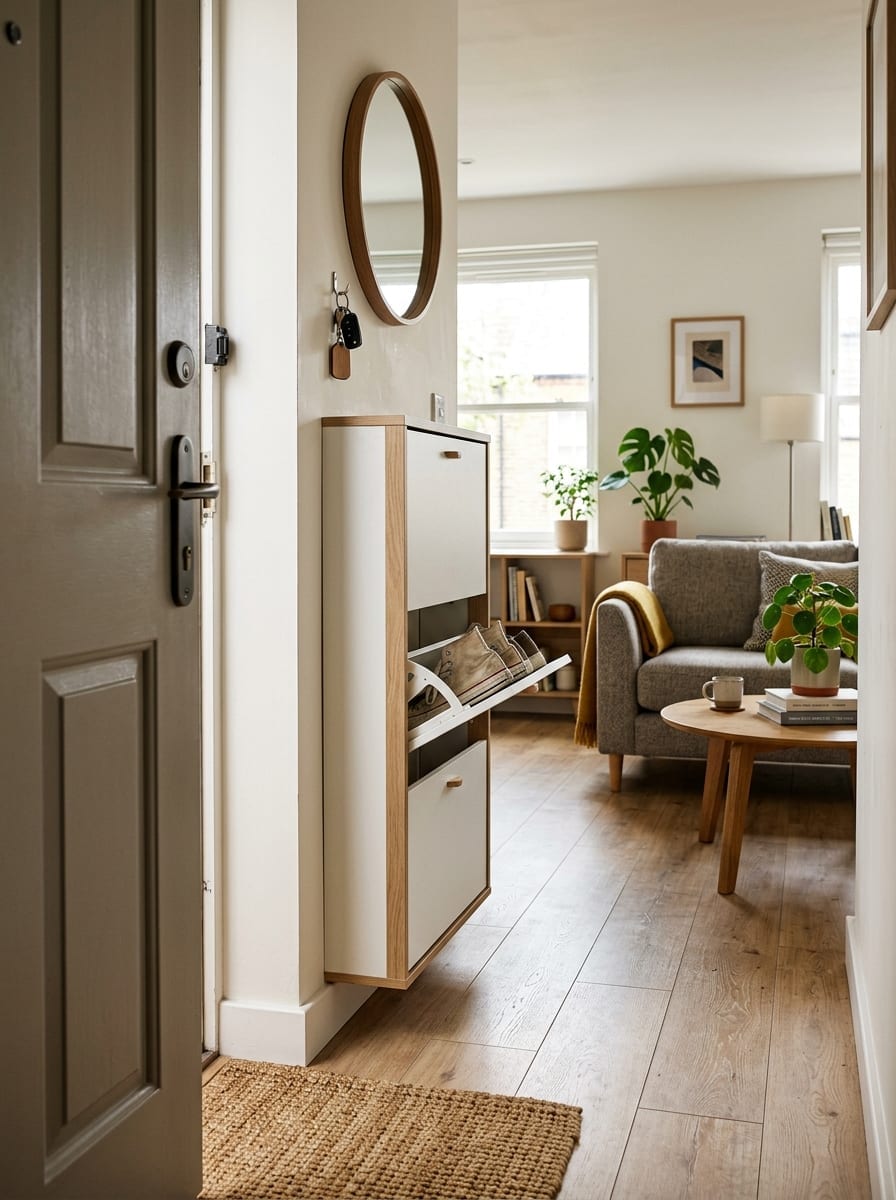
A slim shoe cabinet can do more than store shoes. It can visually mark where the entry area begins.
Why this works
When the door opens straight into the living room, you need some kind of boundary. A shallow cabinet creates that boundary without adding a wall. It says: this strip belongs to the entry.
Choose a low-profile design
A slim tilt-out cabinet works particularly well when wall depth is limited. Use it for the shoes worn most frequently.
Keep the top practical
Good uses include:
- key tray
- sunglasses Do not turn it into a decorative shelf.
Use the furniture edge as the zone limit
The entry area can effectively end where the cabinet ends. Beyond that point, you transition into the living room.
Watch the front door
Measure:
- door swing
- cabinet depth
- compartment opening The cabinet should not make entering the apartment awkward.
4. The Bench-and-Basket Drop Zone
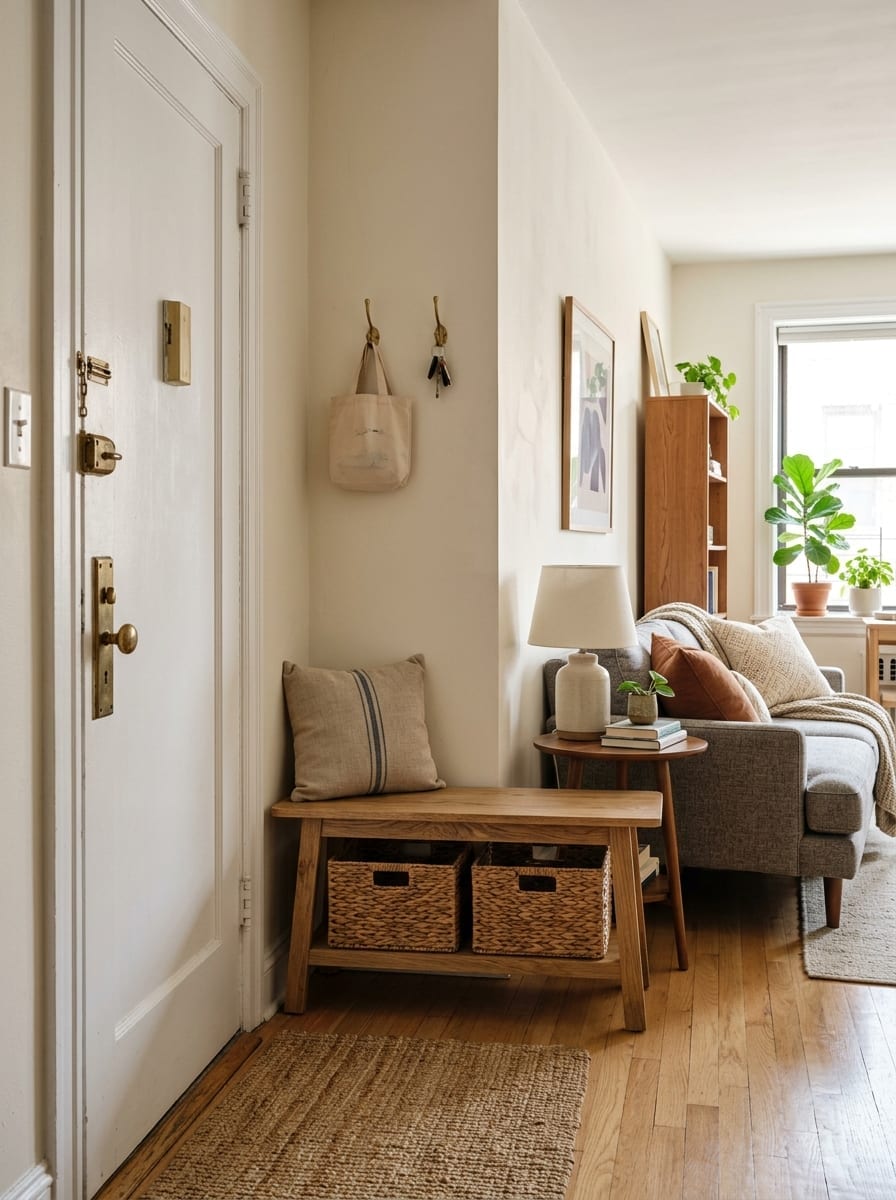
If the wall beside the door is slightly wider, a compact bench can create both seating and storage.
Why a bench works
It provides:
- a place to sit
- shoe storage
- a visual anchor in one footprint.
Keep it narrow
This is not a mudroom bench. Look for something compact enough to fit without projecting into the main room.
Use the space underneath
Add:
- one or two baskets
- shoe cubbies
- closed drawer storage
Decide what the baskets hold
Good categories include:
- shoes
- slippers
- dog-walking items
- scarves Do not let them become mystery storage.
Avoid covering the seat
If the bench becomes permanent storage for:
- bags
- packages
- folded clothes you lose the seating function.
Best use case
This works especially well when the front door opens into a room but there is a short blank wall immediately beside it.
5. The Rug-Defined Mini Entry
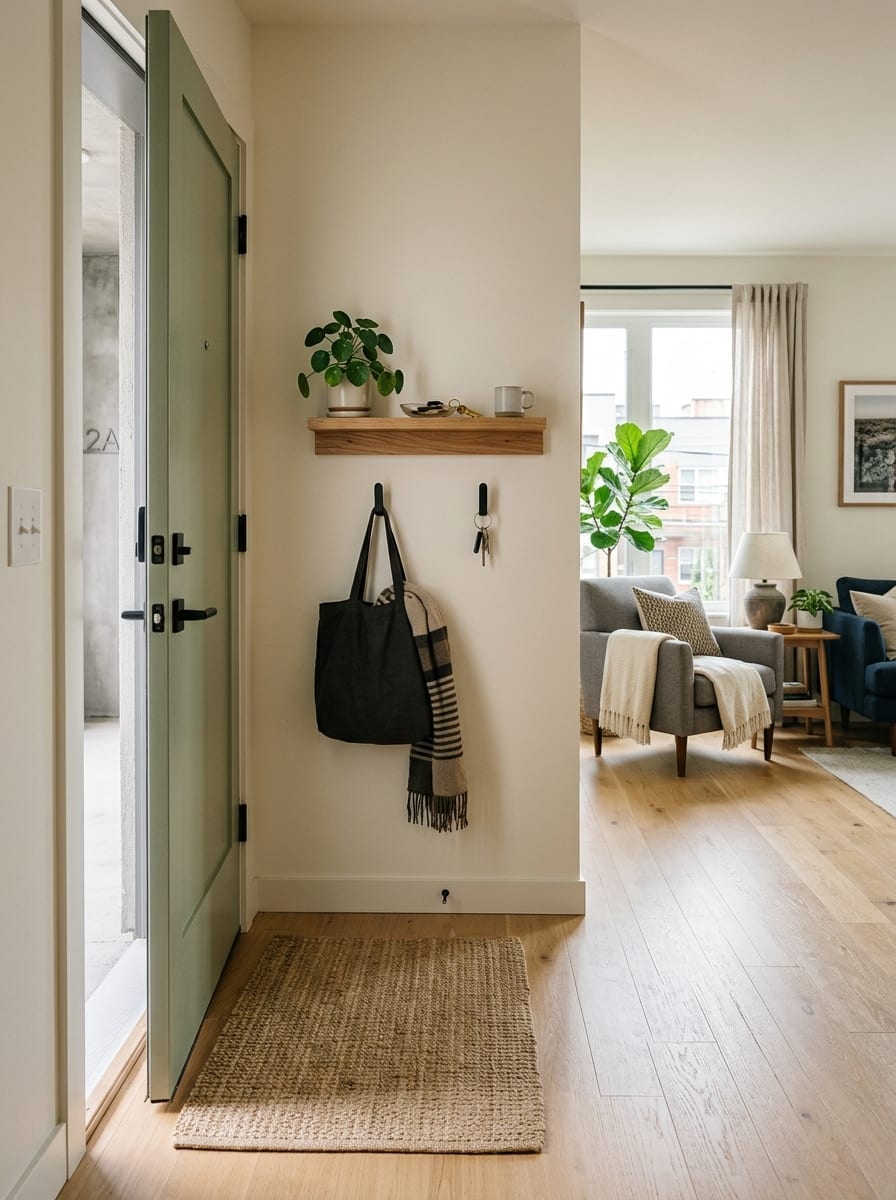
Sometimes the apartment needs a visual boundary more than another piece of furniture. A small rug can define an entry zone.
Why it works
The change in floor surface tells the eye: this is a separate functional area.
Even when the entry shares the same room with the sofa.
Keep the rug proportionate
Choose enough size to:
- step onto comfortably
- catch some dirt
- visually frame the door but not so large that it extends halfway into the living room.
Match the apartment’s circulation
The rug should not:
- bunch
- curl
- block the door
- create a trip hazard
Pair it with one functional element
For example:
- wall hooks
- slim console
- shoe cabinet The rug alone can define the space visually, but one practical storage element makes the zone much more useful.
Keep the color related to the room
You want the entry to feel separate but still connected to the rest of the apartment.
6. The Sofa-Back Entry Divider
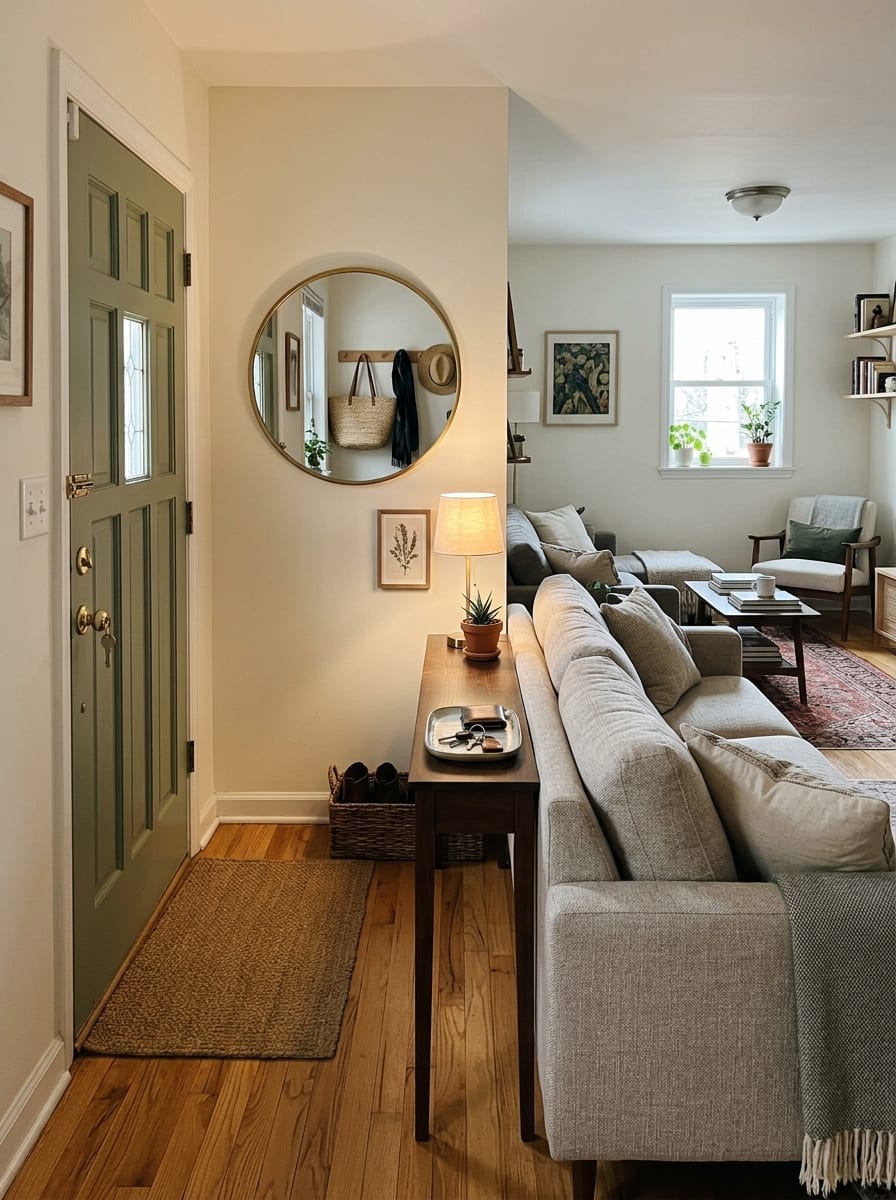
In some apartments, the sofa sits near the front door. Instead of fighting that layout, use the sofa to define the entrance.
Turn the sofa intentionally
Position it so the back of the sofa creates a soft boundary between:
- front door
- living area
Add a slim console behind it
If space allows, a narrow console behind the sofa can become:
- key station
- mail drop
- charging point
- small entry surface
Why this works
The sofa becomes a room divider without adding a wall or screen. You create: Entry side Arrival zone. Sofa side Living zone.
Keep circulation obvious
You should not need to squeeze around the sofa to enter the room. There needs to be a clear path from the door into the apartment.
Avoid oversized consoles
A very deep sofa table can turn the boundary into an obstacle. Keep it shallow.
7. The Floating Shelf Landing Spot
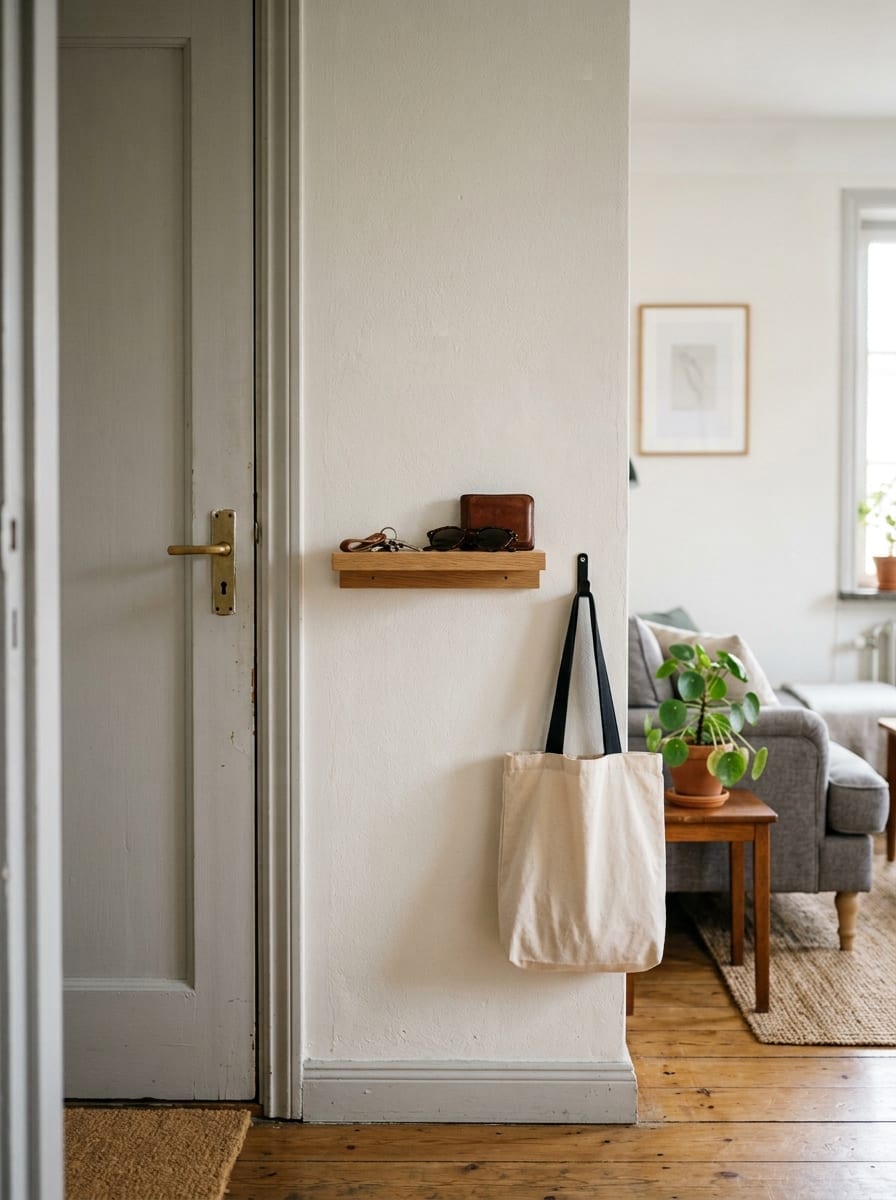
If the apartment is extremely tight, you may not need furniture at all. A small floating shelf can create the simplest possible landing spot.
What belongs there
Keep it to:
- keys
- wallet
- sunglasses
- small mail stack
Pair it with one hook
A single hook underneath or nearby can hold:
- bag
- light jacket
- reusable tote
Why this works
The setup uses almost no floor space. That makes it useful when the front door opens into:
- studio
- narrow living room
- kitchen
Keep shelf depth minimal
The shelf only needs to be deep enough for the items you actually use. A deeper shelf may become a shoulder-level obstacle.
Watch the mounting
The shelf must be installed safely for its load and wall type. If the wall cannot be altered, consider another freestanding option rather than improvising.
8. The Corner Entry Station
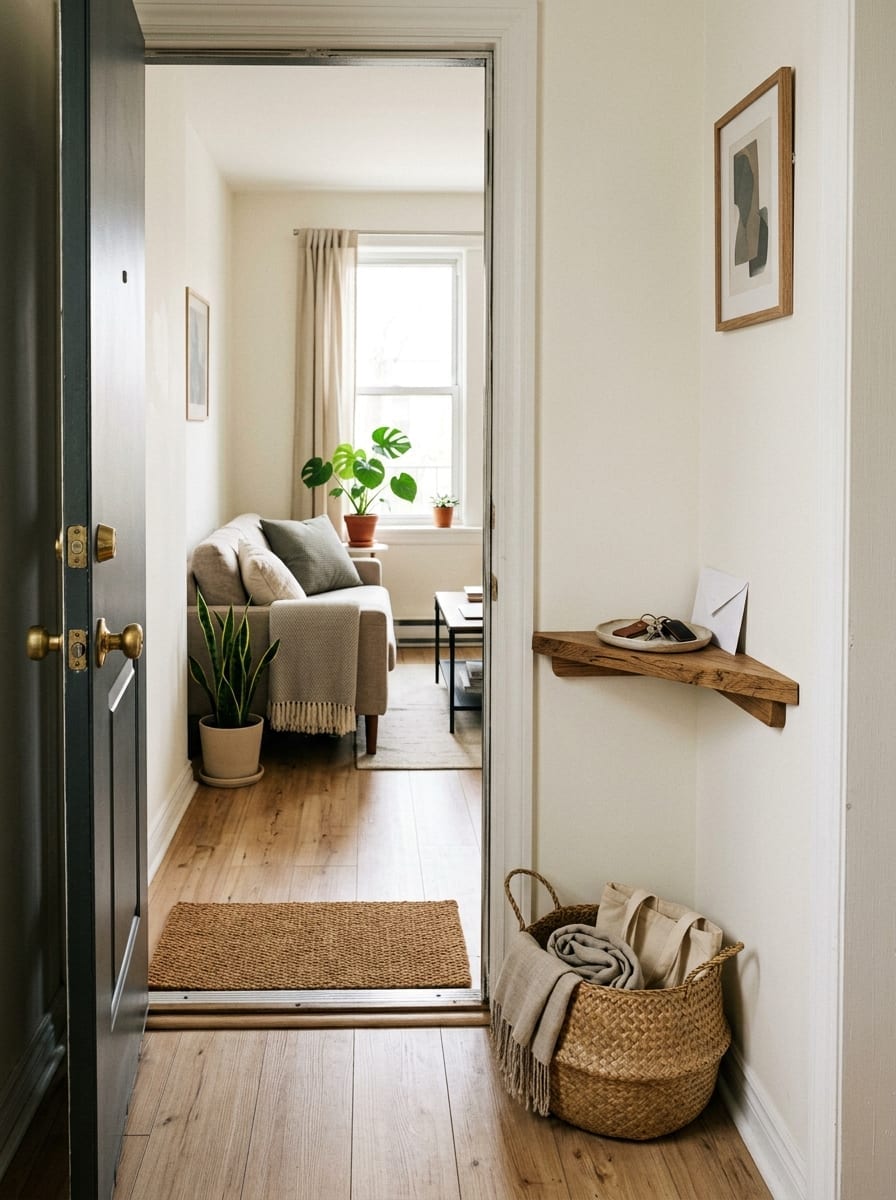
Sometimes there is no usable wall directly beside the door. But there may be a small corner a few feet away. That corner can become the landing zone.
Keep the entry station visually connected to the door
Use:
- matching rug
- wall mirror
- repeated material
- same color family so the corner still reads as part of the entrance.
Good furniture options
Try:
- narrow pedestal table
- small triangular shelf
- corner cabinet
- compact stool with basket
Do not overfill the corner
A corner station should solve the problem, not become another decorative vignette.
Good uses
Store:
- keys
- bag
- shoes
- outgoing mail depending on available space.
When this works best
Use it when the front door itself is surrounded by:
- switches
- door swing
- closet
- kitchen cabinet and there is simply nowhere to place furniture directly beside it.
9. The Door-Side Vertical Zone
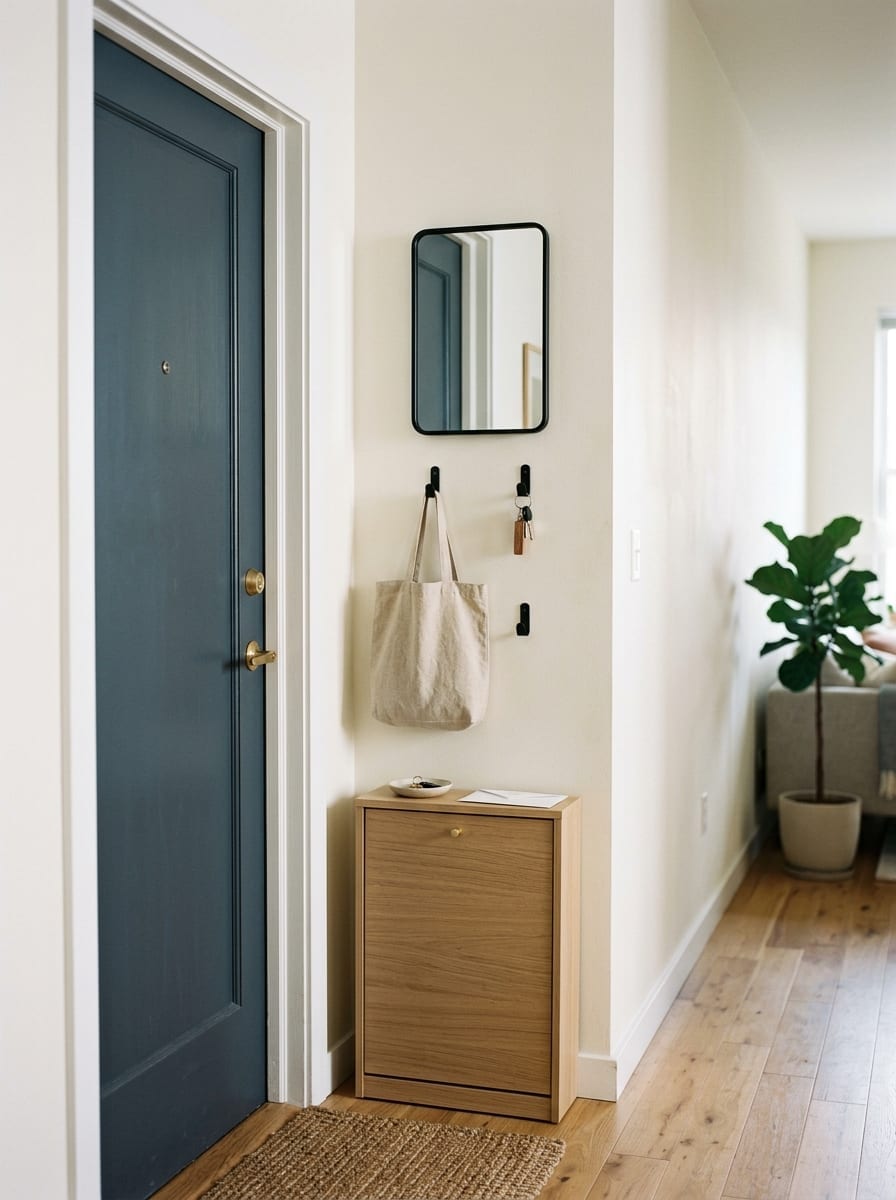
When floor space is extremely limited, use a narrow vertical zone beside the door for several functions.
Stack the functions
For example: Top Small mirror. Middle Hooks. Lower Very slim shoe storage. This uses one small strip of wall from top to bottom.
Why vertical zoning works
Instead of spreading entry functions across:
- wall
- floor
- sofa
- dining table you concentrate them in one place.
Keep each layer shallow
The key is not height alone. Every element should stay relatively flat against the wall.
Avoid visual overload
One mirror, a few hooks and one compact cabinet are enough. Do not add:
- wall art
- sign
- basket
- shelf
- mail holder all on the same narrow strip.
Use the mirror strategically
A mirror can also make the entrance feel more intentional and help reflect light into the area.
10. The Three-Function No-Entryway Formula
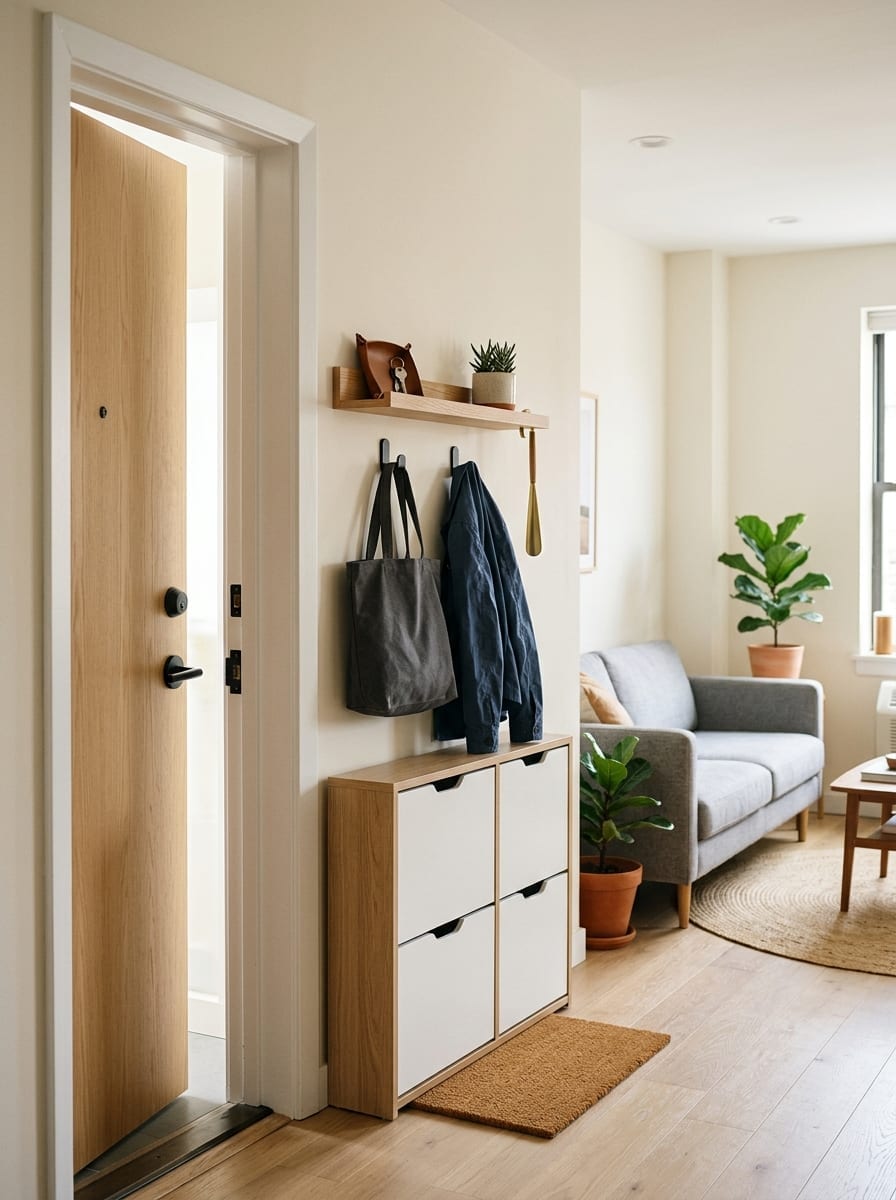
If you do not know what furniture to buy, start with functions instead. A useful entry zone only needs to solve three problems.
Function 1: Drop
Where do:
- keys
- wallet
- mail go? Possible solution:
- tray
- shelf
- drawer
Function 2: Hang
Where does:
- bag
- jacket
- dog leash go? Possible solution:
- hook
- coat stand
- closet
Function 3: Shoes
Where do everyday shoes go? Possible solution:
- slim cabinet
- basket
- small rack That is the entire system.
Why this works
It prevents overbuying. You do not automatically need:
- console
- bench
- mirror
- shelf
- hooks
- shoe rack
- basket all together. Choose one solution for each function.
Example
For a very small apartment: Drop Floating shelf. Hang Two hooks. Shoes Slim cabinet. Done.
Start With the Door Swing
Before adding furniture, open the front door completely. That arc is unavailable floor space. Do not place:
- bench
- console
- basket
- shoe rack inside it. Also check where you naturally stand when:
- unlocking the door
- carrying groceries
- putting shoes on The landing zone should support those movements.
Watch the First Five Feet
In a no-entryway apartment, the first few feet after entering matter most. Ask what currently happens there. Do you:
- drop keys on the kitchen counter?
- leave shoes beside the sofa?
- put bags on the dining chair? Those habits tell you what the entry zone actually needs. Do not design for an imaginary foyer. Design for the behavior already happening.
Create a Boundary Without Building a Wall
A no-entryway apartment needs a visual cue. You can create one with:
- rug
- slim cabinet
- sofa orientation
- vertical wall treatment
- console The boundary does not need to be physical. It just needs to make the entrance feel intentional.
What Should Stay by the Door?
Only items used regularly. Good candidates include:
- current shoes
- everyday jacket
- daily bag
- keys
- sunglasses
- outgoing mail
- reusable shopping bag Do not store the entire category there. For example, the entry does not need every coat you own.
What Should Move Elsewhere?
Move occasional items to deeper storage. That includes:
- formal shoes
- seasonal footwear
- luggage
- rarely used bags
- off-season coats
- bulk household supplies The no-entryway zone should be a daily-use station, not a mini storage room.
How Wide Should a No-Entryway Zone Be?
There is no universal measurement because floor plans vary. Instead, protect the main circulation route. After placing furniture, test whether you can comfortably:
- enter with grocery bags
- turn around
- remove shoes
- carry a package inside
- walk toward the kitchen or living room If the landing zone makes any of those harder, it is too large.
No-Entryway Apartment With a Door Opening Into the Living Room
This is one of the most common layouts. Try: Wall beside door Slim console or shoe cabinet. Floor Small defining rug. Living-room boundary Sofa orientation. You do not need to visually separate the entrance with a large room divider. A few subtle cues are enough.
No-Entryway Studio Apartment
Studios need even more restraint because everything is visible at once. Use:
- one slim vertical entry zone
- closed shoe storage
- minimal hooks
- small key surface Avoid creating a bulky pseudo-mudroom beside the door. The entry should visually disappear when it is tidy.
Front Door Opens Into the Kitchen
If the door opens near the kitchen, resist using the kitchen counter as the permanent landing spot. Otherwise the counter begins holding:
- keys
- bags
- packages instead of supporting food preparation. Create a separate small drop zone even if it is only:
- one shelf
- one tray a few feet away.
Front Door Opens Beside the Sofa
Use the sofa as part of the zoning. You may be able to create: door → narrow console → sofa back → living area That progression can make the entrance feel much more intentional.
What if There Is No Wall Beside the Door?
Look for the nearest usable surface. That could be:
- sofa back
- nearby corner
- side of a closet
- narrow wall several feet away The landing zone does not have to touch the front door. It only needs to be close enough that using it becomes automatic.
Do You Need a Mirror?
A mirror can be useful near the exit. It can also:
- reflect light
- visually define the zone But it is optional. If the wall is already busy with:
- hooks
- storage
- switches skip the mirror. Function comes first.
Should You Use a Coat Rack?
A freestanding coat rack can work when wall mounting is not possible. But it has a larger footprint than hooks. It is best when:
- there is an unused corner
- walkway is generous enough
- only a few items will hang there A coat rack overloaded with jackets can make a small apartment feel crowded quickly.
What About a Room Divider?
Usually, you do not need one just to create an entryway. Tall dividers can:
- block light
- interrupt sightlines
- make the entrance feel tighter Start with lighter zoning methods such as:
- sofa placement
- rug
- console
- cabinet before adding a physical divider.
Use Closed Shoe Storage When the Entry Is Visible
If the door opens directly into the living room, you can probably see the entry from the sofa. Closed shoe storage helps because footwear has a lot of visual detail. A slim cabinet can make the living area feel calmer than a fully loaded open rack.
Keep Mail From Taking Over
Mail is one of the fastest ways to destroy a small landing zone. Create just two outcomes: Keep Move it to a proper location. Discard or recycle Remove it promptly. Do not create a permanent stack beside the door.
Give Bags a Real Home
If your bag always lands on:
- sofa
- chair
- dining table then the entry zone needs a hook. One strong hook can solve more clutter than another decorative cabinet.
The Grocery Test
A good entry setup still works when your hands are full. Imagine entering with:
- two grocery bags
- keys
- phone Can you:
- open the door
- put something down
- close the door
- keep walking without rearranging furniture? If not, simplify the setup.
Keep the Floor Mostly Empty
In an apartment with no foyer, open floor space is part of the entry system. Avoid lining the door area with:
- baskets
- shoes
- umbrella stand
- decorative stool
- packages Use the wall and one compact furniture piece first.
Common No-Entryway Apartment Mistakes
Trying to recreate a full mudroom The apartment probably does not have room for one. Using deep furniture Entry furniture should stay shallow. Letting shoes define the entire entrance Store only current pairs. Hanging every coat by the door Keep the hook zone edited. Using the kitchen counter as the landing zone It quickly becomes cluttered. Ignoring the door swing Furniture may technically fit but still interfere with entering. Adding a large room divider immediately Try visual zoning first. Filling the console with decor Leave room for actual arrival items. Creating too many storage categories The system should be simple.
A Tiny No-Entryway Formula
For an extremely small apartment: Drop One floating shelf. Hang Two hooks. Shoes One slim cabinet. Boundary Small rug. That can be enough.
A No-Entryway Formula With More Wall Space
Try: Slim console Keys and mail. Mirror Vertical definition. Hooks Daily jacket and bag. Closed shoe cabinet Current shoes. Still keep the walkway open.
A No-Furniture Formula
If you have almost no floor space: Wall Hooks. Wall Small shelf. Closet or bedroom Shoes. Floor Small rug if appropriate. You do not need entry furniture simply because most entryway photos have it.
A Renter-Friendly Formula
Use portable or minimally invasive elements such as:
- slim freestanding console
- shoe cabinet
- bench
- rug For wall-mounted items, follow product instructions and rental requirements. Do not compromise furniture safety or safe installation simply to avoid making holes.
Which No-Entryway Idea Fits Your Apartment?
Choose the Slim Console if:
You have a narrow wall and need a landing surface.
Choose the Hook Strip if:
Floor space is nearly nonexistent.
Choose the Shoe Cabinet if:
Shoes are the main source of clutter.
Choose the Bench if:
You have enough width and want seating too.
Choose a Rug Boundary if:
You mainly need visual separation.
Use the Sofa Back if:
The living room starts directly at the door.
Choose a Floating Shelf if:
You need the smallest possible drop zone.
Choose a Corner Station if:
The wall beside the door is unusable.
Choose the Vertical Zone if:
You need several functions in one narrow strip.
Use the Three-Function Formula if:
You want the simplest possible system.
Final Thoughts
An apartment does not need a foyer to have an entryway. It needs a few clear habits supported by the layout. Start with: drop → hang → shoes Then decide where those three functions can live without interfering with the door or walkway. Use furniture depth carefully. Keep current-use items near the entrance and move everything else deeper into the apartment. And do not try to recreate a large home’s mudroom in a tiny floor plan. A small, clearly defined landing zone is enough to make arriving home feel much more organized.