9 Small Bedroom Wall Shelf Ideas That Add Storage Without Crowding the Bed
Free up floor & nightstand space. Discover 9 small bedroom wall shelf ideas—from floating bedside ledges to shallow display shelves that fit tight walls.
In This Guide
When a small bedroom runs out of floor space, the walls become valuable.
A shelf can hold:
- books
- small baskets
- bedside essentials
- decor
- work supplies
- folded accessories
without asking the room for another:
- dresser
- bookcase
- side table
- storage cabinet.
But wall storage is not automatically space-saving.
A shelf can still make a bedroom feel crowded if it:
- projects too far from the wall
- sits directly above your head
- blocks curtains
- makes the bedside zone feel boxed in
- becomes overloaded with objects.
The best wall shelves in a small bedroom do not simply add capacity.
They put storage in a specific unused wall zone and stay shallow enough that the room still feels easy to move through.
Here are nine ways to use bedroom wall shelves without turning the room into a storage wall.
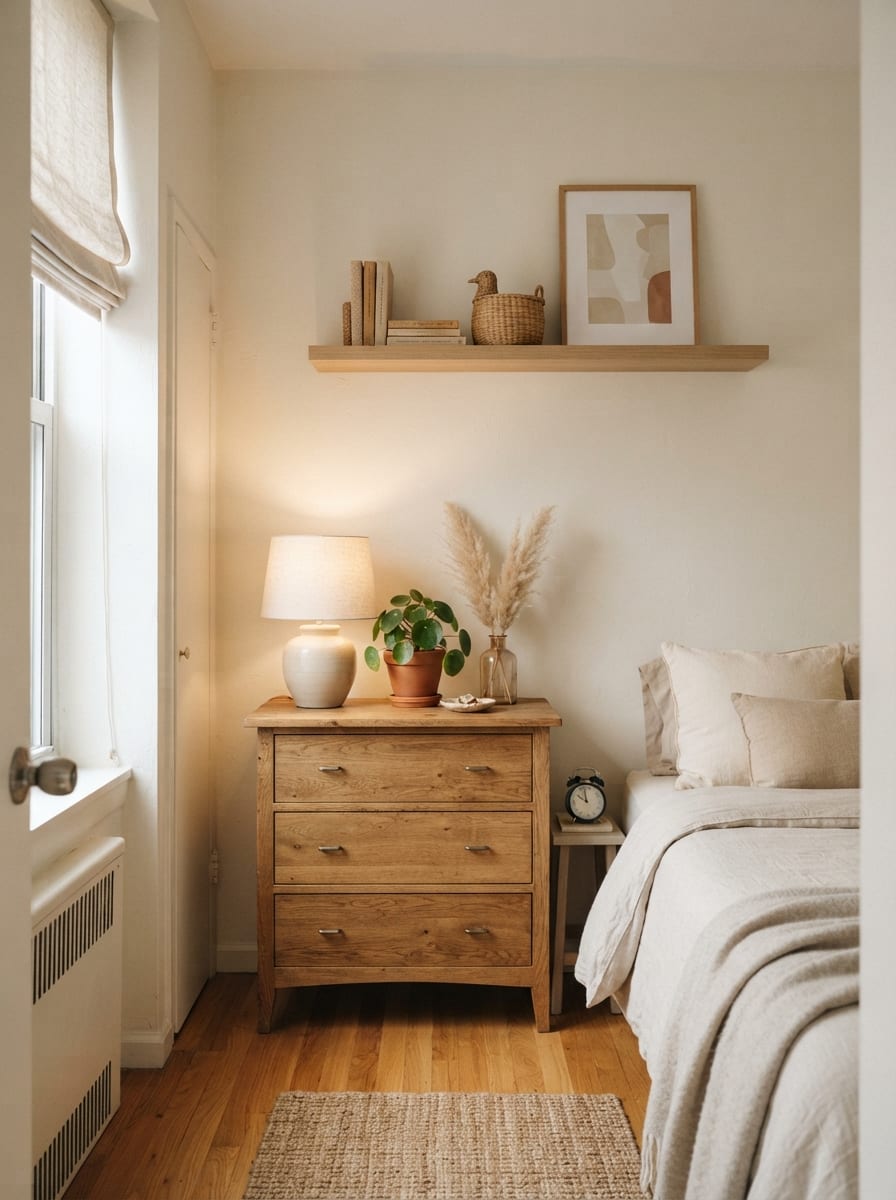
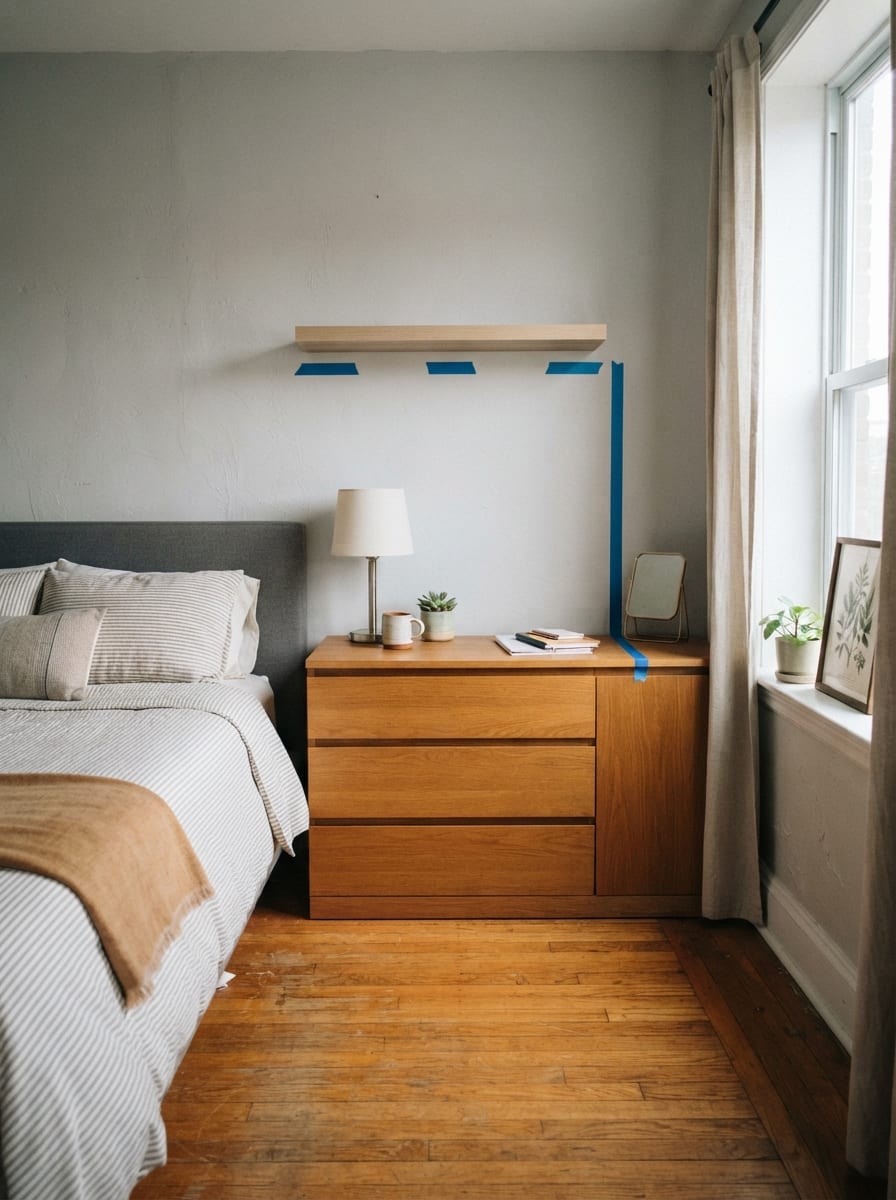
1. The Above-Dresser Shelf
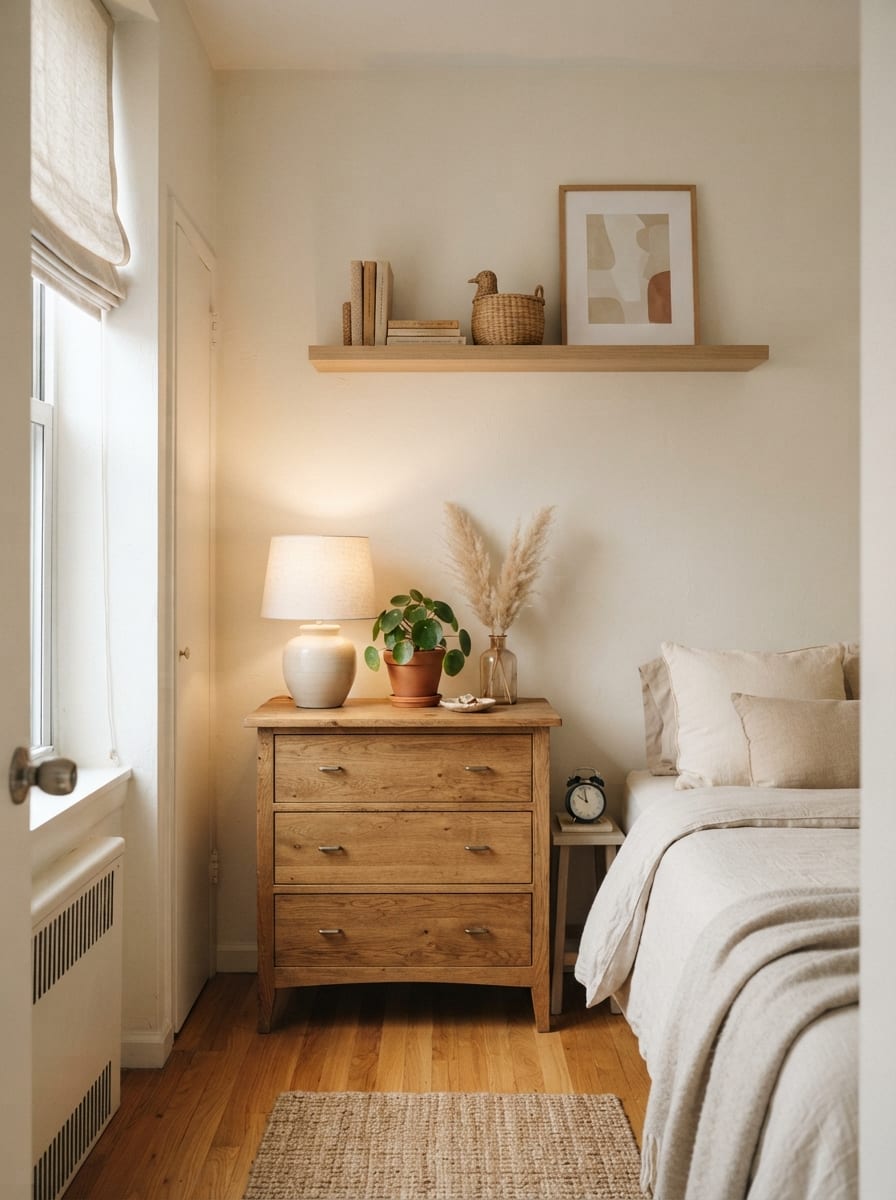
The wall above a dresser is often one of the safest places to add a shelf because furniture is already occupying the space below.
That means the shelf is less likely to project into a walking path.
Why it works
You create a vertical storage zone around one existing furniture footprint instead of spreading storage across several walls.
Good items for the shelf
Use it for:
- books
- one basket
- framed art
- jewelry box
- small decor.
Keep the depth controlled
The shelf does not need to be as deep as the dresser.
A shallower shelf usually looks lighter.
Leave room above the dresser
Do not mount the shelf so low that:
- tall objects hit it
- the dresser feels compressed
- you cannot use the surface normally.
Keep heavier daily-use items lower
Frequently used or heavier objects are usually better on the dresser or inside drawers than high above.
2. The Bedside Shelf-Nightstand
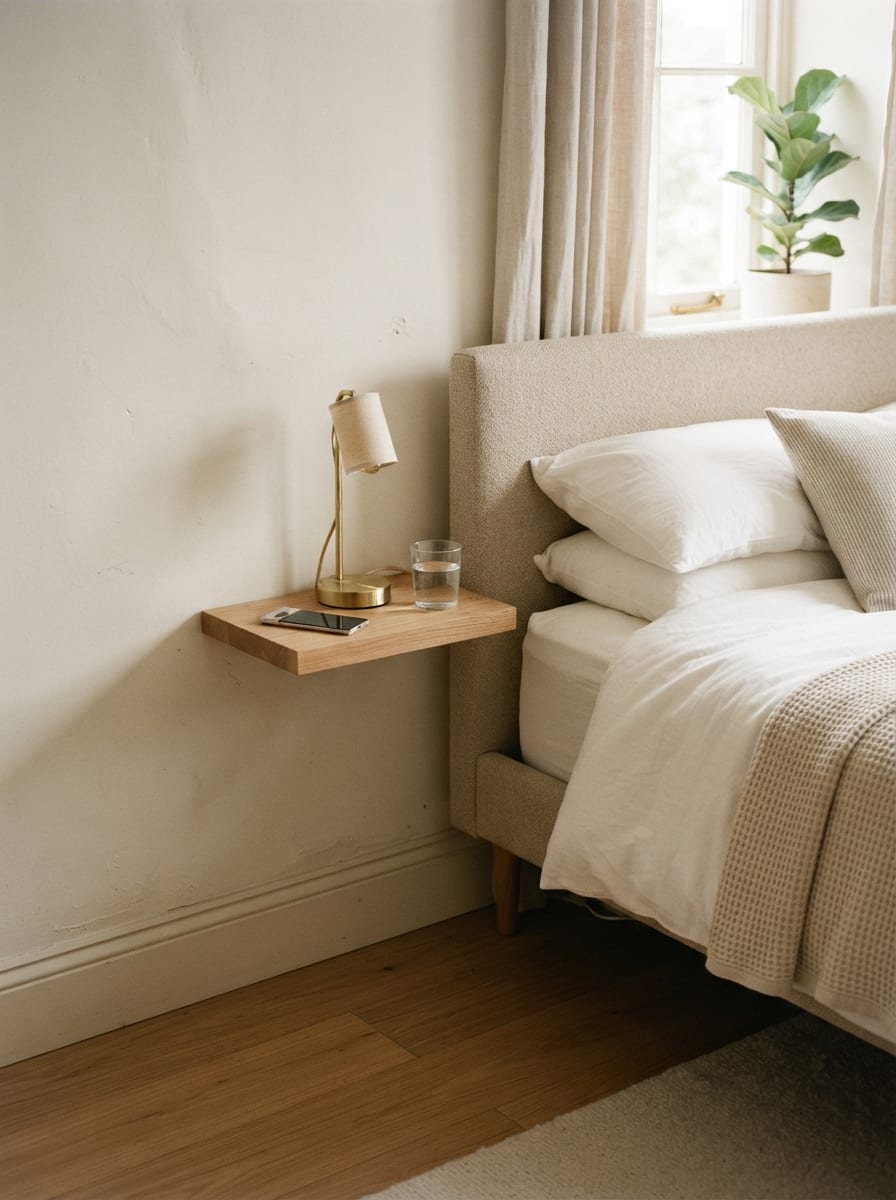
If the room is too narrow for a conventional nightstand, a small wall-mounted shelf can provide just enough bedside surface.
Why it works
You gain a landing spot for:
- phone
- glass of water
- small lamp
- book
without using floor area.
Keep it small
A bedside shelf should not become a full wall cabinet.
The goal is to replace the nightstand footprint, not recreate it on the wall.
Mounting height matters
The shelf should feel comfortable to reach from bed.
Too high:
- awkward to use
Too low:
- may interfere with bedding
- may hit your arm or shoulder.
Avoid sharp projections
Choose a shelf shape and edge profile suitable for a tight bedside zone.
Keep the floor underneath clear
Do not immediately add:
- basket
- stool
- storage cube.
The open floor is the main advantage.
3. The Desk-Top Shelf
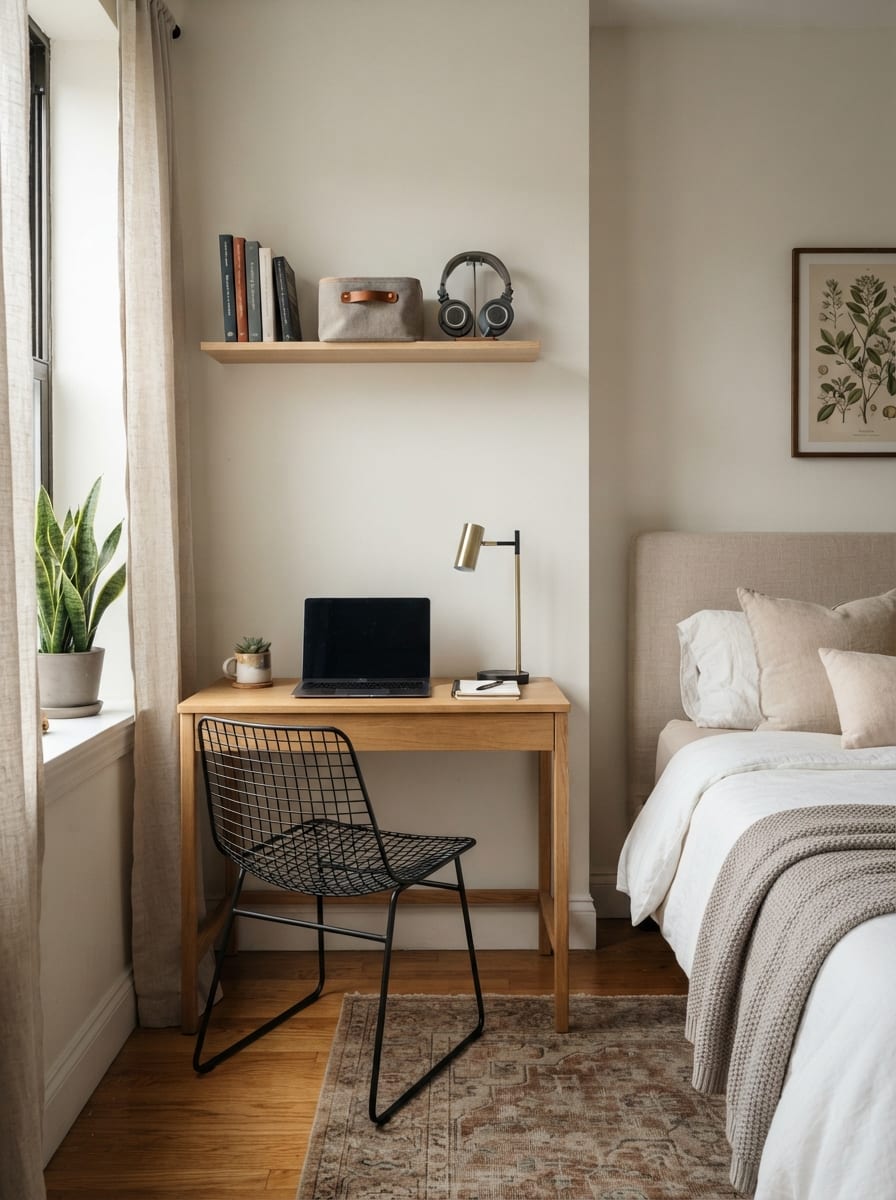
A small bedroom desk often needs storage, but adding drawers or a bookcase can make the work zone too bulky.
One shallow shelf above the desk can solve that.
Why it works
The shelf takes advantage of the wall directly above the work surface.
That keeps supplies near the desk without widening the furniture footprint.
Good uses
Store:
- notebooks
- small boxes
- reference books
- headphones
- light decor.
Do not build a shelving tower automatically
One shelf is often enough.
Several stacked shelves can make the wall feel heavy, especially near the bed.
Keep head clearance in mind
The shelf should not sit where you might hit it when:
- standing up
- leaning forward
- reaching across the desk.
Avoid placing heavy objects directly above your work position
Use proper mounting and sensible item placement.
4. The Short-Wall Shelf Stack
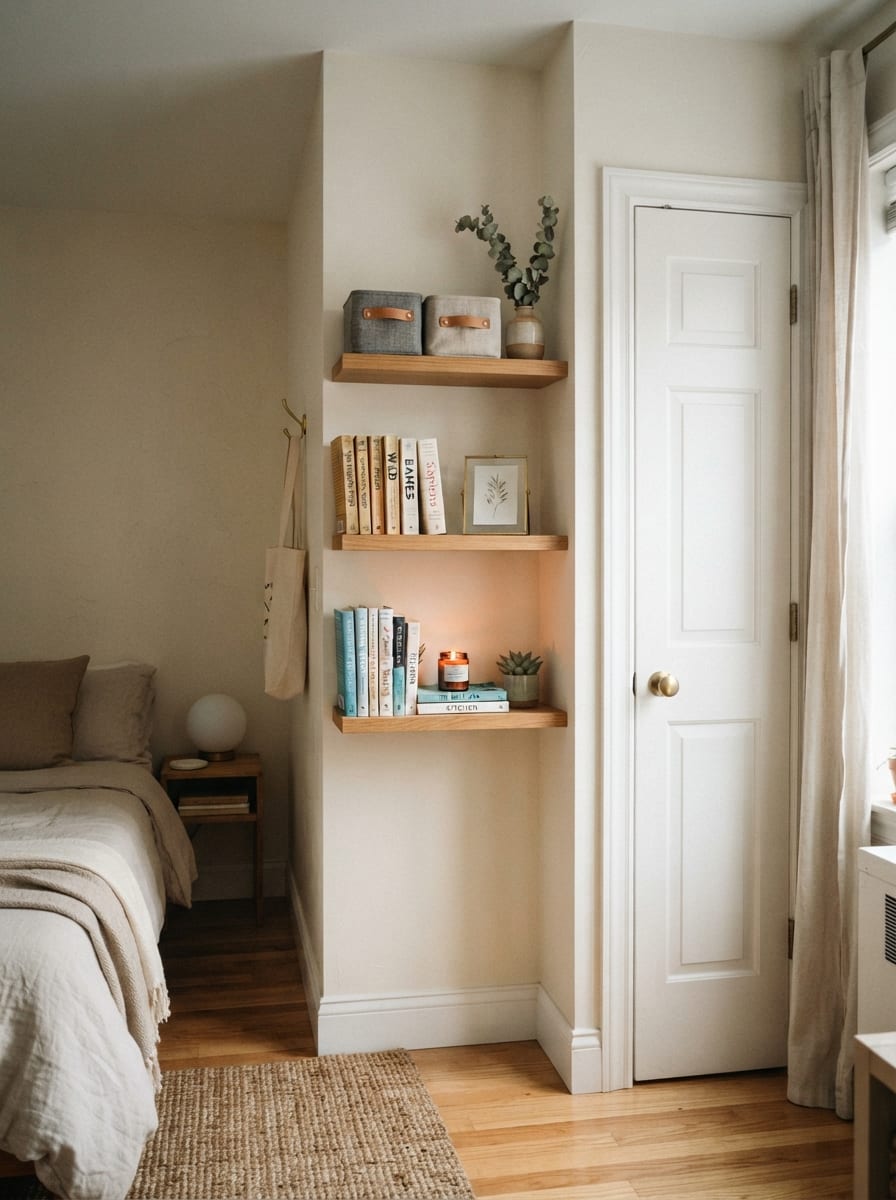
Small bedrooms often have awkward short walls created by:
- doorways
- closets
- windows
- room corners.
A narrow stack of shelves can make use of one of these wall strips.
Why it works
Instead of adding one wide shelf, you build storage upward in a narrow footprint.
Keep the shelves shallow
Short walls are often close to:
- doors
- bed corners
- walkways.
Deep shelves can become collision points.
Use fewer shelves than the wall could technically hold
Three well-spaced shelves often feel calmer than six tightly packed ones.
Best for smaller items
Use them for:
- paperbacks
- small boxes
- accessories
- decor.
Do not overload them with deep baskets.
Keep the lowest shelf above shoulder or movement zones where appropriate
Test how you move past the wall before mounting.
5. The High Perimeter Shelf
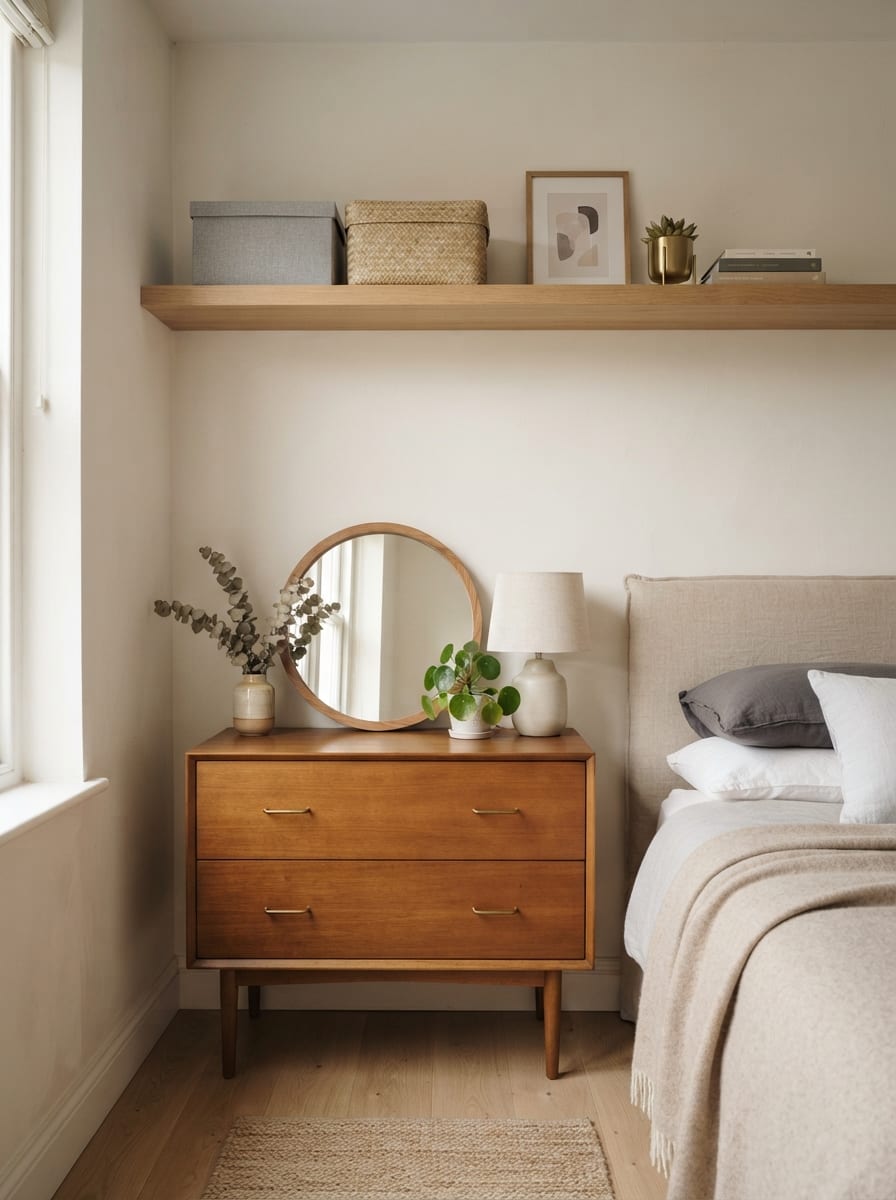
A high shelf can use wall space above normal furniture height.
This can work when you need storage for less-frequently used items.
Why it works
You preserve lower wall zones for:
- bed
- dresser
- desk
- walking clearance.
Best for occasional-use storage
Use it for:
- lightweight baskets
- seasonal accessories
- decorative boxes
- a few books.
Do not place heavy items high unless the shelf and mounting are designed for them
Always follow load and installation guidance.
Keep it away from the pillow zone
A high shelf directly over the head of the bed may still feel visually heavy even if it is technically high enough.
Use the perimeter:
- above dresser wall
- above desk wall
- over a doorway where appropriate.
Keep the display simple
High shelves can collect visual clutter because the entire row is visible from the bed.
6. The Corner Shelf Pair
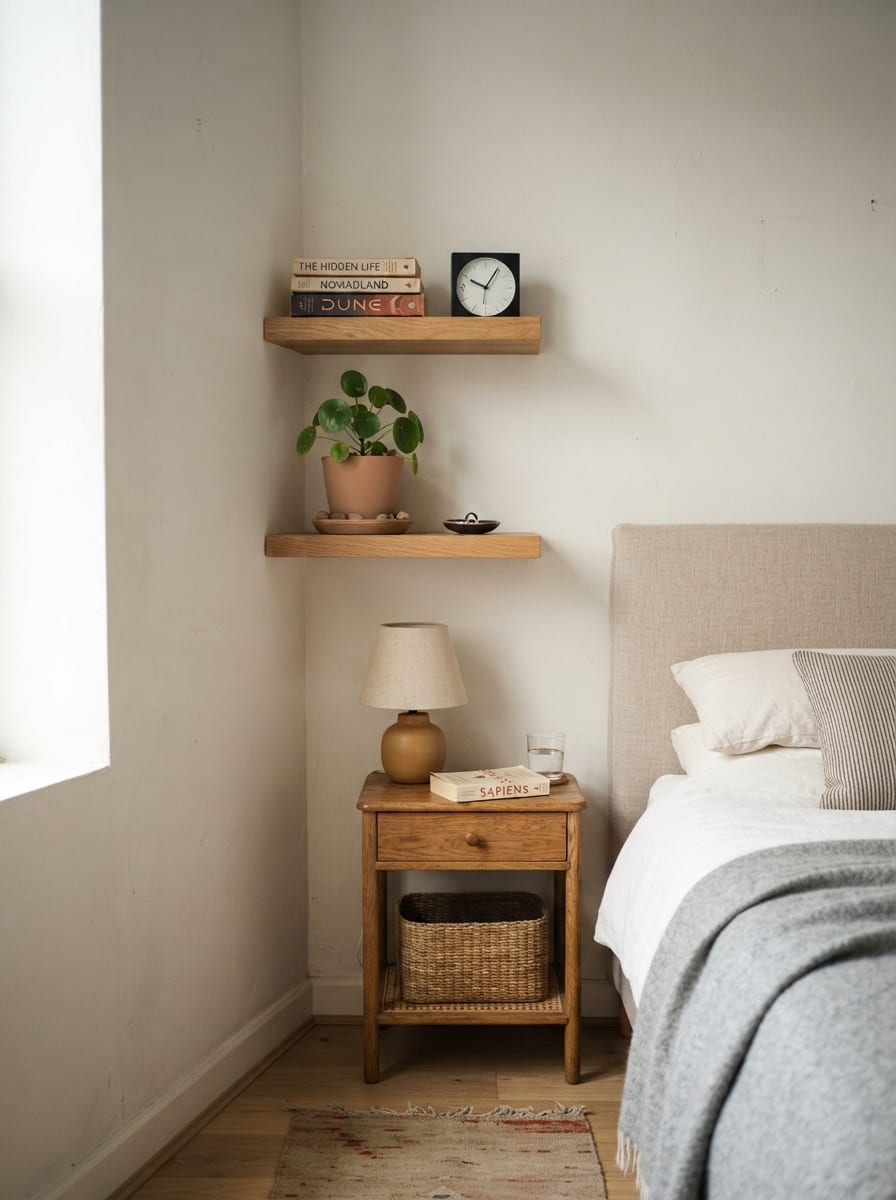
A bedroom corner can hold a small amount of storage without requiring a wide wall.
Instead of a large corner unit, use one or two compact shelves.
Why it works
The corner already contains two meeting walls, so a small shelf can feel integrated.
Keep the shelves shallow
Deep corner shelves project farther into the room than they appear to from the front.
Good uses
Store:
- books
- small plant
- clock
- basket.
Avoid overfilling the corner
Do not combine:
- floor lamp
- tall plant
- corner shelf stack
- wall art
all in the same small area.
Keep furniture away from the shelf edge
A bed or chair directly below can make the corner feel crowded.
7. The Picture-Ledge Bedroom Shelf
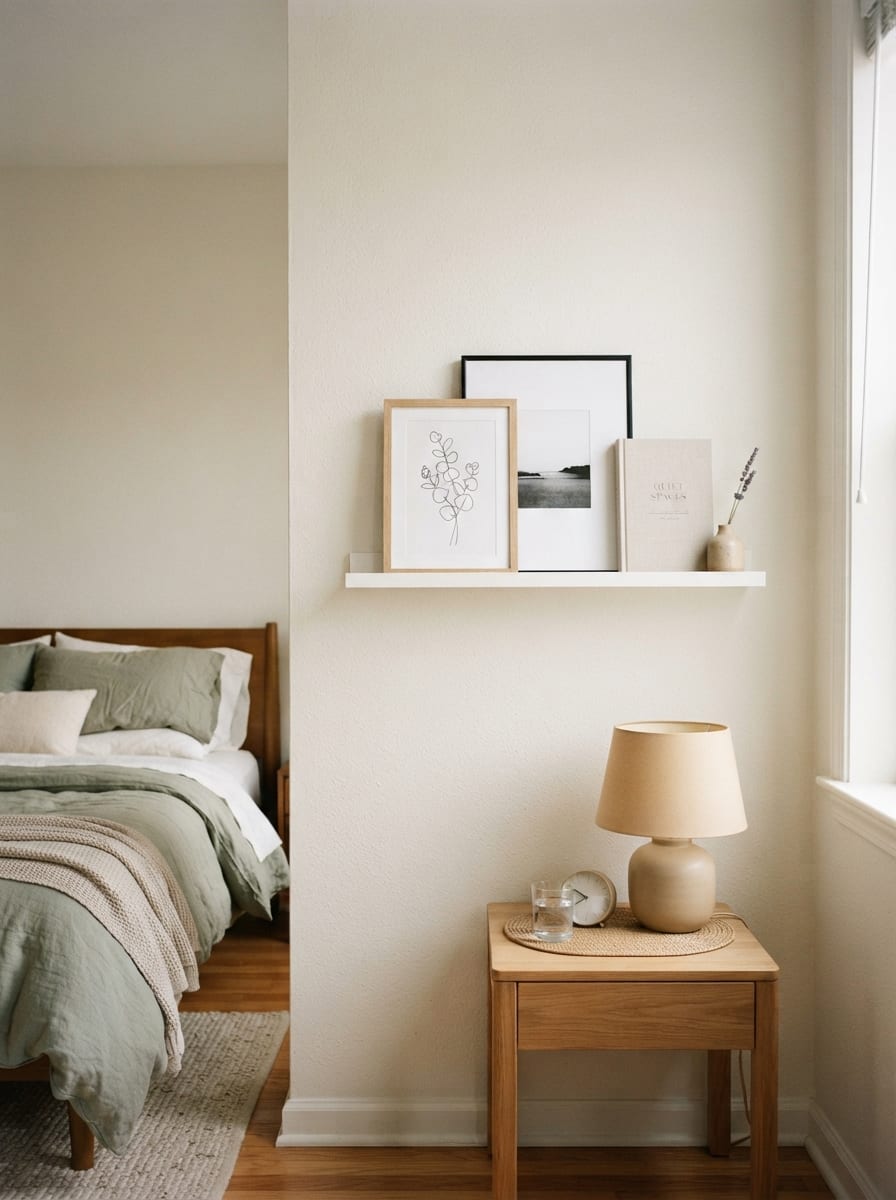
A picture ledge is shallower than a conventional shelf.
That makes it useful when you want a small amount of display or book storage without much wall projection.
Why it works
The ledge can hold:
- framed prints
- thin books
- small decorative objects
while taking up very little depth.
Good for bedside walls
A shallow ledge can work where a deeper shelf would feel intrusive.
Keep objects secured
Use the shelf as designed and avoid unstable objects that could fall.
Layer lightly
One or two overlapping frames can work.
Do not turn the ledge into a dense stack of:
- frames
- candles
- plants
- books.
Use it as decor + light storage
This is best when the bedroom needs some display space but not a large amount of capacity.
8. The Closet-Edge Shelf Zone
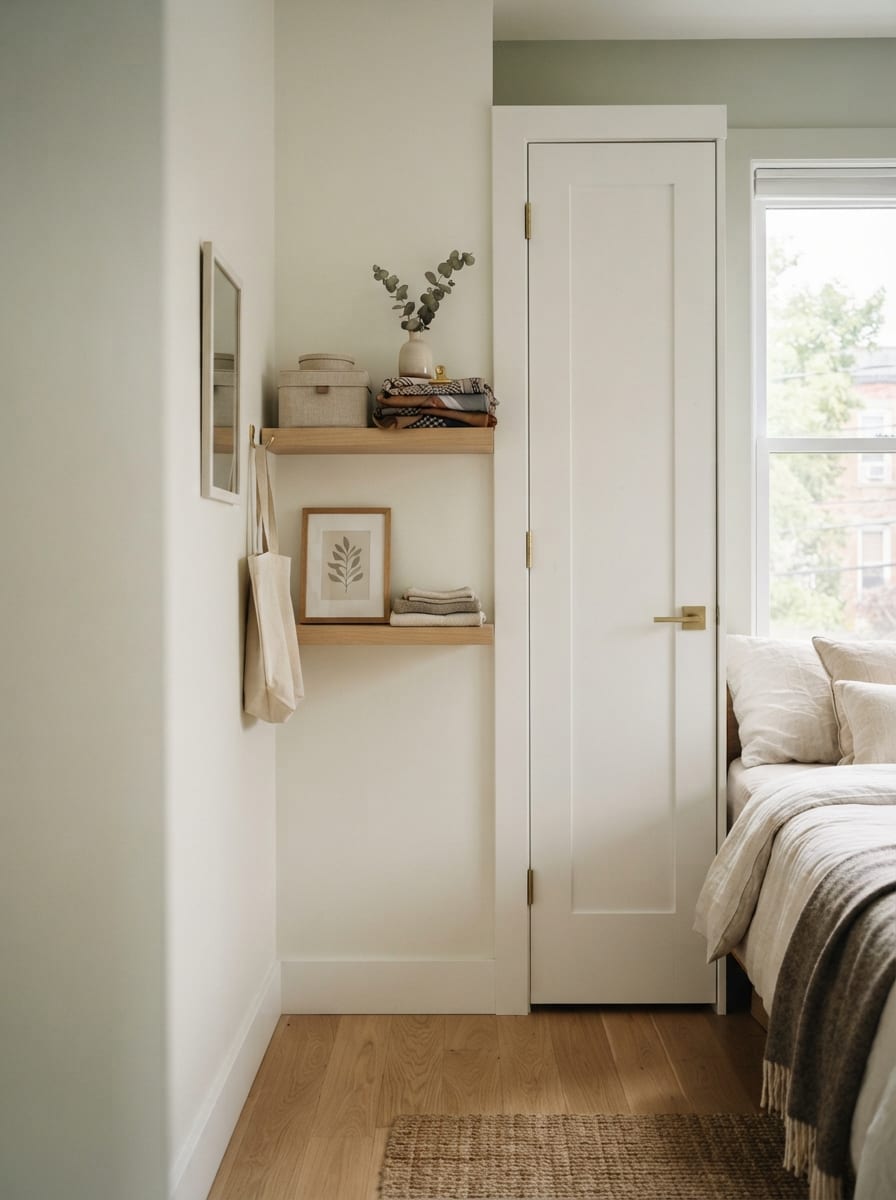
The narrow wall beside a closet is often too small for furniture but can support one or two shelves.
Why it works
You use a leftover wall zone without sacrificing floor area.
Protect closet operation
Before mounting anything, open:
- closet doors
- drawers
- sliding panels.
The shelves should not interfere with access.
Good for dressing-related items
Use the zone for:
- folded accessories
- small bins
- perfumes
- jewelry boxes
depending on the shelf location.
Keep deeper storage away from the door edge
A shelf close to a hinged closet door can become a collision point.
Use vertical organization carefully
One or two shelves may be enough.
The closet wall should not become another full storage tower.
9. The Depth-Height-Clearance Formula
The most useful shelf is not the one with the most storage.
It is the one that fits the room without becoming something you constantly avoid.
Use this order:
depth → height → body clearance → function → styling
Step 1: Decide the maximum depth
Ask:
How far can this shelf project without making the wall feel intrusive?
For tight bedroom zones, shallower is usually safer.
Step 2: Choose the height
Consider:
- bed height
- standing height
- desk use
- dresser use.
Step 3: Test body clearance
Stand where you will normally:
- sit
- stand
- walk
- get dressed.
Will shoulders or head come near the shelf?
Step 4: Decide the shelf’s job
Is it for:
- bedside essentials
- books
- display
- work supplies
- occasional storage?
Step 5: Style only what fits the function
Do not use every inch just because the shelf exists.
Start With the Shelf’s Job
Do not begin by asking:
Which shelf looks best?
Ask:
What does this shelf need to hold?
A bedside shelf has very different requirements from:
- book storage
- display shelf
- high seasonal shelf.
Bedside Shelf
Needs:
- easy reach
- small depth
- light items.
Desk Shelf
Needs:
- practical height
- task-related storage
- safe head clearance.
Dresser Shelf
Can hold more decorative or occasional-use items.
High Shelf
Works best for:
- lightweight
- less-frequently used items.
Shelf Depth Is the First Number to Check
Width gets most of the attention, but depth determines how much the shelf intrudes into the room.
A deep shelf can make a narrow bedroom feel even tighter.
Shallower Shelves Often Work Better
Particularly:
- beside the bed
- near a doorway
- above a desk
- on a short wall.
Deep Shelves Need Safer Locations
If you need more depth, place them above existing furniture rather than over open circulation.
Do Not Put Deep Shelves in Shoulder Zones
A shelf at head or shoulder height can become annoying quickly.
Use Existing Furniture as a Buffer
Mount shelves above:
- dresser
- desk
- console
rather than directly over open floor where practical.
Bed Clearance Matters
Shelves near the bed need extra consideration because you:
- sit up
- reach
- move pillows
- change bedding.
Avoid Heavy Shelves Directly Above the Pillow Area
Even when safely installed, they may make the sleeping zone feel visually heavy.
If You Use a Shelf Above the Bed
Keep it:
- properly mounted
- shallow
- appropriately positioned
- lightly styled.
Above-Bed Shelf vs Artwork
Artwork often feels lighter.
Use a shelf only if you genuinely need the storage.
Side-of-Bed Shelf
Usually safer for practical bedside storage.
Bedside Shelf as Nightstand
One of the strongest small-space options.
Shelf Below a Window
Possible if it does not interfere with:
- curtains
- radiator
- window opening.
Shelf Above a Window
Can work for occasional-use storage in some rooms, but it may create a heavy top border.
Use sparingly.
Shelf Beside a Window
Often easier.
Keep enough room for curtain panels to stack.
Curtain Clearance Matters
Shelves can block curtains from:
- opening fully
- hanging straight.
Blind and Shade Clearance
Do not interfere with operating chains, cords, or handles.
Shelf Above a Dresser
One of the safest zones because the dresser already occupies the lower wall.
Shelf Above a Desk
Useful, but test standing and sitting movement.
Shelf Above a Door
Can use high wall space for occasional items.
But avoid making the entrance feel top-heavy.
Shelf Beside the Closet
Good for accessory storage if the doors still work.
Shelf Inside a Closet
Often better for practical storage than open bedroom wall shelves.
Use visible wall shelving for items that actually benefit from being outside.
Shelf in a Corner
Keep it shallow.
Corners can become visually crowded fast.
Shelf Near the Bedroom Door
Avoid projections where people enter at speed or carry items through.
Shelf Near a Full-Length Mirror
Do not block the viewing distance or reflection.
Shelf Near a Floor Lamp
Both compete for the same vertical wall zone.
Choose one dominant feature.
Shelf Above a Nightstand
Can work if the shelf does not feel low over the sleeper.
Shelf Instead of Nightstand
Often better in extremely narrow rooms.
Floating Shelf vs Bracket Shelf
Floating shelf
Looks visually cleaner.
Bracket shelf
Can sometimes make structural support more visible and become part of the design.
Choose based on:
- load
- wall type
- style.
Shelf Thickness Matters
A very thick floating shelf looks more substantial.
A slim shelf feels lighter.
Thin Does Not Mean Weak
Structural capacity depends on design and mounting, not appearance alone.
Follow the product’s specifications.
Shelf Width Matters
A shelf that spans nearly the entire wall can become a strong architectural line.
That may make the room feel:
- wider
- busier
depending on placement.
Short Shelves Are Easier to Control
Use them to create defined storage zones.
Long Shelves Need More Editing
A long shelf often invites people to fill every inch.
Leave empty space.
Shelf Color
A shelf close to the wall color can visually recede.
White Shelf on White Wall
Creates a low-contrast look.
Light Wood Shelf
Adds warmth.
Dark Shelf on Light Wall
Creates a strong graphic line.
Use deliberately.
Match the Shelf to Existing Furniture?
It can coordinate loosely.
Exact matching is not necessary.
Use One Repeated Finish
For example:
- light wood shelf
- light wood nightstand.
That is enough cohesion.
Shelf Brackets
If visible, keep them consistent with:
- lamp finish
- curtain rod
- hardware
where practical.
Open Shelves Create Visual Clutter Faster Than Closed Storage
Everything remains visible.
That means you should be selective about what goes on them.
Best Things for Open Bedroom Shelves
Often:
- books
- small boxes
- framed art
- one plant
- one basket
- clock.
Worst Candidates
Usually:
- random cables
- loose papers
- toiletries
- laundry
- dozens of small objects.
Use Closed Boxes for Small Items
One simple box can contain:
- chargers
- receipts
- accessories.
Do Not Line the Shelf With Many Tiny Containers
Several small organizers can look busier than the clutter they are meant to hide.
One Basket Is Often Enough
Especially on a narrow shelf.
Decorative Storage Should Still Be Functional
Do not choose a basket too large for the shelf just because it looks good.
Book Storage
Books can become heavy.
Follow shelf load guidance.
Keep Heavy Books Near Properly Supported Areas
Do not overload a long shelf.
Vertical Book Stack
Can add visual variety.
Horizontal Book Stack
Can create a small platform for one object.
Do Not Build Styling Towers
A small bedroom benefits from low visual clutter.
Plants on Shelves
Choose a plant appropriate for:
- available light
- watering access.
Avoid Water Damage
Use suitable protection beneath plants.
Trailing Plants
Can visually soften shelving but may hang into:
- head space
- desk space
- curtains.
Framed Art on Shelves
A picture ledge is particularly good for this.
Leaned Frames
Useful for renters or flexible styling when the shelf is deep enough and stable.
Keep Frames Away From Shelf Edges
Avoid unstable placement.
Lamps on Shelves
Possible, but consider:
- cord routing
- fixture stability
- heat
- available depth.
Wall-Mounted Lighting May Be Better
Especially beside a bed, if installation is appropriate.
Shelf + Sconce Combination
Can create a strong bedside zone.
Keep the wall from becoming overcrowded.
Shelf + Mirror
Useful above a dresser.
But a shelf directly across a mirror may visually double clutter.
Shelf + Artwork
Use one or the other as the dominant element.
Shelf + Wallpaper
A shallow shelf can work against patterned wallpaper.
Keep objects simple.
Shelf + Wainscoting
Align the shelf deliberately with the panel proportions.
Shelf + Accent Wall
A contrasting shelf may disappear or stand out depending on the wall color.
Above-Bed Shelves Need Restraint
Do not install several deep shelves directly above the bed just because the wall is empty.
One Shallow Shelf
May be enough if storage is genuinely needed.
Bedside Pair of Shelves
Can replace two nightstands in a very tight room.
Asymmetrical Bedside Shelf
Also works.
Small rooms do not need perfect symmetry.
Shared Bedroom
Each person can have one compact bedside shelf.
Children’s Bedroom
Mounting, reach, item weight, and furniture anchoring need extra safety consideration.
Guest Bedroom
Keep wall storage lighter and easier to understand.
Studio Sleeping Zone
Visible shelves should coordinate with the broader apartment because they may be seen from the living area.
Small Bedroom With a Queen Bed
Wall shelving can help because the bed already uses so much floor area.
Small Bedroom With a Twin Bed
You may have more freedom, but do not fill every wall.
Bedroom With No Dresser
Wall shelves can help, but they are not a substitute for all clothing storage.
Bedroom With a Desk
Use the desk wall first before scattering shelves around the room.
Bedroom With a Closet
Keep most practical storage inside the closet if possible.
Use wall shelves for overflow or display.
Bedroom With No Closet
Shelving may need to work harder, but open shelves can quickly look busy.
Consider closed storage for larger categories.
Wall Shelf vs Bookcase
A wall shelf preserves floor space.
A bookcase usually provides more capacity.
Choose based on:
- storage volume
- floor availability
- wall structure.
Wall Shelf vs Nightstand
A shelf can save floor space if you only need a small bedside surface.
Wall Shelf vs Dresser
Shelves are not ideal for storing large amounts of clothing.
Wall Shelf vs Pegboard
A pegboard offers flexible small-item storage but can look more utilitarian.
Wall Shelf vs Cabinet
A cabinet hides clutter but projects more from the wall.
Use Wall Shelves Where Their Shallowness Is an Advantage
Do not force them to solve every storage problem.
Mounting Matters
Wall shelves need support appropriate for:
- wall type
- shelf weight
- contents.
Drywall, Masonry, Plaster, and Other Walls Differ
Follow the shelf and hardware manufacturer’s guidance.
Do Not Guess Load Capacity
The load includes:
- shelf
- brackets
- stored objects.
Heavier Items Need More Care
Books and filled baskets can add significant weight.
Renters Should Check Lease Rules
Especially before:
- drilling
- anchoring
- mounting multiple shelves.
Adhesive Shelves Have Limits
Do not assume adhesive systems can hold:
- books
- heavy baskets
- electronics.
Use only within their stated ratings and appropriate surfaces.
Removable Does Not Automatically Mean Damage-Free
Paint and wall conditions vary.
Leaning Shelf Units Are Not the Same as Wall Shelves
They still use floor area.
If floor space is the problem, they may not solve it.
Wire Shelves
Can look visually light but may not suit every bedroom style.
Metal Shelves
Can create a strong graphic line.
Wood Shelves
Usually feel warmer.
Glass Shelves
Can visually recede but require appropriate support and safe placement.
Acrylic Shelves
Can feel light, especially for small display objects.
Picture Ledges
Excellent when depth must stay minimal.
Cube Shelves
Project farther from the wall.
Use carefully in narrow bedrooms.
Deep Box Shelves
May create too much visual bulk.
Floating Cubes
Can work as small bedside storage if they remain compact.
Do Not Cover Every Wall With Shelving
A small bedroom still needs blank space.
Empty Wall Is Not Wasted Space
It helps the room feel calmer.
Concentrate Storage
One defined wall-storage zone usually feels better than small shelves scattered everywhere.
Keep the Bed Wall Calmer
Especially if the desk and dresser walls already contain storage.
Choose One Primary Shelf Wall
Then let other walls breathe.
Style With Negative Space
Leave gaps between objects.
Avoid Edge-to-Edge Styling
A shelf does not need to look full.
Use Repetition Carefully
Two matching boxes can look calmer than six unrelated containers.
Limit Color Variety
Shelving becomes busier when every object is a different bright color.
Books Add Color Automatically
You may not need much other decor.
Group Similar Objects
For example:
- books together
- one box
- one decorative item.
Shelf Styling Rule
Try:
one functional group + one decorative object + empty space.
That is often enough.
Keep Daily Essentials Easy to Reach
Do not place your nightly medication, phone, or glasses on a shelf that requires standing up from bed.
Place Occasional Items Higher
Use high shelves for items you do not need constantly.
Keep Frequently Used Items Lower
Where they are comfortable and safe to access.
Do Not Store Fragile Items Above the Bed
Choose safer locations for breakable decor.
Avoid Loose Objects Near Doorways
Door vibration can affect poorly placed items.
Use Bookends Where Needed
Books should not slide toward the edge.
Keep Cables Controlled
A shelf holding:
- phone charger
- speaker
- lamp
may need a clean cable path.
Do Not Let Cords Hang Across the Bed
Route them appropriately.
Check Outlet Position First
Especially for bedside or desk shelves.
One Shelf Can Replace Several Decor Items
The shelf itself adds:
- line
- depth
- architecture.
You may need less wall art.
Common Small Bedroom Wall Shelf Mistakes
Choosing shelves that are too deep
They project into the room and make the wall feel bulky.
Mounting them too low
They invade head and shoulder space.
Putting heavy shelving directly above the pillow
The sleeping zone feels crowded.
Installing too many shelves
The bedroom starts to feel like a storage room.
Filling every shelf completely
Open storage turns into visual clutter.
Ignoring curtain clearance
The window treatment cannot open properly.
Blocking closet doors
Storage interferes with storage.
Using several unrelated baskets and containers
The wall becomes visually busy.
Storing heavy books on unsuitable shelves
The load exceeds the system’s intended use.
Adding shelving where a bedside surface would be more useful
The storage does not solve the actual problem.
Quick Small Bedroom Wall Shelf Decision Guide
Choose an Above-Dresser Shelf if:
You want more storage without using another floor zone.
Choose a Bedside Shelf if:
A nightstand will not fit.
Choose a Desk Shelf if:
Work supplies are taking over the desktop.
Choose a Short-Wall Shelf Stack if:
You have a narrow unused wall between architectural features.
Choose a High Shelf if:
You need storage for lightweight occasional-use items.
Choose Corner Shelves if:
One corner is underused but the floor must stay open.
Choose a Picture Ledge if:
You need very shallow display storage.
Choose Closet-Edge Shelves if:
There is usable wall space beside the wardrobe.
The Small Bedroom Wall Shelf Formula
Before installing a shelf, solve these five things:
DEPTH
How far can the shelf project without intruding into the room?
HEIGHT
Can you reach it safely without placing it in a collision zone?
CLEARANCE
Does it stay clear of:
- head
- shoulders
- curtains
- doors
- closet movement?
FUNCTION
What exactly needs to live there?
VISUAL LOAD
How much can the shelf hold before the wall starts to feel crowded?
Only after that should you choose:
- wood tone
- bracket style
- shape
- decor.
The best wall shelf does not merely create more storage.
It makes use of wall space the bedroom was not using anyway.
Frequently Asked Questions
Are wall shelves good for small bedrooms?
Yes.
They can add storage without using floor space, especially above existing furniture or in narrow unused wall zones.
Where should I put shelves in a small bedroom?
Good locations include:
- above a dresser
- above a desk
- beside the bed
- on a short wall
- beside a closet.
Is it okay to put shelves above the bed?
It can be, but keep them properly mounted, shallow, appropriately positioned, and lightly loaded.
If storage is not essential there, artwork may feel lighter.
How deep should bedroom wall shelves be?
There is no single depth for every room.
Choose the shallowest depth that comfortably holds the items you need while preserving headroom and circulation.
Can a wall shelf replace a nightstand?
Yes.
A small bedside shelf can hold essentials such as:
- phone
- water
- book
- small light
without using floor space.
How many shelves should a small bedroom have?
There is no fixed number.
In many small bedrooms, one or two well-placed shelving zones work better than shelving every available wall.
Are floating shelves good for renters?
They may require drilling or anchoring, so check lease rules.
Adhesive alternatives should only be used within their stated load limits and surface guidance.
What should I put on bedroom wall shelves?
Good candidates include:
- books
- light storage boxes
- framed art
- a clock
- small decor.
Avoid overcrowding them.
Do shelves make a small bedroom look smaller?
They can if they are:
- too deep
- too numerous
- heavily loaded.
Shallow, lightly styled shelves can add useful storage without making the room feel significantly more crowded.
Final Thoughts
Wall shelves can be one of the most efficient storage tools in a small bedroom because they use a part of the room that often goes unused:
the vertical wall plane.
But the goal is not to fill every blank wall.
Start with the function.
Ask what needs a home.
Then place that storage above furniture or in a narrow unused zone where it does not interfere with:
- the bed
- your head
- curtains
- closet doors
- walking space.
Use shallow shelves wherever possible.
Keep high shelves for lightweight occasional items.
Use a tiny bedside shelf when a full nightstand will not fit.
And resist the urge to fill every inch once the shelf is installed.
The strongest small-bedroom shelving setup creates more storage without making you feel like the walls are moving closer.