9 Shoe Storage Ideas for Small Apartment Entryways That Keep the Floor Clear
Discover 9 shoe storage ideas for small apartment entryways, including slim cabinets, benches, vertical storage and simple systems that keep everyday footwear organized without blocking the walkway.
In This Guide
Shoes can overwhelm a small apartment entrance faster than almost anything else.
It usually starts innocently.
One pair by the door.
Then:
work shoes sneakers slippers boots guest shoes
join them.
Soon the floor becomes the shoe-storage system.
That creates two problems.
First, it makes a small entrance look cluttered.
More importantly, it can interfere with:
opening the front door walking into the apartment reaching a closet carrying groceries inside cleaning the floor
The answer is not necessarily a bigger shoe rack.
In a small entryway, the best shoe storage often comes from controlling three things:
depth + capacity + which shoes are allowed to stay near the door
You probably do not need every pair you own in the entryway.
You need a good system for the pairs you actually use.
Here are nine ways to store shoes in a compact apartment entrance without sacrificing the walkway.
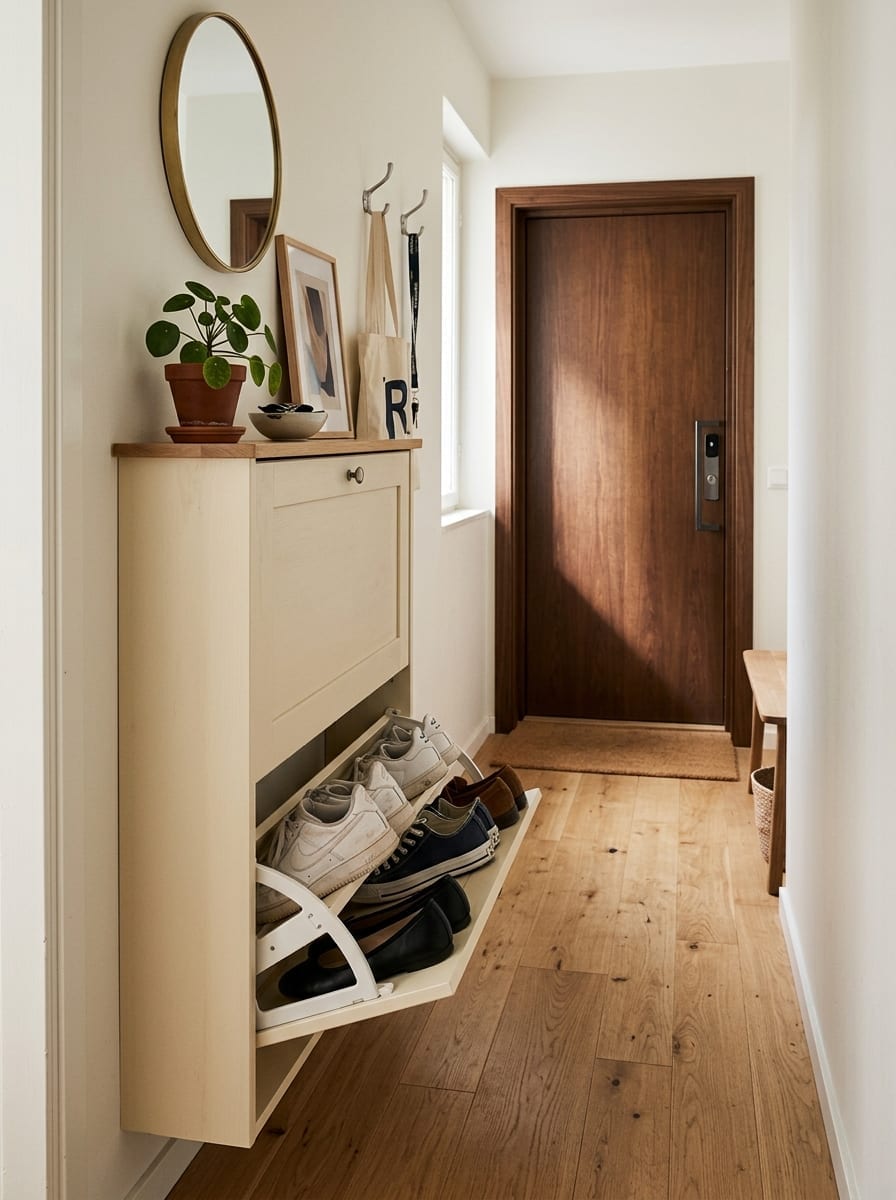
1. The Slim Tilt-Out Shoe Cabinet
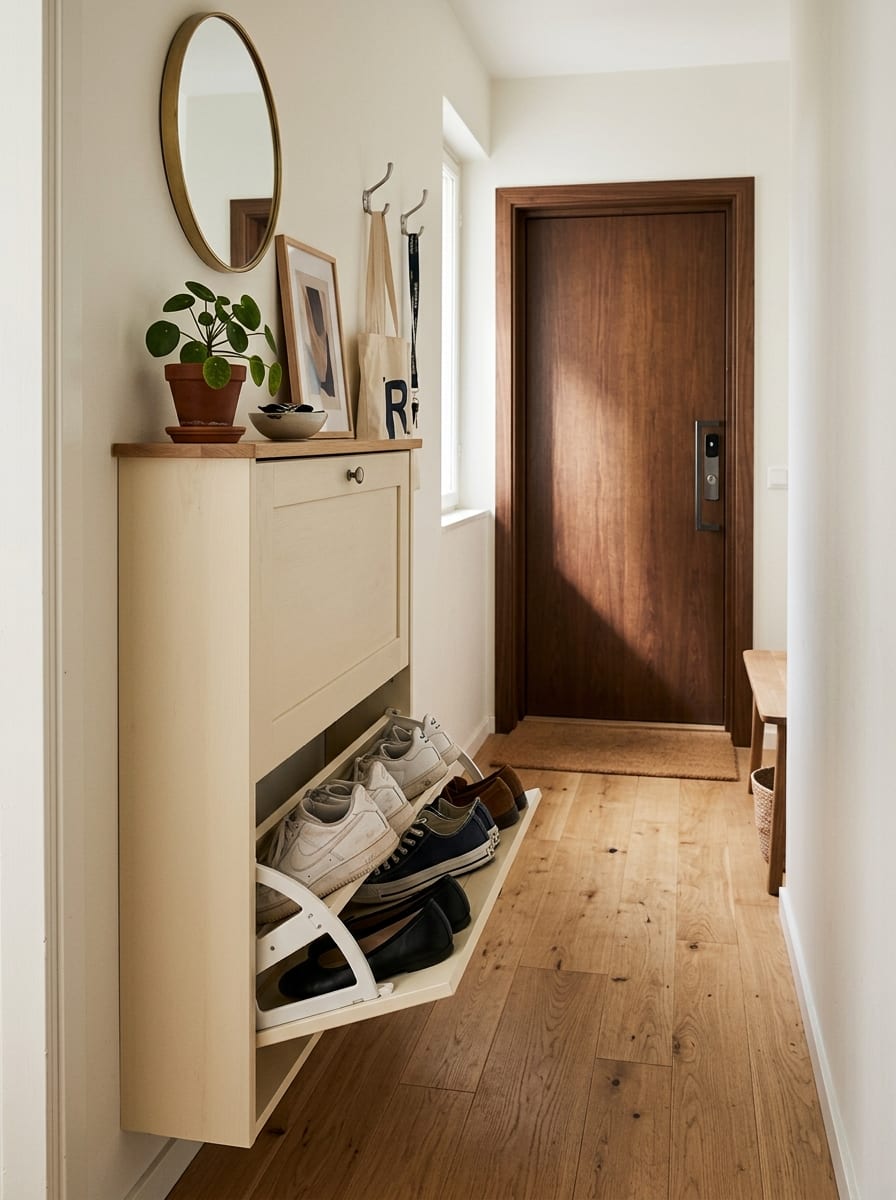
A tilt-out shoe cabinet is one of the most useful options for a very narrow apartment entryway.
Traditional shoe shelves store shoes front-to-back.
That requires a surprising amount of depth.
A tilt-out cabinet stores footwear at an angle inside shallow compartments.
Why it works
The cabinet can provide meaningful storage while projecting less into the hallway than many standard shoe racks.
That matters when the entryway is also the main path into the home.
Best for
It works especially well for:
apartments with no foyer narrow hall entrances entryways beside the living room small rental apartments
What fits best
Tilt-out compartments are usually easiest for:
flats low sneakers loafers sandals everyday shoes
Bulky footwear may be more difficult.
Large:
boots chunky trainers high-tops
may need another storage zone.
Use the top carefully
The cabinet top can become a useful landing surface for:
keys small mail tray sunglasses
But keep it restrained.
A narrow shoe cabinet covered in decor quickly becomes another clutter zone.
Check the front-door swing
This is critical.
Measure the cabinet with:
front door open shoe compartment open
A cabinet that technically fits against the wall may still interfere with one of those movements.
Safety note
Some tall or narrow cabinets require anti-tip attachment.
Follow the manufacturer’s installation requirements. If wall anchoring is necessary and you rent, get appropriate permission or choose a stable design that suits your situation.
2. The Under-Bench Shoe Zone
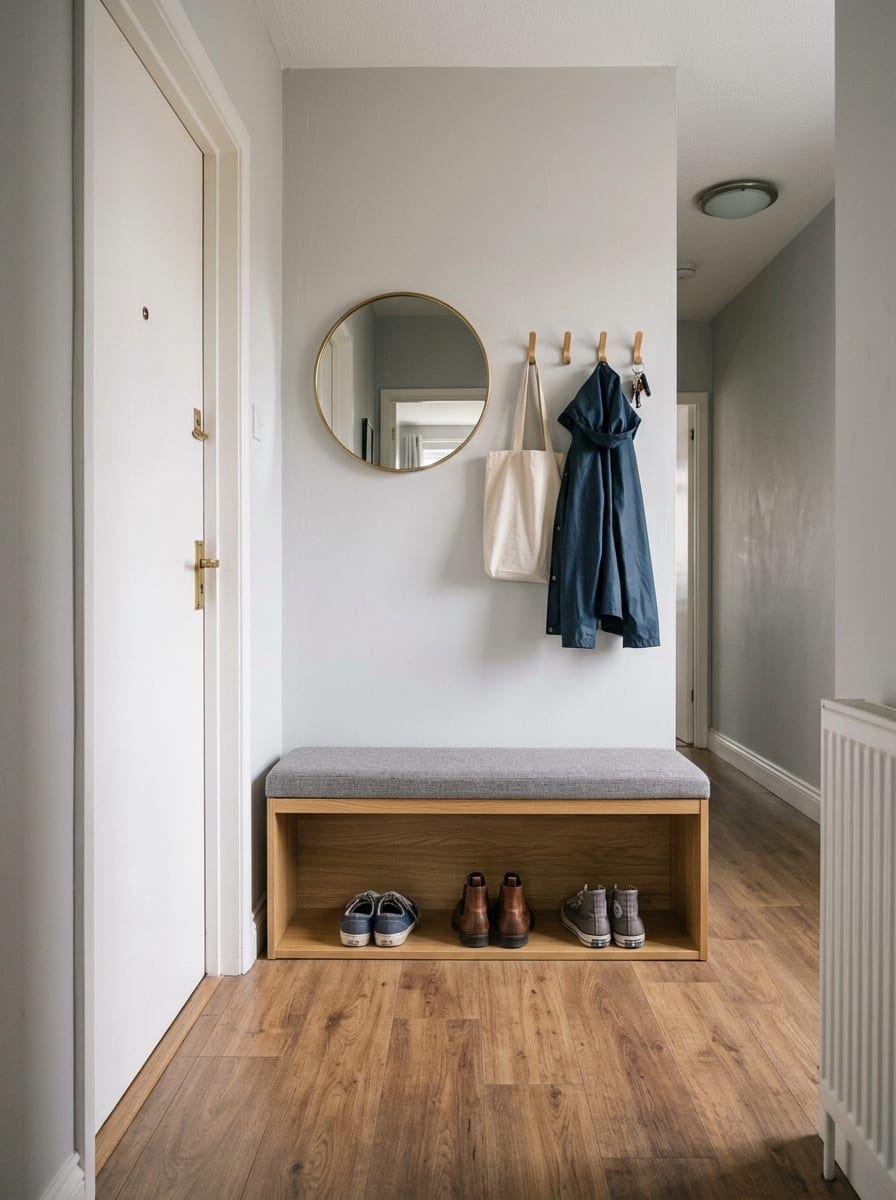
A bench can earn its place in a small entryway when the space underneath does the storage work.
You get:
somewhere to sit while putting shoes on shoe storage underneath
in one footprint.
Keep the bench narrow
An entry bench does not need the depth of a dining bench.
Choose enough depth to sit comfortably without projecting unnecessarily into the walkway.
Open vs closed storage
Open cubbies
Good for:
frequently used shoes quick access
But the shoes remain visible.
Closed drawers or doors
Create a calmer appearance.
They are better if the entry opens directly into the main living space.
Keep capacity reasonable
A small bench holding four or six everyday pairs can work beautifully.
A giant bench designed to store thirty pairs may consume too much space.
Leave some floor visible
Do not fill every cubby with shoes.
A little negative space makes the unit feel lighter.
Make sitting practical
Check that the bench is not covered in:
packages bags decorative pillows
The seating function is part of why the furniture deserves its footprint.
3. The Vertical Shoe Tower
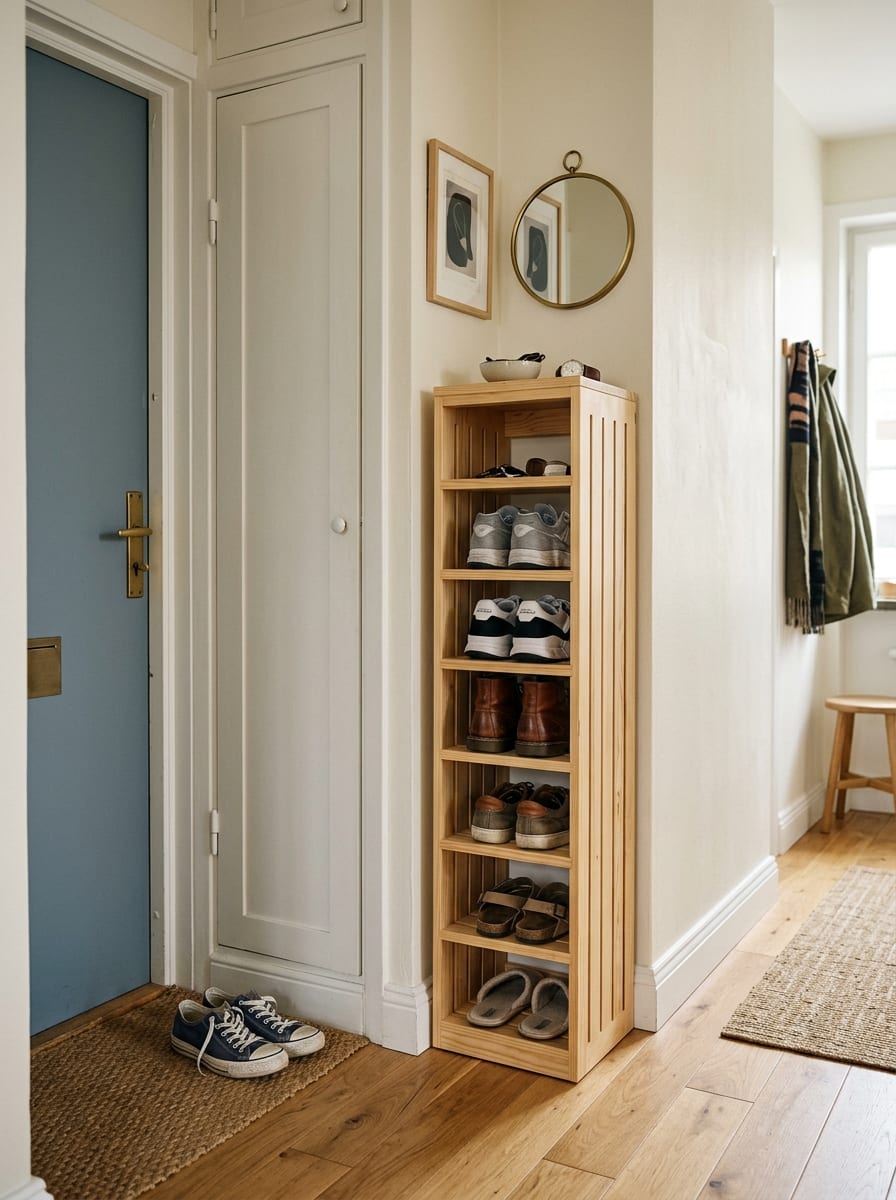
If floor width is scarce, use height.
A tall narrow shoe tower can store several pairs while occupying a relatively small floor footprint.
Why vertical storage helps
Compare:
three low shoe racks side by side
with:
one narrow vertical unit
The tower may store similar capacity while preserving significantly more wall width.
Best location
Use it:
beside entry closet in an unused corner at the end of a short hallway beside a console
Keep daily shoes around waist height
Store the pairs you wear most frequently where they are easy to reach.
Use:
Lower shelves
For heavier footwear.
Middle shelves
For everyday shoes.
Higher shelves
For occasional or lightweight pairs.
Closed fronts are useful
If the entryway is visible from the sofa or kitchen, a closed tower can reduce visual noise.
Open shelving can work too, but it should not become a wall of footwear.
Watch the depth
A vertical cabinet can still be too deep.
Height does not compensate for a piece that narrows the entire hallway.
4. The Closet-Door Shoe System
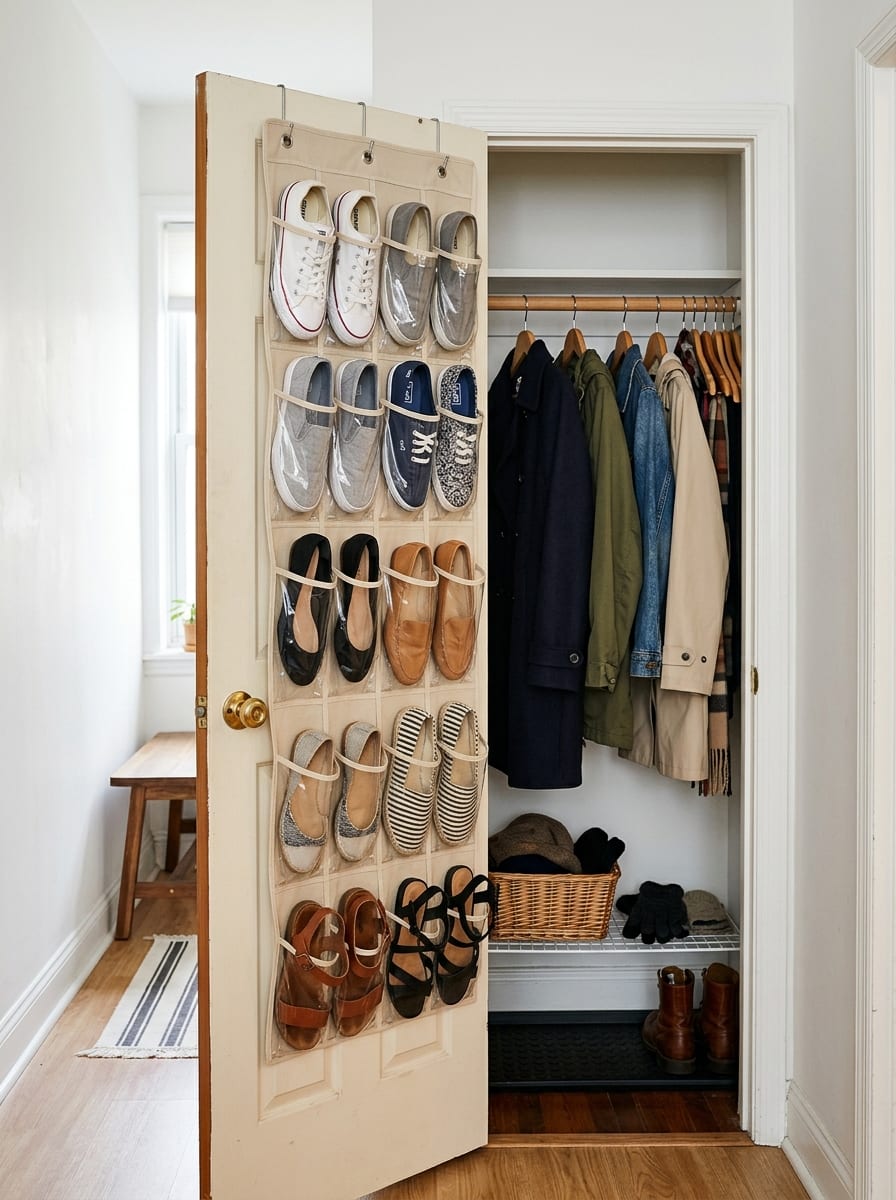
If your apartment entrance includes a coat closet, use the closet before adding more furniture to the hallway.
The inside of the closet door can sometimes hold lightweight shoe storage.
Best options
Depending on the door:
over-the-door shoe organizer hanging pocket organizer appropriate lightweight rack
Why it works
The shoes disappear when the closet door closes.
That means:
no extra floor furniture no visible shoe clutter no narrowing of the entryway
Check closet depth
The organizer must not collide with:
hanging coats shelves stored bags
when the door closes.
Best shoes for door storage
This works particularly well for:
sandals flats slippers lightweight sneakers
Bulky boots usually need more depth.
Do not overload the door
Follow the product’s weight guidance.
A door organizer is not heavy-duty cabinetry.
Keep the load sensible.
5. The One-Basket Daily Shoe Drop
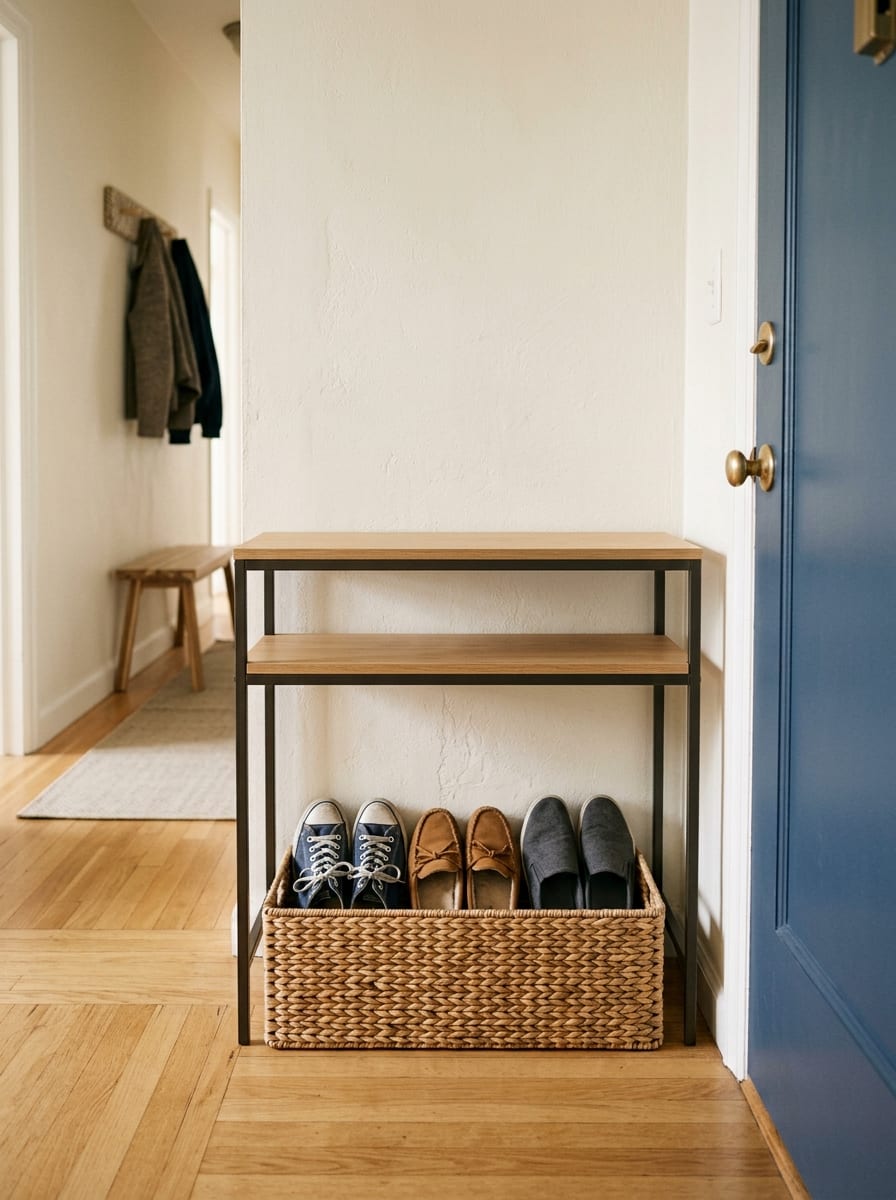
Not every apartment needs a dedicated shoe cabinet.
If one or two people live there and only a few pairs are used regularly, a controlled basket can be enough.
The rule
Use one container for current daily footwear.
That might be:
low woven basket structured fabric bin open low crate
Why the boundary matters
Without a defined limit, the shoe pile grows.
A basket creates a simple rule:
If it does not fit comfortably, another pair needs to move elsewhere.
Best location
Place it:
beneath console inside closet beside bench
not in the center of the walkway.
Use this for casual shoes
It works well for:
slippers sandals children’s everyday shoes lightweight sneakers
Avoid throwing wet footwear inside
Wet shoes need appropriate drying and airflow.
Do not create a damp pile inside a closed container.
6. The Narrow Open Shoe Rack
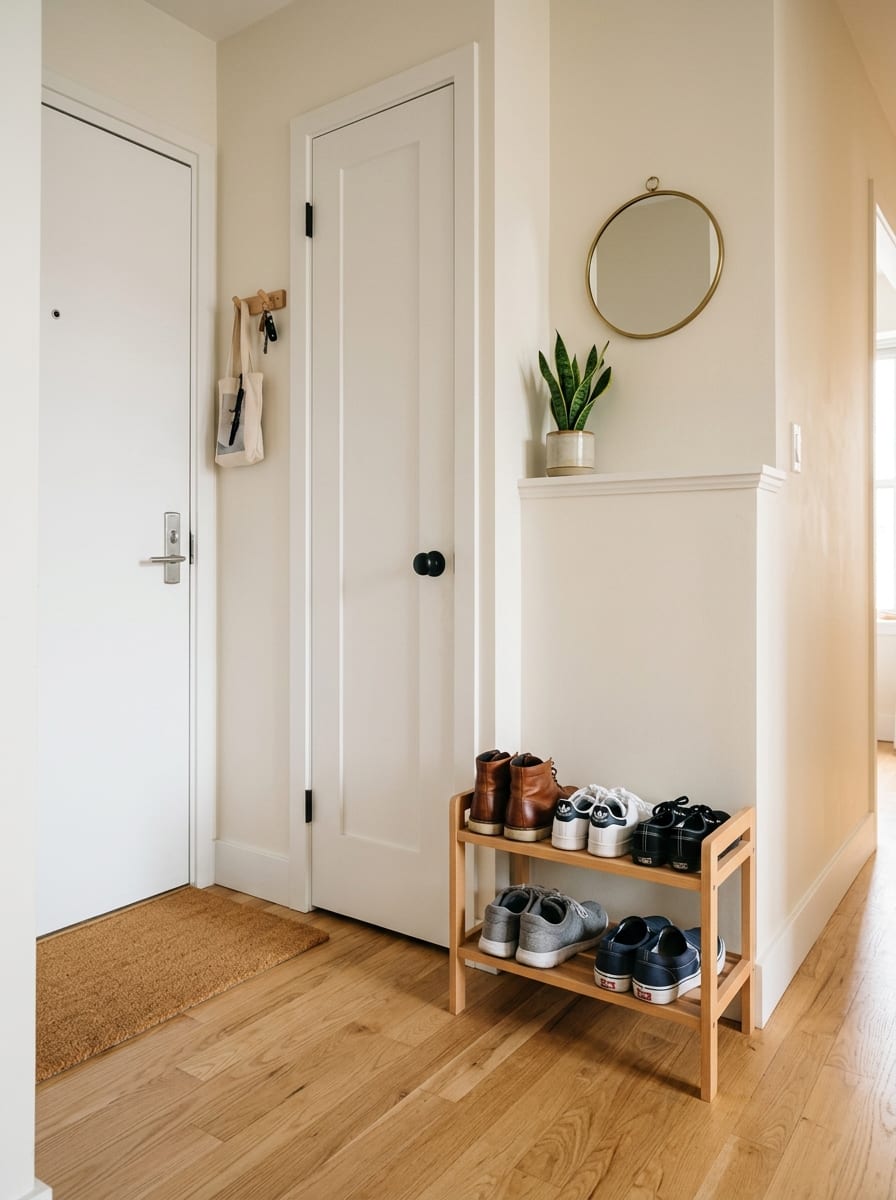
Sometimes simple is better.
A narrow open rack is useful when:
access matters more than hiding shoes you only keep a few pairs by the door the entryway has enough width
Choose fewer tiers
An enormous six-tier rack can dominate a small entrance.
Often:
two tiers three tiers
are enough.
Keep it shallow
Shoes should sit securely without the rack protruding much farther into the walkway than necessary.
Limit the number of pairs
An open rack works best when each pair has obvious space.
Once shoes begin:
stacking leaning sitting beside the rack
the system has exceeded its useful capacity.
Make footwear face the same direction
It sounds minor, but visual consistency can make open storage look significantly calmer.
Best for a closet-adjacent area
If possible, position the rack slightly away from the first line of sight when entering.
7. The Hidden Console Shoe Cabinet
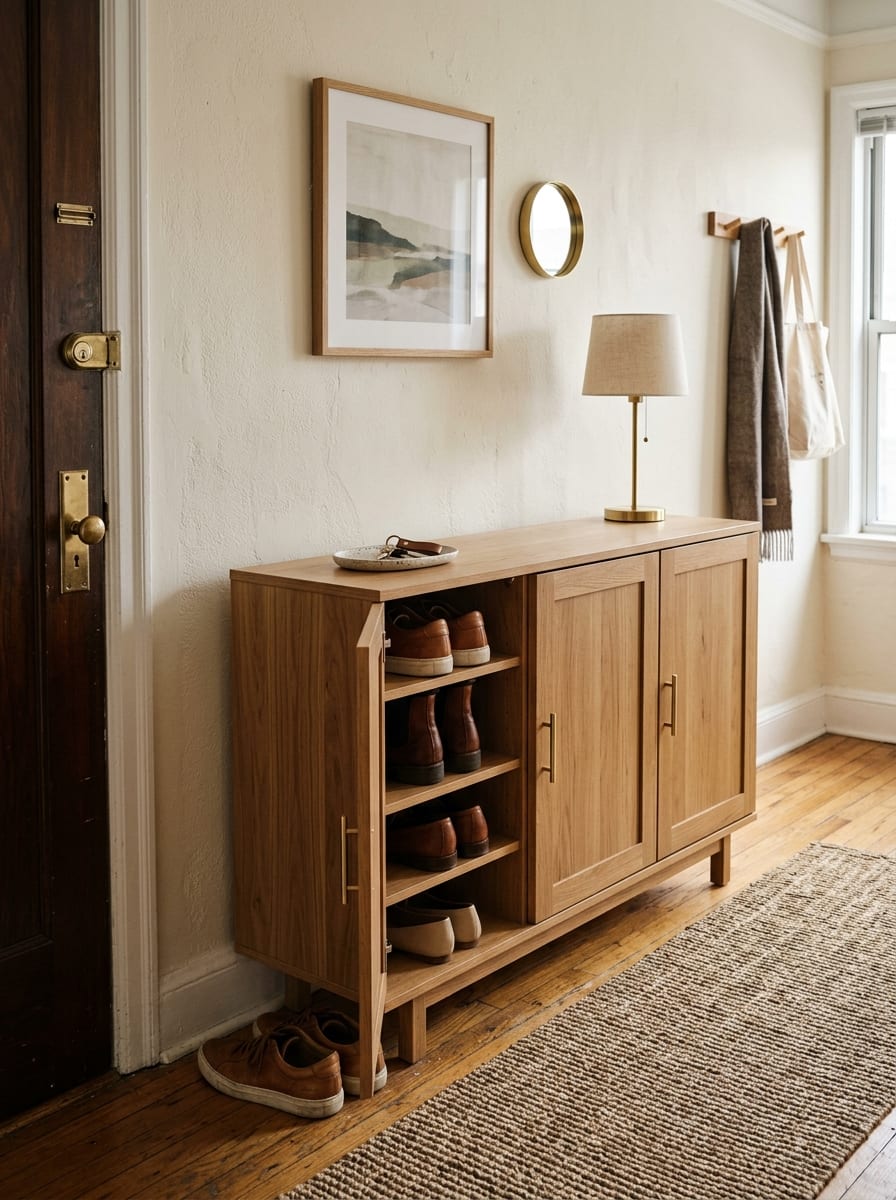
If the entryway is visible from the living room, furniture that does not immediately look like shoe storage can make the space feel more polished.
A shallow closed console can work as:
shoe cabinet key station entry furniture
all at once.
Why this works
The shoes disappear behind normal furniture fronts.
That reduces the feeling that the entrance is primarily a storage area.
Inside organization
Use shelves for:
daily footwear shoe-care supplies small accessories
Keep the categories limited.
Top surface
A good formula:
one key tray lamp if useful one decorative item
Then stop.
Choose furniture with enough ventilation
Shoes should not remain damp inside tightly closed furniture.
Allow footwear to dry appropriately before storing it.
Think beyond this apartment
A simple console may later work as:
dining-room cabinet bedroom storage hallway furniture
That makes it especially useful for renters.
8. The Seasonal Shoe Rotation System
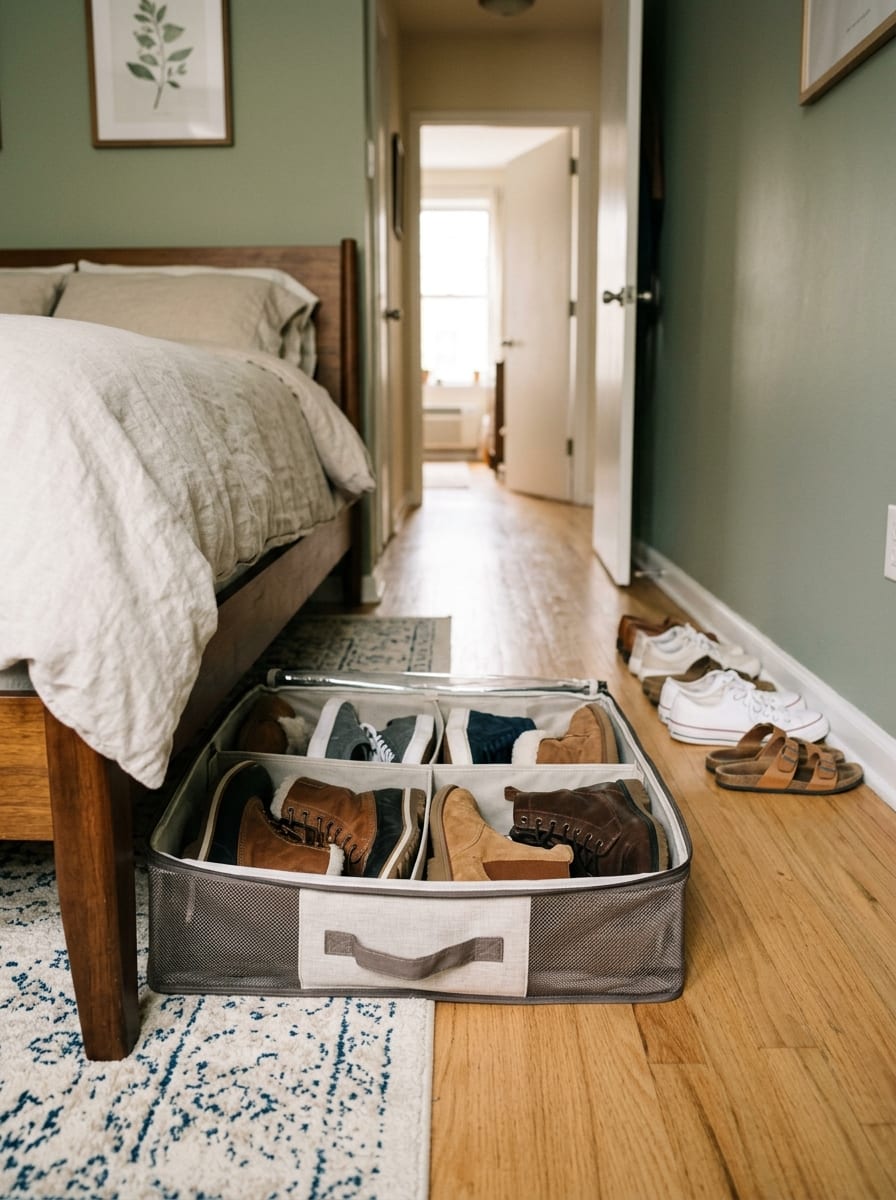
One of the best small-entryway storage ideas does not require buying anything.
Stop storing every season at the door.
Your entryway does not need immediate access to:
summer sandals in winter snow boots in summer formal shoes used twice a year
Create two categories
Entry shoes
Pairs currently used every week.
Stored shoes
Seasonal and occasional footwear.
Where to store the second category
Consider:
under-bed storage bedroom closet top closet shelf storage bed labeled closed bin
Clean shoes before rotating them
Before moving footwear into longer-term storage:
clean dry check condition
Do not seal damp footwear inside a storage container.
Why this works so well
Reducing the number of shoes in the entryway may solve the storage problem without increasing storage capacity at all.
That is usually better for a small apartment.
9. The Five-Pair Entryway Rule
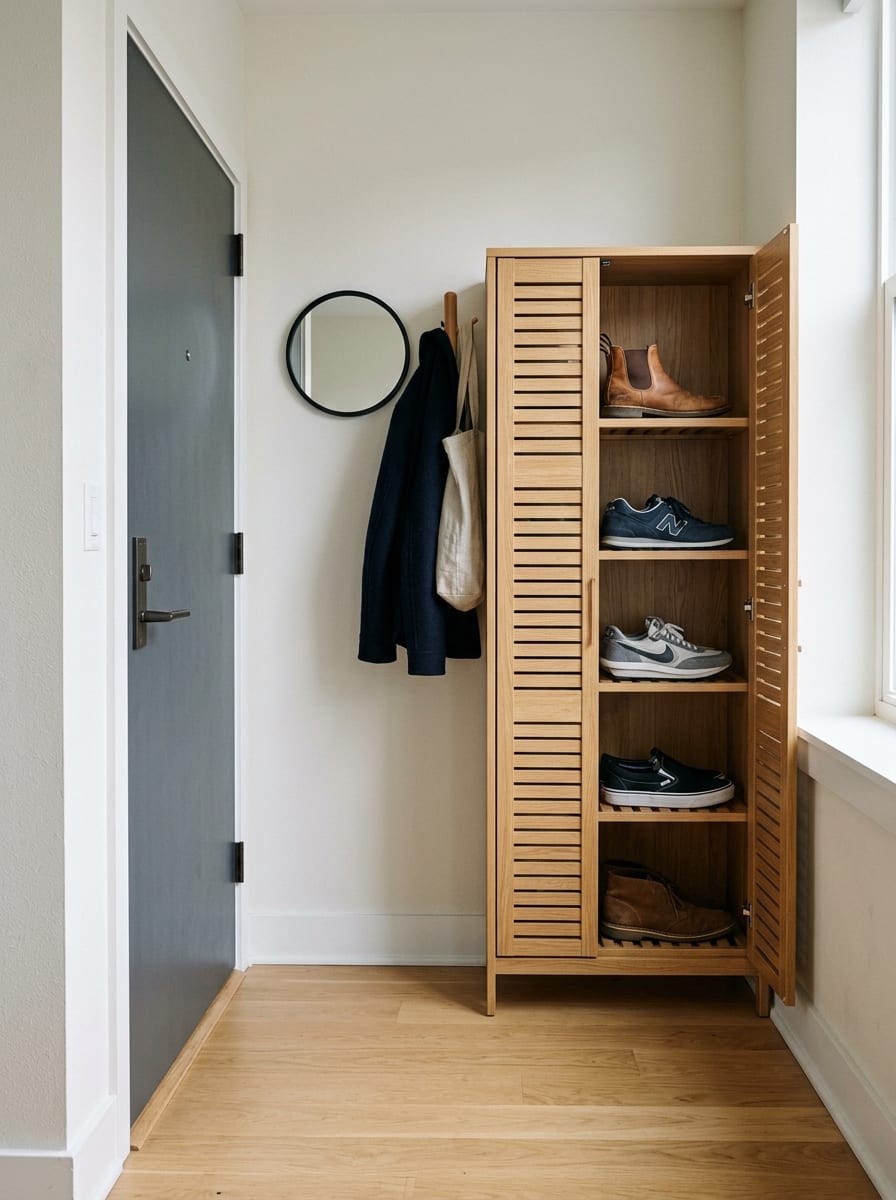
This final idea is a system rather than a piece of furniture.
Give the entryway a hard footwear limit.
For example:
Five pairs per person
or whatever number works for your household.
Why limits help
Storage furniture tends to expand to match whatever you own.
If you buy a larger cabinet, it often becomes full too.
A pair limit forces you to decide:
which shoes are actually current which belong somewhere else
Daily-use pairs should earn the space
Keep shoes at the entrance if they are worn:
frequently currently appropriately for the season
Everything else moves to secondary storage.
Guest shoes do not need permanent storage
If guests visit occasionally, temporary floor space can handle that moment.
You do not need to design the permanent entryway around imaginary daily guests.
Reset weekly
Once a week, return stray pairs to:
closet bedroom seasonal storage
That keeps the system from slowly expanding again.
Start With the Door Swing
Before buying shoe storage, open the front door completely.
Mark the area it uses.
That space is not available for:
cabinet bench shoe rack basket
even if the furniture appears to fit when the door is closed.
Also check:
closet doors bedroom door nearby utility doors
A tiny entrance can contain several competing door swings.
Measure the Walkway After Adding Storage
Furniture measurements alone do not tell you whether the setup will feel comfortable.
Tape the cabinet footprint onto the floor.
Then try:
entering with grocery bags opening the door fully walking past another person removing shoes reaching a closet
A cabinet that fits mathematically may still make daily life annoying.
How Many Shoes Should Stay in a Small Entryway?
Usually fewer than people expect.
For one person, perhaps:
everyday sneaker work shoe casual shoe current seasonal pair
plus one additional option.
The exact number does not matter.
The important part is that the entryway contains current footwear, not your entire shoe collection.
Open Shoe Storage vs Closed Shoe Storage
Open storage
Better for:
ventilation quick access very small collections
But creates more visual clutter.
Closed storage
Better for:
entrances visible from main room larger shoe collections a calmer visual look
But make sure footwear is appropriately dry before storing it.
For small open-plan apartments, closed storage often creates the cleaner result.
How Deep Should Entryway Shoe Storage Be?
As shallow as it can be while still functioning well.
This is why tilt-out cabinets can be useful.
A traditional shelf needs enough depth for the full shoe length.
A tilt-out cabinet can sometimes use less room by storing shoes at an angle.
Before buying, compare:
furniture depth shoe size remaining walkway
not just storage capacity.
What About Boots?
Boots are difficult because they are:
tall bulky seasonal
Do not force them into a cabinet designed for sneakers.
Instead use:
bottom wardrobe shelf boot tray bedroom closet seasonal storage
During wet weather, give boots a suitable place to dry before moving them into enclosed storage.
What About Children’s Shoes?
Children’s footwear is smaller but often more numerous.
A low system works well because children can access it independently.
Consider:
low basket two-tier rack low cubby
Keep the category simple.
You do not need individual compartments for every pair.
Where Should Slippers Go?
Slippers often cause unnecessary clutter because they live halfway between:
bedroom entryway
Choose one permanent location.
If shoes are removed at the front door, a small basket can hold indoor slippers there.
If slippers are mainly used in the bedroom, keep them there instead.
What About Guest Shoes?
Do not permanently sacrifice entryway space for guest footwear unless guests are present constantly.
When visitors arrive, a temporary:
mat tray open floor zone
can handle additional pairs.
Design the permanent storage for the people who actually live there.
Should You Use a Shoe Tray?
A shoe tray can be useful for:
wet shoes snowy weather muddy footwear
But it is not necessarily long-term storage.
Think of it as a temporary drying/dirty-shoe zone.
Once footwear is dry and clean enough, move it to its normal storage position.
Entryway Shoe Storage for Renters
Renters benefit from portable solutions such as:
tilt-out cabinet bench freestanding shoe rack basket over-door closet organizer
These can move with you.
If any tall furniture requires wall anchoring for safe use, follow the product requirements and obtain permission where necessary.
Do not ignore anti-tip guidance simply to avoid drilling.
Match Shoe Storage to the Entryway Shape
Long narrow entry
Use:
very shallow closed cabinet
Short wide entry
A bench may work.
Entry with closet
Use the closet first.
No-entryway apartment
Use one slim piece directly beside the door.
Tiny hallway corner
Consider vertical storage.
The room shape should determine the furniture type.
Why Shoe Storage Often Looks Cluttered Even When Organized
Shoes contain lots of:
shapes colors soles laces textures
So ten neatly arranged pairs can still create more visual information than one closed cabinet.
That is why an open rack can look busier than expected.
If your entry is visible from the main living space, closed storage may be worth prioritizing.
Do Not Store Shoes Across Several Entryway Zones
A common setup becomes:
two pairs under console four on rack three beside door boots near closet slippers in basket
Technically, everything has a place.
Visually, the entire entrance becomes shoe storage.
Consolidate footwear into one primary zone whenever possible.
Keep the Floor Clear
This should be the final test.
After organizing, you should not need to:
step around sneakers kick shoes aside to open the door move a basket before vacuuming
The floor should mostly function as:
circulation space
not storage.
Common Small-Entryway Shoe Storage Mistakes
Buying for maximum capacity
More capacity usually means deeper or larger furniture.
Ignoring door swing
The cabinet works until someone comes home.
Keeping every shoe near the entrance
Store only current pairs.
Choosing open storage when visual calm matters
Closed fronts may work better.
Leaving wet footwear in closed furniture
Let it dry appropriately first.
Adding several small storage products
One good cabinet can be calmer than:
rack basket bench hooks
all together.
Filling the cabinet top
Storage furniture should not generate another clutter surface.
Blocking the walkway
The entrance needs to function before it needs to store things.
A Simple Shoe-Storage Setup for One Person
Try:
Slim tilt-out cabinet
Four to six everyday pairs.
Small tray
One wet pair temporarily.
Bedroom storage
Occasional and seasonal footwear.
That’s enough for many apartments.
A Setup for Two People
Try:
Closed shoe cabinet
Current everyday pairs.
One basket
Slippers or lightweight footwear.
Seasonal storage
Under bed or inside bedroom closet.
Avoid doubling every entryway storage piece just because two people live there.
A Family Setup
A small entryway may need stricter limits.
Try:
Low bench or cabinet
Frequently used shoes.
One low children’s basket
Current kids’ footwear.
Closet
Adult overflow.
Bedroom storage
Seasonal and occasional pairs.
The entryway still should not become the household’s entire shoe collection.
Which Shoe Storage Idea Fits Your Entryway?
Choose a Tilt-Out Cabinet if:
The hallway is narrow and you want closed storage.
Choose an Under-Bench Zone if:
You also need somewhere to sit.
Choose a Vertical Tower if:
You have more height than wall width.
Choose Closet-Door Storage if:
A coat closet already exists.
Choose One Basket if:
You only need to contain a few casual pairs.
Choose an Open Rack if:
Fast access matters and the shoe collection is small.
Choose a Hidden Console if:
The entryway is visible from your living room.
Use Seasonal Rotation if:
Your cabinet is full of shoes you are not currently wearing.
Use the Five-Pair Rule if:
Shoes keep accumulating regardless of the storage system.
Final Thoughts
The best shoe-storage system for a small apartment is not the one that holds the most shoes.
It is the one that protects the entrance.
Start with:
door swing → walkway → current shoes → furniture depth
Then choose storage.
Keep only the pairs you actually use near the door.
Move seasonal footwear elsewhere.
Use closed storage when visual clutter is the bigger problem.
And try to preserve as much empty floor as possible.
When the floor stays clear, even a very small apartment entrance immediately feels easier to use.