10 Christmas Dining Table Ideas for Small Apartments That Still Leave Room for Dinner
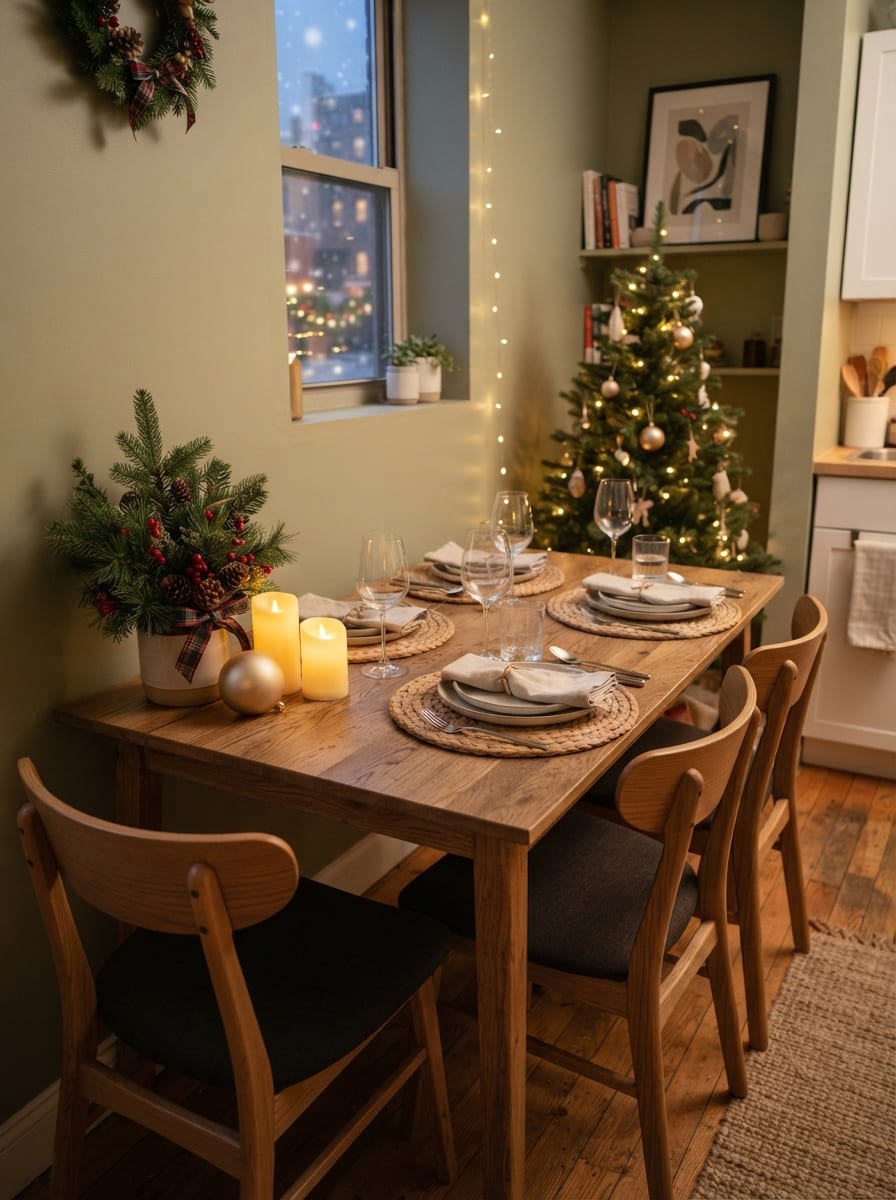
Set a festive holiday table that still leaves room for dinner plates. 10 small apartment Christmas dining table ideas—slim runners, taper candles, and mini greens.
In This Guide
A small apartment dining table has a difficult job at Christmas.
It may need to handle:
- everyday meals
- holiday dinner
- drinks
- serving dishes
- Christmas decor
- perhaps even gifts or baking beforehand.
That is a lot to ask from one small surface.
The usual decorating advice—add a large centerpiece, candles, garland, ornaments, and place settings—works much better on a long dining table than on a compact apartment table.
On a small table, the wrong centerpiece can take over the exact area you need for:
- food
- plates
- glasses
- passing dishes.
The solution is not to skip Christmas decorating.
It is to decorate the table according to usable zones.
Think of the table as three areas:
place-setting zone
serving zone
decor zone
The first two have to function before the third gets any space.
Here are ten Christmas dining table ideas designed specifically for small apartments.
1. The End-Zone Centerpiece
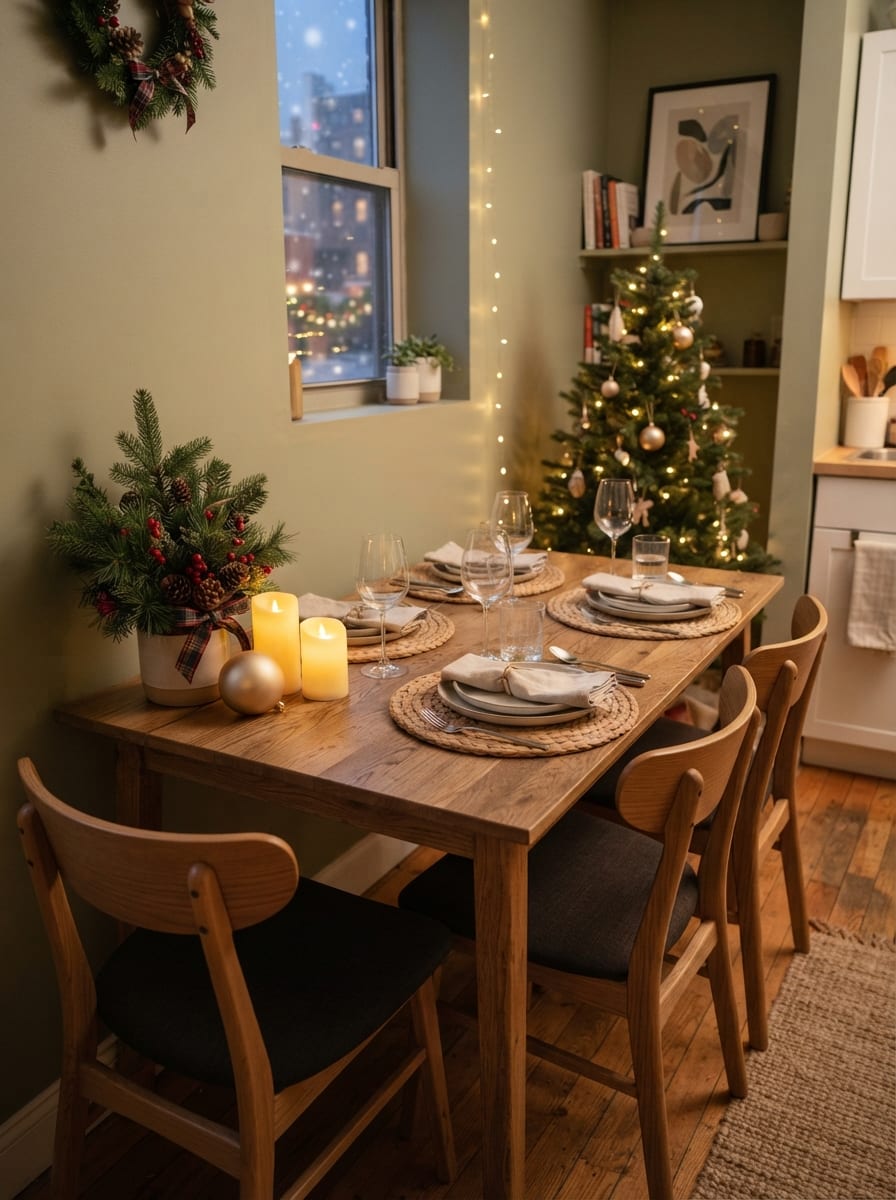
Instead of placing the centerpiece directly in the middle, move it toward one end of the table.
Why it works
The center stays available for:
- shared dishes
- serving bowls
- bread
- drinks.
You still get one strong festive focal point without sacrificing the most useful part of the table.
Good centerpiece options
Try:
- one small vase of greenery
- two battery candles
- one miniature tree
- a shallow ornament bowl.
Keep it compact
The arrangement should not spread across the entire short end.
Leave room for the person seated there if the table uses that position.
Best for
This works especially well on:
- small rectangular tables
- narrow dining tables
- drop-leaf tables.
2. The Runner-Only Christmas Table
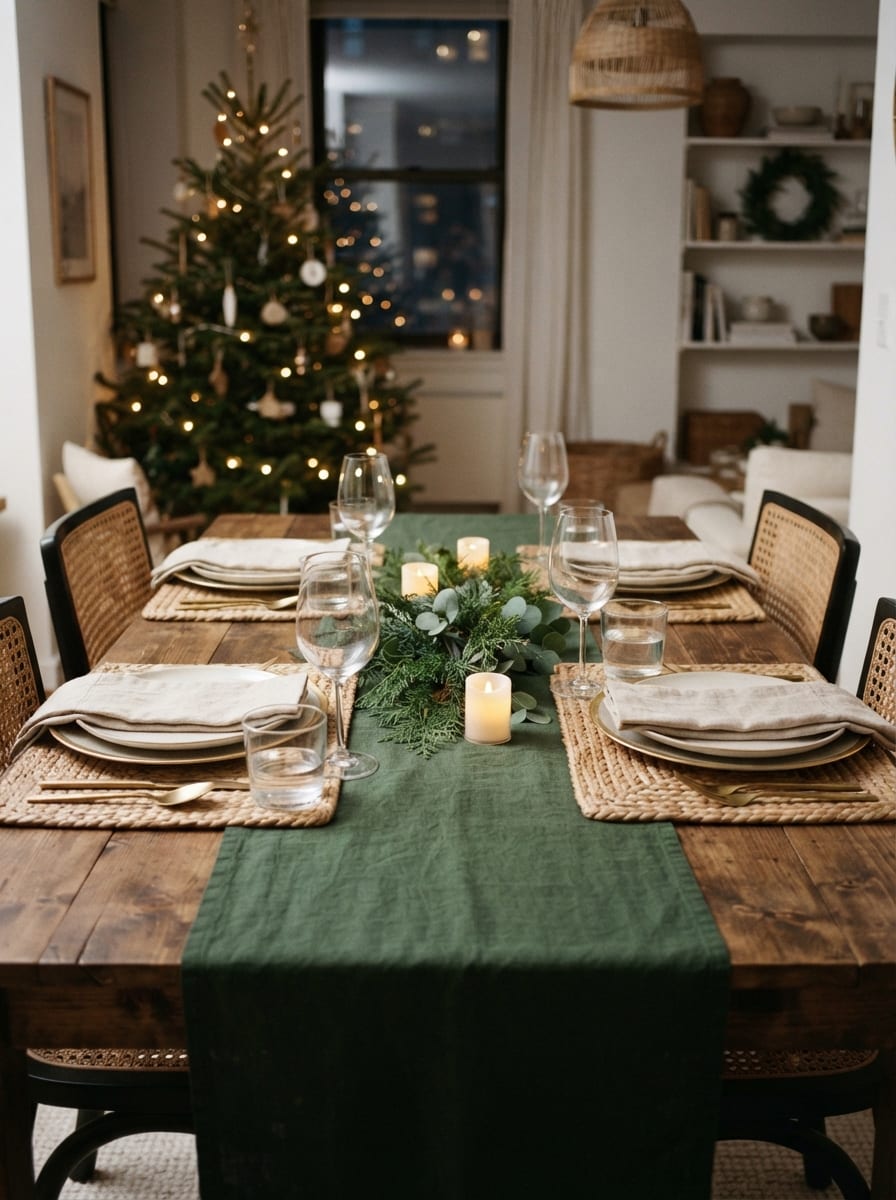
A table runner can add Christmas color and texture without consuming usable surface area.
Why it works
A runner visually defines the table but stays flat.
That means it does not compete with:
- plates
- glasses
- serving bowls.
Keep the palette narrow
Try:
- deep green
- warm ivory
- muted burgundy
- soft tartan
- natural linen.
Avoid heavy layering
A runner plus:
- placemats
- chargers
- napkin rings
- scattered ornaments
- garland
can become too much on a small table.
Use the runner as the main decorative layer.
Add one low detail
A few clipped evergreen sprigs or two candles can be enough.
3. The Candle Cluster With Clear Sides
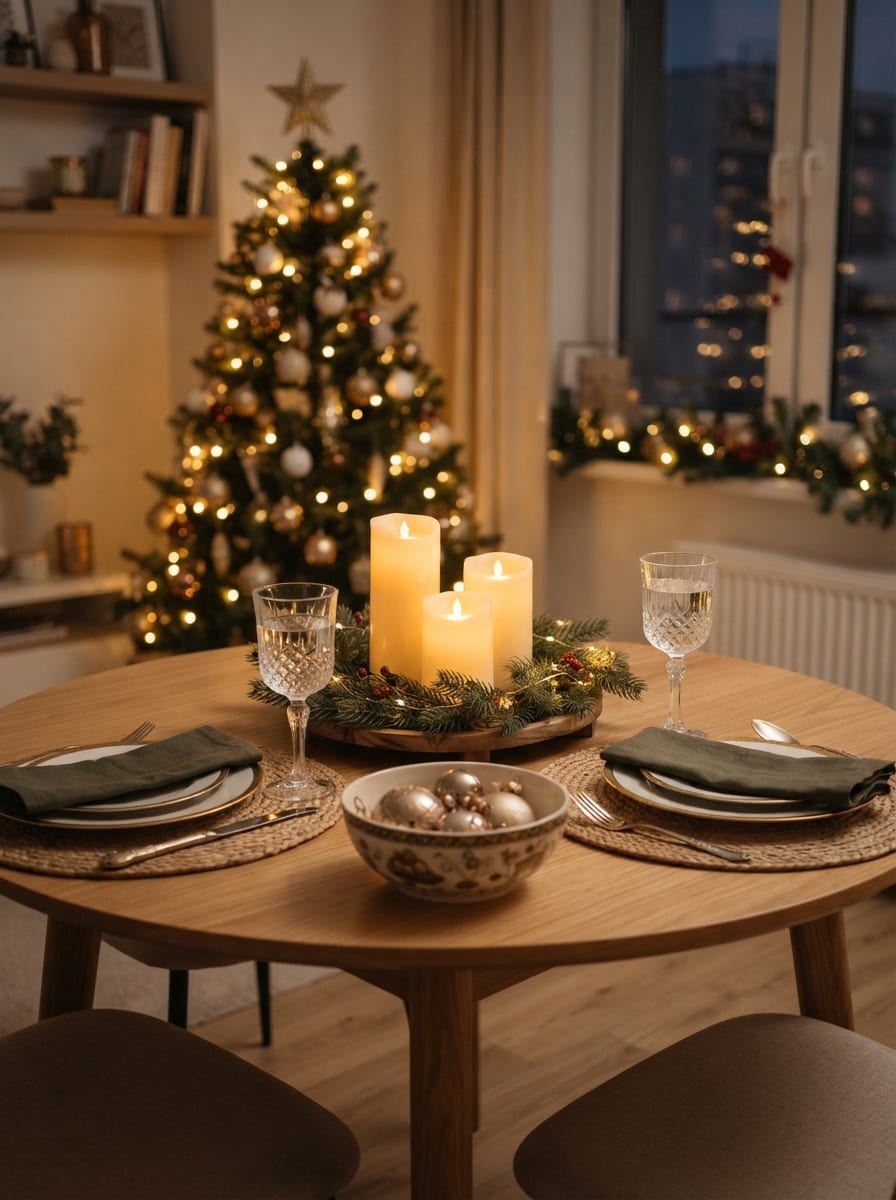
Candles can create strong Christmas atmosphere without requiring a large centerpiece.
The trick is grouping them tightly.
Why it works
Three candles occupying one compact footprint are better than six candles scattered across the table.
Use varied heights
A small group can include:
- one taller candle
- one medium candle
- one low candle.
Keep the cluster narrow
Make sure diners still have room for:
- arms
- glasses
- passing dishes.
Use flameless candles where practical
Battery candles can be useful in tight dining areas, especially near:
- greenery
- napkins
- curtains.
Always follow product guidance.
Keep sightlines open
Do not create a wall of tall candles across the center.
4. The Mini Greenery Line
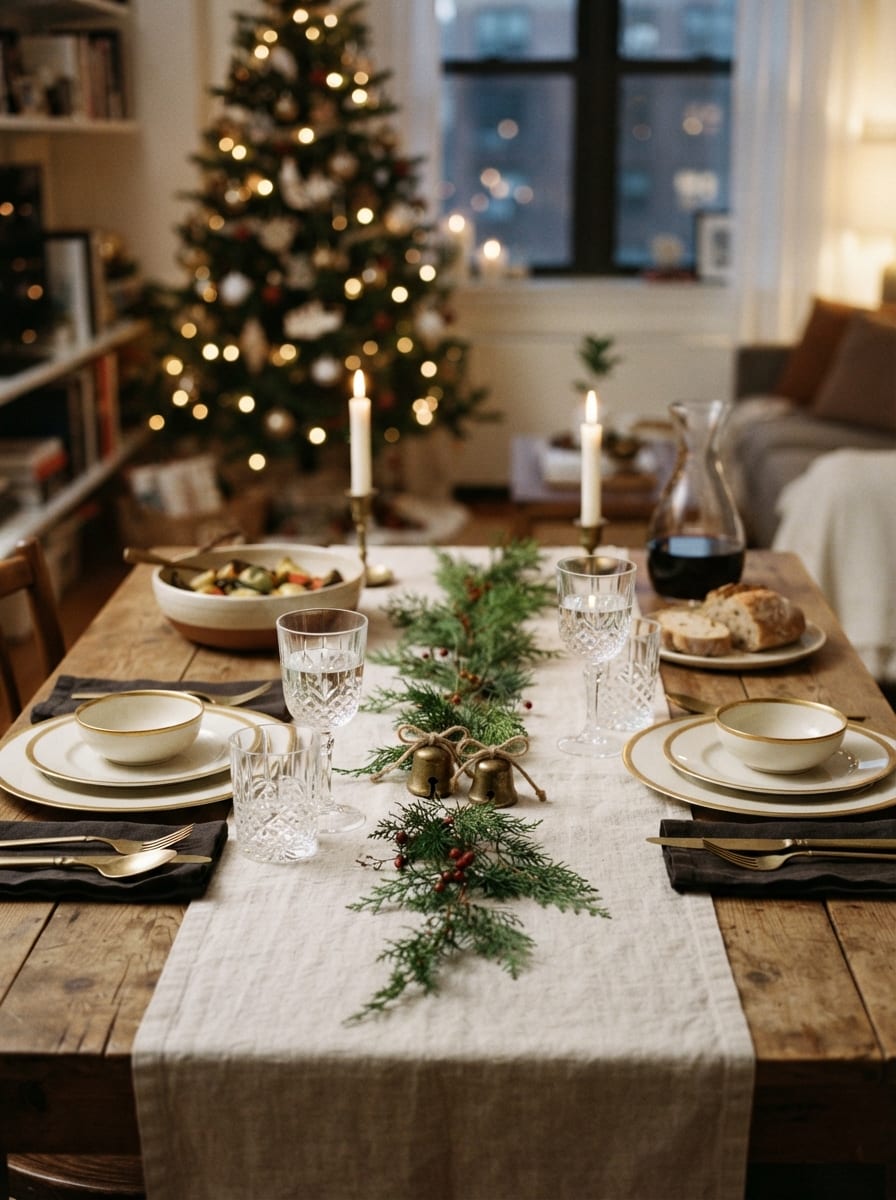
Garland can work on a small table if it is treated like a line, not a pile.
Why it works
A very slim greenery strip adds Christmas texture while staying low enough for conversation.
Use less than you think
A few clipped stems arranged end to end may work better than a thick manufactured garland.
Keep the width narrow
The greenery should not invade plate space.
Skip bulky ornaments
One or two small accents are enough.
Try:
- dried orange slice
- small brass bell
- pinecone.
Keep food in mind
If the greenery is fresh, use clean, appropriate materials and keep it separated from food as needed.
5. The Place-Setting-First Table
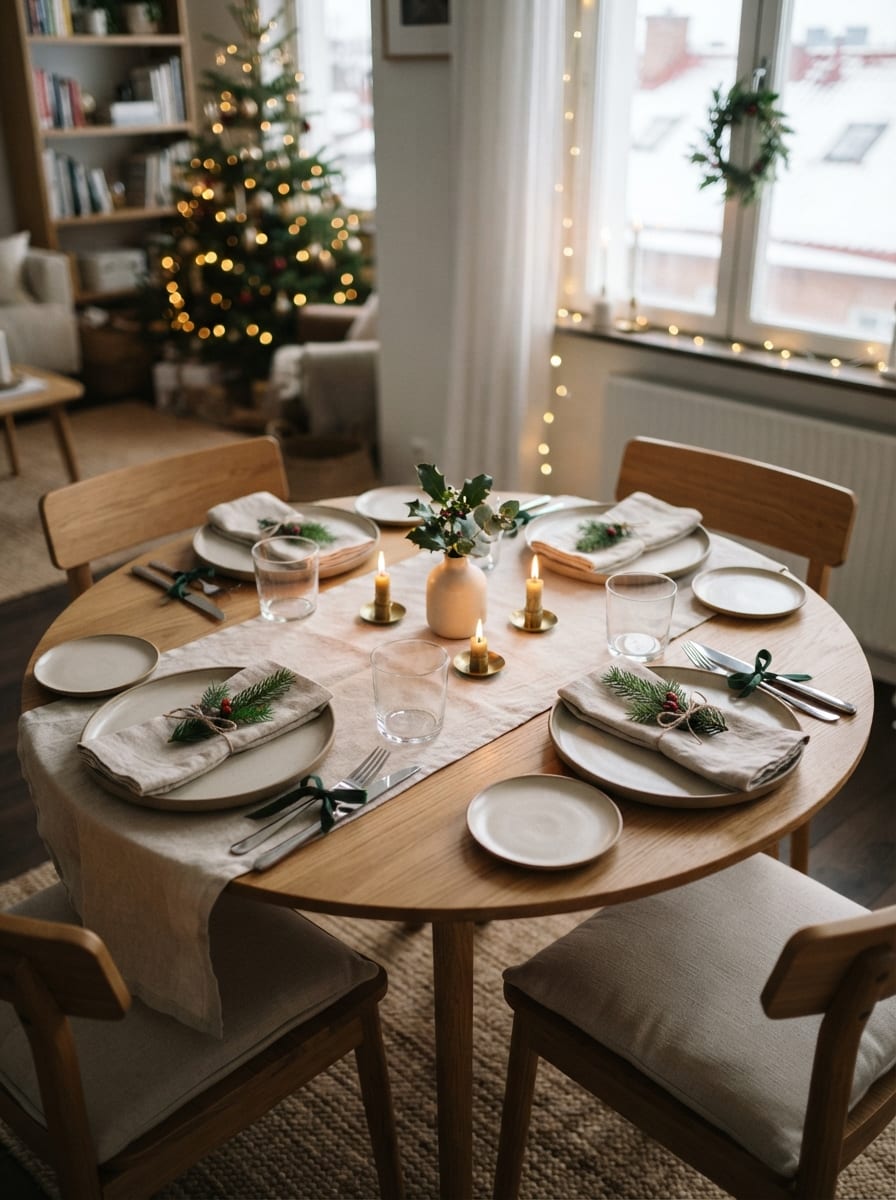
The easiest way to avoid overcrowding is to set the dinner table first and decorate second.
Step 1
Place the actual:
- dinner plates
- cutlery
- glasses
- napkins.
Step 2
Sit down.
Check:
- elbow room
- glass access
- plate clearance.
Step 3
Only then add Christmas decor to the remaining space.
Why it works
The decor has to adapt to the function rather than the other way around.
Keep each place setting compact
A small Christmas detail may be enough:
- sprig of rosemary
- small ribbon
- simple folded napkin.
You do not need a large decorative object at every seat.
6. The Off-Center Christmas Arrangement
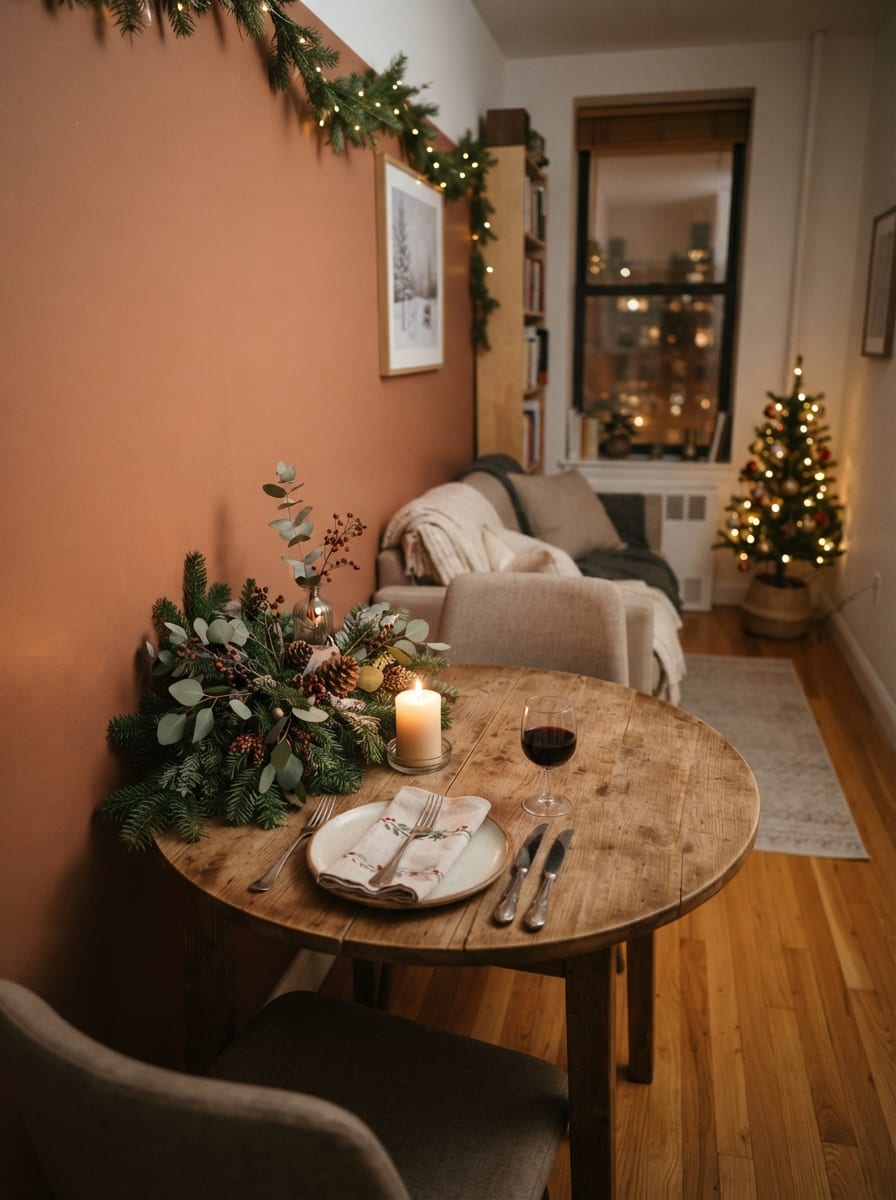
A centerpiece does not have to sit perfectly in the middle.
Moving it to one side can create a more useful serving zone.
Why it works
The arrangement still provides a Christmas focal point while leaving a larger uninterrupted area for:
- serving platter
- salad bowl
- drinks.
Best for asymmetrical seating
This can be especially useful if:
- one side of the table sits against a wall
- one chair is rarely used
- table is pushed toward a corner.
Keep visual balance
If the decor sits to one side, balance it with:
- napkin color
- candle
- small greenery detail
rather than adding another large arrangement.
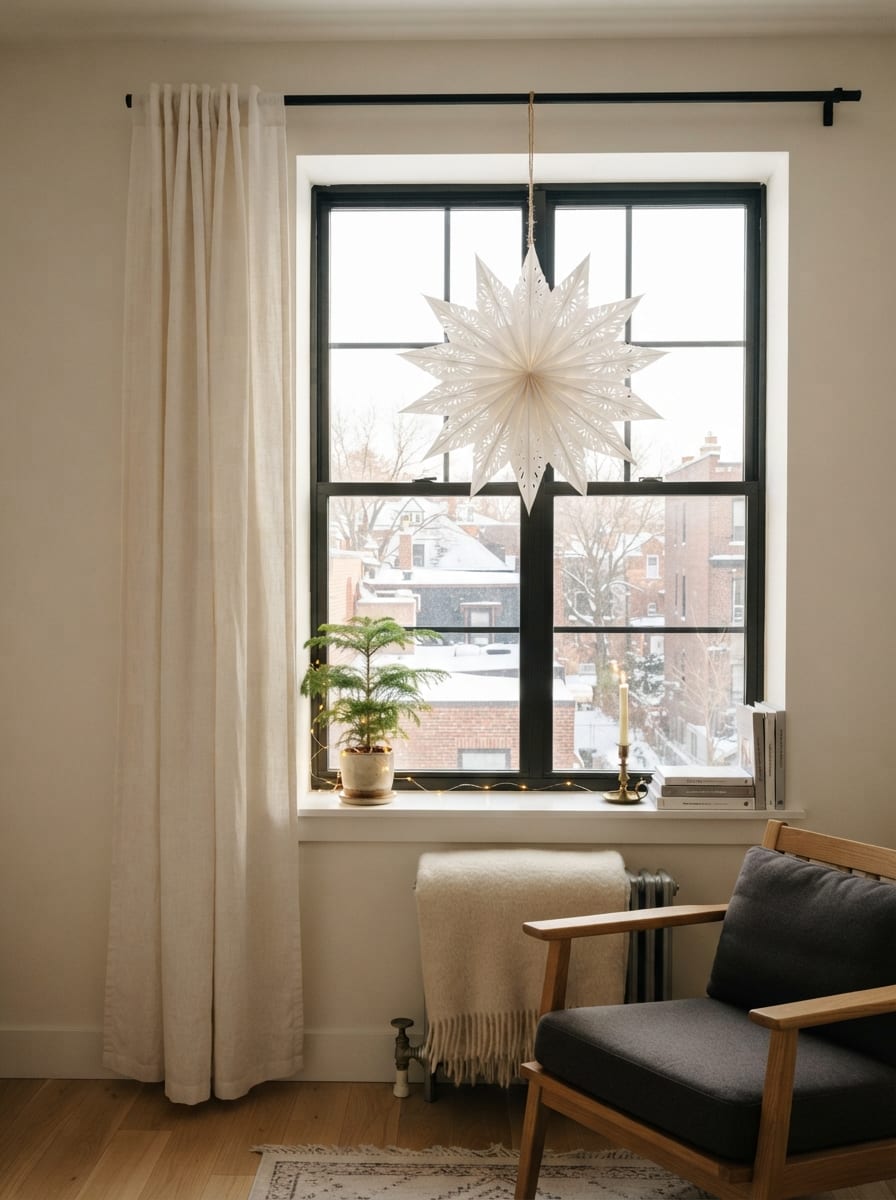
7. The Overhead Christmas Table Moment
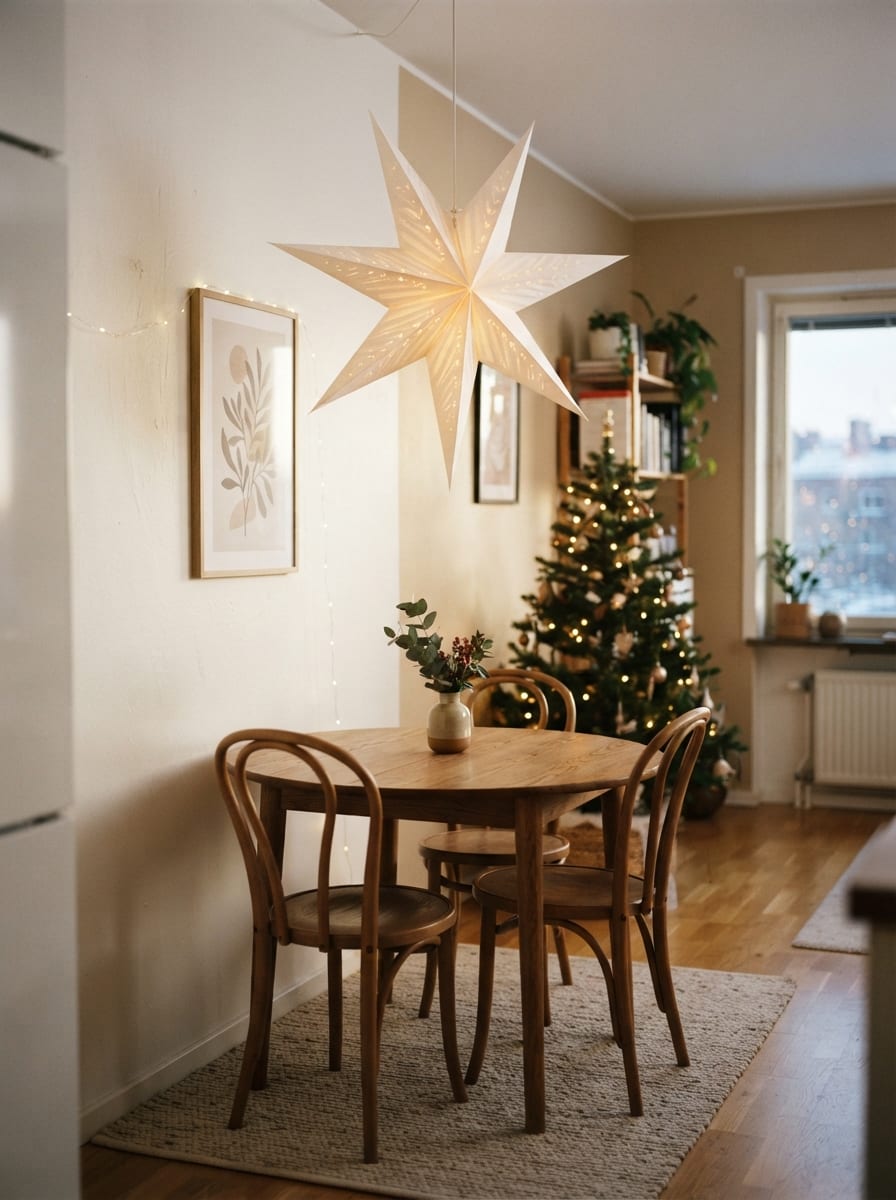
When the tabletop is extremely small, move part of the Christmas decoration above it.
This could be:
- existing pendant light dressed very lightly
- a paper star hung nearby
- festive wall decor behind the table.
Why it works
The Christmas atmosphere remains strong without consuming dining surface.
Keep safety first
Do not attach decorations to:
- light fixtures
- electrical components
- heat-producing surfaces
unless the product and setup are specifically designed for that use.
A safer alternative
Hang lightweight paper decor from an appropriate independent ceiling hook or nearby wall where allowed.
Preserve head clearance
Anything above the table should stay well above seated and standing head height.
Best for
Very small:
- two-person tables
- breakfast nooks
- studio dining corners.
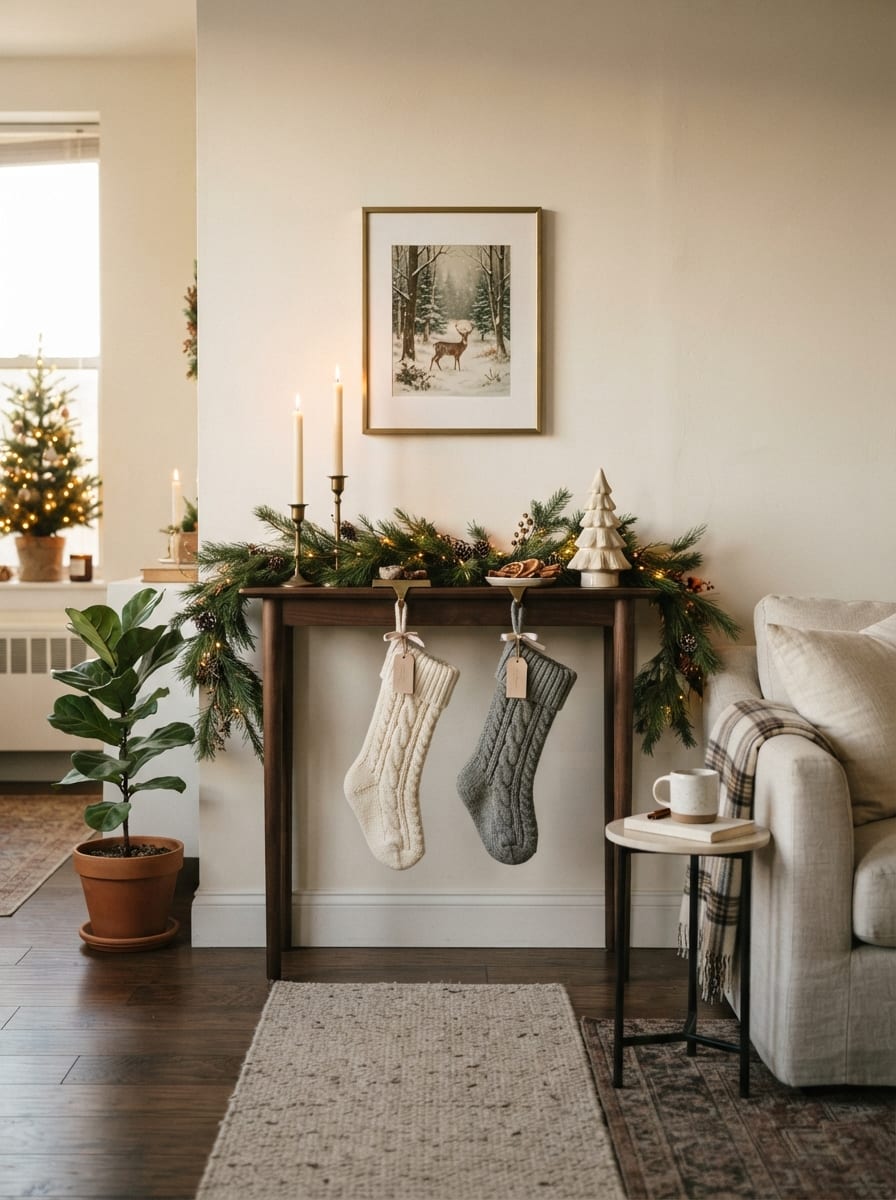
8. The Sideboard-Shifted Tablescape
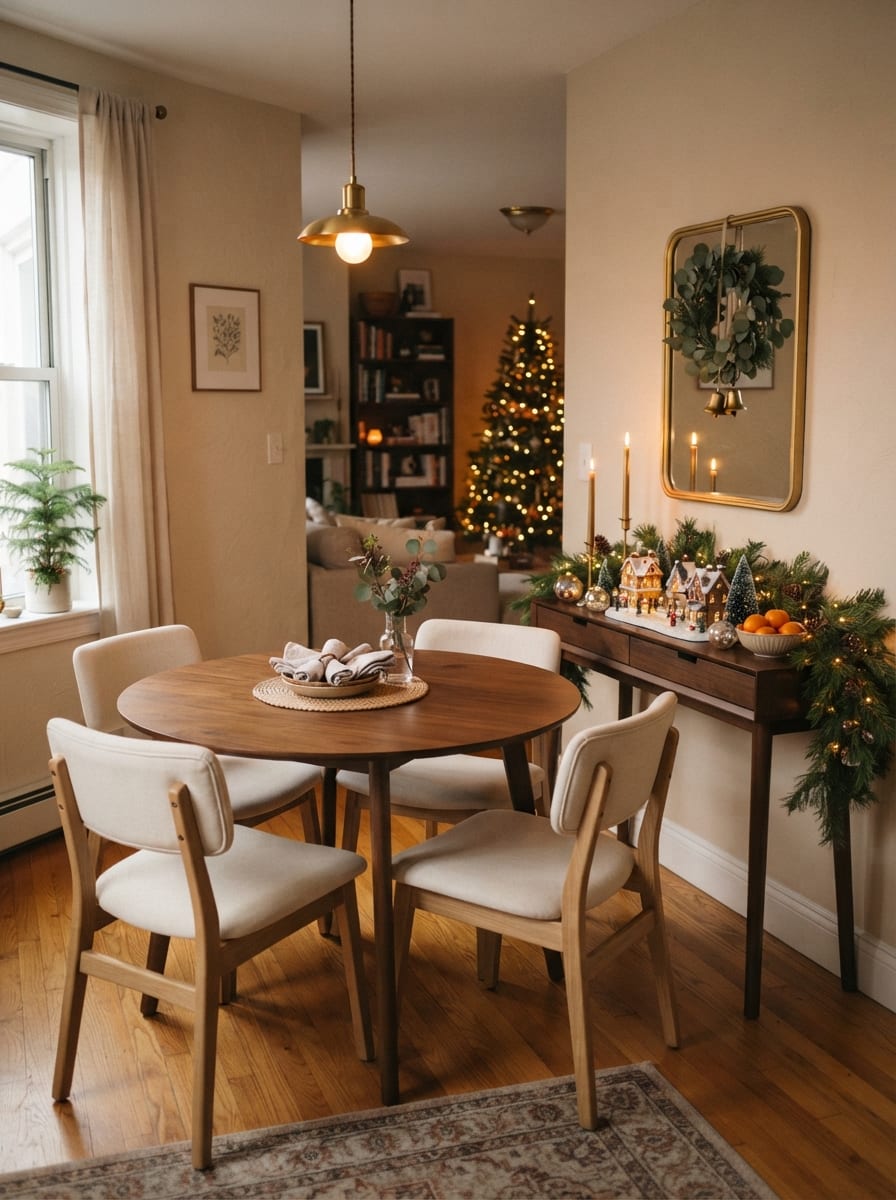
If you have a nearby:
- console
- cart
- shelf
- sideboard
move the larger Christmas styling there instead.
Why it works
The dining table can stay functional while the nearby surface carries the decorative weight.
Use the dining table lightly
Keep only:
- napkins
- one candle
- a few greenery sprigs.
Use the nearby surface for
- taller candles
- Christmas village
- larger arrangement
- bowl of ornaments.
This creates two zones
decorative zone
and
eating zone.
That distinction is especially helpful in small apartments.
9. The Removable Centerpiece Tray
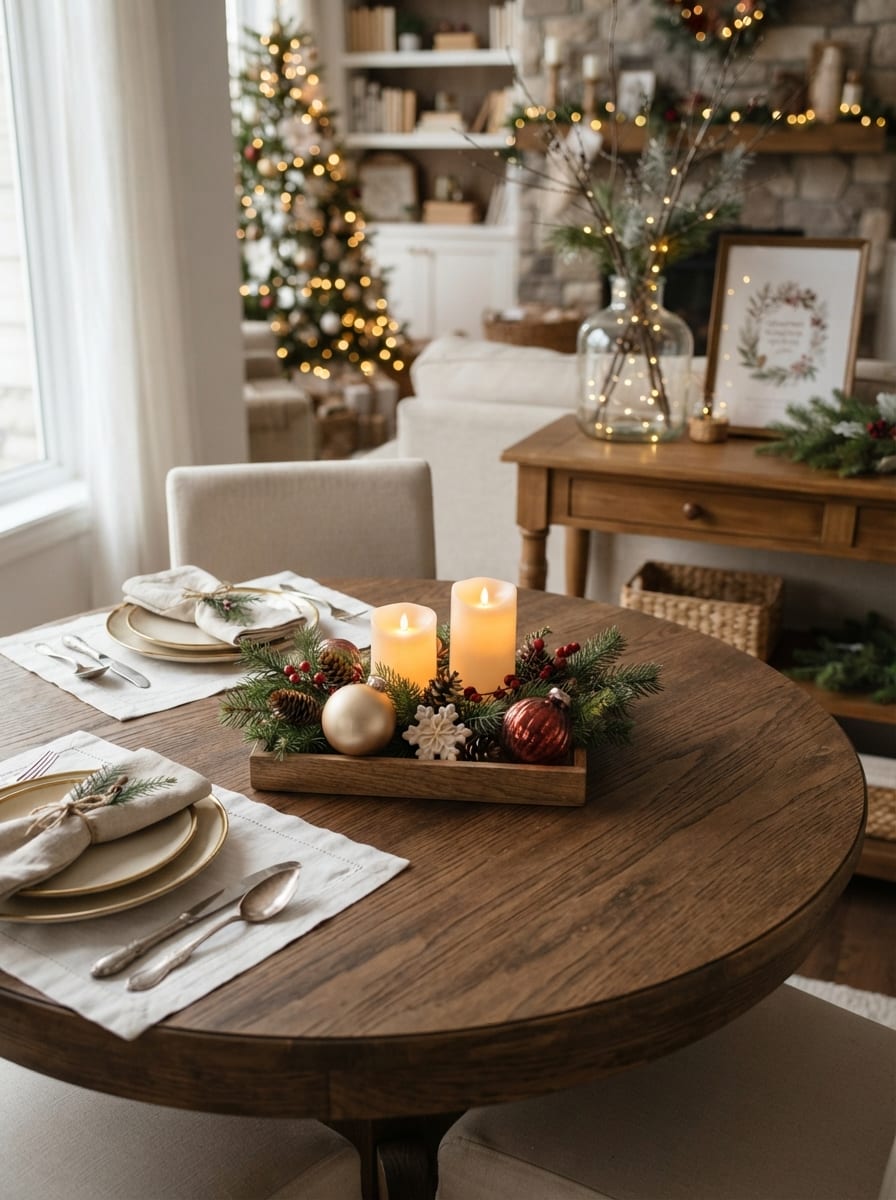
If you want a more substantial centerpiece before dinner, build it on one tray.
Why it works
When food arrives, the entire arrangement can move in one action.
You do not have to relocate:
- six candles
- individual ornaments
- greenery stems
- decorative bowls
one by one.
Keep the tray compact
It should be easy to lift and have an obvious temporary destination.
Good tray contents
Try:
- two candles
- short greenery
- a few ornaments
- one tiny vase.
Plan where the tray goes
Before dinner, decide whether it will move to:
- sideboard
- kitchen counter
- windowsill.
Do not create a centerpiece that has nowhere to go.
10. The Plate-Elbow-Serving Formula
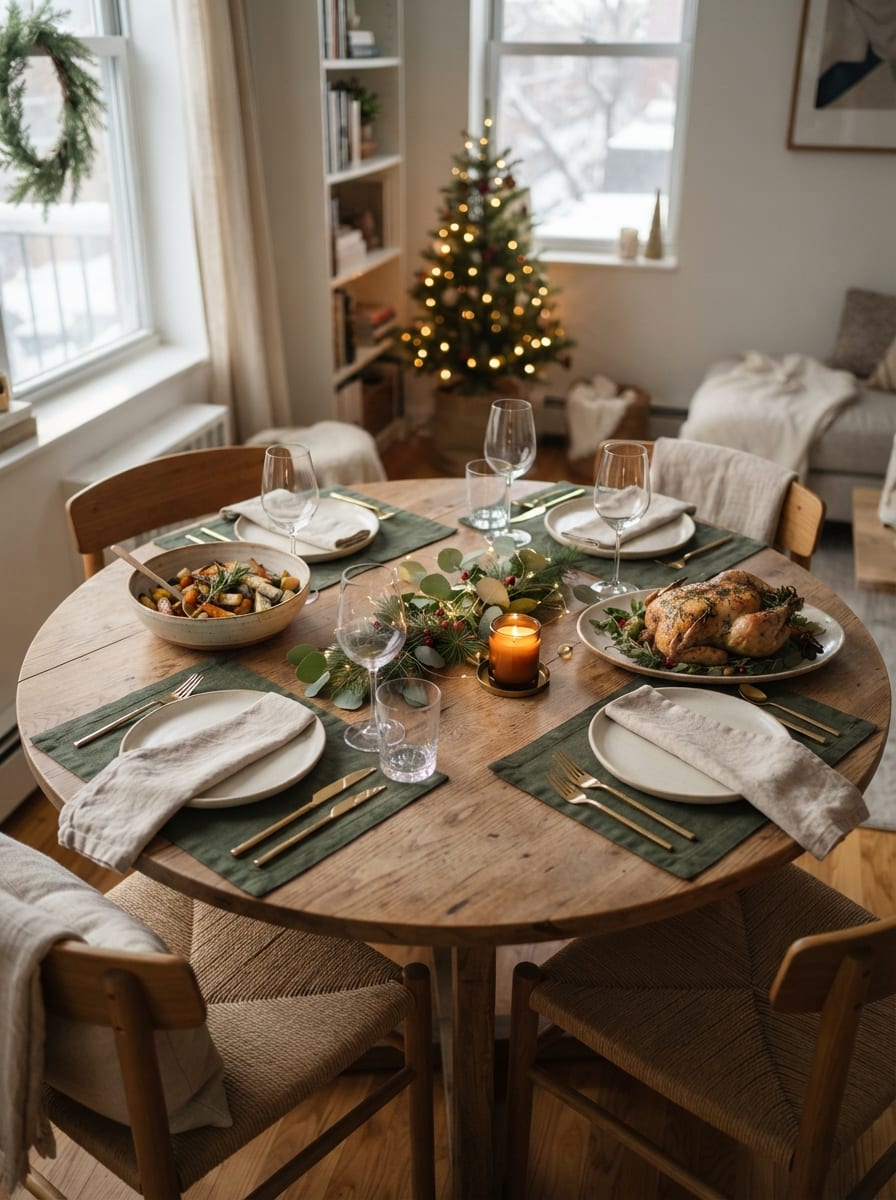
Before styling the table, reserve space in this order:
plates → elbows → glasses → serving dishes → decor
Christmas decor comes last.
Step 1: Set the plates
Use the actual dinner plates you plan to use.
Step 2: Sit down
Check whether elbows feel comfortable.
Step 3: Add glasses
Make sure they do not sit too close to:
- centerpiece
- candle
- neighboring place setting.
Step 4: Reserve serving space
Imagine where:
- main dish
- salad
- bread
- drinks
will go.
Step 5: Decorate what remains
That leftover area is your true decor zone.
Start With the Meal, Not the Centerpiece
The fastest way to overcrowd a small dining table is to decorate it before deciding how dinner will actually be served.
Ask first:
- How many people are sitting here?
- Will food be served family-style?
- Will plates be brought from the kitchen already filled?
- Do serving dishes need to stay on the table?
- Will drinks be on the table?
These answers determine how much decorating space actually exists.
Family-Style Dinner Needs More Center Space
If several serving dishes stay on the table, preserve the middle.
Choose:
- end-zone decor
- very low runner
- removable tray
- nearby sideboard display.
Plated Dinner Gives You More Flexibility
If food is served from the kitchen, the center can hold slightly more decoration.
Even then, leave room for:
- bread
- drinks
- extra serving dish.
Two-Person Christmas Table
A small table for two can feel festive with very little.
Try:
- one candle
- one greenery sprig
- two good napkins.
You do not need a centerpiece scaled for a six-person dinner.
Four-Person Apartment Table
Protect the central serving zone.
Use:
- end placement
- low narrow runner
- removable tray.
Round Table
Round tables can become crowded quickly because every setting points toward the center.
Use one very compact centerpiece.
Square Table
A central arrangement can work if it stays small enough to preserve the four corners for place settings.
Narrow Rectangular Table
Usually benefits from a long, thin decorative line rather than a wide centerpiece.
Drop-Leaf Table
Decorate according to the table’s fully open dinner size.
Do not style it when folded and then discover that the arrangement no longer works.
Extendable Table
If you extend it only for Christmas dinner, set the expanded version before choosing the decor.
Table Against the Wall
Use the wall-side edge for more of the decoration.
This protects the accessible dining side.
Table in a Corner
Keep the open side especially clear so people can sit and stand comfortably.
Table Between Kitchen and Living Room
Use decor that visually connects with both spaces.
Studio Apartment Table
Because the dining table may be visible from the bed and sofa, keep the palette coordinated with the whole apartment.
Small Dining Nook
Move festive impact upward or onto the wall rather than crowding the tabletop.
Built-In Banquette
A low arrangement works well because tall centerpieces can obstruct sightlines across the table.
Bench Seating
Protect the sliding movement needed to enter and leave the bench.
Chairs Need Pull-Out Space
Do not add:
- floor lanterns
- gift baskets
- decorative trees
behind chairs if they reduce movement.
Small Table Doesn’t Need Small Everything
One clear decorative statement can be stronger than many tiny objects.
For example:
- one paper star above
- one good candle cluster
- one compact greenery line.
Avoid Lots of Mini Decorations
Ten tiny ornaments still create clutter.
Low Decor Is Usually Easier
Keep centerpieces below conversation sightlines.
Tall Decor Works Better at the End
If you want:
- branches
- tall vase
move them to one end or a nearby sideboard.
Christmas Runner vs Tablecloth
Runner
Keeps more tabletop visible.
Tablecloth
Can create a stronger seasonal change.
But on a very small table, it may make the whole setup visually heavier.
Use Tablecloths Carefully Around Small Rooms
Long hanging fabric can interfere with:
- knees
- chair movement
- nearby walkways.
Placemats
Useful if you want each place setting clearly defined.
But runner + placemat + charger can become visually layered very quickly.
Chargers
They add formality but increase the footprint of each place setting.
Use only if the table has room.
Dinner Plates
Should determine place-setting width.
Napkins
One of the easiest ways to add color without consuming extra surface area.
Napkin Rings
Optional.
A simple ribbon or greenery sprig can do the same job.
Christmas Napkin Ideas
Try:
- muted burgundy napkin
- forest-green napkin
- natural linen with twine
- cream napkin with rosemary.
Avoid Giant Napkin Displays
Large sculptural folds can occupy plate and glass space.
Flat or Simple Fold
Usually works better.
Place Cards
Small place cards can feel festive for guests without taking much space.
Use Place Cards as Decor
A small card plus:
- herb sprig
- ribbon
may replace the need for extra tabletop objects.
Candle Placement
Keep candles clear of:
- sleeves
- napkins
- greenery
- serving dishes.
Flameless Candles
Often useful on cramped tables.
Tea Lights
Small footprint, but use appropriate holders and safe placement.
Taper Candles
Elegant but visually tall.
Use a small number and keep sightlines in mind.
Pillar Candles
Need more table width.
They may work better on a nearby console.
Candles at the Ends
Can preserve the middle.
Candle Trio
Works if tightly grouped.
Scattered Candles
Usually consume more usable space.
Garland
The word “garland” often suggests something much bulkier than a small dining table needs.
Use Clipped Greenery Instead
A few stems can create the same seasonal impression.
Artificial Greenery
Can be practical and reusable.
Keep it proportionate.
Fresh Greenery
Can look beautiful, but keep it clean and away from food as appropriate.
Eucalyptus
Can provide a lighter look than dense pine.
Rosemary
Small sprigs can work beautifully in place settings.
Pinecones
Use a few, not a whole forest.
Ornaments
One small bowl may be enough.
Loose Ornaments
Can roll and become annoying during dinner.
Contain them.
Bells
One or two can add texture.
Dried Orange
Adds warm seasonal color without much volume.
Berries
Use sparingly if you want stronger color.
Christmas Village on Dining Table
Usually better moved to:
- sideboard
- windowsill
- shelf
unless the table is not being used for meals.
Mini Trees
One small tree at the end can work.
Avoid a cluster of them in the center.
Gifts on Dining Table
Useful for photography, less useful for dinner.
Move them before the meal.
Bow Decor
Ribbon can add festive color without much physical depth.
Tie Ribbon Around Napkins
This is more space-efficient than adding bows to the center.
Use the Wall Behind the Table
This is one of the best small-space Christmas strategies.
Add:
- wreath
- paper star
- framed holiday print
- lightweight garland.
Let the Wall Carry the Visual Weight
Then the table can remain functional.
Use a Window Behind the Table
Decorate the window lightly instead of loading the dining surface.
Hang One Paper Star
Strong festive impact with no tabletop footprint.
Nearby Shelf
Use it for the larger Christmas display.
Sideboard
Ideal for:
- candles
- ornaments
- greenery
- serving overflow.
Kitchen Cart
Can become temporary serving space during dinner.
Serving Cart
Especially helpful if the dining table is extremely small.
Clear the Table of Everyday Items First
Before decorating, remove:
- laptop
- fruit bowl
- paperwork
- everyday decor.
Swap, Don’t Stack
A small-space Christmas principle:
replace ordinary decor with seasonal pieces instead of adding Christmas decor on top of everything else.
Replace the Everyday Vase
Use a Christmas greenery arrangement instead.
Replace Everyday Napkins
Use seasonal napkins.
Replace the Fruit Bowl
Use it for holiday ornaments temporarily, if practical.
Replace Daily Candles
Use holiday candles.
Keep One Main Table Color
Small tables look calmer when the palette is limited.
Green + Cream
Clean and versatile.
Burgundy + Ivory
Warm and festive.
Green + Brass
Classic without bright red.
Forest Green + Pale Wood
Works well in modern small apartments.
White + Natural Linen
Light and Scandinavian-inspired.
Red Can Work
Use it as an accent rather than covering the entire table.
Avoid Every Christmas Color at Once
Too many colors make a compact surface look busier.
Repeat One Accent Elsewhere
For example:
- burgundy napkin on table
- burgundy cushion in living room.
Keep Glassware Simple
Special glasses can feel festive, but you do not need:
- water glass
- wine glass
- champagne glass
for every guest unless they will genuinely be used.
Only Put Out What Dinner Needs
This keeps the place setting compact.
Serving Bowls
Use smaller bowls and refill where practical.
Put Large Serving Dishes on a Sideboard
If the table cannot handle them.
Serve From the Kitchen
Sometimes this is the smartest small-table strategy.
Water Carafe
One carafe can use less space than several bottles.
Bread Basket
Move it on and off as needed.
Condiments
Use a small tray if several need to be on the table.
Dessert
Clear dinner dishes before bringing dessert items.
Do not expect the table to hold every course at once.
Christmas Brunch
Can use lighter decor and more open surface for serving dishes.
Christmas Dinner
Prioritize food clearance.
Christmas Drinks Gathering
A small table can become:
- drink station
- snack station
while guests use other seating.
Buffet-Style Apartment Christmas
Keep food off the dining table and let the table handle seating.
Folding Chairs
Store them until needed so the dining zone stays open beforehand.
Chair Back Decor
Can add Christmas styling without using the tabletop.
Use:
- simple ribbon
- tiny greenery sprig
and keep it lightweight.
Avoid Bulky Chair Wreaths
They can be uncomfortable and interfere with seating.
Table Edge Clearance
Decor should not hang where it catches:
- sleeves
- chairs
- knees.
Runner Overhang
Keep it controlled.
Tablecloth Overhang
Check chair and walking clearance.
Centerpiece Height
Low centerpieces usually make conversation easier.
Centerpiece Width
This is often more important than height on small tables.
A wide arrangement can steal several place settings.
Centerpiece Length
A long but narrow design may work on a rectangular table.
Keep One End Clear
Especially if that is where serving occurs.
Centerpiece Tray
One of the most practical solutions.
Removable Decor
Christmas table styling does not need to stay fixed throughout the meal.
Pre-Dinner Styling
You can have:
- centerpiece
- extra candles
- decorative tray.
Dinner Styling
Move them aside and keep:
- runner
- napkins
- one candle.
Post-Dinner Styling
Return the centerpiece after dishes are cleared.
Small Tables Benefit From Flexible Decor
Think of the setup as movable rather than permanent.
Common Small Christmas Dining Table Mistakes
Putting a large centerpiece in the middle
There is nowhere left for food.
Decorating before setting the plates
You discover too late that place settings do not fit.
Using a thick garland
It consumes too much width.
Layering runner, placemat, charger, and extra decor
The table feels crowded.
Using tall candles across the entire center
Sightlines become awkward.
Scattering ornaments everywhere
They occupy serving space.
Keeping everyday decor on the table
Christmas pieces get added on top and create clutter.
Forgetting serving dishes
The table looks beautiful before dinner and fails during dinner.
Decorating the tabletop when nearby vertical space is empty
You miss an easier small-space solution.
Making the centerpiece difficult to move
Clearing the table becomes a project.
Quick Christmas Dining Table Decision Guide
Choose an End-Zone Centerpiece if:
You need the central area for serving dishes.
Choose a Runner-Only Table if:
You want the smallest possible decor footprint.
Choose a Candle Cluster if:
Atmosphere matters more than decorative objects.
Choose a Mini Greenery Line if:
You want traditional Christmas texture without a bulky garland.
Choose Place-Setting-First Styling if:
Your table is extremely tight.
Choose an Off-Center Arrangement if:
The table sits against a wall or has asymmetrical seating.
Choose Overhead Decor if:
There is almost no spare tabletop space.
Move Decor to a Sideboard if:
The table has to prioritize food.
Choose a Removable Tray if:
You want a stronger pre-dinner centerpiece that can disappear quickly.
The Small Christmas Table Formula
Before decorating, reserve space in this order:
PLATES
Can everyone sit comfortably?
ELBOWS
Can people eat without bumping each other?
GLASSES
Is there a safe spot for each drink?
SERVING FOOD
Where will the dishes actually go?
DECOR
Only the remaining surface belongs to Christmas styling.
If the answer is:
There is almost no space left
that is not a decorating failure.
Move the Christmas impact to:
- wall
- window
- sideboard
- chair backs
- overhead paper decor.
The table’s first job is still:
dinner.
Frequently Asked Questions
How do you decorate a small dining table for Christmas?
Keep the centerpiece:
- low
- narrow
- removable
and preserve space for plates, glasses, and food.
What can I use instead of a large Christmas centerpiece?
Try:
- a table runner
- compact candle cluster
- thin greenery line
- paper star above the table
- decor on a nearby sideboard.
How do you decorate a Christmas table without making it cluttered?
Set the place settings first and decorate only the space that remains.
Limit the palette and avoid layering too many decorative elements.
What is the best centerpiece for a small Christmas table?
A compact arrangement that can sit at one end or move easily is often the most practical.
Should I use a garland on a small dining table?
You can, but keep it very narrow and low.
A few loose greenery stems may use less space than a full garland.
How do I leave room for serving dishes?
Keep the middle largely empty or move the centerpiece toward one end.
A removable centerpiece tray also works well.
Can I decorate above the dining table instead?
Yes.
Wall or overhead decoration can create strong Christmas impact without occupying the table.
What colors work best for a small Christmas table?
A restrained palette often looks calmer.
Good combinations include:
- green + cream
- burgundy + ivory
- green + brass
- white + pale wood.
Do I need placemats and chargers for Christmas dinner?
No.
If the table is small, choose only the layers that genuinely help the setup.
What should I remove from the table before decorating?
Clear everyday items such as:
- laptops
- extra decor
- fruit bowls
unless they are part of the Christmas setup.
Final Thoughts
A small dining table does not need a large centerpiece to feel festive.
It needs a few Christmas details placed where they do not interfere with the actual meal.
Start with:
- plates
- chairs
- glasses
- serving dishes.
Then look at what space remains.
Use a thin runner instead of a thick garland.
Move the centerpiece to one end.
Group candles instead of scattering them.
Build larger arrangements on a removable tray.
And if the table is simply too small, move the Christmas styling to the:
- wall
- window
- sideboard
- space above the table.
The goal is not to create the fullest table.
It is to create a Christmas table that still works when everyone actually sits down to eat.
In a small apartment, the best tablescape leaves room for the most important part:
dinner.